Last week’s announcement of a new high-precision estimate of the mass of the W boson by the CDF collaboration at Fermilab has generated a lot of excitement in the news because it doesn’t seem to fit the predictions of the Standard Model of Particle Physics. Here is a graphic showing the latest result (which is not a new measurement, but a new analysis of old data) together with some previous values:

The units of the measurements are MeV/c2 and the latest number is 80,443.5 ± 9.4 MeV/c2 while calculations based on the standard model give 80,357± 4 [inputs]± 4[theory] MeV/c2. The difference is small but apparently significant, though I’m not sufficiently expert to understand all the details of the statistical analysis.
If true, this result has implications for the Standard Model because although this model has free parameters which have to be measured rather than obtained from theory, the model does imply relationships between these parameters. The reason this applies to particle masses is that these are affected to a greater or lesser extent by interactions with all the fields present in the theory. The first thing you learn when you study particle physics is that it’s not primarily about particles, it’s about fields. The mass of the W-boson is significantly affected by the mass of the top quark and the Higgs boson both of which have been measured to some level of accuracy, but the new W measurement doesn’t seem fit with these known values.
Anyway, here is the discrepancy with the top quark mass
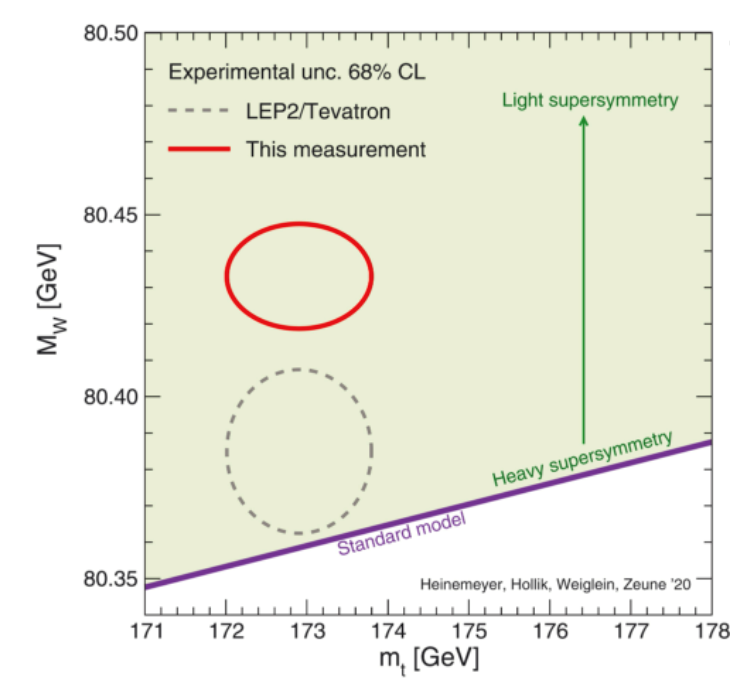
So it’s definitely interesting, though it clearly needs further analysis: there could be uncorrected systematics in the measurement, for example. Also, as far as I know, some of the other masses feeding into this calculation may turn out to be wrong.
Incidentally, a student asked me yesterday why there’s no corresponding measurement for the Z-boson. The answer I gave (which I think is correct) is that the mass of the Z is already known much better than the W because it, being neutral, can decay into an electron-positron pair, both of which are easy to measure, but the W, being charged, has to decay into a charged lepton and a neutrino (or antineutrino) combination and the latter is much harder to deal with experimentally.
P.S. For some comments by a physicist who knows much more about this stuff than I do, see here.

 In the Dark