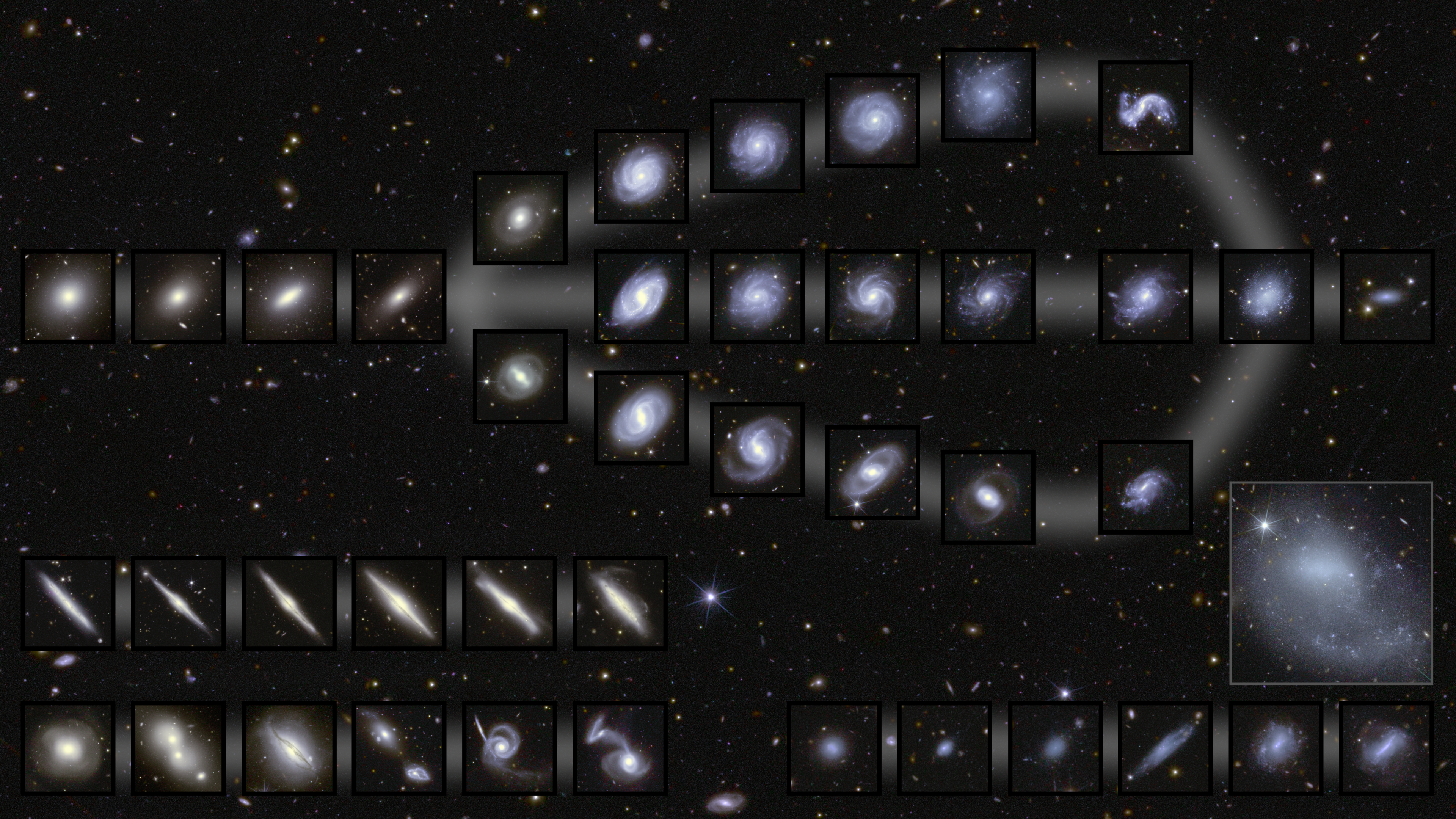
By way of a quick follow-up to yesterday’s post, here’s another Euclid Q1 product. This one is an updated version of the famous “Tuning Fork” representation of galaxy morphology:
You can click on the image to make it (much) bigger.
A galaxy’s structure is a sign of its formation history and the environment in which it resides. Since early on, astronomers have ordered galaxies according to their visible structure – as a basis to understanding the underlying physics: This panorama of galaxies’ structure shows the ‘classical’ morphological sequence from ellipticals (E, left) to lenticulars (S0) through spirals (S) to irregulars and dwarfs (right). The fork divides barred and unbarred spiral families: originally only SA (unbarred) and SB (barred) galaxies were arranged in a ‘tuning fork’ layout, the addition of SAB (weakly barred) galaxies as a third branch is making this term increasingly challenging to use. Lowercase letters a to d indicate progressively later spiral stages (tighter to looser arms), the trailing m (e.g., SAm) denotes Magellanic, very-late-type systems (patchy, often one-armed). The Milky Way is classified as an SBc galaxy.
Below the main sequence there are three auxiliary panels showing objects not represented in the fork: (1) spiral galaxies seen edge-on, with varying bulge-to-disk ratios and warps; (2) interacting and merging galaxies illustrating gravitationally driven morphological change; and (3) the morphological diversity of dwarf galaxies.
You can read more about this image and the other Q1 results here. You can also find an interactive version of the plot here.

 In the Dark