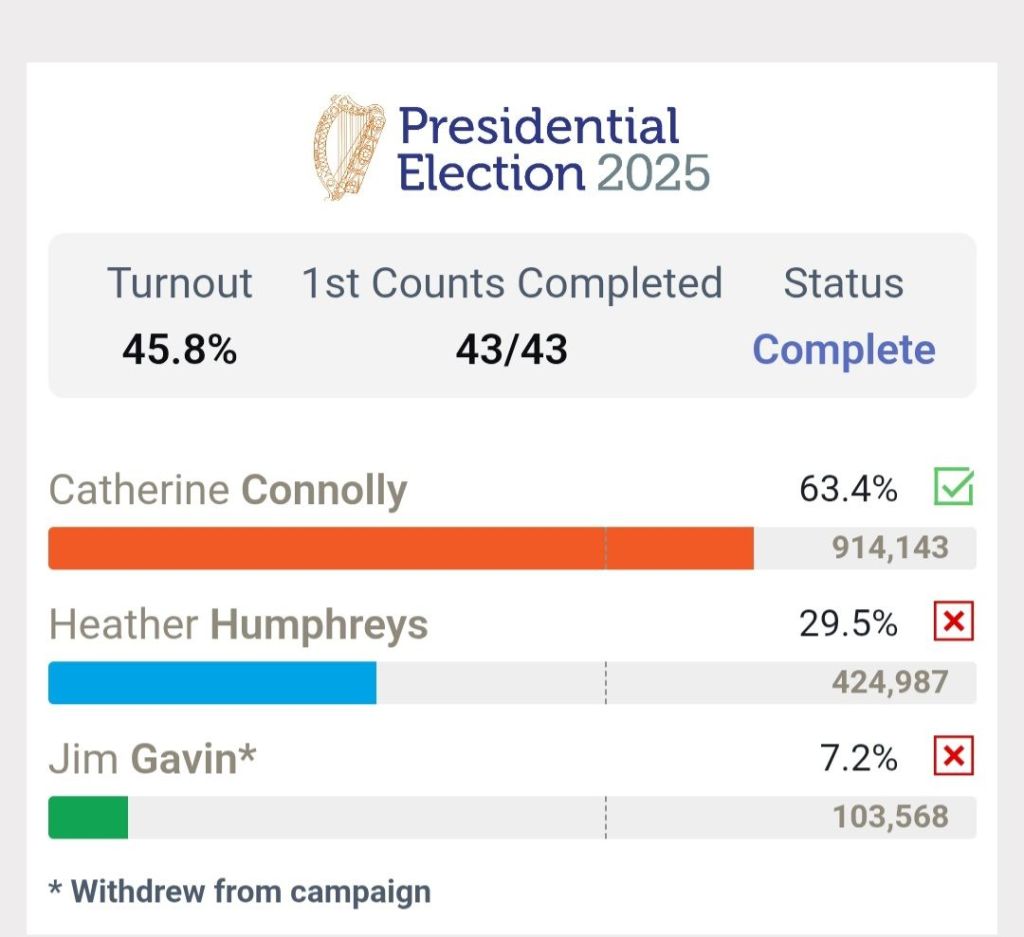
To nobody’s surprise, the winner of the Irish Presidential Election is Catherine Connolly. The official declaration of the results from the 43 constituencies of the Republic of Ireland was announced in Dublin Castle shortly after 7pm this evening, with an emphatic margin of victory for the Galway West TD. The total number of votes cast was 1,656,436, a turnout of just 45.8% (though that was a little higher than in 2018). The number of Invalid votes was 213,738.
Catherine Connolly was comfortably elected on the first count with 914,143 votes, more than half the number of valid votes. Heather Humphreys had 424,987 votes and Jim Gavin (who withdrew at the start) got 103,568 votes.
It is worth pointing out that the share of the vote (63%) and the number of votes cast in her favour are the largest for any President in the Republic’s history.
The large number of spoilt votes (13%) is probably attributable to the narrowness of the field, but those arguing that the nomination process should be changed need to remember that Article 12 of the Constitution of the Republic of Ireland stipulates how the process should occur so any change will need a referendum. People of course are entitled to spoil their paper if they wish, but I did read that one voter smearing their ballot paper with faeces, which is both disgusting and inexcusable.
I’ll repeat my view that the decision to hold the ballot on the Friday before a Bank Holiday long weekend probably contributed to the low turnout, as many people would have been planning to go away. I said the same last time, in 2018. The 2011 Presidential Election was held on a Thursday, which I think is a much better day to have an election.
Anyway, heartiest congratulations to Catherine Connolly, who won by a country mile, and will shortly become the next Uachtarán na hÉireann, the 10th person to hold that title.
Yesterday the official Presidential Election Order was tabled which means that an election for the office of President of Ireland (Uachtarán na hÉireann) will be held in the Republic on Friday 24th October 2025. The incumbent Michael D. Higgins will have served his second 7-year term by November and since by the Constitution nobody can hold the office more than twice, we will have a new President of the Republic.
The Irish media have been trying to make news about the presidential election all summer, which has been pointless and tedious to put up as no candidates had even been nominated then. Actually nobody has yet either, as nominations don’t officially open until tomorrow; they close on September 25th. Still, at least the process has started.
In order to progress to the election, a candidate has to receive the support of at least 20 members of the Oireachtas or at least 4 local authorities (i.e. councils). Former or retiring Presidents can nominate themselves but this is not relevant here.
The way the election works is that voters rank all candidates. In the first round of counting, first preference votes are totted up and if one candidate has more than 50% he/she is elected. If not an Instant Runoff method is used, with votes of lower-ranked being reallocated until there’s a winner (ie until one candidate gains a majority).
I just checked the online electoral register to confirm my status:
I will wait to see who has acually been nominated before deciding who to vote for. In the last Presidential Election (2018), five candidates opposed the re-election of Michael D. Higgins, three of them businessmen best known for having appeared on the Irish version of the TV show Dragon’s Den. There’s ample evidence from elsewhere that the products of reality TV shows do not make good presidents. Neither do rapists, so let’s hope Conor McGregor does not get nominated. It is likely that there will be more than six candidates this time and the election will be more closely contested that last time. In 2018 the turnout was very low, no noubt because many people assumed – correctly – that Higgins would win. In the event he got over 56% of the first-preference vote so the transfers were irrelevant. That might not be the case this time.
The Presidency of Ireland is a ceremonial rather than an executive office, and it has little actual power associated with it. It is nevertheless important in that the President is the guardian of the Constitution as well as representing the Irish Nation as a kind of ambassador and as patron of many good causes. Surprisingly, some of the people who want to put themselves forward don’t seem to know anything about what the job entails. Hopefully, the more obvious fruitcakes who put themselves forward will fail to get nominated. I think Michael D. Higgns has carried out his duties in a very dignified and diligent way over the years, and will be a very hard act to follow. I’ve been proud to have him as my President.
It’s hard to believe that seven whole years have passed since the last election. There’s another reminder of that coming up on Friday September 12th when I will be going to the National Concert Hall for a performance by the National Symphony Orchestra that marks the opening of the 2025/6 season. On September 15th 2018 I went to the season opener for that year. That was also my first ever visit to the National Concert Hall. To mark the occasion we were in the presence of the man himself , Michael D Higgins, and his wife Sabena. The President attended as Patron of the National Symphony Orchestra. I don’t know whether he will attend on Friday 12th September, but if he does I’m sure he will get a good ovation. As well as many other things Michael D. Higgins has been a very strong advocate for the Arts in Ireland. I’m not sure his successor will live up to the standard he set.
It’s Christmas Eve so I thought I’d share this Christmas message from the President of Ireland (Uachtarán na hÉireann) Michael D. Higgins, a person I admire greatly and am proud to call my President. He is a rare example of a politician who is also a decent and likeable human being.
The whole speech is worth listening to, but I draw your attention in particular to this excerpt:
… may I express my gratitude to the migrants who now call Ireland their home. Their presence enriches our culture, contributes to our society, bringing as they do experiences, traditions, and perspectives that make us stronger as a nation.
It’s such a refreshing change to hear such words, contrasting with the toxic rhetoric being spewed out by so many politicians across the world. Well said, Michael Higgins!
This week the deadline passed for nominations of candidates for the post of President of Ireland (Uachtarán na hÉireann). The rather peculiar nomination process has left voters with a choice of six, including the incumbent Michael D Higgins. As a relative newcomer to Ireland, even I know that the post of President doesn’t have any real power associated with it and is largely ceremonial. Surprisingly, some of the people who put themselves forward didn’t seem to understand that but, fortunately, some of the more obvious fruitcakes who put themselves forward failed to get nominated. On the other hand, three of the candidates are businessmen best known for having appeared on the Irish version of the TV show Dragon’s Den. There’s ample evidence that the products of reality TV shows do not make good presidents.
The election takes place precisely four weeks from now, on Friday 26th October 2018, and the term of the presidency is 7 years – the last such election took place in 2011.
Naturally, given the vital importance of the office of the Presidency and the need to treat the forthcoming election with the appropriate gravitas, my first thought was to look at the betting odds on Paddy Power. Here is the full SP:
Michael D. Higgins (Incumbent) 1/5
Sean Gallagher 5/1
Gavin Duffy 14/1
Joan Freeman 25/1
Liadh Ni Riada 33/1
Peter Casey 66/1
Obviously Michael D Higgins is a strong favourite. I think he’s carried out his duties in a very dignified and diligent way for seven years, so he will probably get my vote. Candidates 2, 3 and 6 are the Dragon’s Den people. Joan Freeman is a journalist by trade (and an Independent member of the Seanad Éireann) and Liadh Ni Riada is the official candidate of Sinn Féin. Neither of the two biggest parties in the Dáil Éireann, Fine Gael and Fianna Fianna Fáil, nominated a candidate, preferring to back the incumbent.
It seems likely that Michael D. Higgins will win and serve another seven years, but it’s hard to be confident about anything in politics these days so we’ll just have to wait and see..
Last night I had the pleasure of attending the opening performance of the new season of the RTÉ National Symphony Orchestra at the National Concert Hall in Dublin. As well as being the first concert of the season, it was also my first ever visit to the National Concert Hall. To mark the occasion we were in the presence of the Uachtarán na hÉireann, Michael D Higgins, and his wife Sabena. By `occasion’ I of course mean the first concert of the season, rather than my first visit to the NCH. After the concert the audience were all treated to a glass of Prosecco on the house too!
I’ve done quite a few reviews from St David’s Hall in Cardiff over the years, so before writing about the music I thought I’d compare the venues a little. The National Concert Hall was built in 1865 and soon after its construction it was converted into the main building of University College Dublin. It was converted to a concert venue when UCD moved out of the city centre, and fully re-opened in 1981. It is a bit smaller than St David’s – capacity 1200, compared with 2000 – and does not have such a fine acoustic, but it is a very nice venue with a distinctive and decidedly more intimate vibe all of its own. I had a seat in the centre stalls, which cost me €40, which is about the same as one would expect to pay in Cardiff.
The NCH is situated close to St Stephen’s Green, which is a 15 minute walk from Pearse Station or a 30 minute walk from Connolly (both of which are served by trains from Maynooth). The weather was pleasant yesterday evening so I walked rather than taking the bus or Luas from Connolly. I passed a number of inviting hostelries on the way but resisted the temptation to stop for a pint in favour of a glass of wine in the NCH bar before the performance.
Anyway, last night’s curtain-raiser involved just one piece – but what a piece! – Symphony No.2 (“Resurrection”) by Gustav Mahler. This is a colossal work, in five movements, that lasts about 90 minutes. The performance involved not only a huge orchestra, numbering about a hundred musicians, but also two solo vocalists and a sizeable choir (although the choir does not make its entrance until the start of the long final movement, about an hour into the piece). The choir in this case was the RTÉ Philharmonic Choir. At various points trumpets and/or French horns moved offstage into the wings and, for the finale, into the gallery beside the choir.
About two years ago I blogged about the first performance I had ever heard of the same work. Hearing it again in a different environment in no way diminished its impact.
Stunning though the finale undoubtedly was, I was gripped all the way through, from the relatively sombre but subtly expressive opening movement, through the joyously dancing second that recalls happier times, the third which is based on a Jewish folk tune and which ends in a shattering climax Mahler described as “a shriek of despair”, and the fourth which is built around a setting of one of the songs from Des Knaben Wunderhorn, sung beautifully by Jennifer Johnson (standing in wonderfully for Patricia Bardon, who was unfortunately indisposed). Jennifer Johnson has a lovely velvety voice very well suited to this piece, which seems more like a contralto part than a mezzo. The changing moods of the work are underlined by a tonality that shifts from minor to major and back again. All that was very well performed, but as I suspect is always the case in performances of this work, it was the climactic final movement – which lasts almost half an hour and is based on setting of a poem mostly written by Mahler himself, sung by Orla Boylan – that packs the strongest emotional punch.
The massed ranks of the RTÉ Philharmonic Choir (all 160 of them) weren’t called upon until this final movement, but as soon as they started to sing they made an immediate impact. As the symphony moved inexorably towards its climax the hairs on the back of my neck stood up in anticipation of a thrilling sound to come. I wasn’t disappointed. The final stages of this piece are sublime, jubilant, shattering, transcendent but, above all, magnificently, exquisitely loud! The Choir, responding in appropriate fashion to Mahler’s instruction to sing mit höchster Kraft, combined with the full force of the Orchestra and the fine concert organ of the NCH to create an overwhelming wall of radiant sound.
Mahler himself wrote of the final movement:
The increasing tension, working up to the final climax, is so tremendous that I don’t know myself, now that it is over, how I ever came to write it.
Well, who knows where genius comes from, but Mahler was undoubtedly a genius. People often stay that his compositions are miserable, angst-ridden and depressing. I don’t find that at all. It’s true that this, as well as Mahler’s other great works, takes you on an emotional journey that is at times a difficult one. There are passages that are filled with apprehension or even dread. But without darkness there is no light. The ending of the Resurrection Symphony is all the more triumphant because of what has come before.
The end of the performance was greeted with rapturous applause (and a well-deserved standing ovation). Congratulations to conductor Robert Trevino, the soloists, choir and all the musicians for a memorable concert. On my way out after the Prosecco I picked up the brochure for the forthcoming season by the RTÉ National Symphony Orchestra, which runs until next May. I won’t be attend all the Friday-night concerts, but I will try to make as many as I can of the ones that don’t involve harpsichords.
Update: I hadn’t realised that the concert was actually broadcast on TV and then put on YouTube; here is a video of the whole thing:
The views presented here are personal and not necessarily those of my employer (or anyone else for that matter).
Feel free to comment on any of the posts on this blog but comments may be moderated; anonymous comments and any considered by me to be vexatious and/or abusive and/or defamatory will not be accepted. I do not necessarily endorse, support, sanction, encourage, verify or agree with the opinions or statements of any information or other content in the comments on this site and do not in any way guarantee their accuracy or reliability.



 In the Dark