It has been quite an eventful week for voters either side of the English channel. In the United Kingdom, Keir Starmer’s Labour Party were victorious in the General Election, turfing out the Tories after 14 years of misrule, while in France a left-wing coalition managed against the odds to beat Marine Le Pen’s fascist National Rally into third place in their runoff election. In both elections tactical voting clear played a big role. In France many third-placed candidates of the centre or left stood aside to help defeat the Far Right. What happens now with regard to forming a government is anyone’s guess, even for people who know far more about French politics than me.
In the runup up to the UK general election, opinion polls had Labour much further ahead in terms of popular vote. As it turned out, however, Labour won 411 seats on a share of the vote of just 33.7% compared to the Conservatives 23.7% and a smaller number of votes than in 2019 when they won just 202 seats. The UK system is not proportional – and doesn’t pretend to be – so this kind of outcome is not surprising. Pundits have rightly pointed to the fact that the far-right Reform party got 14.3% of the vote which undoubtedly took seats from the Tories, but only managed 5 seats and that Labour profited greatly from the collapse of the SNP vote in Scotland.
There are other factors, however. One is that the turnout was 59.9%, well down on 2019 (67.35). That may well be partly due to voters generally not being enthused. But there may be more to it than that. The last time the turnout was below 60% in a UK general election was in 2001. In that year, Labour were miles ahead in the opinion polls so I suppose many Labour voters thought the result was a foregone conclusion and didn’t bother to turn out. It seems likely to me that there was a similar effect on the Labour vote this time. Rather than merely predicting the final result, opinion polls often influence it.
Another factor is that there may have been higher levels of tactical voting, especially with Labour voters switching to the Liberal Democrats to remove the Tory. That might account for why the LibDems did so well. Opinion polls play a role in this too. Yet another is that Labour lost several seats to Independents, standing against the stance on Gaza, and former Labour leader Jeremy Corbyn won his seat standing as an Independent.
That brings me to the exit polls in the UK and France. Here the projections, the first released at 10pm on Thursday and the second at 9pm on Sunday:
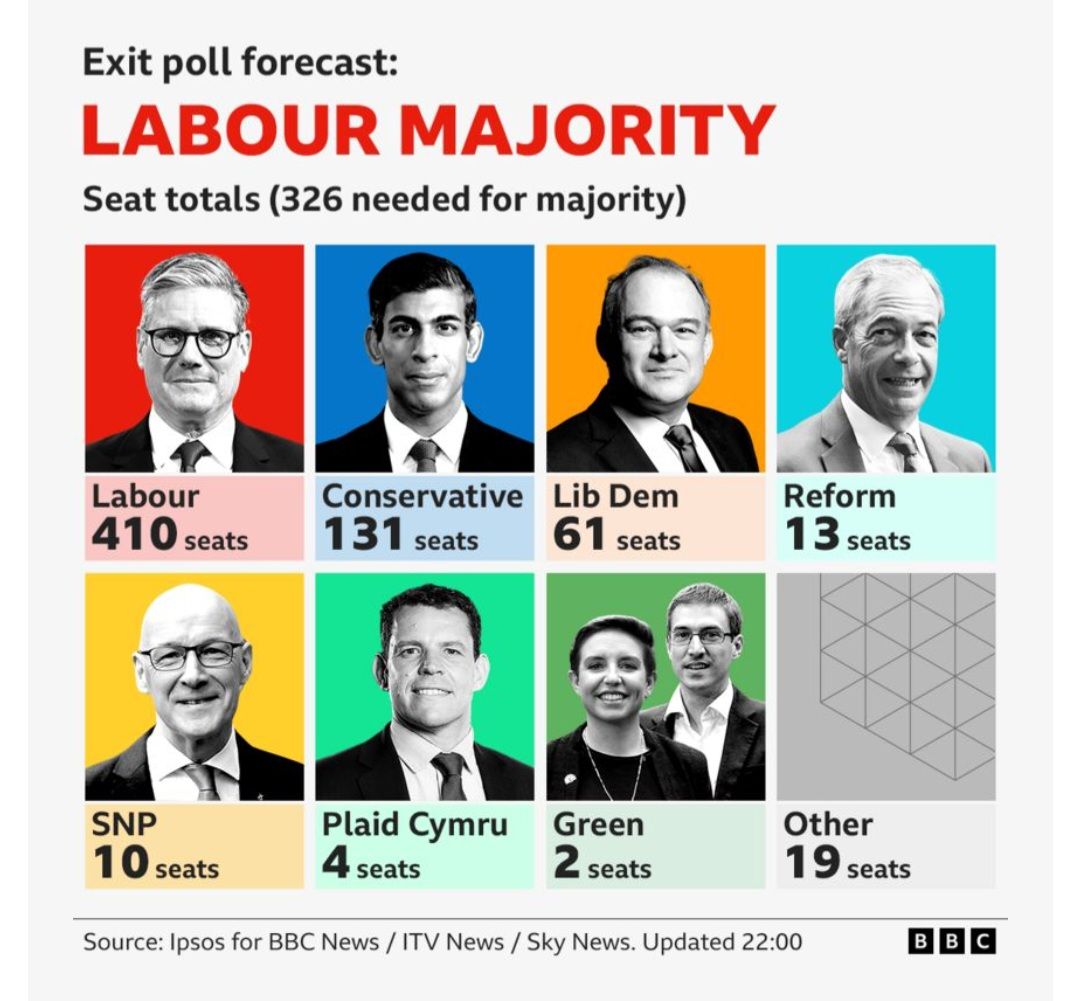

Both are pretty accurate, but I’ve always been annoyed by the way the UK exit poll projection (left) is presented as a point estimate without any indication of the uncertainty (which must be considerable, especially for the smaller parties). The final results were Labour 411, Conservative 121, Lib Dem 72, Reform 5, SNP 9, Plaid Cymru 4, Green 4.
The French method of presenting the results (right) is much better in my opinion. In this case the results were 182, 168 and 143 respectively – all within the range presented.
I have to say that I greatly prefer the voting system used here in Ireland to those deployed in either France or the United Kingdom. Elections here are held under Proportional Representation (Single Transferable Vote) which seems to me a very sensible system. One ranks the candidates in order of preference; you can rank all the candidates or just some. In the system employed here in Ireland, votes are progressively reallocated in various rounds until one ends up with the top n candidates to fill the n available seats. The STV system involves a quota for automatic election which is N/(m+1) + 1 votes, where N is the number of valid ballots cast and m is the number of seats in the constituency. To see why this is the case consider a four-seat constituency, where the quota would be 20% of the votes cast plus one. No more than four candidates can reach this level so anyone managing to get that many votes is automatically elected. Surplus votes from candidates exceeding quota, as well as those of eliminated candidates, are reallocated to lower-preference candidates in this process. This system returns representatives with a local constituency connection but is also (approximately) proportional.
One problem with the First Past The Post system deployed in the UK is that if a Reactionary party (Reform) gets 5 seats while a Progressive party (Green) gets only 4, the former gets all the press coverage and the latter gets none..
P.S. I didn’t vote in the UK general election, but the four constituencies in which I lived before moving to Ireland (Cardiff West, Brighton Kemptown, Broxtowe, and Bethnal Green & Stepney) all voted in Labour MPs.


 In the Dark