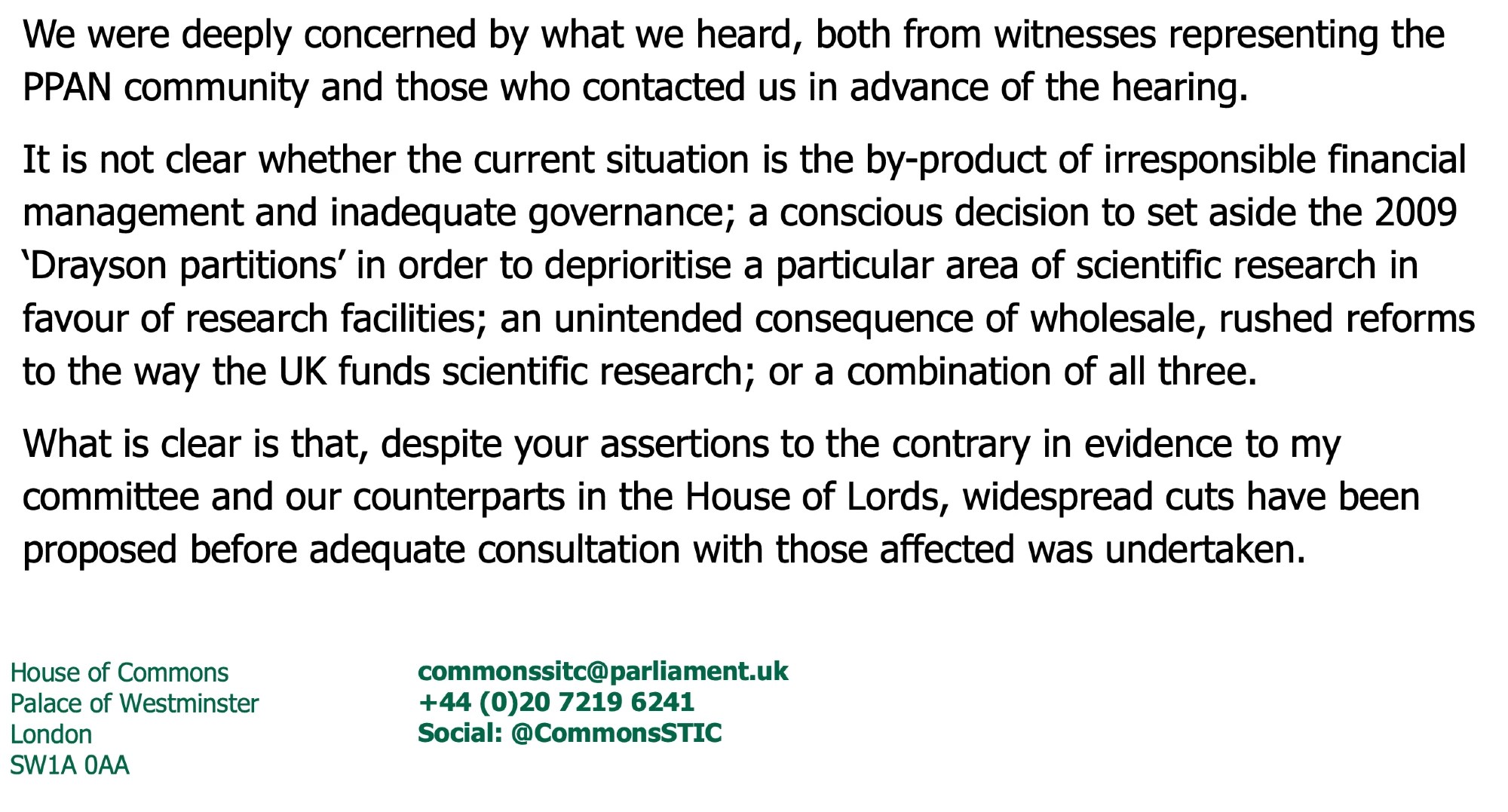
I’ve just got time this evening to pass on news that the Chair of the Parliamentary Select Committee looking at he current STFC debacle (see this account), Chi Onwurah, has responded to the events in extremely frank terms. Here is an excerpt:
The full response – which is definitely well worth reading because it doesn’t pull any punches – can be found here:
This isn’t by any means the end of the story of this fiasco, but it is certainly a positive sign that it is being taken very seriously in political circles. Credit is due not only to all those who attended and gave evidence to the Committee – Catherine Heymans, Jon Butterworth et al – but also to those who lobbied behind the scenes.
I started doing this blog back in 2008 and over the subsequent couple of years wrote many posts about a funding crisis affecting the Science and Technology Facilities Council, the UK funding agency that covers particle physics and astronomy research that had been created in 2007. I particularly remember the cancellation of the experiment Clover back in 2009 which had devastating and demoralising consequences for staff at Cardiff (where I was working at the time). It looks like a return to the Bad Old Days.
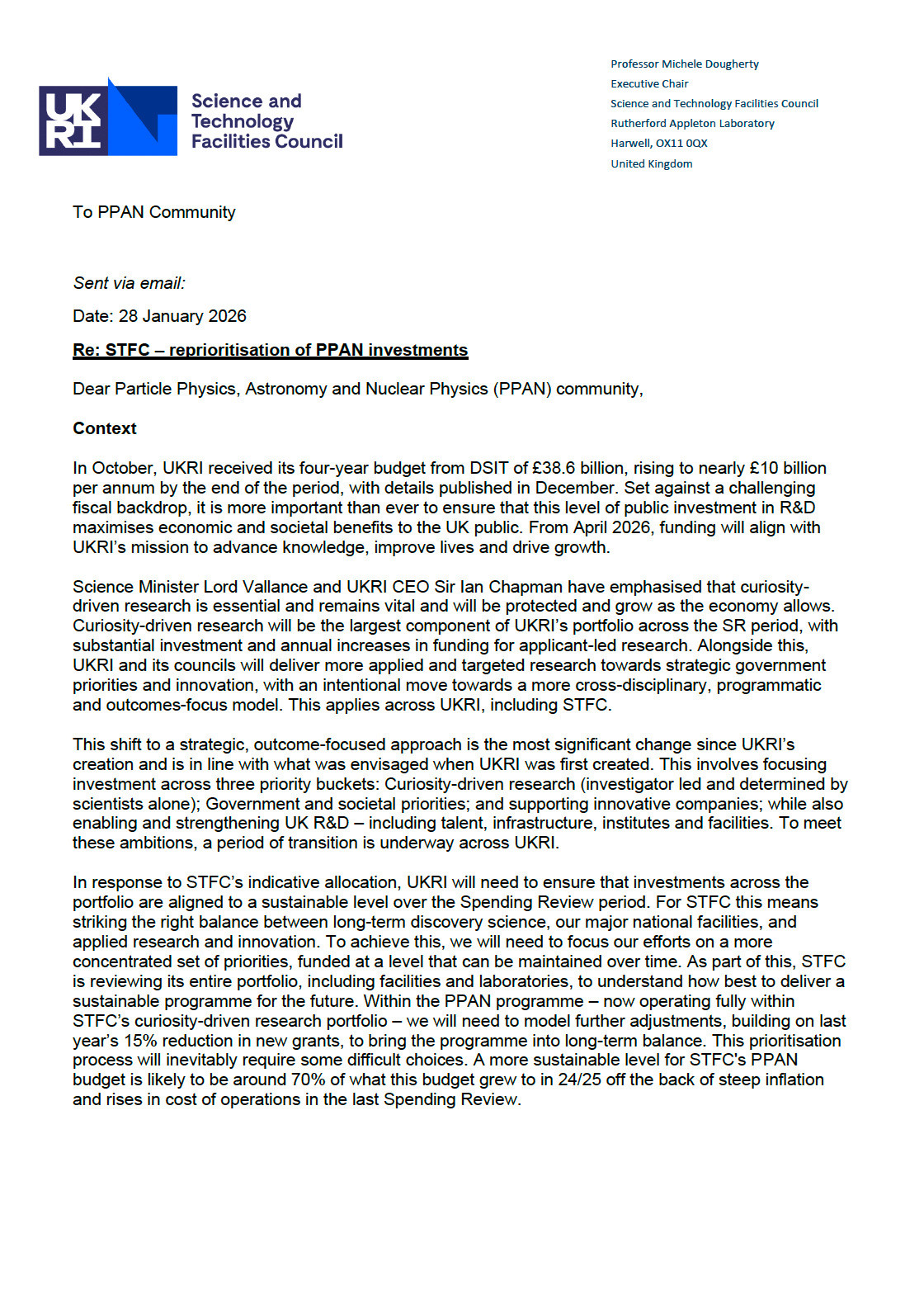
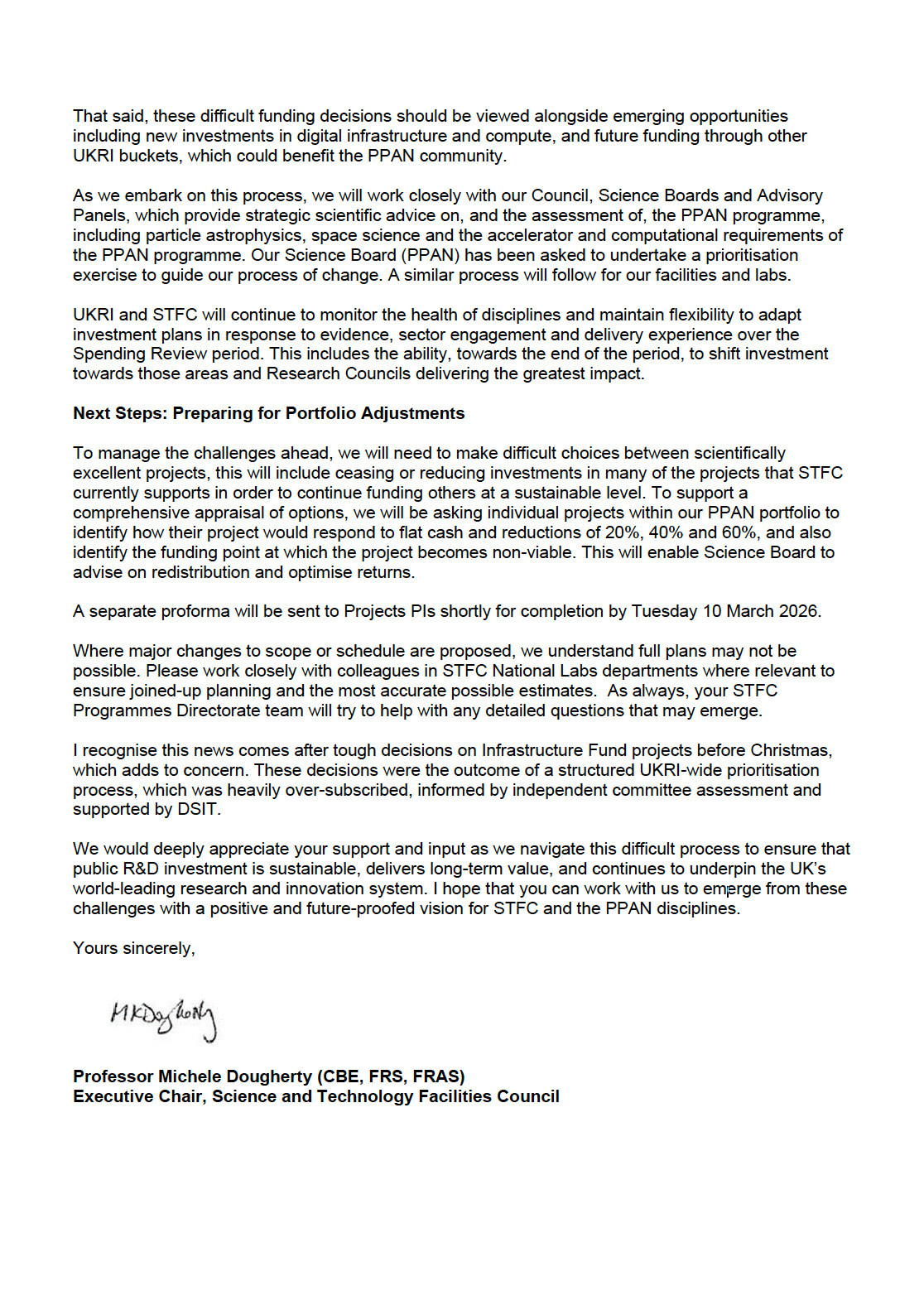
I moved from the UK eight years ago and haven’t really kept up with news related to the science funding situation there so I was very disturbed last night to see a message from the Royal Astronomical Society containing the following:
In a letter from its Executive Chair, Professor Michele Dougherty, the research council indicates that the budget for particle physics, astronomy and nuclear physics together will drop by around 30%. The letter also asks project teams to plan for scenarios where their funding is reduced by 20%, 40% and 60%.
All this is on top of a recent squeeze that has led to grants being delayed to make savings of around 15%. The full letter is here:
Exclusive: Science and Technology Facilities Council seeks £162m cost savings, with existing projects facing axe
The article goes on to point out the dangers of cuts of this scale to physics departments in the UK, many of which have a significant fraction of their activity in astronomy and particle physics.
The additional reduction and prospect of cuts to ongoing projects is likely to be felt as a hammer blow by physics departments in UK universities, of which a quarter are already at risk of closure.
Grim times indeed. It looks to me like the people running UKRI, the umbrella organization for all the UK research councils which has an annual budget of £8bn, have decided to throw STFC under the bus to chase shorter-term economically driven projects and to hell with the long-term funding of basic research. In Ireland we’re familiar with the consequences of that approach.
Still, at least the UK has the Astronomer Royal as an independent voice to speak up against these cuts. The current Astronomer Royal is… checks notes… oh… Michelle Dougherty, Executive Chair of STFC.
You may recall that I blogged here and here about a software platform called Researchfish and the heavy-handed reaction response to criticism by the provider of this “service”, a company called Interfolio, and the Government organization UK Research and Innovation that harvests the data thereby collected. In its response to Interfolio’s apparent misuse of data and bullying of academics who dared to express negative opinions about Researchfish – which I would say, based on my own experiences (admittedly several years ago), is a very poorly designed system – UKRI made a sort of non-apology that managed to make matters worse.
A couple of days ago, in response to a Freedom of Information request, UKRI released correspondence between itself and Infosys that shows not only that UKRI knew about the bullying by Infosys but actively encouraged it. The story is covered in full by Research Professional so I shall comment on briefly here.
Here’s an example from UKRI which talks about taking “disciplinary” action against someone for criticizing Researchfish on Twitter (even though they subsequently apologized and deleted the tweet) and goes on to list their grant awards, presumably in order to facilitate sanctions against the individual:
Here’s another that claims that bullying by Researchfish “set the right tone”:
Unbelievable. I bet the redacted bits are even worse!
It’s a shocking indictment of the culture at UKRI that they are prepared to behave in such a way, conniving in threats against the community it is supposed to be supporting. Moreover, Interfolio seems to be keener to police comments about Researchfish than it is to make improvements to its service. It can’t be healthy for researchers in the UK to have their freedom of speech stifled to protect a software company’s reputation.
The brevity and informality of the emails between UKRI and Infotech suggests they have a very cosy relationship. Does anyone know anything about the tendering process by which Interfolio acquired its contract with UKRI?
You may remember that about a month ago I posted a piece about the scandalous behaviour of the people who operate Researchfish – the execrable software system intended to collect data relating to the outputs of research grants funded by the various UK Research Councils. The scandal consisted of bullying of researchers who dared to criticize mighty Researchfish followed by an atrocious non-apology when challenged about their conduct.
Well now today UKRI (UK Research and Innovation, the umbrella organization for the Research Councils) has stepped in, with the result that the scandal has now deepened.
UKRI issued a statement which begins by claiming Researchfish acted in response to “abusive” tweets. The tweets I have seen were by no means abusive so that’s a very poor start. More importantly however, the “update” doesn’t deal at all with the substantive issues raised, namely the sinister threat to communicate researchers’ personal information to UKRI. I have always thought that Researchfish would be better off trying to engage with the research community to improve its system, especially the awful user interface, than threatening the people who criticize it but it now seems the situation is even worse than I originally thought.
According to a story in Research Fortnight, “UK Research and Innovation has admitted it (my emphasis) encouraged Researchfish to report some tweets from academics to it, after enraged researchers criticized the online service for doing this last month”. UKRI goes on to say that they have “stopped this approach with immediate effect and recognize that it was the wrong thing to do”. Damn right it was wrong, but I wonder who made the decision to do it in the first place, and what sanction they will face?
There is also this:
We understand that this has raised questions around personal data. We take data protection very seriously. Our assessment of the data protection considerations is ongoing and is expected to be concluded shortly.
I rather think this calls for an independent inquiry but, although I fear a whitewash is in progress, let’s see wait and see…
As a practising scientist I too am concerned about the reliability of the definition of the `Beard Second’. In addition to the intrinsic variability from one individual to another (including genetic influences) many external environmental factors affect beard growth, so any definition must include conditions such as temperature, pressure, sunlight levels and whether or not the beard is supplied with nutrients. In any case the term `average’ usually applies to the arithmetic mean, whereas the quoted text seems to imply the median.
My advice to the Beard Liberation Front is to refer this matter to the National Measurement and Regulation Office for review but along with most government offices nowadays it only seems interested in issues that directly affect the ability of businesses to profit rather than safeguarding the accuracy and reproducibility of scientific matters of direct interest to the public, such as the rate of beard growth.
In the longer term, however, I believe the only way to establish a reliable standard for the `beard second’ is through an extensive research programme. A detailed proposal is in preparation to UK Research and Innovation, as it seems an appropriate topic for an interdisciplinary award.
press release 3rd September contact Keith Flett 07803 167266
Doubt expressed over accuracy of measurement of the ‘Beard-Second’
The Beard Liberation Front, the informal network of beard wearers, has expressed doubt over the accuracy of the unit of measurement known as the ‘Beard-Second’.
The ‘Beard-Second’ is designed to measure how quickly in time a beard grows.
According to Wiki:
The beard-second is a unit of length inspired by the light-year, but applicable to extremely short distances such as those in integrated circuits. The beard-second is defined as the length an average beard grows in one second. Kemp Bennett Kolb defines the distance as exactly 100 angstroms (10 nanometers). as does Nordling and Österman’s Physics Handbook. However, Google Calculator supports the beard-second for unit conversions using the value 5 nm.
The beard-second establishes a related unit of time, the beard-inch which is 29.4 days (or 58.8 days…
The views presented here are personal and not necessarily those of my employer (or anyone else for that matter).
Feel free to comment on any of the posts on this blog but comments may be moderated; anonymous comments and any considered by me to be vexatious and/or abusive and/or defamatory will not be accepted. I do not necessarily endorse, support, sanction, encourage, verify or agree with the opinions or statements of any information or other content in the comments on this site and do not in any way guarantee their accuracy or reliability.


 In the Dark