Archive for Universities

University News

Posted in Education, Politics with tags , , , , , , on April 28, 2019 by telescoper

As we stagger towards Week 11 of this twice-interrupted Semester I’m back in the office preparing stuff for another set of lectures. This term seems to have gone on forever, largely because of the two breaks (one at half-term around St Patrick’s Day, and other other for Easter). Now, though, the end is in sight. Or at least the examination period is: there are just two more weeks of lectures, ending on 10th May then a short break, then examinations start (on 17th May). Then, of course, there is marking, checking, conflating exam grades with coursework marks, examination boards, and all the other stuff that go on behind the scenes.

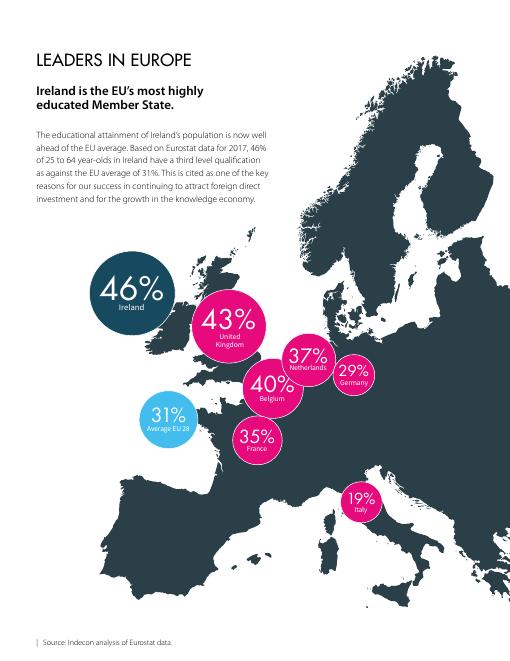
I noticed that this weekend’s edition of the Irish Times included a hard copy of a report called Delivering for Ireland: The Impact of Irish Universities which was produced by the Irish Universities Association. In fact the thing given away with the paper is just a summary report (you can download it in PDF format here). The full report (all 86 pages of it) can be downloaded here.

The report is full of interesting information, including this (which I didn’t know before):
The report was produced with the aim of making the case for further investment in Ireland’s universities. It remains to be seen whether the current Irish government will be persuaded. I’m not holding my breath. right-wing governments never seem to be interested in investing in the future. I think the best we can hope for is that Ireland does not continue its policy of slavishly copying English Higher Education policy, especially with the introduction of student loans and high tuition fees.

And talking of the idiocies of the English University system, there is a story going around that the UK Government is planning to make EU students pay full `Overseas’ fees after Brexit. Actually, Higher Education policy is a devolved matter so this can only be directly enforced on English universities. It will, however, be hard for Scottish Welsh and Northern Irish institutions to resist the consequences.

In fact I’ve long felt that the existing system – in which Home and EU students have to be treated the same way as a matter of law but non-EU students can be charged different (i.e. higher) fees is completely immoral. Once at university students are all taught the same way so why should some be charged more than others because they happen to come from China? What would you think of a shop that tried to charge people different prices for the same goods depending on the nationality of the customer?

This decision is of course an inevitable consequence of Theresa May’s interpretation of the EU referendum result as a mandate for policies of extreme xenophobia, as is the withdrawal from Erasmus. It is just another symptom of the UK’s descent into narrow-minded insularity. The message this decision sends out is that Britain hates foreigners but it likes their money so the rich ones who can pay extortionate fees will be graciously allowed to come here to get fleeced. Does the government really think that EU citizens are daft enough to come to a country that identifies itself in such a way? I don’t think they are. They’ll just find somewhere else to go, and the consequence for UK universities will be severe. I am confident this will push more than one UK higher education institution into bankruptcy.

Anyway, even if the the Irish university continues to be under-resourced, it will at least continue to welcome students from the EU on the same basis as before. So if you’re a European student who was thinking about studying in England, why not come to Ireland instead? It’s far cheaper, and we even have the same weather…

From Phase Walks to Undergraduate Research

Posted in Education, The Universe and Stuff with tags , , , , , on September 28, 2018 by telescoper

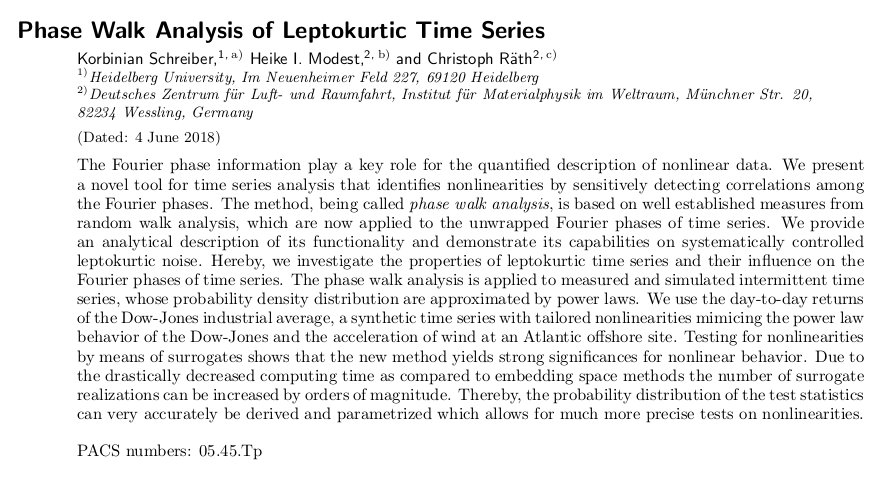
This week I put together a couple of brief descriptions for possible research projects for final-year undergraduate and/or Masters students in the Department of Theoretical Physics at Maynooth University, and I was reminded of the value of projects like this when I found this paper on the arXiv:

In fact the `Phase Walk Analysis’ developed here is based on an original idea I had for an undergraduate summer research project when I was at Nottingham University and have mentioned before on this blog. The student who did the project with me was Andrew Stannard (who is now at King’s College, London) and the work led to a paper that was published in a refereed journal in 2005 and has now been cited 21 times by various authors including the Planck Team.

Although Andrew is now working in a completely different area (Condensed Matter Physics), I like to think this taste of research was of at least some assistance in developing his career. Above all, though, it relates to something I read in the Times Higher by astronomer, Nobel Prize winner, and Vice-Chancellor of the Australian National University, namely that the idea that many politicians seem to have of separating teaching from research in universities is at best misguided and at worst threatens the very idea of a university.

USS Pension Proposal: Poll

Posted in Education, Politics with tags , , , , , on March 13, 2018 by telescoper

Last night I saw the news on Twitter that negotiators on behalf of the Universities and Colleges Union (UCU) and the employers’ organisation Universities UK (UUK) under the auspices of the Advisory Conciliation and Arbitration Service (ACAS) agreed a proposal to end the strike over pensions that has been going on since the end of February.

The text of the agreement can be found here (PDF). This proposal will have to be discussed and ratified formally, but the negotiators hope this can be do today and that the strike will be suspended from tomorrow.

The proposal suggests a transitional period of three years from April 2019 during which a much reduced Defined Benefit scheme will operate, but it still affirms the much disputed November 2017 valuation of the scheme which means that it is overwhelmingly likely that after three years the dispute will be back on.

I shall be leaving the USS scheme in July 2018 as I’m moving full-time to Ireland where I will be joining a Defined Benefit scheme so the changes outlined in the document will not affect me. Moreover, though I have supported the strike I am not a member of UCU. If I were I would not be in favour of accepting this deal because it seems to me that it amounts to an abject surrender on all the main issues. But given my personal situation I don’t think my opinion should carry much weight. The few friends I have discussed this with feel the same as I do, but I’m interested to know what the general opinion is. If you feel like filling in the poll below please feel free to do so. I’ve divided the responses between UCU members and non-UCU members to see if there’s a difference.

On one matter however I am less equivocal. The document calls on staff to `prioritise the rescheduling of teaching’ (lost during the strike). I have a one-word response to that: NO. Not only will it be logistically impossible to reschedule so many teaching sessions, but I am also not going to do extra teaching for free when my pay is being deducted for days on strike.

As usual, I invite your comments through the box below.

UPDATE: Here is a Google Document showing how UCU branches are responding to the proposal: at the time of posting, it is solidly `reject’..

UPDATE: Following on from the above, the UCU has now formally rejected the proposal. The strikes continue.

Why I’m taking part in the UCU Strike Action

Posted in Education, Politics with tags , , , , , , on February 21, 2018 by telescoper

In case you weren’t aware, from tomorrow (22nd February) the University and College Union (UCU) is taking industrial action over proposed drastic cuts to staff pensions funded by the Universities Superannuation Scheme (USS). You can find some background to the pensions dispute here (and in related articles). A clear explanation of why the employers’ justification for these cuts is little more than fraudulent is given here and here you can find an example of the effect of the proposed changes on a real person’s pension (ie a cut of almost 50%). I also blogged about this a few weeks ago. There’s no doubt whose side the Financial Times is on, either.

I am not a member of UCU – I left its forerunner organisation the Association of University Teachers (AUT) as a result of its behaviour when I was at the University of Nottingham – but I will be participating in the industrial action, which takes place over four weeks as follows:

  • Week one – Thursday 22 and Friday 23 February (two days)
  • Week two – Monday 26, Tuesday 27 and Wednesday 28 February (three days)
  • Week three – Monday 5, Tuesday 6, Wednesday 7 and Thursday 8 March (four days)
  • Week four – Monday 12, Tuesday 13, Wednesday 14, Thursday 15 and Friday 16 March (five days)

This is a bit complicated for me because I only work half-time at Cardiff University (usually Mondays, Tuesdays and half of Wednesdays) and at Maynooth University the rest of the time. The USS only covers UK universities, and the dispute does not apply in the Republic of Ireland (though it does affect higher education institutions in Northern Ireland) so I won’t be on strike when I’m working for Maynooth University, which includes the first two strike days (tomorrow and Friday). I will be participating in industrial action next week, however, and have today sent an announcement to my students they hear from me that the strike has been called off there will be no lectures on 27th February, 6th March or 13th March.

All staff will be docked pay for days not worked owing to strike action, of course, but that will be far less than the amount to be lost in these pension cuts. In my case I will be docked the equivalent of three weeks’ pay as 2.5 days a week I work are all strike days in Weeks 2-4. Moreover, I shall be leaving the UK for Ireland this summer and the pension cuts will not affect my pension anyway – any changes will not be made until after I’ve left the USS scheme. Nevertheless, this is an important issue and I feel it is right to take a stand.

One final comment. Last week Cardiff University sent an email to staff including a link to a website that stated:

If staff refuse to cross a picket line and they are not a member of UCU they will be in breach of their contract of employment with the University.

In fact, any strike action (even by a union member) is a breach of contract. The law however prevents employers dismissing staff who participate in industrial action, provided that it is lawful (i.e. following a ballot, and with due notice given to the employer, etc). The government website makes it clear that non-union members have exactly the same protection as union members in this regard. The Cardiff website has now been changed, but I’m very unhappy that this extremely misleading communication was sent out in the first place.

I sincerely hope that there is a negotiated settlement to this issue. Nobody wants to go on strike, especially when it has the potential to damage students’ learning. But there comes a point where you have to draw a line in the sand, and we have reached that point. I hope I’m proved wrong, but I think this could be a very prolonged and very unpleasant dispute.

Problems with two-year degrees

Posted in Education with tags , , , , , on December 13, 2017 by telescoper

I see that the Minister responsible for UK universities, Jo Johnson, has decided that universities should offer two-year degrees, claiming that this will somehow attract more students into higher education.

The idea seems to be that students will get the same `amount’ of teaching, but concentrated in two full calendar years rather than spread over three academic years. This fast-track degree will be offered at a lower level of fee than a normal three-year Bachelors programme.

I can just about accept that this will work in some disciplines and at some universities. The (private) University of Buckingham, for example, already offers such programmes. On the other hand, the University of Buckingham did not participate in the latest Research Excellence Framework, no doubt for the reason that teaching all-year round leaves its academic staff no time to do research or even attend conferences, which (I find) these days is only possible during the summer recess.

Call me old-fashioned, but I think an institution that does not combine teaching and research – and indeed one in which the teaching is not led by research – does not merit the name of `University’. The old polytechnics offered a range of valuable opportunities that complemented the traditional honours degree, but that capacity was basically eliminated in 1992 when all such institutions became universities.

Though my main objection to two-year degrees is their impact on research, there are problems from the teaching side too. One is that keeping up the intensity of full-time study throughout a whole year will, in my opinion, exacerbate the difficulty many students have managing their workload without stress or other mental health difficulties. Moreover, many students currently use the long summer vacation either to work, either to earn money to help offset the cost of study, or to participate in placements, internships or other activities to help make them more employable after graduation.

It would be particularly difficult to manage two-year degrees in STEM disciplines, as the teaching laboratories need maintenance and installation of new equipment, for which the proposed system allows no time. And how would project work fit into the fast-track system? On top of all that there’s the fact that the current fee level does not cover the cost of teaching in STEM disciplines, so having to do it faster and for less money is not going to be possible. Incidentally, many STEM students currently pursue undergraduate programmes that last four years, not three…

These points have no doubt been made before, but there is another point that is less widely understood. The fact is that a two-year Bachelors degree may not be a recognised qualification outside the UK. This is, in fact, already a problem with the four-year undergraduate programmes we call, e.g., MPhys, and regard as Masters level in this country: these are not regarded as Masters qualifications in many European countries. Perhaps this is part of some cunning plan to stop graduates leaving the UK after Brexit?

In the light of these difficulties it is no surprise to me that not a single undergraduate I’ve spoken to thinks that a two-year degree is a sensible option. If the government wants to make studying cheaper, said one Physics student I was chatting to, why don’t they just cut the fees for normal degree programmes?

The impression one gets from all this `thinking’ is that the Government increasingly regards universities as businesses that trade in a commodity called `education’, where the word ‘education’ is narrowly construed as `training’ in the skills needed for future employment. I believe a University education is (or should be) far more about developing critical thinking, problem-solving ability, intellectual curiosity than it is about teaching them, e.g., programming skills. Skills are important, of course, but we also need to educate students in what to use them for.

More Worthless University Rankings

Posted in Bad Statistics, Education with tags , , , on September 6, 2017 by telescoper

The Times Higher World University Rankings were released this week. The main table can be found here and the methodology used to concoct them here.

Here I wish to reiterate the objection I made last year and the year before that to the way these tables are manipulated year on year to create an artificial “churn” that renders them unreliable and impossible to interpret in any objective way. In other words, they’re worthless. This year the narrative text includes:

This year’s list of the best universities in the world is led by two UK universities for the first time. The University of Oxford has held on to the number one spot for the second year in a row, while the University of Cambridge has jumped from fourth to second place.

Overall, European institutions occupy half of the top 200 places, with the Netherlands and Germany joining the UK as the most-represented countries. Italy, Spain and the Netherlands each have new number ones.

Another notable trend is the continued rise of China. The Asian giant is now home to two universities in the top 30: Peking and Tsinghua. The Beijing duo now outrank several prestigious institutions in Europe and the US. Meanwhile, almost all Chinese universities have improved, signalling that the country’s commitments to investment has bolstered results year-on-year.

In contrast, two-fifths of the US institutions in the top 200 (29 out of 62) have dropped places. In total, 77 countries feature in the table.

These comments are all predicated on the assumption that any changes since the last tables represent changes in data (which in turn are assumed to be relevant to how good a university is) rather than changes in the methodology used to analyse that data. Unfortunately, every single year the Times Higher changes its methodology. This time we are told:

This year, we have made a slight improvement to how we handle our papers per academic staff calculation, and expanded the number of broad subject areas that we use.

What has been the effect of these changes? We are not told. The question that must be asked is how can we be sure that any change in league table position for an institution from year to year represents a change in “performance”,rather than a change in the way metrics are constructed and/or combined? Would you trust the outcome of a medical trial in which the response of two groups of patients (e.g. one given medication and the other placebo) were assessed with two different measurement techniques?

There is an obvious and easy way to test for the size of this effect, which is to construct a parallel set of league tables, with this year’s input data but last year’s methodology, which would make it easy to isolate changes in methodology from changes in the performance indicators. The Times Higher – along with other purveyors of similar statistical twaddle – refuses to do this. No scientifically literate person would accept the result of this kind of study unless the systematic effects can be shown to be under control. There is a very easy way for the Times Higher to address this question: all they need to do is publish a set of league tables using, say, the 2016/17 methodology and the 2017/18 data, for comparison with those constructed using this year’s methodology on the 2017/18 data. Any differences between these two tables will give a clear indication of the reliability (or otherwise) of the rankings.

I challenged the Times Higher to do this last year, and they refused. You can draw your own conclusions about why.

P.S. For the record, Cardiff University is 162nd in this year’s table, a rise of 20 places on last year. My former institution, the University of Sussex, is up two places to joint 147th. Whether these changes are anything other than artifacts of the data analysis I very much doubt.

The Worthless University Rankings

Posted in Bad Statistics, Education with tags , , , on September 23, 2016 by telescoper

The Times Higher World University Rankings, which were released this weekk. The main table can be found here and the methodology used to concoct them here.

Here I wish to reiterate the objection I made last year to the way these tables are manipulated year on year to create an artificial “churn” that renders them unreliable and impossible to interpret in an objective way. In other words, they’re worthless. This year, editor Phil Baty has written an article entitled Standing still is not an option in which he makes a statement that “the overall rankings methodology is the same as last year”. Actually it isn’t. In the page on methodology you will find this:

In 2015-16, we excluded papers with more than 1,000 authors because they were having a disproportionate impact on the citation scores of a small number of universities. This year, we have designed a method for reincorporating these papers. Working with Elsevier, we have developed a new fractional counting approach that ensures that all universities where academics are authors of these papers will receive at least 5 per cent of the value of the paper, and where those that provide the most contributors to the paper receive a proportionately larger contribution.

So the methodology just isn’t “the same as last year”. In fact every year that I’ve seen these rankings there’s been some change in methodology. The change above at least attempts to improve on the absurd decision taken last year to eliminate from the citation count any papers arising from large collaborations. In my view, membership of large world-wide collaborations is in itself an indicator of international research excellence, and such papers should if anything be given greater not lesser weight. But whether you agree with the motivation for the change or not is beside the point.

The real question is how can we be sure that any change in league table position for an institution from year to year are is caused by methodological tweaks rather than changes in “performance”, i.e. not by changes in the metrics but by changes in the way they are combined? Would you trust the outcome of a medical trial in which the response of two groups of patients (e.g. one given medication and the other placebo) were assessed with two different measurement techniques?

There is an obvious and easy way to test for the size of this effect, which is to construct a parallel set of league tables, with this year’s input data but last year’s methodology, which would make it easy to isolate changes in methodology from changes in the performance indicators. The Times Higher – along with other purveyors of similar statistical twaddle – refuses to do this. No scientifically literate person would accept the result of this kind of study unless the systematic effects can be shown to be under control. There is a very easy way for the Times Higher to address this question: all they need to do is publish a set of league tables using, say, the 2015/16 methodology and the 2016/17 data, for comparison with those constructed using this year’s methodology on the 2016/17 data. Any differences between these two tables will give a clear indication of the reliability (or otherwise) of the rankings.

I challenged the Times Higher to do this last year, and they refused. You can draw your own conclusions about why.

Staff Whereabouts

Posted in Education with tags , , , on April 19, 2016 by telescoper

There’s been a predictably strong reaction from academic colleagues to an announcement by the University of Edinburgh that it is introducing a new staff monitoring policy that will require employees to tell management if they leave their “normal place of work” for half a day or longer.

Some have argued that this is measure is simply unenforceable and that the University concerned will have to employ extra people if all academics have to notify a management person every time they travel somewhere off campus. Perhaps the plan is to have all staff fitted with microchips like we do with pets so we can find out where they are if they go wandering off, or get temporarily adopted by friendly neighbours.

I did some time ago draft an April Fool email in which I claimed  my current employer was going to extend the attendance monitoring we perform with undergraduate students (which is partly to assess usage of teaching spaces and thus improve timetabling efficiency) to include academic staff, so we could assess usage of office space on a similar basis. I never sent the email because I thought too many would think it was real and get very angry. Although being at least slightly credible is an essential part of an April Fool, causing a riot is not.

Here at the University of Sussex academic staff are obliged to inform the University (via an official form) if they are travelling elsewhere in the course of their duties. In practice this form comes to the Head of School, which is me in in the case of Mathematical and Physical Sciences. This bit of bureaucracy is primarily for insurance purposes, but also means we have a record of where to contact people in case of emergency.

Most staff comply with this procedure  if they are travelling abroad, but they don’t always do so when they’re travelling in the UK for a day or so, e.g. for doing a PhD examination or something like that. Staff also often fail to let us know if they are working from home, which some (especially theorists and mathematicians) do a lot in order to get on with their research without interruption. Although this doesn’t often cause problems, I think it is reasonable that we should be able to get in touch with staff when they’re doing that (in case, e.g., one of their academic advisees has a problem) but it seems to me excessive that they should have to inform someone at an official level every time they work off campus for whatever reason. Leaving a contact phone number for use during working hours is quite adequate.

It seems to me that behind this move by the University of Edinburgh there’s the managerialist suspicion that everyone must be a shirker at heart. In fact one of the problems I have as a manager is not persuading staff to work longer hours, but to  stop working  excessively long hours.  I don’t think I’ve succeeded, largely because I haven’t found a way of doing my job at the same time as achieving  a sensible work-life balance.

Anyway, the point is that academic contracts do not usually specify where staff should work. There is a good reason for this, which is that the job is very diverse and replies flexible work arrangements. Academic contracts do not usually specify fixed hours of work per week, either, for the same reason. Some don’t even give a specific holiday entitlement. Staff in technical and professional service areas generally have contracts that specify both. I floated an idea at a staff that academics should file an official log of official leave. It wasn’t a popular suggestion because academic staff thought there was an implication that they were skiving by taking excessively long holidays. In fact my motivation was quite the opposite: to try to ensure that they take all the leave to which they are entitled.


Research Funding – A Modest Proposal

Posted in Education, Science Politics with tags , , , , , on September 9, 2015 by telescoper

This morning, the Minister for Universities, Jo Johnson, made a speech in which, among other things, he called for research funding to be made simpler. Under the current “dual funding” system, university researchers receive money through two main routes: one is the Research Excellence Framework (REF) which leads to so-called “QR” funding allocations made via the Higher Education Funding Council for England (HEFCE); and the other is through research grants which have to be applied for competitively from various sources, including the Seven Research Councils.

Part of the argument why this system needs to be simplified is the enormous expense and administrative burden of the Research Excellence Framework.  Many people have commented to me that although they hate the REF and accept that it’s ridiculously expensive and time-consuming, they didn’t see any alternative. I’ve been thinking about it and thought I’d make a suggestion. Feel free to shoot it down in flames through the box at the end, but I’ll begin with a short introduction.

Those of you old enough to remember will know that before 1992 (when the old `polytechnics’ were given the go-ahead to call themselves `universities’) the University Funding Council – the forerunner of HEFCE – allocated research funding to universities by a simple formula related to the number of undergraduate students. When the number of universities suddenly increased this was no longer sustainable, so the funding agency began a series of Research Assessment Exercises to assign research funds (now called QR funding) based on the outcome. This prevented research money going to departments that weren’t active in research, most (but not all) of which were in the ex-Polytechnics. Over the years the apparatus of research assessment has become larger, more burdensome, and incomprehensibly obsessed with short-term impact of the research. Like most bureaucracies it has lost sight of its original purpose and has now become something that exists purely for its own sake.

It is especially indefensible at this time of deep cuts to university core funding that we are being forced to waste an increasingly large fraction of our decreasing budgets on staff-time that accomplishes nothing useful except pandering to the bean counters.

My proposal is to abandon the latest manifestation of research assessment mania, i.e. the REF, and return to a simple formula, much like the pre-1992 system,  except that QR funding should be based on research student (i.e. PhD student) rather than undergraduate numbers. There’s an obvious risk of game-playing, and this idea would only stand a chance of working at all if the formula involved the number of successfully completed research degrees over a given period .

I can also see an argument  that four-year undergraduate students (e.g. MPhys or MSci students) also be included in the formula, as most of these involve a project that requires a strong research environment.

Among the advantages of this scheme are that it’s simple, easy to administer, would not spread QR funding in non-research departments, and would not waste hundreds of millions of pounds on bureaucracy that would be better spent actually doing research. It would also maintain the current “dual support” system for research, if that’s  a benefit.

I’m sure you’ll point out disadvantages through the comments box!


Why Research Loans Should Replace Grants For Commercially-Driven Research

Posted in Education, Politics, Science Politics with tags , , , on August 4, 2015 by telescoper

Two recent items in the Times Higher about UK Higher education – concerning the abolition of maintenance grants for less well-off students and whether business should contribute more to the cost of research reminded me of a post I wrote almost exactly five years ago. Was it really so long ago? Anyway, I am old so I am allowed to repeat myself even if people aren’t listening, so here’s the gist of the argument I made way back then….

Universities essentially do two things, teaching and research. However, when you think about it, there’s a fundamental inconsistency in the way these are funded. It seems to me that correcting this anomaly could significantly improve  both the main benefits  universities contribute to the UK economy.

First, research. If  research is going to pay off in the short term it should be funded by private investors, interested businesses or venture capitalists of some sort. Dragon’s Den, even. When the public purse is so heavily constrained, it should only be asked to fund those things that can’t in practice be funded any other way. This is pretty much the opposite of what the Treasury thinks. It wants to concentrate public funds in projects that  can demonstrate immediate commercial potential. Taxpayer’s money used in this way either ends up in the pockets of entrepreneurs if the research succeeds or, if it doesn’t,  the grant has effectively been wasted. It’s yet another example of the taxpayer bearing the risk that an investment might fail, but not sharing in the benefits if it succeeds. This is analogous to the way  the taxpayer bailed out the banking sector in the aftermath of the Credit Crunch in 2008, only to see the profits subsequently transferred back into private hands.  This is happening to an increasing extent elsewhere in the United Kingdom, as public services built up through state investment are being transferred to for-profit organizations. Even our beloved National Health Service seems to be on an irreversible path to privatization.

My proposal for research funding would involve phasing out research grants for groups that want to concentrate on commercially-motivated research and replace them with research loans. If the claims the researchers  make to secure the advance are justified, they should have no problem repaying it  from the profits they make from patent income, commercial sales,  or other forms of exploitation. If not, then they will have to pay back the loan from their own funds (as well as being exposed for having made over-optimistic claims). In the current economic situation the loans could be made at very low interest rates and still save a huge amount of the current research budget for higher education. Indeed after a few years – I suggest the loans should be repayable in 3-5 years –  it would be self-financing. I think a large fraction of research in the Applied Sciences and Engineering should be funded in this way.

The money saved by replacing grants  to commercially driven research with loans could be re-invested in those areas where public investment is really needed, such as pure science and medicine. Here grants are needed because the motivation for the research is different. Much of it does, in fact, lead to commercial spin-offs, but that is accidental and likely to appear only in the very long term. The real motivation of doing this kind of research is to enrich the knowledge base of the UK and the world in general. In other words, it’s for the public good. Remember that?

Most of you probably think that this is a crazy idea, but if you do I’ll ask you to now think about how the government funds teaching in universities and ask yourself why research is handled in such a  different way.

Way back in the mists of time when I was a student, I didn’t have to pay fees and even got a maintenance grant from the government that was more-or-less sufficient to live on. That system changed so that students don’t get grants any more, but may qualify for loans. They also have to pay fees. The government only pays an amount directly to the university on their behalf if they are studying an “expensive” subject, i.e. a laboratory-based science, and that amount is very small (and decreasing with time). This change of policy happened because the (then) Labour government wanted to boost the rate of participation in universities, but didn’t think the taxpayer should pay the whole cost. The logic goes that the students benefit from their education, e.g. in terms of increased earnings over their working lifetime, so they should pay a contribution to it. The policy has changed since then into one in which many students bear the full cost of their tuition.

I don’t come from a wealthy family background so it’s not clear whether I would have been able to go to University under the current system. I would have been prepared to borrow to fund tuition fees, but without a maintenance grant for day-to-day living I don’t think I could have afforded it as my parents could not have supported me financially. In my opinion the removal of maintenance grants is far more likely to deter students from poorer backgrounds from going to University than the introduction of fees.

Anyway, the problem with all these changes is that they have led to a huge increase in enrolment on degree courses in “vocational” areas such as Leisure & Tourism, Media Studies, and Business while traditional courses, such as those in STEM disciplines, providing the sort of rigorous intellectual training that is essential for many sectors of the economy, have struggled to keep up. This is partly because subjects like Mathematics and Physics are difficult, partly because they are expensive, and partly because the UK school system has ceased to provide adequate preparation for such courses. I’m by no means against universities supplying training in vocational subjects, but because these are the areas where the primary beneficiary is indeed the student, I don’t think the government should subsidise them as much as the more rigorous courses that we really need to encourage the brightest students to take up. Universities are not just for training. They have a much deeper purpose.

If it’s fair to ask students to contribute to their teaching, it’s fair to ask commercial companies to pay for the research that they exploit. Just as student grants should be re-introduced for certain disciplines, so should research loans be introduced for others. You know it makes sense.

However, if you want to tell me why it doesn’t, via the comments box, please feel free!