Archive for Universities

Two cultures, or none?

Posted in Art, Biographical, Education with tags , , on February 14, 2013 by telescoper

Just a quick rehash of an old post by way of a follow-up to Sunday’s blog about Emotion and Creativity which touched on the negative stereotypes sometimes used to characterize scientists.

Anti-science attitudes are far from unusual among the Arts & Humanities fraternity, even in the supposedly enlightened environment of a University, which I think is a real shame. After all, you’ll have to work very hard to find a scientist who would be prepared to stand up in front of audience and proudly announce “I hate art”. Many of my scientific colleagues have deep passions for the performing arts (especially music and drama) as well as being very well read across a wide range of subjects.  Many also hold strong  (and often idiosyncratic) political opinions and are involved in a huge range of activities outside science.

In short, scientists don’t just sit in their labs and offices making dangerous chemicals or torturing small animals. We live in the real world and have as much contact with wider society as anyone else. Imagination, creativity and free thinking can be found in scientists, just as they can in the arts.  Scientists both contribute to and participate in our society’s cultural heritage. Scientists are human beings. Culture belongs to us too.

Some time ago there was an article in the Times Higher with the title “Life depends on science but the arts make it worth living“. I agree with a lot of what is written in the piece, in fact, although it does seem also to contain numerous examples of non sequitur and I think it’s both poorly argued and highly exaggerated. The arts are undoubtedly among the things that make  life worth living, but there are others, such as “ordinary” human relationships and the “simple” enjoyment of the natural world, which academics of all persuasions all too frequently neglect.

One of the most prominent examples of non sequitur in the Times Higher article is that we have music, literature, poetry and the rest but how much of this is actually done in universities? The article compares Einstein with Beethoven. Albert went to University in Zurich. Beethoven didn’t go to a university. There’s a big difference between making art and writing about it. One of the big cultural differences between art and science is that we don’t have science critics, although we do have people who popularize it and also people who try to explain it to the general public. Much of the impenetrable cultural analysis that emerges from academia concerning the arts seems to have the opposite aim. Does any university have a Professor of the Public Understanding of Art?

You probably think I’m going to go off on a rant about the famous Two Cultures thesis advanced  by C.P. Snow, but I’m not. I think Snow’s analysis is only marginally relevant. I do think that there are “two cultures”, but these are not “science” and “the arts”. One is a creative, thinking culture that encompasses arts, the humanities and science. The other is its antithesis, a “culture” that sees the sole function of education as being to train people  to take their place on the never-ending treadmill of production and consumption.

The way we are heading, it’s not “two cultures” that we should be worried about. It’s no culture at all.

Open Day and Subject Fair

Posted in Education with tags , , , , , on November 28, 2012 by telescoper

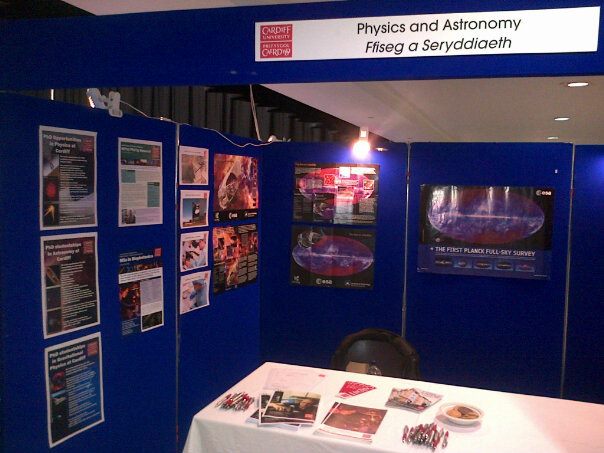
Today was the Postgraduate Open Day for Cardiff University, so I trooped off at lunchtime to man person the School of Physics & Astronomy stand in the Great Hall of the Students in the Students’ Union for the Subject Fair. It’s the first time I’ve ever been in the Great Hall, in fact, for no other reason than it’s for the students not the staff. Anyway, I have to say it didn’t look all that great, although at least it was warm. There’s no heating in my office right now, you see. And they provided coffee and biscuits.

Other than that it was just me, some leaflets and an uncountable infinity of Herschel Space Observatory souvenir pens sitting there for two hours. And there was lousy mobile coverage so I couldn’t even tweet. I got a bit bored, actually. I wish I’d taken my knitting. I did take a picture though…

It has to be said that a general Postgraduate Open Day like this isn’t a very effective method of recruiting postgraduate students, not in Physics and Astronomy at least. Most potential applicants come to apply by looking at web pages and/or listening to advice from people in the department where they are doing or did their first degree. People have already decided between Physics and, say, Astronomy and certainly between either of those and Sociology, so the idea of stalls competing for custom is a bit absurd.

Still, as Director of Postgraduate Studies I decided that it was good for Physics and Astronomy to show willing by maintaining a presence at such events, and if as a bonus we recruit even one promising PhD student then it’s probably worth the investment in time. The additional complication with this now is that I’m soon leaving to go to Sussex University, so I was tempted to tell visitors about opportunities there. I didn’t though. Mainly because I hardly spoke to anyone all afternoon…

The moral of this tale – if there is one – is that recruitment in different subjects is very different, so the “one size fits all” centralised approach isn’t always the right way to proceed. Schools and departments know their market better than anyone, so they need to be allowed to do their own thing at least part of the time.

I suspect this is an argument I’ll shortly be making elsewhere.

The Council for the Defence of British Universities

Posted in Education, Politics with tags , , on November 8, 2012 by telescoper

No time for a proper post today, but time to pass on news of the launch of a new independent campaigning body called The Council for the Defence of British Universities.

Here is the CDBU manifesto:

The Council for the Defence of British Universities is independent of any political party, for although we oppose many of the present government’s proposals, the assumptions to which we object were equally evident under its predecessor.

Our core principle is that the Council for the Defence of British Universities exists to advance university education for the public benefit. This is underpinned by nine supporting aims:

• To defend and enhance the character of British universities as places where students can develop their capacities to the full, where research and scholarship are pursued at the highest level, and where intellectual activity can be freely conducted without regard to its immediate economic benefit

• To urge that university education, both undergraduate and postgraduate, be accessible to all students who can benefit from it

• To maintain the principle that teaching and research are indispensable activities for a university, and that one is not pursued at the expense of the other

• To ensure that universities, while responding to the needs of students and society in general, should retain ultimate control of the content of the courses taught and the methods of instruction employed. As well as often providing vocational training, university education should equip graduates with the mental skills and intellectual flexibility necessary to meet the demands of a rapidly changing economy. It should develop the powers of the mind, enlarge knowledge and understanding, and enable graduates to lead fuller and more rewarding lives

• To emphasise that, as well as often having vital social and economic applications and being subject to accountability, academic research seeks to enhance our knowledge and understanding of the physical world, of human nature and of all forms of human activity

• To ensure that methods employed to assess the quality of university research do not encourage premature or unnecessary publication or inhibit the production of major works that require a long period of gestation

• To safeguard the freedom of academics to teach and to pursue research and enquiry in the directions appropriate to the needs of their subject

• To maintain the principle of institutional autonomy, to encourage academic self-government and to ensure that the function of managerial and administrative staff is to facilitate teaching and research

• To ensure that British universities continue to transmit and reinterpret the world’s cultural and intellectual inheritance, to encourage global exchange and to engage in the independent thought and criticism necessary for the flourishing of any democratic society.

For more information about the CDBU, including details on joining, you can visit their website.

Five Years On

Posted in Biographical with tags , , , , on July 1, 2012 by telescoper

So here we are then. July 1st 2012. Five years to the day since I started my job here in the School of Physics and Astronomy at Cardiff University. Cardiff students reading this will probably be surprised that I haven’t been here for longer than that, because it no doubt seems to younger folks that the staff must have been here since the Boer War. In fact, though, I’ve only been here long enough to see one generation of MPhys students through from induction to graduation; the second such group will graduate in a couple of weeks.

There’s a wikipedia page listing all the important events of July 1st 2007 but owing to some form of administrative error my move to Cardiff isn’t listed there. I notice that July 1st 2007 was also a Sunday, incidentally.

Thinking back to 2007 all I can remember was that my departure from Nottingham appeared to precipitate a collapse in the world’s financial system, ushering in the Credit Crunch just when I put my house in Beeston on the market, with the result that it took me the best part of a year to sell it and buy one here in lovely Pontcanna. In the meantime I had to rent a flat in Cardiff in which I lived during the week and travel back and forth to and from Nottingham at weekends. Actually, the weather in the summer of 2007 wasn’t too different from that of 2012; heavy rain in June and July that year led to the Severn flooding, causing considerable problems for my weekly commute.

Coincident with being the fifth anniversary of my arrival here from Nottingham, today is also the day that I’m officially promoted to Deputy Head of School and Director of Learning and Teaching. Or is it Director of Teaching and Learning? Anyway, five years isn’t exactly a meteoric rise through the ranks but I’m still shocked to have been placed in a position of such responsibility. I fear that the Peter Principle may be doubly appropriate.

The reason I got landed in it was given this opportunity for career progression was the departure of Derek Ward-Thompson to a position of Director of the Jeremiah Horrocks Institute at the University of Central Lancashire (in the Midlands); there was a farewell party for Derek at the Poet’s Corner on Friday which I attended briefly before heading off to the concert I wrote about yesterday. After fourteen years in Cardiff, Derek will be missed around here and I wish him well in his new job.

Meanwhile, life goes on. The last five years have certainly had their ups and downs, both personal and professional, but I’ve definitely got no regrets about moving here. I wouldn’t have predicted in 2007 that I’d be able to gather such a wonderful group of PhD students (Jo, Geraint and Ian), for example, nor that I’d find Cardiff undergraduates such fun to teach, especially as project students.

Here’s to the next five years!

PS. I am tempted to joke that Derek’s move from Cardiff to UCLAN improves the quality of astronomical research at both institutions. But of course I wouldn’t dream of saying anything like that…

🙂

Reffing Madness

Posted in Science Politics with tags , , , , , , , , , , on June 30, 2012 by telescoper

I’m motivated to make a quick post in order to direct you to a blog post by David Colquhoun that describes the horrendous behaviour of the management at Queen Mary, University of London in response to the Research Excellence Framework. It seems that wholesale sackings are in the pipeline there as a result of a management strategy to improve the institution’s standing in the league tables by “restructuring” some departments.

To call this strategy “flawed” would be the understatement of the year. Idiotic is a far better word.  The main problem being that the criteria being applied to retain or dismiss staff bear no obvious relation to those adopted by the REF panels. To make matters worse, Queen Mary has charged two of its own academics with “gross misconduct” for having the temerity to point out the stupidity of its management’s behaviour. Read on here for more details.

With the deadline for REF submissions fast approaching, it’s probably the case that many UK universities are going into panic mode, attempting to boost their REF score by shedding staff perceived to be insufficiently excellent in research and/or  luring  in research “stars” from elsewhere. Draconian though the QMUL approach may seem, I fear it will be repeated across the sector.  Clueless university managers are trying to guess what the REF panels will think of their submissions by staging mock assessments involving external experts. The problem is that nobody knows what the actual REF panels will do, except that if the last Research Assessment Exercise is anything to go by, what they do will be nothing like what they said they would do.

Nowhere is the situation more absurd than here in Wales. The purported aim of the REF is to allocated the so-called “QR” research funding to universities. However, it is an open secret that in Wales there simply isn’t going to be any QR money at all. Leighton Andrews has stripped the Higher Education budget bare in order to pay for his policy of encouraging Welsh students to study in England by paying their fees there.

So here we have to enter the game, do the mock assessments, write our meaningless “impact” cases, and jump through all manner of pointless hoops, with the inevitable result that even if we do well we’ll get absolutely no QR money at the end of it. The only strategy that makes sense for Welsh HEIs such as Cardiff University, where I work, is to submit only those researchers guaranteed to score highly. That way at least we’ll do better in the league tables. It won’t matter how many staff actually get submitted, as the multiplier is zero.

There’s no logical argument why Welsh universities should be in the REF at all, given that there’s no reward at the end. But we’re told we have to by the powers that be. Everyone’s playing games in which nobody knows the rules but in which the stakes are people’s careers. It’s madness.

I can’t put it better than this quote:

These managers worry me. Too many are modest achievers, retired from their own studies, intoxicated with jargon, delusional about corporate status and forever banging the metrics gong. Crucially, they don’t lead by example.

Any reader of this blog who works in a university will recognize the sentiments expressed there. But let’s not blame it all on the managers. They’re doing stupid things because the government has set up a stupid framework. There isn’t a single politician in either England or Wales with the courage to do the right thing, i.e. to admit the error and call the whole thing off.

By Gove, I agree!

Posted in Education with tags , , , on April 4, 2012 by telescoper

I never thought the day would come, but I have to admit it. I agree with Michael Gove. There. I said it.

Not with everything he says, of course. But I do think that universities should take over responsibility for the examinations required for University Entrance, currently known as A-levels. Here is an excerpt from an old post on this, and I’ve said much the same thing on several other occasions:

So what’s the solution? I think it is to scrap A-levels entirely, and give the system of pre-university qualifications over to the people who actually know what students need to know to cope with their courses, i.e. the universities. There should be a single national system of University Entrance Examinations, set and moderated by an Examination Board constituted by university teachers. This will provide the level playing field that we need. No system can ever be perfect of course, but this is the best way I can think of to solve the biggest problem with the current one. Not that it will ever happen. There are just too many vested interests happy with the status quo despite the fact that it is failing so many of our young people.

But lest you all think I’ve turned into a Conservative, let me point out that the fault with the current system is precisely that market forces have operated to the detriment of educational standards. The GCE examination boards compete for customers by offering easier and easier examinations each year, regardless of what students need to know to cope with University courses. What I advocate is renationalisation.  I bet Mr Gove doesn’t like it put that way…

Oh and another thing. I think universities should be given this task, but should also be paid for doing it just as the examination boards now are. That way it will not be treated as yet another imposition from the top, but an important task that has a similar status within a university as teaching and research.

End of Term

Posted in Biographical, Education with tags , , , on March 30, 2012 by telescoper

So here we are, then. The last day of term has finally arrived.  Many of our students will be out partying tonight before they start a three-week break with little to disturb their relaxation but project reports, assignments and examination revision. Probably not all that relaxing at all then, especially for the final-year students.

For various reasons I’ve found this term very heavy going and am  looking forward to spending some time away over the next couple of weeks.  More about that in due course, assuming I have internet access…

The curious thing about the academic year is that since most UK universities switched to a semester system we’ve had to cope with the fact that Easter isn’t on a fixed calendar date. Last year, Easter was rather late so we managed to squeeze in a full 11 weeks teaching in before the vacation started. This year we’ve only got time for 9 weeks, so we resume teaching in three weeks’ time for another two weeks, followed by a revision week and the examination period. I think most students probably agree with me that this hiatus is extremely annoying.

This year Good Friday is on 6th April (a week today) and Easter Monday on 9th April; both are statutory (“bank”) holidays in the UK. Most universities have felt obliged to move their recess so that these two holidays occur outside term-time.

If I had my way we would have fixed semester dates so this nonsense of a 9+2 week teaching semester wouldn’t happen. Last year’s 11-week uninterrupted run was a slog, but I much prefer it over the stop-start affair we’re having this year.

I was a visiting professor at an American university over one Easter period many years ago. Given the fact that the Christian lobby is far more powerful over there than it is here I was quite surprised by the fact that there’s no real interruption for Easter. Lectures were held on Good Friday and there’s no Easter Monday holiday. Easter Sunday was definitely observed, but that had no effect on teaching.

The two Bank Holidays are a bit of a problem, of course, especially because they are followed by two more in May. However, when I was an undergraduate at Cambridge, we had lectures as normal on bank holidays.  I’m not sure whether that practice was restricted to Oxbridge colleges – where term dates are different to elsewhere anyway – or some other Universities did the same. I don’t even know if Oxbridge still carries on over bank holidays today…

A better solution would be to distribute the statutory holidays more evenly through the year so they weren’t concentrated so inconveniently in Spring. There would be  nothing to stop Christians taking a day’s leave in order to observe Good Friday, of course.

But since only a minority of British people are practising Christians, why are the rest of us forced to arrange our calendars according to archaic and irrelevant rituals?  Far better, in my opinion,  to give us all a day off for the start of the cricket season…

Grumble over, it just remains for me to wish my loyal readers (Sid and Doris Bonkers) all the best for the recess, and I hope it’s a good night at the Student Ball tonight!

Is this the “Squeezed Middle”?

Posted in Education, Finance with tags , , on March 29, 2012 by telescoper

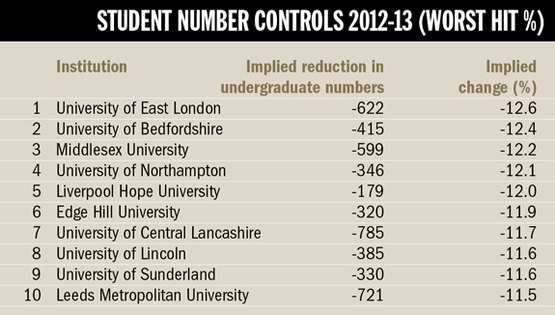
As reported in the Times Higher , the Higher Education Funding Council for England (HEFCE) has announced its allocations to English Higher Education Institutions for 2012/13. As expected, many universities are receiving substantial cuts next year. Here is a table of the biggest losers:

The Times Higher article describes this as the “Squeezed Middle”. It looks more like the “Squeezed Bottom” to me, but then I suppose that would have made an inappropriate headline.

Is there really a University of Sunderland?

Anyways, this allows me the chance to congratulate the former Director of Learning and Teaching in the School of Physics & Astronomy at Cardiff University on his move to the University of Central Lancashire, currently riding high at Number 7 in the above table…


Fee Summary – England versus Wales

Posted in Education with tags , , , on December 1, 2011 by telescoper

We’ve just had our first UCAS visit day of the year, for which those involved were given a handout showing the different fee arrangements for Welsh and English students applying to study at Cardiff University.

On the off-chance that some potential students might come across this blog and also for wider information – since there still seems to be quite a lot of confusion about the financial aspects of study in Wales – I thought I’d share the following useful summary here.

–0–

Cardiff University will charge a tuition fee of £9,000 per annum to new undergraduate students beginning their studies from September 2012 onwards.

I currently live in Wales

Cardiff University will charge an annual fee of £9,000 per annum.  However, if you live in Wales and studying towards your first degree you will not have to pay your tuition fee upfront. You will be eligible for:

• a non-repayable tuition fee grant of £5,535 from the Welsh Government, subject to terms and conditions.
• a repayable tuition fee loan of £3,465 which you only start to pay back when you have finished your studies and are earning more than £21,000pa.
• support towards your living costs – a loan is available to help with your living costs such as food, accommodation, books and travel. Like the tuition fee loan, you only start to pay this back when you have finished your studies and are earning more than £21,000 a year.

You may also be eligible for an Assembly Learning Grant to provide additional help with your living costs such as food, accommodation, books and travel. This grant does not have to be paid back and the amount you receive depends on your household income:

• If your household income is £18,370 a year or less you will be entitled to a full grant of £5,000 a year.
• If your household income is between £18,370 and £50,020 a year you would be entitled to a grant of between £5,000 and £50 a year.

I currently live in England (or elsewhere in the UK)

Cardiff University will charge an annual fee of £9,000 per annum.  However, if you live in England and studying towards your first degree you will not have to pay your tuition fee upfront. You will be eligible for:

• a repayable tuition fee loan of £9,000 which you only start to pay back when you have finished your studies and are earning more than £21,000pa.
• support towards your living costs – a loan is available to help with your living costs such as food, accommodation, books and travel. Like the tuition fee loan, you only start to pay this back when you have finished your studies and are earning more than £21,000 a year.

If you are from England, you may also be eligible for a Maintenance Grant to provide additional help with your living costs such as food, accommodation, books and travel. This grant does not have to be paid back and the amount you receive depends on your household income:

• If your household income is £25,000 a year or less you will be entitled to a full grant of £3,250 a year.
• If your household income is between £25,001 and £42,600 a year you will be entitled to a partial grant.

Please note that the student support arrangements in England are subject to final ratification by Parliament.

I currently live outside the UK but inside the EU

Cardiff University will charge an annual fee of £9,000 per annum.  However, if you are from a country within the EU and studying towards your first degree at Cardiff University, you will not have to pay your tuition fee upfront. You will be eligible for:

• a non-repayable tuition fee grant of £5,535 from the Welsh Government, subject to terms and conditions.
• a repayable tuition fee loan of £3,465 which you only start to pay back when you have finished your studies and are earning more than £21,000pa.

Admissions Latest

Posted in Education, Politics with tags , , , , , , , on November 28, 2011 by telescoper

Only time for a short post today, so I thought I’d just pass on a link to the latest  Higher Education application  statistics, as reported by the Universities and Colleges Admissions Service (UCAS).

It’s still several weeks before the UCAS deadline closes in January so it’s too early to see exactly what is happening, but the figures do nevertheless make interesting reading.

The total number of applications nationally  is down by 12.9% on last year, but the number of  applications from UK domiciled students has fallen by 15.1%; an increase in applications from non-EU students is responsible for the difference in these figures.

Non-science subjects seem to be suffering the biggest falls in application numbers; physical sciences are doing better than average, but still face a drop of 7% in numbers. Anecdotal evidence I’ve gleaned from chatting to Physics & Astronomy colleagues is that some departments are doing very well, even increasing on last year, while others are significantly down. It is, however, far too early to tell how these numbers will translate into bums on seats in lecture theatres.

A particular concern for us here in Wales are the statistics of applications to Welsh universities.  The number of English-domiciled applicants to Welsh universities is down by 17.4% while the number of Welsh applicants to Welsh universities is down by 15.2%. On the other hand, the number of Welsh applicants to English universities is down by just 5.3%.

The pattern of cross-border applications is particularly important for Welsh Higher Education  because of the Welsh Assembly Government’s policy of subsidizing Welsh-domiciled students wherever they study in the United Kingdom, a policy which is generous to students but which is paid for by large cuts in direct university funding.  The more students take the WAG subsidy out of Wales, the larger will be the cuts in grants to Welsh HEIs.

Moreover, in the past, about 40% of the students in Welsh universities come from England.  If the fee income from incoming English students is significantly reduced relative to the subsidy paid to outgoing Welsh students then the consequences for the financial health of Welsh universities are even more dire.

Although it is early days the figures as they stand certainly suggest the possibility that the  number of Welsh students  studying in England will increase both relative to the number staying in Wales and relative to the number of English students coming to study in Wales. Both these factors  will lead to a net transfer of funds from Welsh Higher Education Institutions to their English counterparts.   I think the policy behind this is simply idiotic, but by the time the WAG works this out it may be too late.

Another interesting wrinkle on the WAG’s policy can be found in a piece in last week’s Times Higher. We’re used to the idea that people might relocate to areas where schools or  local services are better or cheaper, but consider the incentives on an English  family who are thinking of the cost of sending their offspring to University. The obvious thing for them  to do is to relocate to Wales in order to collect the WAG subsidy which they can then spend sending their little dears to university in England. That will save them tens of thousands of pounds per student, all taken directly from the Welsh Higher Education budget and paid into to the coffers of an English university.

There are already dark rumours circulating that the WAG subsidy will turn out to be so expensive that the Higher Education Funding Council for Wales is thinking of cancelling all its research funding. That means that Welsh universities face the prospect of having to take part in the burdensome Research Excellence Framework, in competition with much better funded English and Scottish rivals, but getting precisely no QR funding at the end of it.

And all this is because the Welsh Assembly Government wants to hand a huge chunk of its budget back to England. Is this how devolution is supposed to work? Madness.