Archive for University of Cambridge

Bullying at UK Universities

Posted in Harassment Bullying etc with tags , , , , on June 17, 2025 by telescoper

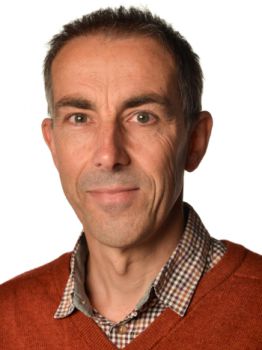
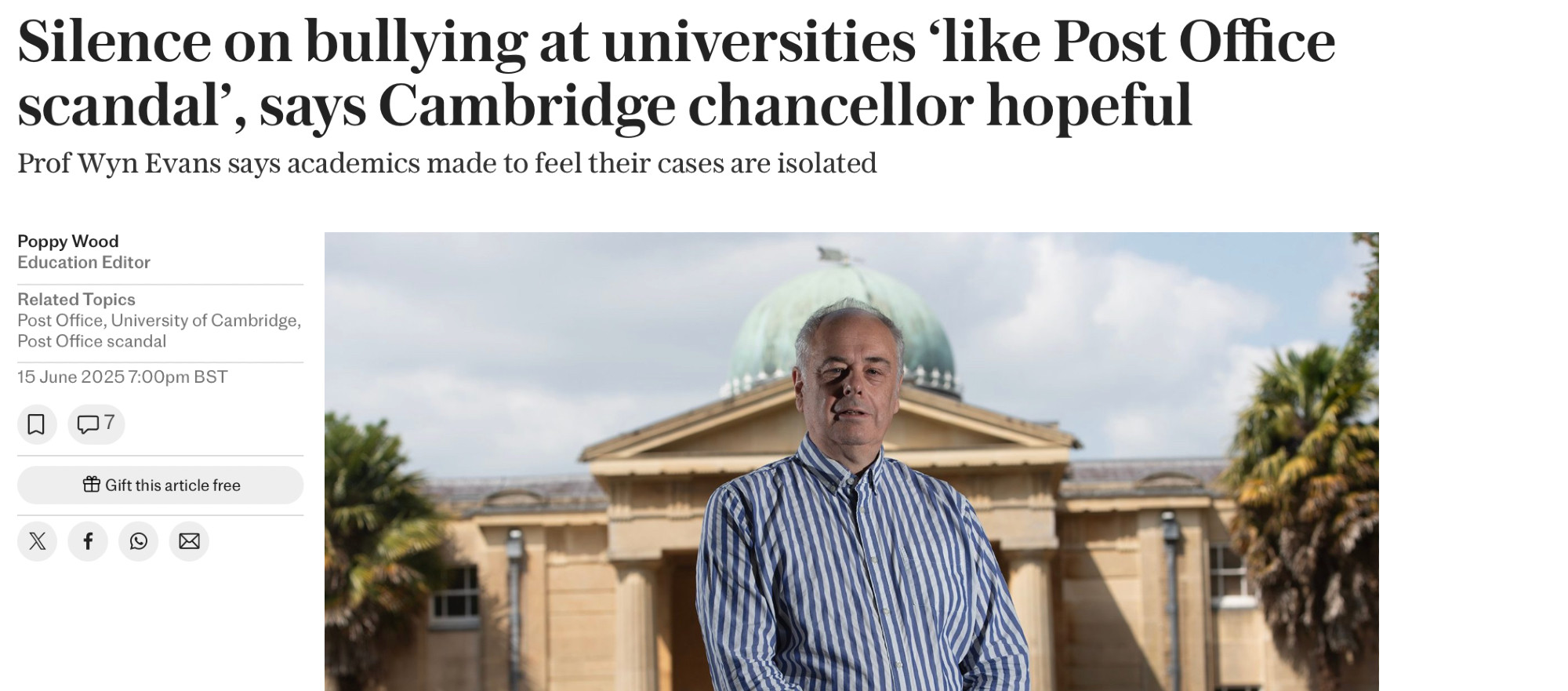
Regular followers of this blog will interested to see that the Daily Telegraph has published an article about Professor Neil Wyn Evans about bullying in UK universities, with particular reference to his own experiences during a long-running dispute at the Institute of Astronomy at Cambridge.

If you would rather not click through to the Torygraph, here is the most remarkable revelation (amongst many). It is about an investigation by an independent barrister that took over eighteen months to do complete. When Prof. blew the whistle on what he saw as bullying, he ended up being himself investigated, though the investigation dismissed all the claims made against him:

In his independent report into Prof Evans’ whistleblowing claims, the external barrister appointed by Cambridge University said he regretted the length of time that the investigation took and “the effect this will undoubtedly have had on all those involved”. The barrister also raised concerns that several staff members pulled out of providing testimony “over fears they would face retaliation.

It is a sorry state of affairs when members of staff refuse to provide testimony to an investigation for for fear of retaliation, and an even sorrier state when you realize that the feared retaliation would come from the University’s own Human Resources Department!

This is not only a problem at Cambridge, of course. Universities generally are terrible at dealing with this sort of thing. At least there’s at least a chance of doing something about it in Cambridge, however, as Neil Wyn Evans is standing for the Chancellorship of Cambridge University. He’s got my vote.

R.I.P. Sverre Aarseth (1934-2024)

Posted in R.I.P., The Universe and Stuff with tags , , , on January 21, 2025 by telescoper
Picture Credit: Institute of Astronomy, Cambridge

I am very late passing this sad news on, but I only just heard of the death (on 28th December 2024, at the age of 90) of Sverre Aarseth, who spent almost all of his research career at the Institute of Astronomy in Cambridge. Sverre was a pioneer in the use of N-body numerical techniques for solving gravitational problems and whose work had enormous impact across many aspects of astrophysics and cosmology, not least because he made his codes available as “open source”. I suspect many of us have used an “Aarseth code” at some point in our careers! I only met him a few times, but he struck me as a friendly and self-effacing man. He was certainly never someone who tried to hog the limelight but he was held in a very high regard across the research community.

You can find fuller tributes here and here.

Rest in peace, Sverre Aarseth (20 July 1934 – 28 December 2024)

R.I.P. Peter Thomas (1961-2024)

Posted in R.I.P. with tags , , , , , on July 25, 2024 by telescoper

Once again I have to use this blog to pass on some very sad news. Professor Peter Thomas of Sussex University passed away last weekend at the age of 62.

Peter Thomas (left) joined the University of Sussex as a lecturer in the Astronomy Centre in 1989 and remained there for his entire career. I know from my own time as Head of School that he was an excellent colleague. who made huge contributions to the University and indeed to his research discipline of cosmology.

Peter studied Mathematics at Cambridge University, graduating in 1983 and then did Part III (also known as the Certificate of Advanced Study) which he obtained in 1984. He stayed in Cambridge to do a PhD in the Institute of Astronomy under the supervision of Andy Fabian on Cooling Flows and Galaxy Formation, which he completed in 1987. He then spent a couple of years in Toronto as a Postdoctoral Fellow at the Canadian Institute for Theoretical Astrophysics (CITA) before taking up his lectureship at Sussex in 1989. His main research interests were in in the areas of galaxy formation, including numerical and semi-analytic models, and computer simulations of the formation of clusters of galaxies.  He was a widely known and very highly respected researcher in the field of theoretical cosmology and extragalactic astrophysics.

I was a PDRA in the Astronomy Centre at Sussex when Peter joined in 1989; he was Professor in the Department of Physics & Astronomy when I returned there as Head of School of Mathematical and Physical Sciences in 2013, a position he himself subsequently held. He was a much-valued member of staff who made huge contributions to the Astronomy Centre, the Department of Physics & Astronomy, the School of Mathematical and Physical Sciences, and the University of Sussex as a whole. I also remember him as a colleague on various panels for PPARC and then STFC on which he served diligently.

Having known Peter for 35 years, and being of similar age, it was a shock to hear that he passed away. I understand that he had been suffering from cancer for over a year. I send my deepest condolences to his family, friends and colleagues. I understand that his funeral will be a private family affair, but there will be a more public occasion to celebrate his life at a later date.

Cosmology and the Born-Again Bayesians!

Posted in Bad Statistics, Biographical, The Universe and Stuff with tags , , , , on May 10, 2021 by telescoper

The other day, via Twitter, I came across an interesting blog post about the relatively recent resurgence of Bayesian reasoning in science. That piece had triggered a discussion about why cosmologists seem to be largely Bayesian in outlook, so I thought I’d share a few thoughts about that. You can find a lot of posts about various aspects of Bayesian reasoning on this blog, e.g. here.
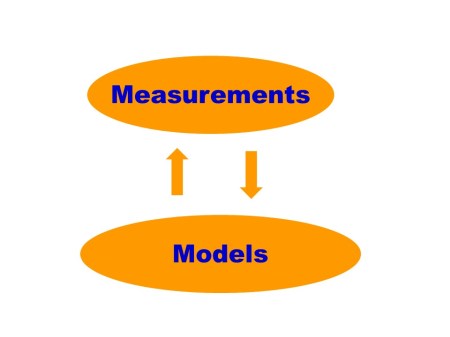
When I was an undergraduate student I didn’t think very much about statistics at all, so when I started my DPhil studies I realized I had a great deal to learn. However, at least to start with, I mainly used frequentist methods. Looking back I think that’s probably because I was working on cosmic microwave background statistics and we didn’t really have any data back in 1985. Or actually we had data, but no firm detections. I was therefore taking models and calculating things in what I would call the forward direction, indicated by the up arrow. What I was trying to do was find statistical descriptors that looked likely to be able to discriminate between different models but I didn’t have the data.

Once measurements started to become available the inverse-reasoning part of the diagram indicated by the downward arrow came to the fore. It was only then that it started to become necessary to make firm statements about which models were favoured by the data and which weren’t. That is what Bayesian methods do best, especially when you have to combine different data sets.

By the early 1990s I was pretty much a confirmed Bayesian – as were quite a few fellow theorists -but I noticed that most observational cosmologists I knew were confirmed frequentists. I put that down to the fact that they preferred to think in “measurement space” rather than “theory space”, the latter requiring the inductive step furnished by Bayesian reasoning indicated by the downward arrow. As cosmology has evolved the separation between theorists and observers in some areas – especially CMB studies – has all but vanished and there’s a huge activity at the interface between theory and measurement.

But my first exposure to Bayesian reasoning came long before that change. I wasn’t aware of its usefulness until 1987, when I returned to Cambridge for a conference called The Post-Recombination Universe organized by Nick Kaiser and Anthony Lasenby. There was an interesting discussion in one session about how to properly state the upper limit on CMB fluctuations arising from a particular experiment, which had been given incorrectly in a paper using a frequentist argument. During the discussion, Nick described Anthony as a “Born-again Bayesian”, a phrase that stuck in my memory though I’m still not sure whether or not it was meant as an insult.

It may be the case for many people that a relatively simple example convinces them of the superiority of a particular method or approach. I had previously found statistical methods – especially frequentist hypothesis-testing – muddled and confusing, but once I’d figured out what Bayesian reasoning was I found it logically compelling. It’s not always easy to do a Bayesian analysis for reasons discussed in the paper to which I linked above, but it least you have a clear idea in your mind what question it is that you are trying to answer!

Anyway, it was only later that I became aware that there were many researchers who had been at Cambridge while I was there as a student who knew all about Bayesian methods: people such as Steve Gull, John Skilling, Mike Hobson, Anthony Lasenby and, of course, one Anthony Garrett. It was only later in my career that I actually got to talk to any of them about any of it!

So I think the resurgence of Bayesian ideas in cosmology owes a very great deal to the Cambridge group which had the expertise necessary to exploit the wave of high quality data that started to come in during the 1990s and the availability of the computing resources needed to handle it.

But looking a bit further back I think there’s an important Cambridge (but not cosmological) figure that preceded them, Sir Harold Jeffreys whose book The Theory of Probability was first published in 1939. I think that book began to turn the tide, and it still makes for interesting reading.

P.S. I have to say I’ve come across more than one scientist who has argued that you can’t apply statistical reasoning in cosmology because there is only one Universe and you can’t use probability theory for unique events. That erroneous point of view has led to many otherwise sensible people embracing the idea of a multiverse, but that’s the subject for another rant.
Eddington at the `Del-Squared V Club’

Posted in History, The Universe and Stuff with tags , , , on May 15, 2019 by telescoper

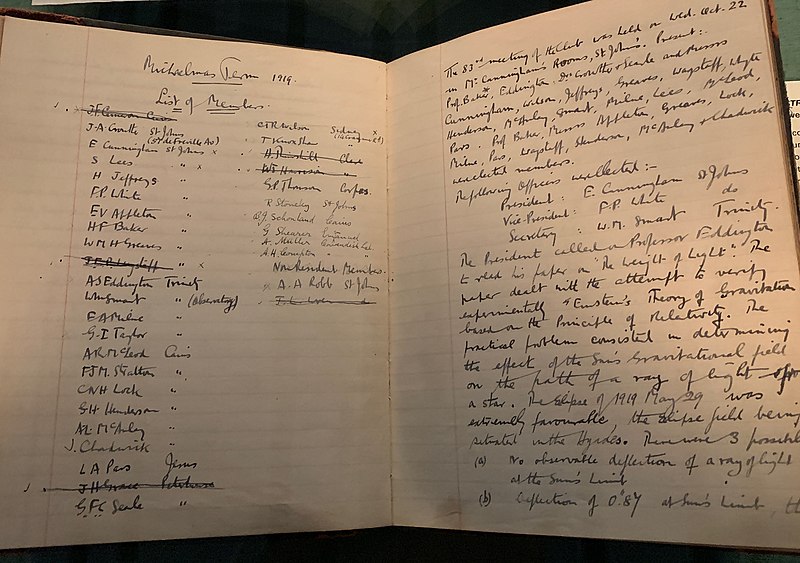
I’m up to my eyeballs in matters Eddingtonian these days preparing for the big centenary, so I thought I’d share this which I was reminded about this morning. The official results of the 1919 Eclipse Expeditions were announced at a joint meeting of the Royal Society and Royal Astronomical Society on November 6 1919. Members of a certain physics graduate student society at Cambridge, however, were treated to a sneak preview in October of that year, to which the minutes of the 83rd Meeting of the `Del-Squared V Club’ attest:

Arthur Stanley Eddington gave a talk at that meeting, a brief note of which appears on the right-hand page of the minute book shown above. You can see the Newtonian value for the expected deflection of 0.87 seconds at the bottom of the page. There’s also a nice reference to `The Weight of Light’. I had no idea Eddington was a lightweight speaker, but there you are.

I don’t think the Del-Squared V Club exists* any more, so I won’t make the joke that if you want to phone them up you have to go through the operator

*I’m reliably informed that it has been defunct since 1970.


R.I.P. James Stirling (1953-2018)

Posted in The Universe and Stuff with tags , , , on November 12, 2018 by telescoper

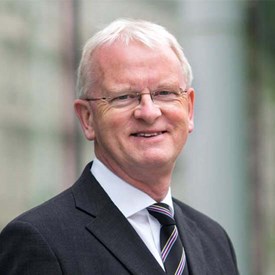
I’m sorry that this blog is once again the bearer of bad news, but it is my sad duty to pass on the news that distinguished particle physicist James Stirling (pictured above) passed away yesterday at the age of 65.

Professor James Stirling was one of the leading lights of the Institute for Particle Physics Phenomenology in Durham (of which he was the first Director) and subsequently became Jacksonian Professor of Natural Philosophy and Head of the Cavendish Laboratory at the University of Cambridge. More recently he was Provost of Imperial College, a post from which he stepped down earlier this year. He was elected to a Fellowship of the Royal Society in 1999, and awarded a CBE in the New Years Honours List in 2006.

As well as being an eminent physicist, with over 300 publications to his name including fundamental contributions to the field of hadronic interactions and perturbative QCD, Professor Stirling also gave great service to the research community, by serving on numerous important committees, including the Science Board of the Science & Technology Facilities Council (STFC).

Not being a particle physicist myself I didn’t know James as a close colleague, but I met him on several occasions during visits to Durham. Most recently, he was the external member of the appointment panel when I was interviewed for the post of Head of School of Mathematical and Physical Sciences at the University of Sussex. It says a lot for his personality that what I expected to be a fierce grilling when he led the questions on my research, turned out to he a friendly (yet challenging) discussion of some of my publications which he had clearly read extremely carefully.

James Stirling was held in extremely high regard by the scientific community and he’ll be greatly missed.I send my deepest condolences to his family, friends and colleagues.

R.I.P. Professor James Stirling (1953-2018)

R.I.P. John M Stewart (1943-2016)

Posted in Biographical, Education, The Universe and Stuff with tags , , , on November 23, 2016 by telescoper

john-stewartI was very sad this morning to hear of the death of distinguished mathematical physicist Dr John M. Stewart (left). Apart from a few years in Munich in the 1970s John Stewart spent most of his working life in Cambridge, having studied there as an undergraduate and postgraduate and then returning from his spell at the Max Planck Institute to the Department of Applied Mathematics and Theoretical Physics for forty years.
John’s research mostly concerned relativistic fluid dynamics. Indeed, he was one of the pioneers of numerical relativity in the United Kingdom, and he applied his knowledge to a number of problems in early Universe cosmology and structure formation. I think it is fair to say that he wasn’t the most prolific researcher in terms of publications, which is perhaps why he only got promoted to Senior Lecturer in 2000 and never made it to a Chair, retiring as Reader in Gravitational Physics in 2010. However, his work was always of a very high technical standard and presented with great clarity and he was held in a very high regard by those who knew him and worked with him.

The tributes paid to John Stewart by King’s College (of which he was a Life Fellow) here and his colleagues in the Centre for Theoretical Cosmology here give a detailed account of his research achievements, so I refer you to them for more information about that aspect of his career.

I just wanted to add a personal note not about John Stewart’s research, but about something else mentioned in the obituaries linked to above: his teaching. I was fortunate enough to have him as a lecturer when I was studying Natural Sciences at Cambridge during the early 1980s. In the second year (Part IB) I specialised in Physics and Mathematics, and John taught part of the Mathematics syllabus. He was an absolutely superb teacher. For a start he was superbly well organized and had clearly thought very deeply about how best to present some quite difficult material. But it wasn’t just that. He projected a very engaging personality, with nice touches of humour, that made him easy to listen. His lectures were also very well paced for taking notes. In fact he was one of the few lecturers I had whose material I didn’t have to transcribe into a neat form from rough notes.

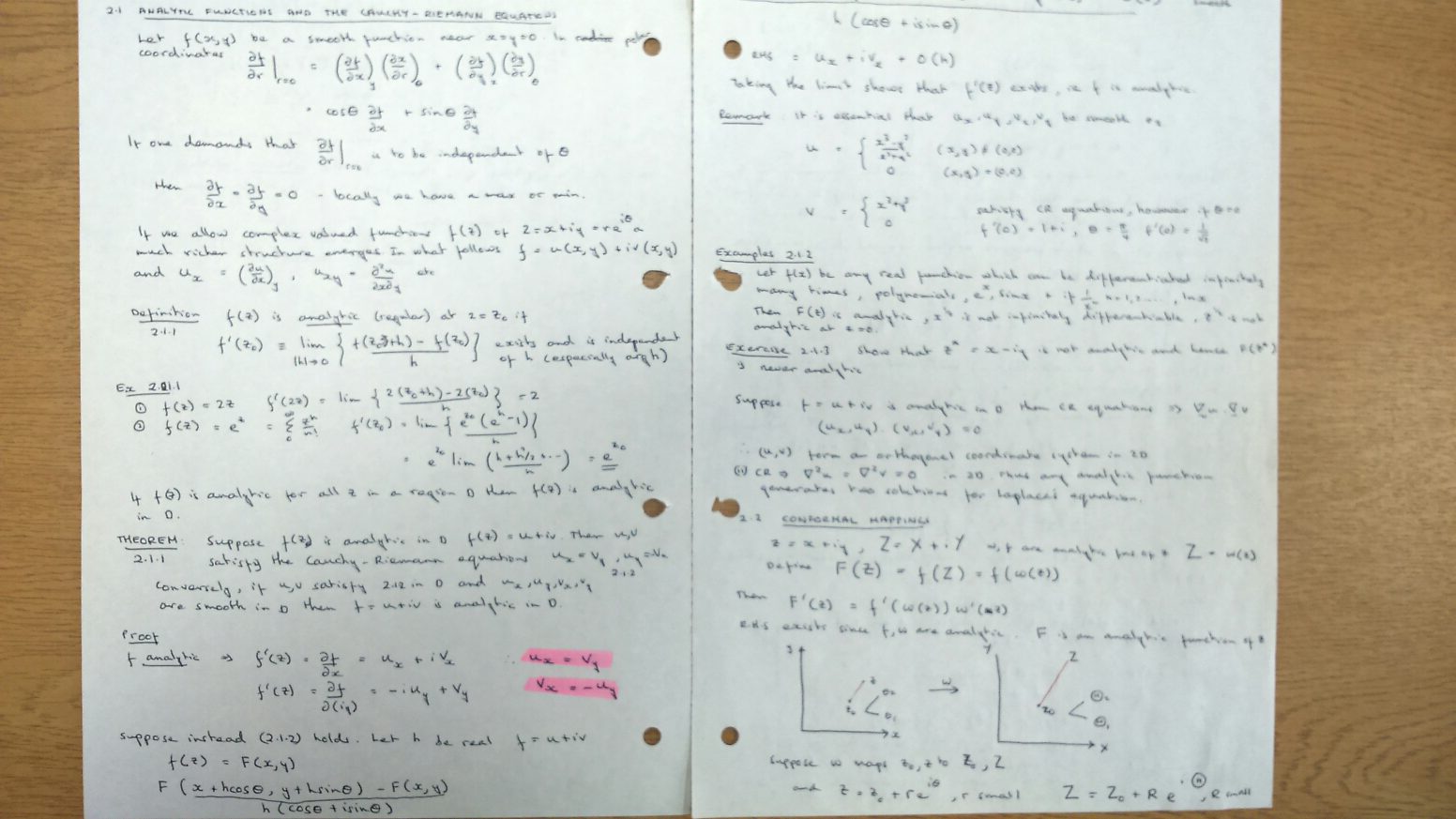
I have kept all the notes from that course for over thirty years. Here are a couple of pages as an example:

wp-1479909754508.jpeg

Anyone who has ever seen my handwriting will know that this is about as neat as I ever get!

When I was called upon to teach similar material at Cardiff and Sussex I drew on them heavily, so anyone who has learned anything from me about complex analysis, contour integration, Green’s functions and a host of other things actually owes a huge debt to John Stewart. Anything they didn’t understand was of course my fault, not his..

I also remember that John came to Queen Mary to give a seminar when I worked there in the early 90s as a postdoc. I was still a bit in awe of him because of my experience of him in Cambridge. His talk was about a method for handling the evolution of cosmological matter perturbations based on an approach based on the Hamilton-Jacobi formalism. His visit was timely, as I’d been struggling to understand the papers that had been coming out at the time on this topic. In the bar after his talk I plucked up the courage to explain to him what it was that I was struggling to understand. He saw immediately where I was going wrong and put me right on my misconceptions straight away, plucking a simple illustrative example apparently out of thin air. I was deeply impressed, not only by his ability to identify the issue but also with his friendly and helpful demeanour.

Rest in Peace, Dr John M. Stewart (1943-2016).

To Cambridge Again

Posted in Biographical, Education with tags , , , on June 13, 2016 by telescoper

The annual cycle of academic life brings me once again to my duties as External Examiner for Physics at the famous Midlands University called Cambridge, so I’m getting ready to take the train there. Here’s a picture of the Cavendish laboratory where I’ll be working for the next three days:

bragg_building_110309

It hasn’t changed much since I was an undergraduate there (I graduated 31 years ago), but the area around it has certainly been heavily developed in the intervening years.

Anyway, I’d better be going. Toodle-pip!

In Praise of Natural Sciences

Posted in Biographical, Education with tags , , , , on April 24, 2016 by telescoper

The other day I was chatting with some students in the Department of Physics & Astronomy at the University of Sussex. One thing that came up was the fact that I’m basing the material for my Second Year Theoretical Physics module on the notes I took when I was a second-year undergraduate student at Cambridge over thirty years ago. I mentioned that to counter suggestions that are often made that the physics curriculum has been excessively “dumbed down” over the years. It may have been elsewhere, of course, but not on my watch. In fact, despite the misfortune of having me as a lecturer, many of the students in my class are picking up things far faster than I did when I was their age!

Anyway, that led to a general discussion of the changing nature of university education. One point was that in my day there weren’t any four-year “Integrated Masters” degrees, just plain three-year Bachelors. Teaching was therefore a bit more compressed than it is now, especially at Cambridge with its shorter teaching terms. We teach in two 12-week blocks here at Sussex. Week 11 of the Spring Term is about to start so we’re nearing the finishing line for this academic year and soon the examinations will be upon us.

The other thing that proved an interesting point of discussion was that the degree programme that I took was the Natural Sciences Tripos That meant that I did a very general first year comprising four different elements that could be chosen flexibly. I quickly settled on Physics, Chemistry and  Mathematics for Natural Sciences to reflect my A-level results but was struggling for the fourth. In the end I picked the one that seemed most like Physics, a course called Crystalline Materials. I didn’t like that at all, and wish I’d done some Biology instead – Biology of Cells and Biology of Organisms were both options – or even Geology, but I stuck with it for the first year.

Having to do such a wide range of subjects was very challenging. The timetable was densely packed and the pace was considerable. In the second year, however, I was able to focus on Mathematics and Physics and although it was still intense it was a bit more focussed. I ended up doing Theoretical Physics in my final year, including a theory project.

My best teacher at School, Dr Geoeff Swinden,  was a chemist (he had a doctorate in organic chemistry from Oxford University) and when I went to Cambridge I fully expected to specialise in Chemistry rather tha Physics. I loved the curly arrows and all that. But two things changed. One was that I found the Physics content of the first year far more interesting – and the lecturers and tutors far more inspiring – than Chemistry, and the other was that my considerable ineptitude at practical work made me doubt that I had a future in a chemistry laboratory. And so it came to pass that I switched allegiance to Physics, a decision I am very glad I made. It was only towards the end of my degree that I started to take Astrophysics seriously as a possible specialism, but that’s another story.

As we are now approaching examination season I’ve been dealing with some matters in my role as External Examiner for Natural Sciences (Physics) at Cambridge, a position I have held since last year. It’s certaintly extremely interesting to see things from the other side of the fence, thirty years on since my finals. In particular I was struck last year by how many senior physicists there are at Cambridge who actually came as undergraduates expecting, like I did, to do Chemistry but also then switched. No doubt some moved in the opposite direction too, but the point is that the system not only allowed this but positively encouraged it.

Looking back, I think  there were great educational advantages in delaying  the choice of speciality the way a Natural Sciences degree did. New students usually have very little idea how different the subject is at university compared to A-level, so it seems unfair to lock them into a programme from Year 1. Moreover – and this struck me particularly talking to current students last week – a Natural Sciences programme might well prove a way of addressing the gender imbalance in physics by allowing female students (who might have been put off Physics at school) to gravitate towards it. Only 20% of the students who take Physics A-level are female, and that’s roughly the same mix that we find in the undergraduate population. How many more might opt for Physics after taking a general first year?

Another advantage of this kind of degree is that it gives scientists a good grounding in  a range of subjects. In the long run this could encourage greater levels of interdisciplinary thinking. This is important, since some of the most exciting areas of physics research lie at the interfaces with, e.g. chemistry and biology. Unfortunately, adminstrative structures often create barriers that deter such cross-disciplinary activities.


Admissions to Degrees

Posted in Biographical with tags , , on June 20, 2015 by telescoper

My trip to Cambridge earlier this week along with talk of other anniversaries made me a bit nostalgic this morning so I dug out the papers I kept about my own graduation.

image

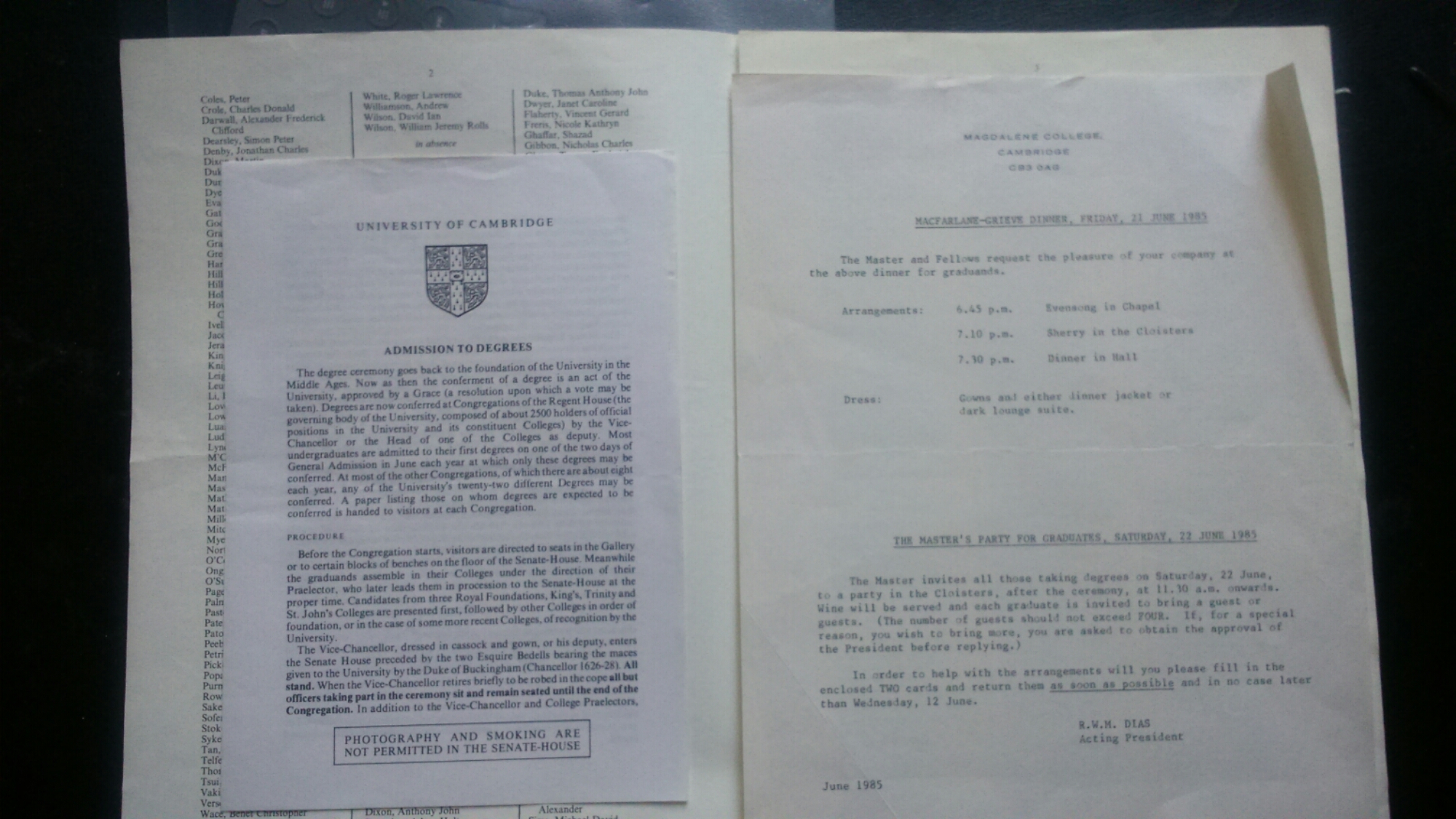
It turns out I graduated on Saturday 22nd June 1985. You can see my name on the list of graduands at the top left of this montage.

I don’t remember much about the actual ceremony nor the rest of the day, perhaps because I was hungover from the night before..

On the right you see details of the Graduation Dinner held on Friday 21st June. When that ended, a large crowd went to the Pickerel where I remember singing all the verses of the Blaydon Races although I don’t remember why..