Archive for University of Sussex

Congratulations, here and there..

Posted in Biographical, Education with tags , , on June 14, 2013 by telescoper

Well, the academic year has finally come to an end at the University of Sussex. This afternoon we had another marathon meeting of Senate to round off the week and today was also the last day of the examination period; final-year students had their last exams earlier in the assessment period so their papers could be marked and scrutinized in time for yesterday’s meeting of the Progression and Awards Board. Although we were operating under new regulations this year, so there was some nervousness about how it would go, it all went pretty well in the end. The recommendations of the PAB were checked by the University authorities yesterday as I went up to London for an event at the Royal Society and when I returned to work this morning it was my (very pleasant) job to sign off the pass lists and also sign the certificates relating to prizes for outstanding students.

When all was done, the pass list was put up in the foyer of Pevensey 2 at which point a scrum of anxious students formed around it to find out how they’d done. 

IMG-20130614-00123

The vast majority of the faces I saw had very happy smiles on them, as I knew would be the case because I had seen the results beforehand and knew how well so many of them had done! Champagne corks popped and prizes were handed out. There then followed a celebratory BBQ outside the building, organized by staff and students. The weather didn’t look very promising, and it remained rather windy – threatening to blow smoke into the building and possibly set off the smoke alarms – but it was a nice occasion.

IMG-20130614-00124

Unfortunately I had to leave in mid-party to attend a Senate briefing meeting, followed by Senate itself, which went on from 2pm until almost 6 during which time the Sun came out. The weather thus looked favourably on similar celebrations going on around campus, but not on those couped up in Bramber House for the Senate meeting.

Anyway, as Head of School I’d just like to say congratulations to all this year’s graduating class on their achievement and wish them well as today’s celebrations no doubt continue into the evening and perhaps beyond. I’d also like to all staff in the School for working so hard to get everything done so the students got their results in time and in good order; to the lecturers and examiners for getting their marks in on time; to the PAB members for their diligence in following the procedures; and, above all, to the wonderful staff in the MPS office for their huge contribution to the administration of the process. It’s the first time I’ve been involved in examinations here and the support staff did a fantastic job, sometimes under very difficult circumstances.

Meanwhile, back in Cardiff, similar events will have unfolded there. I don’t know how many of the graduating class from Cardiff University School of Physics & Astronomy are likely to read this blog nowadays. A few did in the past, but have probably stopped now that I’ve left. Just in case, however, I’d like to congratulate them all on their success and express regret that I didn’t see the same kind of smiles on their faces as I did on the Sussex students!

Well, that was the week that was always going to be very busy. Now I’m going to head home, put my feet up and tackle the latest Private Eye crossword. Oh, and maybe a glass or two of wine…

Bang Goes the Accelerator

Posted in Uncategorized with tags , , , , on May 28, 2013 by telescoper

243679No time to post anything energetic today, so I just thought I’d pass on a little snippet of information that not a lot of people know. The BBC TV series Bang Goes the Theory – or at least the part of it that isn’t done on location – is filmed in the building shown on the left, the Accelerator Building, located just behind Pevensey 2 at the University of Sussex, where the Department of Physics & Astronomy is based (and wherein my own office is located). It’s actually quite a large space, extending underneath a car park, which was (as its name suggests) built to house a linear accelerator (which is no longer there). The building is currently leased out to the BBC by the University, but perhaps before too long it might once again be used for physics…

Buildings of Sussex (University)

Posted in Architecture with tags , , , , , on May 24, 2013 by telescoper

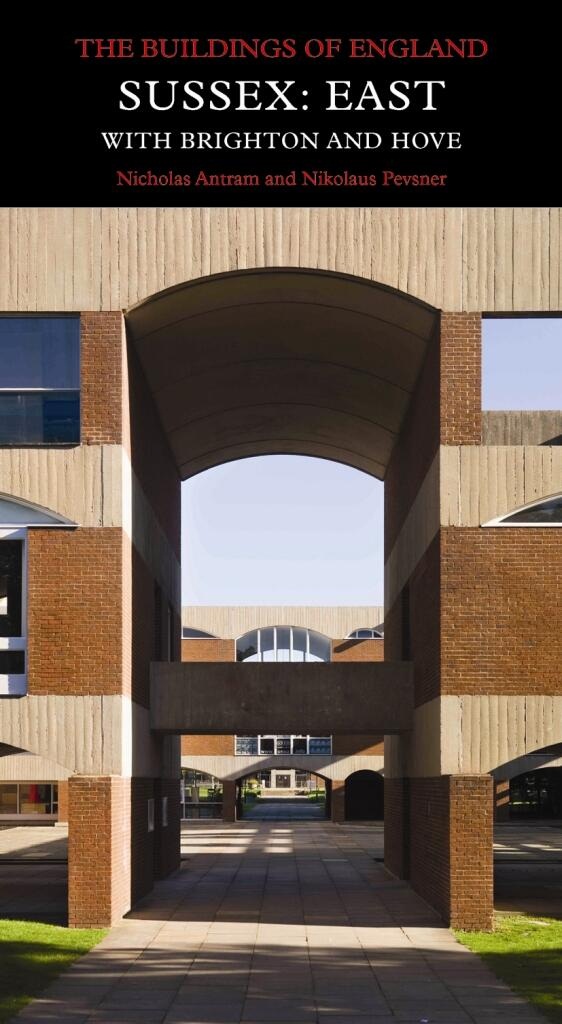
Shamelessly ripped off from the University of Sussex Staff News comes an interest snippet. Nearly 50 years after it first came out, the revised Sussex edition of a renowned series of architectural guides is about to be published – with our own Falmer House on the front cover.

Falmer House

The news item goes on

The Sussex volume of Sir Nikolaus Pevsner’s comprehensive and authoritative 46-volume series was first published in 1965. It includes seven pages on the “uncompromising” 1960s Sussex architecture by Sir Basil Spence – the subject of an exhibition on campus in 2012.

“The campus has worn well,” writes Antram, who is sensitive to the original, listed Spence buildings and those of the later, evolving campus.

“There is a carefully controlled relationship between landscape and buildings, sometimes formal, sometimes informal, the established park and Downland setting omnipresent …

“The buildings are remarkably homogeneous, their leitmotifs being heavy, chunky slabs of in situ cast concrete vaults, often used as bands, contrasted against the red brick walls …

“Roman indeed seems the epic monumentality of the Sussex buildings with their rhythmic arches and grand exterior staircases, even if that formality is softened by the materials and the asymmetrical layout.”

The campus tour of individual buildings begins with Falmer House, the first 1960s building in the country to be given Grade I listed status by English Heritage.

Pevensey 1 is described as “high drama”, the Chichester Lecture Theatre as an “awesomely plain brick drum” and the Library as a “rather brooding presence”.

Swanborough, meanwhile, is “unassuming”, and East Slope consists of 13 “troglodytic blocks stepped up the hillside”.

In my experience, opinions are generally rather divided about the architectural quality of the buildings on the University of Sussex campus. Mine are too, actually. I think the overall plan is wonderful with its accurately aligned central axis visible in the jacket photograph. On the other hand, some of the buildings – especially the John Maynard Smith Building (when I was a student here  it was called BIOLS) is not very good at all and may well be demolished soon to make way for new Science Buildings. I agree that East Slope is dire. The building I am in – Pevensey (formerly MAPS) -is actually rather nice, and most staff seem to like it here. My favourite building on the campus, however, is the Library; largely because Sussex still has a “library” as opposed to a “Learning Resources Unit” or some such nonsense. In any case I don’t find it at all “brooding” so I’m  mystified by that comment.

Some have called it brutalist but I think the relationship between the campus buildings and the surrounding countryside has been managed very sensitively. It’s purely a matter of taste, of course, and no doubt some locals will want to express differing opinions through the comment box!

Hosts, Guests, and Parasites

Posted in Literature with tags , , , , , on April 26, 2013 by telescoper

I just returned from my first experience of Court, at least in the sense of that word that applies to the University of Sussex. It was quite different to what I had imagined, especially because it included three research talks. One of them, by Dr Sara Crangle of the School of English was about the Engagement Diaries of Virginia Woolf (many of which have been acquired by the University). This talk began with a fascinating preamble focussed on a short quote from The Critic as Host by J. Hillis Miller. This revolved around the curious shared etymology of “host” and “guest” and their common relationship to “hostia” the latin word meaning a sacrifice or a victim. Being fascinated by the origin and evolution of words I thought I’d have a look for a bit more of the context so here is an extended discussion.

“Parasite” is one of those words which calls up its apparent “opposite.” It has no meaning without that counterpart. There is no parasite without its host. At the same time both word and counterword subdivide and reveal themselves each to be fissured already within themselves and to be, like Unheimlich, unheimlich, an example of a double antithetical word. Words in “para,” like words in “ana” have this as an intrinsic property, capability, or tendency. “Para” as a prefix in English (sometimes “par”) indicates alongside, near or beside, to the side of, alongside, beyond, wrongfully, harmfully, unfavorably, and among. The words in “para” form one branch of the tangled labyrinth of words using some form of the Indo-European root per, which is the “base of prepositions and pre-verbs with the basic meaning of ‘forward,’ ‘through,’ and a wide range of extended senses such as ‘in front of ,’ ‘before,’ ‘early,’ ‘first,’ ‘chief,’ ‘toward,’ ‘against,’ ‘near,’ ‘at,’ ‘around.’”

I said words in “para” are one branch of the labyrinth of “pers,” but it is easy to see that the branch is itself a miniature labyrinth. “Para” is an “uncanny” double antithetical prefix signifying at once proximity and distance, similarity and difference, interiority and exteriority, something at once inside a domestic economy and outside it, something simultaneously this side of the boundary line, threshold, or margin, and at the same time beyond it, equivalent in status and at the same time secondary or subsidiary, submissive, as of guest to host, slave to master. A thing in “para” is, moreover, not only simultaneously on both sides of the boundary line between inside and outside. It is also the boundary itself, the screen which is at once a permeable membrane connecting inside and outside, confusing them with one another, allowing the outside in, making the inside out, dividing them but also forming an ambiguous transition between one and the other. Though any given word in “para” may seem to choose unequivocally or univocally one of these possibilities, the other meanings are always there as a shimmering or wavering in the word which makes it refuse to stay still in a sentence, like a slightly alien guest within the syntactical closure where all the words are family friends together. Words in “para” include: parachute, paradigm, parasol, the French paravent (screen protecting against the wind), and parapluie (umbrella), paragon, paradox, parapet, parataxis, parapraxis, parabasis, paraphrase, paragraph, paraph, paralysis, paranoia, paraphernalia, parallel, parallax, parameter, parable, paresthesia, paramnesia, paregoric, parergon, paramorph, paramecium, Paraclete, paramedical, paralegal–and parasite.

“Parasite” comes from the Greek, parasitos, etymologically: “beside the grain,” para, beside (in this case) plus sitos, grain, food. “Sitology” is the science of foods, nutrition, and diet. “Parasite” was originally something positive, a fellow guest, someone sharing the food with you, there with you beside the grain. Later on, “parasite” came to mean a professional dinner guest, someone expert at cadging invitations without ever giving dinners in return. From this developed the two main modern meanings in English, the biological and the social. A parasite is (1) “Any organism that grows, feeds, and is sheltered on or in a different organism while contributing nothing to the survival of its host”; (2) “A person who habitually takes advantage of the generosity of others without making any useful return.” To call a kind of criticism “parasitical” is, in either case, strong language.

A curious system of thought, or of language, or of social organization (in fact all three at once) is implicit in the word parasite. There is no parasite without a host. The host and the somewhat sinister or subversive parasite are fellow guests beside the food, sharing it. On the other hand, the host is himself the food, his substance consumed without recompense, as when one says, “He is eating me out of house and home.” The host may then become the host in another sense, not etymologically connected. The word “Host” is of course the name for the consecrated bread or wafer of the Eucharist, from Middle English oste, from Old French oiste, from Latin hostia, sacrifice, victim.

If the host is both eater and eaten, he also contains in himself the double antithetical relation of host and guest, guest in the bifold sense of friendly presence and alien invader. The words “host” and “guest” go back in fact to the same etymological root: ghos-ti, stranger, guest, host, properly “someone with whom one has reciprocal duties of hospitality.” The modern English word “host” in this alternative sense comes from the Middle English (h)oste, from Old French, host, guest, from Latin hospes (stem hospit-), guest, host, stranger. The “pes” or “pit” in the Latin words and in such modern English words as “hospital” and “hospitality” is from another root, pot, meaning “master.” The compound or bifurcated root ghos-pot meant “master of guests,” “ one who symbolizes the relationship of reciprocal hospitality,” as in the Slavic gospodic, Lord, sir, master. “Guest,” on the other hand, is from Middle English gest, from Old Norse gestr, from ghos-ti, the same root for “host.” A host is a host. The relation of household master offering hospitality to a guest and the guest receiving it, of host and parasite in the original sense of “fellow guest,” is inclosed within the word “host” itself. A host in the sense of a guest, moreover, is both a friendly visitor in the house and at the same time an alien presence who turns the home into a hotel, a neutral territory. Perhaps he is the first emissary of a host of enemies (from Latin hostis [stranger, enemy]), the first foot in the door, to be followed by a swarm of hostile strangers, to be met only by our own host, as the Christian deity is the Lord God of Hosts. The uncanny antithetical relation exists not only between pairs of words in this system, host and parasite, host and guest, but within each word in itself. It reforms itself in each polar opposite when that opposite is separated out, and it subverts or nullifies the apparently unequivocal relation of polarity which seems the conceptual scheme appropriate for thinking through the system. Each word in itself becomes separated by the strange logic of the “para,” membrane which divides inside from outside and yet joins them in a hymeneal bond, or allows an osmotic mixing, making the strangers friends, the distant near, the dissimilar similar, the Unheimlich heimlich, the homely homey, without, for all its closeness and similarity, ceasing to be strange, distant, dissimilar.


Interesting!

Neutrino Physics in a Small Universe

Posted in Biographical, The Universe and Stuff with tags , , , , , , , on April 23, 2013 by telescoper

I’ve only just got time for a quick lunchtime post before I head off to attend an afternoon of Mathematics presentations, but it’s a one of those nice bits of news that I like to mention on here from time to time.

It is my pleasure to pass on the wonderful news that one of my colleagues in the School of Mathematical and Physical Sciences here at the University of Sussex,  Dr Jeff Hartnell,. has been awarded  the High Energy Particle Physics prize of the Institute of Physics, which means that his name has now been added to the illustrious list of previous winners. The prize is awarded annually by the HEPP Group, a subject group in the Nuclear and Particle Physics Division of the IOP, to a researcher in the UK who has made an outstanding contribution to their field of study early in their career (within 12 years of being awarded their first degree).

There’s a very nice piece about this award here which reveals, amongst other things, that many moons ago at Nottingham I was Jeff’s undergraduate tutor! In fact Jeff also attended a third-year course on Theoretical Elementary Particle Physics I taught in those days. That he survived those experience and went on to be a world-leading physicist speaks volumes! Not only that, it’s also evidence that the world of physics is smaller than we sometimes suppose. I’ve crossed paths with a number of my new colleagues at various times in the past, but it’s particularly rewarding to see someone you taught as an undergraduate go on to a highly successful career as a scientist. Jeff was awarded a prestigious ERC grant this year too!

Jeff is currently in the USA helping to set up the largest-ever experiment in neutrinos to be built there, called NOvA. You can click on the preceding links for more technical details, and I also found this interesting video showing the NOvA detector being assembled. Particle physics experiments are never small, are they?

p.s. Why do they insist on writing “metric ton” instead of “tonne”?

Remembering David Axon

Posted in The Universe and Stuff with tags , , , on April 19, 2013 by telescoper

Over the past couple of days there has been a special Memorial Event to remember David Axon, my predecessor as Head of  the School of Mathematics and Physical Sciences at the University of Sussex, who passed away suddenly on 5th April 2012. The memorial event has consisted of a two-day specialist discussion meeting of the Royal Astronomical Society about David’s primary research interest – Massive Black Holes in Galaxies – here on the Sussex campus and will end this afternoon with a Memorial Service in the Meeting House Chapel, which will include music and poetry.


IMG-20130419-00094

Professor David John Axon (1951-2012)

Professor David John Axon (1951-2012)

Although I knew David Axon through his published work I didn’t know him very well at all personally. In fact we only met a couple of times. The first of those occasions was when we’d both applied for a certain job. He was interviewed before me and came into the room in which I was waiting when he had finished. You would never expect such a situation to be comfortable, but it turned out to be so because David was very friendly and direct. Those are precisely the qualities that I’ve heard described over the last few days by many people who knew him far better than I did. People say these qualities reflect his Northern heritage. I won’t argue with that, except to point out that he was born in Doncaster, i.e. in the Midlands….

As David’s successor here at Sussex all I can do is say that he clearly left the School of Mathematical and Physical Sciences in excellent shape, which is testament to the energy and ability he brought to the job that I now hold.  He set a very high standard. Equally clearly, David Axon is sorely missed, by staff and students alike, not just in MPS but throughout the University.

Such occasions are inevitably a bit sad, but this occasion is, as it should be, very much the celebration of a life and I’m sure David will live on in the memories of those who knew him closely, as it will for one person who met him only briefly. Remembering David Axon is something many people will do for a very long time.

Snowbound in Brighton

Posted in Biographical with tags , , on March 12, 2013 by telescoper

The last twenty-four hours in Brighton have been very strange. It started snowing yesterday morning. Not snowing very much, actually, but it was also very cold so not a very pleasant way to start the week. Nevertheless I had a trouble-free bus trip to the University of Sussex campus and got on with my business. It carried on snowing a bit, but not much. This is what it looked like outside my office at about 11.30.

IMG-20130311-00075

It kept on snowing a bit, but not much, all afternoon. By five o’clock I noticed that the Twitter feed for the Brighton & Hove Bus and Coach Company was announcing that some bus services were suspended. Then all of its bendy buses were withdrawn from service. Since most of the buses I get to and from campus are of the bendy variety I decided to head home. It was snowing a little heavier by then, and it took a long time to get home owing to heavy traffic, but I made it to my flat by about 6.30pm. Checking Twitter again I saw that all bus servives had been cancelled. The accumulated amount of snow in central Brighton was no more than a centimetre.

Buses remained suspended this morning. Owing to the transport difficulties facing its staff and students the University of Sussex decided to cancel teaching for the day and operate at a minimal level of service. I settled down to work a bit at home, with a view to travelling to campus as soon as the buses were running again. In fact the roads appeared very clear when I decided to make the most of my morning off, by doing some shopping and getting a haircut, but the bus service to Falmer was not reinstated until about two hours after I took this picture…

IMG-20130312-00076

When I did eventually get on a Number 25 bus, the roads were completely clear of snow. Not surprisingly, actually, because although it snowed for quite a long time it was really rather light.

What is staggering is that less than half an inch of snow could paralyse the transport system of entire Town the size of Brighton, especially when it was forecast days in advance. There may have been heavier snowfall elsewhere in the area of course. The town is also rather hilly which, in icy conditions could cause problems for buses. But Brighton & Hove Council’s preparations for this cold snap seem to have been woefully ineffective. It’s sobering to experience how vulnerable this town is to even slightly bad weather.

Anyway, I’m now on campus. It’s not snowing. The sun’s shining, in fact. All the roads are clear. But there are few students about because there’s no teaching going on. Time to get some work done…

..and then try to get home!

Sussex, a month in…

Posted in Biographical, Education, The Universe and Stuff with tags , , on March 2, 2013 by telescoper

Well, although it seems like no time at all it appears I’ve now been in Brighton and working at the University of Sussex for a whole month! Here’s a picture of the street I live in in the Kemptown area of Brighton, taken this afternoon. That’s the English Channel at the end of the road, in case you don’t know where Brighton is; it’s definitely not in the Midlands.

IMG-20130302-00069

I’m currently on campus again, although I made a major miscalculation in that Brighton and Hove Albion are playing at home again today. Since the Amex Stadium is just over the road from the University, that means I’ll either have to go back before the final whistle blows or wait until the crowds have dispersed before returning to base.

It has been unbelievably hectic. Although I knew it was going to be hard work taking over as Head of School halfway through the academic year, several unforeseen things have come up that have made me even busier than I’d anticipated. Some of these were pleasant surprises and some weren’t, but that’s all I’m going to say for now!

Since I arrived a large part of my time has been spent on matters relating to new staff appointments, arising from a mixture of replacements and new investment across the whole School of Mathematical and Physical Sciences. That has included new staff in Applied Mathematics, Theoretical Particle Physics, Experimental Particle Physics, Atomic, Molecular and Optical Physics and of course Astronomy. There are more to come over the next few weeks, including a new group in the area of Probability and Statistics. It’s pleasant work, of course, especially when it goes well (which it definitely is) but I have to admit that the schedule of presentations and interviews is rather exhausting.

Apart from that the other principle preoccupation has been strategic planning for the next five years. On Thursday morning I had a crunch meeting with members of the University’s management team to discuss the plans for MPS, which were actually drafted before I took up my post but have since been modified quite a bit. I was more nervous before that meeting than I’ve been for many years, primarily because I did not know what to expect. It turned out to be quite pleasant, actually, and I left the meeting not only relieved but relaxed.

In the afternoon it was back to interviewing, but this time for postgraduate students. That’s also a pleasant duty, because it involves giving excellent young scientists their first step on the ladder towards a research career. I’m sure it’s not so pleasant for the candidates though. Nerves sometimes get the better of the students in these interviews, but experienced interviewers can calibrate for that. And if you’re nervous, it means that you care…

Anyone reading this who is nervous about doing a PhD interview (or has experienced nerves in one they’ve already had) might reflect on my experience when I was called to interview for a PhD place in Astronomy at the University of Manchester way back in 1985. I was very nervous before that, and arrived very early for my grilling. I was told to wait in a sort of ante-room as the previous interview had only just started. I started to read a textbook I had brought with me. About five minutes later, the door of the interview room opened and the interviewers, Franz Kahn and John Dyson, carried out the unconscious body of the previous candidate. It turned out that, after a couple of friendly preliminary questions, the two Professors had handed the candidate a piece of chalk and told him to go to the blackboard  to work something out, at which point said candidate had fainted. When it was my turn to be handed the chalk I toyed with the idea of staging a mock swoon, but resisted the temptation.

The question, in case you’re interested, was to estimate the angle through which light  is deflected by the Sun’s gravity. I hadn’t done any general relativity in my undergraduate degree, so just did it by dimensional analysis. That seemed to go down well and they offered me a place … which I turned down in favour of Sussex.

Omnibus Edition

Posted in Biographical, Education with tags , , , , on February 27, 2013 by telescoper

One of the things I’ve had to get used to about working at a University based on an out-of-town campus is that it’s no longer feasible to walk to work every morning. Fortunately there is an excellent bus service from central Brighton to Falmer, so this isn’t too much of a hardship. I’ve now invested in one of those new-fangled smart cards that makes it very economical not only for getting to work, but also for hopping on and off while pottering about town doing shopping and whatnot.

I have noticed that if I get the No. 25 bus from Old Steine before 8am it only takes about fifteen minutes to get to the University of Sussex. If I’m a bit late starting out, however, and don’t get to the bus stop until after eight in the morning, the trip can take about forty minutes. The problem is that roadworks on the A27 Lewes Road have reduced it to a single lane in each direction; there’s a critical point when the traffic builds up to rush hour levels and then solidifies. Still, I don’t mind getting in before 9am as that gives me useful time before the roll of meetings commences, so I found it quite easy to adapt to the early start.

Anyway sitting on the bus this morning I had a kind of flashback to my schooldays. The school I went to was on the opposite side of Newcastle to where I lived, so I had to take the bus every morning. I did much the same thing in those days as I am doing now, in fact – getting the bus at 7.30 to avoid the heaviest traffic, and often doing the previous night’s homework before lessons started in the morning.

The one thing that was very different in those days (and we’re talking about the Seventies now) was that the “School Run” didn’t really exist. Even the posh kids took the bus or train to School rather than being ferried back and forth by doting parents. I think it did me a lot of good travelling on the bus along with all kinds of other people rather than being transported in the hermetically sealed cocoon of a family car. The famous friendliness of Tyneside folk undoubtedly contributed to the omnibus experience and left me with a lifelong preference for public over private transport. I’ve never owned a car and have no intention of ever doing so.

Anyway, this all reminds me of the (probably apocryphal) quote from Margaret Thatcher:

A man who, beyond the age of 26, finds himself on a bus can count himself as a failure.

Whilst I’d by no means be ashamed to be counted a failure according to a Thatcherite criterion, I did once get a bit riled by a version of it when I was conducting a UCAS Admissions Day at another institution (also a campus university). A (male) parent of one of the candidates asked me why there was so little car parking space for students on the campus. I replied that undergraduates were basically not allowed to park on the campus, otherwise it would be overrun with motor vehicles and wouldn’t be so nice and spacious and green. However, I said, that’s not a problem because there was an excellent bus service that could take students to the University from town and vice versa in just a few minutes. The indignant father bristled and announced in a very loud and angry voice “No son of mine is going to get on a bus”. That was the nearest I’ve ever come to losing my temper with a parent on a university admissions day. Fortunately nothing like it has happened since.

It never would have occurred to my parents to come with me when I visited universities for interview and I would have been horrified if they had insisted on doing so. Nowadays, however, prospective students are invariably accompanied by parents, who generally ask at least as many questions as their offspring do. Is this just an extension of the School Run, or is because parents now have to foot the bill (when in my day there were maintenance grants and no tuition fees). Either way, times have definitely changed.

Anyway, I’m about to get the bus home. Tomorrow we are interviewing prospective postgraduate (PhD) students. I don’t think any will bring their parents along. And quite a few may even come on the bus.

Open for Mathematics, Physics, Astronomy (and Astrophysics)…

Posted in Education, The Universe and Stuff with tags , , , , , , , , on February 23, 2013 by telescoper

I’ve been here on campus at the University of Sussex all day helping out with an Admissions Day. We were all a bit apprehensive in the School of Mathematical and Physical Sciences about today simply because so many students and guests were scheduled to come that we wondered how well we could organize the large number of groups being shown around. There was also the question of the British weather. It was very cold this morning, with flurries of snow as I made my way to campus. I was wondering whether the weather might put some people off travelling, but as it happened we had a lot of visitors and although we were very busy there was a very good buzz about the place.

Notwithstanding the inclement weather this morning there are also definite signs that spring is on the way:

IMG-20130221-00065

Anyway, it was nice to have the chance to talk to prospective students and parents in both Mathematics and Physics & Astronomy. Although Mathematics, Physics and Astronomy are combined within the School, there are clear distinctions between the way Mathematics and Physics are taught so the topics discussed with Mathematics students tended to be different from those in Physics and Astronomy. However, a chat with one group led eventually to the question What’s the difference between Astronomy and Astrophysics? This is something I’m asked quite often, and have blogged about before, but I thought I’d repeat it here for those who might stumble across it.

The Oxford English Dictionary gives the following primary definition for astronomy:

The science which treats of the constitution, relative positions, and motions of the heavenly bodies; that is, of all the bodies in the material universe outside of the earth, as well as of the earth itself in its relations to them.

Astrophysics, on the other hand, is described as

That branch of astronomy which treats of the physical or chemical properties of the celestial bodies.

So astrophysics is regarded as a subset of astronomy which is primarily concerned with understanding the properties of stars and galaxies, rather than just measuring their positions and motions.

It is possible to assign a fairly precise date when astrophysics first came into use in English because, at least in the early years of the subject, it was almost exclusively associated with astronomical spectroscopy. Indeed the OED gives the following text as the first occurence of astrophysics, in 1869:

As a subject for the investigations of the astro-physicist, the examination of the luminous spectras of the heavenly bodies has proved a remarkably fruitful one

The scientific analysis of astronomical spectra began with a paper by   William Hyde Wollaston in the Philosophical Transactions of the Royal Society Vol. 102, p. 378, 1802. He was the first person to notice the presence of dark bands in the optical spectrum of the Sun. These bands were subsequently analysed in great detail by Joseph von Fraunhofer in a paper published in 1814 and are now usually known as Fraunhofer lines.  Technical difficulties  made it impossible to obtain spectra of stars other than the Sun for a considerable time, but  William Huggins finally succeeded in 1864. A drawing of his pioneering spectroscope is shown below.

Meanwhile, fundamental work by Gustav Kirchoff and Robert Bunsen had been helping  to establish an understanding of the spectra produced by hot gases.  The identification of features in the Sun’s spectrum  with similar lines produced in laboratory experiments led to a breakthrough in our understanding of the Universe whose importance shouldn’t be underestimated. The Sun and stars were inaccessible to direct experimental test during the 19th Century (as they are now). But spectroscopy now made it possible to gather evidence about their chemical composition as well as physical properties. Most importantly, spectroscopy provided definitive evidence that the Sun wasn’t made of some kind of exotic unknowable celestial material, but of the same kind of stuff (mainly Hydrogen) that could be studied on Earth.  This realization opened the possibility of applying the physical understanding gained from small-scale experiments to the largest scale phenomena that could be seen. The science of astrophysics was born.

One of the leading journals in which professional astronomers and astrophysicists publish their research is called the Astrophysical Journal, which was founded in 1895 and is still going strong. The central importance of the (still) young field of spectroscopy can be appreciated from the subtitle given to the journal:

Initially the branch of physics most important to astrophysics was atomic physics since the lines in optical spectra are produced by electrons jumping between different atomic energy levels. Spectroscopy of course remains a key weapon in the astrophysicist’s arsenal but nowadays the term astrophysics is taken to mean any application of physical laws to astronomical objects. Over the years, astrophysics has therefore gradually incorporated nuclear and particle physics as well as thermodynamics, relativity and just about every other branch of physics you can think of.

I realise, however, that this  isn’t really the answer to the question that potential students want to ask. What they (probably) want to know is what is the difference between undergraduate courses called Astronomy and those called Astrophysics? The answer to this one depends very much on where you want to study. Generally speaking the differences are in fact quite minimal. You probably do a bit more theory in an Astrophysics course than an Astronomy course, for example. Your final-year project might have to be observational or instrumental if you do Astronomy, but might be theoretical in Astrophysics.  If you compare the complete list of modules to be taken, however, the difference will be very small.

Over the last twenty years or so, most Physics departments in the United Kingdom have acquired some form of research group in astronomy or astrophysics and have started to offer undergraduate degrees with some astronomical or astrophysical content. My only advice to prospective students wanting to find which course is for them is to look at the list of modules and projects likely to be offered. You’re unlikely to find the name of the course itself to be very helpful in making a choice.

One of the things that drew me into astrophysics as a discipline (my current position is Professor of Theoretical Astrophysics as well as being Head of School) is that it involves such a wide range of techniques and applications, putting apparently esoteric things together in interesting ways to develop a theoretical understanding of a complicated phenomenon. I only had a very limited opportunity to study astrophysics during my first degree as I specialised in Theoretical Physics.  This wasn’t just a feature of Cambridge. The attitude in most Universities in those days was that you had to learn all the physics before applying it to astronomy. Over the years this has changed, and most departments offer some astronomy right from Year 1.

I think this change has been for the better because I think the astronomical setting provides a very exciting context to learn physics. If you want to understand, say, the structure of the Sun you have to include atomic physics, nuclear physics, gravity, thermodynamics, radiative transfer and hydrostatics all at the same time. This sort of thing makes astrophysics a good subject for developing synthetic skills while more traditional physics teaching focusses almost exclusively on analytical skills.