Archive for University of Sussex

The Quantum of Teaching

Posted in Education with tags , , , , on February 19, 2013 by telescoper

I’m gradually finding out enough about the way things are organized here at the University of Sussex to make some comparisons between teaching in the School of Mathematical and Physical Sciences here and in the School of Physics and Astronomy at my former employer, Cardiff University.

One difference I’ve noticed is probably something you find rather trivial, but I think it’s quite important. In the usual scheme of undergraduate teaching, which applies across most of the United Kingdom, students gain “credit” for taking and passing modules. A normal year would correspond to 120 credits, so that a three-year BSc degree involves a total of 360 credits and a four-year MPhys (or equivalent) is 480. In universities that run a two-semester teaching year the load per semester is thus 60 credits.

The question then is what is the best way to divide up that 60 credits into smaller pieces? Until recently at Cardiff the basic unit of teaching was a 10-credit module, which meant that students were typically doing six different things alongside each other. An ordinary ten-credit module would involve two lectures per week. Not all of these are lecture courses, however; there’s usually laboratory or computational work as one of the 10 credit chunks. During a recent course review it was decided to increase the size of some of the modules to 20 credits. That’s how it came to pass that I taught a new module of that size last semester (for the first and last time).

The motivation for increasing the size of modules was twofold. One is that having lots of small modules makes the overall study programme disjointed and “bitty”, with students having lots of things on the go at the same time and little opportunity to study any topics in real depth. The other is that having four hours per week instead of two allows the lecturer to use the time more flexibly, in particular with  sessions intended to develop problem-solving skills.

Although the “core” modules at Cardiff increased to 20 credits, the others remained at 10. There was a lot of discussion about increasing all modules, but in the end the new programme was left as a mixture.

Interestingly, here at Sussex the normal module size is 15 credits (and “modules” are also called “courses”), meaning that students actually only do four things at the same time in a typical semester.  In fact this was what I originally suggested when we started the teaching review at Cardiff, but it was thrown out immediately on the grounds that the University had decreed that modules must be multiples of 10 credits only. I’m not sure whether there was an educational reason for this, or just that it made the arithmetic simpler.

Anyway, I like 15 credits as a basic unit but am not sure how many other Schools and Departments run that system. I’d be interested to learn about module sizes favoured elsewhere through the comments box, and here’s a poll so you can vote:

Another difference is that although Sussex has two teaching semesters, the School of Mathematical and Physical Sciences (MPS) does not have mid-year examinations, so First Semester courses are examined in the Summer along with the Second Semester ones.  In Cardiff, modules are examined at the end of the semester in which they are taught. There are pros and cons with this. I think students who are used to mid-year examinations like the fact that the examinations are not all concentrated in one period during the summer and also that they get some feedback on their progress during the year. On the other hand, students may see an end-of-semester examination as an encouragement to close the lid on a particular module and forget about it as soon as it is over, making it harder to understand how different aspects of physics interconnect.

Students at Sussex seem keen not to have mid-year examinations, while those at Cardiff seem equally keen to retain them. I don’t know what that means, so here’s another  poll to see if there’s any clear opinion one way or another among my readers…

Brighton at home, and at home in Brighton

Posted in Biographical, Education, Football with tags , , , on February 9, 2013 by telescoper

So here I am again, in the office on a Saturday. This morning was the first UCAS Admissions Days during my tenure as Head of School so I came up to campus in order to make a short speech to welcome the prospective students and their parents to the University. Although I’ve only been in post for a week and hadn’t had time to prepare a proper presentation I think it went reasonably well. It’s bound to sound like a cliché when someone like me stands up and says it’s a very exciting time to be coming to the University of Sussex, but it just happens to be true in this case. We’re currently in the middle of quite a large expansion in the faculty across the School of Mathematical and Physical Sciences, or MPS for short, which means that there’s a lot of new blood coming with lots of new ideas in both teaching and research. The buzz around the place is unmistakable.

As far as MPS  is concerned,  today’s event was exclusively for students applying to do Mathematics so I had to pretend to know about  draw on my past experience of working in a Mathematics department in speaking to students and their parents. Of course the various activities inside the School were more detailed, so I tagged along a bit in order to find out what goes on in such events. Among the things that have changed since I was a postgraduate student here 25 years ago, is that there’s a thing called the Creativity Zone, which is a flexible interactive working space for the students to use in a variety of ways. I’m not saying we didn’t have any creativity when I was a student but teaching was rather one-dimensional in those days. I think the wider the range of teaching methods we can deploy the better, because different students respond differently to any given style; what’s best for one may not be best for everyone.

Anyway, in case anyone is interested I managed to find myself a flat in Brighton and took possession of the keys on Thursday morning. I then had to dash around buying bits and bob – bedlinen etc – before coming into work for some meetings in the afternoon. OnThursday evening I made a quick trip back to the old homestead in Cardiff to check everything was OK and  pick up some stuff for the flat (and my P45 which hadn’t arrived by the time I left last week). Passing through London on the way to Brighton last night I managed to make it to the Athenaeum for dinner with the RAS Club before returning late and very tired to my new Brighton residence.

If I hadn’t had to do the honours on campus this morning I would happily have slept until noon. It’s been such a busy week, that I’m definitely a bit knackered.  But then I knew it was going to be hectic and it’s all gone fairly well so far really. Now I’m going to head back home, put my feet up and do today’s crosswords.

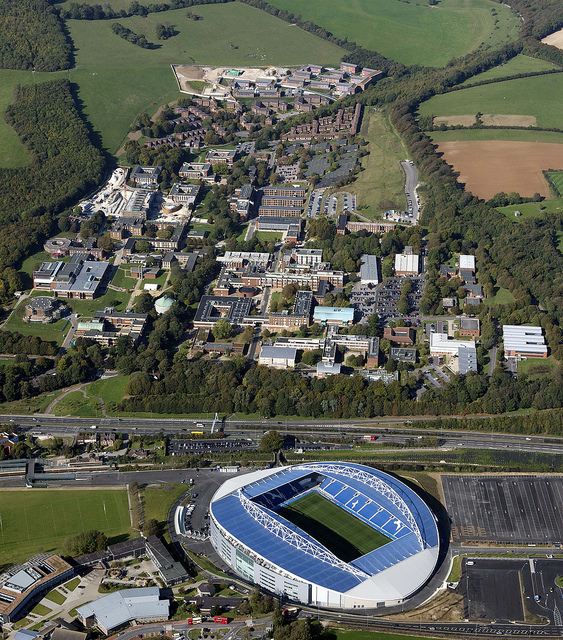
The one complication is that Brighton and Hove Albion are playing at home today (against Hull) and their stadium,as you can see from the map, is right next to the campus, just on the other side of the A27…

campus

However, the match is not until this evening (17.20) so I should be able to get home without too many problems.

A Lab of Honour

Posted in Education, The Universe and Stuff with tags , , on February 5, 2013 by telescoper

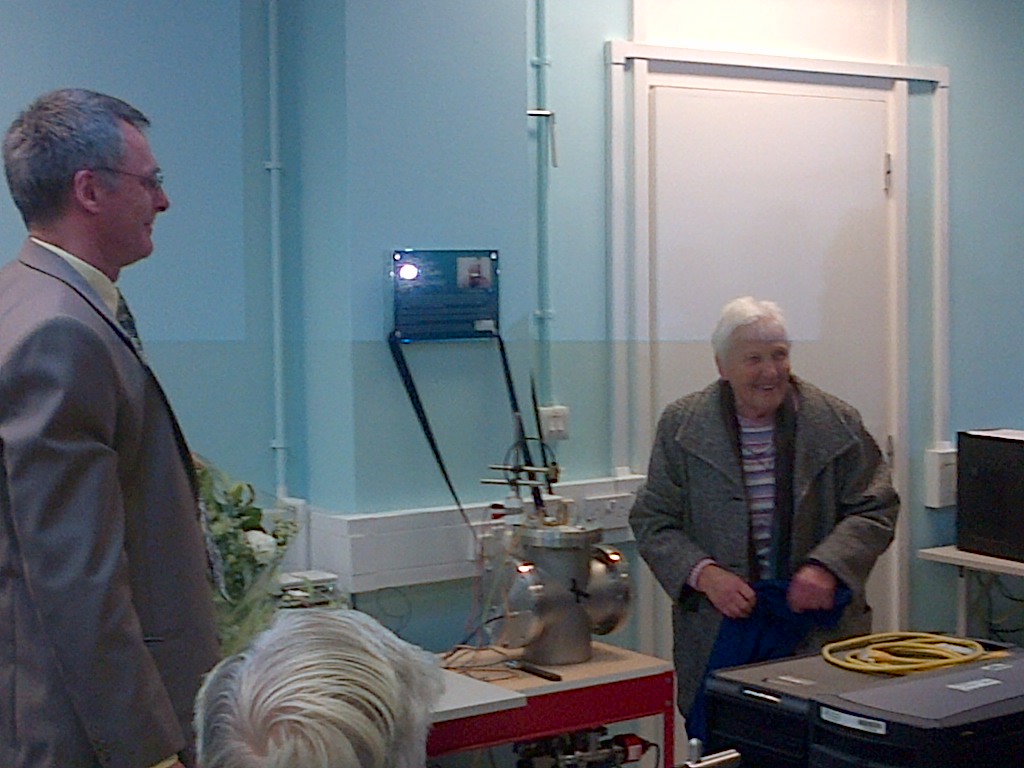
Last Friday, my first day in post here at the University of Sussex, there was a small ceremony to mark the formal opening of a new undergraduate teaching laboratory. Appropriately, it was named after Professor Ken Smith who died last year. Professor Smith was an outstanding experimental physicist who joined the University of Sussex way back in 1960 before the campus had even been built. Over the next three decades, as well as developing a new research activity in which the Department is now world-leading, he made substantial contributions to laboratory teaching in particular. He also played his part in the administration of the Department, serving as the first Chairman of Physics, and then as Dean of the School of Mathematical and Physics Sciences (MAPS) and later as Laboratory Director. Prof. Smith retired in 1988, which was the year I finished my DPhil from the (then) School of Mathematics and Physical Sciences.

IMG-20130201-00049

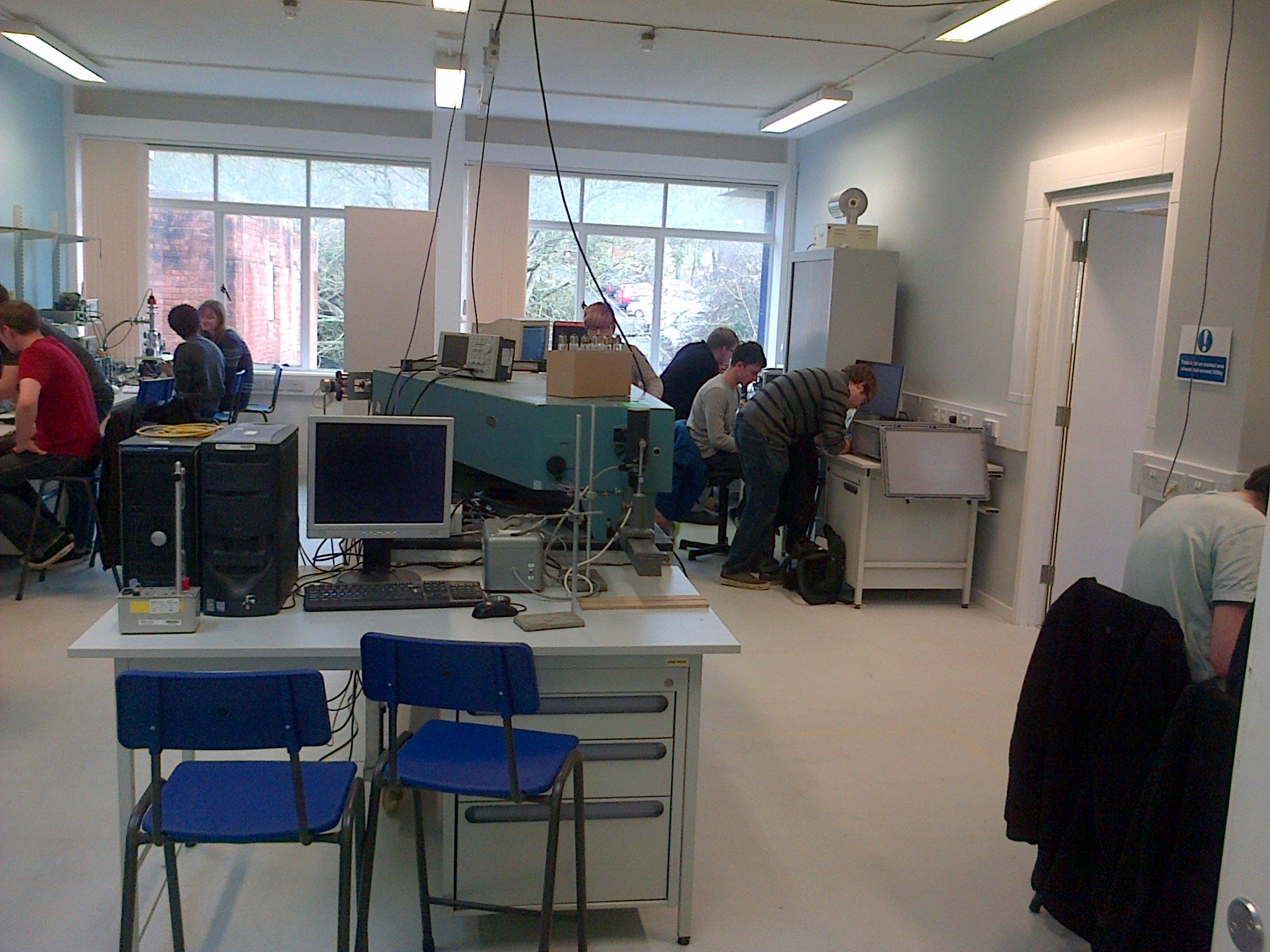
Anyway, it was a pleasant occasion at which Prof. Philip Harris (to the left of the picture), Head of the Department of Physics & Astronomy, spoke of Professor Ken Smith’s many achievements, Ken’s widow Verena unveiled the commemorative plaque, and we all gathered for tea and cakes in the foyer so as not to disturb further the students still hard at work at their experiments…

IMG-20130201-00050

..and hello from Sussex!

Posted in Biographical with tags on February 1, 2013 by telescoper

Well, nearing the end of my first day in my new job at the University of Sussex, I can safely say that I’m more than a bit knackered. I’ve had a day filled with meetings as well as devoid of lunch. On the other hand I did manage to get the keys to my new office and, after some fiddling about, am now connected to the interwebs. They’ve even given me a nice new badge in case I forget who I am.

pic0

I didn’t get to leave Cardiff yesterday until later than I’d imagined I would and then managed to miss the train and had to wait an hour in Cardiff station. In the end I didn’t make it to my temporary lodgings until well after 11. I crashed out and slept like a log, and only just managed to drag myself out of bed to get to the campus in time for the first meeting.

My new office is very nice, although it looks a bit empty at the moment because all my boxes are still in Cardiff awaiting the attentions of hunky removal men. Here’s a picture taken yesterday by Dan Read in my old office…

Pic_2

..having finished packing I was about to add the final touch and clean my whiteboard, but I was persuaded that it’s such a work of art that, far from cleaning it off, I should actually sign it. So I did. No doubt it will be cleaned off soon, if it hasn’t been already.

Anyway, a weekend in Brighton now beckons which I’m going to start by doing down the pub for a pint, which may be the first of many…

I’m appalled

Posted in Biographical, Education with tags , , , , , on January 22, 2013 by telescoper

I was a research student at the University of Sussex from 1985 until 1988, as a result of which I can now put the letters DPhil after my name.  Now I’m gearing up to begin recruiting research students at Sussex when I move there at the end of this month; a list of available projects can be found here, if you’re interested.

However, in the course of this I learned that the University of Sussex has changed the abbreviated form of its postgraduate doctoral degree from DPhil to PhD. Future Susssex researchers will therefore be deprived of the ability to write the letters MADPhil after their name as I do.

The idea that anything in academia should ever actually change sets a dangerous precedent.  What were they thinking of? Everyone knows that PhD just stands for Doctor of Photocopying.

Not to put too fine a point on it, I’m appalled…

Brighton Blog

Posted in Biographical with tags , , , on January 16, 2013 by telescoper

Back to the splendid Cavalaire Hotel after an exhausting day of lectureships interviews, following on from yesterday’s exhausting day of presentations by the candidates and the subsequent (much less exhausting) dinner with the candidates in the Coach House. It’s such a packed schedule because we’re appointing three lecturers at the same time, so have a bigger group of candidates than at a normal recruitment event. I’m going to go out with an old friend for a relaxing pint and a meal later on, but I thought I’d just put up a quick post before I go out into the chilly seaside air.

The first thing I have to say is that I’ve been completely blown away by the quality of the applicants we have to select from. In fact, watching the succession of excellent presentations and participating in today’s interviews made me wonder how I ever managed to get a permanent job at all. It’s a shame we’re going to have to disappoint some of them, as we clearly can’t appoint them all, but fortunately I’m sure they’ll all have other opportunities in the near future. Not that we’ve made any decisions yet. There’s another bunch of interviews tomorrow and then we’ll be locked in a room in Sussex House until we make a decision. It won’t be easy, but it’s a good problem to have: like a football manager having to pick a team from a very strong squad.

Other than that this trip has been a process of gradually rediscovering Brighton. One thing that has changed for the better since I lived here in the late 80s  is the public transport system. The buses from the City Centre to the University Campus at Falmer are very frequent and quite cheap, only £2 for a single full-price and a lot cheaper if you buy a return or have a season ticket. Cardiff’s buses  are expensive and poorly organized in comparison.

One other thing struck me last night as I walked through town to the Coach House for dinner. Large parts of Brighton try very hard to be quite posh. There are many fancy restaurants and upmarket boutiques all over the place. But however hard they try they can’t quite shake off that slightly seedy image that I think Brighton will always possess, and which makes it such a fun place to live. It’s a bit like how a dirty joke is always funnier when it’s told by someone dressed as a vicar.

Three Astronomy Jobs at Sussex – The Deadline Approaches!

Posted in The Universe and Stuff with tags , , , on November 29, 2012 by telescoper

I’m taking the liberty of repeating this advertisement in case anybody out there missed it. Here is an announcement of three (new, permanent) jobs in Astronomy at the University of Sussex. You can also find an advertisment in the November AAS Jobs Register. In fact this is it. The deadline is 30th November, i.e. tomorrow, so if you want to apply then you had better get your skates on!

Full details of the positions are in the above links, but the gist is that applications are invited for 3 permanent, full-time faculty positions within the Astronomy Centre.

The 8 existing faculty have research interests that span the observation, modelling/simulation and theory of extragalactic astronomy and cosmology.  We are seeking talented and ambitious colleagues whose research interests complement and extend our current activity.

I’ll be interested to see how many people apply as a result of seeing this here announcement, so if you do fill in an application form  be sure to answer the question “Where did you see this post advertised” with “In the Dark”!

Value Added?

Posted in Bad Statistics, Education with tags , , , , , on October 22, 2012 by telescoper

Busy busy busy. Only a few minutes for a lunchtime post today. I’ve a feeling I’m going to be writing that rather a lot over the next few weeks. Anyway, I thought I’d use the opportunity to enlist the help of the blogosphere to try to solve a problem for me.

Yesterday I drew attention to the Guardian University league tables for Physics (purely for the purposes of pointing out that excellent departments exist outside the Russell Group). One thing I’ve never understood about these legal tables is the column marked “value added”. Here is the (brief) explanation offered:

The value-added score compares students’ individual degree results with their entry qualifications, to show how effective the teaching is. It is given as a rating out of 10.

If you look at the scores you will find the top department, Oxford, has a score of 6 for “value added”;  in deference to my alma matter, I’ll note that Cambridge doesn’t appear in these tables.  Sussex scores 9 on value-added, while  Cardiff only scores 2. What seems peculiar is that the “typical UCAS scores” for students in these departments are 621, 409 and 420 respectively. To convert these into A-level scores, see here. These should represent the typical entry qualifications of students at the respective institutions.

The point is that Oxford only takes students with very high A-level grades, yet still manages to score a creditable 6/10 on “value added”.  Sussex and Cardiff have very similar scores for entry tariff, significantly lower than Oxford, but differ enormously in “value added” (9 versus 2).

The only interpretation of the latter two points that makes sense to me would be if Sussex turned out many more first-class degrees given its entry qualifications than Cardiff (since their tariff levels are similar, 409 versus 420). But this doesn’t seem to be the case;  the fraction of first-class degrees awarded by Cardiff Physics & Astronomy is broadly in line with the rest of the sector and certainly doesn’t differ by a factor of several compared to Sussex!

These aren’t the only anomalous cases. Elsewhere in the table you can find Exeter and Leeds, which have identical UCAS tariffs (435) but value added scores that differ by a wide margin (9 versus 4, respectively).

And if Oxford only accepts students with the highest A-level scores, how can it score higher on “value added” than a department like Cardiff which takes in many students with lower A-levels and turns at least some of them into first-class graduates? Shouldn’t the Oxford “value added” score be very low indeed, if any Oxford students at all fail to get first class degrees?

I think there’s a rabbit off. Can anyone explain the paradox to me?

Answers on a postcard please. Or, better, through the comments box.

Will University Swapping Work?

Posted in Education with tags , , , , , on October 21, 2012 by telescoper

Yesterday’s crossword having been more straightforward than usual, I found myself with time to peruse the Independent newspaper at my leisure. While doing so I came across a little item describing a plan suggested by Lord Rees that students from “disadvantaged backgrounds” should be allowed to swap universities after two years of a three-year degree and transfer to a Russell group institution. Apparently this idea is based on a scheme that runs “successfully” in the University of California.

The purported aim of this is to give “a second chance” to students who didn’t do well enough at A-level to get into an “elite” university – which is laudable – but it doesn’t deal with the underlying problem, namely that our pre-university education system is a mess, for two reasons.  First, students can have the misfortune to attend a school where certain subjects are taught badly or not at all. This is a particular problem in my own field, physics. Second, the A-level examinations on which most institutions base their entry criteria do not provide a reasonable assessment of a candidate’s suitability for university study.

Because of these problems many students either don’t apply to top universities or fail to make the grades required. Such universities are reluctant to drop their grades to make special allowance because they would then get penalised in the league tables –  a high entry requirement at A-level is perceived to be a mark of quality. I’m convinced that this is a major flaw in the system. Some of the very best students I’ve had the pleasure to work with at Cardiff, for example, came in at a time when our recruitment team was struggling to meet its quota,  with modest A-level scores that would not normally have been high enough to get in. I worry a great deal about how many more talented young people there are out there who lacked that bit of luck and missed out entirely.

Lord Rees is correct in saying that it will take a very long time to fix the pre-university education system, and his proposal is an attempt to provide a sticking-plaster solution later on. If you like, it’s an admission of defeat. Elite universities will be allowed to carry on using inappropriate criteria to reject talented students applying to join the first year of a degree, but will be allowed to cherry-pick the best performers from other institutions into Year 3.

Although I think this proposal contains some good ingredients, there are several things about it that worry me. I don’t know how many students will want to move after two years in the first place. They will have made friends, formed relationships, and generally settled in at their original university and to up sticks in order to travel to another university for their final year would be very disruptive. Steps would have to be taken to ensure continuity of curriculum too. And what about the financial and other implications for the original institution, which would have to be prepared to lose an indeterminate number of its best students at the end of Year 2, with consequent impact on the quality of its graduating class?

I don’t think it’s fair for the so-called “elite” to exploit the hard work put in by other departments and institutions in order to mask its own failure to recruit appropriately. The only fair solution is to fix the university admission system, which means fixing our  broken A-levels.

And another thing. I’m shortly moving from Cardiff (which is a member of the Russell group) to Sussex (which isn’t).  Look at the league tables for Physics and tell me which one should be regarded as “elite”. Should students choose their University on the basis of which one provides the best education, or on the basis that it provides membership of a prestigious club?

On balance, I don’t think this scheme is workable in the way suggested. There is a variant, however, which I think is more promising. I think we should scrap the current confused system of 4-year undergraduate degrees (MPhys, MSci, etc) and adopt a standard system of 3-year Bachelors degrees. The next level of degree should be standalone postgraduate Masters. I’d prefer these to be two years, actually, but that’s not essential to this argument. Students could then transfer after their Bachelors’ degree into an “elite” university for their Masters if they so wish.

A Particle Physics Job at Sussex

Posted in The Universe and Stuff with tags , on October 19, 2012 by telescoper

Following hard on the heels of Tuesday’s news, and the subsequent advert for astronomy jobshere is an announcement of a permanent job in theoretical particle physics at the University of Sussex. I quote from the advertisement:

Candidates are expected to hold a doctorate in theoretical physics and have a strong track record of internationally recognised research in the areas of collider phenomenology, physics beyond the Standard Model, flavour physics, and/or precision tests. The successful applicant will be expected to teach at both the undergraduate and postgraduate level.

Sussex has in recent years invested in SM and BSM phenomenology through faculty appointments both in theoretical and experimental physics. We seek an individual suited and committed to further strengthening and developing this effort.

The group’s wider research interests include model-building, quantum field theory, quantum gravity, and early universe cosmology. It benefits from a close relationship with the Sussex Experimental Particle Physics group, currently expanding its ATLAS effort, an STFC-funded research consortium with Royal Holloway, University of London, and membership of the NExT Institute. The University of Sussex is part of the South East Physics Network (SEPnet).

I’ll be interested to see how many people apply as a result of seeing this here announcement, so if you do fill in an application form  be sure to answer the question “Where did you see this post advertised” with “In the Dark”!