Not long ago I posted a short item about the physics of vortex rings. More recently I stumbled across this video that shows how University of Chicago physicists have succeeded in creating a vortex knot—a feat akin to tying a smoke ring into a knot. Linked and knotted vortex loops have existed in theory for more than a century, but creating them in the laboratory had previously eluded scientists. I stole that bit shamelessly from the blurb on Youtube, by the way. I’m not sure whether knotting a vortex tube has any practical applications, but then I don’t really care much about that because it’s fun!
Follow @telescoperArchive for Vortex Rings
How to make a knotted vortex ring
Posted in The Universe and Stuff with tags Knots, Physics, Topology, University of Chicago, Vortex Rings on May 15, 2013 by telescoperFun with Vortex Rings
Posted in Education, The Universe and Stuff with tags Fluid Dynamics, magnetism, Vortex Rings on November 5, 2012 by telescoperI decided to squeeze in a little bit about vortex rings into this morning’s lecture, partly because they illustrate the connections between fluid vorticity and magnetism, and partly because they’re fun…
Here’s an animation of a vortex ring showing how the fluid elements move around it (you might need to click on it to make it animate):
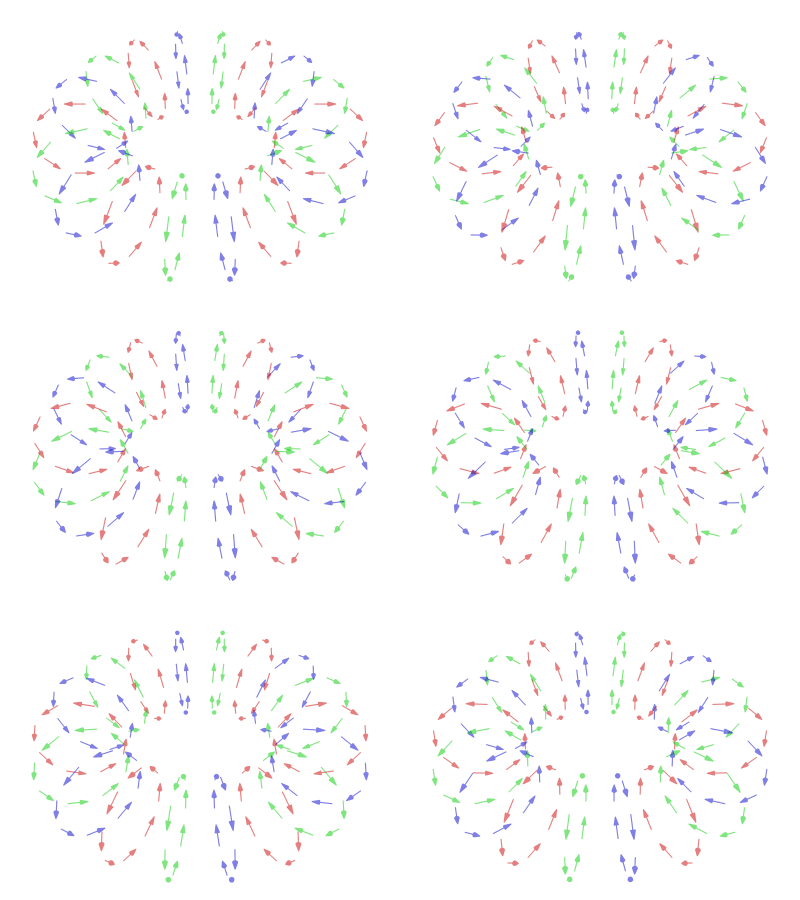
It’s quite easy to generate vortex rings in everyday situations, the simplest way being when a mass of fluid is impulsively pushed from an enclosed space through a narrow opening. In this case the poloidal flow is set in motion, at least in part, by interaction between the outer parts of the fluid mass and the edges of the opening. This results in fluid elements travelling in little circles, like those above, around a “core”; the direction of the vorticity is at right angles to these circles, i.e. in the toroidal direction. A vortex line can be formed from by joining together the vorticity vectors from each little circle to form a circle defining the core of the vortex ring. The behaviour of vortex lines in flows like this is entirely analogous to that of magnetic field lines. In this case, the vortex line follows the motion of the fluid, which is at right angles to it, so it propagates more-or-less without disruption. This is how most vortex ring toys work, such as shown in the two examples here; the second is far more dramatic!
The last video features some naturally-occurring vortex rings (as well as some distinctly man-made examples). What I didn’t realise until I found this video last night is that whales and dolphins know how to make vortex rings too, only underwater. Why do they do this? Is there an evolutionary explanation? I doubt it! I think they’re just having fun.
Follow @telescoper

 In the Dark