

I’m no longer in the part of not-Barcelona known as Sligo (which is Sligeach in Irish) but here are some random pictures and a random video clip I took while I was there.
Archive for W.B. Yeats
About Sligo
Posted in Biographical with tags Benbulbin, ireland, Sligeach, Sligo, W.B. Yeats, William Butler Yeats on May 2, 2024 by telescoperNo Second Troy, by W.B. Yeats
Posted in Poetry with tags No Second Troy, W.B. Yeats, William Butler Yeats on July 27, 2023 by telescoperWhy should I blame her that she filled my days
With misery, or that she would of late
Have taught to ignorant men most violent ways,
Or hurled the little streets upon the great,
Had they but courage equal to desire?
What could have made her peaceful with a mind
That nobleness made simple as a fire,
With beauty like a tightened bow, a kind
That is not natural in an age like this,
Being high and solitary and most stern?
Why, what could she have done, being what she is?
Was there another Troy for her to burn?
by William Butler Yeats (1865-1939)
Nine Modern Poets
Posted in Biographical, Education, Literature with tags Dylan Thomas, E.L. Black, John Betjeman, Nine Modern Poets, Philip Larkin, Poetry, R.S. Thomas, T.S. Eliot, Ted Hughes, W.B. Yeats, W.H. Auden, Wilfred Owen on April 5, 2023 by telescoper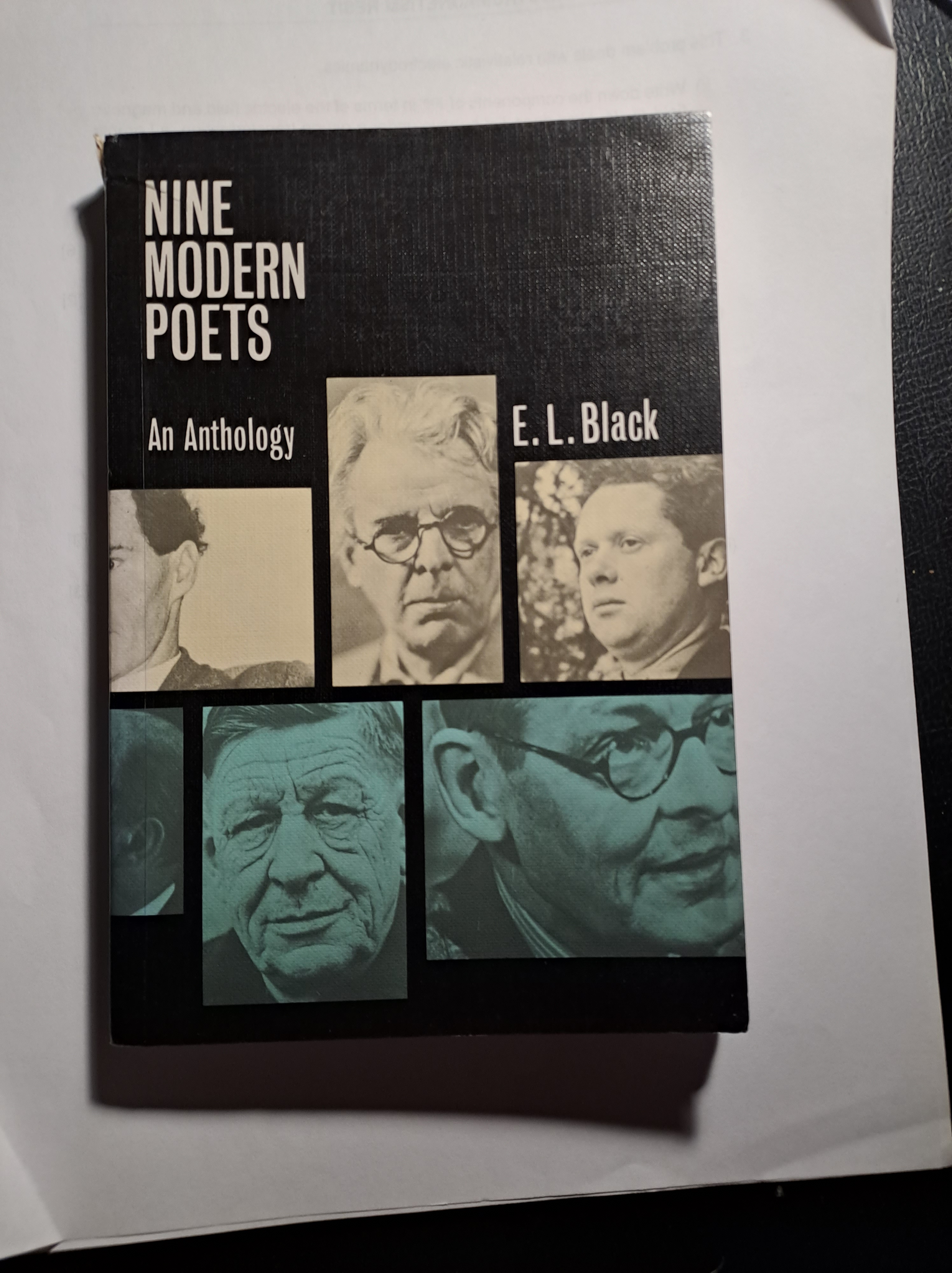
I recently acquired – at negligible expense – the above second-hand copy of the anthology Nine Modern Poets. I got a copy because this book was one we we studied when I was at school back in the 1970s. The First Edition was published way back in 1966, and it was reprinted until the mid-1980s but has long been superseded as a school poetry text by other anthologies. It has been out of print for many years so I had to find a second-hand copy via the internet. I bought some other second-hand anthologies too, which I may share in due course.
Anyway, the Nine Modern Poets are: W.B. Yeats, Wilfred Owen, T.S Eliot, John Betjeman, W.H. Auden, R.S. Thomas, Dylan Thomas, Philip Larkin, and Ted Hughes. Yes, they are all male.
Looking back it’s surprising to see John Betjeman in there, I’d have swapped him for Sylvia Plath (though her first collection, Colossus was only published in 1960 and the second, Ariel, in 1965 so these might have been too late), but the reason I look back on this book with some fondness, indeed nostalgia, is that it was this collection that introduced me to the poetry of R.S. Thomas, and I am very grateful to it for that.
The Song of Wandering Aengus
Posted in Poetry with tags The Song of Wandering Aengus, W.B. Yeats, William Butler Yeats on July 2, 2022 by telescoperI went out to the hazel wood,
Because a fire was in my head,
And cut and peeled a hazel wand,
And hooked a berry to a thread;
And when white moths were on the wing,
And moth-like stars were flickering out,
I dropped the berry in a stream
And caught a little silver trout.
When I had laid it on the floor
I went to blow the fire a-flame,
But something rustled on the floor,
And someone called me by my name:
It had become a glimmering girl
With apple blossom in her hair
Who called me by my name and ran
And faded through the brightening air.
Though I am old with wandering
Through hollow lands and hilly lands,
I will find out where she has gone,
And kiss her lips and take her hands;
And walk among long dappled grass,
And pluck till time and times are done,
The silver apples of the moon,
The golden apples of the sun.
by William Butler Yeats (1865-1939)
The Second Coming
Posted in Poetry with tags Poetry, The Second Coming, W.B. Yeats, William Butler Years on April 19, 2019 by telescoperTurning and turning in the widening gyre
The falcon cannot hear the falconer;
Things fall apart; the centre cannot hold;
Mere anarchy is loosed upon the world,
The blood-dimmed tide is loosed, and everywhere
The ceremony of innocence is drowned;
The best lack all conviction, while the worst
Are full of passionate intensity.
Surely some revelation is at hand;
Surely the Second Coming is at hand.
The Second Coming! Hardly are those words out
When a vast image out of Spiritus Mundi
Troubles my sight: somewhere in sands of the desert
A shape with lion body and the head of a man,
A gaze blank and pitiless as the sun,
Is moving its slow thighs, while all about it
Reel shadows of the indignant desert birds.
The darkness drops again; but now I know
That twenty centuries of stony sleep
Were vexed to nightmare by a rocking cradle,
And what rough beast, its hour come round at last,
Slouches towards Bethlehem to be born?
by William Butler Yeats (1865-1939): this poem was written in 1919.
The Stare’s Nest
Posted in Poetry with tags Meditations in Time of Civil War, Poetry, The Stare's Nest, W.B. Yeats, William Butler Yeats on November 28, 2017 by telescoperThe bees build in the crevices
Of loosening masonry, and there
The mother birds bring grubs and flies.
My wall is loosening; honey-bees,
Come build in the empty house of the stare.
We are closed in, and the key is turned
On our uncertainty; somewhere
A man is killed, or a house burned,
Yet no cleat fact to be discerned:
Come build in he empty house of the stare.
A barricade of stone or of wood;
Some fourteen days of civil war;
Last night they trundled down the road
That dead young soldier in his blood:
Come build in the empty house of the stare.
We had fed the heart on fantasies,
The heart’s grown brutal from the fare;
More Substance in our enmities
Than in our love; O honey-bees,
Come build in the empty house of the stare.
by William Butler Yeats (1865-1939)
Sailing to Byzantium
Posted in Poetry with tags Artifice of eternity, Sailing to Byzantium, W.B. Yeats, William Butler Yeats on June 7, 2015 by telescoper I
That is no country for old men. The young
In one another’s arms, birds in the trees
—Those dying generations—at their song,
The salmon-falls, the mackerel-crowded seas,
Fish, flesh, or fowl commend all summer long
Whatever is begotten, born, and dies.
Caught in that sensual music all neglect
Monuments of unaging intellect.
II
An aged man is but a paltry thing,
A tattered coat upon a stick, unless
Soul clap its hands and sing, and louder sing
For every tatter in its mortal dress,
Nor is there singing school but studying
Monuments of its own magnificence;
And therefore I have sailed the seas and come
To the holy city of Byzantium.
III
O sages standing in God’s holy fire
As in the gold mosaic of a wall,
Come from the holy fire, perne in a gyre,
And be the singing-masters of my soul.
Consume my heart away; sick with desire
And fastened to a dying animal
It knows not what it is; and gather me
Into the artifice of eternity.
IV
Once out of nature I shall never take
My bodily form from any natural thing,
But such a form as Grecian goldsmiths make
Of hammered gold and gold enamelling
To keep a drowsy Emperor awake;
Or set upon a golden bough to sing
To lords and ladies of Byzantium
Of what is past, or passing, or to come.
by William Butler Yeats (1865-1939)
When you are old
Posted in Poetry with tags W.B. Yeats, When you are old on October 6, 2012 by telescoperWhen you are old and grey and full of sleep,
And nodding by the fire, take down this book,
And slowly read, and dream of the soft look
Your eyes had once, and of their shadows deep;
How many loved your moments of glad grace,
And loved your beauty with love false or true,
But one man loved the pilgrim soul in you,
And loved the sorrows of your changing face;
And bending down beside the glowing bars,
Murmur, a little sadly, how Love fled
And paced upon the mountains overhead
And hid his face amid a crowd of stars.
by William Butler Yeats (1865-1939)
Aedh wishes for the cloths of heaven
Posted in Poetry with tags Aedh wishes for the cloths of heaven, astronomy, He wishes for the cloths of heaven, W.B. Yeats, William Butler Yeats on June 15, 2012 by telescoperHad I the heavens’ embroidered cloths,
Enwrought with golden and silver light,
The blue and the dim and the dark cloths
Of night and light and the half light,
I would spread the cloths under your feet:
But I, being poor, have only my dreams;
I have spread my dreams under your feet;
Tread softly because you tread on my dreams.
by W.B. Yeats (1865-1939)
The Song of the Happy Shepherd
Posted in Poetry with tags astronomy, The Song of the Happy Shepherd, W.B. Yeats, William Butler Yeats on June 5, 2012 by telescoperA blog post yesterday by Andy Lawrence put the word Arcady into my head, and thus reminded me of this poem by William Butler Yeats, known to his friends as W.B. I’ve actually quoted a bit of this poem before, but now seem to have excuse to post the whole thing; I’ve highlighted the section that reveals Yeats’ opinion of observational astronomers…
The woods of Arcady are dead,
And over is their antique joy;
Of old the world on dreaming fed;
Grey Truth is now her painted toy;
Yet still she turns her restless head:
But O, sick children of the world,
Of all the many changing things
In dreary dancing past us whirled,
To the cracked tune that Chronos sings,
Words alone are certain good.
Where are now the warring kings,
Word be-mockers? – By the Rood,
Where are now the warring kings?
An idle word is now their glory,
By the stammering schoolboy said,
Reading some entangled story:
The kings of the old time are dead;
The wandering earth herself may be
Only a sudden flaming word,
In clanging space a moment heard,
Troubling the endless reverie.
Then nowise worship dusty deeds,
Nor seek, for this is also sooth,
To hunger fiercely after truth,
Lest all thy toiling only breeds
New dreams, new dreams; there is no truth
Saving in thine own heart. Seek, then,
No learning from the starry men,
Who follow with the optic glass
The whirling ways of stars that pass –
Seek, then, for this is also sooth,
No word of theirs – the cold star-bane
Has cloven and rent their hearts in twain,
And dead is all their human truth.
Go gather by the humming sea
Some twisted, echo-harbouring shell.
And to its lips thy story tell,
And they thy comforters will be.
Rewording in melodious guile
Thy fretful words a little while,
Till they shall singing fade in ruth
And die a pearly brotherhood;
For words alone are certain good:
Sing, then, for this is also sooth.
I must be gone: there is a grave
Where daffodil and lily wave,
And I would please the hapless faun,
Buried under the sleepy ground,
With mirthful songs before the dawn.
His shouting days with mirth were crowned;
And still I dream he treads the lawn,
Walking ghostly in the dew,
Pierced by my glad singing through,
My songs of old earth’s dreamy youth:
But ah! she dreams not now; dream thou!
For fair are poppies on the brow:
Dream, dream, for this is also sooth.

 In the Dark