I haven’t had any guest posts for a while, so I was happy to respond to an offer from Tom Kitching to do one about the GREAT10 challenge. I’ve been working a bit on weak gravitational lensing myself recently – or rather my excellent and industrious postdoc Dipak Munshi has, and I’ve been struggling to keep up! Anyway, here’s Tom’s contribution…
–0–
This guest post is about the the GREAT10 challenge, which was launched this week, I’ll briefly explain why this is important for cosmology, what the GREAT10 challenge is, and how you can take part. For more information please visit the website, or read the GREAT10 Handbook.
GREAT10 is focussed on weak gravitational lensing. This is an effect that distorts the shape of every galaxy we see, introducing a very small additional ellipticity to galaxy images. Weak lensing is a interesting cosmological probe because it can be used to measure both the rate of growth of structure and the geometry of the Universe. This enables extremely precise determinations of dark energy, dark matter and modified gravity. We can either use it to make maps of the dark matter distribution or to generate statistics, such as correlation functions, that depend sensitively on cosmological parameters.
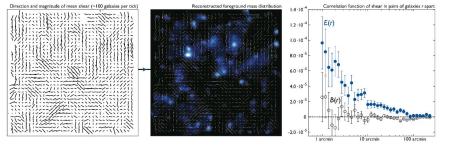
As shown in the Figure (click it for a higher-resolution version), the weak lensing effect varies as a function of position (left; taken from Massey et al. 2007), which can be used to map dark matter (centre) or the correlation function of the shear can be constructed (right; taken from Fu et al. 2008).
However, the additional ellipticity induced by weak lensing generates only about a 1% change in the surface brightness profile for any galaxy, far too small to been seen by eye, so we need to extract this “shear” signal using software and analyse its effect statistically over many millions of galaxies. To make things more complicated, images contain noise, and are blurred by a PSF (or convolution kernel) caused by atmospheric turbulence and telescope effects.
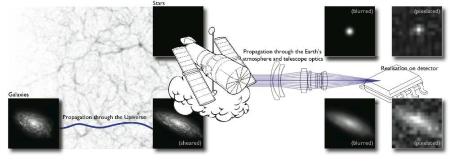
So the image of a galaxy is sheared by the large scale structure, then blurred by the PSF of the atmosphere and telescope, and finally distorted further by being represented by pixels in a camera. Star images are not sheared, but are blurred by the PSF. The challenge is to measure the shear effect (which is small) in the presence of all these other complications.
GREAT10 provides an environment in which algorithms and methods for measuring the shear, and dealing with the PSF, can be developed. GREAT10 is a public challenge, and we encourage everyone to take part, in particular we encourage new ideas from different areas of astronomy, computer science and industry. The challenge contains two aspects :
- The Star Challenge : Is to the reconstruct the Point Spread Function, or convolution kernel, in astronomical images, which occurs because of the slight blurring effects of the telescope and atmosphere. The PSF varies across each image and is only sparsely sampled by stars, which are pixelated and noisy. The challenge is to reconstruct the PSF at non-star positions.
- The Galaxy Challenge : Is to measure the shapes of galaxies to reconstruct the gravitational lensing signal in the presence of noise and a known Point Spread Function. The signal is a very small change in the galaxies’ ellipticity, an exactly circular galaxy image would be changed into an ellipse; however real galaxies are not circular. The challenge is to measure this effect over 52 million galaxies.
The challenges are run as a competition, and will run for 9 months. The prize for the winner is a trip to the final meeting at JPL, Pasadena, and an iPad or similar (sorry Peter! I know you don’t like Apple), but of course the real prize is the knowledge that you will have helped in creating the tools that will enable us to decipher the puzzle of understanding our Universe.
For more discussion on GREAT10 see MSNBC, WIRED and NASA.
–0–
EDITOR’S NOTE: I assume that second prize is two iPads…




 In the Dark