Archive for Welsh National Opera

WNO Peter Grimes

Posted in Cardiff, Opera with tags , , , , , , on April 6, 2025 by telescoper

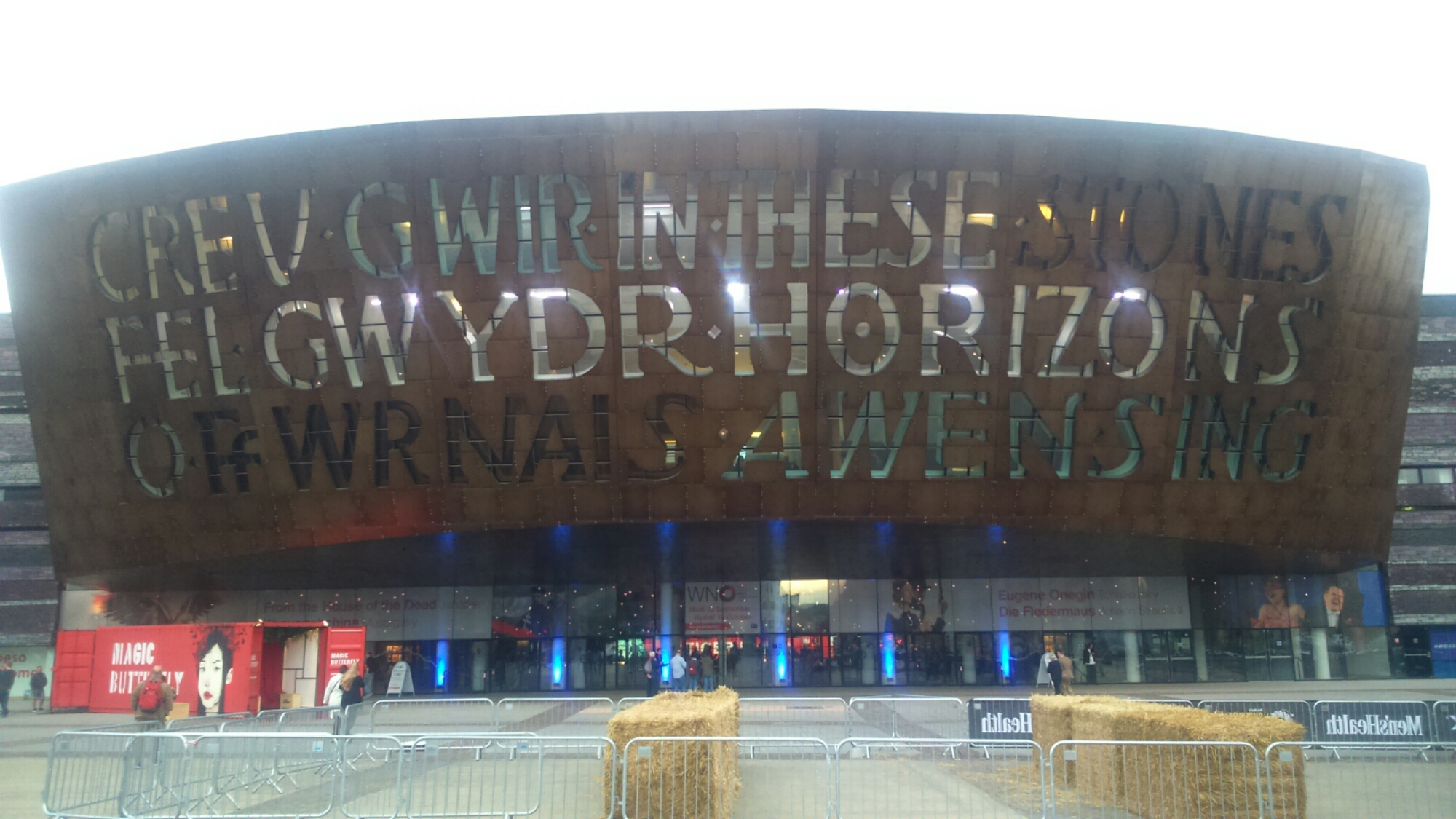
The reason for my flying visit to Cardiff this weekend was to visit the Wales Millennium Centre to catch the opening night of Welsh National Opera’s new production of the Opera Peter Grimes by Benjamin Britten. It was a full house and, being a premiere, there was a fair sprinkling of media types among the crowd. There will no doubt be many reviews but I don’t mind adding to the verbage. I’ve seen this Opera several times and it is one of my favourites in the entire repertoire.
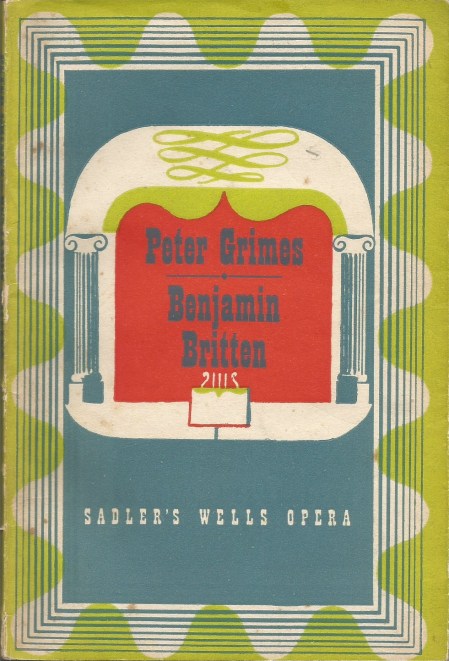
Peter Grimes premiered at Sadler’s Wells in London on 7th June 1945 almost 80 years ago. I wasn’t there – I’m not that old – but I do have an original programme from that season (left), bought in a second-hand bookshop. Perhaps surprisingly, given the grim subject matter and the intense music it was an immediate hit with audiences. Its popularity has not wained. Welsh National Opera gave its first performance in 1946, but is currently facing an uncertain future.

I’ve often heard Peter Grimes described as one of the greatest operas written in English. Well, as far as I’m concerned you can drop “written in English” from that sentence and it’s still true. I think it it’s a masterpiece, fit to rank alongside any by any composer. Searching through the back catalogue on this blog, however, I didn’t find any reviews of it, so the times I’ve seen it must have been before I started blogging back in 2008. I saw an excellent production by Opera North in Nottingham many moons ago, and also remember one at Covent Garden which stuck in my memory for its impressive staging.

Based on a character from the narrative poem The Borough by George Crabbe, the story revolves around the eponymous Peter Grimes, a fisherman, and the inhabitants of a small coastal village in Suffolk. Grimes is by no means a sympathetic character: he is an outcast with no social skills and is prone to fits of violent temper. The Opera begins witha Prologue in which Grimes is in court after the death of his apprentice; he is acquitted of any wrongdoing but the folk of the Borough – apart from the schoolteacher Ellen Orford and retired naval Captain Balstrode – still regard him as guilty. Against all advice, Grimes takes on another apprentice (John) whom he is subsequently suspected of mistreating. When the second boy dies (in accidental circumstances), Grimes flees with the crowd in pursuit. At the end he is given no choice but to take to his boat, sail it out to sea and sink it, taking his own life.

For me the key to the success of this Opera is its treatment of the character of Peter Grimes. In the original poem, Crabbe depicts Grimes is a monstrous figure rather like a pantomime villain. Britten is much more sympathetic: Grimes is misunderstood, a misft who as never been socialised; he just doesn’t know the rules that he should conform to. That’s his tragedy. Britten’s Grimes is not a villain. He’s not a hero either. At one point, shockingly, he even lashes out at Ellen Orford a lady who has shown him nothing but kindness. There’s good and bad in Grimes, like there is in all people. Who of us can say that we don’t share some of the faults of Peter Grimes? And if he’s bad what made him bad? Was he himself abused as a child? Could a little kindness along the way have made him better adjusted?

The Opera not just about Grimes, though. We get a vivid insight into the life of an isolated seaside community: the gossiping hypocrisy of the “good people” of the Borough, the debauchery of the landlady and her two “nieces” who cater to the needs of their male visitors, but above all the importance of the sea in their lives – stressed by Britten’s wonderful interludes describing dawn over the town, moonlight over the sea, and a raging storm. It also sheds light on the common practice of “buying” apprentices from the workhouse, essentially a means of slave labour, a systematic abuse far worse than anything Grimes ever does!

Anyway, to last night’s performance. In short, it was magnificent. The cast was very strong indeed: Nicky Spence shone in the role of Peter Grimes (tenor). Britten wrote the part to suit the characteristics of the voice of his partner, Peter Pears, and it doesn’t suit all tenor voices: the superb arioso When the Great Bear and Pleiades, for example, has dizzying head tones that challenges some singers. Ellen Orford was the excellent Sally Matthews (soprano) and Balstrode was the admirable baritone David Kempster.

I’ll mention three particularly memorable moments, near the end of the opera. The first is after the apprentice John has died; the gorgeous sea interlude Moonlight, which serves as a prelude to the third and final act, is played while the grieving Grimes cradles the lifeless corpse of the boy. The second is when Grimes is on the run, with the chorus calling his name and baying for blood. In fear of his life, he breaks down and is reduced to repeating his own name to himself. I’ve always found that scene unbearably moving and it was that way again last night. Finally, at the very end, the bodies of the two dead apprentices appear, one sprawled on a rock, the other standing eerily in the suspended boat which is tipped up vertically above the stage. When Grimes accepts Balstrode’s advice to drown himself, the two boys come to life; they exchange smiles, hold hands and walk off into the distance. It’s the only time Grimes looks happy in the whole performance. Only in death can he find his peace.

The staging is very spare but cleverly done. The basic set consists of a wet beach sloping up towards the rear above which from time to time a small fishing boat appears, suspended by wires, in a variety of attitudes. Otherwise there is little in the way of scenery. The clever part of this is the use of the dancers of Dance Ensemble Dawns. All the boys’ roles were in fact played by female dancers, including John the second apprentice, a non-speaking role played with great pathos by Maya Marsh whose use of body language was extraordinarily effective. Not only did they portray the boys of the village, often to be found generally misbehaving and taunting Peter Grimes, they also use their movements do evoke the storm in an extraordinarily compelling way. Not content with that they came on from time to time, in stylised fashion, to move scenery and props. The inn, for example, is conjured up by two simple props: a door frame and a window frame, held up by members of the ensemble for other members of the cast to walk or lean through. In all these contributions, the dancers were brilliant.

The simplicity of the staging probably reflects the financial crisis currently engulfing Welsh National Opera. They probably just didn’t have the money to pay for a elaborate sets, but it’s a testament to the skill and creativity of the designers that they were able to pull a triumph out of a financial disaster. I was sitting in the Circle so could see very well into the orchestra pit, where all the musicians of the Orchestra of Welsh National Opera were all wearing “SAVE OUR WNO” t-shirts. They played their hearts out. The WNO Chorus has always been excellent every time I’ve seen them, and last night was no exception.
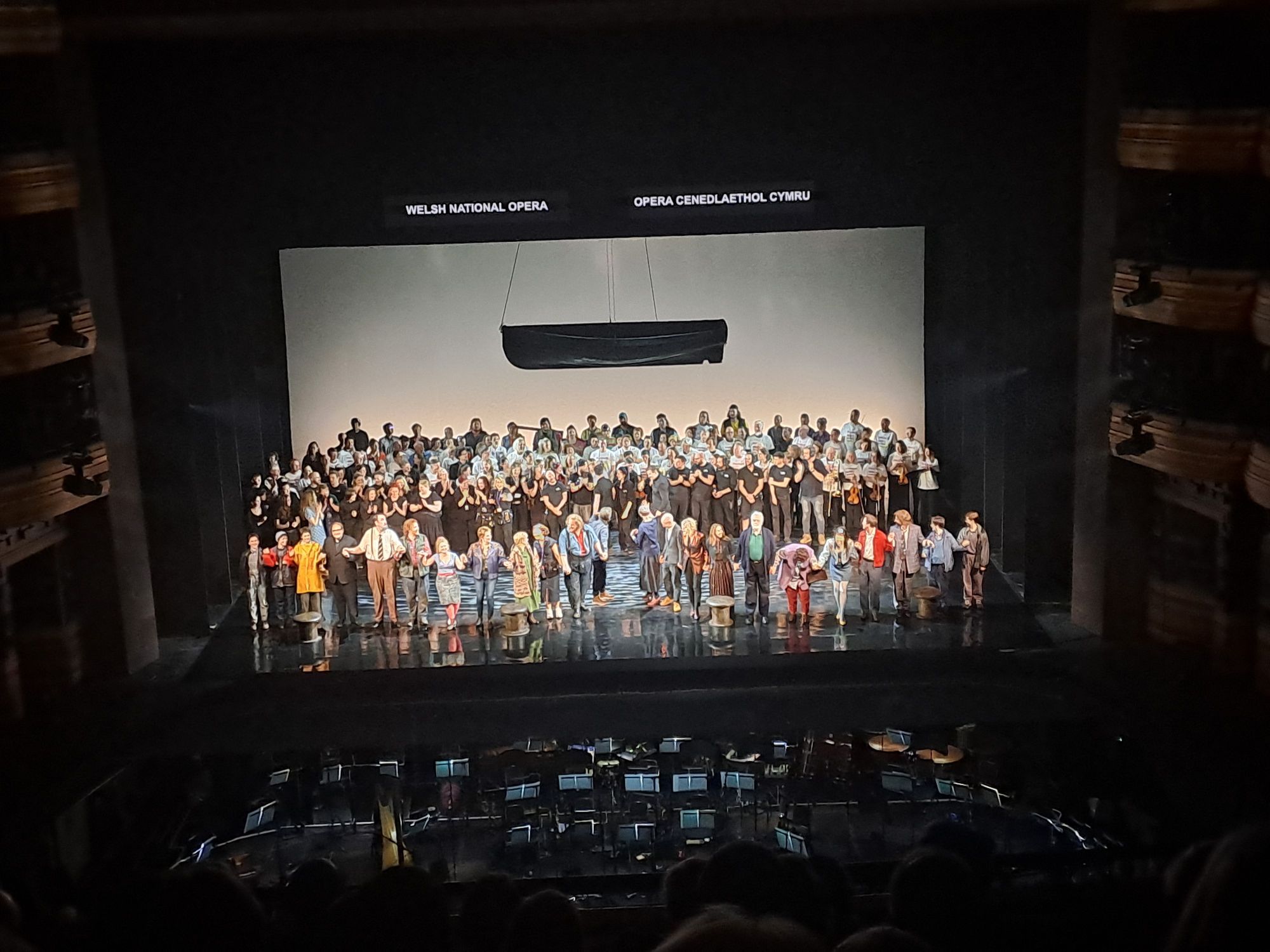
At the end of the opera, the cast, chorus and dancers were joined on stage not only by the entire orchestra (including instruments, where possible) and many members of the technical team. I’ve never seen that happen before! There were speeches by the co-directors of WNO expressing their determination to carry on through the financial turbulence that threatens to drown them. Welsh National Opera is a wonderful part of the artistic and cultural scene not only in Wales but across the rest of the UK and beyond. It just cannot be allowed to wither.

P.S. Last night’s performance was recorded for later broadcast on BBC Radio 3.

WNO Tosca

Posted in Opera with tags , , , , on February 12, 2018 by telescoper

My current schedule takes me back and forth across the Irish Sea, making it a bit of challenge to take in as many musical events as I’d like to, but I did manage to get to see yesterday’s performance of Tosca at Welsh National Opera. I don’t usually go for afternoon performances, but this was basically my option. Not surprisingly there was a packed house in the Wales Millennium Centre for a tale of jealousy and murder set to gorgeous music by Giacomo Puccini.

Tosca is an opera in three acts (which means two intervals wine breaks…). It’s a melodrama, and is set in Rome in 1800. Each act takes place in a very specific location within the Eternal City. Act I is in the Church of  Sant’Andrea della Valle, Act II in the Palazzo Farnese, and the final denouement of Act III takes place among the battlements at the top of the Castel Sant’ Angelo overlooking the Tiber. The setting is so specific to time and place that it resists being monkeyed about with, done in modern dress, staged in a chip shop or whatever. Thankfully, Michael Blakemore’s production (of which this is a revival) is very firmly of the period and location required. As a longstanding opera bore, I have to admit that I have been on a Tosca pilgrimage and have visited all three locations in Rome. The scenery used in last night’s performance isn’t exactly as the real locations but it definitely evokes them very well.

Floria Tosca (Claire Rutter) is a celebrated opera singer who is in love with an artist (and political radical) by the name of Mario Cavaradossi (Hector Sandoval), who helps to hide an escaped political prisoner while working on a painting in Act I. The odious Baron Scarpia (Mark Doss), Chief of Police, comes looking for the convict and decides to catch Tosca and Cavaradossi too. He lusts after Tosca and hates Cavaradossi. In Act II, we find Scarpia at home eating dinner for one while Cavaradossi is being tortured in order to find out the location of the escapee. Tosca turns up to plead for his life, but she hasn’t bargained with the true depths of Scarpia’s depravity. He wants to have his way with her, and to put pressure on he lets her listen to the sound of her lover being tortured. She finally consents, in return for Scarpia’s promise to let Cavaradossi go and grant free passage to the two of them. This he seems to do, but while she is waiting for him to write the letter of conduct she sees a knife. Instead of letting Scarpia defile her, she grabs it and stabs him to death. Act III begins with Cavaradossi facing execution, sure he is about to die. Tosca is convinced that this is just a charade and that Scarpia ordered them to pretend to shoot Cavaradossi so he wouldn’t look like he was being merciful, which would be out of character. The firing squad fire and Cavaradossi falls. But it was no fake. He is dead. Tosca is distraught and bewildered. Shouts offstage reveal that the police have found Scarpia’s body and that Tosca must have murdered him. To avoid capture she hurls herself from the battlements. Her last words are “O Scarpia, avanti a Dio!” – “I’ll meet you before God, Scarpia”.

Hector Sandoval (Cavaradossi) and Claire Rutter (Tosca). Picture credit: WNO.

The opera wasn’t particularly well received when it was first performed in 1900, being famously described by one critic as “a shabby little shocker”, but it has become a firm favourite with audiences around the world and is now acknowledged as a masterpiece of music drama. So how did Puccini manage to transform a penny-dreadful plot into a great work of art? I don’t think it’s hard to see why it works so well.

First and foremost, there’s the music, which  is wonderful throughout, but it is always plays an essential part in keeping everything moving. Of course there are the great arias: Vissi d’arte, Vissi d’amore sung by Tosca in Act II and E Lucevan le Stelle from Act III, sung by Cavaradossi; but even apart from those tremendous set-pieces, Puccini uses the music to draw out the psychology of the characters and underline the drama. Although not usually associated with the use of leitmotifs, Puccini deploys them throughout: Scarpia’s arrival is announced with a suitably menacing theme that recurs whenever he is present or even just referred to.  This theme is actually the first thing we hear as the Opera starts. It also plays Scarpia out at the end of Act 1 when he sings his magnificently chilling Va Tosca over a setting of the Te Deum. Time does stand still for Tosca’s great Act II aria, the dramatic fulcrum of the Opera, but that just emphasises the pace of the rest of the piece. This is a work with no spare flesh or padding anywhere, and a perfect interplay between music and action. The moment when Tosca sees the knife with which she will kill Scarpia is signalled by the orchestra.

And that leads to the second point. Each of the three principals could have been very two-dimensional: Cavaradossi the good guy.; Scarpia the bad guy; Tosca the love interest. But all the characters have real credibility and depth. Cavaradossi is brave and generous, but he succumbs to despair before his death. No superhero this, just a man. Scarpia is a nasty piece of work all right, but at times he is pathetic and vulnerable. He is monstrous, but one is left with the impression that something made him monstrous. And then there’s Tosca, proud and jealous, loving but at the same time capable of violence and spite. It is a truly shocking moment when she kills Scarpia. In this production, she doesn’t just stab him once: she chases him around the room repeatedly plunging the knife into him, then stands over him  as he begs for help. There’s no attempt to sanitise the violence of his death. It’s all so real. I guess that’s why this type of opera is called Verismo!

Top marks for the Orchestra of Welsh National Opera, under the direction of Carlo Rizzi, who did full justice to Puccini’s magnificent score. Claire Rutter has a fine voice for the role, and I thought Hector Sandoval sang and acted wonderfully. The big numbers in Tosca are quite familiar, but they still sounded fresh and were performed with great feeling. Best of all, Mark Doss has a dark baritone voice that gave Scarpia a tremendous sense of power and danger. He even got a few pantomime boos at the end.


A Good Day

Posted in Beards, Biographical, Football with tags , , , , , , on February 11, 2018 by telescoper

It’s been a good day. First of all I was officially presented with the Beard of Winter 2018 Award by the inestimable Keith Flett (right):

The picture was taken (by Megan Davies) outside The Small Bar in Cardiff after a celebratory tipple.

After that it was down to Cardiff Bay, where the Wales Millennium Centre was resplendent in the winter sunshine for an excellent afternoon performance of Tosca (which I’ll review more fully tomorrow):

And if that wasn’t enough, I emerged from the Opera to find that Newcastle Utd had beaten Manchester Utd in the Premiership, a game I had expected them to lose…

So yes, it’s been a good day..

From the House of the Dead in Southampton

Posted in Biographical, Opera with tags , , , , , on October 25, 2017 by telescoper

It has been very hectic around here since I got back from India last week, so I’ve only just found time to do a quick review of Welsh National Opera’s production of From the House of the Dead which I saw last Friday at the Mayflower Theatre in Southampton. I was away for the two performances of this Opera in Cardiff earlier this month and when I mentioned to a couple of friends of mine from London that I was hoping to catch it while it was on tour we decided to compare diaries and see if there was any way we could go together. And so it came to pass that we all ended up in Southampton, me returning to Cardiff through Storm Brian the next day, and Joao and Kim flying off to Cape Verde for two weeks from Gatwick Airport.

Anyway, to the Opera. From the House of the Dead is by Leoš Janáček, and is based on the autobiographical novel of the same (or similar) name by Fyodor Dostoyevsky. It is set in a Siberian prison, in one such establishment Dostoyevsky himself spent four years of his life. It’s a grim story that starts with the arrival of a nobleman, Goryanchikov, to start his sentence. He is stripped of his fine clothes, beaten and tortured, then joins the wretched ensemble of captives until he is unexpectedly released at the end of the Opera. In between the prisoners take turns to describe their life stories, holding on to the past as people do who perceive that they have no future. There is little plot other than this series of narratives apart from a quasi-comic interlude provided by an Easter `show’, in the form of a pantomime. The work is in three relatively short acts which, in this production, run together without an interval. The whole performance lasts about 90 minutes. The picture above, taken during a previous run of this production in Finland, conveys the look and feel of this revival of a production by David Pountney that was first performed in 1982.

From the House of the Dead was written in the last years of Janáček’s life and was not performed until two years after his death. It opens with a prelude that reminded me a lot of his superb String Quartet No. 2 (`Intimate Letters’), written around the same time (1928) but whereas that work is about the nature of love, this Opera is about loneliness, isolation and brutality. The musical score is very rich and varied, but the vocal lines rather constricted, as if to emphasise the sense of captivity. It’s also really an ensemble piece rather than one in which the principal vocalists stand out from the chorus. This works very well for Welsh National Opera, as the chorus of WNO is exceptional. The Orchestra, under the direction of Tomas Hanus (himself a native of Brno, where Janáček lived for much of his life), played superbly, bringing out the subtleties of the orchestration by adding contrasting notes of optimism and hope to the intense, unrelenting darkness.

In short it was well worth the trip to Southampton, even if it did take me five hours to get home via two trains and a rail replacement bus service. This production has deservedly been very positively reviewed in the national media and I strongly recommend you see it during one if its remaining dates, in Oxford, Birmingham, Bristol or Llandudno.

WNO Eugene Onegin

Posted in Opera with tags , , , on October 2, 2017 by telescoper

Just time for a quick review of my second opera of the new season at Welsh National Opera, Eugene Onegin by Pyotr Ilyich Tchaikovsky which I saw on Friday evening. This Opera, based on a famous novel in verse by Alexander Pushkin continues this Autumn’s Russian theme, though it is very different in style from Khovanshchina which I saw last week.

The plot revolves around the eponynmous character Eugene Onegin who is dashing and handsome but also arrogant and self-centred. Young Tatyana becomes infatuated with Onegin, and writes him an an impassioned love letter but he haughtily dismissed her advances, not least because she is a simple country girl. Onegin then decides to flirt with Olga, girlfriend of his best friend Lensky who, infuriated, challenges Onegin to a duel. Onegin kills Lensky in the duel then, in remorse, Onegin travels abroad for many years (during which he grows his hair long but apparently doesn’t change his suit). He returns to St Petersburg and attends a posh shindig only to find Tatyana all grown up and the belle of the ball. Now that she has some social standing he now finds her desirable, but it turns out that she’s married (to a Prince no less). Though she still fancies him – Heaven knows why, as Onegin is not at all a likeable character – she puts loyalty before passion, and Onegin is left alone with his regrets.

Tchaikovsky’s music is very beautiful, with memorable arias and passages for the chorus. The most famous piece is, of course, the Polonaise that opens Act III. I have to admit that although I’ve heard this piece dozens of times I never knew how to dance the Polonaise before seeing this production. Here’s what it looks like (from a rather more opulent production):

This production has a conventional design and overall look, and is none the worse for that. It’s very much a piece about a particular time and place. Classic countryside settings are contrasted with beautiful ballroom scenes using a simple but effective staging involving a wall across the entire stage with a large rectangular gap in the centre. This aperture is used as a window, or a grand door for the interior scenes but also as a clever way to suggest outdoor settings. The only problem with this device is that it does restrict the stage area quite a bit, so the ballroom scenes look a bit cramped. Costumes are in period style, their rich colours complementing the rather simple staging. Onegin makes his first appearance in black, complete with a top hat, looking rather like an undertaker.

The Opera is in Three Acts, adding up to seven scenes in all. That makes for quite a few changes of scenery and two intervals or, as I call them, wine breaks. The kind of opera I like best of all is the kind with two intervals…

Nicholas Lester (baritone) was a fine Onegin in a role that’s challenging mainly because the character is so unsympathetic; he does get to sing some lovely music. Natalya Romaniw (soprano) sang and acted beautifully, her transformation from country girl to high society lady was very convincing. Miklós Sebestyén (bass-baritone) took the singing honours, though, with a stunning vocal performance that was very warmly received by the audience. It almost goes without saying that the WNO chorus were excellent, but I’ll say it anyway.

P.S. The house was pretty much full, by the way, which is good news. I just wish more people would turn up for the less familiar works!

WNO Khovanshchina

Posted in Opera with tags , , , , on September 24, 2017 by telescoper

So, as promised, yesterday evening I took a stroll down to Cardiff Bay for the opening night of this run of Welsh National Opera’s production of Kovasnshchina. The walk proved a bit more eventful than anticipated because I blundered into the middle of some sort of police operation involving the pursuit of a suspect but I made it to the Wales Millennium Centre on time and relatively unruffled.

Khovanshchina (which roughly translates as `The Khovansky Affair’ or `The Khovansky Episode’) is based on historical events that took place in Moscow in the 1682. Prince Khovansky, at the head of his private army (the Strelsty) leads a rebellion against the government represented by Sofia, who is regent on behalf of her young brother Ivan and his half-brother Peter (destined to become Peter the Great) who has, with assistance from her lover Prince Golitsyn, restricted the power of the the Boyars (aristocracy). These rebels form an uneasy alliance with The Old Believers, who are opposed to religious reforms introduced by the Patriarch Nikon. The rebellion is crushed by Peter’s army. Khovansky is murdered, but the Streltsy, having been lined up to be executed, are spared by the young Tsar. Golitsyn is forced into exile. The Old Believers, on the other hand, convinced that the failure of the uprising means that the devil is taking over the world, opt for mass suicide.

Mussorgsky was inspired to write this Opera by the bicentenary of the birth of Peter the Great (who was born in 1672). He worked on it, off and on, composing the music and writing the libretto, from 1872 until his death in 1881 and which point it still wasn’t finished. His friend Nikllai Rimsky-Korsakov subsequently completed the work, and it is his version that is most frequently performed. This production, however, uses a different version, completed in 1959 by Dmitri Shostakovich and with the addition of the final scene – the immolation of the Old Believers – the music for which was composed by Igor Stravinsky. The compositional history of this piece is almost as complex as the historical events it depicts.

At a very basic level the message of Khovanshchina is “look how terrible everything was before Peter the Great”. None of the protagonists is a remotely sympathetic character, especially Khovansky himself who is an extremely unpleasant individual, as is his son, whom we first meet trying to force his attentions on a young German girl. Khovansky Senior arrives on the scene to stop him assaulting the girl, but only because he wants her for himself. They’re all charm, these Khovanskys.

Golitsyn seems at first like a good guy, but when a fortune teller forecasts doom and gloom he casually orders her to be murdered. The Old Believers just seem to be a group of religious maniacs. Peter the Great never actually appears on stage and neither does Sofia, a deliberate ploy to focus our attention on the undesirables in front of us. The story that unfolds is one full of horror and brutality, while hope waits in the wings, perhaps never to arrive.

This particular episode also serves to highlight the themes that recur elsewhere in Russian history, and indeed the history of any country that has a history, namely the conflicts between reason and superstition, between rich and poor, between East and West and, well, between War and Peace…

David Pountney’s design for  this production isn’t specific to the 17th century. The striking set, with its curious juxtaposition of abstract geometrical forms, owes much to the constructivist art that informed the iconography of the early Soviet era. Other elements of the design, such as the costumes of the serfs (grey) and the Old Believers (white), are more traditional. The Streltsy wear uniforms that look 20th century, but are a bright pink. This colour-coding is helpful, actually, given the complexities of the plot, and the fact that the stage is frequently crowded. The final apocalyptic suicide scene is not an immolation, but death by poison gas, administered by a steampunk contraption that descends from above the stage. These, and other devices, shift attention away from the specifics and emphasize the thematic universality of the piece.

Spread over five acts, and lasting about 3½ hours (including one interval), Khovanshchina is quite a long Opera but it doesn’t get bogged down because so much is happening musically, dramatically and visually.  It may not be the most comfortable viewing, but it’s a gripping story compelling realised. I certainly never felt bored, though I do wish I’d read a little more about the story beforehand as I got a bit confused in places.

With the exception of a few iffy moments by the French horns, the Orchestra of Welsh National Opera under the direction of Tomáš Hanus played excceedingly well, adding a sense of danger to the opening prelude that set the tone wonderfully. A special mention must be made of the Chorus of Welsh National Opera who were absolutely magnificent, showing off some of the sublime choral writing in this opera as well as provide lots of energy and colour to the crowd scenes.  It isn’t really fair to single out any of the principals, as this is really an ensemble piece, but I thought Robert Hayward was absolutely compelling.

There are two more performances in Cardiff but this piece goes on tour. Do go and see it if you can. It’s an enthralling experience.


Dawn over the Moscow River

Posted in Opera with tags , , , , on September 22, 2017 by telescoper

If the world doesn’t come to an end tomorrow, around 7pm I hope to be in my seat at the Wales Millennium Centre in Cardiff Bay for the start of Khovanschina performed by Welsh National Opera, it being the first night of their new season.

Khovanschina, composed by Modest Mussorgsky, is not a particular well-known opera but the lovely Prelude to Act I is performed fairly often as a concert piece with the title Dawn Over the Moscow River. Here it is, played in 1991 by the Orchestra of the Mariinsky Theatre conducted by Valery Gergiev:

Summer’s Ending

Posted in Bad Statistics, Biographical, Cricket with tags , , , , , on September 11, 2017 by telescoper

There’s no escaping the signs that summer is drawing to a close. The weather took a decidedly autumnal turn  at the end of last week, and though I resisted the temptation to turn the central heating on at Chateau Coles I fear it won’t be long before I have to face reality and take that step. I hope I can hold out at least until the conventional end of summer, the autumnal equinox, which this year happens at 21.02 BST on Friday, 22 September.

Saturday saw the Last Night of the BBC Proms season. I’ve enjoyed a great many of the concerts but I only listened to a bit of the first half of the Last Night as I find the jingoism of the second half rather hard to stomach. I did catch Nina Stemme on the wireless giving it some welly in the Liebestod from Tristan und Insolde, though.  Pretty good, but difficult to compare with my favourite version by Kirsten Flagstad.

One of the highlights of the season, just a few days ago, was Sir András Schiff’s late-night performance of Book I of The Well Tempered Clavier which had me captivated for two hours, until well past my usual bedtime…

However, as the Proms season ends in London the music-making continues in Cardiff with a new series of international concerts at St David’s Hall and Welsh National Opera’s new season at the Wales Millennium Centre (which starts on 23rd September). I notice also that, having finished his complete Beethoven cycle,  Llŷr Williams is embarking on a series of recitals of music by Schubert, starting on November 9th at the Royal Welsh College of Music and Drama.

Another sign that summer is over is that the last Test Match of the summer has ended. Excellent bowling by Jimmy Anderson (and, in the first innings, by Ben Stokes) meant that England had only a small total to chase, which they managed comfortably. Victory at Lord’s gives England a 2-1 win for the series over West Indies. That outcome is welcome for England fans, but it doesn’t do much to build confidence for the forthcoming Ashes series in Australia. England’s pace bowlers have shown they can prosper in English conditions, when the Duke ball can be made to swing, but in Australia with the Kookaburra they may find success much harder to come by. More importantly, however, only two of England’s five top-order batsmen are of proven international class, making their batting lineup extremely fragile. So much depends on Cook and Root, as I don’t think it is at all obvious who should take the other three positions, despite a whole summer of experimentation.

There are a few one-day internationals and Twenty20 matches coming up as well as three full weeks of County Championship fixtures. In particular, there are two home games for Glamorgan in the next two weeks (one against Northants, starting tomorrow, and one next week against Gloucestershire). Their last match (away against Derbyshire) was drawn because three of the four days were lost to rain, but weather permitting there should still be a few opportunities to see cricket at Sophia Gardens this year.

And of course it will soon be time to for the start of the new academic year, welcoming new students (including the first intake on our MSc courses in Data-Intensive Physics and Astrophysics and new PhD students in Data-Intensive Science who form the first intake of our new Centre for Doctoral Training). All that happens just a couple of weeks from today, and we’re having a big launch event on 25th-26th September to welcome the new intake and introduce them to our industrial and academic partners.

Anyway, that reminds me that I have quite a lot to do before term starts so I’d better get on with it, especially if I’m going to make time to watch a few days of cricket between now and the end of the month!

The Shrinking Seasons at WNO

Posted in Opera with tags , , , , , , , , on July 12, 2017 by telescoper

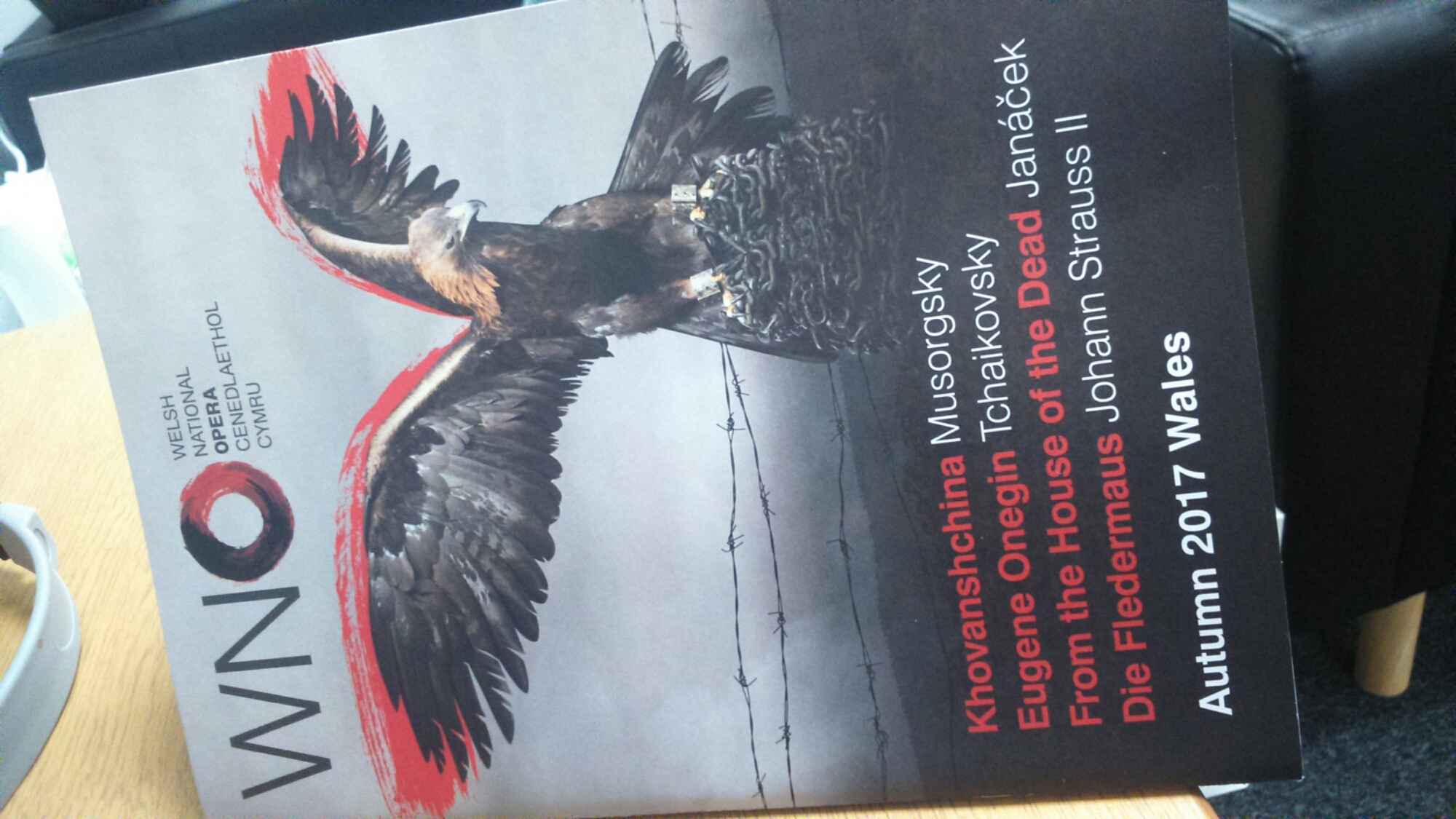
I was excited to receive the brochure shown above for the 2017/18 season at Welsh National Opera, but although it contains some very exciting things there are also many signs that times are getting very tough at WNO.

This October sees the 100th anniversary of the Russian Revolution so it’s no surprise that the Autumn season has a distinctive Russian flavour. There’s Tchaikovsky’s Eugene Onegin, Mussorgky’s Khovanschina and Janáček’s From the House of the Dead. Yes, I know Janáček wasn’t Russian – but `From the House of the Dead’ is based on a novel by Fyodor Dostoyevsky, who was…

That looks like an interesting season, but there are only two performances of From the House of the Dead in Cardiff (both of which I think I’ll have to miss) and only three each of Eugene Onegin and Khovanschina. There’s also an additional performance of Johan Strauss’s light operetta Die Fledermaus, which is one of this year’s productions.

Spring 2018 sees performances of Puccini’s Tosca, Verdi’s La Forza del Destino and Mozart’s Don Giovanni which again looks like a nice season. I’ve seen the productions of Tosca and Don Giovanni before, but won’t mind seeing them again.

But the real disappointment is that there’s no Summer season at all. Austerity has clearly bitten very hard. For year’s I’ve been celebrating my birthday (which falls in June) by going to a WNO performance in Cardiff but I guess next year I’ll just have to do something else….

Der Rosenkavalier at WNO

Posted in Opera with tags , , , , , , , on June 5, 2017 by telescoper

I’m in London attending a cosmology meeting (of which more, perhaps, anon) but I couldn’t resist posting a quick review of yesterday’s birthday treat: the first performance of a new production of Der Rosenkavalier by Richard Strauss. It wasn’t exactly a first night as such because it was a 3pm start. In fact it was still daylight when I got home..

Der Rosenkavalier is superficially a comic opera but it also moments of great depth and poignancy, dealing with the passage of time and the nature of love. The libretto contains some lovely passages, such as this:

Die Zeit, die ist ein sonderbar Ding.
Wenn man so hinlebt, ist sie rein gar nichts.
Aber dann auf einmal, da spürt man nichts als sie.
Sie ist um uns herum, sie ist auch in uns drinnen.
In den Gesichtern rieselt sie,
im Spiegel da rieselt sie,
in meinen Schläfen fliesst sie.
Und zwischen mir und dir da fliesst sie wieder,
lautlos, wie eine Sanduhr.

Most of the comedy is supplied by an intrigue involving the boorish Baron Ochs, played brilliantly by bass Brindley Sherrat, who wishes to marry the innocent Sophie (largely to acquire the property of Sophie’s father). The Baron engages dashing young Octavian to deliver a ceremonial silver rose to Sophie as a wedding gift. Octavian arrives with the gift but falls in love at first sight with Sophie and his feelings are reciprocated. When the Baron turns out to be the horrible git that he is, Octavian engineers a plot to discredit him, rescue Sophie from a potentially disastrous marriage and claim her for himself. The cunning plan, which proves successful, involves Octavian dressing as a maid in order to catch the Baron in flagrante.

It’s worth mentioning that the part of 17-year old Octavian is played by a female singer – in this production the excellent Lucia Cervoni – who at one point has to be a girl playing a boy playing a girl, rather like Cherubino in the Marriage of Figaro. Sounds silly? Well, it is but it was beautifully done and gloriously funny.

Octavian (right) presents Sophie with the silver rose..

Octavian is a `trouser role’ but in this production the character begins with trousers off, having a bit of rumpy-pumpy with the Marschallin (played by the wonderful Rebecca Evans), who is much older than Octavian. At the start of the Opera they are in a passionate relationship, but the Marschallin is conscious of the passage of time and that her relationship with Octavian can’t last. At the end of Act I, she points out to Octavian that their relationship can’t go on and he storms out, shortly to meet young Sophie (in Act II).

In this production the Marschallin is often accompanied on stage by the silent and solitary figure of an old lady, who it turns out is a representation of herself in later life. It’s a clever device and would have been even more effective had the old lady not reminded me so much of Madge Allsop

The staging is in period, and for the most part pleasantly straightforward but there is a rather gimmicky element of steadily encroaching sand, presumably ‘the sands of time’ referred to in the last line of the excerpt quoted above. I felt this was neither necessary nor convincing. The theme of time’s inexorable progress is clear enough. There’s no need to labour it.

Near the end of Act III, after much coming and going, and the odious Baron’s entrapment and humiliation, the Marschallin  is left alone with her former lover Octavian and his intended bride Sophie, we arrive at the Opera’s emotional high point, and indeed one of the most sublime moments in the entire operatic repertoire, the sumptuous trio Hab Mir’s Gelobt,  in which the Marschallin comes to terms with the loss of Octavian and blesses the relationship between him and Sophie. This is one of the pieces of music that really affects me very powerfully, and I am not too proud to admit that I did let go a tear or two. Maybe more. Not because it is especially sad, but because it’s so very beautiful the way the three voice blend together and with the orchestra.

I don’t give star ratings but from a vocal point of view this is definitely one of the finest performances I’ve ever seen on the Opera stage. All four principals: Rebecca Evans, Lucia Cervoni, Brindley Sherratt and Louise Alder (Sophie) rose to the challenges of their roles in great style. All were superb so it would be wrong to single out one, but I will say that I was surprised to discover that this was Rebecca Evan’s debut as the Marschallin – she was just about perfect in the role.

The Orchestra of Welsh National Opera directed by Tomas Hanus played Strauss’s lush score with great precision and passion,  holding together a wonderful afternoon at the Wales Millennium Centre. An altogether excellent way to spend a birthday afternoon!