Archive for Welsh National Opera

Lohengrin at WNO

Posted in Opera with tags , , , , on June 2, 2013 by telescoper

Yesterday evening I went to the Wales Millennium Centre in Cardiff Bay to see Welsh National Opera’s new production of Richard Wagner‘s Opera Lohengrin, along with an old friend who’s almost certain to add a comment or two to this post. I had been looking forward to this performance for ages, but my sense of anticipation was enhanced even further by reading the excellent reviews this Opera has been getting in the national newspapers recently. I don’t often agree with the critics, actually, but in this case I wasn’t disappointed. It was absolutely superb.

Lohengrin  is set in Germany in the 10th Century at a time of impending war with Hungarian tribes. In Act I Heinrich, the King, arrives in the province of Brabant in order to muster troops, but finds the place in turmoil because of the disappearance of  young Gottfried, the heir to the Dukedom of Brabant in mysterious circumstances. Telramund, who governs Brabant after the death of the Duke and is also guardian to Gottfried and his sister Elsa, accuses Elsa of having killed her younger brother Gottfried. The King eventually agrees to Elsa’s guilt being decided in a  trial by combat and Telramund prepares to fight Elsa’s champion. But who is her mysterious defender? You can tell that he’s no ordinary Joe because he arrives as if by magic in a boat pulled by a swan…

In this production the swan is represented by a handsome white-clad boy (played by Thomas Rowlands) who propels the boat on stage with sweeping gestures of his arm and the unfurling of a single wing, creating one of the most memorable entrances I’ve ever seen in an opera, but that turned out to be just one of many wonderful moments in this production:

Swan

The champion gets out of the boat and, pausing only to fall in love with Elsa and ask her to marry him, he defeats Telramund but spares his life. There’s only one condition to the marriage – Elsa must never ask the champion his name or where he comes from. She agrees.

In Act II, as preparations are being made for Elsa’s wedding, it is revealed that Telramund was duped into making his allegation about Elsa by his evil wife Ortrud. Unfortunately Elsa doesn’t understand the situation and takes pity on Ortrud, who then starts to sow the seeds of doubt about the identity of her champion, the mysterious knight, who has now been declared ruler of Brabant. Near the end of the Act, as Elsa is arriving at the church for her wedding, Ortrud intervenes again, and hatches a plot to reveal the identity of her husband.

Act III begins after the wedding, but instead of being filled with nuptial bliss, Elsa is wracked with doubt. Might there be something sinister about her husband, the knight? To make matters worse, Telramund breaks into the honeymoon suite, attacks the champion and gets himself killed in the process. At this point Our Hero has had enough. He tells Elsa that at dawn he will reveal his identity to the King and the assembled troops, who are preparing for battle expecting him to lead them to victory. However, when the appointed time comes, he explains that he can not after all lead them, but must return where he came from. In one of the most beautiful songs  in all opera, In fernem Land, unnahbar euren Schritten (“In a far-off land, beyond the realm of mortals..”), Lohengrin (for it is he) explains all. He is one of the Knights of the Holy Grail, none other than the son of the legendary Parsifal, licensed to travel about undertaking acts of chivalry and valour, but obliged to return home, licence revoked, whenever his identity is known. The boat (and swanboy) return to take him away, Elsa collapses in despair, and Ortrud is triumphant, but only until it is revealed that the swan is in fact Elsa’s lost brother Gottfried, who is installed as Brabant’s new leader, at which points she collapses too.

It’s an epic tale of, course, unfolding over almost five hours, but at its core it’s really not about swords and sorcery but about the conflicts between love and duty and between trust and doubt; themes that are timeless. I wasn’t particularly surprised, therefore, to see that the design of this production places it somewhere in the middle of the nineteenth century, a setting that works well because that was also avtime of great turmoil across mainland Europe. It is also interesting that the first ever performance of Lohengrin was in 1850. The set is rather spare, and the garb of the soldiers rather drab blue and khaki, with peaked caps and greatcoats. The exceptions are Lohengrin and Gottfried whose pure white costumes pick them out as being not quite of this Earth.

As for the performances, I have to pick out Emma Bell as Elsa. I had read great things about her before this performance, but I still wasn’t prepared for the combination of such a lovely voice and fine acting. Susan Bickley was a splendidly feisty badass as Ortrud, and Matthew Best played Heinrich  with great gravitas. I have to admit, though, that I found Peter Wedd a little less impressive as Lohengrin. He sang well enough, although his voice on a couple of occasions got lost in the orchestra, but I just felt he lacked the imposing stage presence that a Wagnerian hero demands.

Lothar Koenigs is  a particularly fine conductor of romantic music and he had the Orchestra of Welsh National Opera on fine form – there were a couple of ragged moments, but there were enough sublime moments to compensate. I’d pick out: the Prelude to Act I – surely the most beautiful overture in all Opera? – which unfolded in suitably majestic fashion; the Prelude to Act III, a rip-roaring piece totally different in character to that of Act I; and the passage in Act III that leads to the entrance of the King. For that piece, trumpets took up positions at various points around the hall, two of them right next to where we were seated. The effect of the fanfares calling and answering across the theatre was spine-tingling.

Above all, though, I have to take my hat off to the Chorus of  Welsh National Opera. I’ve been to many performances at the Wales Millennium Centre over the last six years or so. Some have been better than others, but the Chorus has always been excellent. Last night was no exception. They got the mixture of passion and control just right, and at times the power they generated was breathtaking.

I’ve tried to explain very often to people who don’t like Opera why I love it so much. That always involves explaining how you can take a piece of drama seriously when everyone is singing all the time. I have to say that somehow the music just creates an alternative universe and you fall into it. Sometimes that takes a while, and sometimes it doesn’t really happen at all. Yesterday, it only took about two bars of the Prelude to Act I to get me hooked and I stayed hooked for the whole performance.

It’s a wonderful thing, Opera. If you haven’t tried it before, you should. If you don’t like, fair enough. But if you never try you might just miss something that will change your life for the better. You won’t find many better productions to start with than this one!

Lulu at WNO

Posted in Opera with tags , , on February 18, 2013 by telescoper

Time for a quick post about Saturday night at the Opera while I have my sandwich lunch. I have reviewed Lulu by Alban Berg before but David Pountney’s production for Welsh National Opera was quite different to the Covent Garden version I saw a few years ago.

Berg was a student of Arnold Schoenberg, but he developed his own take on the twelve-tone techniques developed by his mentor. Not everyone finds  serialist music easy to enjoy, but I think if you’re going to have a go at it this Opera is one of the best places to start. I think the score for Lulu is completely wonderful with a constantly changing texture, sometimes lushly romantic (with a big  nod in the direction of Mahler in Act I), sometimes bleak and disjointed. It’s easy to understand why Berg is such an influential composer: you can hear in this Opera the ideas behind many Hollywood movie scores, and there are whole sections that sound like they come from the soundtrack of a Hammer Horror film.

So what about the Opera itself? The plot revolves around the character of Lulu, an enigmatic figure who is at times innocent and vulnerable and at others cynical and manipulative. Her personality is only revealed to us through her interactions with men, all of which end in disaster. Lulu’s first husband has a heart attack and dies; her second commits suicide. She then shoots another man and is imprisoned but eventually escapes. By the end of the opera, many years later on, she has wound up in London and is living in poverty and working as a prostitute. She dies at the hands of Jack the Ripper.

The structure of the Opera is like a mirror, with Lulu’s reversal of fortunes happening after an intermezzo in the middle of Act 2, at the centre of which there is a remarkable musical palindrome (shown above). Before this her role in the drama is to drive the men around her into obsession, madness and death, although she never appears to understand why she has this effect on them. After the dramatic fulcrum of the piece she becomes more and more of a victim. The reason for this is not some great change in her own psychological make-up but just that she is losing her looks, as a result of illness and ageing. No longer sexually desirable, she has lost the only way of controlling the men in her life. From this point her decline is inexorable and death inevitable. It’s also no coincidence that her murderer is played by the same actor who plays her first lover, Dr Schön.

This production looks very different to the Covent Garden production, but rather than describe it in words it’s probably easier to look at the promotional video made by WNO.

It’s a very vivid and imaginative staging based on a stark framework made of metal that dominates the stage.  A particularly effective and disturbing idea is to have the corpses of Lulu’s ex-lovers winched up into this structure on meat hooks after they’re dead and left to dangle there for the rest of the performance. Although the principal element of the set remains in place throughout, changes of mood and location are represented with dramatic changes of lighting and colour; Victorian London is memorably evoked with fog and a plethora of raised umbrellas. It’s all quite different from how I would have imagined the piece, but none the worse for that.

Marie Arnet was an excellent Lulu, giving a delicately nuanced portrayal of a complex central character who is as manipulated as she is manipulating. She is in turns cold-hearted and vulnerable, seductive and exploited. She bares all in this production, first in Act II, and is again naked when she is killed at the end of Act III. Neither scene is done gratuitously. Although her death scene is very shocking and horrific, it is not done in a titillating way. The rest of the cast was very good too, and the Orchestra of Welsh National Opera under Lothar Koenigs played the extraordinary music with clarity and energy. The saxophones and vibraphone, included to lend a bit of jazz-age decadence to the piece, were very prominent.

Before seeing this production I saw that the first night got a rave review and five stars  in the Guardian. I wasn’t sure what to make of that as I rarely agree with published reviews. In fact I agree with much of Andrew Clements said, but wouldn’t have given it five stars. I’d probably give it four, if I did stars…

In Berg’s score the singers are sometimes called upon to use a stylised method of vocalisation in between speaking and singing (called Sprechstimme). This can be extremely effective from a dramatic point of view when done well. In this production I was perturbed that the short pieces of the libretto intended to be performed in this way were in fact delivered by disembodied recorded voices. I thought that was peculiar when I first noticed it, and as it recurred throughout the performance it started to irritate me quite considerably. I couldn’t tell which character was meant to be speaking, and in any case the recorded voices sounded nothing like those of any of the characters on stage. This device was probably used because some of the parts were played by people in animal masks, but other than that I couldn’t see the point of it.

That was an unfortunate blot on an otherwise excellent production, but there was still much to enjoy and I’m very glad I went back to Cardiff to see it.

Rebranding Welsh National Opera

Posted in Opera with tags , , , on February 17, 2013 by telescoper

I went last night to Welsh National Opera’s new production of Lulu by Alban Berg; I’ll post a review in due course when I’ve got more time. Before I get the train back to Brighton I thought I’d post a quick comment on WNO’s recent “rebranding” exercise. This was described by Director David Pountney as follows:

WNO’s rebranding exercise is an integral part of its overall strategy to make itself as fit as possible to face the many challenges of the current environment. This includes a reinvigorated artistic programme, a rigorously tight management of our financial outgoings, and a positive search for alternative funding. The branding exercise is far more than creating a new logo. It has resulted from detailed consultations within and outside the company on its mission and its identity, and has resulted in a renewed image that will serve for the next decade. Central to this is of a re-designed website, together with a new style of programme book to reflect the company’s themed seasons. Together these form an integrated strategy to support the company’s prosperity and creative energy over the coming seasons.

One immediately obvious consequence of this rebranding is the demise of the very attractive and handy old programmes (such as the one for Tosca on the left), and their replacement by a much bigger season programme that covers in this case three different operas (Lulu, Madame Butterfly and The Cunning Little Vixen, bundled together incongruously under the theme of Free Spirits) . The new style programme is much heavier and larger so that it doesn’t fit in jacket pocket. It also means that if you just want to see one Opera in the season, and want to buy a programme for that one only, you can’t. Shades of the academic publishing industry. Any further visits of mine to WNO definitely won’t involve buying a programme..

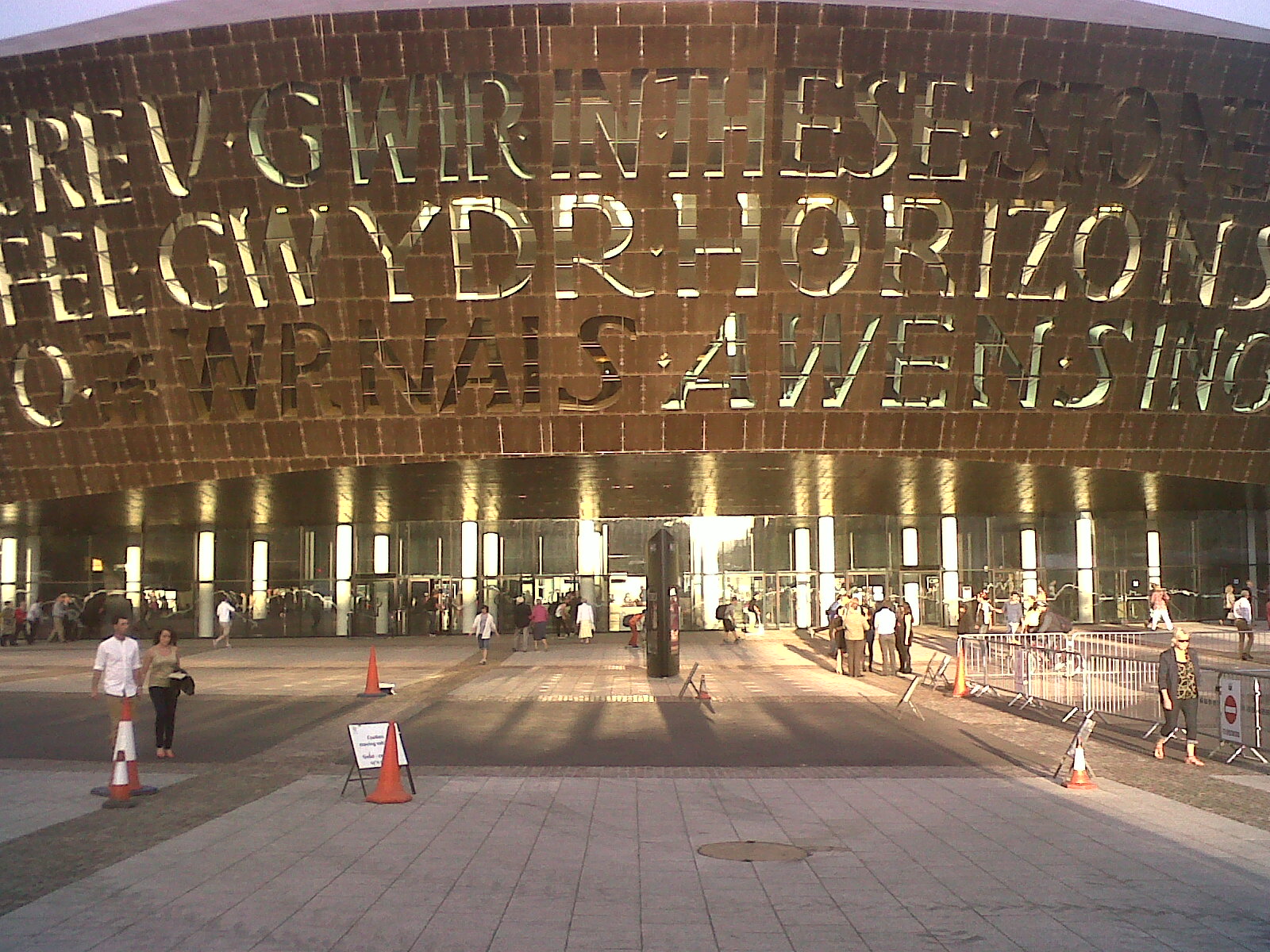
Anyway, one thing the marketing types can’t bugger up with their rebranding nonsense is the wonderful Wales Millennium Centre, snapped here as I went to get a bite to eat after last night’s performance.

Jephtha

Posted in Opera with tags , , , , , on October 5, 2012 by telescoper

I took time out from a busy week yesterday evening for a performance by Welsh National Opera of Jephtha by George Frideric Handel. Based on a biblical story (from the Book of Judges), Jephtha was written late in Handel’s life (indeed it was the last major work Handel wrote) as an oratorio rather than an opera, and was first performed as such in 1752.

Last night’s production brought movement, scenery and costumes to Handel’s lovely music in an attempt to turn it into an opera. It was only partially successful in doing that. Owing to the nature of the piece, it appeared as a series of rather static tableaux rather than a compelling music drama. It did however, feature excellent music and singing, and very imaginative use of a rather simple set, an interior of faded and battered opulence, complete with broken plaster and bullet holes, and costumes that evoke the period leading up to World War II.

You can get a good idea of the look of the performance in the following WNO trailer:

The story revolves around the character Jephtha who is called upon to lead the people of Gilead in battle against Ammon. He takes up the challenge, and when he proves victorious he rashly (and cruelly) vows to make a sacrifice of the first human being to greet him when he returns home. That turns out to be his daughter, Iphis. Will he carry out his pledge and turn Iphis into a burnt offering? Will an Angel of the Lord intervene and spare her? I won’t spoil the plot, except that that the operatorio does not end in the same way as the bible story seems to…

As for the singers, I thought Fflur Wyn (Iphis) was the pick – her voice beautifully conveyed the innocence and fragility of the young daughter. Robin Blaze as Hamor (Iphis’ betrothed) was also excellent in the counter-tenor role. I wasn’t so keen on Robert Murray as Jephtha, whose voice was rather thin and undistinguished especially early on in the performance. But it was really Handel’s music that took centre stage. Although the performance contained much to savour, I’m not convinced that staging Jephtha as an opera was really worth it. I would probably have enjoyed it just as much if it had been performed as an oratorio, like Messiah.

La Bohème

Posted in Opera with tags , , , , , , , on September 9, 2012 by telescoper

Time rolls on and the end of the summer brings the beginning of the new Opera season in Cardiff, with  La Bohème  by Giacomo Puccini at Welsh National Opera. It seems like a thousand years since I last went to the Wales Millennium Centre but it was only May. Still, a lot has happened between then and now. It felt good to see the Wales Millennium Centre again, looking resplendent in the sunshine of a September evening. Life’s getting back to normal.

I confess that I still get butterflies in my stomach as I take my seat before a night at the Opera. I guess if that thrill ever disappears I’ll just stop going, but last night reminded me why I love the Opera so much. The performance was absolutely wonderful, perhaps the best I’ve seen at Cardiff since I moved here five years ago.


I suppose the story of La Bohème will be familiar to anyone with even a passing interest in Opera, but I’ll give a quick synopsis anyway.  It’s a boy-meets-girl love story, of course. The boy in this case is the poet Rodolfo (Alex Vicens) and the girl, actually named Lucia but known  as Mimi (Giselle Allen).  The setting is Paris around 1830, and the poet and his painter friend Marcello (David Kempster) are starving and freezing, as it is winter and they have no money.  Act I is set on Christmas Eve, but the two friends have nothing to eat and nowhere to go. Fortunately, their musician friend Schaunard (Daniel Grice) turns up with money and provisions. After various comings and goings everyone but Rodolfo leaves to spend Christmas Eve out on the town; Rodolfo has to finish a piece for a journal, and promises to join them when he is done. However, he is interrupted by the arrival of Mimi, who lives nearby and whose candle has gone out. It’s love at first sight…

The later stages of Act I are built around Rodolfo’s aria Che Gelida Manina (“your tiny hand is frozen”) and Mimi’s Mi Chiamano Mimi. These beautiful songs follow one another in quick succession, and are then rounded off with a wonderful duet O Soave Fanciulla  in a manner guaranteed to melt the stoniest of hearts. And, before you ask, yes I did cry. Just a little bit. I don’t think anyone noticed.

But it’s not just the ravishing music that makes this passage so special, it’s also Puccini’s gift as a story-teller: after the two arias by Rodolfo and Mimi, the audience knows everything they need to know about these characters. It’s a great example of why I think Puccini is a far greater writer of Opera than, say, Wagner. Puccini understood much better than Wagner how to vary  pace and colour  without allowing the story to bogged down, and he knew exactly how to use his big tunes to maximum dramatic effect (i.e. without excessive repetition). In fact, La Bohème is in four acts, but its running time is just about 2 hours and 15 minutes, packed full of gorgeous music and compelling drama. It’s a supreme example of Puccini’s artistry as a composer of Opera.

Anyway, back to the plot. Act II finds Rodolfo and Mimi joining in the party started by Marcello and his buddies. There’s a huge contrast here between the dingy garret in which Act I is set, as this is set in the Latin Quarter of gay Paris (with a few drag queens in this production thrown in to make the point). Marcello gets off with the object of his desire, the coquettish Musetta (Kate Valentine), and all seems well with the world as we go into the interval.

In Act III we find things have changed. Rodolfo’s love for Mimi has soured and, overcome by jealousy and suspicion, he has left her. Clearly unwell, Mimi wanders around looking for Rodolfo and he hears her coughing. They clearly still love each other, but find it difficult to live with each other. If Opera were Facebook they would both have “It’s complicated” on their status.

The last act finds us back in the garret, Rodolfo and Mimi having separated. But Mimi has been wandering the streets in the freezing cold and turns up, clearly gravely ill. Rodolfo’s friends quickly pawn some meagre possessions and Marcello and Musetta rush out to buy medicine and summon a doctor. They return with the medicine but, before the doctor arrives, Mimi dies.

Well, what did you expect in an Opera, a happy ending?

People say that this is a romantic opera but it’s a pretty bleak story when you think about it. The lovers’ happiness is brief and it all ends in despair and death in surroundings of poverty and squalor. That’s what Opera Verismo is all about.

I don’t give star ratings when I review Opera performances, but if I did this would get the highest grade. All the principals were marvellous. It was refreshing to see Rodolfo played by a tenor who not only looked the part (i.e. youthful and dashing rather than middle-aged and portly) but could also cope with the demands of the role. I thought Alex Vicens’ voice sounded a little thin at the start and was worried that he might have to force it during the big arias, but he warmed up magnificently. Kate Valentine was a very sexy Musetta. The other person who deserves a particular mention is Welsh baritone  David Kempster, who was absolutely superb as Marcello. His compelling stage presence matched by an exceptionally  fine voice. World class, I’d say…

And a word for the production. Annabel Arden’s design managed to bring fresh elements to what is basically a straightforward interpretation of the Opera. The visual effects, such as the animated snow,  were clever but not intrusive. There was no attempt to translate the action into a different period or location nor was there an attempt to preach about disease as a metaphor for moral failings. In this respect it’s very faithful to what I think Puccini’s intentions were, i.e. to let the audience make their own mind up about what message they want to take away. The only slight departure I spotted was that in Act I Mimi actually blows her own candle out deliberately in order to get Rodolfo to light it again. Methinks she’s a bit more forward than usual in this production.

This was the first performance of this run of La Bohème. If you love Opera and can get to Cardiff, then do go and see it. It’s very special.

By way of a postscript I couldn’t resist posting this, which I found on Youtube this morning. It’s a vintage recording of O Soave Fanciulla dating back to 1956 and featuring the great Jussi Björling as Rodolfo. He may be a bit old for the part, but listen to that voice! The greatest tenor of his generation, without question. And Renata Tebaldi as Mimi too…

Tristan und Isolde

Posted in Opera with tags , , , , , on May 20, 2012 by telescoper

Regular readers of this blog will know that, although I’m a regular opera-goer, I’m by no means as much of a devout fan of Richard Wagner as many of that ilk, including some of my colleagues. Nevertheless, I have decided to persevere in much the same way as I have done with Brahms. Last night I had an opportunity to do just that by going to the first night of the new run of Tristan und Isolde by Welsh National Opera. I was particularly delighted to see this opera on the WNO schedule for this year, because it is an opera with which I am a little bit familiar, and thus provided me with an excuse to persevere a little bit more, for reasons I shall explain…

Years ago, when I lived in Nottingham, on a warm summer evening I decided to listen to some of the live broadcast on BBC Radio 3 of Tristan und Isolde from Glyndebourne. I made myself a cocktail and took the radio out into the garden with the intention of listening to a bit of it before going out for the evening. This was back in the days when I actually used to go out on the town on Saturday nights; now I’m too old for that sort of thing. Anyway, I was hooked right from the Prelude. Act I came and went and I decided to make some dinner in the interval, opened a bottle of wine, and returned to listen to the rest of it. The glorious music washed over me in the sultry twilight. Darkness fell, a second bottle of wine was opened, and still I listened – no doubt to the consternation of my neighbours. The final Liebestod was so beautiful I almost cried. Eventually I retreated to the house having experienced my first all-out Wagner trip.

My enjoyment of that occasion was of course helped by the fact I could get up and walk around occasionally, as well as by the liberal intake of fine wine. Nevertheless, I took enough out of it to want to see a full performance. Last night was my chance.

I think the first thing to say about Tristan und Isolde is that the music is completely wonderful. Not only ravishingly beautiful, but also haunting and complex. The opening bars establish a vividly chromatic orchestral palette which is used to brilliant effect to create the atmosphere of tragedy that pervades this work. The opening chord, the Tristan chord, is dissonant and its effect is strengthened by its resolution into another dissonant chord.

It’s often been said – probably with justification – that the freedom with which Wagner composed this opera opened up a whole new set of possibilities for Western classical music. It’s also wonderful to listen to.

So as a music drama it scores nearly 100% for the music. As a drama, though, it leaves a lot to be desired. The plot in Act I is absurd even by operatic standards. Isolde plans to poison Tristan and then take poison herself, but her servant Brangäne does a nifty switch of the vials and the two drink a love potion instead. This ignites a mutual desire that had previously been dormant and leads them into a tragic confrontation between love and responsibility. Isolde, you see, is betrothed to King Mark of Cornwall, and Tristan is his most loyal and virtuous knight. You know this isn’t going to end well, but the bit with the potions reminded me of that old Danny Kaye sketch about the “Vessel with the Pestle”.

Act 2 finds Tristan and Isolde in a dark wood, having embarked on an illicit love affair. It’s basically just the two of them on stage expressing their love to each other in wonderful music. Dramatically, however, nothing at all happens for the best part of an hour until right at the end when the King and his men find the couple in flagrant deliciousness. Now I understood why this opera works so well on the radio..

Tristan is stabbed by one of the King’s cronies at the end of Act 2, but the start of Act 3 finds him back in his ancestral home in Brittany, mortally wounded, lying under a very large plank of wood. In despair he hopes that Isolde will find him and mend his wounds with one of her potions (hopefully the right one this time). She arrives, but he snuffs it before she can help. Then another ship arrives, carrying King Mark and his boys, who have obviously been in hot pursuit across the English Channel. Isolde sings of being reunited in love with the dead Tristan and as she sings the stage and other actors fade from view. She dies.

Full marks to Isolde, Ann Petersen, a wonderful dramatic soprano with an electrifying voice; she’s from Denmark, incidentally. Canadian-born Ben Heppner as Tristan, was also in good voice, although he sometimes struggled to project and his rotund appearance called for a bit of audience imagination for him to be seen as a dashing knight. Mezzo  Susan Bickley was a splendid Brangäne too.

The Orchestra of Welsh National Opera under the direction of Lothar Koenigs were excellent too, after a rather nervous opening during which they seemed almost to be in awe of the music they were playing. And a special word for the staging, which was rather stark but also very clever, especially during Act I when a translucent screen divided the front and back of the stage and allowed some intriguing lighting effects.

I’d prepared myself psychologically for the 5 hours plus of this performance – not too bad actually, when you realise that includes two intervals, of 25 minutes and 50 minutes respectively – so I coped well enough. The piece definitely has its   longueurs, but you can always shut your eyes and imagine you’re in the garden at home..

Don Giovanni

Posted in Art, Opera with tags , , , , , , on September 24, 2011 by telescoper

Another sign that autumn is nigh is that the opera season has started again, which at least gives me the opportunity to resume my series of occasional opera reviews.

I was planning to go to see the new  Welsh National Opera production of Don Giovanni by Wolfgang Amadeus Mozart   last week but was stymied it clashed with the cricket, which turned out to be a day-night game finishing too late to allow me to go to both. Anyway, I was able to get tickets for last night’s performance as well as dispose of last week’s so it all worked out for me in the end.

First night reviews of this production weren’t particularly good – the reviews in the Telegraph and the Guardian are fairly typical – which probably accounted for the fact that the Wales Millennium Centre wasn’t particularly  full even for such an extremely popular opera. I don’t usually pay much attention to reviews myself and I thought the critics were excessively harsh, although some of the points they make are valid.

I won’t repeat the synopsis in detail here because it’s probably familiar to most people likely to read this, even those who aren’t opera buffs. In fact it’s all explained by the subtitle il dissolute punito. We meet the villainous “nobleman” Don Giovanni attempting to molest  Donna Anna after sneaking into the house of the Commendatore, Donna Anna’s father. Don Giovanni is rumbled and confronted by the Commendatore; a duel  ensues which appears to be ending without bloodshed until the Don draws a dagger and murders the Commendatore.

There then follows a series of escapades: attempted seductions, disguises, mistaken identities, narrow escapes, and so on. Typical comic opera stuff in fact, except that it’s not really typical comic opera  because it’s comic opera with music by Mozart and libretto by da Ponte. In other words, it’s genius.

Finally,  Don Giovanni’s past catches up to him. He taunts a statue of the dead Commendatore while seeking refuge in a graveyard. Later, back at Don Giovanni’s  house the statue arrives  and sends Don Giovanni to Hell.

The first impression you get of this production on entering the theatre is the monumental set, which is based (not inappropriately) on the  Gates of Hell by Auguste Rodin (shown left), a huge bronze sculpture that depicts a scene from Dante’s Inferno. What you see on stage, however, is not a simple replica of the Rodin piece, but a series of variations on and extensions of the original artwork. Extra pieces are added to form a walled courtyard, it opens out to form a series of rooms and chambers, and in the end the gates themselves open to take the eponymous villain down to Hell (along with a smoke and fire effect which unfortunately didn’t work very well last night; there wasn’t enough smoke to engulf him as was clearly intended).

The idea of basing the set around this work of art was potentially brilliant but I didn’t think it really worked as well as it might. The reason is that the magic of Mozart’s operas emanates, at least in part, from the huge dramatic contrasts. Don Giovanni certainly has a very dark edge, but it also has a great many lighter comic episodes, some of them bordering on the slapstick. Having this heavy sombre backdrop to everything tended to dampen the swings between light and shade. It’s as if the  production was so obsessed with this one idea, that everything else became subservient to it. What could have been brilliant was just too clumsy. You don’t have to force things so much, especially not with Mozart, especially not with Don Giovanni.

Another criticism I would make concerns David Kempster as Don Giovanni. He certainly sang extremely well, his smoky baritone voice sounding very rakish. However I thought he acted the part too broadly, at times like a pantomime villain, to the extent that he seemed delighted by the theatrical boos he got on his curtain call. He was at times very funny indeed, but again I thought he was a bit forced.

However, if it sounds like I’m being very negative about the performance then I don’t mean to be. Apart from the unnecessarily imposing set, the look of the production is wonderful: the costumes and lighting were beautifully done, and the crypto-Gothic look was appropriately spooky when “spooky” was called for.

David Soar was a really oustanding Leporello; I think the audience agreed with me as he got a huge cheer at the end. Camilla Roberts was excellent as Donna Anna as was Nuccia Focile as Donna Elvira. On the other hand I found Carlo Malinverno a disappointment as the Commendatore. He looked scary enough but his undistinguished and occasionally  wobbly bass voice didn’t have the necessary menace for climactic scene with Don Giovanni near the end. For me it has to be a voice that really reverberates with doom. Few can really pull it off, and Carlo Malinverno isn’t one of them.

A special mention, however, must be made of Samantha Hay, who stepped in at short notice to sing the part of Zerlina owing to the indisposition of Claire Ormshaw. She was absolutely wonderful, with a beautifully crystal-clear voice and engaging stage presence. Well done to her for a performance that was very warmly received by the audience.

Watching the opera last night it struck me again, as it always does listening to Don Giovanni,  just how many great pieces of music there are in it. Whereas most operas can offer at most a few set-pieces, in Don Giovanni they keep coming one after the other for well over three hours. This is Mozart at the very peak of his powers, and  a few blemishes don’t even come close to taking the magic away.

Turandot

Posted in Opera with tags , , on May 31, 2011 by telescoper

On the way to the Wales Millennium Centre in Cardiff Bay this evening it struck me that it was quite fitting to be going to see Welsh National Opera‘s production of Turandot so soon after Friday’s concert. After all this was Giacomo Puccini‘s last Opera and it was incomplete at the time of the composer’s death in 1924. It’s a work most famous for the rousing tenor aria Nessun Dorma from Act III , which was made even more famous when, sung by the great Pavarotti, it became the theme tune for the Italia 90 World Cup. But there’s also the gorgeous Signore Ascolta in Act I and, even better, the dramatic fulcrum of the Opera, and one of the greatest Puccini’s arias of all, the climactic In Questia Reggia. Puccini undoubtedly had a great gift for writing memorable songs but there’s much more to him than that, as this opera proves. Turandot is a particularly dark and troubling story, with music to match the drama at every stage, and it contains some extremely interesting “modern” ideas alongside the classic showpiece numbers.

The story is set in China (“in legendary times”). Princess Turandot (definitely pronounced “-dot” rather than “-doh”) is a tyrannical ruler who challenges potential suitors to solve three riddles. The penalty for failure is death; no resits allowed. The Opera begins with the Prince of Persia being led to his doom. You know the sort of thing – girl meets boy, boy falls in love with girl, girl beheads boy, etc. Calaf, Prince of the Tartars, arrives with his elderly father Timur and faithful servant Liu. Crazy fool that he is, he decides to have a go at the riddles. Three sinister ministers, Ping Pang and Pong, prepare the trial, letting on as they do so just how many others have died in the attempt to woo Turandot. Calaf, of course, succeeds, but Turandot doesn’t want to go along with her side of the bargain. Calaf sets his own riddle – Turandot simply has to guess his name by dawn and he’ll give up his suit and let Turandot execute him too. She tries everything she can think of to identify the mystery contestant, including keeping the entire population of Peking up all night and torturing Liu to the point where she kills herself rather than risk giving away her master’s name. Liu loves Calaf herself, you see, so naturally she dies for her beloved’s sake. That’s what women do, in Opera. Moved by Liu’s sacrifice, Turandot feels the power of love and agrees to marry Calaf. And they all live happily ever after. Apart from Liu, of course, who’s dead.

That’s one of the thing’s that’s so problematic about this Opera for me. If Calaf is meant to be so noble and courageous, so why does he fall for Turandot who, at least at the beginning, is cruel beyond belief? And if he’s such a good egg why does he let the innocent Liu die just so he can get his leg over? This isn’t the only Puccini opera in which the romance has a dark undertone and in which the hero isn’t all that heroic when you look hard enough at him. Calaf isn’t quite as bad as the ghastly Pinkerton in Madame Butterfly, but I still think he’s basically a prat.

This production is a revival of one first performed in 1994. The setting spans a number of epochs, ancient Chinese costumes mingling with 20th century dress, and the minimal set periodically hung with mugshots of slain suitors evoking the “disappeared” in a South American dictatorship. Turandot’s dress and hairstyle in Act II made her look a lot like a cross between Ymelda Marcos and Eva Peron. In the crowd scenes, the chorus writhe with stylised anguish of an almost masochistic nature, as if their oppression by the brutal regime has become a sort of fetish for them.

Star of the show was dramatic soprano Anna Shafajinskaia as Turandot. With a name like an Icelandic volcano and a voice of exceptional power to match, she sent shivers down my spine on several occasions, especially in Act II. Gwyn Hughes Jones was a fine Calaf. Rebecca Evans being unfortunately indisposed, Liu was played by Michelle Walton. She started very hesitantly, and I wasn’t at all impressed with her rendition of Signore Ascolta; what she sang was quite nice, but it was only a vague approximation to what Puccini wrote. She did settle down as the performance went on, however, and was much more impressive in Act III. The rest of the cast were good and, as always, the Chorus of Welsh National Opera were superb throughout.

It’s difficult to explain to people who don’t “get” Opera how it can possibly work. People don’t actually sing to each other in real life, after all. All I can say is that, when it’s good, you somehow just fall into it and it takes on its own dramatic logic. That doesn’t always happen, of course, but for me it certainly happens sufficiently frequently to make it worthwhile. This one took a while to get going, and I didn’t really start to get involved until Act II, but thereafter I was gripped.

I should also say that it was very nearly a full house. Not bad for a Tuesday night!

Cosi fan tutte

Posted in Opera with tags , , , , on May 21, 2011 by telescoper

It’s been a long time since I posted an opera review. That’s because neither of the operas offered by Welsh National Opera earlier this year appealed to me very much and since then I’ve been too busy doing other things to take in an opera anywhere else. However, the summer season of WNO has now started so now at last there’s something of an operatic nature to write about. In fact, I was lucky enough to get tickets for the first night of WNO’s new production of Così fan tutte by Wolfgang Amadeus Mozart and duly went along yesterday evening. The Millennium Centre was pretty full – as you’d expect for a first night of an enduringly popular opera.

In case you weren’t aware, Così fan tutte is a masterpiece of comic opera (or, technically speaking, opera buffa) written in collaboration with Lorenzo da Ponte who also wrote the libretti for Don Giovanni and The Marriage of Figaro. The title can be loosely translated as “That’s how all women behave”; the -e on “tutte” indicates a feminine plural. The plot -such as it is – revolves around two pays of lovers: Guglielmo, who is engaged to Fiordiligi, and Ferrando, who is engaged to Fiordiligi’s sister, Dorabella. Both Guglielmo and Ferrando are sailors. All four are friends with the scheming Don Alfonso, who orchestrates the unfolding events, presumably for his own amusement.

Don Alfonso suggests to Ferrando and Guglielmo that their beloved fiancées are not as faithful as they seem to imagine and the three agree a wager. Ferrando and Guglielmo pretend that they’ve been called up for active service. Don Alfonso joins Fiordiligi and Dorabella in the sumptuous trio Soave sia il vento as the men appear to sail off for battle. The ladies are heartbroken and pledge fidelity to their departed lovers. However, the two sailors soon return in disguise in order to attempt their seduction. After various goings-on the men succeed in seducing each others fiancees and a mock wedding is staged. The marriage is interrupted by the sound of the sailors’ return. After the quickest of quick changes the two men re-appear without their disguises and confront their unfaithful women. Don Alfonso has won his bet.

Like all opera buffa the plot sounds faintly ridiculous – which it is – but of course the key to its success as a piece is not just the comic action, but also the gorgeous music which carries it along. In this particular opera there’s almost no end to the musical loveliness as Mozart has each principal singing alone, and in combinations of twos and threes. Mozart’s writing for two, three or four voices is truly wonderful to listen to, and there are many fine examples of such in this opera.

In this production Guglielmo and Ferrando are sailors who are stationed in a British seaside resort, complete with promenade, pier, Punch & Judy show and Italian ice-cream parlour (named Botticelli‘s). This setting takes  it quite a long way downmarket  compared to the original location of Naples, especially when the Butlins-style redcoats appear, and this is carried through to the much coarser way the comedy is handled than you find in many productions of this piece. This approach does provide enjoyable moments of slapstick hilarity but also causes some difficulties.

For example, it is key to this opera that the character of Don Alfonso has to have some sort of power over the four main protagonists. In other words, it has to be credible that they believe what he says and go along with his suggestions. In this production, however, Don Alfonso is meant to be a “local pier entertainer” – in fact he actually looks more like Flash Harry. I found it hard to accept that anyone would believe anything that this particularly dodgy spiv had to say, and his interaction with the two ladies in particular lacked all credibility.

Another thing I didn’t like was the way the opening of the piece was handled. Like most of Mozart’s operas, Così fan tutte is blessed with a splendid overture, perhaps not as brilliant the other Da Ponte operas but full of playful exuberance and very much worth listening to. You can call me old-fashioned, but I do like to hear the overture, preferably with an empty stage or with the curtain down. In this production, however, as soon as the overture started, the stage began to fill with various extras doing various (admittedly comic) things. A particularly funny sequence of people walking dogs backwards and forwards got a huge laugh, but which drowned out the music entirely. What a waste.

I suppose the overall point I’m trying to make is that this production tried too hard to get cheap laughs. It’s just not necessary to milk it like that – it’s funny enough anyway!

However, these are relatively small objections. I’ll temper them by adding that some of the comedy in this production is inspired. Ferrando wore a false nose that made him look like Barry Manilow and Guglielmo’s false moustache gave him the appearance of Comrade Stalin. The latter looked particularly louche in white tennis shorts and ghastly red blazer.

Neal Davies (baritone) was Don Alfonso, amusingly played but lacking the deep sonority in his voice really needed to carry the role off. Ferrando was played by Robin Tritschler (tenor), whose light agile voice is ideal.  Gary Griffiths (baritone) as Guglielmo was outstanding, with an excellent voice and obvious flair for the comic touches. Fiordiligi (Camilla Roberts) and Dorabella (Helen Lepalaan) were also good. Despina – a waitress in Botticelli’s ice-cream parlour and Don Alfonso’s accomplice (often in disguise) – was pert and feisty but her voice lacked projection; at times she was barely audible.

Anyway, in view of the fact that the comedy dog-walking interfered with last night’s overture I thought I’d end  by posting a version here. I love the way that little phrase is thrown around among the wind instruments!

Share/Bookmark

Ariadne auf Naxos

Posted in Opera with tags , , , , on October 8, 2010 by telescoper

There are three operas in the current season from Welsh National Opera, and last night I went to see the final one of the set,   a revival of their 2004 production of Ariadne auf Naxos by Richard Strauss. It seems I saved the best until last! It was a wonderful evening, beautifully sung and imaginatively staged.

It’s a strange opera, consisting of two acts. The first is a prologue, set backstage during the preparations for  a musical performance commissioned by the “wealthiest man in Vienna”, a character who never actually makes an appearance but who communicates with the others through his Major-Domo (a speaking role, played by Eric Roberts).  The centrepiece of the performance is to be a new opera, the tragedy of Ariadne on the Island of Naxos, written by a gifted young composer (played in male drag by the lovely Sarah Connolly). Afraid that the opera might bore his guests, the patron decides to liven up the performance by adding a musical comedy act, in the style of the Commedia dell’Arte, and a firework display. While the opera singers argue with assorted clowns and grotesques of the rival Harlequinade about who should perform first, news comes down from on high that in order that the fireworks are not delayed, instead of performing one after the other, the two performances will be merged. The upshot of this is that instead of being marooned on a desert island with only three nymphs for company, the lovelorn Ariadne has to put up with the presence of the entire cast of a comic burlesque.

In case you hadn’t figured it out, this is a comedy. It’s very German, of course, in the sense that it’s not all that funny really, but the set up does pay off in the second act, wherein the comedy and tragedy (or, more precisely, an Opera Buffa and an Opera Seria) are played together. It’s a bit like the “play-within-a-play” in Shakespeare’s Midsummer Night’s Dream.

First Ariadne (played by Orla Boylan) appears on her island, singing of her desire for death after the loss of her beloved Theseus. Then the clowns interrupt the performance and try to cheer her up, by suggesting she finds another man. Then the comics take over the show entirely, at least for a while. Finally Ariadne reappears and is met by Bacchus, the god of wine, who brings much-needed consolation. The two sing a rapturous duet and eventually ascend to heaven, in a style reminiscent of Close Encounters, while the clowns look on from the wings.

It’s all a bit daft, of course, but the juxtaposition of comedy and tragedy is unexpectedly moving. It works largely because of the sheer beauty of Strauss’ music, especially in the second act. People who don’t like opera probably don’t understand how it’s possibly to fall into such a stylised form of drama in which people sing to each other rather than speak, but somehow – at least for me – that’s what happens. Something draws you into the drama and you forget the artificiality of the performance. That it works in this opera is especially surprising because it’s  a second-order opera; the audience knows it’s an opera, but within the opera there’s another opera. Nevertheless, the sensuously romantic score still pulls you in, especially in the scenes with Ariadne. Strauss was always a superb writer for the female voice, and this opera is no exception.

Last night’s performance was lovely, with Sarah Connolly and   Orla Boylan both oustanding. Boyland in particular was simply superb, a true dramatic soprano with a voice of great lyrical beauty as well as  thrilling power when needed. I was expecting Sarah Connolly to be great, and she didn’t disappoint at all, but Orla Boylan was even better. 10/10.

The only part I didn’t like was the Wig-Maker, a crude gay stereotype mincing ostentatiously around the stage during the Prologue. Very naff.

Oh, and Eric Roberts as the Major-Domo seemed to get a bit confused in a couple of places and repeated his lines, sending the surtitle machine into chaos for a bit. Even though the performance was in German I didn’t really look at the surtitles. When you wear varifocals it’s quite difficult to read them without missing out on what’s happening on stage.

These were only minor blemishes, however, and overall it was a wonderful evening. I’ll add a word for the orchestra too, which played beautifully under the baton of Lothar Koenigs.

There’s only one other performance of this in Cardiff, tomorrow night (Saturday 9th October). Do go and see it if you can!


Share/Bookmark