Archive for Wendy Freedman

Hubble Tension Reduced?

Posted in The Universe and Stuff with tags , , , , on August 14, 2024 by telescoper

Back in April I posted about a meeting at the Royal Society in London called Challenging the Standard Cosmological Model, some of which I attended virtually. In that post I mentioned that Wendy Freedman gave a talk related to the ongoing issue of the Hubble Tension, i.e. the discrepancy between different types of measurement of the Hubble Constant, usually characterized as local measurements (using stellar distance indicators) and larger-scale measurements (chiefly Planck). There are quite a few posts about this issue on this blog. Anyway, Wendy Freedman mention in her talk that her latest work on stellar distances suggested a value of 69.1 ± km s-1 Mpc-1, which reduces the tension with Planck significantly. At the time, however, there was no paper explaining how this number was derived.

Yesterday there appeared on arXiv a preprint by Freedman et al. which summarizes the recent results. The abstract is here:

We present the latest results from the Chicago Carnegie Hubble Program ( CCHP) to measure the Hubble constant using data from the James Webb Space Telescope (JWST). This program is based upon three independent methods: (1) Tip of the Red Giant Branch (TRGB) stars, (2) JAGB (J-Region Asymptotic Giant Branch) stars, and (3) Cepheids. Our program includes 10 nearby galaxies, each hosting Type Ia supernovae (SNe Ia), suitable for measuring the Hubble constant (H0). It also includes NGC  4258, which has a geometric distance, setting the zero point for all three methods. The JWST observations have significantly higher signal-to-noise and finer angular resolution than previous observations with the Hubble Space Telescope (HST). We find three independent values of H0 = 69.85 ± 1.75 (stat) ± 1.54 (sys) for the TRGB, H0 = 67.96 ± 1.85 (stat) ± 1.90 (sys)  km s-1 Mpc-1 for the JAGB, and H0 = 72.05 ± 1.86 (stat) ± 3.10 (sys) for Cepheids. Tying into SNe Ia, and combining these methods adopting a flat prior, yields our current estimate of H0 = 69.96 ± 1.05 (stat) ± 1.12 (sys)  km s-1 Mpc-1. The distances measured using the TRGB and the JAGB method agree at the 1% level, but differ from the Cepheid distances at the 2.5-4% level. The value of H0 based on these two methods with JWST data alone is H0 = 69.03 ± 1.75 (total error)  km s-1 Mpc-1. These numbers are consistent with the current standard ΛCDM model, without the need for the inclusion of additional new physics. Future JWST data will be required to increase the precision and accuracy of the local distance scale.

You can read the full paper on arXiv here. A summary of the summary is that of the three methods they use, two give lower values of the Hubble constant and one (Cepheids) gives a higher value but with larger errors. The number quoted in the Royal Society talk was presumably preliminary as it doesn’t match any of the numbers in the abstract, but the point remains.

You can see the reduction in scatter in the new JWST measurements in this Figure (old on the left and new on the right).

On the face of it, these results suggest that the Hubble tension is greatly reduced. I am sure, however, that advocates of a higher value will have been preparing their ripostes and it’s just a matter of time before they arrive on the arXiv too!
Challenging the Standard Cosmological Model

Posted in The Universe and Stuff with tags , , , on April 16, 2024 by telescoper

Some time ago I used the medium of this blog to plug a mini-conference at the Royal Society in London entitled Challenging the Standard Cosmological Model. Here’s a description of the meeting:

Is the universe simple enough to be adequately described by the standard ΛCDM cosmological model which assumes the isotropic and homogeneous Friedmann-Lemaître-Robertson-Walker metric? Tensions have emerged between the values of cosmological parameters estimated in different ways. Do these tensions signal that our model is too simple? Could a more sophisticated model account for the data without invoking a Cosmological Constant?

That conference is actually taking place this week (on 15th and 16th April, i.e. yesterday and today). I can’t be there, of course, because I’m here, but I can share the recording of the talks. Here is the first day’s worth. The recording is about 8 hours long so you probably won’t want to watch it all in one sitting. Let me point out the talk by Wendy Freedman, which starts at around 2:13.30 talking about the Hubble Tension largely from the point of view of stellar distance indicators and suggesting an answer of 69.1 ± km s-1 Mpc-1, which reduces the tension with Planck significantly.

And here is Day 2:

You can find more information about the meeting, including a full list of the talks here.

Hubble Tension – The Plot Thickens

Posted in The Universe and Stuff with tags , , , on July 2, 2021 by telescoper

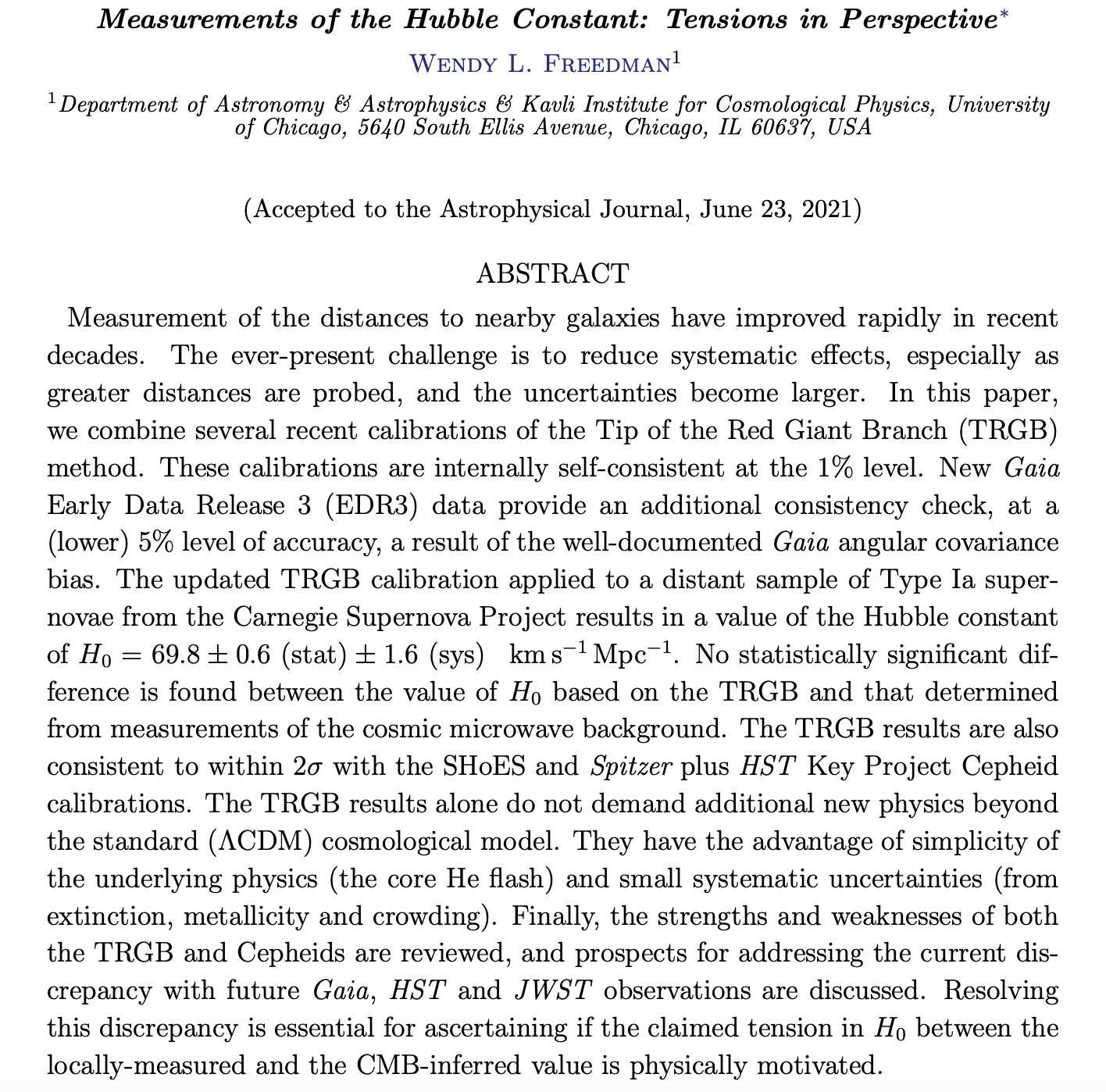
One topic on this blog seems to be as perennial as the weeds in my garden: the so-called Hubble Tension. I just saw a review paper by Wendy Freedman, one of the acknowedged experts in this area, on arXiv here. I have abstracted the abstract here:

You can find the PDF here.

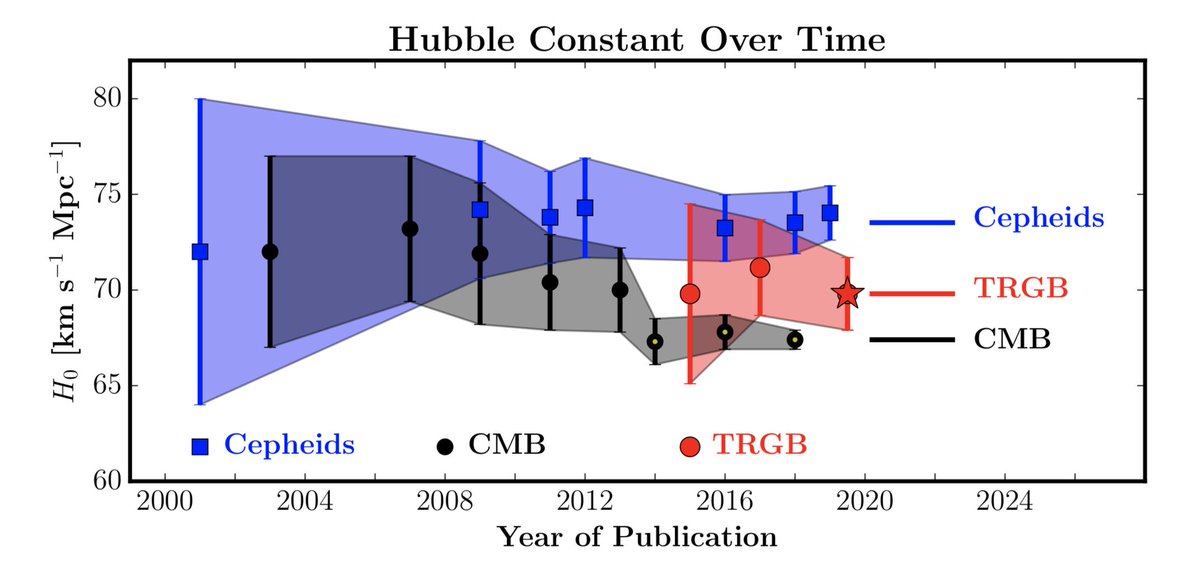
What’s particularly interesting about this discussion is that stellar distance indicators have typically produced higher values than the 69.8 ± 0.6 (stat) ± 1.6 (sys) km s-1 Mpc-1 quoted here, which is consistent with the lower value favoured by Planck. See the above graphic discussed here. So perhaps there’s no tension at all. Maybe.

Anyway, here’s that poll again! I wonder if this paper might change the voting.


The Hubble Constant from the Tip of the Red Giant Branch

Posted in The Universe and Stuff with tags , , , , on July 16, 2019 by telescoper

At the risk of boring everyone again with Hubble constant news there’s yet another paper on the arXiv about the Hubble constant. This one is another `local’ measurement, in that it uses properties of nearby stars,  time based on a new calibration of the Red Giant Branch. This one is by Wendy Freedman et al. and its abstract reads:

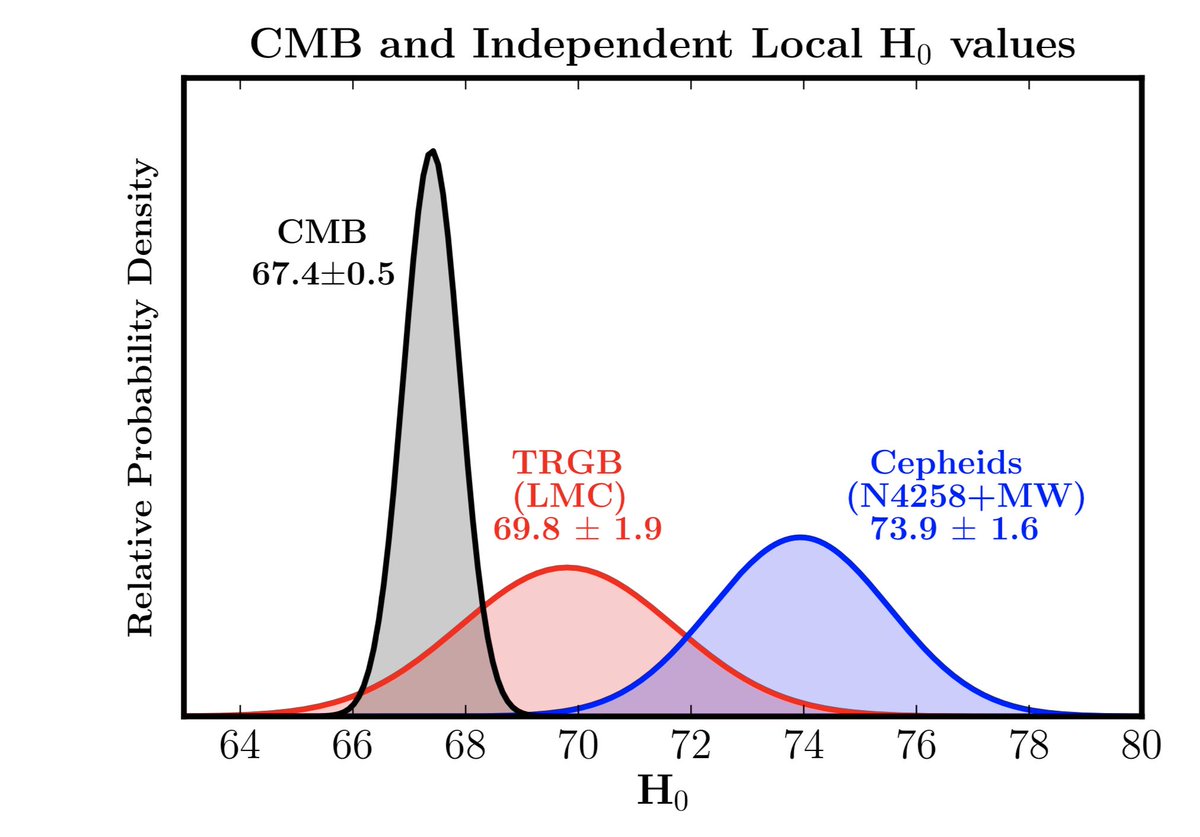
We present a new and independent determination of the local value of the Hubble constant based on a calibration of the Tip of the Red Giant Branch (TRGB) applied to Type Ia supernovae (SNeIa). We find a value of Ho = 69.8 +/- 0.8 (+/-1.1\% stat) +/- 1.7 (+/-2.4\% sys) km/sec/Mpc. The TRGB method is both precise and accurate, and is parallel to, but independent of the Cepheid distance scale. Our value sits midway in the range defined by the current Hubble tension. It agrees at the 1.2-sigma level with that of the Planck 2018 estimate, and at the 1.7-sigma level with the SHoES measurement of Ho based on the Cepheid distance scale. The TRGB distances have been measured using deep Hubble Space Telescope (HST) Advanced Camera for Surveys (ACS) imaging of galaxy halos. The zero point of the TRGB calibration is set with a distance modulus to the Large Magellanic Cloud of 18.477 +/- 0.004 (stat) +/-0.020 (sys) mag, based on measurement of 20 late-type detached eclipsing binary (DEB) stars, combined with an HST parallax calibration of a 3.6 micron Cepheid Leavitt law based on Spitzer observations. We anchor the TRGB distances to galaxies that extend our measurement into the Hubble flow using the recently completed Carnegie Supernova Project I sample containing about 100 well-observed SNeIa. There are several advantages of halo TRGB distance measurements relative to Cepheid variables: these include low halo reddening, minimal effects of crowding or blending of the photometry, only a shallow (calibrated) sensitivity to metallicity in the I-band, and no need for multiple epochs of observations or concerns of different slopes with period. In addition, the host masses of our TRGB host-galaxy sample are higher on average than the Cepheid sample, better matching the range of host-galaxy masses in the CSP distant sample, and reducing potential systematic effects in the SNeIa measurements.

You can download a PDF of the paper here.

Note that the value obtained ising the TRGB here lies in between the two determinations using the cosmic microwave background and the Cepheid distance scale I discussed, for example, here. This is illustrated nicely by the following couple of Figures:

I know that this result – around 70 km s-1 Mpc-1 – has made some people a bit more relaxed about the apparent tension between the previous measurements, but what do you think? Here’s a poll so you can express your opinion.

My own opinion is that if there isn’t any tension at all at the one-sigma level then you should consider the possibility that you got sigma wrong!

Cosmology at a Crossroads – Poll

Posted in The Universe and Stuff with tags , , , on June 13, 2017 by telescoper

A short comment piece by Wendy Freedman has appeared in Nature Astronomy; there’s a free version on the arXiv here. It gives a nice perspective on the current debate about the value of the Hubble constant from the point of view of an expert on cosmological distance scale measurements.

The abstract is here:

We are at an interesting juncture in cosmology. With new methods and technology, the accuracy in measurement of the Hubble constant has vastly improved, but a recent tension has arisen that is either signaling new physics or as-yet unrecognized uncertainties.

For the record, I’d go for `as-yet unrecognized uncertainties’, primarily because this field has a long history of drastically underestimated error-bars!

However, the publication of this piece gives me the excuse to resurrect the following poll, in which I invite you to participate: