Archive for William Shakespeare

“Who was Mr. W.H.”? – and Other Questions

Posted in LGBTQ+, Poetry with tags , , , , , , , on October 2, 2025 by telescoper

Today is National Poetry Day in the UK and Ireland but, instead of posting a poem like I usually do on this occasion, I thought I’d do a bit of reflecting on Shakespeare’s Sonnets. What prompted this is an article in the Times Literary Supplement I mentioned in a post on Monday. The cover picture shows a newly-discovered miniature by Nicholas Hilliard that is claimed to be of Henry Wriothesley, 3rd Earl of Southampton, and patron of William Shakespeare:
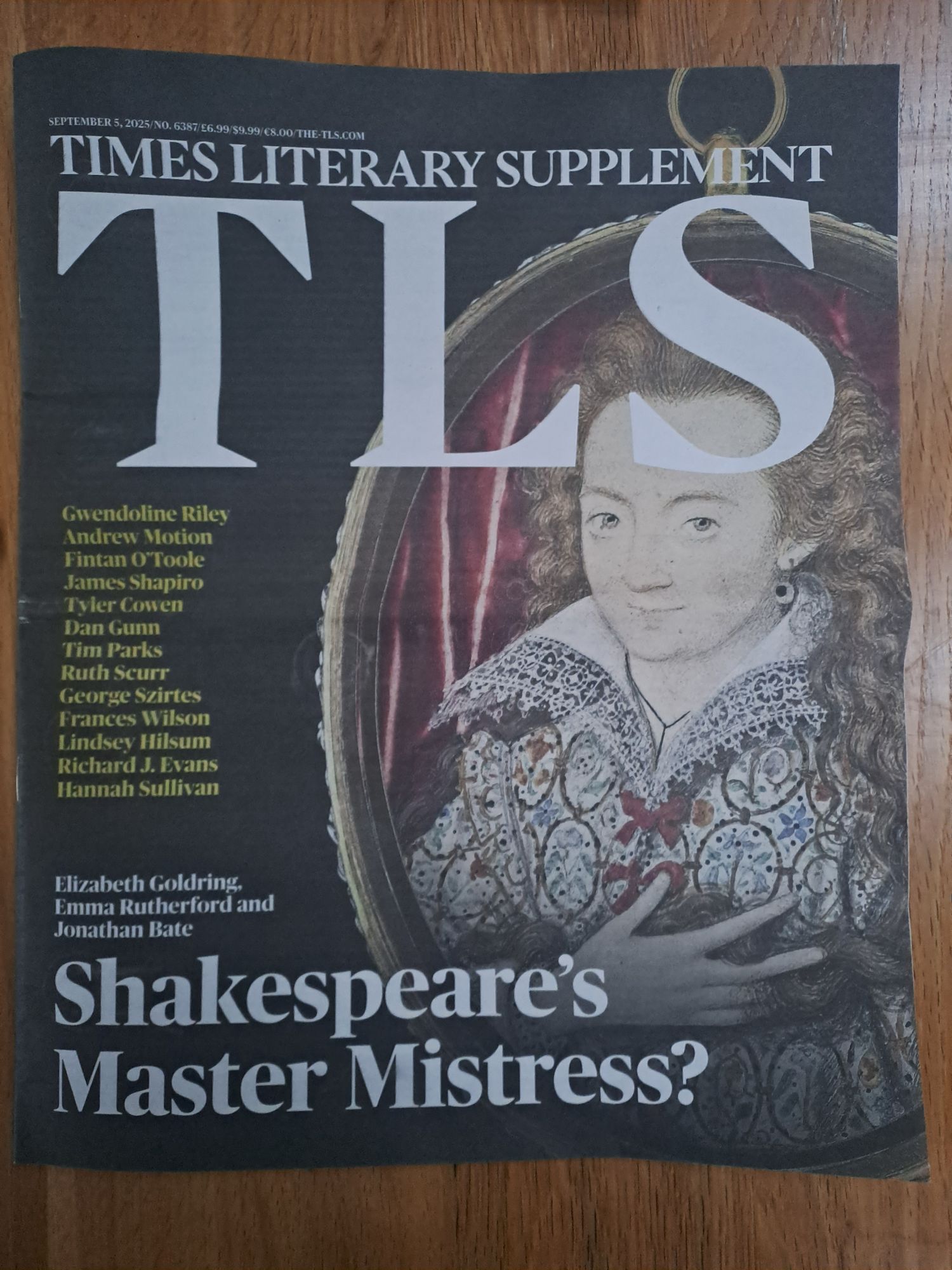
On the 20th May 1609, a collection of 154 Sonnets by William Shakespeare was published, which arguably represents at least as high a  level of literary achievement as his plays. The “Master Mistress” in the title of the TLS article is a reference to Sonnet No. 20 in the collection, published on 20th May 1609, of 154 Sonnets by William Shakespeare, which arguably represents at least as high a  level of literary achievement as his plays. Here is Sonnet No. 20 in the form usually printed nowadays:

A woman’s face with nature’s own hand painted,
Hast thou the master mistress of my passion,
A woman’s gentle heart but not acquainted
With shifting change as is false women’s fashion,
An eye more bright than theirs, less false in rolling:
Gilding the object whereupon it gazeth,
A man in hue all hues in his controlling,
Which steals men’s eyes and women’s souls amazeth.
And for a woman wert thou first created,
Till nature as she wrought thee fell a-doting,
And by addition me of thee defeated,
By adding one thing to my purpose nothing.
But since she pricked thee out for women’s pleasure,
Mine be thy love and thy love’s use their treasure.

The somewhat androgynous facial appearance of Henry Wriothesley – seen in other portraits – has led some to suggest that the above Sonnet was addressed to him. Others think that the poem was addressed to a young male actor (a “boy player“) who played female roles on the stage, as was usual in Shakespeare’s time. It was illegal for women to perform on stage until 1660.
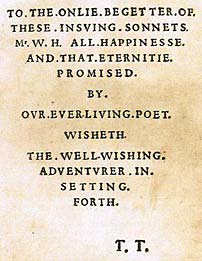
The dedication in the First Folio edition of the Sonnets, published in 1609, is shown on the left. The initials “T.T.” are accepted to stand for the name of the publisher Thomas Thorpe but the identity of “Mr. W.H.” is unknown. Of course “W.H.” is a reversal of the “H.W. ” that could be Henry Wriothesley, but would the publisher really use “Mr” to refer to a member of the nobility? Another curiosity is the prevalence of full stops, which is more characteristic of inscriptions carved in stone than on printed pages.

The First Folio edition was the only edition of the Sonnets published in Shakespeare’s lifetime and the circumstances of its publication remain uncertain to this day and not only because of identity of “Mr W.H.” For example, if it was authorised by Shakespeare, why did Shakespeare himself not write the dedication? Some have argued that it must have been published posthumously, so Shakespeare must have been dead in 1609, whereas most sources say he died in 1616.

Most of the poems (126 out of 154) contain poetic statements of love for a young man,  often called the “Fair Youth”. However, there is also a group of sonnets addressed to the poet’s mistress, an anonymous “dark lady”, which are far much more sexual in content than those addressed to the “Fair Youth”. The usual interpretation of this is that the poet’s love for the boy was purely Platonic rather than sexual in nature.  If Mr W.H. was a boy player then he would have been very young indeed, i.e. 13-17 years old…

Anyway, it was certainly a physical attraction: verse after verse speaks of the young man’s beauty. The first group of sonnets even encourage him to get married and have children so his beauty can continue and not die with his death. Sonnet 20 laments that the youth is not a woman, suggesting that this ruled out any sexual contact.  These early poems seem to suggest a slightly distant relationship between the two as if they didn’t really know each other well. However, as the collection goes on the poems become more and more intimate and it’s hard for me to accept that there wasn’t some sort of involvement between the two.  Although homosexual relationships were not officially tolerated in 17th Century England, they were not all that rare especially in the theatrical circles in which Shakespeare worked.

Oscar Wilde wrote a story called “A Portrait of Mr. W.H.” which suggests he is a young actor by the name of “Will Hughes”. The main evidence for this is Sonnet 20.

Look at the First Folio version:
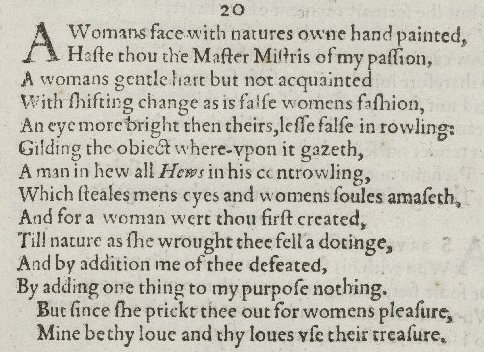
The initial capital and emphasis of “Hews” seen in line 7 is very unusual and suggests that it is a joke (one of many in this poem), in the form of a pun on the preceding “hew”. It is suggested that “Hews” is actually “Hughes”. Ingenious, but I’m not convinced. There were many other meanings of “hew” in use in Shakespeare’s time; it was a variant spelling of “ewe” for example.

We’ll probably never know who Mr W.H. was – presumably not Smith – or indeed what was the real nature of his relationship to Shakespeare but we do not need to know that to read and enjoy the poems.

I do have a fundamental misgiving, though, about the assumption that the “Onlie begetter” of these sonnets means the person to whom they are addressed, or who inspired them. That assumption entirely disregards the “Dark Lady” sequence. There are at least two addressees so neither can be the only begetter, if that is what begetter is supposed to mean.

I think it more likely Mr W.H., whoever he was, is the person who caused the collection to be created and/or published, perhaps by sponsoring the First Folio. It’s also possible that these poems may have been commissioned over the years by Mr. W.H. and/or others – experts think they were written over a period of at least 16 years – and only published together at much later date. It is indeed said that some of verses were circulated in private well before they were published, though they may perhaps have been edited or otherwise tidied up for the 1609 edition. Perhaps Shakespeare supplemented his income by writing sonnets to order?

This line of thought also took me to another question: why does everyone assume that all 126 of the “Fair Youth” sonnets are about the same person? That person is never named and only occasionally described. Some of the 126 are thematically linked, but overall it is a collection rather than a sequence. Some are humorous and some are very serious indeed. Some are downright cryptic. I think it quite possible, especially if the poems really were written over a period of 16 years, that they not all addressed to the same individual. Once you accept the evident truth that there is more than one recipient, then why not more than two?

Some have taken this even further and asked: do we really know that all 154 sonnets were written by the same person? The same question is asked about Shakespeare’s work generally. Was there really one person behind his plays, or were they collaborative efforts.

Finally, I wonder for what purpose these sonnets were written. Were they actually sent to the addressee(s) as expressions of love, like letters, or were they private meditations, like one might write in a journal?

I don’t suppose we’ll ever really know the answers to these questions, but I find it fascinating that the origin of such a famous collection is enshrouded in so many mysteries! I promise to post more of them here in due course.
Supplementary Information

Posted in Biographical, Crosswords, Literature with tags , , on September 29, 2025 by telescoper

Regular readers of this blog know that I have a habit of reading the Times Literary Supplement which I buy not only for the book reviews, but also for its excellent crossword. I’ve even won the crossword competition prize a few times. You can find an assortment of posts related to the TLS here.

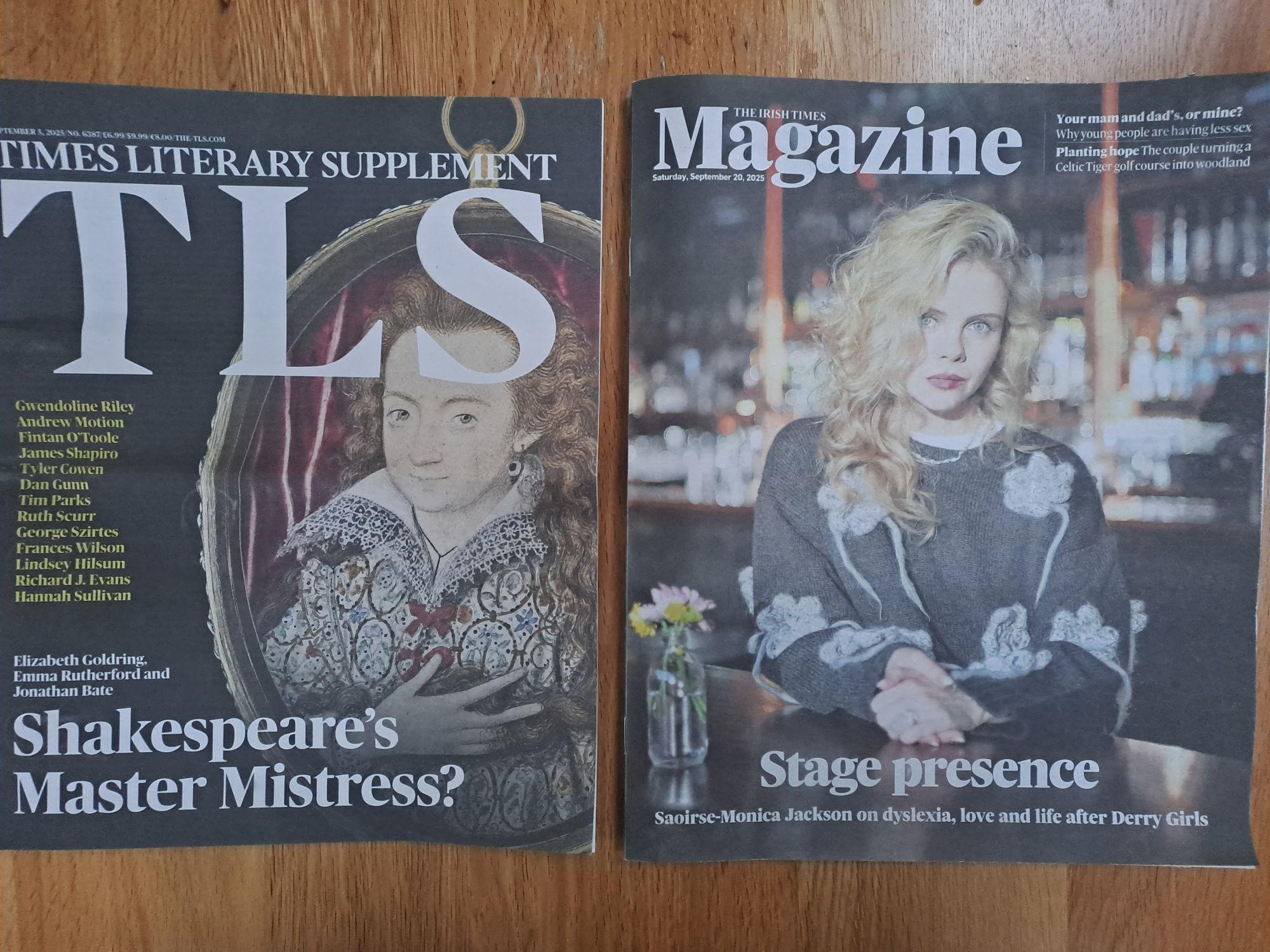
Recently the Times Literary Supplement underwent something of a makeover, changing the design and switching from a weekly to fortnightly publication. The first new-style issue was published on September 5th. Here is the cover:

The cover article is about the possible identity of the “Mr W.H.” to whom William Shakespeare dedicated his collection of Sonnets; see here. I may write something about that in the not too distant future, as I’ve been reading these again recently.

Anyway, my subscription definitely specifies a “weekly print edition delivered to my door”, so that has gone out the window. I wasn’t best pleased to have the terms of my subscription changed unilaterally like that. Of course I could just read the online edition, but I don’t like reading too much on a screen. I’ve never adapted to reading books on a Kindle either. And crosswords are impossible that way. The old format TLS was rather like a tabloid newspaper, which I found easy to read and handle, and of 28 pages per edition. The new format has 48 pages (which is not 2 times 28) and is rather cramped and crowded and with heavier paper to make it look there’s more to it than there is.

The look and feel they seem to have gone for is “Generic Weekend Supplement”, as you can see if you compare it with last week’s Irish Times Weekend Magazine:

The latter supplement has 52 pages instead of 48 and has more advertisements inside but is otherwise similar.

So why mention this? Well one thing is that the number of crosswords provided by the TLS per year has now reduced by half, which to me reduces the value of the subscription significantly. Moreover, the first issue of the new style supplement was published on September 5th, but didn’t arrive through my letterbox until 24th September. That’s 19 days. The deadline for entries to the crossword competition was September 15th.

Now the old-style issues used to take about 10 days to cross the Irish Sea, which I thought was bad, but 19 days is just awful. One theory of this is that the TLS launches issues with the same momentum, so that the new edition, having about twice the mass, has half the speed and therefore takes roughly twice as long to reach the subscriber. Checking the envelope, incidentally, I see that it was postmarked Bratislava. There must be a very cheap – but slow – way of sending post from the UK to Ireland via Slovakia.

Anyway, I’ve decided not to renew my subscription to the TLS, as I did with Private Eye recently. I cancelled my subscription to the Eye not because I was offended by anything in it, but because it was taking a ridiculously long time to arrive. I can still pick up copies of both publications in the local newsagent. I’m sure Paddy will keep copies of both to one side if I ask him.

Alternatively, I might switch from the TLS to the London Review of Books or some similar. Does anyone have recommendations?

Sonnet No. 75

Posted in Poetry with tags , , , , , on September 18, 2025 by telescoper
So are you to my thoughts as food to life,
Or as sweet-season'd showers are to the ground;
And for the peace of you I hold such strife
As 'twixt a miser and his wealth is found.
Now proud as an enjoyer, and anon
Doubting the filching age will steal his treasure;
Now counting best to be with you alone,
Then better'd that the world may see my pleasure:
Sometime all full with feasting on your sight,
And by and by clean starved for a look;
Possessing or pursuing no delight
Save what is had, or must from you be took.
Thus do I pine and surfeit day by day,
Or gluttoning on all, or all away.

by William Shakespeare (1564-1616)

Sonnet No. 112

Posted in Poetry with tags , , , , , on September 2, 2025 by telescoper
Your love and pity doth the impression fill
Which vulgar scandal stamp’d upon my brow;
For what care I who calls me well or ill,
So you o’er-green my bad, my good allow?
You are my all the world, and I must strive
To know my shames and praises from your tongue;
None else to me, nor I to none alive,
That my steel’d sense or changes right or wrong.
In so profound abysm I throw all care
Of others’ voices, that my adder’s sense
To critic and to flatterer stopped are.
Mark how with my neglect I do dispense:
You are so strongly in my purpose bred
That all the world besides methinks are dead.

by by William Shakespeare (1564-1616)

I find myself returning once again to Shakespeare’s sonnets, especially to the sequence of 126 poems that the poet addressed to a “Fair Youth“. This one is written in quite difficult language (for me) with some obscure words and phrases such as “adder’s sense”, “o’er-green” and “steel’d sense”. It’s almost as if parts of it are written in code. Nevertheless the overall meaning of the poem is clear: it revolves around the beautiful “You are my all the world” in line 5, shining out through the thickets, with “all the world” repeated in the last line for extra effect. The poet is saying that nobody’s opinion of him matters at all except that of his beloved. Know the feeling?

An Island of Strangers

Posted in Literature, Politics with tags , , , on May 13, 2025 by telescoper

In the light of Keir Starmer’s deplorable Faragist rhetoric about Britain becoming an ‘Island of Strangers’, and the obscene deportations and detentions without legal process of immigrants in the United States, I thought I’d repost this speech from the play Sir Thomas More which is widely attributed to William Shakespeare. It’s from Act 2 Scene 4, at which point in the drama Thomas More (who was then London’s Deputy Sheriff) is called upon to put down an anti-immigration riot in the Parish of St Martin Le Grand, that took place on 1st May 1517. In reality  More’s intevention wasn’t effective, and it took the arrival of 5000 troops to disperse the mob.

As well as being powerful for many other reasons, this speech especially fascinating because a hand-written manuscript (thought to be by Shakespeare himself) survives and is kept in the British Library.

The backdrop to this story is that, between 1330 and 1550 about 64,000 immigrants from all across Europe came to England in search of better lives. Locals blamed them for taking their jobs and threatening their culture. Tensions reached breaking point in 1517 and a mob armed with stones, bricks, bats, boots and boiling water attacked the immigrants and looted their homes.  Five hundred years on, and we still haven’t learned.

Here is the text of the opening part of the speech ‘This is the strangers case’.

Grant them removed, and grant that this your noise
Hath chid down all the majesty of England;
Imagine that you see the wretched strangers,
Their babies at their backs and their poor luggage,
Plodding to the ports and coasts for transportation,
And that you sit as kings in your desires,
Authority quite silent by your brawl,
And you in ruff of your opinions clothed;
What had you got? I’ll tell you: you had taught
How insolence and strong hand should prevail,
How order should be quelled; and by this pattern
Not one of you should live an aged man,
For other ruffians, as their fancies wrought,
With self same hand, self reasons, and self right,
Would shark on you, and men like ravenous fishes
Would feed on one another….

Say now the king
Should so much come too short of your great trespass
As but to banish you, whither would you go?
What country, by the nature of your error,
Should give you harbour? go you to France or Flanders,
To any German province, to Spain or Portugal,
Nay, any where that not adheres to England,
Why, you must needs be strangers: would you be pleased
To find a nation of such barbarous temper,
That, breaking out in hideous violence,
Would not afford you an abode on earth,
Whet their detested knives against your throats,
Spurn you like dogs, and like as if that God
Owed not nor made not you, nor that the claimants
Were not all appropriate to your comforts,
But chartered unto them, what would you think
To be thus used? this is the strangers case;
And this your mountainish inhumanity.

Better an Island of Strangers than an Island of Starmers, I’d say…

Sonnet No. 19

Posted in Poetry with tags , , , , on April 11, 2025 by telescoper
Devouring time, blunt thou the lion's paws
And make the earth devour her own sweet brood,
Pluck the keen teeth from the fierce tiger's jaws
And burn the long-liv'd phoenix in her blood,
Make glad and sorry seasons as thou fleet'st,
And do what e'er thou wilt, swift-footed time,
To the wide world and all her fading sweets:
But I forbid thee one most heinous crime,
O carve not with thy hours my love's fair brow,
Nor draw no lines there with thine antique pen,
Him in thy course untainted do allow
For beauty's pattern to succeeding men.
Yet do thy worst, old time, despite thy wrong,
My love shall in my verse ever live young.

by William Shakespeare (1564-1616)

(I don’t know why it’s been such a long time since I last posted one of Shakespeare’s sonnets.)

Sonnet No. 87

Posted in Poetry with tags , on November 21, 2018 by telescoper

Farewell! thou art too dear for my possessing,
And like enough thou knowst thy estimate.
The Charter of thy worth gives thee releasing;
My bonds in thee are all determinate.
For how do I hold thee but by thy granting,
And for that riches where is my deserving?
The cause of this fair gift in me is wanting,
And so my patent back again is swerving.
Thy self thou gav’st, thy own worth then not knowing,
Or me, to whom thou gav’st it, else mistaking,
So thy great gift, upon misprision growing,
Comes home again, on better judgement making.
Thus have I had thee as a dream doth flatter:
In sleep a king, but waking no such matter.


Sonnet No. 121

Posted in Literature with tags , on April 23, 2016 by telescoper

Oh, go on then. Here’s another post for the 400th anniversary of the death of William Shakespeare. I’ve posted quite a few of Shakespeare’s sonnets over the years, and my book of them goes with me whenever I travel, so it seems appropriate to post another as a personal way of marking the quatercentenary. This is Sonnet 121, another in the “fair youth” sequence, although to some extent it stands apart from the verses preceding and following it.  It was apparently written about the time a mysterious scandal was circulating about the poet and it’s presumably a specific reaction to that. The message is basically that having a bad reputation  is even worse than actually being bad. The poet does not claim to be blameless, be argues that he is being insulted by those whose sins are far worse than his and who therefore have no right to criticise him. So he decides to reject hypocrisy and be himself no matter what people say. It’s a poem that will resonate for anyone who has been falsely, perhaps maliciously, accused of something they did not do.

‘Tis better to be vile, than vile esteemed,
When not to be, receives reproach of being,
And the just pleasure lost which is so deemed
Not by our feeling, but by others’ seeing:
For why should others’ false adulterate eyes
Give salutation to my sportive blood?
Or on my frailties why are frailer spies,
Which in their wills count bad what I think good?
No; — I am that I am, and they that level
At my abuses reckon up their own:
I may be straight, though they themselves be bevel;
By their rank thoughts my deeds must not be shown;
Unless this general evil they maintain,
All men are bad, and in their badness reign.


Next! – The Complete Animated Shakespeare

Posted in Literature, Television with tags , , , on April 23, 2016 by telescoper

I’m sure most readers are aware that today is the 23rd April 2016, which is the 400th anniversary of the death of William Shakespeare. Despite the fact that most modern scholars agree that many of Shakespeare’s plays were not actually written by Shakespeare, but by someone else who had the same name, it’s still a good excuse to celebrate the life and work of a towering figure in the world of literature and drama. I was trying to think I suddenly remembered this marvellous animated film I saw when it was first released over 20 years ago. I couldn’t remember the name so it took me a bit of time to find it, but I got there in the end. It’s by Aardman Animations (best known for the later Wallace and Gromit films) and it was part of a splendid series of animated shorts called Lip-synch commissioned by Channel 4 and broadcast in 1990. It’s hard to imagine Channel 4 doing anything this good nowadays.  This film, called Next,  is only 5 minutes long yet it manages to refer to every single one of Shakespeare’s plays by having the immortal bard himself do them all as an audition. It’s not only clever and visually appealing but also a lot of fun…


Sonnet No. 98

Posted in History, Poetry with tags , , , on April 5, 2016 by telescoper

It’s been a while since I posted any of Shakespeare’s sonnets. A brief mention on the radio this morning that William Shakespeare died 400 years ago this month convinced me to rectify that omission and, since it is April, I thought I’d put up this one, No. 98. As with the rest of the first 126 of these poems, it is addressed by the poet to a “fair youth”, i.e. from an older man to a younger one. These sonnets deal with such themes as love, beauty, mortality, absence and longing, framed by the affectionate relationship between two men of very different ages:

From you have I been absent in the spring,
When proud-pied April, dressed in all his trim,
Hath put a spirit of youth in every thing,
That heavy Saturn laughed and leaped with him.
Yet nor the lays of birds, nor the sweet smell
Of different flowers in odour and in hue
Could make me any summer’s story tell,
Or from their proud lap pluck them where they grew.
Nor did I wonder at the lily’s white,
Nor praise the deep vermilion in the rose;
They were but sweet, but figures of delight
Drawn after you, you pattern of all those.
Yet seemed it winter still, and you away,
As with your shadow I with these did play.