Archive for William Wordsworth

Intimations of Immortality

Posted in Poetry with tags , on April 12, 2011 by telescoper

One of my very first blog posts was inspired by a book of poems by William Wordsworth. That piece included an excerpt from this poem, and since I’m a bit pressed for time these days I thought I’d post the whole thing. It also seems to suit a theme that’s been running through a few recent items. The full title is ODE: Intimations of Immortality from Reflections of Early Childhood, and it was written in the period 1803-1806. In the poem, Wordsworth returns to a theme he developed in Tintern Abbey, which provides an interesting contrast with this later masterpiece. You might disagree with Wordsworth’s metaphysical viewpoint, but I think few will argue that there’s sheer genius in his use of language.

I found a nice critique on the net, from which I decided to post the following extract:

Wordsworth consciously sets his speaker’s mind at odds with the atmosphere of joyous nature all around him, a rare move by a poet whose consciousness is so habitually in unity with nature. Understanding that his grief stems from his inability to experience the May morning as he would have in childhood, the speaker attempts to enter willfully into a state of cheerfulness; but he is able to find real happiness only when he realizes that “the philosophic mind” has given him the ability to understand nature in deeper, more human terms—as a source of metaphor and guidance for human life. This is very much the same pattern as “Tintern Abbey” ’s, but whereas in the earlier poem Wordsworth made himself joyful, and referred to the “music of humanity” only briefly, in the later poem he explicitly proposes that this music is the remedy for his mature grief.

The structure of the Immortality Ode is also unique in Wordsworth’s work; unlike his characteristically fluid, naturally spoken monologues, the Ode is written in a lilting, songlike cadence with frequent shifts in rhyme scheme and rhythm. Further, rather than progressively exploring a single idea from start to finish, the Ode jumps from idea to idea, always sticking close to the central scene, but frequently making surprising moves, as when the speaker begins to address the “Mighty Prophet” in the eighth stanza—only to reveal midway through his address that the mighty prophet is a six-year-old boy.

And here is the Ode in full. It’s a poem that moves me in ways I can’t explain.

THERE was a time when meadow, grove, and stream,
The earth, and every common sight,
To me did seem
Apparelled in celestial light,
The glory and the freshness of a dream.
It is not now as it hath been of yore;–
Turn wheresoe’er I may,
By night or day,
The things which I have seen I now can see no more.

II

The Rainbow comes and goes,
And lovely is the Rose,
The Moon doth with delight
Look round her when the heavens are bare,
Waters on a starry night
Are beautiful and fair;
The sunshine is a glorious birth;
But yet I know, where’er I go,
That there hath past away a glory from the earth.

III

Now, while the birds thus sing a joyous song,
And while the young lambs bound
As to the tabor’s sound,
To me alone there came a thought of grief:
A timely utterance gave that thought relief,
And I again am strong:
The cataracts blow their trumpets from the steep;
No more shall grief of mine the season wrong;
I hear the Echoes through the mountains throng,
The Winds come to me from the fields of sleep,
And all the earth is gay;
Land and sea
Give themselves up to jollity,
And with the heart of May
Doth every Beast keep holiday;–
Thou Child of Joy,
Shout round me, let me hear thy shouts, thou happy
Shepherd-boy!

IV

Ye blessed Creatures, I have heard the call
Ye to each other make; I see
The heavens laugh with you in your jubilee;
My heart is at your festival,
My head hath its coronal,
The fulness of your bliss, I feel–I feel it all.
Oh evil day! if I were sullen
While Earth herself is adorning,
This sweet May-morning,
And the Children are culling
On every side,
In a thousand valleys far and wide,
Fresh flowers; while the sun shines warm,
And the Babe leaps up on his Mother’s arm:–
I hear, I hear, with joy I hear!
–But there’s a Tree, of many, one,
A single Field which I have looked upon,
Both of them speak of something that is gone:
The Pansy at my feet
Doth the same tale repeat:
Whither is fled the visionary gleam?
Where is it now, the glory and the dream?

V

Our birth is but a sleep and a forgetting:
The Soul that rises with us, our life’s Star,
Hath had elsewhere its setting,
And cometh from afar:
Not in entire forgetfulness,
And not in utter nakedness,
But trailing clouds of glory do we come
From God, who is our home:
Heaven lies about us in our infancy!
Shades of the prison-house begin to close
Upon the growing Boy,
But He beholds the light, and whence it flows,
He sees it in his joy;
The Youth, who daily farther from the east
Must travel, still is Nature’s Priest,
And by the vision splendid
Is on his way attended;
At length the Man perceives it die away,
And fade into the light of common day.

VI

Earth fills her lap with pleasures of her own;
Yearnings she hath in her own natural kind,
And, even with something of a Mother’s mind,
And no unworthy aim,
The homely Nurse doth all she can
To make her Foster-child, her Inmate Man,
Forget the glories he hath known,
And that imperial palace whence he came.

VII

Behold the Child among his new-born blisses,
A six years’ Darling of a pigmy size!
See, where ‘mid work of his own hand he lies,
Fretted by sallies of his mother’s kisses,
With light upon him from his father’s eyes!
See, at his feet, some little plan or chart,
Some fragment from his dream of human life,
Shaped by himself with newly-learned art;
A wedding or a festival,
A mourning or a funeral;
And this hath now his heart,
And unto this he frames his song:
Then will he fit his tongue
To dialogues of business, love, or strife;
But it will not be long
Ere this be thrown aside,
And with new joy and pride
The little Actor cons another part;
Filling from time to time his “humorous stage”
With all the Persons, down to palsied Age,
That Life brings with her in her equipage;
As if his whole vocation
Were endless imitation.

VIII

Thou, whose exterior semblance doth belie
Thy Soul’s immensity;
Thou best Philosopher, who yet dost keep
Thy heritage, thou Eye among the blind,
That, deaf and silent, read’st the eternal deep,
Haunted for ever by the eternal mind,–
Mighty Prophet! Seer blest!
On whom those truths do rest,
Which we are toiling all our lives to find,
In darkness lost, the darkness of the grave;
Thou, over whom thy Immortality
Broods like the Day, a Master o’er a Slave,
A Presence which is not to be put by;
Thou little Child, yet glorious in the might
Of heaven-born freedom on thy being’s height,
Why with such earnest pains dost thou provoke
The years to bring the inevitable yoke,
Thus blindly with thy blessedness at strife?
Full soon thy Soul shall have her earthly freight,
And custom lie upon thee with a weight
Heavy as frost, and deep almost as life!

IX

O joy! that in our embers
Is something that doth live,
That nature yet remembers
What was so fugitive!
The thought of our past years in me doth breed
Perpetual benediction: not indeed
For that which is most worthy to be blest–
Delight and liberty, the simple creed
Of Childhood, whether busy or at rest,
With new-fledged hope still fluttering in his breast:–
Not for these I raise
The song of thanks and praise;
But for those obstinate questionings
Of sense and outward things,
Fallings from us, vanishings;
Blank misgivings of a Creature
Moving about in worlds not realised,
High instincts before which our mortal Nature
Did tremble like a guilty Thing surprised:
But for those first affections,
Those shadowy recollections,
Which, be they what they may,
Are yet the fountain light of all our day,
Are yet a master light of all our seeing;
Uphold us, cherish, and have power to make
Our noisy years seem moments in the being
Of the eternal Silence: truths that wake,
To perish never;
Which neither listlessness, nor mad endeavour,
Nor Man nor Boy,
Nor all that is at enmity with joy,
Can utterly abolish or destroy!
Hence in a season of calm weather
Though inland far we be,
Our Souls have sight of that immortal sea
Which brought us hither,
Can in a moment travel thither,
And see the Children sport upon the shore,
And hear the mighty waters rolling evermore.

X

Then sing, ye Birds, sing, sing a joyous song!
And let the young Lambs bound
As to the tabor’s sound!
We in thought will join your throng,
Ye that pipe and ye that play,
Ye that through your hearts to-day
Feel the gladness of the May!
What though the radiance which was once so bright
Be now for ever taken from my sight,
Though nothing can bring back the hour
Of splendour in the grass, of glory in the flower;
We will grieve not, rather find
Strength in what remains behind;
In the primal sympathy
Which having been must ever be;
In the soothing thoughts that spring
Out of human suffering;
In the faith that looks through death,
In years that bring the philosophic mind.

XI

And O, ye Fountains, Meadows, Hills, and Groves,
Forebode not any severing of our loves!
Yet in my heart of hearts I feel your might;
I only have relinquished one delight
To live beneath your more habitual sway.
I love the Brooks which down their channels fret,
Even more than when I tripped lightly as they;
The innocent brightness of a new-born Day
Is lovely yet;
The Clouds that gather round the setting sun
Do take a sober colouring from an eye
That hath kept watch o’er man’s mortality;
Another race hath been, and other palms are won.
Thanks to the human heart by which we live,
Thanks to its tenderness, its joys, and fears,
To me the meanest flower that blows can give
Thoughts that do often lie too deep for tears.


Share/Bookmark

The Two Deserts

Posted in Poetry, The Universe and Stuff with tags , , , on March 28, 2011 by telescoper

An interesting choice for Poem of the Week in the Grauniad today is this, Two Deserts, by Coventry Patmore.

Not greatly moved with awe am I
To learn that we may spy
Five thousand firmaments beyond our own.
The best that’s known
Of the heavenly bodies does them credit small.
View’d close, the Moon’s fair ball
Is of ill objects worst,
A corpse in Night’s highway, naked, fire-scarr’d, accurst;
And now they tell
That the Sun is plainly seen to boil and burst
Too horribly for hell.
So, judging from these two,
As we must do,
The Universe, outside our living Earth,
Was all conceiv’d in the Creator’s mirth,
Forecasting at the time Man’s spirit deep,
To make dirt cheap.
Put by the Telescope!
Better without it man may see,
Stretch’d awful in the hush’d midnight,
The ghost of his eternity.
Give me the nobler glass that swells to the eye
The things which near us lie,
Till Science rapturously hails,
In the minutest water-drop,
A torment of innumerable tails.
These at the least do live.
But rather give
A mind not much to pry
Beyond our royal-fair estate
Betwixt these deserts blank of small and great.
Wonder and beauty our own courtiers are,
Pressing to catch our gaze,
And out of obvious ways
Ne’er wandering far.

I think this is quite an interesting composition because of its fluid structure and variable metre, although I think the language is a bit contrived in places. Or is it just dated? However, as a scientist, I can’t really agree with the sentiments it expresses (which are also found in abundance elsewhere in 19th Century poetry, such in Walt Whitman’s When I heard the learn’d astronomer).

As the accompanying piece in the Guardian puts it,

Patmore hymns imaginative perception of local realities at the expense of scientific discovery: the reverse position is today’s default.

I’m not sure that last statement is true, for most people, but in any case I’d argue that the more we discover through scientific means the more there is to inspire artists, as long as they have their imaginative eyes open…

Although you probably associate Patmore’s point view with poets of the romantic tradition, such as Wordsworth (whose poetry I admire enormously), I think it’s a misguided assertion that science ignores “the imaginative eye”.  I don’t think it does. Science is full of imagination, it’s just of a form different from that found in the arts. Science and the arts offer complementary ways of imagining. They’re neither incompatible with each other nor is one superior to the other.

And, as I’ve mentioned before there’s more to life than the tedious arts-versus-science rants beloved of certain academics. I can’t think of a clearer expression of the supreme importance of simply living than this, from a poem by William Wordsworth I posted just a few days ago:

Enough of Science and of Art;
Close up these barren leaves;
Come forth, and bring with you a heart
That watches and receives.


Share/Bookmark

The Tables Turned

Posted in Poetry with tags , on March 22, 2011 by telescoper

Up! up! my Friend, and quit your books;
Or surely you’ll grow double:
Up! up! my Friend, and clear your looks;
Why all this toil and trouble?

The sun above the mountain’s head,
A freshening lustre mellow
Through all the long green fields has spread,
His first sweet evening yellow.

Books! ’tis a dull and endless strife:
Come, hear the woodland linnet,
How sweet his music! on my life,
There’s more of wisdom in it.

And hark! how blithe the throstle sings!
He, too, is no mean preacher:
Come forth into the light of things,
Let Nature be your teacher.

She has a world of ready wealth,
Our minds and hearts to bless–
Spontaneous wisdom breathed by health,
Truth breathed by cheerfulness.

One impulse from a vernal wood
May teach you more of man,
Of moral evil and of good,
Than all the sages can.

Sweet is the lore which Nature brings;
Our meddling intellect
Mis-shapes the beauteous forms of things:–
We murder to dissect.

Enough of Science and of Art;
Close up those barren leaves;
Come forth, and bring with you a heart
That watches and receives.

by William Wordsworth (1770-1850).


Share/Bookmark

A Gloom of Uninspired Research

Posted in Education, Poetry, Politics, Science Politics with tags , , , , , , , on November 26, 2010 by telescoper

I don’t mind admitting that I’m a bit down today. Being stuck at home with a fever and sore throat, and with mounting backlog of things to do isn’t helping my mood. On top of that I’ve got a general sense of depression about the future.

On the one hand there’s the prospect of huge increases in tuition fees for students, the motivation for many demonstrations all around the country (including an occupation here at Cardiff). I have to admit I’m firmly on the side of the students. It seems to me that what is happening is that whereas we used to finance our national gluttony by borrowing on over-valued property prices, we’ve now decided to borrow instead from the young, forcing them to pay for what we got for free instead of paying for it ourselves; it’s no wonder they’re angry. Call me old-fashioned, but I think universities should be funded out of general taxation. How many universities, and what courses, are different questions and I suspect I differ from the younger generation on the answers.

The other depressing thing relates to the other side of academic life, research. The tide of managerialism looks like sweeping away every last vestige of true originality in scientific research, in a drive for greater “efficiency”. I’ve already blogged about how the Science & Technology Facilities Council (STFC) is introducing a new system for grants which will make it impossible for individual researchers with good ideas to get money to start new research projects. Now it seems the Engineering and Physical Sciences Research Council (EPSRC) is going to go down the same road. It looks likely that in future only large-scale, low-risk research done in big consortia will be funded. Bandwagons are in; creativity is out.

Improving “efficiency” sounds like a good idea, but efficiency of what? These plans may reduce the cost of administering research grants, but they won’t do anything to increase the rate of scientific progress. Still, scientific progress can’t be entered easily on a spreadsheet so I suppose in this day and age that means it doesn’t matter.

I found the following in a story in this weeks Times Higher,

A spokeswoman for the Science and Technology Facilities Council also cited stability and flexibility as the main rationales for merging its grants programmes into one “consolidated grant”, a move announced earlier this month.

It looks like STFC has seconded someone from the  Ministry of Truth. The change to STFC’s grant system is in fact driven by two factors. One is to save money, which is what they’ve been told to do so no criticism there. The other is that the costly fiasco that is the new RCUK Shared Services Centre was so badly conceived that it has a grant system that is unable to adminster 5-year rolling grants of the type we have been used to having in astronomy. On top of that, research grants will last only 3 years (as opposed to the previous 5-year duration). There’s a typically Orwellian inversion  going on in our spokesperson’s comment: for “stability and flexibility”, read “instability and inflexibility”.

We’re not children. We all know that times are tough, but we could do with a bit less spin and a bit more honesty from the people ruining running British science. Still, I’m sure the resident spin doctors at STFC are “efficient”, and these days that’s all that matters.

The following excerpt from Wordsworth’s The Excursion pretty much sums it up.

Life’s autumn past, I stand on winter’s verge;
And daily lose what I desire to keep:
Yet rather would I instantly decline
To the traditionary sympathies
Of a most rustic ignorance, and take
A fearful apprehension from the owl
Or death-watch: and as readily rejoice,
If two auspicious magpies crossed my way;–
To this would rather bend than see and hear
The repetitions wearisome of sense,
Where soul is dead, and feeling hath no place;
Where knowledge, ill begun in cold remark
On outward things, with formal inference ends;
Or, if the mind turn inward, she recoils
At once–or, not recoiling, is perplexed–
Lost in a gloom of uninspired research;
Meanwhile, the heart within the heart, the seat
Where peace and happy consciousness should dwell,
On its own axis restlessly revolving,
Seeks, yet can nowhere find, the light of truth.


Share/Bookmark

The Ladies of Llangollen

Posted in History, Poetry with tags , , on September 19, 2010 by telescoper

I was doing the crossword in the Times Literary Supplement this morning and one of the clues triggered only a distant memory which I had to check via the fount of all wisdom that is Google. The clue referred to a “Vale of Friendship” which I’d vaguely remembered seeing in a poem by William Wordsworth. Anyway, I was right in remembering the origin of the phrase, but I accidentally found out a lot more about the context as well and thought I’d share it here.

In fact there’s an entire wikipedia page devoted to the Ladies of Llangollen, so there’s no need to reproduce it all here. However, for the sake of you who haven’t heard of them, they were Lady Eleanor Charlotte Butler and the Honourable Sarah Ponsonby. They were of Anglo-Irish extraction and had been brought up just a few miles from each other in Ireland. They met in 1768 and immediately hit it off together. They ran off together to avoid being forced into unwanted marriage, and moved to Wales in order to set up home  at Plas Newydd, near Llangollen in Denbighshire, in 1780.

They lived together for the best part of 50 years in Plas Newydd, in relative seclusion, devoting their time to private studies of literature and languages and improving their estate, comprehensively redesigning the house in a Gothic style, and adding a superb garden. They did not actively socialise and town-dwellers of Llangollen seem to have regarded them as eccentrics, simply referring to them as “The Ladies”.

Gradually, their life attracted the interest of the outside world. Their house became a haven for all manner of visitors, mostly writers such as Wordsworth, Robert Southey, Shelley, Byron and Scott, but also the military leader Duke of Wellington and industrialist Josiah Wedgwood; aristocratic novelist Caroline Lamb, who was born a Ponsonby, came to visit too. Even travellers from continental Europe had heard of the couple and came to visit them, for instance Prince Hermann von Pückler-Muskau, the German nobleman and landscape designer who wrote admiringly about them.

The story of the “romantic friendship” between these two ladies is both charming and moving, but it’s also fascinating to learn how their lifestyle was accepted and even celebrated by wider society. One might have thought their relationship would have been regarded as scandalous by their contemporaries, rather than being widely admired as it turned out to be. One is tempted to assume that their  “marriage” had a sexual dimension, which it may well have done, but it could have been a platonic, yet still romantic, friendship. As far as I’m concerned, that doesn’t really matter;  what I find inspiring about them is that they dared to be different.

Anyway, here is the beautiful sonnet that William Wordsworth wrote after meeting the Ladies of Llangollen in 1824, although I believe the Ladies took exception to the description of their magnificent house as a “low-roofed cot”!

A stream, to mingle with your favourite Dee,
Along the vale of meditation flows;
So styled by those fierce Britons, pleased to see
In Nature’s face the expression of repose;
Or haply there some pious hermit chose
To live and die, the peace of heaven his aim;
To whom the wild sequestered region owes
At this late day, its sanctifying name.
Glyn Cafaillgaroch, in the Cambrian tongue,
In ours, the Vale of Friendship, let ‘this’ spot
Be named; where, faithful to a low-roofed Cot,
On Deva’s banks, ye have abode so long;
Sisters in love, a love allowed to climb,
Even on this earth, above the reach of Time!


Share/Bookmark

Influence of Natural Objects

Posted in Poetry with tags on May 22, 2010 by telescoper

For no particular reason I thought it would be good to post some more Wordsworth. Influence of Natural Objects, not one of his better known poems,  was written in 1799, just a year or so after this great Tintern Abbey; it deals with similar themes and contains several memorable passages and turns of phrase. I especially love “cut across the reflex of a star”….

Wisdom and Spirit of the universe!
Thou Soul, that art the Eternity of thought!
And giv’st to forms and images a breath
And everlasting motion! not in vain,
By day or star-light, thus from my first dawn
Of childhood didst thou intertwine for me
The passions that build up our human soul;
Not with the mean and vulgar works of Man;
But with high objects, with enduring things,
With life and nature; purifying thus
The elements of feeling and of thought,
And sanctifying by such discipline
Both pain and fear,–until we recognise
A grandeur in the beatings of the heart.
Nor was this fellowship vouchsafed to me
With stinted kindness. In November days,
When vapours rolling down the valleys made
A lonely scene more lonesome; among woods
At noon; and ‘mid the calm of summer nights,
When, by the margin of the trembling lake,
Beneath the gloomy hills, homeward I went
In solitude, such intercourse was mine:
Mine was it in the fields both day and night,
And by the waters, all the summer long.
And in the frosty season, when the sun
Was set, and, visible for many a mile,
The cottage-windows through the twilight blazed,
I heeded not the summons: happy time
It was indeed for all of us; for me
It was a time of rapture! Clear and loud
The village-clock tolled six–I wheeled about,
Proud and exulting like an untired horse
That cares not for his home.–All shod with steel
We hissed along the polished ice, in games
Confederate, imitative of the chase
And woodland pleasures,–the resounding horn,
The pack loud-chiming, and the hunted hare.
So through the darkness and the cold we flew,
And not a voice was idle: with the din
Smitten, the precipices rang aloud;
The leafless trees and every icy crag
Tinkled like iron; while far-distant hills
Into the tumult sent an alien sound
Of melancholy, not unnoticed while the stars,
Eastward, were sparkling clear, and in the west
The orange sky of evening died away.
Not seldom from the uproar I retired
Into a silent bay, or sportively
Glanced sideway, leaving the tumultuous throng,
To cut across the reflex of a star;
Image, that, flying still before me, gleamed
Upon the glassy plain: and oftentimes,
When we had given our bodies to the wind,
And all the shadowy banks on either side
Came sweeping through the darkness, spinning still
The rapid line of motion, then at once
Have I, reclining back upon my heels,
Stopped short; yet still the solitary cliffs
Wheeled by me–even as if the earth had rolled
With visible motion her diurnal round!
Behind me did they stretch in solemn train,
Feebler and feebler, and I stood and watched
Till all was tranquil as a summer sea.

“Tintern Abbey”

Posted in Poetry with tags , , on March 25, 2010 by telescoper

We haven’t had any Wordsworth for a while, so here’s possibly his greatest poem. It was

Composed A Few Miles Above Tintern Abbey,
On Revisiting The Banks Of The Wye During A Tour. July 13, 1798

I’m ashamed to admit that although it’s only 30 miles or so from Cardiff, and I’ve lived here nearly three years now, I still haven’t visited Tintern Abbey. That doesn’t stop me thinking this is deeply evocative of the place.

      FIVE years have past; five summers, with the length
      Of five long winters! and again I hear
      These waters, rolling from their mountain-springs
      With a soft inland murmur.–Once again
      Do I behold these steep and lofty cliffs,
      That on a wild secluded scene impress
      Thoughts of more deep seclusion; and connect
      The landscape with the quiet of the sky.
      The day is come when I again repose
      Here, under this dark sycamore, and view                        10
      These plots of cottage-ground, these orchard-tufts,
      Which at this season, with their unripe fruits,
      Are clad in one green hue, and lose themselves
      ‘Mid groves and copses. Once again I see
      These hedge-rows, hardly hedge-rows, little lines
      Of sportive wood run wild: these pastoral farms,
      Green to the very door; and wreaths of smoke
      Sent up, in silence, from among the trees!
      With some uncertain notice, as might seem
      Of vagrant dwellers in the houseless woods,                     20
      Or of some Hermit’s cave, where by his fire
      The Hermit sits alone.
                              These beauteous forms,
      Through a long absence, have not been to me
      As is a landscape to a blind man’s eye:
      But oft, in lonely rooms, and ‘mid the din
      Of towns and cities, I have owed to them
      In hours of weariness, sensations sweet,
      Felt in the blood, and felt along the heart;
      And passing even into my purer mind,
      With tranquil restoration:–feelings too                        30
      Of unremembered pleasure: such, perhaps,
      As have no slight or trivial influence
      On that best portion of a good man’s life,
      His little, nameless, unremembered, acts
      Of kindness and of love. Nor less, I trust,
      To them I may have owed another gift,
      Of aspect more sublime; that blessed mood,
      In which the burthen of the mystery,
      In which the heavy and the weary weight
      Of all this unintelligible world,                                 40
      Is lightened:–that serene and blessed mood,
      In which the affections gently lead us on,–
      Until, the breath of this corporeal frame
      And even the motion of our human blood
      Almost suspended, we are laid asleep
      In body, and become a living soul:
      While with an eye made quiet by the power
      Of harmony, and the deep power of joy,
      We see into the life of things.
                                       If this
      Be but a vain belief, yet, oh! how oft–                        50
      In darkness and amid the many shapes
      Of joyless daylight; when the fretful stir
      Unprofitable, and the fever of the world,
      Have hung upon the beatings of my heart–
      How oft, in spirit, have I turned to thee,
      O sylvan Wye! thou wanderer thro’ the woods,
      How often has my spirit turned to thee!
        And now, with gleams of half-extinguished thought,
      With many recognitions dim and faint,
      And somewhat of a sad perplexity,                               60
      The picture of the mind revives again:
      While here I stand, not only with the sense
      Of present pleasure, but with pleasing thoughts
      That in this moment there is life and food
      For future years. And so I dare to hope,
      Though changed, no doubt, from what I was when first
      I came among these hills; when like a roe
      I bounded o’er the mountains, by the sides
      Of the deep rivers, and the lonely streams,
      Wherever nature led: more like a man                            70
      Flying from something that he dreads, than one
      Who sought the thing he loved. For nature then
      (The coarser pleasures of my boyish days,
      And their glad animal movements all gone by)
      To me was all in all.–I cannot paint
      What then I was. The sounding cataract
      Haunted me like a passion: the tall rock,
      The mountain, and the deep and gloomy wood,
      Their colours and their forms, were then to me
      An appetite; a feeling and a love,                              80
      That had no need of a remoter charm,
      By thought supplied, nor any interest
      Unborrowed from the eye.–That time is past,
      And all its aching joys are now no more,
      And all its dizzy raptures. Not for this
      Faint I, nor mourn nor murmur, other gifts
      Have followed; for such loss, I would believe,
      Abundant recompence. For I have learned
      To look on nature, not as in the hour
      Of thoughtless youth; but hearing oftentimes                    90
      The still, sad music of humanity,
      Nor harsh nor grating, though of ample power
      To chasten and subdue. And I have felt
      A presence that disturbs me with the joy
      Of elevated thoughts; a sense sublime
      Of something far more deeply interfused,
      Whose dwelling is the light of setting suns,
      And the round ocean and the living air,
      And the blue sky, and in the mind of man;
      A motion and a spirit, that impels                             100
      All thinking things, all objects of all thought,
      And rolls through all things. Therefore am I still
      A lover of the meadows and the woods,
      And mountains; and of all that we behold
      From this green earth; of all the mighty world
      Of eye, and ear,–both what they half create,
      And what perceive; well pleased to recognise
      In nature and the language of the sense,
      The anchor of my purest thoughts, the nurse,
      The guide, the guardian of my heart, and soul                  110
      Of all my moral being.
                              Nor perchance,
      If I were not thus taught, should I the more
      Suffer my genial spirits to decay:
      For thou art with me here upon the banks
      Of this fair river; thou my dearest Friend,
      My dear, dear Friend; and in thy voice I catch
      The language of my former heart, and read
      My former pleasures in the shooting lights
      Of thy wild eyes. Oh! yet a little while
      May I behold in thee what I was once,                          120
      My dear, dear Sister! and this prayer I make,
      Knowing that Nature never did betray
      The heart that loved her; ’tis her privilege,
      Through all the years of this our life, to lead
      From joy to joy: for she can so inform
      The mind that is within us, so impress
      With quietness and beauty, and so feed
      With lofty thoughts, that neither evil tongues,
      Rash judgments, nor the sneers of selfish men,
      Nor greetings where no kindness is, nor all                    130
      The dreary intercourse of daily life,
      Shall e’er prevail against us, or disturb
      Our cheerful faith, that all which we behold
      Is full of blessings. Therefore let the moon
      Shine on thee in thy solitary walk;
      And let the misty mountain-winds be free
      To blow against thee: and, in after years,
      When these wild ecstasies shall be matured
      Into a sober pleasure; when thy mind
      Shall be a mansion for all lovely forms,                       140
      Thy memory be as a dwelling-place
      For all sweet sounds and harmonies; oh! then,
      If solitude, or fear, or pain, or grief,
      Should be thy portion, with what healing thoughts
      Of tender joy wilt thou remember me,
      And these my exhortations! Nor, perchance–
      If I should be where I no more can hear
      Thy voice, nor catch from thy wild eyes these gleams
      Of past existence–wilt thou then forget
      That on the banks of this delightful stream                    150
      We stood together; and that I, so long
      A worshipper of Nature, hither came
      Unwearied in that service: rather say
      With warmer love–oh! with far deeper zeal
      Of holier love. Nor wilt thou then forget,
      That after many wanderings, many years
      Of absence, these steep woods and lofty cliffs,
      And this green pastoral landscape, were to me
      More dear, both for themselves and for thy sake!

So it doesn’t have anything to do with astronomy or cosmology, except for the “unintelligible world” (line 40) of STFC…

Poem for the Day

Posted in Poetry with tags , , on December 17, 2009 by telescoper

October, 1803 

These times strike monied worldlings with dismay:
Even rich men, brave by nature, taint the air
With words of apprehension and despair:
While tens of thousands, thinking on the affray,
Men unto whom sufficient for the day
And minds not stinted or untilled are given,
Sound, healthy, children of the God of heaven,
Are cheerful as the rising sun in May.
What do we gather hence but firmer faith
That every gift of noble origin
Is breathed upon by Hope’s perpetual breath;
That virtue and the faculties within
Are vital,–and that riches are akin
To fear, to change, to cowardice, and death?

(by William Wordsworth).

Examination Matters

Posted in Biographical, Education with tags , , on June 10, 2009 by telescoper

I made it safely back to Blighty last night and have spent the day catching up on a few things. I wasn’t really planning to post anything today, but after looking through the comments on my previous item I thought it was probably a good idea to move on!

My trip to Copenhagen was carefully timed to miss the mammoth examiners’ meeting that took place yesterday in the Cardiff School of Physics & Astronomy, at which decisions were made about the degree classes of the graduating students. Final results have to be confirmed by the University but, following a longstanding tradition, provisional pass lists went up on the boards immediately after the meeting.

When I came in this morning I was delighted to hear that the meeting went off fairly smoothly and also delighted to see the pass lists had very good news for many of the students I know quite well personally. Particular congratulations to all the students who got First Class Honours, some of whom will be taking another step on the academic treadmill and going on to do PhDs here and there. I’m not really sorry I missed the examiners’ meeting, but I am sorry I wasn’t here to congratulate the soon-to-be-graduates in person.

I remember that when I finished my degree and got the result I didn’t actually feel much euphoria, only exhaustion. When I was younger, exams were always times of enormous stress for me. I guess that’s because, when I first went to School, I was very far behind everyone else and, as one of the “slow” kids, I was almost thrown in the educational wastebin. I gradually caught up but for a long time felt that I was still regarded as a bit of a dunderhead so, to prove I wasn’t a fake,  to myself as much as anyone else, I worked very hard at all the examinations I had to take. It was only when I got to University that I realised all the stress wasn’t worth it. It’s nice to pass but you shouldn’t become obsessed with grades and certificates. Examinations seem to have an almost overwhelming significance when they’re the only thing on your horizon, but years later you will look back on them as being of very little real importance (regardless of whether you did well or not).

My feelings about examinations agree pretty much with William Wordsworth, who studied at the same University as me, as expressed in this quotation from The Prelude:

Of College labours, of the Lecturer’s room
All studded round, as thick as chairs could stand,
With loyal students, faithful to their books,
Half-and-half idlers, hardy recusants,
And honest dunces–of important days,
Examinations, when the man was weighed
As in a balance! of excessive hopes,
Tremblings withal and commendable fears,
Small jealousies, and triumphs good or bad–
Let others that know more speak as they know.
Such glory was but little sought by me,
And little won.

It seems to me a great a pity that our system of education – both at School and University – places such a great emphasis on examination and assessment, to the detriment of real learning. The biggest bane of physics education is the way modular degrees have been implemented. Don’t get me wrong. I’m not opposed to modularisation in principle. I just think the way we teach modules in British university fails to develop any understanding of the interconnection between different aspects of the subject. That’s an educational disaster because what is most exciting and compelling about physics is its essential unity. Splitting it into little boxes, taught on their own with no relationship to the other boxes, provides us with no scope to nurture the kind of lateral thinking that is key to the way physicists attempt to solve problems. The small size of each module makes the syllabus very “bitty” and fragmented. No sooner have you started to explore something at a proper level than the module is over. More advanced modules, following perhaps the following year, have to recap a large fraction of the earlier modules so there isn’t time to go as deep as one would like even over the whole curriculum.

Our students take 120 “credits” in a year, split into two semesters. These are usually split into 10-credit modules with an examination at the end of each semester. Laboratories and other continuously-assessed work does not involve a written examination, but the system means that a typical  student will have 5 written examination papers in January and another 5 in May. Each paper is two hours.

These factors mean that the ratio of assessment to education has risen sharply over the last decades with the undeniable result that academic standards have fallen in physics. The system encourages students to think of modules as little bit-sized bits of education to be consumed and then forgotten. Instead of learning to rely on their brains to solve problems, students tend to approach learning by memorising chunks of their notes and regurgitating them in the exam. I find it very sad when students ask me what derivations they should memorize to prepare for examinations. A brain is much more than a memory device. What we should be doing is giving students the confidence to think for themselves.

You can contrast this diet of examinations with the regime when I was an undergraduate. My entire degree result was based on six three-hour written examinations taken at the end of my final year, rather than something like 30 examinations taken over 3 years. Moreover, my finals were all in a three-day period. Morning and afternoon exams for three consecutive days is an ordeal I wouldn’t wish on anyone so I’m not saying the old days were better, but I do think we’ve gone far too far to the opposite extreme. The one good thing about the system I went through was that there was no possibility of passing examinations on memory alone. Since they were so close together there was no way of mugging up anything in between them. I only got through  by figuring things out in the exam room.

I don’t want to denigrate the success of our high achievers. They have taken the course we have given them and done extremely well. They deserve admiration and praise. What I’m saying is that I don’t think the education we provide does justice to their talents. That’s our fault, not theirs…

Poems of Space

Posted in Books, Talks and Reviews, Poetry, The Universe and Stuff with tags , , , , , , , on February 1, 2009 by telescoper

A couple of weeks ago I bought a copy of Dark Matter: Poems of Space, an anthology of poems old and new with astronomical connections edited by Maurice Riordan and Dame Jocelyn Bell Burnell.

I quite like having anthologies because if you open one randomly you’re not absolutely sure what’s going to crop up, which can lead to pleasant surprises. But they’re also unsatisfactory to read through from cover to cover because there are huge differences in style and substance that are difficult to adjust to on a poem-by-poem basis. Random access is definitely better than sequential for this type of thing, so rather than attempt to study it all, over the last fortnight or so I’ve been taking regular dips into this particular collection, and very interesting it has been too.

The book contains over 200 poems mostly by different authors, although there is more than one contribution from a few (including Shelley and Auden). It’s a mixture of the familiar and the brand new, including some commissioned especially for this book. I couldn’t possibly write about the whole, but a few things struck me as I sampled various tidbits.

The first is that while many of these poems celebrate the beauty and majesty of the heavens, and some even embrace the wonder of scientific discovery, quite a few are quite anti-scientific. Two examples spring to mind (both of them paradoxically by favourite poets of mine!). This excerpt from The Song of the Happy Shepherd, a very early poem by WB Yeats is a good example

………………………………Seek, then,
No learning from the starry men,
Who follow with the optic glass
The whirling ways of stars that pass –
Seek, then, for this is also sooth,
No word of theirs – the cold star-bane
Has cloven and rent their hearts in twain,
And dead is all their human truth.

Hardly a ringing endorsement of observational astronomy, although strictly speaking it only refers to optical techniques so I suppose those working in radio-, X-ray and other types of astronomy are off the hook.

Incidentally, if I’d been given the task of picking a poem by Yeats for this collection it would have been this:

HAD I the heavens’ embroidered cloths,
Enwrought with gold and silver light,
The blue and the dim and the dark cloths
Of night and light and the half light,
I would spread the cloths under your feet:
But I, being poor, have only my dreams;
I have spread my dreams under your feet;
Tread softly because you tread on my dreams.

It’s not really much to do with astronomy or space but it’s one of his most beautiful lyrical verses, with a wonderful use of repetition (e.g. light, dreams, spread, tread) and assonance (light/night, spread/tread).

Anyway, another example of this kind of attitude displayed by Yeats Happy Shepherd is provided by Walt Whitman:

WHEN I heard the learn’d astronomer;
When the proofs, the figures, were ranged in columns before me;
When I was shown the charts and the diagrams, to add, divide, and measure them;
When I, sitting, heard the astronomer, where he lectured with much applause in the lecture-room,
How soon, unaccountable, I became tired and sick;
Till rising and gliding out, I wander’d off by myself,
In the mystical moist night-air, and from time to time,
Look’d up in perfect silence at the stars.

I think I’ve been to enough boring seminars to understand how he feels, but the theme of both these poems is that  studying the stars or applying science to them somehow robs them of their wonder. I think many non-scientists probably go along with this view: it’s beautiful to gaze at the sky but reducing it to measurements and graphs somehow ruins it.

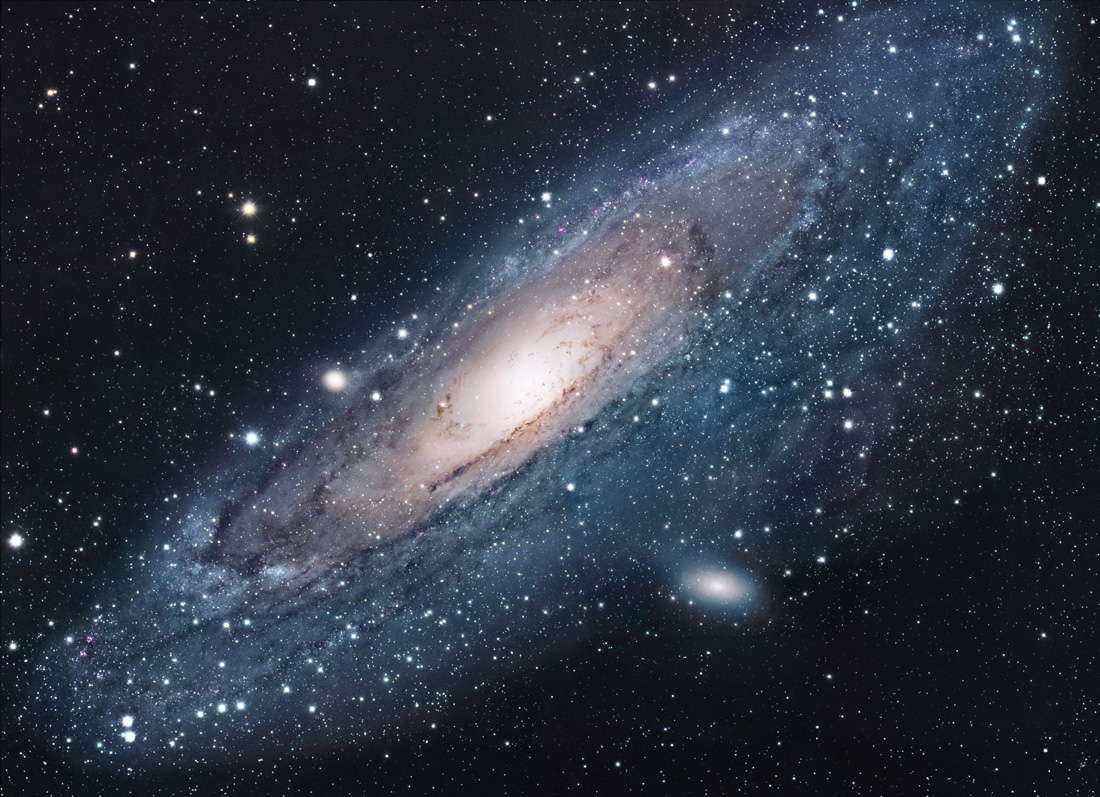
Andromeda_gendler_smOf course I don’t agree.  Without professional astronomers we would never have discovered that, say, the Andromeda Nebula (shown above) was a galaxy just like our own Milky Way containing thousands of millions of stars like our Sun  and that it is rotating about its axis with a timescale of hundreds of millions of years. Knowing things like this surely increases the sense of wonder rather than decreasing it?

On the other hand it is true that the nature of science makes it rather prosaic. When scientists try to write for a popular readership they often spice up their accounts with quotations from poems, even if the quotes aren’t really all that appropriate. Perhaps some will turn to this collection for a source of such snippets. I know I will!

Another thing that struck me was that I always tended to think that engagement between science and poetry was a relatively recent thing, typified by WH Auden’s humorously perplexed After Reading a Child’s Guide to Modern Physics:

Our eyes prefer to suppose
That a habitable place
Has a geocentric view,
That architects enclose
A quiet Euclidian space:
Exploded myths – but who
Could feel at home astraddle
An ever expanding saddle?

But in fact the metaphysical poets of the 17th century also grappled with such issues. Consider this fragment from John Donne’s An Anatomy of the World:

We think the Heavens enjoy their spherical,
Their round proportion embracing all.
But yet their various and perplexed course,
Observed in divers ages, doth enforce
Men to find out so many eccentric parts,
Such divers down-right lines, such overthwarts,
As disproportion that pure form….

That could almost have been written about the possibility of a lop-sided universe that I’ve blogged about here and there, and which is a major topic of current cosmological research.

Other reactions I had were more personal. There is a poem in the collection by Fleur Adcock, who visited the Royal Grammar School in Newcastle when I was there. She judged a poetry reading competition (which I didn’t win) for which the test piece was Stevie Smith’s Not Waving but Drowning. I remember that she was quite a glamorous-looking lady, but she got everybody’s name wrong in her presentation address. She must be getting on a bit by now.

I have also met one of the other poets represented here too, Gwyneth Lewis, who was elected the first national poet for Wales and also spent some time as poet-in-residence in the School of Physics & Astronomy at Cardiff University where I now work. She wrote a number of poems about science but is probably most famous for writing the words “In These Stones Horizons Sing” which are incorporated in the design of the facade of the Wales Millennium Centre.

Anyway, I thoroughly recommend this book which is a rich treasury of verse ancient and modern. Some of the lovely things in it are quite new to me and I am definitely going to read more by some of the poets represented in it. That’s the way to use an anthology: go and read more systematically whoever catches your eye.

Being an old-fashioned romantic I think I’ll finish off with an excerpt from William Wordsworth‘s epic The Prelude. Regular readers (both of you) will know that I greatly admire Wordsworth and, for me, The Prelude is one of the highest pinnacles in all of English literature.

The universal spectacle throughout
Was shaped for admiration and delight,
Grand in itself alone, but in that breach
Through which the homeless voice of waters rose,
That dark deep thoroughfare, had Nature lodged
The Soul, the Imagination of the whole.