Archive for Winter Solstice

Time for Perihelion

Posted in The Universe and Stuff with tags , , , on January 4, 2025 by telescoper

Earth’s elliptical orbit viewed at an angle (which makes it look more eccentric than it is – in reality is very nearly circular).

At 13.28 GMT today (Saturday 4th January 2025), the Earth reaches its perihelion. At this time the distance from the Sun’s centre to Earth’s centre will be 147,103,686 km. This year, aphelion (the furthest distance from the Sun) is at 20.54 GMT on July 3rd 2025 at which point the centre of the Earth will be 152,087,738 km from the centre of the Sun. You can find a list of times and dates of perihelion and aphelion for future years here.

At perihelion the speed of the Earth in its orbit around the Sun is greater than at aphelion (about 30.287 km/s versus 29.291 km/s). This difference, caused by the Earth’s orbital eccentricity, contributes to the difference between mean time and solar time which, among other things, influences the time of sunrise and sunset at the winter solstice that happened a couple of weeks or so ago.

It surprises me how many people think that the existence of the seasons has something to do with the variation of the Earth’s distance from the Sun as it moves in its orbit in that the closer to the Sun we get the warmer the weather will be. The fact that perihelion occurs in the depth of winter should convince anyone living in the Northern hemisphere that this just can’t be the case, as should the fact that it’s summer in the Southern hemisphere while it is winter in the North.

The real reason for the existence of seasons is the tilt of the Earth’s axis of rotation. I used to do a little demonstration with a torch (flashlight to American readers) to illustrate this when I taught first-year astrophysics. If you shine a torch horizontally at a piece of card it will illuminate a patch of the card. Keep the torch at the same distance but tilt the card and you will see the illuminated patch increase in size. The torch is radiating the same amount of energy but in the second case that energy is spread over a larger area than in the first. This means that the energy per unit area incident on the card is decreases when the card is tilted. It is that which is responsible for winter being colder than summer. In the summer the sun is higher in the sky (on average) than in winter. From this argument you can infer that the winter solstice not the perihelion, is the relevant astronomical indicator of winter.

That is not to say that the shape of the Earth’s orbit has no effect on temperatures. It may, for example, contribute to the summer in the Southern hemisphere being hotter than in the North, although it is not the only effect. The Earth’s surface possesses a significant North-South asymmetry: there is a much larger fraction of ocean in the Southern hemisphere, for example, which could be responsible for moderating any differences in temperature due to insolation. The climate is a non-linear system that involves circulating air and ocean currents that respond in complicated ways and on different timescales not just to insolation but to many other parameters, including atmospheric composition (especially the amount of water vapour).

The dates when Earth reaches the extreme points on its orbit (apsides) are not fixed because of the variations in its orbital eccentricity so, in the short-term, the dates can vary up to 2 days from one year to another. The perihelion distance varies slightly from year to year too; it’s slightly larger this year than last year, for example.

There is however a long-term trend for perihelion to occur later in the year. For example, in 1246, the December Solstice (winter solstice for the Northern Hemisphere) was on the same day as the Earth’s perihelion. Since then, the perihelion and aphelion dates have drifted by an average of one day every 58 years. This trend will continue, meaning that by the year 6430 the timing of the perihelion and the March Equinox will coincide, although I hope to have retired by then…

The Winter Solstice 2024

Posted in Maynooth, The Universe and Stuff with tags , , , on December 20, 2024 by telescoper
Sunlight at dawn on the Winter Solstice at Newgrange

Just a quick note to point out that the Winter Solstice in the Northern hemisphere happens tomorrow, Saturday 21st December 2024, at 9.21 UT (GMT). I am posting this in advance as I am planning to have a line-in tomorrow morning.

In Dublin, sunrise today (20th December) was at 8.37 am and sunset at 4.07 pm, while tomorrow the sunrise is at 8.38 am and sunset at 4.08 pm. Notice that both sunrise and sunset happen later tomorrow than today, so the Solstice marks neither the latest sunrise nor the earliest sunset: the interval between the two events will, however, be about 2 seconds shorter tomorrow than today. For a full explanation of this, see this older Winter Solstice post.

Anyway, today is has been the last day of teaching at Maynooth University. I did my final lecture of 2024 this morning and attended project presentations this afternoon. Campus has been very quiet all day, most people having already departed for the break. That makes me feel less guilty about going home earlier than usual at 4.15pm. Now it’s time power down everything in my office for the break and head home via the shops!

The Time of Perihelion

Posted in The Universe and Stuff with tags , , , on January 3, 2024 by telescoper

Earth’s elliptical orbit viewed at an angle (which makes it look more eccentric than it is – in reality is very nearly circular).

I haven’t received a Royal Astronomical Society diary this year, which I’m sad about as it has been a bit of a tradition, as well as being a useful source of astronomical information. According to other sources,  however, today (Wednesday 3rd January 2024) at approximately 00.39 GMT the Earth reached the point on its orbit  closest to the Sun, i.e. its perihelion. At this time the distance from the Sun’s centre to Earth’s centre was  147,100,632 km. This year, aphelion (the furthest distance from the Sun) is at 06.06 GMT on July 6th 2023 at which point the centre of the Earth will be 152,099,968 km from the centre of the Sun. You can find a list of times and dates of perihelion and aphelion for future years here.

At perihelion the speed of the Earth in its orbit around the Sun is greater than at aphelion (about 30.287 km/s versus 29.291 km/s). This difference, caused by the Earth’s orbital eccentricity, contributes to the difference between mean time and solar time which, among other things, influences the time of sunrise and sunset at the winter solstice that happened a couple of weeks or so ago.

It surprises me how many people think that the existence of the seasons has something to do with the variation of the Earth’s distance from the Sun as it moves in its orbit in that the closer to the Sun we get the warmer the weather will be. The fact that perihelion occurs in the depth of winter should convince anyone living in the Northern hemisphere that this just can’t be the case, as should the fact that it’s summer in the Southern hemisphere while it is winter in the North.

The real reason for the existence of seasons is the tilt of the Earth’s axis of rotation. I used to do a little demonstration with a torch (flashlight to American readers) to illustrate this when I taught first-year astrophysics. If you shine a torch horizontally at a piece of card it will illuminate a patch of the card. Keep the torch at the same distance but tilt the card and you will see the illuminated patch increase in size. The torch is radiating the same amount of energy but in the second case that energy is spread over a larger area than in the first. This means that the energy per unit area incident on the card is decreases when the card is tilted. It is that which is responsible for winter being colder than summer. In the summer the sun is higher in the sky (on average) than in winter. From this argument you can infer that the winter solstice not the perihelion, is the relevant astronomical indicator of winter.

That is not to say that the shape of the Earth’s orbit has no effect on temperatures. It may, for example, contribute to the summer in the Southern hemisphere being hotter than in the North, although it is not the only effect. The Earth’s surface possesses a significant North-South asymmetry: there is a much larger fraction of ocean in the Southern hemisphere, for example, which could be responsible for moderating any differences in temperature due to insolation. The climate is a non-linear system that involves circulating air and ocean currents that respond in complicated ways and on different timescales not just to insolation but to many other parameters, including atmospheric composition (especially the amount of water vapour).

The dates when Earth reaches the extreme points on its orbit (apsides) are not fixed because of the variations in its orbital eccentricity so, in the short-term, the dates can vary up to 2 days from one year to another. The perihelion distance varies slightly from year to year too; it’s slightly larger this year than last year, for example.

There is however a long-term trend for perihelion to occur later in the year. For example, in 1246, the December Solstice (winter solstice for the Northern Hemisphere) was on the same day as the Earth’s perihelion. Since then, the perihelion and aphelion dates have drifted by an average of one day every 58 years and this trend will continue. This means that by the year 6430 the timing of the perihelion and the March Equinox will coincide, although I hope to have retired by then…
The Winter Solstice 2023

Posted in The Universe and Stuff with tags , , , on December 21, 2023 by telescoper
Sunlight at dawn on the Winter Solstice at Newgrange

Just a quick note to point out that the Winter Solstice in the Northern hemisphere happens tomorrow, Friday 22nd December 2023, at 4.27 am CET (3.27 UT). I am posting this in advance as although I am will be getting up quite early to catch a flight, it won’t be that early…

People often think that the Winter Solstice is defined to be the “shortest day” or the “longest night” of the year. The Solstice is actually defined in astronomical terms much more precisely than that. It happens when the axial tilt of the Earth away from the Sun is greatest, so that the Sun appears in the sky with its lowest maximum elevation. The timing of this event can be calculated with great precision.

In Barcelona, sunrise today (21st December) is at 8.13 am and sunset at 5.24 pm, while tomorrow the sunrise is at 8.14 am and sunset at 5.25 pm. The Solstice therefore occurs before sunrise tomorrow morning and the interval between sunrise and sunset tomorrow will be very close to that today; the interval between sunrise and sunset on 20th December (yesterday) was four whole seconds longer than on 22nd (today); the shortest day is therefore today rather than tomorrow. Moreover, the Solstice marks neither the latest sunrise nor the earliest sunset: sunrise will carry on getting later until the new year, the length of the day nevertheless increasing because sunset occurs even later. For a full explanation of this, see last year’s Winter Solstice post.

The Winter Solstice 2022

Posted in The Universe and Stuff with tags , , , , , on December 21, 2022 by telescoper

The Winter Solstice in the Northern hemisphere happens later today, Wednesday 21st December, at 21:48 Irish Time.

People often think that the Winter Solstice is defined to be the “shortest day” or the “longest night” of the year. The Solstice does indeed happen on the shortest day, but it is defined in astronomical terms much more precisely than that. It happens when the axial tilt of the Earth away from the Sun is greatest, so that the Sun appears in the sky with its lowest maximum elevation. The timing of this event can be calculated with great precision.

Anyway, today is the shortest day of the year in the Northern hemisphere. Days will get steadily longer from then until the Summer Solstice next June.  The shortest day – defined by the interval between sunrise and sunset – is today, although not by much. Today in Dublin is shorter than yesterday by about six seconds, but tomorrow will be longer than today by less than a second.

This does not, however,  mean that sunrise will happen earlier tomorrow than it did this morning.  Actually, sunrise will carry on getting later until the new year, the length of the day nevertheless increasing because sunset occurs even later. Sunrise yesterday morning (20th December) was at 08.42 Dublin Time while today it was 08.43; the latest sunrise will be on 30th December (09.05). Sunset last night was at 16.49 and tonight it will be at 16.50. The earliest sunset this year was actually on 13th December (16:48).

These complications arise because there is a difference between mean solar time (measured by clocks) and apparent solar time (defined by the position of the Sun in the sky, i.e. what you would measure on a sundial), so that a solar day does not always last exactly 24 hours as measured by a clock. A description of apparent and mean time was given by Nevil Maskelyne in the Nautical Almanac for 1767:

Apparent Time is that deduced immediately from the Sun, whether from the Observation of his passing the Meridian, or from his observed Rising or Setting. This Time is different from that shewn by Clocks and Watches well regulated at Land, which is called equated or mean Time.

The discrepancy between mean time and apparent time arises because of the Earth’s axial tilt and the fact that it travels around the Sun in an elliptical orbit in which its orbital speed varies with time of year (being faster at perihelion than at aphelion). The upshot of this is that solar noon – when the Sun is at its highest point in the sky on a given day – is not always at 12 noon local mean time. Solar noon today in Ireland is actually at 12.30 Irish time. Around the time of the Winter Solstice, solar noon is getting later in the day and this will continue to happen until well into the New Year; solar noon on New Year’s Eve is at 12.34. While the interval between sunrise and sunset shrinks towards the solstice, the mid-point of this interval is drifting later in the day, making both sunrise and sunset occur later despite the gap between the two getting smaller.

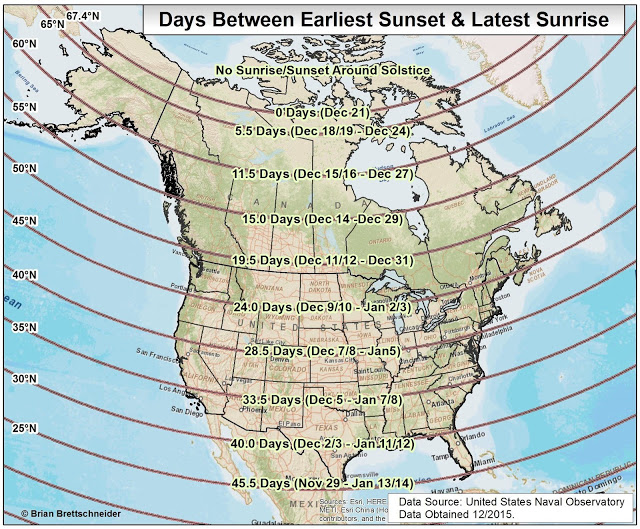
The discrepancy between latest sunrise (or earliest) and the solstice varies with latitude, although if you go far enough North into the Arctic Circle, there is neither sunrise or sunset around the Winter Solstice, and if you go far enough South to the Equator the length of the day does not vary at all with time of year. The behaviour is illustrated for North America in this graphic produced by the United States Naval Observatory

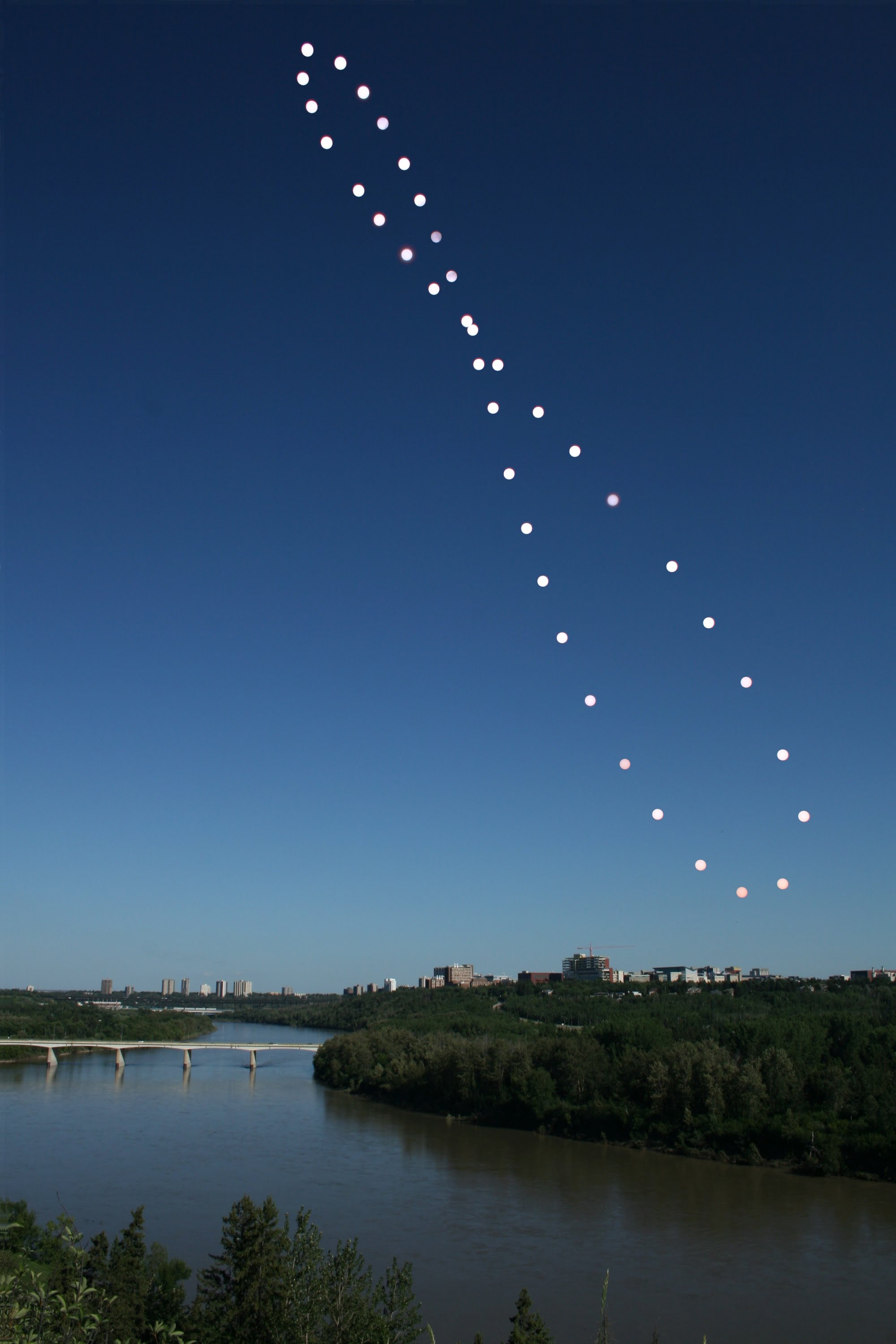
If you plot the position of the Sun in the sky at a fixed time each day from a fixed location on the Earth you get a thing called an analemma, which is a sort of figure-of-eight shape whose shape depends on the observer’s latitude. Here’s a photographic version taken in Edmonton, with photographs of the Sun’s position taken from the same position at the same time on different days over the course of a year:

maxresdefault

The winter solstice is at the lowermost point on this curve and the summer solstice is at the top. These two turning points define the time of the solstices much more precisely than the “shortest day” or  “longest night”. The Winter Solstice is takes place at a very specific time, when the angle of tilt of the Earth’s axis relative to the Sun is maximum.

Anyway, the north–south component of the analemma is the Sun’s declination, and the east–west component arises from the  equation of time which quantifies the difference between mean solar time and apparent solar time. This curve is used to calculate the earliest and/or latest sunrise and/or sunset. Looking at a table of the local mean times of sunrise and sunset for Dublin around the 2022  winter solstice shows that today is indeed the shortest day (with a time between sunrise and sunset of 7 hours 33 minutes and 49 seconds).

P.S. As usual, crowds gathered today at the spectacular neolithic monument at Newgrange in County Meath to observe the sunrise at the Solstice.

The Winter Solstice 2021

Posted in The Universe and Stuff with tags , , , on December 21, 2021 by telescoper

So it comes around again. The winter solstice in the Northern hemisphere happens today, Tuesday 21st December, at 15.59 Irish Time. Among other things, this means that tomorrow is the shortest day of the year in the Northern hemisphere. Days will get steadily longer from then until the Summer Solstice next June.  The  the shortest day – defined by the interval between sunrise and sunset – is today. Tomorrow will be two whole seconds longer. Make the most of it!

This does not, however,  mean that sunrise will happen earlier tomorrow than it did this morning.  Actually, sunrise will carry on getting later until the new year, the length of the day nevertheless increasing because sunset occurs even later. Sunrise yesterday morning (20th December) was at 08.37 Dublin Time while today it was 08.38; the latest sunrise will be on 29th December (08.40). Sunset last night was at 16.07 and tonight it will be at 16.08. The earliest sunset this year was actually on 13th December (16:06).

These complications arise because there is a difference between mean solar time (measured by clocks) and apparent solar time (defined by the position of the Sun in the sky), so that a solar day does not always last exactly 24 hours. A description of apparent and mean time was given by Nevil Maskelyne in the Nautical Almanac for 1767:

Apparent Time is that deduced immediately from the Sun, whether from the Observation of his passing the Meridian, or from his observed Rising or Setting. This Time is different from that shewn by Clocks and Watches well regulated at Land, which is called equated or mean Time.

The discrepancy between mean time and apparent time arises because of the Earth’s axial tilt and the fact that it travels around the Sun in an elliptical orbit in which its orbital speed varies with time of year (being faster at perihelion than at aphelion).

In fact if you plot the position of the Sun in the sky at a fixed time each day from a fixed location on the Earth you get a thing called an analemma, which is a sort of figure-of-eight shape whose shape depends on the observer’s latitude. Here’s a photographic version taken in Edmonton, with photographs of the Sun’s position taken from the same position at the same time on different days over the course of a year:

maxresdefault

The winter solstice is the lowermost point on this curve and the summer solstice is at the top. These two turning points define the time of the solstices much more precisely that the “shortest day” or  “longest night”.

Anyway, the north–south component of the analemma is the Sun’s declination, and the east–west component arises from the  equation of time which quantifies the difference between mean solar time and apparent solar time. This curve can be used to calculate the earliest and/or latest sunrise and/or sunset.

Using a more rapid calculational tool (Google), I found a table of the local mean times of sunrise and sunset for Dublin around the 2020  winter solstice. This shows that today is indeed the shortest day (with a time between sunrise and sunset of 7 hours 29 minutes and 57 seconds).

P.S. As usual, crowds gathered at the spectacular neolithic monument at Newgrange in County Meath to observe the sunrise at the Solstice. As usual it was cloudy.

The Winter Solstice 2020

Posted in The Universe and Stuff with tags , , , , , , , on December 20, 2020 by telescoper

The winter solstice in the Northern hemisphere happens tomorrow, Monday 21st December, at 10.02 Irish Time. Among other things, this means that tomorrow is the shortest day of the year in the Northern hemisphere. Days will get steadily longer from then until the Summer Solstice next June.  The longest night – defined by the interval between sunset and sunrise – is tonight and the shortest day – defined by the interval between sunrise and sunset – will be tomorrow. The day tomorrow will be two seconds shorter than today, while the interval between sunrise and sunset on Tuesday 22nd December will be four seconds longer than tomorrow.

This does not, however,  mean that sunrise will happen earlier tomorrow than it did this morning. Actually, sunrise will carry on getting later until the new year, the length of the day nevertheless increasing because sunset occurs later. Sunrise this morning (20th December was at 08.37 Dublin Time while tomorrow it will be at 08.38. Sunset tonight will be at 16.07 and sunset tomorrow will be at 16.08.

These complications arise because there is a difference between mean solar time (measured by clocks) and apparent solar time (defined by the position of the Sun in the sky), so that a solar day does not always last exactly 24 hours. A description of apparent and mean time was given by Nevil Maskelyne in the Nautical Almanac for 1767:

Apparent Time is that deduced immediately from the Sun, whether from the Observation of his passing the Meridian, or from his observed Rising or Setting. This Time is different from that shewn by Clocks and Watches well regulated at Land, which is called equated or mean Time.

The discrepancy between mean time and apparent time arises because of the Earth’s axial tilt and the fact that it travels around the Sun in an elliptical orbit in which its orbital speed varies with time of year (being faster at perihelion than at aphelion).

In fact if you plot the position of the Sun in the sky at a fixed time each day from a fixed location on the Earth you get a thing called an analemma, which is a sort of figure-of-eight shape whose shape depends on the observer’s latitude. Here’s a photographic version taken in Edmonton, with photographs of the Sun’s position taken from the same position at the same time on different days over the course of a year:

maxresdefault

The winter solstice is the lowermost point on this curve and the summer solstice is at the top. These two turning points define the time of the solstices much more precisely that the “shortest day” or  “longest night”.

Incidentally, the Tropic of Capricorn is the circle of latitude (about 23.5°, the declination of the Sun at the Winter Solstice) that contains the subsolar point at the December solstice. This is therefore the most southerly latitude on Earth where one can see the Sun directly overhead.

Anyway, the north–south component of the analemma is the Sun’s declination, and the east–west component is the so-called equation of time which quantifies the difference between mean solar time and apparent solar time. This curve can be used to calculate the earliest and/or latest sunrise and/or sunset.

Using a more rapid calculational tool (Google), I found a table of the local mean times of sunrise and sunset for Dublin around the 2020  winter solstice. This shows that tomorrow is indeed the shortest day (with a time between sunrise and sunset of 7 hours 29 minutes and 57 seconds).  The table also shows that sunset already started occurring later in the day from 17th December,  before the winter solstice, and sunrise will continue to happen later  after the solstice, notwithstanding the fact that the interval between sunrise and sunset gets longer from tomorrow onwards.

I hope this clarifies the situation.

The Winter Solstice 2019

Posted in The Universe and Stuff with tags , , , , , , on December 21, 2019 by telescoper

The winter solstice in the Northern hemisphere happens tomorrow, Sunday 22nd December 2019, at 04.19 Irish Time (04.19 UTC). Among other things, this means that tomorrow is the shortest day of the year in the Northern hemisphere. Days will get steadily longer from now until the Summer Solstice next June.  In fact, the interval between sunrise and sunset tomorrow will be a whole second longer tomorrow than it is today. Yippee!

This does not mean that sunrise will happen earlier tomorrow than it did this morning, however. Actually, sunrise will carry on getting later until the new year. This is because there is a difference between mean solar time (measured by clocks) and apparent solar time (defined by the position of the Sun in the sky), so that a solar day does not always last exactly 24 hours. A description of apparent and mean time was given by Nevil Maskelyne in the Nautical Almanac for 1767:

Apparent Time is that deduced immediately from the Sun, whether from the Observation of his passing the Meridian, or from his observed Rising or Setting. This Time is different from that shewn by Clocks and Watches well regulated at Land, which is called equated or mean Time.

The discrepancy between mean time and apparent time arises because of the Earth’s axial tilt and the fact that it travels around the Sun in an elliptical orbit in which its orbital speed varies with time of year (being faster at perihelion than at aphelion).

In fact if you plot the position of the Sun in the sky at a fixed time each day from a fixed location on the Earth you get a thing called an analemma, which is a sort of figure-of-eight shape whose shape depends on the observer’s latitude. Here’s a photographic version taken in Edmonton, with photographs of the Sun’s position taken from the same position at the same time on different days over the course of a year:

maxresdefault

The winter solstice is the lowermost point on this curve and the summer solstice is at the top. The north–south component of the analemma is the Sun’s declination, and the east–west component is the so-called equation of time which quantifies the difference between mean solar time and apparent solar time. This curve can be used to calculate the earliest and/or latest sunrise and/or sunset.

Using a more rapid calculational tool (Google), I found a table of the local mean times of sunrise and sunset for Dublin around the 2019 winter solstice. This shows that tomorrow is indeed the shortest day (with a time between sunrise and sunset of 7 hours 29 minutes and 58 seconds).  The table also shows that sunset already started occurring later in the day before the winter solstice, and sunrise will continue to happen later for a few days after the solstice, notwithstanding the fact that the interval between sunrise and sunset gets longer from today onwards.

I hope this clarifies the situation.

The Winter Solstice 2018

Posted in The Universe and Stuff with tags , , , , , , on December 21, 2018 by telescoper

The winter solstice in the Northern hemisphere happens today, Friday 21st December 2018, at 22.23 Irish Time (22.23 UTC). Among other things, this means that today is the shortest day of the year. Days will get longer from now until the Summer Solstice next June.  In fact, the interval between sunrise and sunset tomorrow will be a whole second longer tomorrow than it is today. Yippee!

This does not mean that sunrise will happen earlier tomorrow than it did this morning, however. Actually, sunrise will carry on getting later until the new year. This is because there is a difference between mean solar time (measured by clocks) and apparent solar time (defined by the position of the Sun in the sky), so that a solar day does not always last exactly 24 hours. A description of apparent and mean time was given by Nevil Maskelyne in the Nautical Almanac for 1767:

Apparent Time is that deduced immediately from the Sun, whether from the Observation of his passing the Meridian, or from his observed Rising or Setting. This Time is different from that shewn by Clocks and Watches well regulated at Land, which is called equated or mean Time.

The discrepancy between mean time and apparent time arises because of the Earth’s axial tilt and the fact that it travels around the Sun in an elliptical orbit in which its orbital speed varies with time of year (being faster at perihelion than at aphelion).

In fact if you plot the position of the Sun in the sky at a fixed time each day from a fixed location on the Earth you get a thing called an analemma, which is a sort of figure-of-eight shape whose shape depends on the observer’s latitude. Here’s a photographic version taken in Edmonton, with photographs of the Sun’s position taken from the same position at the same time on different days over the course of a year:

maxresdefault

The winter solstice is the lowermost point on this curve and the summer solstice is at the top. The north–south component of the analemma is the Sun’s declination, and the east–west component is the so-called equation of time which quantifies the difference between mean solar time and apparent solar time. This curve can be used to calculate the earliest and/or latest sunrise and/or sunset.

Using a more rapid calculational tool (Google), I found a table of the local mean times of sunrise and sunset for Dublin around the 2018 winter solstice. This shows that today is indeed the shortest day (with a time between sunrise and sunset of 7 hours 29 minutes and 59 seconds).  The table also shows that sunset already started occurring later in the day before the winter solstice, and sunrise will continue to happen later for a few days after the solstice, notwithstanding the fact that the interval between sunrise and sunset gets longer from today onwards.

I hope this clarifies the situation.

The Winter Solstice

Posted in The Universe and Stuff with tags , , , , , on December 21, 2017 by telescoper

The winter solstice in the Northern hemisphere happens today, Thursday 21st December 2017, at 16.28 GMT (16.28 UTC). This marks the shortest day of the year: days will get longer from now until the Summer Solstice next June.  In fact the interval between sunrise and sunset tomorrow will be a whole two seconds longer tomorrow than it is today. Yippee!

Anyway, in advance of this forthcoming celestial event I thought I’d present some solstitial facts for your entertainment and edification or so you can bore people with them in the pub later on.

As we were discussing in the office today, however, this does not mean that sunrise will happen earlier tomorrow than it did this morning. In fact, sunrise will carry on getting later until the new year. This is because there is a difference between mean solar time (measured by clocks) and apparent solar time (defined by the position of the Sun in the sky), so that a solar day does not always last exactly 24 hours. A description of apparent and mean time was given by Nevil Maskelyne in the Nautical Almanac for 1767:

Apparent Time is that deduced immediately from the Sun, whether from the Observation of his passing the Meridian, or from his observed Rising or Setting. This Time is different from that shewn by Clocks and Watches well regulated at Land, which is called equated or mean Time.

The discrepancy between mean time and apparent time arises because of the Earth’s axial tilt and the fact that it travels around the Sun in an elliptical orbit in which its orbital speed varies with time of year (being faster at perihelion than at aphelion).

In fact if you plot the position of the Sun in the sky at a fixed time each day from a fixed location on the Earth you get a thing called an analemma, which is a sort of figure-of-eight shape whose shape depends on the observer’s latitude. Here’s a photographic version taken in Edmonton, with photographs of the Sun’s position taken from the same position at the same time on different days over the course of a year:

maxresdefault

The winter solstice is the lowermost point on this curve and the summer solstice is at the top. The north–south component of the analemma is the Sun’s declination, and the east–west component is the so-called equation of time which quantifies the difference between mean solar time and apparent solar time. This curve can be used to calculate the earliest and/or latest sunrise and/or sunset.

Using a more rapid calculational tool (Google), I found a table of the local mean times of sunrise and sunset for Cardiff (where I live) around the 2016 winter solstice. The table shows that today is indeed the shortest day (with a time between sunrise and sunset of 7 hours 49 minutes and 59 seconds).  The table also shows that sunset already started occurring later in the day before the winter solstice (although the weather has been too overcast to notice this), and sunrise will continue to happen later for a few days after the solstice. In fact the earliest sunset this year in Cardiff was on 12th December, and the latest sunrise will be on 30th December.

I hope this clarifies the situation.