Archive for October, 2008

Crash! There goes another one..

Posted in Uncategorized with tags on October 9, 2008 by telescoper

Another day, another bank failure.

Further to my post about the crisis in the Icelandic banking system, it now appears the third major private Icelandic bank, Kaupthing, has also been taken into admininistration over concerns about its liquidity (or lack of it). The UK-based online subsidiary Kaupthing Edge has, however, been taken over by ING Direct, another direct savings bank. ING claims that all the deposits it has acquired are now safe, but something tells me this crisis is far from over and I interpret “safe” as meaning “for the time being”. This is all coming very close to home, as I have savings in Kaupthing Edge.

At least I’m in a better position than someone who had savings in Icesave which was the second Icelandic bank to fail. The scary thing about this one was that the Icelandic government had given guarantees to protect depositors, but has now thrown away those guarantees leaving the UK government to step in to compensate those who have lost their savings. For once, I actually agree with Prime Minister Gordon Brown’s reaction to this. I hope Britain seizes any Icelandic assets it can to compensate the UK taxpayer. That is if Iceland actually has any assets left at all.

Iceland has also today suspended all dealings in its shares as its economy rapidly melts down.  Apparently the country now has debts totalling 12 times its Gross Domestic Product which makes it as near as dammit to being bankrupt.

Meanwhile despite massive intervention from central banks around the world, stocks and shares have continued to lurch around violently above and below a steady downward trend. All this seems totally irrational to me. And they have the nerve to award a Nobel prize to economists!

If only everything in life were as simple as the Cabibbo-Kobayashi-Maskawa theory.

Jenufa

Posted in Music, Opera with tags , on October 8, 2008 by telescoper

Another day, another opera. Today I had to duck out of the usual post-seminar drinks and food and get down to the Wales Millennium Centre in Cardiff Bay for one of only two performances in Cardiff by WNO this season of Jenufa by Leos Janacek.

You couldn’t wish for an opera more different in style and substance than Saturday’s Otello, although I suppose both operas would probably be classed as tragedies. Gone are the opulent sets and costumes and associated courtly intrigues of Otello. Instead we enter a world of drab and claustrophobic interiors within which a dark story of ordinary country folk unfolds in all its bleakness. Jenufa has a child by her lover, Steva, whom she hopes will marry her. When he refuses to do the honorable thing, Jenufa’s stepmother, Kostelnicka, drugs Jenufa and kills the baby, disposing of the body in a freezing lake. Jenufa is then persuaded to marry the dim but devoted Laca. In the final act, the baby’s body is found, Jenufa is accused and then Kostelnicka confesses her guilty act, claiming that she wanted to save Jenufa from disgrace. She goes off to be tried for the murder, while the steadfast Laca promises to stand by Jenufa come what may.

None of the characters is particularly sympathetic or even comprehensible. Laca (Peter Hoare) changes from a brutish oaf, who accidentally stabs Jenufa in the face in Act 1, to a doting husband in Act 3. Steva (Stephen Rooke) is superficially attractive but clearly a bit of a bounder. Kostelnicka (Susan Bickley) is severe, pompous and moralistic. Jenufa (Nuccia Focile) just seems a bit vacuous in Act 1 but progressively disintegrates under the stress of shame and rejection becomes increasingly morose and unpredictable as the opera goes on.

But these are not meant to be easy roles to understand. They are as inconsistent as real people, and as difficult to figure out.

On paper the plot and characterization seem very slight, but what holds it all together is Janacek’s wonderful music which seems to pull together all the rather ragged strands left dangling by the libretto. The score features lush romantic passages interspersed with snatches of folk tunes and jagged unresolved ideas that seem to mirror the fractured psychology engulfing Jenufa and Kostelnicka. Although the story is unrelentingly grim, there always seems to be something interesting going on in the music. Near the end, when Kostelnicka confesses the infanticide and accepts her punishment the music is particularly beautiful and even uplifting. However dark the deed, it seems to say, some form of redemption is always possible. How Janacek manages to conjure such a radiant burst of optimism at the end of such a dark tragedy is nothing short of miraculous.

I could listen to Janacek’s music for hours. As a matter of fact, now I think about it, that’s exactly what I did.

Icelandic Sagas

Posted in Biographical, Finance with tags , on October 7, 2008 by telescoper

I read in the news today that the Icelandic government has taken over a second of its leading banks in an attempt to stop the total collapse of its economic infrastructure. Last week it took over the country’s third largest bank, Glitnir, to prevent it collapsing as a consequence of bad debts and this week it has nationalised Landsbanki, the second largest. This particular one brings Iceland’s imminent bankruptcy closer to home as hundreds of thousands of savers in the UK have cash tied up in either Icesave or Heritable, which are divisions of Landsbanki. The only private Icelandic remaining is Kaupthing, which also has a UK operation called Kaupthing Edge. This bank claims to have minimal exposure to toxic debt, but it remains to be seen whether it can avoid a run on its deposits that will surely lead it into oblivion too. I am an interested party in this case, as I recently bought some of its fixed rate high-interest bonds. This may turn out not to be the best decision I have ever made.

Iceland’s economy seems to be a microcosm of the current world situation. A decade of incredible growth built on speculative financial operations abroad led to growth beyond the wildest dreams of such a small country. With a population of only just over 300,000 – that of a small English city – most of whom live in the capital Reykjavik, this boom generated a huge increase in living standards for its own people and created a new generation of Icelandic billionaires. Now that bubble has well and truly burst. The country as a whole is on the verge of bankruptcy, its currency has fallen through the floor, and inflation is rampant.

Iceland may have a reputation as the one of the hottest destinations for a weekend of partying, but it seems to me that it’s about to suffer a sudden and very chill winter.

I had the opportunity to visit Iceland this May in order to participate in an event called the Experiment Marathon, which is one of those artists-meet-scientists events that are either excruciatingly terrible or intensely enjoyable. Held in the Hafnarhus – Reyjkavik Art Museum – the contributions included scientists talking about science or doing experiments live in front of the audience, alongside artists talking about or demonstrating their work.

I am really not sure why I was invited to take part, although I suspect it was some form of administrative error. Most of the really crap things that happen are caused by mistakes, so why shouldn’t the good things also happen that way?

Anyway, I gave a talk about the cosmic microwave background. My “experiment” was a television set that wasn’t tuned properly producing a screenful of static. I pointed out that some (actually not that much) of the buzz was coming from the beginning of the universe. Pretty lame as a gimmick, I know, but it seemed to go down quite well with the audience and I had some nice questions and comments at the end of my 20 minutes. But I also got to meet quite a few artists and other luminaries, including Brian Eno (who celebrated his 60th birthday at the festival) and Dr Ruth. I also had breakfast in the hotel with a noted performance artist called Marina Abramovic who I’m ashamed to say I’d never heard of. I didn’t actually know who she was until much later.

Even better than this I had a sort of VIP pass which meant that I got to go to a couple of wonderfully boozy receptions, including one at the President’s house, and hang out with the in-crowd at some of Reykjavik’s nightspots, although at one of them I had to listen to some experimental music that sounded like what I imagined to be played to prisoners at Guantanomo Bay. Being so far North the nights are very long which definitely added to the enjoyment, especially since the few days I was there were blessed with lovely sunny weather. Perhaps even more importantly, I don’t remember having to pay for anything at all, drinks included. They even paid me a fee! (However, they paid it in Icelandic Krona, which I never got around to cashing, so it’s probably not worth very much by now.)

It goes without saying that I formed a very positive opinion of Reykjavik as a city full of energetic and creative people who know how to have a good time: it has its own opera house, countless restaurants and bars and several excellent museums and art galleries. But at the back of my mind I was wondering how such a small country can find the money to sustain such a level of artistic and musical activity as well as lavish personal consumption. Now at last I have the answer.

It can’t.

Nobel Sur-prize

Posted in The Universe and Stuff with tags , , on October 7, 2008 by telescoper

I was waiting for the letter from Stockholm, but it didn’t come. Maybe next year…

Anyway, this year’s Nobel Prize for Physics has been awarded to Yoichiro Nambu (half the prize) and the other half is split between
Makoto Kobayashi and Toshihide Maskawa. All three are extremely distinguished physicists and their contributions certainly deserve to be rewarded. But, in the case of Kobayashi and Maskawa, the Nobel Foundation has made a startling omission that I really can’t understand at all and which even threatens to undermine the prestige of the prize itself.

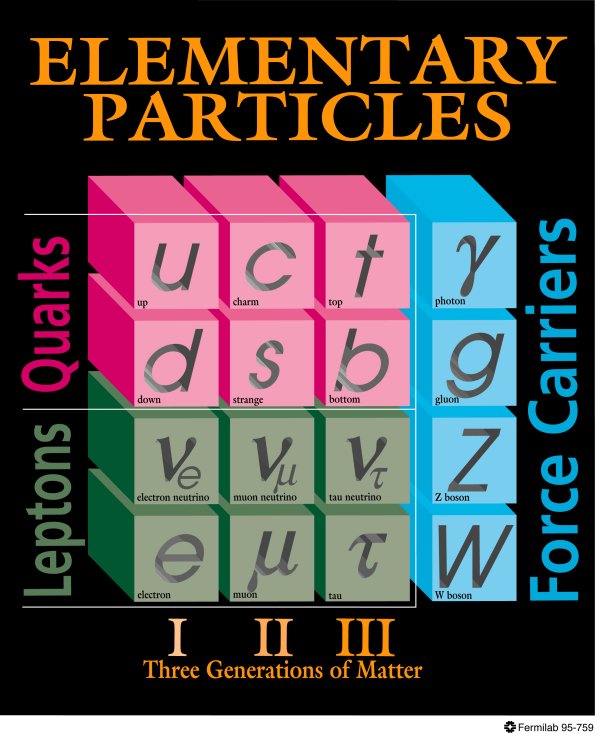
The work for which these two were given half the Nobel Prize this year relates to the broken symmetry displayed by weak interactions between quarks. We now know that there are three generations of quarks, each containing quarks of two different flavours. The first generation contains the up (u) and the down (d), the second the strange (s) and the charmed (c), and the third has the bottom (b) and the top (t). OK, so the names are daft, but physicists have never been good at names.

The world of quarks is different to penetrate becauses quarks interact via the strong force which binds them close together into hadrons which are either baryons (three quarks) or mesons (a quark and an anti-quark).

But there are other kinds of particles too, the leptons. These are also arranged in three generations but each of these families contains a charged particle and a neutrino. The first generation is an electron and a neutrino, the second a muon and its neutrino, and the third has the tau and another neutrino. One might think that the three quark generations and the three lepton generations might have some deep equivalence between them, but leptons aren’t quarks so can’t interact at all by the strong interaction. Quarks and leptons can both interact via the weak interaction (the force responsible for radioactive beta-decay).

Weak interactions between leptons conserve generation, so the total number of particles of electron type is never changed (ignoring neutrino oscillations, which have only relatively recently been discovered). It seemed natural to assume that weak interactions between quarks should do the same thing, forbidding processes that hop between generations. Unfortunately, however, this is not the case. There are weak interactions that appear to convert u and/or d quarks into c and/or s quarks, but these seem to be relatively feeble compared to interactions within a generation, which seem to happen with about the same strength for quarks as they do for leptons. This all suggests that there is some sort of symmetry lurking somewhere in there, but it’s not quite what one might have anticipated.

The explanation of this was proposed by Nicola Cabibbo who, using a model in which there are only two quark generations, developed the idea that states of pure quark flavour (“u” or “d”, say) are not really what the weak interaction “sees”. In other words, the quark flavour states are not proper eigenstates of the weak interaction. All that is needed is to imagine that the required eigenstates are a linear combination of the flavour states and, Bob’s your uncle, quark generation needn’t be conserved. This phenomenon is called Quark Mixing. What makes it simple for only two generations is that it can be described entirely by one number: the Cabibbo angle, which measures how much the quark flavour basis is misaligned with the weak interaction basis. The angle is small so the symmetry is only slightly broken.

Kobayashi and Maskawa generalized the work of Cabibbo to the case of three quark generations. That’s actually quite a substantial task as the description of mixing in this case requires not just a single number but a 3×3 matrix each of whose entries is complex. This matrix is universally called the Cabibbo-Kobayashi-Maskawa (CKM) matrix and it now crops up all over the standard model of particle physics.

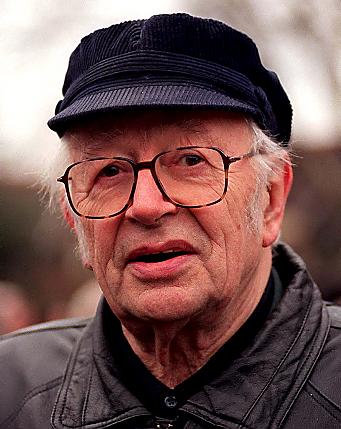
And there’s the rub. Why on Earth was Cabibbo not awarded a share of this year’s prize? I was shocked and saddened to find out that he’d been passed over despite the fact that his work so obviously led the way. I can think of no reason why he was omitted. It’s outrageous. I even feel sorry for Kobayashi and Maskawa, because there is certain to be such an outcry about this gaffe that it may detract from their success.

But really

Otello

Posted in Opera with tags , on October 5, 2008 by telescoper

Last night I went to the splendid Wales Millennium Centre in Cardiff Bay to see the production of Verdi’s Otello currently being staged by Welsh National Opera. The Opera is of course based on Shakespeare’s play Othello; I never met an Italian who could pronounce “th” properly, which presumably explains the change in spelling.

The Wales Millennium Centre is an excellent venue for Opera, both because it has very comfortable seats (quite necessary for operas of three hours’ duration, like Otello) and is also quite heavily subsidised. Last night’s tickets were about a quarter of the price you would expect to pay for the stalls at the Royal Opera House in Covent Garden. Unfortunately the centre is currently having financial problems, which I hope can be resolved.

I know many music experts – including Rob Cowan, who I listen to every morning on BBC Radio 3 – regard Otello as not only Verdi’s greatest masterpiece, but also the high point of all Italian grand opera. I’m not sure I would go that far, but it is certainly a compelling work both musically and dramatically. Watching last night’s performance it struck me how well theatrical tragedies suit adaption to the operatic form. The whole point of a tragedy is that the fall is inevitable. The hero contains within himself the seeds of his own destruction which, in the case of Otello is born of his uncontrollable jealousy.

But in order to have its full effect on the audience there must be time for the depth of impending calamity to eat into the audience. The pace of opera fits very well with this requirement. Building slowly but inexorably to the gut-wrenching climax, the best Opera achieves the kind of intensity that in Sport you can only get with Test cricket.

Verdi wrote this Opera in 1887 (when he was 74) and it represented a glorious return from self-imposed retirement. He went on to wrote another Shakespeare-inspired masterpiece, Falstaff, when he was 80.

But is Otello so very good? I think there’s one big problem with it, which is the role of the villain Iago. In Shakespeare’s play, Iago has many more lines than Otello and this gives this character time to develop into a believable, and sometimes even appealing, individual. In the operatic version he is just a bad guy who is bad for the sake of it. His pointless cruelty makes him completely two-dimensional and he therefore doesn’t work for me at all as a motivating force behind the plot.

On the good side, the production looked great, especially the giant golden lion that appeared in Act 3. The costumes were good too, set in period in a very traditional provincial-opera kind of way but easy on the eye. The chorus of Welsh National Opera was outstanding and the principals all did very well. Amanda Roocroft was an especially tender and vulnerable Desdemona.

And then there was Otello himself, played by Denis O’Neill. Sixty years old but in very fine voice, and with lots of stage presence, my only problem with him was that he’s a bit too short and portly to be playing the fearsome warrior leader. Iago (David Kempster) towered over him almost comically in their scenes together. If Iago hated Otello so much why didn’t he just kill him? He looked as though he could easily beat him in a fight.

The orchestra played well and the final act in particular was paced superbly to achieve real dramatic power. Otello strangles Desdemona and then, when he realises the treachery of Iago and the innocence of the wife he has just murdered, he kills himself with a dagger.

What did you expect from an Opera, a happy ending?

American Excess

Posted in Biographical, Uncategorized with tags , on October 4, 2008 by telescoper

I posted an item last week about my encounter with the Kansas Police Force, primarily because looking back it is pretty funny. A few people contacted me to apologize for what had happened, perhaps surprised about how over-zealous law enforcement officers can be. I guess it’s pretty boring being a cop in Kansas, so if something unusual happens they tend to get a bit excited.

But if anyone in the States is in a mood for apologizing about something, they should read this item. Three years on  it still makes me seethe whenever I think about it, unlike the Kansas City tale which I look back on with amusement rather than animus.

When I was working at the University of Nottingham, I was given a sabbatical for one semester for the Autumn of 2005. I had already received an informal invitation from George Smoot at the University of California at Berkeley to visit, specifically from 1st August to 10th December that year. I had visited him the previous year while I was on holiday in California and enjoyed it very much, especially the good food and stupid jokes.

All I had to do was to get my visa and travel arrangements sorted out. The period of the visit was longer than the 90 days for which visa-free travel was allowed, and also the restrictions brought in after 9/11 involved stricter monitoring of scientific visitors. It was therefore necessary to apply for a J-1 visa.

For a J-1 visa for the USA you need first of all a form called a DS-2109 which, in the case of visiting scholars like me, is a kind of formal invitation issued by the host institution. I applied for this using a special form on March 10th 2005. My first problem was that Berkeley did not send the papers back to me until 12th July 2005. However, once I had it I was in a position to get the visa.

Nowadays nobody is issued a US visa without an “interview” at a US Embassy consular division. You are not allowed to book an interview until you have your DS-2109. I called the Embassy visa line (cost £1.30 per minute) and made an appointment. Unbelievably, the first available appointment was a month later, on 11th August 2005, 10 days after my sabbatical visit was supposed to start. Worse still, the instructions I received indicated a minimum of a further 5 working days should be allowed after the interview for the return of the passport with the visa.

You also have to surrender your passport at the interview with no promise of when it will be returned. They don’t even guarantee 5 days. As a matter of fact they don’t guarantee anything at all, as we shall see.

The next thing you have to do is to pay a fee called a SEVIS fee. In my case that was $100. You can do this online, so it was no problem. I paid the fee by credit card and printed out the receipt as instructed. There are then several forms to be filled in. DS-156 is the basic application form. I also needed to fill in a DS-157 and DS-158, which contain detailed information about my work history, qualifications and family circumstances. I was also told I would need to take with me to the interview evidence of my employment, bank statements, mortgage statements, and so on, presumably to prove I was not planning to gain entry to the US to work there; obviously everyone in Britain, even a University professor, really wants to leave their home and work as a waiter in America.

Finally you have to go to a bank and pay the visa application fee (£60) and get a formal receipt. Oh, and you need a photograph. Armed with all this paperwork, and my passport, I went to the Embassy in London on the morning of 11th August 2005. My appointment was scheduled at 12.45, but it’s a two-hour train journey from Nottingham to London. Incidentally, that cost me £94. I got there in good time, and actually entered the Embassy through its extensive security checks around 12.15.

The Embassy operates a take-a-ticket-and-wait system like the deli counter at a supermarket. I took a number and waited. After about an hour, my number was called. I went to a window and a lady who could hardly speak English asked for my documents. I passed them through the window. I then had my fingerprints scanned. And that was that. Except it turns out that is only Stage 1. I returned to my seat and waited for Stage 2, the interview

Three hours later I was finally called for my interview. The consular official was quite polite. He asked me some questions about my job, and work. I thought it was all going fine. It took about 15 minutes. Then he picked up my passport. It was a perfectly valid passport that I had used for a trip to Belgium a few weeks previously without any problems and it still had about two years left to run before a new one was required. He turned to the back page where the photograph was. He picked up a paper knife and stuffed it into the edge of back cover of the passport, between the plastic covering the photograph and the actual back cover, and started to waggle the knife about. He did this so violently that the photograph came loose, which it was not when I entered the Embassy.

Oh dear”, he said. “Looks like someone has tampered with your passport.” He showed me the damaged page through the glass.

I couldn’t believe my eyes. “Yes..you just did.”

Oh, anyone could have done that”, was the response. “Someone could replace your photograph with theirs, so I can’t accept this.”

I was actually shaking with anger and confusion at this point. He continued to the effect that he couldn’t issue a visa until I got a new passport. He gave me a form for the re-application and instructions on how to send everything back to the Embassy by courier. He told me if I did re-apply it would take at least 5 working days to process, but I wouldn’t need to pay another fee or have another interview. Finally, as an added bonus he stamped my ruined passport to indicate a visa had been refused.

Have a nice day”. He actually said that as I left.

Walking back from the Embassy to St Pancras station to get the train back to Nottingham my head was spinning. Had this really happened? Does the US Embassy actually think it has the right to destroy someone’s passport?

I came back to Nottingham that evening half-convinced I had dreamt the whole thing. Why would anyone do that? The passport was fairly old, but had another year or two to run. It was also a machine-readable passport, as is now required. It did not have a digital photograph printed directly on the information page, but the regulations did not actually require that to be the case. My passport was perfectly valid when I entered the Embassy, but it was now useless.

I can only guess that Consular staff had been issued with instructions not to accept passports with old-fashioned photographs in them, even if they were otherwise acceptable. However, rather than print updated guidelines the individual in charge of my application chose to mutilate my passport in order to give him an “official” reason for rejecting it.

Whatever the reason, my passport was ruined and if I was to go anywhere at all I would need a new one. I went to the Post Office the very next day, on Friday 12th August, and applied for a replacement passport. I received a shiny new one (with a digital photograph in it) the following week. As a bonus, the Passports office had noted the fact that my previous one had two years left to run so had given me a passport that wouldn’t expire until 2017.

Now I had to decide what to do. Partly because I had invested so much time and money already, and partly because I was worried about the fact that the immigration records for the US would contain information that I had been refused a visa, I decided to continue with the re-application. After all, if my record showed a refused visa it would be very unlikely I could travel to the USA without extreme difficulty at any time in the future. So I filled in all the forms again, got another photograph, got some more copies of bank statements and all the rest. I rang the Courier (SMS) and arranged for them to pick up the re-application (together with new passport) on 25th August. I paid for the return trip of my documents too. Total cost £19. The courier came and picked up the package to take to the Embassy as arranged.

Fine, I thought. Only 5 days and it will all be sorted. What a fool I was. By September 9th I still hadn’t received anything back. Without my passport I wasn’t able to travel abroad at all. I called the embassy to demand the immediate return of my passport whether it had a visa or not. I no longer cared about visiting the USA. I just wanted my papers back. The Embassy staff said that I would have to wait until it had been processed and, if I read the conditions of application, the five day processing time was never guaranteed.

I contacted the Member of Parliament for my constituency, Nick Palmer, who informed me that I should lodge a formal complaint to the Foreign & Commonwealth Office about the damage to my passport. Since UK passports remain Crown Property at all times, this is the appropriate channel for such matters. I even asked the Foreign Office to attempt the retrieval of my passport from the Embassy.

I was in such a rage I sent a few emails out to friends and colleagues who I thought might be interested in the story, some of whom forward them on. I got a number of nice replies from people all around the world with their own stories. I realized that although I was angry and frustrated, at least I wasn’t having my life torn apart, which is exactly what this kind of petty officialdom can do in different circumstances.

I don’t know which, if any, of these routes actually achieved anything but a few days later my passport arrived back by Courier. It even had a J-1 Visa in it.

Finally! Success!

But wait, there was a covering letter included with my documents. It said that although I had been given a J-1 visa , it wouldn’t be sufficient to achieve entry to the United States. I would have to take with me to the airport all the documents I had taken to the Embassy for my interview. Helpfully, they also pointed out that my DS-2109 had now expired because I should have entered the states on August 1st 2005 and it was now the middle of September. before I travelled I would therefore need to acquire a new DS-2109. Effectively I was back at square one.

Given how long it had taken to get this in the first place, I gave up. I abandoned all hope of ever taking my sabbatical in Berkeley or indeed anywhere in the USA. I had lost six weeks of my allotted time in any case.

I had to find a plan B. I contacted Dick Bond at the Canadian Institute for Theoretical Astrophysics in Toronto and asked if I could go there instead. I didn’t expect him to agree because it was very short notice, but he said yes. Next day I received a formal letter of invitation by FedEx and I booked my ticket to Canada. No visa needed.

I arrived in Toronto at the end of September and spent about three months there. It was an extremely enjoyable time, during which I managed to finish my book From Cosmos to Chaos, as well as a few other things. Of course the climate was a bit different from what I would have experience at Berkeley. It got quite cold in Toronto towards Christmas, but I didn’t mind at all. My only regret is that I wasted so much time and money before deciding to go there when I could have had another six weeks in Toronto without the hassle.

Nothing ever came of any of the formal protests. I’m not surprised about that. The chap who wrecked my passport has diplomatic immunity so can’t be prosecuted. I doubt that the British Government ever even approached the US Ambassador with this matter. Given the collusion of the British in the illegal rendition and torture of prisoners by US agents, it seems unlikely that they give a toss about international law anyway.

I passed the details onto Berkeley who contacted the US Visa Department in Washington, but I never heard anything back from them either. Even less surprising.

So I now have a passport with a J-1 visa in it, but no US entry stamp. I sometimes wonder what would happen if I turned up in the States and showed it to an immigration officer, but then I doubt if I’ll be going to the USA in the foreseeable future. I’ve also been asked about this unusual state of affairs a few times on entering other countries, which gives me the chance to tell the story I’ve just posted or at leas the gyst of it. The best response was from a Canadian Immigration Officer, when I arrived in Toronto in Autumn 2005.

That’s America for you. But you’re in a civilized country now.”

I am sorry I didn’t get the chance to visit George Smoot, though I did manage to meet up with him a year later in Sweden. But that’s another story…
Meek Movie

Posted in Jazz, Music with tags , on October 3, 2008 by telescoper

I didn’t realise it when I posted my piece about Humph’s record Bad Penny Blues a couple of days ago, that there is a new film to be premiered this in London this Saturday (October 4th) called “A Life in the Death of Joe Meek”, which includes an interview with Humph.

You can read about the movie here.

Wakeham Review

Posted in Science Politics, The Universe and Stuff with tags , , on October 1, 2008 by telescoper

Today is the day of publication of the Wakeham Review of the state of Physics in the United Kingdom. This report was commissioned by the Secretary of State for Innovation, Universities and Skills (DIUS) against the backdrop of the funding crisis that threatened to engulf the
Science and Technology Facilities Council (STFC) in December 2007 and which has led to drastic cuts in research grant funding in particle physics and astronomy throughout the country.

I started blogging a bit too late to join in the chorus of anger surrounding the handling of this crisis by STFC and especially by the behaviour of its Chief Executive, Keith Mason. An investigation of this by a parliamentary Select Committee stated that

Substantial and urgent changes are now needed in the way in which the Council is run in order to restore confidence and to give it the leadership it desperately needs and has so far failed properly to receive”

If anyone was ever given a clear message that he should resign, this was it. But Keith Mason remains Chief Executive of STFC.

I hoped, therefore, to find some comment about this state of affairs in the Wakeham Review. I haven’t had time to read all of it, but most of it seems bland and rather self-congratulatory. It does, however, describe the strengths of astronomy and space science research in the UK, which is one of the areas placed in jeopardy by STFC’s cack-handed management and woeful lack of political nous. On the other hand, the UK has less impressive impact in other areas. Condensed matter physics was the research area in which most University-based physicists in the UK worked in 2001but their impact, at least in bibliometric terms, was and is unspectacular compared with other countries. Perhaps this is the reason why the number of condensed matter physicists submitted to the Research Assessment Exercise in 2008 has declined, while astronomy and astrophysics have increased.

The Wakeham review does not come to any clear conclusions on why some areas of physics are more popular than others, citing as possibilities laboratory costs and difficulties of attracting people into cross-disciplinary areas like biophysics or nanoscience. Since I’m not a member I don’t have to mince words like the panel did. I think some fields are popular because they are more interesting. And if people wanted to do chemistry or biology they wouldn’t have become physicists in the first place.

There are two paragraphs specifically about STFC, and they make very specific proposals although falling short of asking the current leadership to step down:

6. There is a need to ensure that there is coherence of planning of physics facilities and the allocation of physics research grants, so that research needs are closely aligned with facility provision. For that reason it is not desirable to separate former PPARC-like physics from the funding of its facilities. For this reason the Panel recommends that the current division of physics funding between Research Councils remains. Whilst recognising recent difficulties, the Panel believes that it is important that facilities provided for particle physics and astronomy researchers be directly tensioned with the budget for the research that will utilise those facilities. The current structure provides this tension in part of its remit. However, the panel believes that adding to this tension a further dimension of national facilities and a government Science and Innovation Campuses is just too much.

This is true but I think it’s only a small part of the problem.

The Panel recommends that:
a) the STFC be required at each CSR to bid for and allocate specific funds to former PPARC facilities and grant funding together.This would avoid the undesired tensioning of these grants and facilities support against national facilities and the project for the development of science and innovation campuses.

Good! But will this happen?

b) the existing structure should be allowed time to develop, given it was founded on the basis of extensive positive consultation. However, at an appropriate point following the review of STFC management currently being conducted by Dr David Grant, DIUS should commission a review to examine STFC operations.

*Sigh* Another review. Great.

The next one is a bit stronger:


7. The STFC’s governance structure must be representative of the community it serves in order to gain stakeholders’ confidence going forward.

“..stakeholders’ confidence going forward”? Ugh! Who wrote that bollocks?

The Panel believes that significant damage has been done to the UK’s international reputation in some areas of the discipline of physics following the furore that was generated by the manner, timescale of changes and announcement of recent STFC funding decisions.

You can say that again.

The Panel were very concerned at the make-up of the STFC Council, both in terms of the over representation of the executive and the lack of representation of the community it serves in comparison with other Research Councils. It is understood that this structure was deliberately adopted to deal with the distinct features of STFC that arose because of its multiple missions. However, this has not best served the scientific community in some branches of science whose input was at one level below the Council. This is in sharp distinction to the practice of other Research Councils.


The Panel recommends to DIUS that the membership of STFC’s Council be broadened to include more of the stakeholders in the science activity at the highest level, and to redress the balance between executive presence and non-executive oversight.

Somebody must have deleted the sentence about having to get a new Chief Executive.

I’m sure there’ll be a lot more on physics blogs when there’s been time to digest the whole report, and if I think I’ve missed anything at a first reading I may post some more myself.

Companion Piece

Posted in Books, Talks and Reviews with tags on October 1, 2008 by telescoper

I’ve just heard that my review of The Oxford Companion to Cosmology, by Andrew Liddle and Jon Loveday (both from the University of Sussex) has just been published in the journal Classical and Quantum Gravity. If you don’t have access to CQG then you can still get the review as long as you’re quick as it is available here free of charge for 30 days.

Bad Penny Blues

Posted in Jazz, Music with tags , on October 1, 2008 by telescoper

I knew I could’t blog for long without writing something about a great hero of mine, the inimitable Humphrey Lyttelton, better known to his many fans as “Humph”. He died earlier this year (on April 25 2008, at the age of 86) of complications following a heart operation. News of his death came as a massive shock to me, as it had never really occured to me that one day he would be no more. Tributes to him in the media were unsurprisingly glowing in their admiration.

In later years, Humph was best known as the chairman of the long-running radio comedy show I’m Sorry I Haven’t a Clue, subtitled “The Antidote to Panel Games” in which his gravelly but perfectly elocuted voice, schoolmasterish manner and impeccable comic timing proved the perfect foil to the antics of Barry Cryer, Tim Brooke-Taylor, Graeme Garden and many other contributors. I hope I get the chance to say a bit more about this programme in due course, as I treasure my collection of recordings of shows that still make me laugh at the umpteenth listening.

But Humph had many other strings to his bow. He was a talented cartoonist and a gifted writer, and also hosted the BBC Radio programme “The Best of Jazz” on Radio 2 for forty years, counting the great John Peel among his legions of listeners. I owe a special debt to Humph for this programme as I listened to it religiously every monday night at 9pm during my teenage years. He would open the show with “This his Humphrey Lyttelton here, with the best part of an hour of jazz between now and five to ten”. His theme tune then was Wanderlust, recorded by a subset of Duke Ellington’s orchestra with the great saxophonist Coleman Hawkins appearing as a guest and contributing a truly magnificent tenor solo near the end of the piece.

Through Humph I discovered most of the music I still listen to on a daily basis, jazz from the classic era of Louis Armstrong and Jelly Roll Morton, through the swing era of Duke Ellington, Benny Goodman and Count Basie, the postwar bebop period of Charlie Parker, Dizzy Gillespie and Thelonious Monk, Miles Davis and John Coltrane, then modernists like Ornette Coleman, Sam Rivers, Archie Shepp and onto the avant-garde of the time. Humph loved all kinds of jazz, and he communicated his encyclopedic knowledge a style flavoured by a dry sense of humour. I never met him in person, but I would have loved the chance to thank him for helping nurture in me a passion for all that wonderful music.

Humph was also a fine Jazz trumpeter and bandleader in his own right. When my father was at school in the 1950s, the Lyttelton band was the leading “traditional Jazz” band in Britain. Humph had played with many of the greats, including Louis Armstrong and Sidney Bechet, and won their admiration for his trumpet-playing.

My dad had become a Lyttelton fan at School and it was this that persuaded him to take up playing the drums. He joined the RAF for his national service, and he had the opportunity to play with various bands then and later on when he went back into civvy street. He was a life long admirer of Humph and eventually got to play with him at the Corner House in Newcastle but not until the 1990s. He told me it was one of the proudest moments of his life, although he had been so nervous he didn’t really play very well.

I have a photograph of this occasion somewhere, but I can’t find it for the moment. I’ll add it when I can get it scanned.

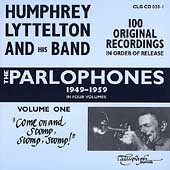
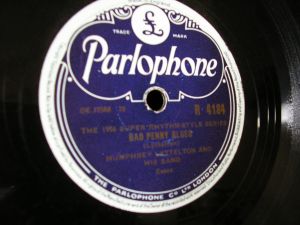
In the late 1940s Humph’s band had started to record a series of 78rpm records for the Parlophone label, starting with a lovely version of “Maple Leaf Rag” and stretching to over a hundred titles. Among these tracks was one record that actually made it into the Top 20 of the British pop charts in 1956, admittedly at Number 19, but nevertheless that’s no mean feat for a Jazz record. I should point out that this was long before my birth, but I remember hearing the track many times around the house when I was young.

The Bad Penny Blues was written by Humphrey Lyttelton and the hit recording features a quartet drawn from his band which, by the mid-1950s, had gravitated to a more mainstream jazz style, away from the “traddy” sound favoured by most contemporary jazz outfits. Indeed, he had incurred the wrath of many conservative fans by daring to include a saxophonist, the brilliant but eccentric Bruce Turner, in his outfit. Bad Penny Blues, though, featured only Humph on trumpet, Johhny Parker on piano, Stan Greig on drums and Jim Bray on bass. It was only recorded as an afterthought because it went down well at live gigs at Humph’s Jazz Club the HL Club (which later became the 100 Club, at 100 Oxford Street.)

But the real key to the success of this record was a young man by the name of Joe Meek. Starting out as a sound engineer at the Parlophone studios, Meek had quickly established an excellent reputation and in this case he was asked to take over the whole production of the record. According to Humph, they were slightly concerned at what he was doing with the microphones before they made the take but after it was done they all went home and left Meek to do some tinkering with the sound before cutting the disk. In those days, recording techniques were relatively crude and there generally wasn’t much in the way of post production, especially in jazz.

When he heard the final record, Humph was shocked. For one thing, Meek had close-miked all the instruments, including the drums – something which wasn’t generally done with jazz records for fear of (a) drowning out the rest of the band and (b) exposing the clumsiness of the drummer, the latter being a particularly problem. As Humph said, his band always sounded like the rhythm section was wearing diving boots. For this reason the drums were usually recorded with a distant mike and generally hidden in the ensemble playing. But in this case it worked out very well. Stan Greig used brushes on this track and his playing served beautifully both to propel and to punctuate the performances of the other musicians.

But it wasn’t the drums that so disturbed Humph. Meek had also fiddled with the double bass and with the left hand boogie-woogie figures of Johnny Parker’s piano, fattening them out and changing the balance to bring them right up in the final mix. He also compressed the overall sound so that the bass lines seem to press in on both the piano’s right hand and the growling muted trumpet lead, tying them closer to Greig’s insistent drum patterns and creating an unusually dense sound. The result is an intense, driving feel, with a dark undertone that is quite unlike any other jazz record of its period and redolent with the atmosphere of a smoky jazz club. I love it, especially the moment when Humph’s trumpet takes over from the piano solo. With a timely kick from the drums and against the backdrop of those bluesy thumping bass lines the band finds another gear and they build up a fine head of steam before riffing their way into the fade.

You can hear the original recording here, in a bizarre video I found on Youtube in which someone films their cassette player. I have an original 78 of this track but at the moment can’t transfer it to digital because I haven’t got a turntable, but when I do I’ll post it. Hopefully it will have better balance than the video.

Humph didn’t like the way the record had been put together, but it was an instant hit. He later joked that he hated it all the way to the bank.

Joe Meek went on to produce several classic pop records, generating many ideas that were later used by Phil Spector, but ultimately he became a tragic figure. Such commercial success as he achieved didn’t really last and he sank into debt, depression and paranoia. A gay man in an era in which homosexuality was still illegal, he became a victim of blackmail and was questioned by the police for alleged encounters with rent boys. He committed suicide in 1967 at the age of 37.

The Bad Penny Blues went on to be the “inspiration” behind Paul Macartney’s Lady Madonna, a Beatles track which has a lot of the same notes in it and also borrows the same overall feel. I can’t put it more subtly than that. George Martin, who produced the Beatles’ track, was actually in charge of the Parlophone studio at the time Bad Penny Blues was recorded…

And Humph went on to live another 52 years, bringing music and laughter to millions.

To end with, here’s a link to a later version of the tune recorded by a more recent manifestation of Humph’s band, probably in the 1980s. Note the way his technique involved the use of his eyebrows! I may be wrong, but I think the pianist on this performance is Mick Pyne and the bass is played by Dave Green. I can’t really make out the drummer.