Archive for March, 2009

Spring is Here

Posted in Bute Park, Jazz with tags on March 17, 2009 by telescoper

All of a sudden it seems like Spring. We had a little foretaste a few weeks ago, but this was followed by a return into chilly miserable weather for a while. That even seemed to dampen the spirits of the blackbird that was waking me up and he’s left me alone for a while.

Now, though, it’s sunny and warm and the forecast is set fair until the weekend. My walk through Bute Park takes me past hosts of daffodils, appropriately enough for Wales. The trees are covered once more in green leaves. It’s just a pity there’s another week or so before the Easter holiday so I can’t spend more time outside or make use of the weather to get some necessary house repairs done, such as new window frames and repointing the chimney.

Still, I shouldn’t get too depressed. Spring has come early anyway. The clocks don’t go forward for another couple of weeks.

And if the weather wasn’t enough, my weekly veggie box arrived this morning with further evidence of springtime. After a steady supply of winter vegetables (such as swedes and parsnips), things have suddenly changed. The selection of seasonal vegetables I got today includes lettuce and tomatoes (for the first time in months), as well as Red Russian Kale and Cauliflower.

Oh, and the blackbird was back this morning too.

I haven’t put any music up for a while, so I hope you enjoy the following clip from Youtube which seems to fit the season. Errol Garner was a brilliant musician who invented a very distinctive style of Jazz piano entirely of his own. Many attempted to copy him, but nobody managed to get it quite right. He perfected a style of playing that involved using his left hand to keep a solid rhythm while his right hand usually played behind the beat created by his left. In other hands this lagging effect would probably have made the music drag, but in his it produced a wonderful sense of tension that he always somehow managed to resolve.

On slower numbers, such as most famous hit, Misty,
he tended to be elaborately decorative, something which I don’t like at all. But on the faster ones he could rattle along producing wonderful ad-libbed melodies like no other Jazz pianist, putting in little musical jokes here and there at the same time.

His other trademark was to play lengthy disguised out-of-tempo introductions that kept the audience guessing as to what tune was coming next and what speed it would be played at. I always thought his bass player and drummer were probably in the dark too, until he broke into tempo and played the melody, usually to spontaneous applause and broad grins all round. You can see that happening on this clip, around 2 minutes in, when at last he plays the theme of It Might as Well be Spring, a tune which was a big hit for Stan Getz and Astrud Gilberto in the 1960s.

If you’re interested in hearing Errol Garner at his absolute best, you have to get the classic Concert By the Sea, recorded live in Carmel, California in 1955, which is a joy to listen to over and over again. But in the meantime, here is in 1964.

Factoid-based Learning

Posted in Books, Talks and Reviews, The Universe and Stuff with tags , on March 16, 2009 by telescoper

There’s a post over on cosmic variance that asks the question What is Scientific Literacy? Some of the comments reminded me of a book review I did for Nature a while ago, so I thought I’d put it on here.

My point is that teaching science isn’t about teaching facts, it’s about trying to develop critical thinking and problem-solving skills.
At least that’s what it should be, if only the dumbers-down would stop meddling.

BOOK REVIEWED Heavenly Errors: Misconceptions about the Real Nature of the Universe

by Neil F. Comins

Columbia University Press: 2001. 288 pp. $27.95, £18.95

Astronomy is a curious subject to teach. Even the most unpromising fledgling scientist has probably, at some stage, looked at the night sky and wondered about the meaning of it all. Students usually therefore enter the classroom with some preconceived notions about astronomical matters. These notions are often naïve, sometimes inaccurate, and occasionally downright bogus. The teaching of astronomy does not, therefore, begin with a blank piece of paper, as it does with other topics in physical science, but with the correction of misconceptions that may be deeply held.

In Heavenly Errors, Neil F. Comins illustrates the ambivalent consequences of astronomy’s peculiar allure with a series of commonly held misconceptions, misunderstandings and errors of logic. It is a promising idea for a book, particularly when the author has enlisted the willing help of thousands of undergraduate students to compile a list of frequently held wrong ideas about the Solar System and beyond. It is interesting to read of the origins of these misconceptions: Hollywood movies, astrology, the Internet and bad reporting of science all share some of the blame. But it’s even more interesting to look at the different kinds of misconception and what they tell us about the chasm that often lies between scientific thinking and the ‘common-sense’ reasoning they represent.

Ask why the weather is colder in the winter and you may well get the reply that, because its orbit is elliptical, the Earth is further from the Sun during winter than it is during summer and therefore receives less of the Sun’s power at that time of year. This explanation fails to explain why the Southern Hemisphere experiences summer at the same time as the Northern Hemisphere experiences winter, that is, at the same stage of the Earth’s orbit around the Sun. Talking through the logic of this example with students not only corrects the misconception, but also illustrates the scientific method by examining other necessary consequences of a given explanation before settling on the correct one. In this case, it is to do with the varying length of day and angle of the Sun in the sky.

Many of the examples presented by Comins are simple errors of fact. For example, “Polaris is the brightest star in the night sky”, comes in at number 8 in the top 50 Cosmic Clangers (it is Sirius). Many others do not justify being called misconceptions at all. Time travel, which Comins takes to be self-evidently impossible, is not, as he claims, excluded by the general theory of relativity. On the other hand, he states that black holes are definitely not black because they give off Hawking radiation — this despite the fact that Hawking radiation has not yet been observed in an astronomical object.

And what is a misconception anyway? Contrary to popular belief, planetary orbits are not circular, and yet circles provide a useful approximate description for many purposes. We are told that they are actually elliptical, but this is itself an approximation that ignores perturbations from other bodies and relativistic effects. Most scientific explanations are misconceptions if you view them like this.

Much of the early part of Heavenly Errors is excellent, particularly its explanations of the basic astronomical properties of the Sun, planets and comets. But further on, the book goes badly off the rails. Through its conflation of fact and theory, and its blurring of the distinction between truth and approximation, it turns into a misguided crusade that encourages the rote learning of factoids as a means to “acquire a sound scientific foundation for understanding nature”. I think this does more harm than good. T. H. Huxley, who knew a thing or two about science, put it best: “irrationally held truths may be more harmful than reasoned errors.”

The Forces of History

Posted in Uncategorized with tags , , , , on March 15, 2009 by telescoper

Sorting through my old books yesterday, I picked up my copy of Das Kapital, and had a quick browse through it for old times’ sake because I found the following passage on the BBC website:

Owners of capital will stimulate the working class to buy more and more expensive goods, houses and technology, pushing them to take more and more expensive credits, until their debt becomes unbearable. The unpaid debt will lead to bankruptcy of banks, which will have to be nationalised, and the state will have to take the road which will lead eventually to communism.

How’s that for a prediction of the Credit Crunch?


The words were written in London by Karl Marx in 1867 and appears in the first volume of his mammoth book Das Kapital; the second and third volumes were edited by his friend Engels and published after Marx’s death. In case you didn’t know, Karl Marx is buried in London, in Highgate cemetery. His memorial, a very popular tourist attraction, is shown on the left.

Of course the word “communism” now has irredeemable connotations of totalitarian excess, stemming not only from Stalin’s Russia but other attempts to impose communist rule around the world. In the United States of America in particular, communism is now a dirty word that right-wingers use to describe any aspect of government interference in economic affairs. As a matter of fact, American politics is so far to the right that even the word “liberal” is a term of abuse in some quarters.

While not in any way wanting to defend the various tyrannies that emerged as distorted manifestations of some of the ideas in his book, I think Marx’s analysis of the way capitalist economies work remains as valid today as it was in the 19th Century. It may be a little dated now, and class relationships are undoubtedly more complex now than the simple model he proposed to describe industrialised economies, but I think Marx is to political economy what Newton was to physics: much of his work has been superceded, but basically it’s right.

Ask me if I’m a Marxist and I’ll say that’s like asking a physicist if they are a Newtonian…

Marx argued that increasingly severe crises would inevitably punctuate the cycle of growth and recession owing to the inherent instability of the system. In the long term the capitalist class tends to invest more in new technologies rather than in labour. Marx believed that the source of all profit was the “surplus value” generated by waged labour, who also buy the goods that are created. As economies grow, the rate at which this profit accrues inevitably falls, leading to recession. The laws governing this behaviour are just as unavoidable as the laws of physics, Marx argued.

Reading the news today about the recent G20 summit, it struck me as quite surprising how many people seem to think that a bit of tinkering with market regulation is going to bring the world rapidly out of this current recession.

I don’t share this optimism at all. It seems to me that the global financial system is completely broken in the way that the quotation describes. The recent economic growth that western economies have enjoyed has virtually all been founded on credit tied to ridiculous over-valuations of the value of property. It is no surprise that the stock markets have been in free fall for over a year: the proper value of our economy is much much lower than we’ve all been deluding ourselves into thinking. I would say that the last ten years of growth has been completely fictitious in a well-defined sense, and the markets will probably bottom out at the value they had about a decade ago. The problem is that in these circumstances many debts will go bad, salaries are all way too high for the labour market to sustain, unemployment rises catastrophically, and the only way out is to print money leading to wholesale inflation and the consequent devaluation of the economy. The British Treasury has only recently grasped the scale of the issue and started a modest bit of “quantitative easing“. I think there’s going to be a lot of this over the next year or two.

I don’t believe that stimulus measures will work, since the resources of governments are dwarfed by the levels of bad debt, nor do I believe that pensioners and taxpayers should pay for the excesses of the prodigal banking sector. I can’t predict what will happen over the next few years, but I think we’re heading for a depression as deep as the 1930s and, unless something drastic is done, all the social unrest and political instability during and after the Great Depression will accompany this one too.

And it seems to me that the only way out of it is for the full-scale nationalisation (or even internationalisation) of the banking system so that money can be directed towards where it is needed rather than into the pockets of a few unscrupulous bastards.

But that would lead to communism, and communism is a dirty word…

Black March

Posted in Poetry with tags , on March 14, 2009 by telescoper

By way of a contrast with yesterday’s silliness, I thought I’d mark the time of year with one of my favourite poems by one of my favourite poets, Stevie Smith. Her verses are quirky and enigmatic, sometimes frivolous and sometimes profound and sometimes somehow both of those at the same time. Some of her work is quite religious in nature, but she had a very ambivalent attitude to God.

This particular poem was written near the end of her life and it’s quite typical of her thoughts about death at that time. She had contracted a brain tumour and knew the end was coming soon. It didn’t frighten her at all, as the verse makes clear. She died in 1971, just a few months after writing this and without having to endure a lengthy illness.

There’s always something (usually the weather) that reminds me of this poem at this time of year and I dig out my old book of Stevie Smith’s collected verse and read it again.

This is Black March.

I have a friend
At the end
Of the world.
His name is a breath

Of fresh air.
He is dressed in
Grey chiffon. At least
I think it is chiffon.
It has a
Peculiar look, like smoke.

It wraps him round
It blows out of place
It conceals him
I have not seen his face.

But I have seen his eyes, they are
As pretty and bright
As raindrops on black twigs
In March, and heard him say:

I am a breath
Of fresh air for you, a change
By and by.

Black March I call him
Because of his eyes
Being like March raindrops
On black twigs.

(Such a pretty time when the sky
Behind black twigs can be seen
Stretched out in one
Uninterrupted
Cambridge blue as cold as snow.)

But this friend
Whatever new names I give him
Is an old friend. He says:

Whatever names you give me
I am
A breath of fresh air,
A change for you.

Veteran at the Veterinarian

Posted in Columbo with tags , , on March 13, 2009 by telescoper

Just a very quick update about Columbo, my elderly diabetic cat. I took him to the vet earlier this week for a test of his fructosamine levels because these were higher than expected when I had them tested last time he went.

Today I got the results back, and this time the fructosamine levels were much lower. Now he appears to have excellent control of his blood sugar level. Whatever went wrong to produce the high previous readings remains unclear but, for the time being at least, he’s back to normal and I won’t need to take him back for another 6 months.

Late Arrivals at the Physics Ball

Posted in The Universe and Stuff, Uncategorized with tags , , on March 13, 2009 by telescoper

Today is the day we have to endure Comic Relief, an event which happens mercifully only once a year. The idea is to raise money for charity by doing something funny. If only.

I’ve also recently been persuaded to part with £30 to buy a ticket for the annual Physics Ball, organized by Chaos (Cardiff University Physics student-staff society). In the light of this I thought I’d add yet another item of debatable comic value to Comic Relief. My old friend Bryn Jones and I have been taking a leaf out of the I’m Sorry I Haven’t a Clue book of appalling puns.

Without further ado, therefore, it gives us great pleasure to announce the late arrivals at the Physics Ball:

Mr. and Mrs. Sirquashens and their son Maxwell
Mr and Mrs Rowave and their son Mike
Mr and Mrs Ofmotion and their daughter Constance
Mr and Mrs Destate and their son Solly
And from Ireland, Mr and Mrs O’genesis and their son Barry who has brought his two pet newts (Ron and Reno).
Mr and Mrs Yabatick and their daughter Ada.
Mr and Mrs Dardtemperatureandpressure and their son, Stan.
Mr and Mrs Hertz and their son Terry.
Mr and Mrs Avolt and their energetic daughter Meg
Mr and Mrs Persymmetry and their daughter Sue
Mr and Mrs Mentum and their daughter Mo.
Mr and Mrs Sticity and their daughter Ella.
Mr and Mrs Ryovrelativity and their son, Theo, who has a successful career in the military, yes it’s General Theo Ryovrelativity. He’s brought a couple of friends too: Chris Toffle-Cymbals and Joe Desick. Oh, and have you met Rick Tensor?

Here’s Mr and Mrs Zeinstein-Condensate with their son Bo.
Mr and Mrs Gular-velocity and their daughter Anne.
And now we have Mr. and Mrs. Ihilation and their destructive daughter Ann.
Here are Mr. and Mrs. Barr and their highly pressured daughter Millie.

Mr. and Mrs. Farparticull with their son Al.
Mr. and Mrs. Diantflucks and their bright son Ray.
And the coach party has arrived from Ireland with Mr. and Mrs. O’Moshun and their important son Newt Onslow.
Mr. and Mrs. O’Lissforss and their daughter rotating daughter Kerry.
From the Institute of Electrical Engineers we have Mr. and Mrs. Arrsirkitt and their pulsating daughter Elsie.
We now have Mr. and Mrs. Rectcurrant and their son Dai.
Mr and Mrs Hair-Theorem and their son Noah.
Mr and Mrs Mix and their daughter Dinah
Mr and Mrs Clotron and their son Si
Mr and Mrs Yaolis and, doing her best to circulate, their daughter Cora
Mr and Mrs Daze-Lore and their Daughter Farrah
From the Ruritanian principality of Energee we have Prince Ippilocon-Servashun of Energee.
Mr. and Mrs. Jeenslaw and their far-from-energetic son Ray Lee.
Mr. and Mrs. Minnusflucks and their bright son Lou.
Mr. and Mrs. Litonian and their dynamic son Hammy.
Mr. and Mrs. Shuoffheet-Capassitees and their son Ray.
And more arrivals from Ireland: Mr. O’Savar-Law and his attractive wife Bea.
Mr. and Mrs. O’Watt and their powerful daughter Meg.
Mr. and Mrs. O’Particull and their petite daughter Nan
Mr and Mrs Ear-accelerator and their daughter Lynne

And although I don’t think they were invited here are Mr and Mrs Osoficklenonsense and their son Phil along with Mr and Mrs Logicaldistraction and their son Theo.

And a definitely unwelcome are Mr and Mrs Thropic-principle and their daughter Anne

Sorry you can’t come in wearing those jeans. You might not like it, but we do have a Jeans criterion.

Mr and Mrs Ittifluctuation and their son Dennis
Mr and Mrs Punovexponent and their rather chaotic daughter, Leah
Mr and Mrs Stransition and their daughter Fay
Mr and Mrs Trope with their children Polly and Barry.
And we now welcome Mr. and Mrs. Way-Veckwashunn and their canny daughter Inga; that’s the shrewd Inga Way-Veckwashunn.
Mr. and Mrs. Broywavelength and their daughter Deb.
Please welcome Mr. and Mrs. Noldsnumber and their turbulent son Ray.

And now it’s Cabaret time!

First we’ve got sensational pop in the form of singer Larry Tee, followed by a quick burst of Pump up the Volume, folllowed by Norwegian artist Lars Kattering, then chillout with the smooth background sounds of The Three Degrees and ending up with a number of fading stars performing Back to Black.

For those of you wanting something more traditional, we’ve got folk music by The Spinors.

Mr. and Mrs. Helmholtz-Instability and their unstable son Kelvin.
Mr. and Mrs. Tensor and their son Richie
From Wales, Mr and Mrs Menshanalanalissis and their son Dai
Mr and Mrs Eyelength and their daughter Deb Eyelength
Mr and Mrs Notanotherloadofbolloxaboutstringtheory and their son Gordon Bennett Notanotherloadofbolloxaboutstringtheory
Mr and Mrs Dingo-Flyte and their son Ben
From Norway, Mr and Mrs Tableorbit and their son Lars
Mr and Mrs Sonscattering and their son Tom.
Mr. Skelleration and his rapidly moving wife Constance.
Mr. and Mrs. Vennspeed and their son Alf.
And the Welsh electrician, Dai Electric.
From Germany we have Herr Diffraction and his wife Frau Enhofer Diffraction.
Mr. and Mrs. Offslaw and their electrical engineer son Kirk.
Mrs and Mrs Ginvariance and their daughter Gay
Mr and Mrs Terry-Matrix and their daughter Una
And here is Solly, the only member of the Ton family who could make it, but then he always comes on his own
Mr and Mrs On and their daughter Kay and son Barry
Mr and Mrs Roscopic-quantity and their son Mac.
Mr. and Mrs. Moment and their bipolar son Dai Paul.
Mr. and Mrs. Covraydiashonn and their glowing daughter Cherry Ann.
Mr. and Mrs. Arisation and their son Paul.
Mr. and Mrs. Onsprinkippiah and their very important son Newt.
Mr. and Mrs. Cannsoyldropp-Experryment and their very practical daughter Millie.
Mr. and Mrs. Sonnmorlie-Experryment, and here comes their son Michael with no positive result.
Mr. Menterryparticalls and his fundamentally important wife Ellie.
Mr. and Mrs. Swelldeemon and their problematic son Max.
Mr. and Mrs. Defect and their slightly spolit daughter Crystal.
Mr. Formmotion and his constant wife Una.
And here are the Tonn children with their father Newt, and their father’s unmarried sister Prue – that’s Auntie Prue Tonn.
The coach party has arrived from Wales, with Mr. and Mrs. Nammicks and their fast-moving son Dai.
Mr. and Mrs. Vergance-Theorem and their son Dai.
Mr. and Mrs. Oolie-Ekwayshonn and their son Bernie.
From America, Mr and Mrs Chure and their spaced-out son Cosmic Tex Chure
Mr and Mrs Wurld and their son Brian
Mr and Mrs Theory and their Daughter Emma
and here are the Structive-interference family, with brother and sister Des and Connie
Mr and Mrs Medes-Principle with their son Archie
Mr and Mrs Fishalsatellites and their son Artie
In a bit of a whirl here’s Mr and Mrs Currants and their son Eddy

From Germany, Mr and Mrs Duranium and their son Heinrich
Mr and Mrs Photon and their son Virgil
Mr and Mrs Velocity and their typical son Aramis
Mr and Mrs Gadrowsnumber and their daughter Ava
Mr and Mrs Experryment and their son Jules
Mr and Mrs Psimeson and their son Jay
Mr and Mrs Dington-Limit and their son Ed.
Mr. and Mrs. Eslaw and their son Charles.

From the Institution of Electrical Engineers we have Mr. and Mrs. Acksialcabell and their shielded son Carl.
We are pleased to receive Mr. Tennar and his wife Ann.
And from the Science and Technology Facilities Council we have their chief accountants, Mrs. Nanshall-Dissastar and Mr. Jettery-Kayoss: that’s Fi Nanshall-Dissastar and Bud Jettery-Kayoss.

Mr. Motiff-Forss and his magnetic wife Elektra.
Here from the left come Mr. and Mrs. Saslaw and their charged son Guy, and in the opposite direction their son Len.
Mr. and Mrs. Annicall-Annerjee and their son Mike.
Mr. and Mrs. Tamass and their son Rhys.
Mr. and Mrs. Statickpotenshall and their daughter Elektra.
Mr. Jenner-Ait-Annerjee-Levell and his wife Dee.
Mr. and Mrs. Mental-Constance and their humorous, light-hearted son Dai. That’s fun Dai Mental-Constance

Feel free to add more via the comments if you get the idea! The more excruciating the better…

The First Digit Phenomenon

Posted in Bad Statistics, The Universe and Stuff with tags , , on March 11, 2009 by telescoper

I thought it would be fun to put up this quirky example of how sometimes things that really ought to be random turn out not to be. It’s also an excuse to mention a strange connection between astronomy and statistics.

The astronomer Simon Newcomb (right) was born in 1835 in Nova Scotia picture2(Canada). He had no real formal education at all, but since there wasn’t much else to do in Nova Scotia, he taught himself mathematics and astronomy and became very adept at performing astronomical calculations with great diligence. He began work in a lowly position at the US Nautical Almanac Office in 1857, and by 1877 he was director. He became was professor of Mathematics and Astronomy and Johns Hopkins University from 1884 until 1893 and was made the first ever president of the American Astronomical Society in 1899; he died in 1909.
Newcomb was performing lengthy numerical calculations in an era long before the invention of the pocket calculator or desktop computer. In those days many such calculations, including virtually anything involving multiplication, had to be done using logarithms. The logarithm (to the base ten) of a number x is defined to be the number a such that x=10a. To multiply two numbers whose logarithms are a and b respectively involves simply adding the logarithms: 10a times 10b=10(a+b), which helps a lot because adding is a lot easier than multiplying if you have no calculator. The initial logarithms are simply looked up in a table; to find the answer you use different tables to find the “inverse” logarithm.

Newcomb was a heavy user of his book of mathematical tables for this type of calculation, and it became very grubby and worn. But he also noticed that the first pages of the logarithms seemed to have been used much more than the others. This puzzled him greatly. Logarithm tables are presented in order of the first digit of the number required: the first pages therefore contain logarithms for numbers beginning with the digit 1. Newcomb used the tables for a vast range of different calculations of different things. He expected the first digits of numbers that he had to look up to just be as likely to be anything. Shouldn’t they be randomly distributed? Shouldn’t all the pages be equally used?

Once raised, this puzzle faded away until it was re-discovered in 1938 and acquired the name of Benford’s law, or the first digit phenomenon. In virtually any list you can think of – street addresses, city populations, lengths of rivers, and so on – there are more entries beginning with the digit “1” than any other digit.

To give another example, although I admit this one is much harder to explain, in the American Physical Society’s list of fundamental constants, or at least the last version I happened to look at, no less than 40% begin with the digit 1. If you’ve been writing physics examination papers recently like I have, you will notice a similar behaviour. Out of the 16 physical constants listed in the rubric of a physics examination paper lying on my desk right now, 6 begin with the digit 1.

So what is going on?

There is a (relatively) simple answer, and a more complicated one. I’ll take the simple one first.

Consider street numbers in an address book as an example. Suppose Any street will be numbered from 1 to N. It doesn’t really matter what N is as long as it is finite (and nobody has ever built an infinitely long street). Now think about the first digits of the addresses. There are 9 possibilities, because we never start an address with 0. On the face of it, we might expect a fraction 1/9 (approximately 11%) of the addresses will start with 1. Suppose N is 200. What fraction actually starts with 1? The answer is more than 50%. Everything from 100 upwards, plus 1, and 11 to 19. Very few start with 9: only 9 itself, and 90-99 inclusive. If N is 300 then there are still more beginning with 1 than any other digit, and there are no more that start with 9. One only gets close to an equal fraction of each starting number if the value of N is an exact power of 10, e.g. 1000.

Now you can see why pulling numbers out of an address book leads to a distribution of first digits that is not at all uniform. As long as the numbers are being drawn from a collection of streets each of whom has a finite upper limit, then the result is bound to be biased towards low starting digits. Only if every street contained an exact power of ten addresses would the result be uniform. Every other possibility favours 1 at the start.

The more complicated version involves a scaling argument and is a more suitable explanation for the appearance of this phenomenon in measured physical quantities. Lengths, heights and weights of things are usually measured with respect to some reference quantity. In the absence of any other information, one might imagine that the distribution of whatever is being measured possesses some sort of invariance or symmetry with respect to the scale being chosen. In this case the prior distribution p(x) can be taken to have the so-called Jeffreys form, which is uniform in the logarithm, i.e. p(x) is proportional to 1/x. There obviously must be a cut-off at some point as this can’t be allowed to go on forever as it doesn’t converge for large x, but this doesn’t really matter for the sake of this argument. We can suppose anyway that there are many powers of ten involved before this upper limit is reached.

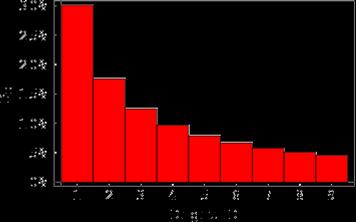
In this case the probability that the first digit is D is just given by the ratio of two terms: In the numerator we have the integral between D and D+1 of p(x) (that’s a measure of how much of the distribution represents numbers starting with the digit D) and on the denominator we have the integral between 1 and 10 of p(x) (the overall measure). The result, if we take p(x) to be proportional to 1/x, is just log (1+1/D).

picture1

The shape of this distribution is shown in the Figure. Note that about 30% of the first digits are expected to be 1. Of course I have made a number of simplifying assumptions that are unlikely to be exactly true, and the case of the physical constants is complicated by the fact that some are measured and some are defined, but I think this captures the essential reason for the curious behaviour of first digits.

If nothing else, it provides a valuable lesson that you should be careful in what variables you assume are uniformly distributed!

The Feline Condition

Posted in Columbo with tags , , , on March 9, 2009 by telescoper

It’s time for my regular update about Columbo, my famous diabetic cat.

I took said moggy to the vet today for a repeat fructosamine test. When I took him a couple of months ago his level was quite high (280), which surprised me because he’s actually been in fine fettle and there was no reason to think anything was going wrong on the health front. Nevertheless, the vet had suggested an increase in his regular insulin injection to 4 units (from three) and a repeat test a bit later. So I went back today.

The fructosamine test measures the level of blood sugar over a period of 1-3 weeks. Fructosamines are stable complexes of carbohydrates and proteins that are produced by an irreversible, nonenzymatic glycosylation of protein. Increased fructosamine values are due to higher quantities of glucose in the blood, resulting in increased glycosylation of proteins. This provides a more stable measurement of blood sugar concentration than a one-off glucose test because the latter can be heavily influenced by stress, such as is induced by visiting the vet….

Just as a check, they took a glucose reading today which came out at 18, much higher than the level he showed on his last visit to the vet (which was 7 on the same scale). I didn’t notice any real evidence that he was stressed out at all when they did this. In fact he was purring in the vet’s examination room. So the glucose result appears to be consistent with his previously high fructosamine test and probably indicates poorer control of his diabetes than we would have wished for.

So they took another, largerm blood sample from his neck (which he never enjoys) to find the fructosamine level. Today proved to be no exception to his displeasure at this procedure, and he’s been in a huff since we got home. They have to send the sample off to a lab for analysis so I’ll have to wait until Wednesday to find out the score and what to do about it.

His diabetes has been pretty stable for many years now, and I’m not sure why it the control doesn’t seem to be as good these days. It’s may be just because his metabolism is changing as he gets older. If the level of fructosamine remains high I’ll probably have to increase the dose again and have another test done to see if it succeeds in lowering his sugars.

Columbo will be 15 on March 31st, and he’s definitely showing signs of age and of his diabetes. He began to develop cataracts some time ago, giving his eyes a slightly cloudy appearance; these are apparently associated with diabetes, although they are a bit more common in dogs than in cats. He probably doesn’t see very well as a result of this but it doesn’t seem to bother him. He certainly still manages to play with moving toys alright so his close-up vision is good enough. The rest of his observable Universe isn’t so very large anyway, only consisting of my house and small garden.

He sleeps a lot, as most cats do, but he still has his playful moments and maintains a healthy interest in the little bits of wildlife that stray into my garden. While I’m a bit concerned about his condition, I’m not too worried while he still seems to be enjoying life.

Starless and Bible Black

Posted in Jazz, Literature, Poetry with tags , , , , , on March 7, 2009 by telescoper

A few weeks ago in my bit about the great jazz composer and pianist Thelonious Monk, I mentioned another great musician, Stan Tracey. He was Ronnie Scott’s house pianist for many years, as well as being a composer and leader of his own band. It’s only the fact that he stayed all his life in England that prevented him from gaining wider recognition. No less a musician than Sonny Rollins asked (of British Jazz fans)

Does anyone here realise how good he is?

Well, I think they do but he remains relatively unknown outside these shores.

Amongst the collection of old LPs that I am gradually making into CDs using the USB turntable I got for Christmas is one of the greatest British jazz albums, Under Milk Wood, which was written by Stan Tracey and recorded by his band in 1965.

Living in Wales, I’m somewhat ashamed that I didn’t do this one before because it is of course inspired by the “play for voices” with the same name by Dylan Thomas. The music is brilliant throughout, vividly evoking the atmosphere of various episodes in the play, but my favourite track is about the very first lines. Stan Tracey’s piano and Bobby Wellins‘ saxophone hauntingly evoke the atmosphere of the opening of Under Milk Wood which, if you’ll forgive me for quoting a rather lengthy extract, shows Dylan Thomas extraordinarily imaginative use of language, superb control of rhythm even in a prose setting. His poems are wonderful to listen to as well as to read, especially when read by the poet himself with his sonorous yet lilting voice; if you want a short example try this example, steeped in a sense of nocturnal melancholy

In My Craft or Sullen Art

In my craft or sullen art
Exercised in the still night
When only the moon rages
And the lovers lie abed
With all their griefs in their arms,
I labour by singing light
Not for ambition or bread
Or the strut and trade of charms
On the ivory stages
But for the common wages
Of their most secret heart.

Not for the proud man apart
From the raging moon I write
On these spindrift pages
Nor for the towering dead
With their nightingales and psalms
But for the lovers, their arms
Round the griefs of the ages,
Who pay no praise or wages
Nor heed my craft or art.

Anyway, the play Under Milk Wood‘s famous opening goes along these lines:

It is Spring, moonless night in the small town, starless and bible-black, the cobblestreets silent and the hunched, courter’s-and-rabbits’ wood limping invisible down to the sloeblack, slow, black, crowblack, fishingboat-bobbing sea. The houses are are blind as moles (though moles see fine tonight in the snouting, velvet dingles) or blind as Captain Cat there in the muffled middle by the pump and the town clock, the shops in mourning, the Welfare Hall in widows’
weeds. And all the people of the lulled and dumbfound town are sleeping now.

Hush, the babies are sleeping, the farmers, the fishers, the tradesmen and pensioners, cobbler, schoolteacher, postman and publican, the undertaker and the fancy woman, drunkard, dressmaker, preacher, policeman, the webfoot cocklewomen and the tidy wives. Young girls lie bedded soft or glide in their dreams, with rings and trousseaux, bridesmaided by glow-worms down the aisles of the organplaying wood. The boys are dreaming wicked of the bucking ranches of the night and the jollyrodgered sea. And the anthracite statues of the horses sleep in the fields, and the cows in the byres, and the dogs in the wet-nosed yard; and the cats nap in the slant corners or lope sly, streaking and needling, on the one cloud of the roofs.

You can hear the dew falling, and the hushed town breathing.

Only your eyes are unclosed to see the black and folded town fast, and slow, asleep.

And you alone can hear the invisible starfall, the darkest-before-dawn minutely dewgrazed stir of the black, dab-filled sea where the Arethusa, the Curlew and the Skylark, Zanzibar, Rhiannon, the Rover, the Cormorant, and the Star of Wales tilt and ride.

Listen. It is night in the chill, squat chapel, hymning in bonnet and brooch and bombazine black, butterfly choker and bootlace bow, coughing like nannygoats, sucking mintoes, fortywinking hallelujah; night in the four-ale, quiet as a domino; in Ocky Milkman’s lofts like a mouse with gloves; in Dai Bread’s bakery flying like black flour. It is tonight in Donkey Street, trotting silent, with seaweed on its hooves, along the cockled cobbles, past curtained fernpot, text and trinket, harmonium, holy dresser, watercolours done by hand, china dog and rosy tin teacaddy. It is night neddying among the snuggeries of babies.

Look. It is night, dumbly, royally winding through the Coronation cherry trees; going through the graveyard of Bethesda with winds gloved and folded, and dew doffed; tumbling by the Sailors Arms.

Time passes. Listen. Time passes.

Here are Stan Tracey and Bobby Wellins with Stan Tracey’s meditation on that piece, Starless and Bible Black, played in a way that’s as moving and ethereal as the sound of time passing….

The Atomic Mr Basie

Posted in Jazz with tags , , , on March 6, 2009 by telescoper

I’ve been lecturing and writing bumf all day and decided I could do with a bit of a break, but my fingers are so used to typing today that they insisted I should use this ten-minute hiatus to write a blog entry. And who am I to argue with my digits?

Anyway, I had an idea last night of something to put up so I’ll take it off the mental shelf on which I store silly blog ideas and present it now.

Last weekend I went to see the Opera Doctor Atomic in London, and last night I was tidying up my CDs which I usually leave lying around all over the place. In amongst the ones I found in my study and moved back to their rack was the brilliant album that my version calls The Atomic Mr Basie, but I think was originally issued in 1957 on LP with the name E=MC2. I doubt that there is that much musical fare with the word “Atomic” in the title so it struck me as a bit of a coincidence. Apart from anything else it’s a reminder of how far the language of atomic bombs had entered into popular circulation during the 1950s. I can’t think of any other Jazz albums with an equation as the title either.

I’m not sure why Count Basie became Mr Basie for the purposes of the later title, but there you are.

Jazz historians tend to distinguish quite sharply between two versions of the Count Basie Orchestra. According to the books, the first Basie Band was a rough-and-ready blues outfit that arrived in New York from Kansas City in 1936 and the second was a magnificently slick powerhouse machine that emerged after a short hiatus in 1951. Actually both bands were terrific, able to slip from laid back swing to full-throttle up-tempo rabble-rousing in barely the bat of an eye. Anyway, how “rough-and-ready” could a band be with the great Lester Young in the saxophone section? Another invariant between the two bands was the brilliance of the rhythm section which had a featherlight touch but was able to drive the band along like no other.

The late and very great Ella Fitzgerald described the Count Basie Orchestra as

They’re the swinginest band there ever was. They swing ya into bad health.”

Quite.

The real difference in the two bands wasn’t really the personnel (although that did change substantially over the years), but in the style of playing. The early Count Basie Orchestra didn’t have very sophisticated written arrangements so it relied a lot more on punchy riffs and call-and-answer exchanges between the brass and reeds, which were executed incredibly tightly considering that they were ad-libbed. The second manifestation drew on superb arrangers, particularly Neal Hefti who wrote most of the arrangements on The Atomic Mr Basie. The band still had an almost telepathic gift for synchronized riffing, especially playing behind a star soloist improvising in one of the many gaps left in the arrangements.

I had a quick shufti for hefti on Youtube and found one of the tracks from The Atomic Mr Basie, Whirlybird, performed in 1965 but with the same tenor sax soloist, Eddie “Lockjaw” Davis that plays on the album. I remember going to see him play in Newcastle once and was blown away by his enormous sound, the muscular leatheriness of his tone, and his uncanny ability to change up a gear just when you think he’s going flat out. Then in his sixties, he was an exhilirating musician to listen to and he was even better twenty years earlier with this great band punching out riffs behind him. I love this version nearly as much as the original, even if the drum solo (by the overrated Rufus Jones) does go on a bit, because the brass section is just awesome…