Archive for June, 2009

Returning to Lognormality

Posted in Biographical, Science Politics, The Universe and Stuff with tags , , , on June 7, 2009 by telescoper

I’m off later today for a short trip to Copenhagen, a place I always enjoy visiting. I particularly remember a very nice time I had there back in 1990 when I was invited by Bernard Jones, who used to work at the Niels Bohr Institute.  I stayed there several weeks over the May/June period which is the best time of year  for Denmark; it’s sufficiently far North that the summer days are very long, and when it’s light until almost midnight it’s very tempting to spend a lot of time out late at night.

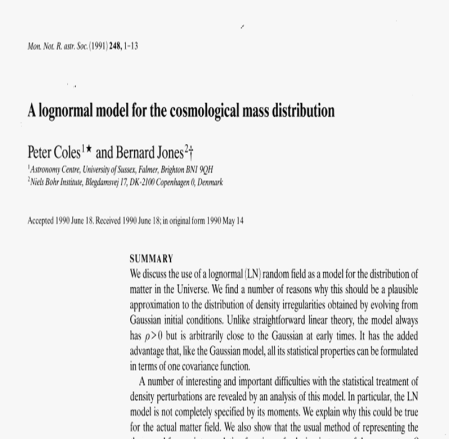
As well as being great fun, that little visit also produced my most-cited paper. I’ve never been very good at grabbing citations – I’m more likely to fall off bandwagons rather than jump onto them – but this little paper seems to keep getting citations. It hasn’t got that many by the standards of some papers, but it’s carried on being referred to for almost twenty years, which I’m quite proud of; you can see the citations per year statistics are fairly flat. The model we proposed turned out to be extremely useful in a range of situations, hence the long half-life.

nph-ref_history

I don’t think this is my best paper, but it’s definitely the one I had most fun working on. I remember we had the idea of doing something with lognormal distributions over coffee one day,  and just a few weeks later the paper was  finished. In some ways it’s the most simple-minded paper I’ve ever written – and that’s up against some pretty stiff competition – but there you go.
Picture1

The lognormal seemed an interesting idea to explore because it applies to non-linear processes in much the same way as the normal distribution does to linear ones. What I mean is that if you have a quantity Y which is the sum of n independent effects, Y=X1+X2+…+Xn, then the distribution of Y tends to be normal by virtue of the Central Limit Theorem regardless of what the distribution of the Xi is  If, however, the process is multiplicative so  Y=X1×X2×…×Xn then since log Y = log X1 + log X2 + …+log Xn then the Central Limit Theorem tends to make log Y normal, which is what the lognormal distribution means.

The lognormal is a good distribution for things produced by multiplicative processes, such as hierarchical fragmentation or coagulation processes: the distribution of sizes of the pebbles on Brighton beach  is quite a good example. It also crops up quite often in the theory of turbulence.

I;ll mention one other thing  about this distribution, just because it’s fun. The lognormal distribution is an example of a distribution that’s not completely determined by knowledge of its moments. Most people assume that if you know all the moments of a distribution then that has to specify the distribution uniquely, but it ain’t necessarily so.

If you’re wondering why I mentioned citations, it’s because it looks like they’re going to play a big part in the Research Excellence Framework, yet another new bureaucratical exercise to attempt to measure the quality of research done in UK universities. Unfortunately, using citations isn’t straightforward. Different disciplines have hugely different citation rates, for one thing. Should one count self-citations?. Also how do you aportion citations to multi-author papers? Suppose a paper with a thousand citations has 25 authors. Does each of them get the thousand citations, or should each get 1000/25? Or, put it another way, how does a single-author paper with 100 citations compare to a 50 author paper with 101?

Or perhaps the REF should use the logarithm of the number of citations instead?

Lulu

Posted in Biographical, Opera with tags , , , on June 6, 2009 by telescoper

On Thursday (4th June) I went to the first night of the Royal Opera’s new production of Lulu, an Opera by Alban Berg. I was planning to blog about this yesterday but after the Opera my birthday celebrations descended into drunken chaos and I ended up getting back very late to Cardiff yesterday; I had to catch up a number of things so I didn’t have time. After the performance and dinner in a nearby restaurant we sat out on Joao’s roofgarden in Notting Hill drinking until the sun started to come up. That part is a bit of blur, but judging by the scale of my hangover yesterday it must have been good. Anyway, I’ve now recovered enough write something about the Opera.

Before Thursday I hadn’t seen Lulu in a live performance, although I do have it on DVD so I knew a bit about it. Berg was a student of Arnold Schoenberg, but he developed his own take on the twelve-tone techniques developed by his mentor. Not everyone finds  serialist music easy to enjoy, but I think if you’re going to have a go at it this Opera is one of the best places to start. I think the score for Lulu is completely wonderful: it’s constantly changing texture, sometimes lushly romantic (with a big  nod in the direction of Mahler in Act I), sometimes bleak and jagged. Sometimes there is no music at all and the singers use a stylised method of vocalisation in between speaking and singing (called Sprechstimme). This  is used only sparingly in Lulu, but it is wonderfully effective dramatically when it is.

The Orchestra of the Royal Opera House, conducted by Antonio Pappano, were absolutely fantastic throughout the performance. I’m no musician but I reckon this music must be extremely difficult to play, especially in the brass section, but they played with great passion as well as flawless precision. They really brought Berg’s music to life, and invested it with a vitality that positively glowed throughout the performance. With playing like this, it was easy to understand why Berg is such an influential composer: you can hear in this Opera the ideas behind many Hollywood movie scores, for example.

So what about the Opera itself? The play revolves around the character of Lulu, an enigmatic figure who is at times innocent and vulnerable and at others cynical and manipulative. Her personality is only revealed to us through her interactions with men, all of which end in disaster. Lulu’s first husband has a heart attack and dies; her second commits suicide. She then shoots another man and is imprisoned but eventually escapes. By the end of the opera, many years later on, she has wound up in London and is living in poverty working as a prostitute. She dies at the hands of Jack the Ripper.

The structure of the Opera is like a mirror, with Lulu’s reversal of fortunes happening after an intermezzo in the middle of Act 2, at the centre of which there is a remarkable musical palindrome (shown above). Before this her role in the drama is to drive the men around her into obsession, madness and death, although she never appears to understand why she has this effect on them. After the dramatic fulcrum of the piece she becomes more and more of a victim. The reason for this is not some great change in her own psychological make-up but just that she is getting older and  losing her looks. No longer sexually desirable, she has lost the only way of controlling the men in her life. From this point on, her decline is inexorable and death inevitable.

The new production is quite unlike the recording I have on DVD in that the staging is resolutely minimal. There is no set, just an occasional translucent screen, the costumes are modern and colours are monochrome. Lulu is dressed at one point  in a black cocktail dress very like that worn by Audrey Hepburn in Breakfast at Tiffany’s. This might have been a deliberate reference to the parallels between Lulu and Holly Golightly (at least in Truman Capote’s novella, which is a much darker concoction than the film based on it); soprano Agneta Eichenholz bears more than a passing resemblance to Audrey Hepburn too. Her slender build -unusual for an opera singer with such a powerful voice – allowed her to play Lulu’s vulnerable aspects very well.
Against a sparse backdrop  the characters emerge as series of grotesques, which – at least in principle – is not a bad way of  presenting this Opera. Set in such a way it appears as a piece of absurdist theatre which is definitely part of what it represents. There are two problems, however.

One is that the sets give very little clue as to the location of the drama: I wouldn’t have known that the last scene was meant to be Victorian London unless I’d seen it before, so Jack the Ripper’s appearance must have been very  confusing to those who hadn’t picked up on that. Lulu is also meant to be a lot older in the last Act, but no attempt is made to age her in this production.  The libretto makes repeated reference to a painting of her, and it serves at the end to remind her of her age, but no portrait ever appears; I found that a bizarre omission.

The other problem is that there are strong links between the story of Lulu and the Grand Guignol  genre of horror plays, with their  opulently macabre  stagings and exaggeratedly gory endings. Throwing all those connections  away robs the Opera of all of its schlock value and, with that, a great deal of the irony needed to make this blackest of black comedies work the way it should. The killing of Lulu in fact happens off stage in this production which makes the ending very tame. I wouldn’t want to go over-the-top in depicting the horror of Lulu’s death – I wanted to see an Opera, not a snuff movie – but the audience should be shocked by the brutality of her final moments; these are the key to what the Opera is about. Perhaps the director was concerned not to let the drama descend into mere titillation. There’s always a danger of crossing the line into vulgar pornography in depicting explicit sexuality and violence, but I think this production is too afraid of taking risks. This opera should feel more dangerous than this setting allows it to be. Ypu’re not meant to feel comfortable about this Opera.

Although limited by the stylized nature of the production, the principals were good. Agneta Eichenholz’s is a  desensitized creature, damaged by abuse and inhabiting a moral vacuum. Her detachment in the face of the death and destruction around her is perfectly judged. She sang beautifully for the most part but – possibly because of first night nerves – her voice came apart on a couple of high notes early on. Other characters worth mentioning are Michael Volle who was outstanding as Dr Schön and Philip Langridge in the dual role of the Prince and the Marquis.

This morning I read Andrew Clements’ review in the Guardian which I thought was a bit harsh: only two stars doesn’t really do justice to a fascinating evening. I would have  given three stars for the quality of the music alone. Personally, I could have listened to the whole thing in a concert performance and still enjoyed it. But having decided to go for a full staging,  it seems to me a bit perverse to have stripped  it down so drastically. Clements claimed he was “bored” by what happened on stage. I certainly wasn’t, but I did find myself more perplexed by the production than by the moral ambivalence of the story itself, so I’d have to say it didn’t really do justice to an Opera which I still think of as masterpiece.

Day of Days

Posted in Biographical with tags , on June 4, 2009 by telescoper

Well, here we are then.

Another birthday.

Actually, this one has been great (so far) and I’m looking forward to the rest of the day. Although it coulded over yesterday evening leading me to think our sunny spell was over, today I awoke to bright sunshine again and it’s stayed the same all morning. The garden looks unkempt but is at least full of flowers and smells, and I had my breakfast outside again before toddling off down to the polling station in St Catharine’s Church Hall to cast my vote in the Elections for the European parliament.

We won’t get the results of that election until Sunday because different European countries are voting on different days and the results are only announced when all polls are closed. I’ll be in Copenhagen on Sunday so will have to catch up on the news from there. Other parts of the United Kingdom are also voting for their local Councils too, and those results will be out tomorrow.

I’m not an expert political analyst but it seems to me these elections could go one of two ways: either the major political parties get a complete drubbing or the population is so disgusted with the political establishment that they don’t turn out at all. When I went to my polling station it was completely deserted apart from the two ladies keeping track of the ballot papers. On the basis of that observation, it could be that apathy will carry the day.

Incidentally, I’m very old-fashioned about voting. I don’t agree at all with the trend of encouraging on-line or postal voting. I think it’s part of one’s civic duty to cast a vote and that means getting off your arse and putting a cross on a bit of paper. It gives a sense of participation to vote in person and most excuses for not doing so just amount to  laziness. There are polling stations all over the place, they open from the early morning until late at night, and it only takes a minute or so to vote.  So get out there and do your bit.

Now I have time to do mark a few more examinations before having a shower and getting ready to get on the train to London. As a birthday treat, organized by Joao Magueijo, a bunch of us are off to the posh seats at Covent Garden to see the opening night of the Royal Opera‘s new production of Alban Berg‘s Lulu, which I’ll review when I get back tomorrow.

ps. A package arrived in the post on Tuesday from my Mum with my usual birthday gift. It turned out to be a raincoat – usually a useful thing for someone living in Wales – but on a sweltering day it seemed a bit comical. No doubt I’ll get a chance to wear it before too long…

Honey, Suck My Nose

Posted in Jazz with tags , on June 3, 2009 by telescoper

I got home this evening to find that the honeysuckle along one side of my garden had burst into flower and was filling the air with beautiful scents.  Unfortunately, it looks like our little heatwave is on the wane so I might not be able to sit outside in the balmy air enjoying the aromas for much longer. It’s nice they chose to open out today though; it was like a birthday present that arrived a day early.

I think Tennyson would have approved:

Come into the garden, Maud,
     For the black bat, night, has flown,
Come into the garden, Maud,
     I am here at the gate alone ;
And the woodbine spices are wafted abroad,
     And the musk of the rose is blown.
 

I already mentioned yesterday that I have beautiful roses in full bloom on the other side of the garden, so I just couldn’t resist posting a version of the Jazz standard Honeysuckle Rose. This one is by the great Errol Garner, who I posted about not long ago, and features one of his characteristically offbeat introductions followed by his usual delightful improvisation.

Cat-and-Mouse

Posted in Columbo with tags on June 2, 2009 by telescoper

I haven’t really got time for a long post today, but a couple of people have independently asked me how Columbo is getting on so I think it’s probably a good time for an update.

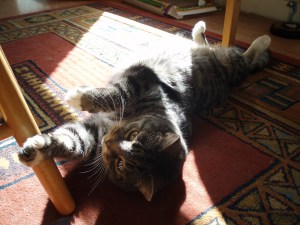
Since his scary Easter seizure Columbo has recovered extremely well and is doing fine, in fact. I don’t know what caused his little episode, but judging by his recovery it seems unlikely that it could have been a stroke like the vet suggested. He’s enjoying the nice weather and spends most of his time in my little garden these days.  (Incidentally, I’ve got loads of beautiful pink roses at the moment which quite wonderful to look at although they don’t smell very much.)

I’ve had various rather tedious things to do (such as marking examinations and project reports) but the glorious sunshine has allowed me to do these al fresco. When I’m sitting at the garden table, Columbo almost always climbs up and sits next to whatever I’m doing. It can be a bit difficult to get on with him there, especially when I’ve got the computer. When my fingers move over the keys he thinks its a game and tries to catch them with his paw. He also goes walkabout on the keyboard from time leading to some strange passages in my usually flawless prose.

On Sunday I spent a bit of time marking examination scripts but, in the course of doing that I realised that Columbo had found something to attract his attention. My garden table is actually on a piece of decking at the far end of the garden. The cat was sniffing and scratching at the decking in a peculiar way. Eventually I realised that the reason was a scuttling sound coming from underneath: almost certainly a mouse.

Columbo has never been an accomplished predator. I’m sure the few things he has brought into the house died of natural causes, apart from the huge black toad he caught when I was living in Nottingham. The problem with toads is that they secrete poisonous mucus, so Columbo had only just got the thing through the cat flap when he realised it was nasty, dropped it and started to drool from his mouth and cry like a baby. Thinking he had been poisoned when I came to investigate, I immediately rinsed his mouth with salt water which did the trick. It was only then I saw the disgruntled reptile sitting by the kitchen door with hardly a mark on it. I returned it to the garden and Columbo stayed away from toads thereafter.

P1010026

Anyway, the invisible mouse could be heard quite clearly moving to and fro in the invisible space underneath while Columbo followed it about on the surface like a destroyer trying to track a submarine. Finally he located it at the edge of the decking near the fence, where he went berserk scrabbling for the little critter. He didn’t manage to catch it, but it was very funny to watch although he went into a bit of a huff after the disappointment of failing to score a kill.

He has caught mice before – or, more likely, found them – but never really ate them. He always just played with them until they felt to bits and left a pile of guts on the carpet. He’s always been absolutely hopeless with birds too, never getting anywhere near them before they fly away. Until a couple of weeks ago, that is, when I found a dead sparrow in my bed…

There’s plenty of shade in my garden so there are places for him to take shelter from the hot sun. I can’t believe it’s much fun wearing a fur coat in this weather and cats have virtually no way of losing heat: they don’t pant, and only sweat through their paws. Fortunately he’s happy to take it easy and, as long as he’s got plenty of water, there’s no real problem. Cats survive in much hotter environments than this.

Because Columbo is diabetic he’s a bit of a magnet for fleas. The reason is that diabetic animals  have more sugar in their blood, so once fleas get on they have a bonanza. The hot weather and the fact that he’s outside so much of the time means that he’s always likely to pick up fleas and ticks. Fortunately there is an easy treatment for fleas that you dab onto the cat’s neck and it stops them breeding. I gave him a good comb last night and there was no sign of any parasites.

Flaming June

Posted in Biographical, Bute Park with tags , , , , on June 1, 2009 by telescoper

Since we’re in the middle of a heatwave I thought “Flaming June” would be a good title. I only just discovered, however, that it’s not as I thought some sort of folk expression or quotation from a poem, but the title of this Pre-Raphaelite painting by Frederic Leighton of a lady wearing what looks like a dress made out of old curtains. Apparently the oleander branch seen in the upper right symbolizes the fragile link between sleep and death. Or, in this weather, the fragile link between sleep and sunstroke.

Anyway, the year rolls on. The examination period is almost over, marking season is upon us and it will soon be time for  examiners’ meetings, class lists and all the arcane business of academic life.

Yesterday I sat in the garden marking a third-year paper or, actually, only half a paper as I give the course jointly with another member of staff. After I’d finished I decided to go for a ride on my bicycle up the Taff Trail and around Bute Park. It was nice, but should have been nicer. Unfortunately, Cardiff City Council’s insane policy of organizing “events” all over the park, involving heavy vehicle movements and temporary buildings, has led to the wholesale destruction of the grass in many places. If the hot summer continues then this will get worse. The site of last year’s National Eisteddfod on Pontcanna Fields still hasn’t recovered; fifteen local sports fields have been completely ruined as you can see from this little video taken a couple of months ago.

Despite ongoing protests, the Council seems determined to press ahead with its plans to make Bute Park unfit as a place of quiet recreation by building a road so that more lorries can enter it.

Anyway, hordes of people were still about in the park yesterday, sunbathing, playing cricket, having barbecues, swimming in the Taff (illegally) and a few brave souls were jogging  around, leaving trails of sweat on the footpaths.

This took me back to the occasion – the best part of twenty years ago – when I entered the Great North Run for the first time. Nowadays this race – the biggest mass participation half-marathon race in the world, with 50,000 competitors – is run in September, but in those days it was held in June. As it happened, there was also a heatwave the first time I did it. I remember lining up at 9.30 on a Sunday morning on the start grid (I was number eleven thousand and something) while the stewards went round pleading with all the participants to take plenty of water as they went around as it was going to be very hot indeed and they didn’t want people suffering from dehydration.

In those days I was quite a keen long-distance runner and was fairly fit. I wasn’t that concerned about the heat but took the advice to heart and determined to stop at all the water stations on the way from Newcastle to South Shields. When we started I also took care not to go off too fast over the first mile or so, which is basically all downhill from the Town Moor to the Tyne Bridge. Not that you could go fast anyway, as the track was so crowded with runners.

I remember the wonderful feeling as we emerged onto the Tyne Bridge and took in the splendid view of the bridges along the river. When we got to Gateshead the crowds were out in large numbers cheering everyone on and I felt completely elated. The first water station was near Gateshead athletics stadium, and I took a drink there as I did at the next, and the next. After Gateshead the route heads towards the Felling bypass at about 4-5 miles and then the runners can see a long climb in front of them. A large thermometer showed the temperature on the road to be about 45 Celsius. Fortunately the people living in houses either side of the road were out in their front gardens offering encouragement and sometimes had their hoses out to shower people as they went past. At one point there was a fire engine that had made an impromptu fountain by the side of the road too.

Unfortunately, as I near the ten mile mark I started to feel a bit strange. I had never actually taken on water while I was running before this race; I never felt the need for it when on training runs. My stomach wasn’t used to the water sloshing around while I was running. I felt quite sick by the time we got to the top of the climb but when I saw the sea and felt its breath on my face I cheered up and descended the steep downward slope towards the seafront near Marsden Rock.

There’s a good mile and a half along the seafront to the finish, however, and I was definitely struggling really badly by then. I could see the finish line but it felt like it wasn’t getting any closer. I slowed to a crawl but kept going, finally reaching the grandstand where a large crowd shouted encouragement. I must have looked dreadful because I heard several people shouting out my number along with “keep going, son”  and “you’re nearly there”.

Eventually I got to the finish line but the feeder lanes were quite busy then – I was finishing at about the peak  time of about 1hr 50 – so I was forced to slow right down because of the people in front of me.

As I crossed the line, I stopped running and was immediately overcome with nausea. I bent over, hands on my knees and emptied the contents of my stomach – mainly water – all over the grass. I felt absolutely dreadful but, after a quick check from the St John Ambulance crew who were on hand, I recovered and found my folks who were nearby. After we got home and I had a shower I felt fine.

About a week later, when I had returned to my flat in London a letter arrived for me. I opened it up and found a small passport-sized photograph, with the caption “YOUR MOMENT OF TRIUMPH”. It turns out there was an automatic camera near the finishing line that snapped everyone crossing it along with a shot of the digital clock showing their finishing time. The idea is that you could order a blow-up of the picture for £25 to put on your wall.

In my case, though, the picture showed not a moment of splendid athletic achievement, but a bedraggled creature puking uncontrollably while those around him looked on in disgust. I didn’t order the blow-up of my throw-up.

Over the years I did the Great North Run a number of times – six or seven, I don’t remember exactly – and a few marathons too, but the strain of running on the roads around London gradually told on my knees and I had to stop because of recurrent pain and swelling. Eventually, a few years ago I surrendered to the inevitable and had arthroscopic surgery to sort out the damage to my knee joints. That seems to have fixed the problem, but my running days are over.