Archive for February, 2010

Astronomy Look-alikes, No. 13

Posted in Astronomy Lookalikes with tags , on February 8, 2010 by telescoper

Some of you may previously have been unaware that Professor Ian Roxburgh of Queen Mary, University of London had an extremely successful career playing Compo in the longrunning television series Last of the Summer Wine. Sadly, I’ve been unable to find a look-alike for Nora Batty.

Compo

Ian Roxburgh

RIP Sir John Dankworth

Posted in Jazz with tags , on February 7, 2010 by telescoper

I awoke this morning to news of the death of Sir John Dankworth (on Saturday 6th February) at the age of 82. I won’t write a long post about him today as the newspapers and television have been filled with glowing detailed tributes that do greater justice to his many achievements than I could possibly do. However, there is a special place in my heart for Jazz musicians, do I couldn’t let this sad event pass without paying a small tribute here.

John Dankworth was born in 1927 and started playing Jazz clarinet as a teenager in the 1940s, largely inspired by Benny Goodman. However, he soon came under the spell of Charlie Parker who was leading the way towards a new, “modern” kind of Jazz called bebop. In the early 1950s, the British jazz scene was split in two hostile camps, the traditionalists (exemplified at that time by Humphrey Lyttelton‘s band) and the modernists (exemplified by the lovely band that John Dankworth put together in 1952). The mutual loathing of the fans of these two kinds of music often erupted in the form of pitched battles which prefigured the fights between “mods” and “rockers” in the 1960s.  You can find a fine example of John Dankworth with his  7-piece band (vintage 1950) here, playing a Charlie Parker tune called Marmaduke and showing the Parker influence clearly during his alto sax solo.

As I’ve often mentioned on this blog, my Dad played the drums with various jazz bands over the years but was firmly rooted in the traditionalist camp. I remember him telling me how furious he and his friends were when Humphrey Lyttelton’s marvellous trombonist Keith Christie defected to John Dankworth’s band in the 50s. It was like a Newcastle player signing for Sunderland. However, despite this treason, even diehard traddies like my Dad never had personal animosity towards John Dankworth, who was universally admired for his technical playing ability, encyclopedic knowledge of music and, above all, kindly and warm personality. But then musicians rarely think the same way that their fans do. Humph was a great admirer of John Dankworth’s music as, incidentally, was Benny Goodman of Charlie Parker’s…

Everyone who got to meet John Dankworth – which I did only once, and only very briefly – immediately came to the conclusion that he was a class act. A few days ago I quipped about how few remaining National Treasures we have in Britain. How could I have forgotten John Dankworth? Now he’s gone too.

He broke up his small group around 1952 or so to concentrate on running a big band, which gave him the opportunity to develop his talents as an arranger. During the 60s and 70s he became a prolific writer of TV and film music, including the original theme tune  for Tomorrow’s World. However, it’s his partnership with Cleo Laine that I guess people will remember best. He hired her as a singer for his small band in 1951. . They married in 1958 and remained together for over 50 years, until separated by John’s death. She was (and is) a feisty lady, but you could tell whenever you saw them together at any time that John loved her very much.

Anyway, let’s go out on a high note with this lovely version of George Gershwin’s great tune Lady be Good. John Dankworth takes a back seat – as he often did when Cleo was singing – but the band is in great form. And if you didn’t realise what a terrific vocalist Cleo Laine was, then pin back your lugholes around 2 minutes in where she demonstrates a range and level of control that would put many opera singers to shame.

(Guest Post) What is Colour?

Posted in Art, The Universe and Stuff with tags , , , , , on February 7, 2010 by telescoper

As often happens on this blog, the comments following an item a few days ago went off in unexpected directions, one of which related to optics and vision. This led to my old friend, and regular commenter on this blog, Anthony Garrett (“Anton”), sending me an essay on the subject of colour perception and some very fine examples of abstract art. There thus appeared a perfect opportunity for another Guest Post, so for the rest of this item I’m handing over to Anton…

-0-

Some years ago I was privileged to get to know, toward the end of her life, a retired teacher from Durham called Olive Chedburn. She made wonderful greeting cards which she sent to her friends, using a technique known as encaustic art. This employs heated beeswax with coloured pigment added, and a hot iron; you can read more about it at Wikipedia.

Here are the three pieces that she sent to me:
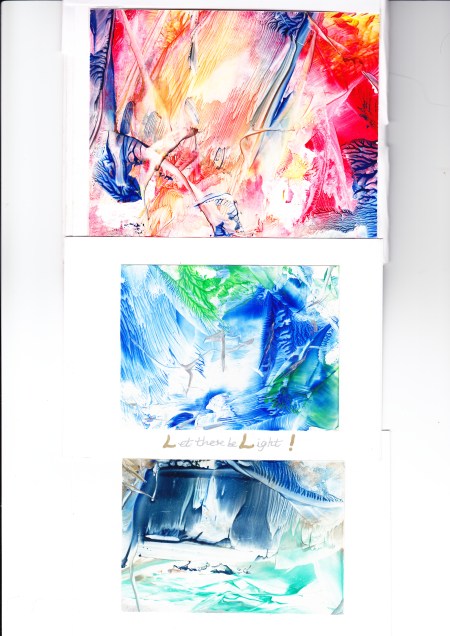
Although I am in general not a fan of abstract art, I think these are lovely. One friend said that they resembled underwater coral scenes. To me they look more like the inside of caves or chasms, perhaps with a waterfall. One of their beauties is that they definitely look like something – but you can never quite catch what.

Olive wrote a meditation on light and colour, in nature and in the Christian Bible, which I enjoyed reading very much. The main thing she left out was the science of light and colour, of which she had no knowledge. I wrote and sent her a complementary essay about this. Peter clearly likes her art and my essay, because he kindly offered to reproduce both on his blog, as you see. Olive died two years ago and her art now stands as her memorial. I hope you enjoy it as much as I did.

My essay now follows; if you want to look into the subject in greater depth then I recommend this website, which was designed to inform artists.

Colour perception is often said to be subjective. It is less clear what that means, however. The relevant scientific notion is wavelength. Light is a wave – although, remarkably, no physical medium oscillates (unlike sound waves in air, for instance); in the language of a century ago there is no ‘aether’.

Strictly speaking it would be better to talk about the frequency of light waves, because the wavelength changes with the density of the medium through which the light passes, but the frequency is unchanged. (The product of the wavelength and the frequency is the speed of light, which is a staggering 300,000 kilometers per second in empty space.) But the change in wavelength of light passing from a vacuum into air is so small that it can be ignored for present purposes. The change in wavelength (and in wave speed) is much greater when light passes into glass, or into the transparent fluids inside the eye, is much greater (25% reduction in water), since these media are much denser than air.

Light that consists of a single wavelength is called monochromatic light. Monochromatic light is not divided (further) by a prism, or by anything else that is done to it – a fact discovered by Isaac Newton in the 17th century. (Newton also reassembled the various colours back into white light.) One may superimpose differing amounts (intensities) of light of various wavelengths and look at the result. ‘White light’ is a superposition having roughly the same intensity in each colour band, as we confirm by putting it through a prism. (A prism splits light, because differing wavelengths of light entering the prism are shortened by differing amounts. The same effect creates rainbows as light passes through water droplets in the atmosphere.) In analysing colour, physics deals only the notion of how much light of each wavelength reaches the eye – the ‘spectrum’ (formally, the spectral density function) of the light. The distribution of the light across the retina – the screen at the back of the eye – also counts; a single object may appear to be coloured somewhat differently when viewed against differing backgrounds. Light has further characteristics (such as coherence, which is significant in lasers), but they make no difference to the perception of colour. A property of light known as its polarisation may change upon reflection from – or transmission through – a medium, but polarisation of light is not itself detected by the eye. (This raises the question: Are we interested in the object we are looking upon, or the light entering our eye?)

Wavelength is precisely defined, but colours – such as ‘blue’ – relate to a (fairly narrow) band of wavelengths, such that any monochromatic beam within that band will be perceived as blue. Moreover, if I add a low intensity of white light into blue, the result will still be perceived as blue. And if, in a spectrum that is generally agreed to be white, I make a small change in the amount of one particular wavelength, the result will still generally be agreed to be white. Only black is unambiguous: it is the absence of any light, of any wavelength. (Even then, it is the perceived absence, for light that is below the sensitivity threshold of the eye does not count; we shall consider perception below.)

We perceive some objects because they emit light into our eyes, such as a LED (light-emitting diode). Light of a particular frequency/wavelength/colour is emitted is when a (negatively charged) electron within an atom falls from one orbit around the positively charged atomic nucleus to another orbit around it; quantum theory tells us that only certain orbits are possible. (The difference in energy between the two orbits goes into the light that is emitted when the electron shifts orbit, and is proportional to the frequency of the light.) We see non-emitting objects because they reflect some of the light that falls on them, into our eyes. The colour that we say such an object is depends on the light that passes from the object to our eyes. This depends in turn on two factors: the combination of wavelengths falling on it; and how much of each particular wavelength the object reflects. (All light that is not reflected is absorbed, warming the object in the same way as sunbathing.) Intrinsic to the object is not its ‘colour’ but the proportion of each wavelength hitting it that it reflects. ‘Red paint’ means paint containing pigment that reflects only red light and absorbs all other colours (likewise for blue paint, etc); so that if ‘red paint’ is illuminated by a uniform mixture of light colours (i.e., white light) then only the red bounces back off it, and it looks red. But if the same object is illuminated by blue light, it absorbs the blue light so that (virtually) nothing comes off by way of reflection, and the object is perceived as black. We say that objects ‘are’ a particular colour because we generally view them in daylight or artificial white light, which contains all colours. ‘White paint’ is paint that reflects all colours and absorbs none. It looks whatever colour is shone at it – red in red light, blue in blue light, white in white light, and so on. Black paint absorbs all colours, and (uniquely) looks the same in any light.

A ‘red filter’ is something designed to let only red wavelengths through (and similarly for other filters). Something that lets all wavelengths through – the analogue of ‘white paint’ – is called transparent. (Air is virtually transparent, although it lets slightly more blue light through than other wavelengths – that is why the sky, which is lit by the many wavelengths emitted by the sun, looks blue.) Something that lets no light through – the analogue of black paint – is called a barrier. On its far side from the light source it looks black.

Also important is the texture of a surface. A perfectly reflecting material is colloquially called a white surface if it is rough enough to disperse incoming light in all directions, but if it is smooth on the scale of the incoming wavelengths then it is called a mirror. Texture is also responsible for the difference between matt and gloss paint. As for the scales involved, wavelengths of light visible to humans vary from red, which is around wavelength 0.7 micrometers (a micrometer is one thousandth of a millimetre) to blue/violet, which is about half that wavelength. In contrast, radio waves, which are of the same family and speed as light, have wavelengths of hundreds of metres.

Biological science can translate the physical specification of what lands on the retina into a specific pattern of nerve impulses passing from the eye to the visual cortex. That can in turn be correlated with the person saying “it’s green” or “it’s red” (or whatever). The names of colours are learned by tradition. As a child, each of us shared with an adult the experience of perceiving light of a particular wavelength; the adult named the colour and we learned the name. If children were not taught the names of colours then a consensus would emerge among them of what to call the colours, based on the similarity of their experiences. This consensus arises in turn from the common features of their perceptive systems (eye plus visual cortex).

Every colour to which humans give a name corresponds to a characteristic shape of the spectrum of wavelengths entering the eye. Lodged in the human retina are different types of colour receptor cells, known as cones. Each type of cone contains a different light-sensitive pigment, which absorbs and reacts most strongly to light of a particular wavelength. If you fire monochromatic light at a particular cone cell and then gradually decrease the wavelength (starting from red), the cell will transmit an increasingly strong signal to the brain until its own wavelength of peak sensitivity is reached; after that the signal will fall away on the other side the peak. Humans have three working types of cone cell, having distinct wavelengths of peak sensitivity. (The three sensitivity curves overlap to some extent.) This is why we can reasonably accurately simulate all colours that humans perceive by mixing just three colours, known as the primary colours.

People who are said to be colour-blind may have only two types of working cone, rather than three. They perceive the world differently, although they learn this only by observing that their reactions to certain wavelengths of light differ from the reactions of the majority. A man who was not colour-blind and whose cones of one particular type were suddenly switched off would see the world tinted, but a colour-blind man whose retinal cells had identical firing responses would say that things looked normal – because his brain would have trained itself from birth to regard this as the norm. Some species of animals have sensitivity spectra very different from the normal human one. Some animals see in black-and-white only (like humans at low light levels – see below); others have cone combinations with a less or a more uniform response than humans to light that is equally intense across the visual spectrum.

The mixing of primary colours of light to generate any colour known to human experience is a conceptually different problem from mixing paints to do the same. When you mix (‘add’) together light beams of the primary colours (Red, Green, Blue, roughly corresponding to the responses of the differing pigments in the three types of cone cells), you get white light. (Colour monitors and televisions have a multitude of ‘RGB’ dots.) These three are known as the ‘additive primary colours’. If you mix pigments of the three primary colours then the result is black paint, since each primary reflects only one colour, which the other primary pigments in the mixture suppress. Colour printers in fact mix cyan (which is blueish), yellow and magenta (pink-purple) in order to create all the colours known to man when the printer output is viewed in white light. These are the ‘subtractive’ primary colours, so named because if we subtract one of the additive primary colours from white light, leaving a mixture of the other two, we obtain the three subtractive primary colours. Whereas the mixing of light to obtain a desired colour is systematic, the mixing of pigment to do likewise is based on a library of knowledge gained by trial and error. Similarly, prediction of the colour of light that passes through consecutive glass jars of coloured translucent liquid (i.e., filters) is systematic, but the result of mixing the fluids is not.

Photography is conceptually more complicated than painting. What you see depends on further factors: the light that originally hit the photosensitive recorder; the response of the photosensitive recorder; the printing of the photograph (which may compensate for deficiencies in the response); and the light that the photograph is viewed in. Furthermore, negative film followed by printing and viewing; slide film viewing; digital photography viewed onscreen; and viewing a printout of a digital photograph each provide distinct re-creations at the eye of the light coming into the viewfinder.

Human perception of colour is actually more complex than I have stated. There are other cells in the retina called rods. These are more sensitive to light than cones but do not distinguish between colours. They come into their own at low levels of illumination; as a result, human vision under dimly lit conditions is essentially black-and-white. When the light intensity increases, beginning from darkness, the cones ‘kick in’ roughly when the rods become ‘saturated’ and send out no stronger signal as the brightness increases further. The brain also appears to take into account differences between the signals coming from the three types of cone, and differences between these and the rods.

A century after Newton, Goethe wrote on colour in an apparently opposing (and highly critical) way. Although what Newton had said was correct, hindsight makes it clear that Goethe was more concerned with the perception of colour than with the physics of light. We glimpse here two different philosophies: the ‘modern’ view espoused by the Enlightenment (no pun is intended on the name) that a world exists ‘out there’ to be explained (Newton), and the ‘post-modern’ view that our sensory impressions are all we have, and are therefore the most fundamental (Goethe). Goethe took the view that colour arises from the interplay between light and dark. Nowadays we have learned that humans perceive colours when they look at a spinning disc with a particular black-and-white pattern printed on it, for instance – presenting a challenge to theories of colour perception. Although Goethe’s explanations have been superseded, he was an acute observer of colour phenomena more complex than those analysed by Newton. There is still plenty to learn about the perception of colour.

Results and Transfer Gossip

Posted in Finance, Football, Science Politics, Uncategorized with tags , , on February 6, 2010 by telescoper

I had to skip the usual trip to the Poet’s Corner last night and go home early because the general state of fatigue I’ve been in suddenly morphed into a fever. I went home at 5, went straight to bed, and it was only Columbo’s frantic pawing that woke me up several hours later. I had not only missed a leaving party for Kate Isaak, who is now off to work for the European Space Agency, but also slept all the way through Newcastle United’s splendid 5-1 hammering of Cardiff City in last night’s Coca Cola Championship match at St James’ Park.

Despite home advantage, and the fact that Newcastle won the corresponding away fixture here in Cardiff, I thought this tie would be pretty difficult for Newcastle so I was overjoyed to see the result when I finally roused myself from feverish slumbers. It seems that Newcastle’s recent signings in the January transfer window actually came good, especially Wayne Routledge who gives the side a much-needed injection of pace down the wing. Cardiff City, on the other hand, didn’t buy any players at all because they need all the cash they’ve got to pay off an outstanding tax bill and thwart various winding-up orders that have been served on them. The turbulence behind the scenes seems to have worked its way onto the pitch: the blues are definitely the most erratic team in the division, winning 6-0 only a week or so ago and then getting thrashed 5-1 yesterday.

And just to make  my allegiances clear, I do have a soft spot for Cardiff City and do want to see them do well – except when they’re playing Newcastle. Once a Geordie, always a Geordie…

Results of a different kind were the topic of discussion around the School of Physics & Astronomy yesterday, as it was the official day for tutors to hand the results of the 1st semester exams to their tutees. It’s always great to see students leaving their tutor’s office with a big smile on their face, which happened rather a lot yesterday.  Some, of course, got more disappointing news, but to them I’d just say that it’s only half way through the year so there’s plenty of time to recover. Stick at it, and don’t let setbacks get you down.  I hope to see even more happy faces in June than I did yesterday….

Football teams like Cardiff City aren’t the only things to be enduring financial uncertainty these days, either. Even the Premiership clubs of the university sector are feeling the pinch. Many institutions around the country are planning departmental closures and redundancies, but you know it’s serious when it hits the big colleges in London. Last week University College (UCL) and Imperial both announced plans for large-scale layoffs, and this week they were joined by King’s College which plans to sack 205 academics, including 30 in the School of Physical Sciences and Engineering.

The background to all this is that the cuts announced by Lord Mandelson in December have now been officially passed on to English universities by HEFCE, but one suspects also that in some cases this is being used as a cover for other management decisions. Imperial, for example, is going ahead with the purchase of new property in Wood Lane for a cool £28 million at the same time as cutting academic positions costing a fraction of that.

Amid all the gloom, however, it is nice to be able to report some good news. Cardiff University was almost declared bankrupt in the 1980s when it failed to get to grips with the cuts imposed by Margaret Thatcher’s Conservative  government which were similar in scale to those being implemented by New Labour. It was brought back from the brink, however, and since then has managed its finances with almost excessive caution. Other universities have scored spectacular successes in the League tables by spending money freely on fancy research initiatives and overseas campuses, but in the new reality of austerity Britain these may turn out to have been risky ventures.

By contrast, “Safe and Steady” has long been the motto in Cardiff. We might not have done brilliantly in the RAE but the insitution has an extremely sound financial base that should put it in as good position as any to withstand these difficult times. Moreover, we’ve just heard that the University management has agreed that the School of Physics & Astronomy can go ahead and make  four new academic appointments, and that these will be accompanied by substantial startup packages with which the new appointees can begin to equip their own laboratories. This involves a considerable investment in the School from the University’s central coffers and I think it’s fantastic news. I doubt if many UK universities are going to be investing so heavily in physics at this time, so this is an extremely welcome development. It’s always nice to buck the trend.

The adverts will be going out pretty soon, so the transfer window is about to open.  I look forward to meeting our new signings in due course, and I’m confident that they’ll help us climb up the League.

If only I could say the same for Cardiff City…

Of the Last Verses in the Book

Posted in Biographical, Columbo, Poetry with tags , , , on February 5, 2010 by telescoper

I was having some quality Columbo time last night, giving my old moggy a good going-over with his favourite brush while watching a DVD featuring the detective with the  same name. Columbo (the cat) loves being brushed with a metal brush, especially on his head and his face. If I stop he grabs hold of it and pulls it back onto his muzzle as if to say “All right then, I’ll do it myself.” He likes such a firm application of the brush that it seems incredible to me that it doesn’t hurt him, but he clearly enjoys it,  so what the hell…

When I’d finished he looked even more handsome than usual, but as he sat next to me on the sofa I reflected on the fact that he is starting to show his age a bit especially around the face – possibly owing to his penchant for the brush! Nowadays his purring sounds more like snoring, his kittenish moments are rarer and crotchety episodes a bit more common. He also gets stiffness in his legs from time to time, which the vet attributes to rheumatism and, although it doesn’t cause him actual pain, this problem  makes him a lot less active than he used to be.  Still, he has a right to take things easy. He’ll be 16 next month, which is quite a venerable age for a Tom cat.

I’ve been feeling pretty old myself this week,  probably caused by fatigue associated with the onset of lecturing. All that walking up and down and waving your arms about can be quite tiring, I can tell you. Not sleeping much might have something to do with it too. I’m also feeling miserable because I  need new spectacles,  another sign of ongoing physical deterioration.  I’ve got less excuse for feeling my age than Columbo, however, as I’m only 46. I think that’s only about 6 in cat years!

However, getting older definitely has its good points too.  Twenty years ago I would never have envisaged myself sitting at home reading dusty old poetry books rather than going out to some sleazy nightclub, but the cardigan, carpet slippers and Columbo are suiting me just fine these days. Next week I’m going to go wild and have a night at the Opera, something that always makes me feel young. I may be no chicken, but I’m still younger than the average  opera-goer!

I haven’t posted any poems for a few days, so here’s one that seems to fit. It’s by a relatively obscure poet and politician called Edmund Waller. The wikipedia page about him isn’t very complimetary about his talents as a poet, but he is at least credited with having pioneered the use of heroic couplets in English verse. His biography is interesting too. He narrowly escaped being executed in 1643, during the English Civil War,  and was instead imprisoned in the Tower of London. He was only released after paying a fine of £10,000 – a truly enormous amount of money for the time. Although banished on his release, he subsequently returned to politics and lived to the ripe old age of 81.

Although his poetry is very unfashionable, this one is quite well known and – I think – rather marvellous, especially the last verse which puts me in mind of the lines from Leonard Cohen‘s great song Anthem:

There is a crack in everything
That’s how the light gets in.

The poem is called Of the Last Verses in the Book.

When we for age could neither read nor write,
The subject made us able to indite.
The soul, with nobler resolutions deckt,
The body stooping, does herself erect:
No mortal parts are requisite to raise
Her, that unbodied can her Maker praise.

The seas are quiet, when the winds give o’er,
So calm are we, when passions are no more:
For then we know how vain it was to boast
Of fleeting things, so certain to be lost.
Clouds of affection from our younger eyes
Conceal that emptiness, which age descries.

The soul’s dark cottage, batter’d and decay’d,
Lets in new light through chinks that time has made;
Stronger by weakness, wiser men become
As they draw near to their eternal home:
Leaving the old, both worlds at once they view,
That stand upon the threshold of the new

(And, please, no jokes about “cottages”….)

Value for Money?

Posted in Art, Biographical, Finance, Science Politics with tags , , , , , on February 4, 2010 by telescoper

Looking at the BBC website at lunchtime while I munched a sandwich I’d bought for £1.40, the item that really caught my eye was a story about the sale of a sculpture at Sotheby’s for £65 million. The starting price for this particular work (L’Homme qui Marche by Alberto Giacometti) was set at £12 million, but only took a few minutes for the bidding to reach its final level. An anonymous bidder now gets to keep the sculpture, which will probably now be kept in a private location, or possibly even a bank vault.

Let me make it clear at the start that I’m not going to embark on a rant about modern art in general or Giacometti in particular. A couple of years ago I went to an exhibition of his work at the Museum of Modern Art in Louisiana, just north of Copenhagen (in Denmark) and I found his strange elongated figures really fascinating. He started out making small ones that he stretched and scratched  obsessively to get the shape he wanted. Over time the figures got larger, but he didn’t make many of them. I suppose the rarity of his work has something to do with why they are so valuable, which they obviously are.

But when I say they’re fascinating, I don’t necessarily mean £65 million worth of fascinating….

The point that has always really fascinated me about this sort of thing is exactly how something can acquire such an absurdly high commercial value and what it is that makes any collector decide to pay such a huge price. A work of art obviously has some intrinsic worth, but there doesn’t seem to me to be any simple relation between aesthetic, technical or historical considerations and the market value. That’s not just the case for modern art, either. Go to the Louvre in Paris and you’ll see hordes of people clamouring around a small, drab and frankly rather uninteresting painting called the   Mona Lisa –  and ignoring the dozens of wonderful things all around them in the same room, and even in the corridor leading to it. Some process – I don’t know what – has assigned a particular status to this painting and not to others which seem to me to have at least as much value, in an artistic sense. Not that I’ve any right claim my judgement is any better than anyone else’s, of course.

A similarly mysterious process goes on with other collectible things. Take wine, for example. I like a glass of wine now and then – or rather more often than that, if truth be told. I am, however, very fortunate that I don’t have a particularly discerning palate. I can tell the difference between cheap-and-nasty stuff and pretty good stuff but, generally speaking, my taste has saturated by the time the price reaches about £25 a bottle, and often long before that. That’s great because it means I can have a perfectly enjoyable evening drinking a bottle costing £15 when if I’d been an expert I would be unsatisfied unless I spent a lot more.

Years ago I went with a friend of mine to a house clearance in rural Sussex. He was an interior designer and he liked to buy old furniture from country houses and do it up to sell on. It’s a good plan, actually – old furniture is far better made than the modern stuff. Anyway in the middle of a whole load of junk was a case of vintage wine. Not just any wine, either. It was, in fact, Chateau Petrus – one of the finest Pomerols. It wasn’t a specialist auction, however, and nobody seemed to think it had any value. Bidding was slow when it came up in front of the auctioneer so I bid for it. In the end I bought the case (12 bottles) for about £300. When I got it home I realised what I had got. It turned out £300 per bottle would have been cheap. I was scared to open any of the bottles in case the wine was off or I didn’t like it, so I put it away. I sold the case some years later for about £6500.

Having told that story though, my main point is to wonder out loud about those wines that cost thousands of pounds per bottle. There is a roaring trade in these things – even ones that are two hundred years old – but I don’t think their value has anything to do with how  they are likely to taste. In the local wine merchant – conveniently located about 20 yards from my house – price is a good indicator of taste, but the scaling doesn’t apply at the extreme end of the fine wine market. Some other process is involved.

A house also  has a value that doesn’t have anything to do with anything other than what someone will pay to buy it.  But what sets this price? The market, obviously, but that is guided and controlled by Estate Agents who influence values in strange and subtle ways.

I suppose this all just goes to show I don’t know anything about economics, a point I’m now no doubt going to reinforce.

Governments also have to decide how much to spend on different things: health, education, defence, and so on. You can argue with the way their priorities work out at any given time, but the thing that baffles me is what the process is that leads to a decision to spend X on hospitals and Y on education. How can anyone possibly decide the relative value of £1 spent on health versus £1 spent on education?

I strongly support the notion that the government should support the performing arts, such as  the Opera. But how much it should spend is an unfathomable question to me. Some will say nothing, some would say more. Who decides? Clearly someone does.

And that brings us back home to science. The ongoing ructions about the financial crisis  at the Science and Technology Facilities Council –  unfolding in front of a parliamentary select committee –  seem to me to be really about the process by which value is assigned different bits of science by the people who hold the purse strings but probably don’t know much at all about science. I place a high value on astronomical research and, within that field, on cosmology. But that’s a personal judgement. Others will disagree. We all end up working in those areas we find  more interesting than the others so we can’t really be unbiased, but I think I’m more even-handed than many when it comes to the scientific merits of other fields. Having said that, it would take a lot of doing to convince me that the scientific value for money involved in sending, say, another probe to the Moon was anything like as high as, say, exploiting the full potential of the Herschel observatory.

Worse still, all spending on  blue skies research looks like to be cut back severely at the expense of shorter-term activity that leads to immediate commercial spinoffs. Commerce clearly trumps curiosity in the value game. If the STFC debacle was – as certainly seems likely to me – the result of a deliberate high-level decision, then who was it and what were their reasons for placing so little value on the quest to understand the most fundamental properties of the Universe?

And why doesn’t science have patrons like the anonymous buyer of the Giacometti figure? £65 million would solve an awful lot of STFC’s problems, as long as we stop certain people from wasting it on silly moon missions….

Cheers to Two Fellow Bloggers

Posted in Biographical, Jazz with tags , , , , , , , on February 3, 2010 by telescoper

Last Friday I went as usual with a bunch of Cardiff astronomers to the local pub, The Poet’s Corner, for a traditional end-of-the-week drink or two. This is by no means the most upmarket hostelry in the vicinity of the School of Physics & Astronomy, but it’s quite friendly and serves pretty good beer. The older generation have been finding their way there after work each Friday for some time now, but more recently we’ve found quite a few of our postgrads ending up there too, usually playing pool while the oldies indulge in a chinwag.

Last week, I was a bit surprised to bump into a fellow astro-blogger and Cardiff PhD student , Rob Simpson (orbitingfrog), in the pub. I’m one of the regulars, but he’s not usually there.  It turned out it was a special occasion and he was celebrating, as he’d just been offered a postdoctoral research fellowship at the University of Oxford starting in March.  I mention this partly to offer my congratulations on here – well done Rob! – and partly to demonstrate that despite all the doom and gloom about STFC there are still opportunities for talented people to carve out a career in UK astronomy. As long as they finish writing up their thesis, that is…

It was interesting to chat with Rob about his blog, something I rarely get the chance to do. I don’t know many bloggers personally. His site has been around much longer than mine, he gets way more readers than me, and I also think our audiences are quite different. 

The number of people reading my blog has been growing steadily since I started and  I now  average about 1000 unique hits a day, few compared with many sites, but many more than I would have anticipated when I started. However, on top of this trend there are large fluctuations depending on what I’m posting about. All the recent doom and gloom about STFC  generated a lot of readers, no doubt in the same way that bad news sells newspapers, as did the ongoing story of Mark Brake of which more, perhaps, soon. Moreover, some of my referrals come from very peculiar places. A couple of my jazz and poetry pieces are now linked from wikipedia articles, although who put them there I don’t know. I’m flattered, of course, but just hope that nobody actually thinks I’m some kind of expert. Generally speaking I’m very surprised that people read this sort of post at all, but I guess it’s not the same people that read the more obviously science-based posts.

However, there is at least one astronomer that reads the jazz and poetry posts too, and that’s another blogger called Sarah Kendrew (her blog is here; she’s a postdoc in the Netherlands). We had a little electronic chat a few days ago, during which I discovered that she plays the oboe and was interested to know if there’s any jazz on that instrument. Jazz owes at least part of its origin to the marching bands of New Orleans which typically used army surplus musical instruments – trumpet, trombone, clarinet, etc. When jazz moved off the streets and into the bordellos of Storeyville, pianos were added, the portable brass bass or tuba replaced by a double string bass, and individual bass and snare drums were incorporated in a drum kit. Later on, saxophones became increasingly popular in jazz groups of various sizes, and so on. As the music developed and diversified I think pretty much every instrument there is has been used to play some form of Jazz. For some reason, though, the oboe never caught on as a jazz instrument. I don’t know why. Answers on a postcard.

This got my curiosity going, so I hunted around and found this  video on Youtube of Yusef Lateef playing oboe in 1963 with the Adderley Brothers (Julian, also known as “Cannonball”, and Nat). I’d never seen it before, and although I don’t think Lateef sounds all that fluent, it’s a really interesting sound and I’m very grateful to Sarah for prodding me in it’s direction. The tune is called Brother John.

P.S. If anyone wants to challenge me to find a bit of jazz involving an instrument of their choice, please feel free!

Stephen Fry was right…

Posted in Biographical with tags , , on February 2, 2010 by telescoper

I’ve recently been reminded of a comment made by Britain’s only remaining National Treasure, Stephen Fry, in the Guardian a while ago.

“I don’t know about you but whenever I read a blog I do not let my eye drop below half the screen in case I accidentally hit the bit where the comments reside. Of all the stinking, sliding, scuttling, weird, entomological creatures that inhabit the floor of the internet those comments on blogs are the most unbearable, almost beyond imagining,”

There’s also a similar piece by David Mitchell that expresses the same sort of view.

Let me say straight away that I’m not referring to the comments posted on this blog recently. I always enjoy reading the threads on here, even if – or perhaps actually because – they fly off at unpredictable tangents from the main point of the original item. I would never have imagined that Bob Kirshner’s guest post would have led to an in-depth discussion of lavatory seats, for example. I disagree with quite a lot of the opinions expressed, but it’s actually quite nice to give people the opportunity to get something off their chest, as long as they remain civilised – which they usually do.

So please keep commenting on here, and please don’t be scared to look at the comments either. Some of them may indeed be weird, but they’re not going to disturb your piece of mind. Stephen Fry and David Mitchell were referring   to the sort of stuff you often see on higher-profile sites, especially newspapers, where the online comments are filled with  drivel so moronic that it’s actually depressing to think that there are people lurking out there capable of writing it. These guys (Mitchell and Fry) are in the public eye and so they attract a great deal of comment themselves, much of it staggering in its inanity and abusiveness.

One might have expected a bit better from the readership of the Times Higher, an organ which I thought was read by academics and university-based professionals who presumably must have received some sort of education themselves before gaining employment that involves attempting to educate others. However, the comments following the piece I blogged about recently contains, as well as  some sensible reactions (both for and against my actions),  a few that are just puerile and others that barely conceal the writer’s bigotry. Clearly not everyone who works in a university is either articulate or rational. But then I knew that already.

One particular commenter, the presumably pseudonymous John Fitzpatrick, states

As for Coles, what an effete and bitchy little man he has exposed himself as. How he can face his students and colleagues after that is simply amazing.

Amazing it may be, but I certainly can and do face my students and colleagues, although I usually refrain from exposing myself. I’m sure they don’t all agree with what I did, but my conscience is clear. I don’t have the luxury of anonymity anyway.

The Times Higher asked me to contact them if I felt any of the comments were defamatory or abusive so they could remove them, but I replied to say I thought it was better to leave them all there whatever they said. In their own way, they speak  eloquently  for the very point of view they are trying to oppose…

A Little Respect

Posted in Biographical, Music with tags , on February 1, 2010 by telescoper

To point out that 1989 wasn’t all bad, and to draw a line under yesterday’s revelations, here’s something that brings back very happy memories for me 20+ years on. This is Erasure, performing live during their Wild! tour that year.