It’s a grey gloomy and rainy August lunchtime here in Wales and so I thought I’d just try to brighten things up a little by posting this video of a lovely set by the quintet led in the early 60s by the great Dizzy Gillespie, clearly enjoying himself on the BBC TV program Jazz 625. This was the band that also featured the brilliant James Moody on saxophones and flute. As you can hear, they played music that was strongly flavoured by Dizzy’s lifelong interest in Cuban jazz. The programme was introduced by the late great Humphrey Lyttelton and it’s in several bits which you will have to click through if you want to see them all. I hope you at least go as far as Part 3, where there’s a big laugh waiting for you…
Archive for August, 2010
Dizzy on the BBC
Posted in Jazz with tags BBC, Dizzy Gillespie, Humphrey Lyttelton, James Moody, Jazz 625 on August 10, 2010 by telescoperNotes for the Reader
Posted in Uncategorized on August 9, 2010 by telescoperI’m going to be too busy to post much this week so I thought I’d take the opportunity to point out a couple of things for the benefit of regular readers, newcomers and occasional visitors to this blog.
First, about RSS Feeds. If you wish to subscribe to the whole blog via an RSS feed you will find it at
https://telescoper.wordpress.com/feed/
If you wish only to see posts in a particular category, you can do so via
https://telescoper.wordpress.com/category/categoryname/feed/
So if, for example, you only want to read the “Science Politics” items via RSS the feed is at
https://telescoper.wordpress.com/category/science-politics/feed/
A full list of categories, together with the number of posts so far published in each one, can be found on the home page. You can use this to browse my back catalogue, so to speak, although I should point out that I didn’t file that many of my earlier posts in categories and haven’t had time to go back through them and sort them out…
I also wanted to make some comments about comments. Please note what it says on my home page:
Feel free to comment on any of the posts on this blog but comments may be moderated; anonymous comments and any considered by me to be abusive will not be accepted.
You may use a nickname or anonymous handle on a comment, but I insist on a valid email address that identifies you (although the email address will not be visible to anyone but me). The system that operates on comments is that, if you haven’t posted before, your comment will be held until I have approved it. Comments are posted immediately from “approved” users but I reserve the right to moderate them if they turn out to be abusive. Serial offenders are put on a blacklist and their comments will be treated as spam.
Even if you are a regular commenter you may find that some comments don’t appear straight away. That is because I operate a spam filter – spam comments outnumber genuine ones by more than two-to-one – and it sometimes makes mistakes. If this happens it is probably because your comment contains several embedded URLs, which makes the spam filter suspicious. I usually manage to rescue comments blocked in this way, but it may take a while before your comment appears.
Let me point out that there is a separate RSS feed for comments at
https://telescoper.wordpress.com/comments/feed/
if you wish to follow discussion that way.
I realise that there isn’t really a convenient way to communicate suggestions for improvements or to ask general questions about the blog, so when I have a bit of time I’ll set up a permanent page to serve that purpose.
Astronomy (and Particle Physics) Lookalikes, No. 39
Posted in Astronomy Lookalikes with tags Ian Halliday, Jim Broadbent on August 8, 2010 by telescoperWell, having got the positive discrimination out of my system (at least for today), I’ll add just one more. I’ve always been struck by the similarity between distinguished former Chief Executive of PPARC, current Chief Executive of the Scottish Universities Physics Alliance and President of the European Research Council, Professor Ian Halliday and actor Jim Broadbent.
Ian Halliday

Jim Broadbent
Astronomy Look-alikes, No. 38
Posted in Astronomy Lookalikes with tags Carole Tucker, Helen Hunt on August 8, 2010 by telescoperAnd how about Cardiff’s own Carole Tucker and multi-talented actress director and screenwriter, Helen Hunt?

Carole Tucker
Helen Hunt
Astronomy Look-alikes, No. 37
Posted in Astronomy Lookalikes with tags Julia Roberts, Sarah Kendrew on August 8, 2010 by telescoperI’m aware of the gender imbalance so far in my lookee-likee series, but here’s a step in the right direction courtesy of Rob Simpson (aka orbitingfrog). Have you noticed the resemblance between astronomer (and blogger) Sarah Kendrew and actress Julia Roberts? I wonder if by any chance they might be related?

Astronomy Lookalikes, No. 36
Posted in Astronomy Lookalikes with tags Nacho Libre, Nacho Trujillo on August 8, 2010 by telescoperI was interested yesterday to see a trailer advertising that Channel 4 is planning to show a biographical film next week about a famous astronomer...
Nacho Libre

Nacho Trujillo
Postscript: The Bombing of Alnmouth
Posted in Biographical, History with tags Alnmouth, World War II on August 7, 2010 by telescoperI realised late last night that, in writing yesterday’s account of the air raid on North-East England in August 1940, I had forgotten to mention the reason why I started reading about this particular event. I think it might be interesting to a few people so have decided to put up a short postscript today.
My Uncle George, my late father’s older brother, lives in the picturesque coastal village of Alnmouth in Northumberland. It’s a lovely little place, not far from the market town of Alnwick (which in 2002 was voted the best place to live in Britain by Country Life magazine; it’s always been popular with the huntin’ shootin’ fishin’ crowd). The countryside around is spectacularly beautiful and full of historical interest; Alnwick Castle is particularly interesting. Alnmouth itself is a small port, with a number of splendid pubs and places to eat, and is well worth a visit if you’re in the area. In fact, I intend to move to that part of the world when I retire (if I live that long).
Anyway, Uncle George lives in Argyle Street in the centre of Alnmouth but I was quite surprised to see that the street has a few modern dwellings when virtually every property in the town is quite old, most of the others being of traditional stone construction like so many houses in Northumberland. It turns out that Argyle Street was bombed during World War II and that the new houses were built to replace several that had been destroyed.
It seemed strange to me that the Luftwaffe would bother bombing a tiny place like Alnmouth, so I decided to see what I could find out about the event. Knowing a little about the huge raid I described yesterday, I assumed that it might have been a German bomber involved in that particular raid, jettisoning its load in order to evade an RAF fighter. So I found as many books as I could and started reading about the Battle of Britain, which I found fascinating. Hence yesterday’s post.
However, it turns out that the bombing of Alnmouth in fact took place over a year later, on Saturday 8th November, 1941 at 19.20:
Two bombs on Alnmouth Village; one on a house in Argyle Street, the other in the roadway (a cul-de-sac). People trapped – still digging for four adults and three children believed buried. Later – five missing presumed dead, two died in hospital and twenty were injured. The bodies of a woman identified, also that of a man believed to be a Major Hawkes. Another woman’s body recovered later. Three houses demolished, eleven uninhabitable and many others damaged badly.
The bombs killed seven people, in fact; one man and six women. It was clearly a traumatic event for the people of the village and one which has left a scar to this day.
At that time in the evening in November it would have been dark, and it is thought that the bombing must have resulted from a failure to maintain the wartime blackout that was usually strictly enforced. Initially the blame was attached to two buses at terminus in Argyle Street whose headlights were thought to be reflecting in the water.
It’s still not clear what this plane actually was or what it was doing there on its own. It might have been on a reconnaissance mission, although that seems unlikely given that it was dark and would have been dark for some time; the sun would have sets around 16.15 at that time of year in Alnmouth, three hours before the bombs were dropped. It is more likely to have been part of a larger raid going elsewhere that noticed a light and went for what they call “a target of opportunity”.
PS. Almnouth is just a few miles North of Acklington, which featured prominently in yesterday’s post.
The Day the War came to Tyneside
Posted in Biographical, History with tags 1940, Acklington, Battle of Britain, Chain Home, Kenton, Newcastle, RAF, Royal Air Force, Spitfire on August 6, 2010 by telescoperWe’re now approaching the 70th anniversary of August 15th 1940, the day that most historians regard as the start of the Battle of Britain. There had been a great deal of aerial combat, especially over the English Channel, in the weeks following the fall of France and the evacuation from Dunkirk in 1940, but August 15th was the day when the German Luftwaffe initiated a series massive daytime raids aimed at knocking out Britain’s air defences. Over the following weeks they nearly succeeded. It was only an erroneous change of tactics by the Luftwaffe, away from targetting the airfields and towards the terror bombing of cities, that gave the Royal Air Force time to recover from the punishment it had been taking. Eventually, by late September 1940, the threat of invasion, which at one point appeared imminent, had finally subsided.
I’m sure there will be many commemorations of the Battle of Britain over the next week or so, in which tributes will be paid to the few of The Few that survive to this day and, of course, those that gave their lives in the momentous struggle which happened all those years ago. There will be much talk of famous places such as Kenley, Northolt and Biggin Hill, key sector airfields for 11 Group, responsible for defending London and the South East, which were under massive attack on August 15th and over the following days and weeks.
But it wasn’t just the South-East that was attacked on August 15th 1940. An enormous incoming raid from the North of France was met by Spitfires and Hurricanes of 10 Group and a terrifying dogfight involving about 200 aircraft brewed up over Portland. Further North, 12 Group’s defences were probed by bombers flying from Denmark intent on destroying airfields in Yorkshire.
And then there was 13 Group, which was charged with the task of defending Scotland and the North-East of England. The map below (courtesy of the RAF website) shows the location of their principal airfields and radar installations in 1940. The Operations HQ for 13 Group, RAF Newcastle, was in Kenton, not far from the location of what is now Newcastle Airport. In fact I cycled past the place countless times when I used to work at Cramlington without knowing what it was. Then it was opened to the public for a time and all the maps, charts and telephones were still there. I felt a distinct shudder when I saw it.

I’ve always been fascinated by history. I read a lot of books about it and in Britain you’re never very far from the site of some historical event, perhaps a castle or the site of a bloody battle. Whenever I travel I also try to visit places of historical interest. Reading is fine, but there’s no subsitute for being there and seeing it for yourself.
It’s quite a different matter when history comes after you rather than you going to find it. The idea that such a familiar place (to me) as Kenton could have been so central to the epic struggle that was the Battle of Britain brings it home that the things we take for granted haven’t always been so secure. When I was a kid growing up in Newcastle, Biggin Hill seemed to me as distant as Dunkirk or El Alamein, but the idea of German planes flying over such places as the Farne Islands and Tynemouth is something that still gives me the shivers. I’m sure the people of Iraq felt the same way about the American and British planes that bombed their country during the two Gulf Wars…
I’ve therefore decided to post the following short account of some of what happened on August 15th 1940 in my own neck of the woods, partly because of what I said in the previous paragraph and partly because the numerical facts are are pretty representative of the situation all around the country on that day seventy years ago. I got the details from a book called The Narrow Margin by Derek Wood and Derek Dempster, and you can find a more complete report here where there is a full account of every day’s action during the Battle of Britain.
For a start it appears that the Luftwaffe thought that most of Britain’s fighter defences were committed to the South. They were probably aware of the effectiveness of the long-range Radio Direction Finding (RDF, now known as radar) network known as Chain Home, but disregarded it because they thought there would not be many planes around to intercept them even if they were detected. The raid over Tyneside was despatched from Stavanger in Norway and flew in a roughly south-westerly direction across the North Sea.
At 12.08, RDF trackers began to plot the path of a formation of “twenty plus” incoming aircraft opposite the Firth of Forth at a range of over 90 miles. As the raid drew closer, the estimated number was revised up to thirty, in three sections, approaching from the North-East and heading SW towards Tynemouth.
The radar operators of 13 Group hadn’t had as much practice as their colleagues further south in 11 Group, which probably accounts for the difficulty they had in estimating the number of incoming planes. Nevertheless, with a full hour’s warning, the controller was able to put squadrons in excellent positions to attack, with 72 Squadron Spitfires in the path of the enemy off the Farne Islands and 605 Squadron over Tyneside. Nos 79 and 607 were also put up, but while the latter was in the path of the raid, No. 79 was initially too far north.
No. 72 Squadron from Acklington was the first to make contact, seaward of the Farne Islands. Closing rapidly with the incoming aircraft, it came as a distinct shock when the “thirty” materialised as sixty-five Heinkel 111s and thirty-four Messerschmidt-110s (or ME110s for short), i.e. almost a hundred aircraft. The RAF squadron facing them comprised a mere 11 Spitfires.
When I first read the numbers involved I could hardly believe them. Imagine being outnumbered almost ten to one, but knowing that you had no choice but to attack. Reading through the RAF daily reports makes it clear that these odds were by no means unusual. Time and time again during August 1940, a squadron or half a squadron would be scrambled to meet inbound formations of 100-plus aircraft. Although the RAF pilots were both brave and skillful, facing such an overwhelming weight of numbers against them it was inevitable that the attrition rate would be high. It was the steady loss of pilots, rather than planes shot down, that almost brought the RAF to its knees.
The only chance of an effective defence a small group of fighters could offer was to scatter the massed formation by attacking from the front, trying to disrupt them so much that they would not find their targets inland. That was the plan anyway; it didn’t always work. In the absence of a Squadron-Leader, 72 Squadron was led by Flight-Lieutenant Edward Graham, who, as it turned out that day, led one of the most spectacularly successful air combats of the War.
Thirty miles off the coast, the squadron sighted the enemy. As the RDF stations had predicted, the Germans were flying in three formations – the bombers ahead and the fighters in two waves stepped up to the rear. Misled by the supplementary fuel tanks slung below their wings, which looked like bombs, Graham and his pilots took the closer wave for Junkers 88 bombers whereas they were in fact (twin-engined) ME110s of the fighter escort.
The incoming formation was so vast in comparison with Graham’s small force that he hesitated for a moment, uncertain at what point and from what direction to attack. Apparently unable to bear the suspense, one of his pilots asked him whether he had seen the enemy aircraft. With a stutter which was habitual, but which deteriorated in times of stress, he replied
Of course I’ve seen the b-b-b-bastards, I’m trying to w-w-w-work out what to do.
The reply was to became famous throughout Fighter Command. I don’t blame him for stuttering. If it had been me I would have been filling my pants.
But he didn’t hesitate for long. The Spitfires had had plenty of time to gain height during their long flight from the coast, and were about three thousand feet above the enemy’s mean height. Making the most of his advantage, he decided to lead the squadron in a deliberate frontal attack, diving out of the Sun to achieve maximum surprise. Each pilot was free to choose his own target. Two-thirds attacked bombers or supposed bombers, the remaining third the second wave of fighters, correctly identified as ME110s.
The attack was startlingly effective and caused widespread panic among the German planes whose pilots had been told not to expect that much opposition. Jettisoning their external tanks, some of the ME110s formed a defensive circle, while others dived almost to sea level and were last seen heading East. The bombers, less an indeterminate number destroyed by Graham’s squadron, then split into two formations, each accompanied by some of the remaining fighters. One formation headed for Tyneside, apparently with the intention of bombing the sector station at Usworth; the rest turned South-East towards two aerodromes at Linton on Ouse and Dishforth which they had been ordered to attack. Some of them jettisoned their bombs and headed back to Norway, leaving several of their number in the sea.
The separate parts of the remaining formation finally reached the coast, one near Acklington and the other south of Sunderland. The first formation, engaged successively by the remaining (No. 79) squadron from Acklington, the triple-A batteries defending the Tyne area, and some Hurricanes of 605 Squadron which had come south from Scotland, dropped most of their bombs in the sea. The second, engaged by a squadron of Spitfires from Catterick, a Hurricane squadron from Usworth and the anti-aircraft artillery from the Tees batteries, dropped theirs almost as ineffectively near Sunderland and Seaham Harbour.
Overall, backed by the guns of the 7th Anti-Aircraft Division under Major-General R.B. Pargiter, 13 Group’s aircraft destroyed at least eight Heinkels and seven 110s without suffering a single casualty themselves, although several civilians were killed by bombs and there was considerable damage on the ground, including a few airfields. It is known that, in addition to the enemy losses reported during this period, many German aircraft struggled back to their bases with battle damage and some were written off after crash-landings.
This was one of the most successful actions fought during the entire Battle of Britain and its effect was that that 13 Group met no further daylight raids for the duration. However, it was just one episode in a struggle that became increasingly desperate as the summer of 1940 dragged on. As I said at the start, the defences of 11 Group came particularly close to breaking point, but eventually recovered and the expected invasion never materialised.
The rest, as they say, is history…
Slim’s Jam
Posted in Jazz with tags bebop, Charlie Parker, Dizzy Gillespie, Jazz, Slim Gaillard, Zutty Singleton on August 5, 2010 by telescoperIt’s been a tiring and frustrating day during which I accomplished very little, apart from becoming tired and frustrated. I think I’m going to have an early night, but before doing that I thought I’d share this old record with you. There’s not much information about it on Youtube, but I actually have it on an very battered vinyl LP. The sleevenote doesn’t give the exact date of the recording session, but it was somewhere around the middle of December 1945.
The band is dubbed Slim Gaillard and his Orchestra, but it’s just a seven-piece band. It is, however, notable for the presence on it of two giants of the bebop era, Charlie Parker and Dizzy Gillespie. I thought I’d put it on here primarily because it has such a relaxed atmosphere and is a lot of fun to listen to, as well as providing a fascinating window into this transitional period of American Jazz in which Charlie Parker was the leading figure.
Before 1945 Charlier Parker had worked mainly as a featured soloist in big bands of the swing era, including those of Jay McShann, Earl Hines and Billy Eckstine; after 1945 he almost exclusively performed and recorded in small groups. The year 1945 was also important for two other reasons: it was the first year he was able to record any of his own compositions and it was the first time he was able to record with Dizzy Gillespie in a band made entirely of like-minded musicians, rather than a mixed bag as on this track.
Another quite interesting thing I almost forgot to mention is that this particular 1945 track is – I think – the earliest known recording of Charlie Parker’s voice…
This period also marked the beginning of Parker’s acceptance as an important solo voice by music critics and by the “hipper” sections of the American public. This spreading awareness of his importance is why both he and Dizzy were invited to perform on the West Coast of America, specifically at Billy Berg’s club in Hollywood. It was during a short residency there that Slim’s Jam was recorded.
Apart from Charlie Parker (alto sax) and Dizzy Gillespie (trumpet), the band also contained the relatively unknown swing-era musician Jack Mcvea (tenor sax) as well as young bebop devotee Dodo Marmarosa (piano). The drummer was the great Zutty Singleton, who in fact played on some of the Hot Five recordings with Louis Armstrong in the 1920s, and the bass was “Bam” Brown. Slim Gaillard played guitar on this track as well as doing the intros in characteristic fashion.
Slim Gaillard was a truly remarkable character who led a remarkable life, as his wikipedia page makes clear. He was a talented musician in his own right, but also a wonderful comedian and storyteller. He’s most famous for the novelty jazz acts he formed with musicians such as Slam Stewart and, later, Bam Brown; their stream of consciousness vocals ranged far afield from the original lyrics along with wild interpolations of nonsense syllables such as MacVoutie and O-reeney; one such performance figures in the 1957 novel On the Road by Jack Kerouac. It’s also very much the style of the commentary he adds to this track.
In later life Slim Gaillard travelled a lot in Europe – he could speak 8 languages in addition to English – and spent long periods living in London. He died there, in fact, in 1991, aged 75. I saw him a few times myself when I used to go regularly to Ronnie Scott’s Club. A tall, gangly man with a straggly white beard and wonderful gleam in his eye, he cut an unmistakeable in the bars and streets of Soho. He rarely had to buy himself a drink as he was so well known and such an entertaining fellow that a group always formed around him whenever he went into a pub in order to enjoy his company. You never quite knew what he was going to do next, in fact. I once saw him sit down and play a piano with his palms facing upwards, striking the notes with the backs of his fingers. Other random things worth mentioning are that Slim Gaillard’s daughter was married to Marvin Gaye and it is generally accepted that the word “groovy” was coined by him (Slim). I know it’s a cliché, but he really was a larger-than-life character and a truly remarkable human being.
They don’t make ’em like Slim any more, but you can get a good idea of what a blast he was by listening to this record, which is bound to bring a smile to the most crabbed of faces. But alongside the offbeat humour there’s some terrific playing too. Charlie Parker’s virtuoso blues-inflected choruses and Dizzy Gillespie’s dissonant pyrotechnics form a strong stylistic contrast with Jack McVea’s earlier tenor sax solo which sounds positively old-fashioned by comparison.
Anyway, it’s time for bed-o-voutie so I’ll say goodbye-o-reenie with a little hot cocoa on it. I gotta get up early in the mornin’ myself…
The Fractal Universe, Part 1
Posted in The Universe and Stuff with tags Cosmology, Fractals, Francesco Sylos-Labini, Large-scale Structure, Las Campanas Redshift Survey on August 4, 2010 by telescoperA long time ago I blogged about the Cosmic Web and one of the comments there suggested I write something about the idea that the large-scale structure of the Universe might be some sort of fractal. There’s a small (but vocal) group of cosmologists who favour fractal cosmological models over the more orthodox cosmology favoured by the majority, so it’s definitely something worth writing about. I have been meaning to post something about it for some time now, but it’s too big and technical a matter to cover in one item. I’ve therefore decided to start by posting a slightly edited version of a short News and Views piece I wrote about the question in 1998. It’s very out of date on the observational side, but I thought it would be good to set the scene for later developments (mentioned in the last paragraph), which I hope to cover in future posts.
—0—
One of the central tenets of cosmological orthodoxy is the Cosmological Principle, which states that, in a broad-brush sense, the Universe is the same in every place and in every direction. This assumption has enabled cosmologists to obtain relatively simple solutions of Einstein’s General Theory of Relativity that describe the dynamical behaviour of the Universe as a whole. These solutions, called the Friedmann models [1], form the basis of the Big Bang theory. But is the Cosmological Principle true? Not according to Francesco Sylos-Labini et al. [2], who argue, controversially, that the Universe is not uniform at all, but has a never-ending hierarchical structure in which galaxies group together in clusters which, in turn, group together in superclusters, and so on.
These claims are completely at odds with the Cosmological Principle and therefore with the Friedmann models and the entire Big Bang theory. The central thrust of the work of Sylos-Labini et al. is that the statistical methods used by cosmologists to analyse galaxy clustering data are inappropriate because they assume the property of large-scale homogeneity at the outset. If one does not wish to assume this then one must use different methods.
What they do is to assume that the Universe is better described in terms of a fractal set characterized by a fractal dimension D. In a fractal set, the mean number of neighbours of a given galaxy within a volume of radius R is proportional to RD. If galaxies are distributed uniformly then D = 3, as the number of neighbours simply depends on the volume of the sphere, i.e. as R3 and the average number-density of galaxies. A value of D < 3 indicates that the galaxies do not fill space in a homogeneous fashion: D = 1, for example, would indicate that galaxies were distributed in roughly linear structures (filaments); the mass of material distributed along a filament enclosed within a sphere grows linear with the radius of the sphere, i.e. as R1, not as its volume. Sylos-Labini et al. argue that D = 2, which suggests a roughly planar (sheet-like) distribution of galaxies.
Most cosmologists would accept that the distribution of galaxies on relatively small scales, up to perhaps a few tens of megaparsecs (Mpc), can indeed be described in terms of a fractal model.This small-scale clustering is expected to be dominated by purely gravitational physics, and gravity has no particular length scale associated with it. But standard theory requires that the fractal dimension should approach the homogeneous value D = 3 on large enough scales. According to standard models of cosmological structure formation, this transition should occur on scales of a few hundred Mpc.
The main source of the controversy is that most available three-dimensional maps of galaxy positions are not large enough to encompass the expected transition to homogeneity. Distances must be inferred from redshifts, and it is difficult to construct these maps from redshift surveys, which require spectroscopic studies of large numbers of galaxies.
Sylos-Labini et al. have analysed a number of redshift surveys, including the largest so far available, the Las Campanas Redshift Survey [3]; see below. They find D = 2 for all the data they look at, and argue that there is no transition to homogeneity for scales up to 4,000 Mpc, way beyond the expected turnover. If this were true, it would indeed be bad news for the orthodox among us.
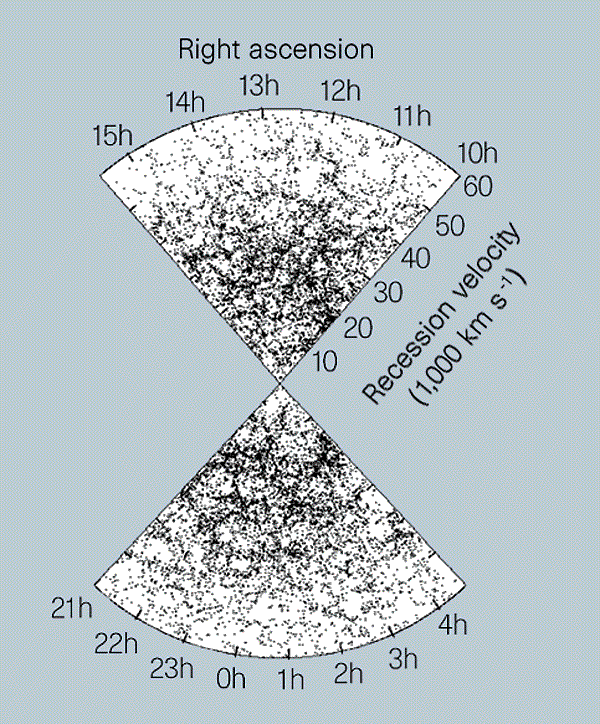
The survey maps the Universe out to recession velocities of 60,000 km s-1, corresponding to distances of a few hundred million parsecs. Although no fractal structure on the largest scales is apparent (there are no clear voids or concentrations on the same scale as the whole map), one statistical analysis [2] finds a fractal dimension of two in this and other surveys, for all scales – conflicting with a basic principle of cosmology.
Their results are, however, at variance with the visual appearance of the Las Campanas survey, for example, which certainly seems to display large-scale homogeneity. Objections to these claims have been lodged by Luigi Guzzo [4], for instance, who has criticized their handling of the data and has presented independent results that appear to be consistent with a transition to homogeneity. It is also true that Sylos-Labini et al. have done their cause no good by basing some conclusions on a heterogeneous compilation of redshifts called the LEDA database [5], which is not a controlled sample and so is completely unsuitable for this kind of study. Finally, it seems clear that they have substantially overestimated the effective depth of the catalogues they are using. But although their claims remain controversial, the consistency of the results obtained by Sylos-Labini et al. is impressive enough to raise doubts about the standard picture.
Mainstream cosmologists are not yet so worried as to abandon the Cosmological Principle. Most are probably quite happy to admit that there is no overwhelming direct evidence in favour of global uniformity from current three-dimensional galaxy catalogues, which are in any case relatively shallow. But this does not mean there is no evidence at all: the near-isotropy of the sky temperature of the cosmic microwave background, the uniformity of the cosmic X-ray background, and the properties of source counts are all difficult to explain unless the Universe is homogeneous on large scales [6]. Moreover, Hubble’s law itself is a consequence of large-scale homogeneity: if the Universe were inhomogeneous one would not expect to see a uniform expansion, but an irregular pattern of velocities resulting from large-scale density fluctuations.
But above all, it is the principle of Occam’s razor that guides us: in the absence of clear evidence against it, the simplest model compatible with the data is to be preferred. Several observational projects are already under way, including the Sloan Digital Sky Survey and the Anglo-Australian 2DF Galaxy Redshift Survey, that should chart the spatial distribution of galaxies in enough detail to provide an unambiguous answer to the question of large-scale cosmic uniformity. In the meantime, and in the absence of clear evidence against it, the Cosmological Principle remains an essential part of the Big Bang theory.
References
- Friedmann, A. Z. Phys. 10, 377–386 ( 1922).
- Sylos-Labini, F., Montuori, M. & Pietronero, L. Phys. Rep. 293, 61-226 .
- Shectman, S.et al. Astrophys. J. 470, 172–188 (1996).
- Guzzo, L. New Astron. 2, 517–532 ( 1997).
- Paturel, G. et al. in Information and Online Data in Astronomy (eds Egret, D. & Albrecht, M.) 115 (Kluwer, Dordrecht,1995).
- Peebles, P. J. E. Principles of Physical Cosmology (Princeton Univ. Press, NJ, 1993).

 In the Dark