Archive for 2010

The Fractal Universe, Part 1

Posted in The Universe and Stuff with tags , , , , on August 4, 2010 by telescoper

A long time ago I blogged about the Cosmic Web and one of the comments there suggested I write something about the idea that the large-scale structure of the Universe might be some sort of fractal.  There’s a small (but vocal) group of cosmologists who favour fractal cosmological models over the more orthodox cosmology favoured by the majority, so it’s definitely something worth writing about. I have been meaning to post something about it for some time now, but it’s too big and technical a matter to cover in one item. I’ve therefore decided to start by posting a slightly edited version of a short News and Views piece I wrote about the  question in 1998. It’s very out of date on the observational side, but I thought it would be good to set the scene for later developments (mentioned in the last paragraph), which I hope to cover in future posts.

—0—

One of the central tenets of cosmological orthodoxy is the Cosmological Principle, which states that, in a broad-brush sense, the Universe is the same in every place and in every direction. This assumption has enabled cosmologists to obtain relatively simple solutions of Einstein’s General Theory of Relativity that describe the dynamical behaviour of the Universe as a whole. These solutions, called the Friedmann models [1], form the basis of the Big Bang theory. But is the Cosmological Principle true? Not according to Francesco Sylos-Labini et al. [2], who argue, controversially, that the Universe is not uniform at all, but has a never-ending hierarchical structure in which galaxies group together in clusters which, in turn, group together in superclusters, and so on.

These claims are completely at odds with the Cosmological Principle and therefore with the Friedmann models and the entire Big Bang theory. The central thrust of the work of Sylos-Labini et al. is that the statistical methods used by cosmologists to analyse galaxy clustering data are inappropriate because they assume the property of large-scale homogeneity at the outset. If one does not wish to assume this then one must use different methods.

What they do is to assume that the Universe is better described in terms of a fractal set characterized by a fractal dimension D. In a fractal set, the mean number of neighbours of a given galaxy within a volume of radius R is proportional to RD. If galaxies are distributed uniformly then D = 3, as the number of neighbours simply depends on the volume of the sphere, i.e. as R3 and the average number-density of galaxies. A value of D < 3 indicates that the galaxies do not fill space in a homogeneous fashion: D = 1, for example, would indicate that galaxies were distributed in roughly linear structures (filaments); the mass of material distributed along a filament enclosed within a sphere grows linear with the radius of the sphere, i.e. as R1, not as its volume.  Sylos-Labini et al. argue that D = 2, which suggests a roughly planar (sheet-like) distribution of galaxies.

Most cosmologists would accept that the distribution of galaxies on relatively small scales, up to perhaps a few tens of megaparsecs (Mpc), can indeed be described in terms of a fractal model.This small-scale clustering is expected to be dominated by purely gravitational physics, and gravity has no particular length scale associated with it. But standard theory requires that the fractal dimension should approach the homogeneous value D = 3 on large enough scales. According to standard models of cosmological structure formation, this transition should occur on scales of a few hundred Mpc.

The main source of the controversy is that most available three-dimensional maps of galaxy positions are not large enough to encompass the expected transition to homogeneity. Distances must be inferred from redshifts, and it is difficult to construct these maps from redshift surveys, which require spectroscopic studies of large numbers of galaxies.

Sylos-Labini et al. have analysed a number of redshift surveys, including the largest so far available, the Las Campanas Redshift Survey [3]; see below. They find D = 2 for all the data they look at, and argue that there is no transition to homogeneity for scales up to 4,000 Mpc, way beyond the expected turnover. If this were true, it would indeed be bad news for the orthodox among us.
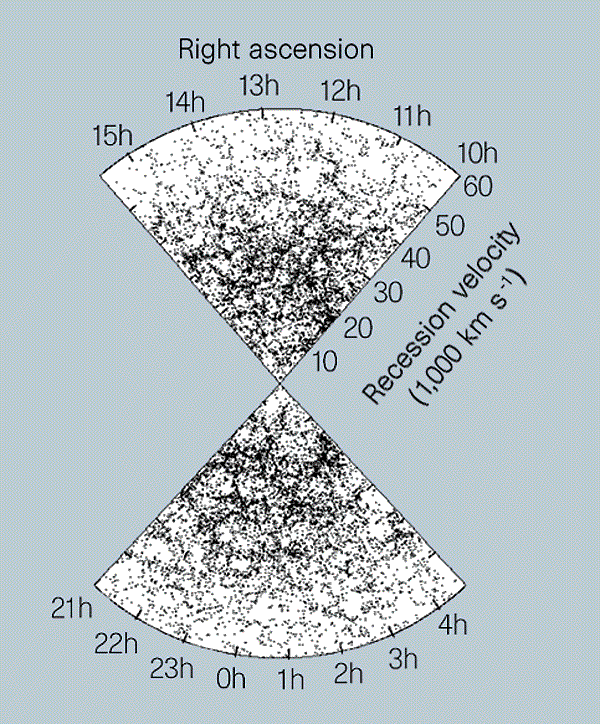
The survey maps the Universe out to recession velocities of 60,000 km s-1, corresponding to distances of a few hundred million parsecs. Although no fractal structure on the largest scales is apparent (there are no clear voids or concentrations on the same scale as the whole map), one statistical analysis [2] finds a fractal dimension of two in this and other surveys, for all scales – conflicting with a basic principle of cosmology.

Their results are, however, at variance with the visual appearance of the Las Campanas survey, for example, which certainly seems to display large-scale homogeneity. Objections to these claims have been lodged by Luigi Guzzo [4], for instance, who has criticized their handling of the data and has presented independent results that appear to be consistent with a transition to homogeneity. It is also true that Sylos-Labini et al. have done their cause no good by basing some conclusions on a heterogeneous compilation of redshifts called the LEDA database [5], which is not a controlled sample and so is completely unsuitable for this kind of study. Finally, it seems clear that they have substantially overestimated the effective depth of the catalogues they are using. But although their claims remain controversial, the consistency of the results obtained by Sylos-Labini et al. is impressive enough to raise doubts about the standard picture.

Mainstream cosmologists are not yet so worried as to abandon the Cosmological Principle. Most are probably quite happy to admit that there is no overwhelming direct evidence in favour of global uniformity from current three-dimensional galaxy catalogues, which are in any case relatively shallow. But this does not mean there is no evidence at all: the near-isotropy of the sky temperature of the cosmic microwave background, the uniformity of the cosmic X-ray background, and the properties of source counts are all difficult to explain unless the Universe is homogeneous on large scales [6]. Moreover, Hubble’s law itself is a consequence of large-scale homogeneity: if the Universe were inhomogeneous one would not expect to see a uniform expansion, but an irregular pattern of velocities resulting from large-scale density fluctuations.

But above all, it is the principle of Occam’s razor that guides us: in the absence of clear evidence against it, the simplest model compatible with the data is to be preferred. Several observational projects are already under way, including the Sloan Digital Sky Survey and the Anglo-Australian 2DF Galaxy Redshift Survey, that should chart the spatial distribution of galaxies in enough detail to provide an unambiguous answer to the question of large-scale cosmic uniformity. In the meantime, and in the absence of clear evidence against it, the Cosmological Principle remains an essential part of the Big Bang theory.

References

  1. Friedmann, A. Z. Phys. 10, 377–386 ( 1922).
  2. Sylos-Labini, F., Montuori, M. & Pietronero, L. Phys. Rep. 293, 61-226 .
  3. Shectman, S.et al. Astrophys. J. 470, 172–188 (1996).
  4. Guzzo, L. New Astron. 2, 517–532 ( 1997).
  5. Paturel, G. et al. in Information and Online Data in Astronomy (eds Egret, D. & Albrecht, M.) 115 (Kluwer, Dordrecht,1995).
  6. Peebles, P. J. E. Principles of Physical Cosmology (Princeton Univ. Press, NJ, 1993).

A Sonnet of Significance

Posted in Poetry, The Universe and Stuff with tags , , , on August 3, 2010 by telescoper

Inspired by Dennis Overbye’s nice article in the New York Times about the plethora of false detections in physics and astronomy, and another one in Physics World by Robert P Crease with a similar theme, I’ve decided to relaunch my campaign to become the next Poet Laureate with this Sonnet (in Petrarchean form) which I offer as an homage to John Keats. I’ve slavishly copied the rhyme scheme of one of Keats’ greatest poems, although I think I’ve made all the lines scan properly which he didn’t manage to do in the original.  Nevertheles, I’m sure that if he were alive today he’d be turning in his grave.

Much have I marvell’d at discov’ries bold
And many gushing press releases seen
But often what is “found” just hasn’t been
(Though only rather later are we told).
Be doubtful if you ever do behold
A scientific “certainty” between
The pages of a Sunday magazine;
The complex truth is rarely so extolled.
So if you are a watcher of the skies
Or particle detection is your yen,
Refrain from spreading rumour and surmise
Lest you look silly time and time again.
Two sigma peaks – so you should realise –
Are naught but noise, so hold your tongue. Amen.

The Matrix

Posted in Poetry with tags , on August 2, 2010 by telescoper

Back to the grind after a week off, lots of catching up to do and things to confront that I’ve been putting off. This poem, a sonnet by Amy Lowell, seems an appropriate choice for today. It’s just a bit of a shame I can’t find any nectarines.

Goaded and harassed in the factory
That tears our life up into bits of days
Ticked off upon a clock which never stays,
Shredding our portion of Eternity,
We break away at last, and steal the key
Which hides a world empty of hours; ways
Of space unroll, and Heaven overlays
The leafy, sun-lit earth of Fantasy.
Beyond the ilex shadow glares the sun,
Scorching against the blue flame of the sky.
Brown lily-pads lie heavy and supine
Within a granite basin, under one
The bronze-gold glimmer of a carp; and I
Reach out my hand and pluck a nectarine

Crater 308

Posted in Art, The Universe and Stuff with tags , , , , , on August 1, 2010 by telescoper

I haven’t got time to post much today – WordPress was down earlier when I had a bit of time and now I’m going to watch the highlights of England’s Test victory against Pakistan in the cricket today, which they achieved by bowling out their opponents for only 80 runs in the second innings.

Nevertheless, as a quick filler, I thought it would be nice to show this wonderful image of the crater Daedalus, formerly known as Crater 308, which is located on the far side of the Moon. Not the dark side, by the way, the far side of the Moon gets just as much sunlight as the near side!
This is one of the images I’ve been working on as part of the project Beyond Entropy for a forthcoming exhibit at the Venice Biennale of Architecture which opens at the end of this month. I won’t say too much about the exhibit I’m involved with, except that it explores the way higher-dimensional information can be recorded in surfaces of lower dimension, like a kind of architectural holographic principle. I was particularly struck by the way the pattern of cratering on the Moon yields information about its formation history, which is why I went looking for dramatic examples. This – taken during the Apollo 11 mission- is my favourite image of all those I’ve looked at. I love the complexy topography, its textural contrasts and the way the shadows play across it.

Daedalus is an impact crater that formed about 3.75 to 3.2 bn years ago. It’s about 93km across. The crater looks relatively fresh; showing sharp-ish-looking rims all around with sequences of wonderfully-preserved terraces down onto a pock-marked, flat floor consisting of numerous craterlets and a central peak divided up into two to three well-defined hills. You can also see the effect of more recent impacts in and around it.

Talking of impact, I wonder if I can get this project into our REF submission?

The Balding Version

Posted in Uncategorized with tags , , , , on July 31, 2010 by telescoper

Now that I’m back from a period of rest and recuperation I thought I’d try to get back into the swing of things by posting a few short items about things I found interesting in the papers. One item today caught my eye as it touches on a theme I’ve addressed before: Freedom of speech, and its limits.

This story concerns sports presenter Clare Balding who is apparently presenting a new TV series called Britain by Bike. I don’t know much about her or the new series, but it was reviewed last week in the Sunday Times by a person by the name of AA Gill who referred to her as

…the dyke on a bike, puffing up the nooks and crannies at the bottom end of the nation

Not very nice at all. I’m not linking to the original article (a) because it’s behind a paywall and (b) because I don’t want to send the Evil  Empire  of Murdoch any traffic. You can find the gist of it in a story at the Guardian.

I didn’t know that Clare Balding is a lesbian, but then there’s no reason why I should have thought about her sexuality as it’s not at all relevant to her job.  Apparently she is quite open about and comfortable with her orientation, but the obviously pejorative reference to the word “dyke” got her understandably riled. She complained to the Sunday Times editor, a nasty piece of work called John Witherow, who replied

In my view some members of the gay community need to stop regarding themselves as having a special victim status and behave like any other sensible group that is accepted by society.Not having a privileged status means, of course, one must accept occasionally being the butt of jokes. A person’s sexuality should not give them a protected status.

Clare Balding was unhappy with the response, saying

This is not about me putting up with having the piss taken out of me, something I have been quite able to withstand, it is about you legitimising name calling. ‘Dyke’ is not shouted out in school playgrounds (or as I’ve had it at an airport) as a compliment, believe me..

She has now made the matter to the Press Complaints Commission under article 12 of its Editor’s Code of Practice, which states

The press must avoid prejudicial or pejorative reference to an individual’s race, colour, religion, gender, sexual orientation or to any physical or mental illness or disability.

There’s no denying that the word “dyke” is a pejorative term for a lesbian so one would imagine that this will be an open-and-shut case. Note also that the response from John Witherow explicitly refuses to accept the terms of article 12. Whether he likes it or not, sexual orientation is specifically protected in the Editor’s Code of Practice to which he is a signatory. John Witherow probably thinks so little of this code that he hasn’t even read it. If he is exonerated it will prove beyond any doubt that the Editor’s Code of Practice is simply a sham.

Whether the right to free speech should be bounded by law is a topic that has come up several times on this blog, including one very recent example and one rather older which has direct parallels with the Clare Balding complaint. I think it is right that this matter should be dealt with outside the law courts. Gill’s comment may be nasty but I don’t think such things should be regarded as criminal, unless they are clearly intended to harrass. If, for example, he’d screamed the word dyke through her letterbox, I think that would be a criminal matter.

However, the problem with voluntary “codes of conduct” such as this – including those that form part of certain employment contracts – is that they usually amount to nothing other than window-dressing, at least when it comes to sexual orientation. The word “dyke” is as offensive to a lesbian as the word “faggot” is to a gay man, but cases involving these words are rarely taken as seriously as those involving racial or gender-based terms. Can you imagine the outcry if AA Gill had used the word “nigger” or “paki” in a review?

Mentioning “sexual orientation” in a list isn’t the same as taking the related prejudice seriously or trying to something about it. The fact of the matter is that lesbians and gay men may be more accepted in society now than they were twenty years ago, but there are still many walks of life in which this is not the case.  In fact, I think the depressing reality is that the vast majority of heterosexual people simply don’t like homosexual people and resent their apparent “acceptance”.  You can argue about the rights and wrongs of “politically correct language”, but the problem it is trying to address in this case is very real and it is often the only thing that prevents overt abuse, as indeed it is with racist abuse.

Having said that, it wouldn’t surprise me at all if the Sunday Times gets away with this clear violation of the PCC code. It would just be another example of gross hypocrisy to add to the many that already demonstrate that political correctness is  a very thin veneer. Far better, in my view, to dispense with the code of practice altogether if this happens than keep it there and openly flout it. At least then we’d all know where we really stand.

A Martian Oz?

Posted in The Universe and Stuff with tags , , on July 31, 2010 by telescoper

I noticed a news item last week about research which points out that the remarkable fact that parts of Mars look a bit like Australia. Take this image, for example, of the region called Nili Fossae in which the Sydney Opera House can be seen clearly in the upper left…

Apparently the rocks in this region “resemble” those in an area of Australia called the Pilbara. Scientists believe that microbes formed some distinctive features in the Pilbara rocks – features called “stromatolites” that can be seen and studied today. According to  Adrian Brown, who works for the SETI Institute,

“Life made these features. We can tell that by the fact that only life could make those shapes; no geological process could.”

Unfortunately however, all that has really been established is that the Martian rocks have a similar mineral composition to those found in Australia – there’s no evidence (yet) that the “features” made by living creatures are present. Nevertheless, the newspapers have got very excited about this and today’s Guardian even ran an editorial on this item, from which I quote

Sceptics may think the comparison tenuous. They may also note that yesterday’s news reports either framed the possibility as a question – could there be life? – or put it in inverted commas. There is no proof. There is quite likely no life either.

Quite.

I always find it very interesting how everyone gets so worked up about the possibility of there being, or having been, life on Mars when we’re such careless custodians of the flora and fauna of our own planet. I suppose behind it all there’s a hope that there might be sentient beings out there in space who can tell us how to look after ourselves a bit better than we’re able to figure out for ourselves.

Unfortunately, the recent “discovery” provides very strong evidence against there being any form of intelligent life whatsoever on Mars. After all, it’s just like Australia.

The Complete Animated Shakespeare

Posted in Literature with tags , , on July 30, 2010 by telescoper

While I was blathering on about Shakespeare a couple of days ago, I suddenly remembered this marvellous animated film I saw when it was first released over 20 years ago. I couldn’t remember the name so it took me a bit of time to find it, but I got there in the end. It’s by Aardman Animations (best known for the later Wallace and Gromit films) and it was part of a splendid series of animated shorts called Lip-synch commissioned by Channel 4 and broadcast in 1990. It’s hard to imagine Channel 4 doing anything this good nowadays.  This film, called Next,  is only 5 minutes long yet it manages to refer to every single one of Shakespeare’s plays by having the immortal bard himself do them all as an audition. It’s not only clever and visually appealing but also a lot of fun…

Astronomy (and Physics) Look-alikes, No. 35

Posted in Astronomy Lookalikes with tags , on July 30, 2010 by telescoper

I wonder if anyone else has noticed the remarkable resemblance between these two international celebrity heart-throbs? I wonder if by any chance they might be related?

Enrique Iglesias

Joao Magueijo

A Commonplace Blog

Posted in Biographical, Poetry with tags , , on July 29, 2010 by telescoper

Just a brief interruption to my holiday from blogging. Posting from the old Blackberry isn’t particularly easy, so I’ll keep it brief. It struck me that this would provide a nice postscript to my recent navel-gazing post about blogging so I decided to put it up before I forget which, in fact, is part of the point of the text…

Thy glass will show thee how thy beauties wear,
Thy dial how thy precious minutes waste;
The vacant leaves thy mind’s imprint will bear,
And of this book this learning mayst thou taste.
The wrinkles which thy glass will truly show
Of mouthed graves will give thee memory;
Thou by thy dial’s shady stealth mayst know
Time’s thievish progress to eternity.
Look, what thy memory can not contain
Commit to these waste blanks, and thou shalt find
Those children nursed, deliver’d from thy brain,
To take a new acquaintance of thy mind.
These offices, so oft as thou wilt look,
Shall profit thee and much enrich thy book.

Shakespeare’s Sonnet No. 77 is open to quite a bit of interpretation, but it seems clear that the “vacant leaves” refer to the blank pages of a “commonplace book“. To paraphrase wikipedia

Such books came into use in the middle ages and were essentially scrapbooks, filled with items of every kind: medical recipes, quotes, letters, poems, tables of weights and measures, proverbs, prayers, legal formulas. Commonplaces were used by readers, writers, students, and humanists as aids for remembering or developing useful concepts ideas or facts they had learned. Each commonplace book was unique to its creator’s particular interests.

Dare I say, just like a blog? In particular, the phrase to “take a new acquaintance of thy mind” surely rings true to anyone who writes a blog…

Interlude

Posted in Uncategorized on July 24, 2010 by telescoper

Well, dear readers, the old batteries definitely need recharging so I’ve decided to take spot of annual leave during which I’ll be away from the blog. Accordingly, in the words of the old BBC continuity announcers, there will now follow a short intermission..

Back in a week. Toodle-pip!

PS. The suitably restful and very typical bit of 1950s  “light” music accompanying this is called Pastoral Montage, and it was written by South African born composer Gideon Fagan.