Not a lot of people know that famous cosmologist Andrei Linde provided the inspiration behind the cartoon character Barney Rubble from the Flintstones. Or was it the other way round?

Barney Rubble

Andrei Linde
Not a lot of people know that famous cosmologist Andrei Linde provided the inspiration behind the cartoon character Barney Rubble from the Flintstones. Or was it the other way round?
Barney Rubble
Andrei Linde
I wonder if anyone else has noticed that Gallic cosmologist extraordinaire and doyen of the French division of the Planck consortium, Francois Bouchet, looks a lot like English National Treasure and fount of all wisdom, Stephen Fry? Perhaps they could be related?

Stephen Fry

Francois Bouchet
Last week I read an interesting bit of news in the Times Higher that the forthcoming Research Excellence Framework (REF) seems to be getting cold feet about using citation numbers as a metric for quantifying research quality. I shouldn’t be surprised about that, because I’ve always thought it was very difficult to apply such statistics in a meaningful way. Nevertheless, I am surprised – because meaningfulness has never seemed to me to be very high on the agenda for the Research Excellence Framework….
There are many issues with the use of citation counts, some of which I’ve blogged about before, but I was interested to read another article in the Times Higher, in this weeks issue, commenting on the fact that some papers have ridiculously large author lists. The example picked by the author, Gavin Fairbairn (Professor of Ethics and Language at Leeds Metropolitan University), turns out – not entirely surprisingly – to be from the field of astronomy. In fact it’s The Sloan Digital Sky Survey: Technical Summary which is published in the Astronomical Journal and has 144 authors. It’s by no means the longest author list I’ve ever seen, in fact, but it’s certainly very long by the standards of the humanities. Professor Fairbairn goes on to argue, correctly, that there’s no way every individual listed among the authors could have played a part in the writing of the paper. On the other hand, the Sloan Digital Sky Survey is a vast undertaking and there’s no doubt that it required a large number of people to make it work. How else to give them credit for participating in the science than by having them as authors on the paper?
Long author lists are increasingly common in astronomy these days, not because of unethical CV-boosting but because so many projects involve large, frequently international, collaborations. The main problem from my point of view, however, is not the number of authors, but how credit is assigned for the work in exercises like the REF.
The basic idea about using citations is fairly sound: a paper which is important (or “excellent”, in REF language) will attract more citations than less important ones because more people will refer to it when they write papers of their own. So far, so good. However the total number of citations for even a very important paper depends on the size and publication rate of the community working in the field. Astronomy is not a particularly large branch of the physical sciences but is very active and publication rates are high, especially when it comes to observational work. In condensed matter physics citation rates are generally a lot lower, but that’s more to do with the experimental nature of the subject. It’s not easy, therefore, to compare from one field to another. Setting that issue to one side, however, we come to the really big issue, which is how to assign credit to authors.
You see, it’s not authors that get citations, it’s papers. Let’s accept that a piece of work might be excellent and that this excellence can be quantified by the number of citations N it attracts. Now consider a paper written by a single author that has excellence-measure N versus a paper with 100 authors that has the same number of citations. Don’t you agree that the individual author of the first paper must have generated more excellence than each of the authors of the second? It seems to me that it stands to reason that the correct way to apportion credit is to divide the number of citations by the number of authors (perhaps with some form of weighting to distinguish drastically unequal contributions). I contend that such a normalized citation count is the only way to quantify the excellence associated with an individual author.
Of course whenever I say this to observational astronomers they accuse me of pro-theory bias, because theorists tend to work in smaller groups than observers. However, that ignores the fact that not doing what I suggest leads to a monstrous overcounting of the total amout of excellence. The total amount of excellence spread around the community for the second paper in my example is not N but 100N. Hardly surprising, then, that observational astronomers tend to have such large h-indices – they’re all getting credit for each others contributions as well as their own! Most observational astronomers’ citation measures reduce by a factor of 3 or 4 when they’re counted properly.
I think of the citation game as being a bit like the National Lottery. Writing a paper is like buying a ticket. You can buy one yourself, or you can club together and buy one as part of a syndicate. If you win with your own ticket, you keep the whole jackpot. If a syndicate wins, though, you don’t expect each member to win the total amount – you have to share the pot between you.
You may recall that I’ve posted a few times about Mark Brake, the professor at the University of Glamorgan who falsely claimed to have a PhD on a grant application written in 2006 (see, for example, here, here, and here). The UoG purportedly held an “investigation” into this matter, but took no disciplinary action against Brake. When the story resurfaced again last year, first in the Western Mail and then in the Times Higher, the University of Glamorgan kept very quiet about why it hadn’t taken this case more seriously in the first place, but promised a further investigation into the actions taken at the time.
Things have been very quiet on this front for quite some time now, but I recently heard from a reliable source that Mark Brake has been made redundant by the University of Glamorgan (as of March 31st 2010). If this is a result of an investigation into past wrongdoings then clearly the UoG have decided to let Brake go quietly rather than make any of the evidence public. I have no information about the redundancy settlement but, whatever it is, it is largely funded by the taxpayer, as his salary has been for the past three years, since the original investigation exonerated him. Of course, if the UoG did uncover evidence that was overlooked in 2007 then it would be extremely embarrassing to have to admit it three years later…
The UoG remains quiet about the affair which – at least to me – casts grave doubts on its system of governance. They seem to want this case to disappear quietly, but I don’t think it is in the public interest to let the circumstances of Brake’s departure remain secret. At the very least I hope they make an official announcement confirming that he has left the organisation, otherwise his famous wikipedia page will forever state that he is an employee of the UoG.
The University of Glamorgan website doesn’t say anything about the Mark Brake affair. However, there is an announcement about the new Wales Fraud Forum which will meet there for the first time later this month. Who said irony was dead?
While I’m on the subject of look-alikes, I couldn’t help noticing the resemblance between Baroness Susan Greenfield, former Director of the Royal Institution, and popular American recording artist Lady Gaga. I wonder if by any chance they might be related?
Grandmother and granddaughter perhaps?

Lady Greenfield

Lady Gaga
While watching Carry on Screaming on the telly tonight, I was reminded of the similarity in visual appearance possessed by the villainous Orlando (played by Kenneth Williams) and the distinguished Astronomer Royal, President of the Royal Society and Master of Trinity College, Cambridge, and the Universe, Lord Rees of Ludlow (who, I hasten to add, is not at all villainous..).

Lord Martin of Rees

Sir Kenneth of Williams
What could be nicer on lovely spring day than to take a walk through the local park? Even better if you live in the city of Cardiff, home to one of the largest areas of mature parkland in any urban setting, so you can take a stroll among lovely old trees and fields (landscaped by Capability Brown) in the shadow of a picturesque and historic castle.
At least that’s what it should be like. Unfortunately, Cardiff City Council has other ideas. Bute Park is currently being redeveloped by the Council in order to make it more accessible to lorries and other heavy vehicles. This is intended to allow more large-scale “Events” to take place on Coopers Fields, the area just behind Cardiff Castle. Further commercial exploitation of this area will no doubt ensue. Despite vigorous opposition to the plans by regular users of the Park, including myself, and widespread condemnation in the press (including the esteemed organ Private Eye) the Council last year granted itself planning permission (surprise, surprise) to construct a new road into the heart of this precious “green lung”.
I’m depressed to say that work on the new road has gathered pace during the early months of this year. Irreplaceable trees have been felled, and a hideous new bridge is being built over the Dock Feeder Canal. Needless to say, all this construction is accompanied by frequent movement of heavy vehicles in and out of the park. Large areas are now out of bounds for pedestrians, and those that do bravely venture along the footpaths elsewhere have to vie with the trucks. Many of the paths have been resurfaced to make them more suitable for motor vehicles and the signs denoting the speed limit, which used to be 5 mph throughout, have now all been removed. It’s no fun sharing a footpath with a juggernaut doing 30 mph, I can tell you. Still, I suppose we better get used to it. Bute Lorry Park it’s going to be from now on.
I’ve just got one of those new-fangled Blackberry things (which I don’t know how to work yet). However, a few days ago I did use the old one to take a few pictures of the devastation on view from my usual route into work. The first one shows the view looking North from just behind the castle.
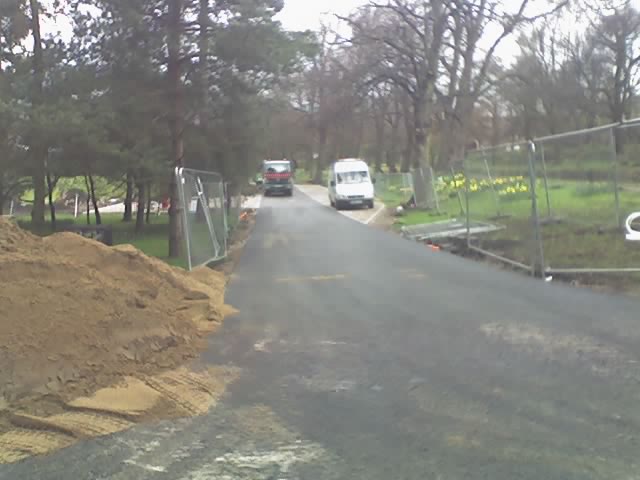
The Dock Feeder canal is just to the right. There used to be a relatively narrow trackway running along the route taken shown here, which the Council decided to replace to make it more suitable for heavy road vehicles. Coopers’ Fields lie to the left and this road is used to bring equipment, temporary buildings etc for use there. On the Council’s literature this work is described as “resurfacing”, but, as you can see from the picture, in addition to the new tarmac surface they have taken the opportunity to construct a sort of lay-by which more-or-less doubles the width of the path. Here’s another view, showing the new stretch of tarmac snaking its way along the side of the canal. You can see more clearly the area of grassland onto which lorries will be driving in ever-increasing numbers. It would be easier for them to tarmac over the whole thing and be done with it.
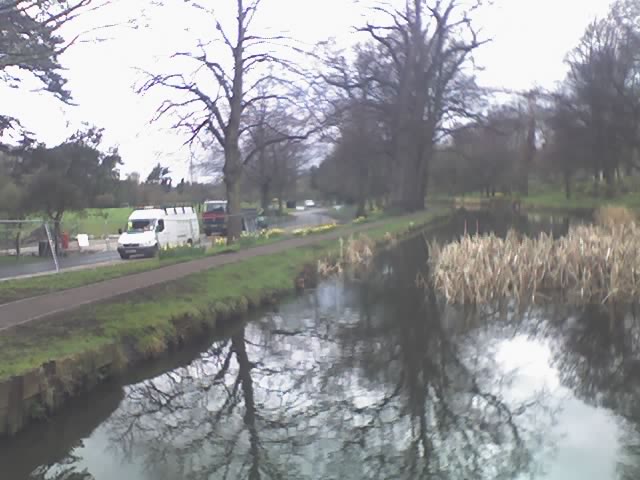
Two short but wide spurs to the left cut into the fields, presumably to allow vehicles easier access to the grass in order to churn it up into a quagmire. Here’s a view taken from a vantage point to the left of that in the first picture, showing the dire state of disprepair that Coopers Fields are in anyway, even before the new regime of rapacious commercial exploitation. The grass has been left in this damaged state since last September. No doubt it will be similarly neglected in those brief future periods in between being covered by temporary buildings and mobile entertainments of various sorts.
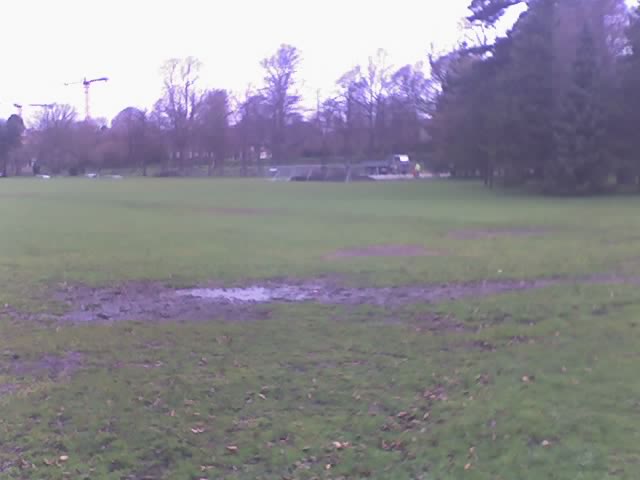
To the left of the above picture you can also see the cranes involved in construction work further North. I’ve stopped walking in that part of the park because it’s just too dangerous. A main road far worse than the one shown here, and complete with traffic lights, now enters from North Road and cuts deep into the park in order to reach the Council’s nursery facility – the type for plants, not children – which is right next to the River Taff (which lies to the East of the site shown in the pictures). At least the Council says its so lorries can reach the nursery. But how many lorries are going to need to get to the nursery every day such that they require a whole new road to be built? I know I’m not the only one who thinks this is just a cover. Phase 2 of the operation isn’t hard to guess: an extension of the road Eastwards across the River Taff via a new road bridge to Sophia Gardens, completely bisecting Bute Park and creating a major thoroughfare to relieve congestion to the West.
If you think the Council wouldn’t dare, and that they’d never get away with it, just look at what they have got away with already. And not just here. The idiotic Highways Department of Cardiff City Council has been responsible for monstrosity after monstrosity in this city. Only now are they turning their attention to beautiful Bute Park. They must be stopped.
The first line of this poem sprang suddenly into my mind this morning. I don’t really know why. It mentions the month of April, of course, but nothing especially cruel has happened so far, at least not to me. In fact, I’m in an unusually good mood, considering I have a bit of a hangover. Any excuse will do, though, for posting (the first part of) the definitive modernist poem, The Waste Land, by T.S. Eliot.
The opening section of the wikipedia article I linked to above sums this poem up beautifully:
Despite what is seen by some as the poem’s obscurity – its shifts between satire and prophecy, its abrupt and unannounced changes of speaker, location and time, its elegiac but intimidating summoning up of a vast and dissonant range of cultures and literatures – the poem has nonetheless become a familiar touchstone of modern literature.
Although it’s undoubtedly dense with cross-cultural references, and for many people it crosses over into sheer pretentiousness, it has always come across to me as an intensely humorous piece, somehow brilliant and dark at the same time. Its meaning is often cryptic, sometimes impenetrably so. Nevertheless, I keep returning to it, partly in the hope of understanding it better and partly just to enjoy the words on the page and the sounds they make when you read them out loud.
“Nam Sibyllam quidem Cumis ego ipse oculis meis
vidi in ampulla pendere, et cum illi pueri dicerent:
Sibylla ti theleis; respondebat illa: apothanein thelo.”
I. THE BURIAL OF THE DEAD
April is the cruellest month, breeding
Lilacs out of the dead land, mixing
Memory and desire, stirring
Dull roots with spring rain.
Winter kept us warm, covering
Earth in forgetful snow, feeding
A little life with dried tubers.
Summer surprised us, coming over the Starnbergersee
With a shower of rain; we stopped in the colonnade,
And went on in sunlight, into the Hofgarten,
And drank coffee, and talked for an hour.
Bin gar keine Russin, stamm’ aus Litauen, echt deutsch.
And when we were children, staying at the archduke’s,
My cousin’s, he took me out on a sled,
And I was frightened. He said, Marie,
Marie, hold on tight. And down we went.
In the mountains, there you feel free.
I read, much of the night, and go south in the winter.
What are the roots that clutch, what branches grow
Out of this stony rubbish? Son of man,
You cannot say, or guess, for you know only
A heap of broken images, where the sun beats,
And the dead tree gives no shelter, the cricket no relief,
And the dry stone no sound of water. Only
There is shadow under this red rock,
(Come in under the shadow of this red rock),
And I will show you something different from either
Your shadow at morning striding behind you
Or your shadow at evening rising to meet you;
I will show you fear in a handful of dust.
Frisch weht der Wind
Der Heimat zu
Mein Irisch Kind,
Wo weilest du?
“You gave me hyacinths first a year ago;
“They called me the hyacinth girl.”
––Yet when we came back, late, from the Hyacinth garden,
Your arms full, and your hair wet, I could not
Speak, and my eyes failed, I was neither
Living nor dead, and I knew nothing,
Looking into the heart of light, the silence.
Oed’ und leer das Meer.
Madame Sosostris, famous clairvoyante,
Had a bad cold, nevertheless
Is known to be the wisest woman in Europe,
With a wicked pack of cards. Here, said she,
Is your card, the drowned Phoenician Sailor,
(Those are pearls that were his eyes. Look!)
Here is Belladonna, the Lady of the Rocks,
The lady of situations.
Here is the man with three staves, and here the Wheel,
And here is the one-eyed merchant, and this card,
Which is blank, is something he carries on his back,
Which I am forbidden to see. I do not find
The Hanged Man. Fear death by water.
I see crowds of people, walking round in a ring.
Thank you. If you see dear Mrs. Equitone,
Tell her I bring the horoscope myself:
One must be so careful these days.
Unreal City,
Under the brown fog of a winter dawn,
A crowd flowed over London Bridge, so many,
I had not thought death had undone so many.
Sighs, short and infrequent, were exhaled,
And each man fixed his eyes before his feet.
Flowed up the hill and down King William Street,
To where Saint Mary Woolnoth kept the hours
With a dead sound on the final stroke of nine.
There I saw one I knew, and stopped him, crying “Stetson!
“You who were with me in the ships at Mylae!
“That corpse you planted last year in your garden,
“Has it begun to sprout? Will it bloom this year?
“Or has the sudden frost disturbed its bed?
“Oh keep the Dog far hence, that’s friend to men,
“Or with his nails he’ll dig it up again!
“You! hypocrite lecteur! – mon semblable, – mon frere!”
As an added bonus, here is the poet himself reading it, in his characteristically clipped but very nuanced style.
The full text of The Waste Land can be found online here.
Although it’s meant to be a holiday I’ve actually been in the department most of the day working on some research (or, rather, writing up some old research). Since I’ve been tapping away at the keys most of the day I haven’t got the energy to write much, and I’m looking forward to a drink and a spot of curry in a few minutes’ time followed by a crack at the jumbo-sized Guardian Easter crossword compiled by my favourite setter, Araucaria.
However, for the purposes of my own record-keeping – this blog is, at least in part, some kind of a journal – I thought I’d make a quick note of the day’s sport. Usually as we near the end of the football season I get into a state of nervous anxiety wondering what sort of mess my own team, Newcastle United, are going to make of the run-in. However, today I’m pleased to say they followed up Monday’s win against Nottingham Forest with another victory, 3-2 away at Peterborough. Although their opponents are the bottom club of the division at the moment, I always thought this would be a tricky game and so it proved if the press reports are to be believed. Peterborough in fact took an early lead, and Newcastle didn’t equalise until stoppage time in the first half. They then went 3-1 up, only to have one goal pegged back by a determined home team.
That result might have sealed promotion to the Premiership for Newcastle, had Nottingham Forest done the decent thing and lost to Bristol City. They didn’t lose, but only managed a draw. The gap between Newcastle and Nottingham Forest is now 15 points with Forest having five games to play while Newcastle have six games left. It’s extremely improbable that Newcastle will lose all 6 of their games and Forest win all 5 of theirs, so I think we’re pretty much guaranteed to go up. We need just one point to turn that into mathematical certainty.
Today was a big game here in Cardiff too, between Cardiff City and fierce local rivals Swansea. Police helicopters were circling the town all day and there was a heavy presence of uniformed officers trying to ensure there wasn’t any trouble at the match. This too was a close-fought game. With the score at 1-1 until stoppage time at the end of the match, Michael Chopra popped up to score a winner for Cardiff. They’re now hard on the heels of Nottingham Forest in fourth place, with 68 points to Forest’s 71. Cardiff might still have to play Swansea in the playoffs. That could be interesting..
And finally, it’s worth noting that today was the day of the annual Oxford versus Cambridge Boat Race in London. I’m not going to pretend that I follow this sport particularly closely, but the occasions on which I’ve been to watch the spectacle have been very enjoyable (even though Oxford has beaten my own Alma Mater every time I’ve bothered to watch it). It’s usually more of an excuse to have a few drinks while watching other people busting a gut than a genuine interest in the sport. Still, I do have a residual loyalty to Cambridge University so I was delighted to find out that they won today. If I’d seen the pre-race odds, I might have had a bet as Oxford were clear favourites.
Not at all a bad day results-wise. I almost finished my paper too…
Another quick break from writing gives me an excuse to post another favourite tune…
If you thought that raunchy lyrics were bound to be banned from records made 80 years ago, then just get a load of this.
It was recorded in 1928 by the greatest female blues singer of them all, Bessie Smith (“The Empress of the Blues”), together with Clarence Williams on piano and Eddie Lang on guitar. Bessie Smith was a notoriously loud and sometimes violent woman, who had an insatiable appetite for booze and sex (with, it’s said, both men and women). She also had a voice like no-one else on earth before or since.
This is one of several very naughty records she made in the late twenties, others including “Do your duty” and “Take me for a buggy ride” but this is probably the rudest of the lot. I like the video too. Enjoy!
Now, anyone for round steak?

 In the Dark