Archive for 2010

Two Cheers for Lord Drayson

Posted in Science Politics with tags , , on March 4, 2010 by telescoper

The long awaited announcement of Lord Drayson‘s review of the structure of the Science & Technology Facilities Council (STFC)  has finally appeared together with parallel announcements by STFC and RCUK. There’s already been a lot of reaction on Twitter about this, and it has also reached the  BBC News.

There’s actually not much in the announcement that’s particularly surprising.  The plan is to insulate STFC from the effects of currency fluctuations on its subscription commitments to international organizations, and also to share the cost of large domestic facilities across the whole science programme rather than just STFC on its own. In the shorter term (i.e. 2010-11) STFC will continue to receive some help to deal with the uncontrollable external pressures on its budget.

In the longer term it is anticipated that the subscription to the European Space Agency will move to a new UK Space Agency anyway.

These moves are all good news, and will probably help STFC to reach some level of stability. I am certainly grateful to Lord Drayson for getting involved in this process. It will be a while before we find out how it will work out in practice, but at least it’s a start.

The big problem I see is that STFC may well reach “stability”, but the position of equilibrium looks likely to be one with a very low level of grant funding for astronomy and particle physics. Perhaps I’m being excessively cynical, but it still looks to me like this financial crisis was deliberately engineered in order to squeeze fundamental research by 25%. That has now been achieved, so the grey men of the Treasury can now remove the straitjacket. I don’t see any signal that our grants will return to a sustainable level, however, so the astronomy community will probably continue to wither away. The Drayson review may staunched the flow of blood, but the patient will remain  dangerously  ill unless additional measures are taken. (Too many metaphors, Ed.)

Which brings me to a final point. Having a sensible management structure for STFC isn’t the same as having a sensible STFC management. I know I’m not the only astronomer in the UK to have lost all confidence in the current Chief Executive, Keith Mason. As long as he remains in charge I’m suspicious that any structural modifications will amount to no more than window-dressing and astronomy and particle physics will continue to be neglected in favour of technology-driven projects.

We might – just might –  have stopped going backwards, but in order to start going forwards we need a new leader.

PS. For  the best compilation of sources on the STFC crisis, see Paul Crowther’s pages here.

Astronomy Look-alikes, No. 17

Posted in Astronomy Lookalikes with tags , on March 3, 2010 by telescoper

It’s been a while so I thought I’d try this one. It’s not at all unusual for my former colleague and cosmologist extraordinaire Professor Bernard Carr to be mistaken for the popular television celebrity Mr Noel Edmonds. I wonder if by any chance they might be related?

Mr Noel Edmonds

Professor Bernard Carr

Education. Education. Education.

Posted in Science Politics with tags , , on March 2, 2010 by telescoper

I can’t believe it. It’s an outrage. My world has fallen apart. Everything I used to believe in now stands in ruins.The unthinkable has happened. The Conservative Party has had a good idea.

Actually several. 

This is from the Guardian’s coverage of the story:

A Conservative government would immediately overhaul the national curriculum in English, maths and science – and hand control of A-level exam content to universities and academic experts to end “political control” , the shadow education secretary, Michael Gove, said today.

Every child would get the chance to study all three science subjects – physics, chemistry and biology – separately at GCSE and there would be a return to disciplines such as geometry and algebra in tests for 11-year-olds.

The Tories would abolish the Qualifications and Curriculum Development Agency (QCDA), the quango in charge of curriculum design, and benchmark the exams sat by children in England against those taken by young people across the world.

Outlining his plan in a speech to the annual conference of the Advisory Committee for Mathematics Education (Acme), Gove suggested that calculus be restored to A-level physics, and statistical concepts such as randomness and prediction – which have been key to understanding the financial crisis – be part of the GCSE curriculum for the brightest students.

“We will make a radical change to the way in which A-levels are designed,” Gove said. “We must ensure that A-levels are protected from devaluation at the hands of politicians. The institutions with the greatest interest in maintaining standards at A-level are those which receive A-level students – our universities.

“The individuals with the keenest interest in ensuring A-levels require the depth of knowledge necessary to flourish at university are our teaching academics. So we will take control of the A-level syllabus and question-setting process out of the hands of bureaucrats and instead empower universities, exam boards, learned societies and bodies like Acme.”

The national curriculum would be reformed to specify core knowledge “based on global evidence for what children can and should learn at different ages”, with changes to be introduced from September 2011.

Science would be divided into the disciplines of physics, chemistry and biology, rather than the hybrid headings currently used, which include “chemical and material behaviour” and “the environment, earth and universe”.

“When we reconstruct the national curriculum, we will ensure that it is built around a basic entitlement to study each of these scientific disciplines in a proper, rigorous fashion,” Gove said.

“We will ensure that each of the three basic sciences takes its place within the curriculum, in significantly greater depth and greater detail than now. Studying what has now become known as triple science should not be an elite activity but a basic curriculum entitlement.”

There isn’t much  in this that I would disagree with. The only thing that makes me nervous is that  abolishing the QCDA and handing over curriculum control to Universities may simply be a cost-cutting measure. I can see a strong possibility that we might have to take on this duty for free at a time when we’re threatened with big cuts in our research and teaching funds.

I’d also say that I think we’d be better off scrapping A-levels entirely – they’re damaged beyond repair, in my view. “Benchmarking” could be achieved quite easily by making British students take the International Baccalaureate.

These things aside, I would strongly endorse the statement that a proper science education should be an entitlement not a privilege. People might sneer at the reintroduction of geometry into the syllabus but I think it’s an excellent idea. Too much education these days consists of the rote-learning of snack thoughts in bit-sized factoid pieces. Too little involves nurturing brains to exploit their full potential to do things other than act as memory devices.  Education is there to help people learn to apply rigorous logical thinking as well as exercising its creative problem-solving powers. Doing classical Euclidean geometry is a wonderful way to develop the idea of a mathematical proof and, in my view, cutting it out of the school syllabus was a very retrograde step and one that should be reversed as soon as possible.

We’ve been going backwards in science education for far too long. Educationalists have convinced our schools that today’s students are not sufficiently intelligent to do science or mathematics and must instead be content to reproduce it. That’s an insult to the intelligence of the younger generation and it means Universities have to do a great deal of remedial teaching before they can get on and do things properly.

I’m no Conservative, but there’s no doubt in my mind that New Labour lost the plot a long time ago so I think the Tory plans are to be applauded.

Not that I’m going to vote for them.

A Poem for St David’s Day

Posted in Poetry with tags , , on March 1, 2010 by telescoper

Today is St David’s Day, and it seems apt to celebrate it with a poem by Dylan Thomas. I’ve loved this particular one since I first heard it when I was a student many years ago. I say “heard it” rather than “read it” because it was through buying a tape of the man himself reading his poems that got me hooked. Fern Hill reflects about the passage of time, the loss of childhood happiness and the inevitability of death but its mood is defiant rather than gloomy. It’s full of vibrant imagery, but it’s also written with a wonderful feeling for the natural rhythms and cadences of the English language. You can listen to Dylan Thomas reading this exactly as if it were music.

 Fern Hill

Now as I was young and easy under the apple boughs
     About the lilting house and happy as the grass was green,
       The night above the dingle starry,
         Time let me hail and climb
       Golden in the heydays of his eyes,
     And honoured among wagons I was prince of the apple towns
     And once below a time I lordly had the trees and leaves
         Trail with daisies and barley
       Down the rivers of the windfall light.

     And as I was green and carefree, famous among the barns
     About the happy yard and singing as the farm was home,
       In the sun that is young once only,
         Time let me play and be
       Golden in the mercy of his means,
     And green and golden I was huntsman and herdsman, the calves
     Sang to my horn, the foxes on the hills barked clear and cold,
         And the sabbath rang slowly
       In the pebbles of the holy streams.

     All the sun long it was running, it was lovely, the hay
     Fields high as the house, the tunes from the chimneys, it was air
       And playing, lovely and watery
         And fire green as grass.
       And nightly under the simple stars
     As I rode to sleep the owls were bearing the farm away,
     All the moon long I heard, blessed among stables, the nightjars
       Flying with the ricks, and the horses
         Flashing into the dark.

     And then to awake, and the farm, like a wanderer white
     With the dew, come back, the cock on his shoulder: it was all
       Shining, it was Adam and maiden,
         The sky gathered again
       And the sun grew round that very day.
     So it must have been after the birth of the simple light
     In the first, spinning place, the spellbound horses walking warm
       Out of the whinnying green stable
         On to the fields of praise.

     And honoured among foxes and pheasants by the gay house
     Under the new made clouds and happy as the heart was long,
       In the sun born over and over,
         I ran my heedless ways,
       My wishes raced through the house high hay
     And nothing I cared, at my sky blue trades, that time allows
     In all his tuneful turning so few and such morning songs
       Before the children green and golden
         Follow him out of grace.

     Nothing I cared, in the lamb white days, that time would take me
     Up to the swallow thronged loft by the shadow of my hand,
       In the moon that is always rising,
         Nor that riding to sleep
       I should hear him fly with the high fields
     And wake to the farm forever fled from the childless land.
     Oh as I was young and easy in the mercy of his means,
         Time held me green and dying
       Though I sang in my chains like the sea.

When Energy Becomes Form

Posted in Art, The Universe and Stuff with tags , , , , , , on February 28, 2010 by telescoper

I’m back in Cardiff, exhausted but, at the same time, rather exhilirated by the past few days in Geneva. Before I crash out I thought I’d update the post I filed a couple of days ago.

On Friday we visited CERN, the highlight of which visit was, for me, seeing the facility where they test the superconducting magnets used in the Large Hadron Collider. We also saw the surface buildings of the ATLAS experiment, but since the LHC was getting ready to rumble again after its winter break we weren’t allowed to see the thing itself, 100 metres below ground. Coincidentally, I learned today that the LHC is now back making collisions once more. Obviously, the practical tips I passed on while I was there did the trick. One likes to help where one can.

The rest of Friday, back in downtown Geneva, was bizarre to say the least. We had the obligatory Swiss dinner of fondue, which is basically a big bowl of melted cheese into which you dip bits of bread repeatedly while hoping that at some point they’re going to bring some proper food. They don’t. To make matters worse we were serenaded by Swiss folk music:  cowbells, alphorns, yodelling – the works. One of the musicians was the spitting image of Dr Evil from the Austin Powers movies but at least there was no sign of Mini-me. I was traumatised by the thought that the world might be brought to a premature end, not by the LHC creating black holes but by excessive yodelling.

After that, as midnight approached, all 24 of us – 8 scientists, 8 artists and 8 architects – gave very short presentations about our work to the others in the hotel lobby area.  I couldn’t do justice to the range of ideas and forms presented there in a short blog like this so I’ll just say it was totally fascinating to listen to these people, see examples of their work, and have the chance to ask questions.

Saturday was the most intense and also the most interesting day. We were housed in a beautiful 19th Century house in the old part of Geneva that used to be the French ambassador’s residence the whole day. Split into various groups we thought, discussed, sketched, scribbled and generally brainstormed our way towards ideas for something to exhibit on our allocated theme. We got together at the end so each group could exchange their ideas with the others. It seemed every group had great fun and there seemed to be some great concepts floating around.

The artist I’m collaborating with is Carlos Garaicoa, who was born in Cuba and who has exhibited his work all over the world. He now shares his time between Havana and Madrid. He showed us examples of his work encompassing a huge range of materials and technologies: video, photography, sculpture – you name it. One of the themes he has been interested in is the idea of documentary matter, meaning objects of various kinds that bear testimony to events or forces acting on them.  Eyal Weizman is the architect Carlos and I will be working with.  He’s a research architect who has, amongst other things, recently completed a long project looking at the construction of the wall that the Israeli government has built in the west bank

And then there was me, like a fish out of water. I had looked at the title of the programme, Beyond Entropy: How Energy Becomes Form and decided that it might be interesting to get across the central idea in general relativity, i.e. that gravitational forces can be described in terms of the curvature of space. In my presentation I took this to an extreme and tried to explain how the large-scale structure of the Universe is shaped by small ripples in space in the early Universe that evolve under the action of gravity to produce the structures we see on scales as large as 100 million light years. It seemed to be a good example of gravitational energy becoming form. I summed it up with a quote from John Archibald Wheeler:

Matter tells space how to curve. Space tells matter how to move

Taking cue from these perspectives we had a wide-ranging conversation that took the idea of gravity as an effect of space, and explored this in more general contexts and from different angles. Space is often understood through its boundaries or through the surfaces constraining it and these edges take on a form that represents a sort of diagram of the forces that have acted on it. On a human scale we thought about walls and how the path they follow is shaped not only by topographical constraints but also by socioeconomic considerations. Walls and buildings generally suffer decay or damage too, including catastrophics events like explosions or earthquakes.

We also talked about the relationship between surfaces and the spaces they enclose or divide. The path of a wall such as the west bank barrier is extremely complicated because of the interplay between such factors. It curves in and out seemingly at random, but its shape makes it a document that contains information about the forces that have shaped it. It is a document in itself, not just because it happens to have things written on it in some places!

This thread of discussion got us interested in the possibility of using material objects to reconstruct the history of the processes that formed them: the Moon’s surface offers an example wherein the sequence of impacts can be inferred from the pattern of overlying and underlying craters. This led on to discussions about the relationship between surfaces and volumes generally, taking in holography as a specific example where  two-dimensional object contains three-dimensional volumes.

This all took us quite a long way from the initial riff, but I’m glad of that. My main worry about getting involved in this was that we might end up producing something that was merely didactic, just a fancy metaphorical treatment of basic physics. I wanted to avoid that because I think it would be very boring. I think I shouldn’t have worried that we might head in such a dull direction.

Some of the other groups managed to work up concrete ideas for prototypes to be exhibited. We didn’t really get that far. We were much keener to explore as many concepts as possible before settling on one. For myself, I was just really enjoying the discussion! There are no real constraints on what we can make – within reason of course. Sculptures, plans, buildings, installations, videos, photographs, and even books are all possibilities. It’s quite scary having such a blank canvas. We discussed a number of ways we might develop our discussion into material that can be exhibited but they all need a lot of work to develop, so we’ll carry on our collaboration remotely. I’m quite keen to bring some sort of holographic element into it, and promised to investigate the possibility of making some prototypes.

For the meantime, however,  it’s back to reality for me. A lecture to prepare and give, problem sets to get ready and an exercise class to run, an examination paper to finish writing, and a whole afternoon at the School’s research committee. I wonder if what I’ve been doing over the weekend will count as having “impact”?

The True Origin of CERN

Posted in Uncategorized with tags , , on February 27, 2010 by telescoper

During my fascinating visit to CERN to see the Large Hadron Collider yesterday it occurred to me that many of my readers might be unaware of the true historical origin of that organization. I have to say the general misunderstanding of the background to CERN is not helped by the information produced locally which insists that CERN is an acronym for Conseil Européen pour la Recherche Nucléaire and that it came into being in the 1950s. This is false.

CERN is in fact named after the Dorset village of Cerne Abbas, most famous for a prehistoric hill figure called the Cerne Abbas Giant. The following aerial photograph of this outstanding local landmark proves that the ancient Brits had the idea of erecting a large hardon facility thousands of years ago…

Beyond Entropy

Posted in Art, The Universe and Stuff with tags , , , , , on February 26, 2010 by telescoper

It’s a cold and rainy morning here in Geneva, but I’m really looking forward to the next few days here. I arrived yesterday evening after a flight that was longer than it should have been. It seems the French air traffic controllers went on some sort of strike so my flight from Heathrow wasn’t allowed to cross French air space. For a flight between London and Geneva that is a bit of a problem. In the end we flew west over Belgium and then down into Switzerland from the North, the whole thing taking about an hour longer than expected. Still, when I did get to where I was going I found the hotel nice and comfortable and, better still, had a very enjoyable dinner at a swish Italian restaurant. It was nice to leave the chaos of French airspace behind.

I’m here as part of an unusual research project called (ironically, in the light of the aforementioned travel problems) Beyond Entropy. Organized by the Architectural Association School of Architecture, this experiment will bring together a group of artists, architects and scientists to investigate the notion of Energy. The way this is being done is by setting up a series of groups (one artist, one architect and one scientist) to look at each of a number of different forms of energy: potential, electric, thermal, mechanical, and so on; my own focus is gravitational energy. Each group will work together over the following few days to generate ideas a collaboration intended to create a work of some sort that gives form to the specific concept of energy they’re looking at. The subtitle of the project is “When Energy becomes Form”.

After we go back home, we’ll continue to work over the following months to produce prototypes of whatever emerges from the collaboration. The results will be exhibited at the Venice Architecture Biennale and the Architectural Association in August 2010. It is hoped that next year these prototypes will be developed into full-scale installations for the Venice Art Biennale in 2011.

I have no idea at this stage how the collaboration will work out or what is going to come out at the other end. The canvas is completely blank. I don’t really know the artist (Carlos Garaicoa) or the architect (Eyal Weizman) that I’ll be working with either. That makes it strangely exciting. At any rate it’s certainly different from the sort of scientific workshop I usually attend.

Anyway, to kick things off we’re going to be spending most of today at CERN, where I’ll be heading by bus just about as soon as I’ve finished this blog post. Later on today I’ll be giving a short presentation about how gravitational energy relates to my own research in the hope that this will stimulate a few ideas for my collaborators. Arts-science collaborations like this have been tried before and they have a chequered history, but we’ll just have to see how it goes. It feels more like research than most research workshops I’ve been to, in fact, because I really haven’t a clue what is going to happen!

P.S. Fellow blogger Andrew Jaffe is here too, but I think I might have beaten him in the competitive blogging stakes.

New Cats on the Block

Posted in Columbo with tags , on February 25, 2010 by telescoper

Having a slightly later than usual breakfast this morning, I noticed two feline intruders in the garden. I’ve never seen either of them before so it was quite a shock.

One of them was a stunningly sleek black cat with spectacular orange-coloured eyes. This one is clearly a very cool animal, sitting elegantly on the shed roof  and surveying the scene below with apparent disdain. The other one was totally different: a tortoiseshell  with white patches, young and quite slightly built, with a small face but big ears and a very large nose. Most comically of all, cat number two had disproportionately large feet to the extent that she (?) looked like she was wearing white boots.  I went out to try to take a picture, but they both did off like greased lightning as soon as I went outside.

Columbo didn’t pay them much attention, so maybe they’re regular visitors and I only noticed them this morning because I’m on a different routine, heading off to the airport instead of going to work. I’m sure if they went anywhere near his food it would be a different story.

Anyway, this little episode reminded me to let Columbo’s many admirers know that he’s doing fine. He’s spending more time outside now that the worst of the winter appears to be over (?) and seems to be in good spirits. I promise to post some pictures when I get back. I know I’ve promised before but I keep forgetting.

The Solution

Posted in Cute Problems with tags , , on February 24, 2010 by telescoper

A few days ago I posted a little puzzle about the resistance measured between two adjacent nodes in an infinite square grid made of of 1Ω resistors. There was a bit of discussion after the post that hinted at the solution but, since a few people have asked me about it, I thought I’d post a fuller answer here.

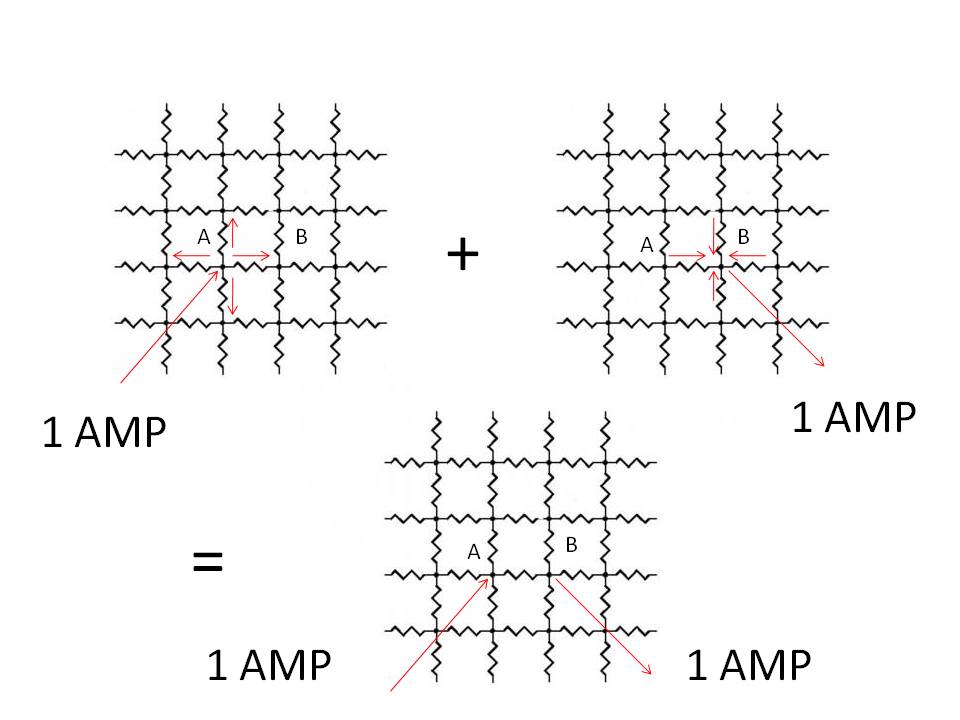
The quickest way I know to get the answer uses the Principle of Superposition, as illustrated in the following picture.

Consider two copies of the grid, both earthed at infinity. Imagine injecting a current of 1 Amp into the grid through a wire attached to node A as shown in the top left of the picture. The current will run to earth through the grid, but, by symmetry, it is obvious that 1/4 of the current entering the grid through A must travel through each of the 4 wires radiating out from it. Each of the wires leading out from A therefore carries 0.25 Amps in this solution.

Now, in the top right hand picture, forget about A, but attach a wire to B and pull out 1 Amp from the earth (at infinity). By a similar argument to the first diagram, 0.25 Amps must be flowing into B along each of the wires connected to it in the directions shown.

We now have two perfectly good solutions for currents flowing in resistive networks. The principle of superposition says that if we add the two solutions we also get a solution. Adding the two configurations above means that the resistor joining A to B must be carrying 0.5 Amp (0.25 from the first solution and 0.25 from the second, both in the same direction). But this is a 1Ω resistor so the Voltage across AB must be 0.5 V.

Now think of the whole mesh as being a black box in between the input wire and output wire. This black box has a current of 1 Amp flowing through it and the voltage dropped is 0.5 V. It’s resistance is therefore 0.5 Ω.

If anyone has a better solution than this, I’d like to see it!!

Scientists in Residence

Posted in Biographical, The Universe and Stuff with tags , , , on February 23, 2010 by telescoper

I’ve managed to get through the hectic  first couple of days of what promises to be a very hectic week without feeling too much of the strain, which is quite a pleasant surprise given my advancing senility.

This week a whole bunch of Cardiff astronomers are taking part in a Scientists in Residence scheme at Monkton Combe School which nestles in among the lovely hills in the picturesque countryside near Bath. The idea was to try to give the pupils some sort of idea what it’s like being a scientist – specifically an astronomer – by having an intensive series of teaching sessions run by scientists who visit the school for several days running.  A whole range of different types have taken part, from graduate students and postdoctoral researchers all the way down to Professors. Some, in fact, have been staying overnight there too.; it’s a boarding school, in fact.

As with most things these days, I’ve been a bit of a freeloader in this thing – the course materials were prepared by others, principally Chris North, so all I had to do was turn up and lend a hand on the day. Members of the department with duties at Cardiff have only been able to go for part of the time and even that has meant, for me at least, a bit of dashing backwards and forwards on the train. On Monday I had a full complement of meetings, lectures and exercise classes in Cardiff before heading off to Bath to give an evening lecture on The Big Bang to what turned out to be quite a large and attentive audience of sixth-form students. When I finished I had to get the train back to Cardiff – about 70 minute journey – in order to be able to give Columbo his evening insulin fix in good time.

This morning I was up at six to get the train again to Bath – after doing the necessary with Columbo again – in order to take part in a classroom session where we took the students through activities centred around the idea of using the orbital motions of astronomical objects to work out masses. I found this very interesting. On the one hand the students were keen and very easy to interact with, but on the other this experience reinforced the impression that today’s A-level physics students are given a syllabus that is diluted beyond all recognition compared with what older generations of physicists learned. Even in a private school, with excellent laboratoty facilities and highly motivated teachers, it is difficult for todays 16-18 year olds to learn anything meaningful about what physics is really like.

Not having kids of my own, I’ve only observed the changes in educational standards over the last decade indirectly, so this couple of days was a bit of a reality check for me. Unless someone can be persuaded to force schools to teach science properly again, university lecturers will have to carry on doing what is essentially remedial teaching.

Anyway, I’ve found the last couple of days very interesting and I hope the others taking part in the week will enjoy it as much as I did.

You might reasonably ask why a bunch of University academics – mainly funded by the taxpayer – should be running backwards and forwards organizing activities for a posh private school? The mercenary answer is, of course, that some of the kids we’ve been talking to might actually turn into Cardiff undergraduates one day and even if only one does so, the income that generates for the School of Physics & Astronomy more than pays for the number of person-hours we have put in. But even if that doesn’t happen it’s still worth it. Our plan is to offer this type of activity to all kinds of schools in  local areas, not only for our own recruitment, but also for the general purpose of “outreach”, communicating an interest in science in the society beyond academia. This week is the first time we’ve done it. Undoubtedly some things will work and others won’t. This week we will iron out some of the problems before we take it on the road to more challenging audiences.

It will need to be a good show if it is to go down well in the Valley Comprehensives, and what better way to improve it than to practice on the rich kids?