Archive for 2010

Tiger Rag

Posted in Jazz with tags , , , , on February 22, 2010 by telescoper

Being a bit busy last week I didn’t have time to celebrate Mardi Gras or, as it’s known here in Britain, Shrove Tuesday. I was fresh out of shroves last Tuesday anyway.

Last year at this time I blogged a bit about Mardi Gras parades in New Orleans, the home of Jazz and that came to mind again when I found the following clip on Youtube. It’s from an experimental film made in the 1950s called Cinerama Holiday which involved shooting the film using three cameras and projecting the results onto a curved screen to make the viewer feel in the middle of the action. There was also an early attempt at surround sound. Interesting though this is as a bit of film history, the thing that caught my eye was the little bit of Jazz history it captures.

Jazz began with the  marching bands that performed in New Orleans but then largely moved into the bordellos of Storyville, the biggest (legal) red light district in the history of the United States. When Storyville was closed down in 1917 most professional jazz musicians lost their only source of regular income. However, a few years later, in 1919, the United States Senate proposed the 18th Amendment to the Constitution which prohibited the manufacture, distribution and sale of alcohol for human consumption and ushered in the era of Prohibition. This turned Chicago into a bootlegger’s paradise and jazz musicians flocked there to perform in the numerous speakeasies. That’s why the great New Orleans Jazz records of the 1920s were all made in Chicago and it also caused the music to evolve in new directions.

However, not all Jazz musicians left New Orleans. Many stayed there and kept the music going in authentic style. One of the characters who did so was the legendary Oscar “Papa” Celestin who led various bands through the 20s and 30s, including one called The Original Tuxedo Jazz Orchestra. Everything was an orchestra in those days, come to think of it. These bands kept going through the depression but never really achieved great commercial success until the traditional Jazz revival of the 1950s.

It must have been strange for Papa Celestin to have become a celebrity in his old age – he was born way back in 1884 – but that’s what happened in 1955 when he appeared in this film. I never knew that he’d appeared on the big screen and it’s great to see him in the flesh, even if the Cinerama format doesn’t lend itself to Youtube particularly well. He turns out to have been quite a showman and is clearly having a lot of fun in the “hold that tiger” chorus. I would love to have seen these guys play live. I bet they were a blast!

The tune they’re playing is another New Orleans flag-waver called Tiger Rag. This was first recorded in 1917 by the Original Dixieland Jazz Band and its composition is credited to Nick Larocca and Larry Shields who played with that band. There is a considerable argument about who actually wrote it, and the first section is definitely taken from a dance called the quadrille that was popular in New Orleans around the turn of the century, but it’s too ancient now to matter much anyway.

You can find countless renditions of Tiger Rag on record and on the net, but this is just a bit special. I hope you like it.
PC and the PCC (by PC)

Posted in Uncategorized with tags , , on February 21, 2010 by telescoper

Another bit of news to emerge last week was the decision by the Press Complaints Commission (PCC) not to censure the Daily Mail journalist Jan Moir for the truly odious article she wrote after the death of Stephen Gately. Even by the standards of the Daily Mail, this piece was so horrendous that it led to a Twitter storm and provoked no less than 25,000 complaints from the public in addition to a direct complaint from Stephen’s partner, Andrew Cowles. I even blogged about it here.

The PCC, however, decided not to uphold these complaints. I can’t say that I’m at all surprised at their decision and not surprised either that it has also led to many expressions of outrage via Twitter and elsewhere. In among all the noise there have also been some thoughtful blog posts giving more reasoned discussions of the outcome. If you’re interested, I recommend Unspeak,  The Free Speech Blog and Enemies of Reason for a range of different takes on the affair. I’m sure you will all have your own views on whether the PCC was right or wrong to let Jan Moir off the hook. My own opinion – for what it’s worth – is that they were partly right and partly wrong.

If you read the PCC announcement you will see that the complaints were made under three clauses of their code: 1 (which stipulates that articles must distinguish fact from conjecture), 5 (that reporting should be handled sensitively at a time of grief) and 12 (that articles must avoid pejorative references to an individual’s sexual orientation).

The overriding issue is, of course,  the freedom of the press. I quote

The price of freedom of expression is that often commentators and columnists say things with which other people may not agree, may find offensive or may consider to be inappropriate.

In other words, the price we have to pay for freedom of speech is that we have to allow people to say things we don’t like. I agree.

However, the PCC is a body formed by the press in order to regulate the press. This is tacit acceptance that freedom of speech has its limits. We  all know that there are things we shouldn’t say even though we have the right to say them. In private life our outbursts are controlled by social conventions or by guidelines issued by our employers governing conduct in the workplace. Political Correctness is sometimes taken to ridiculous extremes, but its primary aim is, in my opinion, laudable – to be aware of the possibly pejorative interpretation of certain words and avoid using them in a way that could cause offence. The PCC plays a similar role for the press.  Conscious of the harm that can be caused by extremely prejudicial articles, the press has subjected itself to voluntary regulation.

I think that’s a good thing, in principle. The alternative would be official censorship and the further intrusion of the criminal law into matters of individual expression. However, self-regulation must not be mere window-dressing. Any organization can publish codes of conduct and the like, but unless they are applied rigorously and in good faith they are nothing other than exercises in hypocrisy.

It’s clear that the PCC found much of Moir’s article extremely distasteful but did not feel that she had offended sufficiently in respect of any of the clauses to warrant censure. I think they were right on Clause 1 – the piece was clearly identifiable as comment rather than fact – and I’m not sure about Clause 5. I’m convinced, however, that they got it wrong with respect to Clause 12. You can make your own mind up, of course, but if that is their decision in this case I’d like to know what sort of article they would censure.

In particular, the adjudication on Clause 12 states

While many complainants considered that there was an underlying tone of negativity towards Mr Gately and the complainant on account of the fact that they were gay, it was not possible to identify any direct uses of pejorative or prejudicial language in the article. The columnist had not used pejorative synonyms for the word “homosexual” at any point.

The Commission made clear that this part of the Code was not designed to prevent discussion of certain lifestyles or broad issues relating to race, religion or sexuality. There was a distinction between critical innuendo – which, though perhaps distasteful, was permissible in a free society – and discriminatory description of individuals, and the Code was designed to constrain the latter rather than the former.

Jan Moir’s article mocked Stephen Gately’s relationship with his partner as “unnatural”, implied that all gay relationships are tainted with sleaze, and suggested that gay people are all promiscuous drug-users. However, a panel of (presumably heterosexual) press pundits decided that it was not sufficiently homophobic to warrant censure, since they didn’t actually call Stephen Gately a faggot. I wonder what might have happened if a young black pop singer had died suddenly and Jan Moir had written an article suggesting that all black people were promiscuous drug-users living unnatural and debauched lives?

This is why I’m not surprised at the PCC conclusion. Guidelines and codes of conduct are just words. They only actually mean anything if they are enforced, and when it’s a matter of sexual orientation they rarely are. The PCC has given carte blanche to Jan Moir’s bigotry but since 99% of what’s in the Daily Mail is horrendous anyway, nothing much has changed.

What is more interesting, I think, is that this episode contains fascinating glimpses of the future. This morning I bought my regular Sunday newspaper, The Observer. Like all print media, newspapers are struggling to survive in a period of rapid technological change. The Observer has this week been re-launched, in a condensed form, because it is losing money hand-over-fist. Digital media, social networking and blogs are taking over from traditional formats as ways of communicating news and opinion about current events. Newspapers are dying, and the PCC will die with them. I doubt if it will be mourned.

The point is that although the press regularly make noises about freedom of speech, the freedoms most newspapers really care about are the freedom to make money and the freedom to promote the political views of the barons that control them. There are exceptions of course. I’m sure some journalists are motivated by democratics ideals and a desire for public good, atlhough I doubt if many of them work for the Daily Mail.  But the traditional press is in any case losing its grip. News websites may continue to exist, but the ability of large media conglomerates to control what we can read about is vanishing. I don’t think that’s a bad thing.

The New Media  sector has only minimal regulation and is consequently more diverse than the popular press. It’s anarchistic, I suppose, but is accessible and  democratic as a result. I don’t see any way that the blogosphere will ever be policed, voluntarily or otherwise. Nor do I think that’s desirable. There are dark corners where horrible creatures lurk. Nasty stuff will emerge. However, if somebody publishes something obnoxious it will be greeted with the same sort of reaction as Jan Moir’s article. There’ll be no PCC to hide behind. As the PCC itself made clear

Indeed, the reaction to the article, and the publicity which had ensued as a result of its publication, was a testament to freedom of expression, and was indicative of a broader process at work demonstrating the widespread opportunity that exists to respond to an article and make voices of complaint heard.

Twitter mobs aren’t always pretty, and they don’t always get it right,  but they’re the future. Get used to them.

Cosmic Vision

Posted in Science Politics, The Universe and Stuff with tags , , , , , , , , , on February 20, 2010 by telescoper

It’s nice to have a bit of science stuff to blog about for a change. Just this week the European Space Agency (ESA) has  announced the results of its recent selection process for part of its Cosmic Visions programme, which represents ESA’s scientific activity for the period 2015-2025.

The selection process actually began in 2007, with over 50 proposals. This list was then whittled down so that there were six candidate missions under consideration for the so-called M-class launch slots (M meaning medium-sized), and three in the L-class list of larger missions. The latest exercise was to select three of the M-class missions for further study. They succeeded in selecting three, but have also kept another, much cheaper, mission in the frame.

As far as I understand it, only two M-class missions are actually envisaged so the race isn’t over yet, but the missions still in the running are:

PLATO.  The PLATO mission is planned to study planets around other stars. This would include terrestrial planets in a star’s habitable zone, so-called Earth-analogues. In addition, PLATO would probe stellar interiors by through stellar seismology. In some sense, this mission is the descendant of a previous proposal called Eddington. (PLATO stands for PLAnetary Transits and Oscillations of stars – I’ll give it 3/10 for quality of acronym).

EUCLID. Euclid would address key questions relevant to fundamental physics and cosmology, namely the nature of the mysterious dark energy and dark matter. Astronomers are now convinced that these substances dominate ordinary matter. Euclid would map the distribution of galaxies to reveal the underlying ‘dark’ architecture of the Universe. I don’t think this is meant to be an acronym, but I could be wrong. Perhaps it’s European Union Cosmologists Lost in Darkness?

SOLAR ORBITER. Disappointingly, this is neither an acronym nor a Greek person. It would take the closest look at our Sun yet possible, approaching to just 62 solar radii. It would deliver images and data that include views of the Sun’s polar regions and the solar far side when it is not visible from Earth.

These are the three main nominations, but the panel also decided to endorse another mission, SPICA, because it is much cheaper than the approximately 500 Million Euro price tag on the other contenders. SPICA would be an infrared space telescope led by the Japanese Space Agency JAXA. It would provide ‘missing-link’ infrared coverage in the region of the spectrum between that seen by the ESA-NASA Webb telescope and the ground-based ALMA telescope. SPICA would focus on the conditions for planet formation and distant young galaxies.

Many of Cardiff’s astronomers will be very happy if SPICA does end up being selected as it is the one most directly related to their interests and also their experience with Herschel which is, incidentally,  continuing to produce fantastic quality data. If SPICA is to happen, however, extra money will have to be found and that, in the current financial climate, is far from guaranteed.

Which of these missions will get selected in the end is impossible to say at this stage. There are dark mutterings going on about how realistic is the price tag that has been put on some of the contenders. Based on past experience, cost overruns on space missions are far from unlikely and when they happen they can cause a great deal of damage in budgets. Let’s hope the technical studies do their job and put realistic figures on them so the final selection will be fair.

Whatever missions fly in the end, I also hope that the Science and Technology Research Council (STFC) – or whatever replaces it – remembers that these are science missions, and its responsibility extends beyond the building of instruments to fly on them. Let’s to hope we can count on their support for research grants enabling us to answer the science questions they were designed to address.

Truth, Lies and Wikipedia

Posted in Uncategorized with tags , , , on February 19, 2010 by telescoper

I think it’s time to post a brief update on the story of Mark Brake, a Professor at the University of Glamorgan who falsely claimed to have a PhD from Cardiff University when applying for a grant in 2006. After this came to light through a story in the Western Mail, it was covered in the Times Higher, and I also blogged about it here.

There’s relatively little I can say about what’s been going more recently on in connection with this story, for reasons of confidentiality. However, one thing I am allowed say in public that Professor Mark Brake is no longer a Fellow of the Institute of Physics, a status he acquired in 2008.  I’m not allowed to discuss the events leading up to, or the reasons behind, his decision to resign from the IOP, but he did so in January 2010.

That little bit of news hardly merits an entire blog post, but what’s interesting is the subsequent behaviour of the wikipedia editors. Mark Brake’s wikipedia page currently states:

He was elected as a Fellow of the Institute of Physics in 2008[1] and is presently Director of the Science Communication Research Unit at Glamorgan.

As soon as Brake creased to be a FInstP, the IOP Director of Membership and Business, John Brindley, edited the page to make it clear that he no longer held the Fellowship. Bizarrely, however, a wikipedia editor overruled the change and the text reverted to the above form. The editor says that this “leaves open the possibility that this may no longer be the case”.

Well, it may leave open that possibility but the implication of the above form is definitely that Brake remains a Fellow. As John Brindley himself wrote on the corresponding wikipedia discussion page

there is a well established and understood convention that memebrships of professional institutions is considered as continuous from the date of election unless or untl a date of resignation or removal is given.

However, the editor has refused to budge on the grounds that

Other than your comments here, which unfortunately can’t be considered to be a reliable source according to wikipedia rules, I can find nothing to indicate that he has, in fact, resigned.

Short of putting an announcement on their webpages that Brake has resigned his Fellowship – something that is contrary to their usual practice – there doesn’t seem to be anything the IOP can do to convince wikipedia to amend this page so it says the whole truth, rather than just a partial and potentially misleading version.

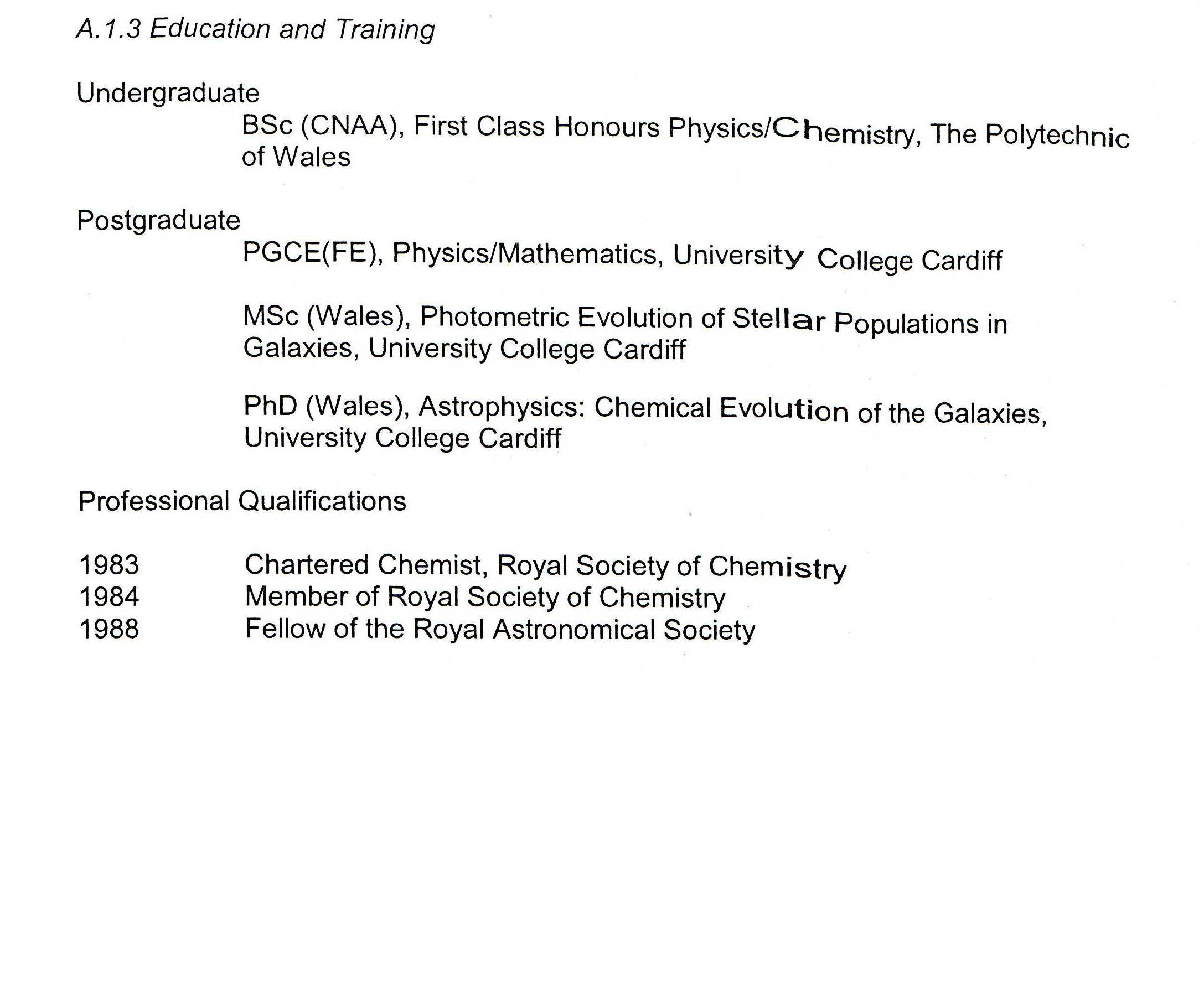
And while I’m on the subject of potentially misleading statements, it is perhaps worth going back to the original grant application that started this whole affair off. I showed part of this in a previous post, but here is the whole page showing the false claim of a PhD:

Under Professional Qualifications you will see Brake lists professional connections with the Royal Society of Chemistry as well as a Fellowship of the Royal Astronomical Society. This was written in 2006. In fact Brake disappeared from the membership register for the Royal Society of Chemistry in 1993 and ceased to be a Fellow of the Royal Astronomical Society in 1994. Hmmm…

You might argue – as the editor seems to be doing in the case of the wikipedia page – that these aren’t factually incorrect in that they give the year of election but say nothing about whether his tenure may or may not have ended.  I think most academics would agree with John Brindley, however, that the convention is to give a date of termination if the qualification no longer applies, otherwise the implication is that the status is unchanged.

Seeing further pieces of misleading information on the grant application doesn’t really surprise me, but I find it strange that somebody seems to want wikipedia’s pages  to misrepresent the truth in a similar fashion.

Talk, Nosh and Gridlock

Posted in Biographical, Books, Talks and Reviews, Cute Problems with tags , on February 18, 2010 by telescoper

I paid a flying visit yesterday to the beautiful city of Edinburgh in order to give a seminar at the Institute for Astronomy, which is situated with the historic Royal Observatory. I was there not long ago, in fact, to do a PhD examination but on this occasion all I had to was stand up in a lecture room and rabbit on for an hour or so. That part of it seemed to go reasonably well, in that no more than half the audience fell asleep while I wittered away.

The morning flight from Cardiff to Edinburgh was uneventful and got me there in time to chat with various people and have lunch before the talk. I elected not to rush straight from the seminar to the airport in order to return the same day, but stayed overnight giving some of  the locals the dubious pleasure of paying for my dinner and enduring my company during it, which they did with great patience. I’d like to thank Alan, John, Alina, Stefano and Brendan for rounding off such a nice day with such a pleasant evening.

In the restaurant we ended up setting each other little geometry problems drawn on napkins, to the palpable disdain of our waiter who clearly wanted us to leave.  However, since I had to get up at 5am the following morning (i.e. this morning) to get the flight back to Cardiff, we didn’t stay out too late. I got back to the B&B where I was billeted in good time to check last night’s football results  before retiring to grab some shut-eye. Newcastle United 4 Coventry City 1 was the result, so it was good news to end the day…

I had to get up at the ungodly hour of 5am in order to catch the flight at Edinburgh airport, but the return flight was right on time. This was fortunate because, not long after the plane landed, a blizzard descended on Cardiff. Snow has fallen intermittently all day. Although I’m a bit tired after getting up so early – hence the brevity of this post –  I’m relieved I managed to get back to work without any major travel hitches.

Anyway, my contribution to the little problem-setting session that took place between the plates and wine glasses was this one, which I was asked during the interview I had to undergo to get a place to study at Cambridge:

Consider an infinite square grid made as shown above from 1Ω resistors. What is the resistance between any two adjacent nodes of this network?

If you’re really interested, a general solution for the resistance between any two (not necessarily adjacent) nodes is given here but you should be able to get the answer for adjacent nodes by a much simpler line of reasoning!

Eidolons

Posted in Poetry, The Universe and Stuff with tags , , on February 17, 2010 by telescoper

Off early this morning, as I have to travel to the frozen North to give a seminar in a foreign land. Time, therefore, to pad this blog thing out with another poem. I haven’t posted much by Walt Whitman so now seems like a good time to correct the omission. This is called Eidolons, and it’s taken from Whitman’s famous and, at the time of its publication, controversial, collection of poems Leaves of Grass.

The word itself is from the Greek ειδωλον, meaning an image, spectre or phantom and, according to the Oxford English Dictionary (which Whitman would of course not have been using), it can have the additional meanings in English of a “mental image” or an “insubstantial appearance”, a “false image or fallacy”. It  also has the meaning of “an image of an idealised person or thing”, and is thus the origin of the word Idol.

Eidolons is written in Whitman’s characteristic free verse style, with a broad sweep and strong cadences which really should be read out loud rather than silently on the page.

I’ve heard it said that this poem is anti-scientific. I suppose it is, in some respects, but only if you think that science is capable of telling us everything there is to know about the Universe. I don’t think of science like that, so I don’t see this poem as anti-scientific. It celebrates world beyond that which we perceive directly and that which our minds comprehend. Our representations of true reality are eidolons because they are incomplete and imperfect and not, I think, because they are mere fallacies. Whitman is not saying science is wrong, just that it only gives us part of the picture.

Anyway, that’s why I think. Read for yourself and see what you think. But whether or not it is anti-science it is definitely about science. The references to professors, stars, spectroscopes and the like are all clear. He even seems to be having a pre-emptive dig at the multiverse theory!

I met a seer,
Passing the hues and objects of the world,
The fields of art and learning, pleasure, sense,
To glean eidolons.

Put in thy chants said he,
No more the puzzling hour nor day, nor segments, parts, put in,
Put first before the rest as light for all and entrance-song of all,
That of eidolons.

Ever the dim beginning,
Ever the growth, the rounding of the circle,
Ever the summit and the merge at last, (to surely start again,)
Eidolons! eidolons!

Ever the mutable,
Ever materials, changing, crumbling, re-cohering,
Ever the ateliers, the factories divine,
Issuing eidolons.

Lo, I or you,
Or woman, man, or state, known or unknown,
We seeming solid wealth, strength, beauty build,
But really build eidolons.

The ostent evanescent,
The substance of an artist’s mood or savan’s studies long,
Or warrior’s, martyr’s, hero’s toils,
To fashion his eidolon.

Of every human life,
(The units gather’d, posted, not a thought, emotion, deed, left out,)
The whole or large or small summ’d, added up,
In its eidolon.

The old, old urge,
Based on the ancient pinnacles, lo, newer, higher pinnacles,
From science and the modern still impell’d,
The old, old urge, eidolons.

The present now and here,
America’s busy, teeming, intricate whirl,
Of aggregate and segregate for only thence releasing,
To-day’s eidolons.

These with the past,
Of vanish’d lands, of all the reigns of kings across the sea,
Old conquerors, old campaigns, old sailors’ voyages,
Joining eidolons.

Densities, growth, facades,
Strata of mountains, soils, rocks, giant trees,
Far-born, far-dying, living long, to leave,
Eidolons everlasting.

Exalte, rapt, ecstatic,
The visible but their womb of birth,
Of orbic tendencies to shape and shape and shape,
The mighty earth-eidolon.

All space, all time,
(The stars, the terrible perturbations of the suns,
Swelling, collapsing, ending, serving their longer, shorter use,)
Fill’d with eidolons only.

The noiseless myriads,
The infinite oceans where the rivers empty,
The separate countless free identities, like eyesight,
The true realities, eidolons.

Not this the world,
Nor these the universes, they the universes,
Purport and end, ever the permanent life of life,
Eidolons, eidolons.

Beyond thy lectures learn’d professor,
Beyond thy telescope or spectroscope observer keen, beyond all mathematics,
Beyond the doctor’s surgery, anatomy, beyond the chemist with his chemistry,
The entities of entities, eidolons.

Unfix’d yet fix’d,
Ever shall be, ever have been and are,
Sweeping the present to the infinite future,
Eidolons, eidolons, eidolons.

The prophet and the bard,
Shall yet maintain themselves, in higher stages yet,
Shall mediate to the Modern, to Democracy, interpret yet to them,
God and eidolons.

And thee my soul,
Joys, ceaseless exercises, exaltations,
Thy yearning amply fed at last, prepared to meet,
Thy mates, eidolons.

Thy body permanent,
The body lurking there within thy body,
The only purport of the form thou art, the real I myself,
An image, an eidolon.

Thy very songs not in thy songs,
No special strains to sing, none for itself,
But from the whole resulting, rising at last and floating,
A round full-orb’d eidolon.

Killing Vectors

Posted in The Universe and Stuff with tags , , , on February 16, 2010 by telescoper

I’ve been feeling a rant coming for some time now. Since I started teaching again three weeks ago, actually. The target of my vitriol this time is the teaching of Euclidean vectors. Not vectors themselves, of course. I like vectors. They’re great. The trouble is the way we’re forced to write them these days when we use them in introductory level physics classes.

You see, when I was a lad, I was taught to write a geometric vector in the folowing fashion:

\underline{r} =\left(\begin{array}{c} x \\ y \\ z \end{array} \right).

This is a simple column vector, where x,y,z are the components in a three-dimensional cartesian coordinate system. Other kinds of vector, such as those representing states in quantum mechanics, or anywhere else where linear algebra is used, can easily be represented in a similar fashion.

This notation is great because it’s very easy to calculate the scalar (dot) and vector (cross) products of two such objects by writing them in column form next to each other and performing a simple bit of manipulation. For example, the scalar product of the two vectors

\underline{u}=\left(\begin{array}{c} 1 \\ 1 \\ 1 \end{array} \right) and \underline{v}=\left(\begin{array}{c} 1\\ 1 \\ -2 \end{array} \right)

can easily be found by multiplying the corresponding elements of each together and totting them up:

\underline{u}\cdot \underline{v} = (1 \times 1) + (1\times 1) + (1\times -2) =0,

showing immediately that these two vectors are orthogonal. In normalised form, these two particular vectors  appear in other contexts in physics, where they have a more abstract interpretation than simple geometry, such as in the representation of the gluon in particle physics.

Moreover, writing vectors like this makes it a lot easier to transform them via the action of a matrix, by multipying rows in the usual fashion, e.g.

\left(\begin{array}{ccc} \cos \theta & \sin\theta & 0 \\ -\sin\theta & \cos \theta & 0 \\ 0 & 0 & 1\end{array} \right) \left(\begin{array}{c} x \\ y \\ z \end{array} \right) = \left(\begin{array}{c} x\cos \theta + y\sin\theta \\ -x \sin \theta + y\cos \theta \\ z \end{array} \right)

which corresponds to a rotation of the vector in the x-y plane. Transposing a column vector into a row vector is easy too.

Well, that’s how I was taught to do it.

However, somebody, sometime, decided that, in Britain at least, this concise and computationally helpful notation had to be jettisoned and students instead must be forced to write

\underline{r} = x \underline{\hat{i}} + y \underline{\hat{j}} + z \underline{\hat{k}}

Some of you may even be used to doing it that way yourself. Why is this awful? For a start, it’s incredibly clumsy. It is less intuitive, doesn’t lend itself to easy operations on the vectors like I described above, doesn’t translate easily into the more general case of a matrix, and is generally just …well… awful.

Worse still, for the purpose of teaching inexperienced students physics, it offers the possibility of horrible notational confusion. In particular, the unit vector \underline{\hat{i}} is too easily confused with i, the square root of minus one. Introduce a plane wave with a wavevector \underline{k} and it gets even worse, especially when you want to write \exp(i\underline{k}\cdot\underline{x})!

No, give me the row and column notation any day.

I would really like to know is who decided that our schools had to teach the horrible notation, rather than the nice one, and why? I think everyone who teaches physics knows that a clear and user-friendly notation is an enormous help and a bad one is an enormous hindrance.  It doesn’t surprise me that some student struggle with even simple mathematics when its presented in such a silly way. On those grounds, I refuse to play ball, and always use the better notation.

Call me old-fashioned.

Astronomy Look-alikes, No. 16

Posted in Astronomy Lookalikes with tags , on February 15, 2010 by telescoper

I read with great interest a recent story that Geoff Hoon MP is planning to stand down at the next election. No doubt he took this decision in order to avoid the embarassment of losing his seat by popular vote. Perhaps he took his lead from his double, astronomer Richard Ellis, who also recently jumped ship from his Chair at Oxford in order to return to Caltech?

Richard Ellis

Geoff Hoon

The Abduction from the Seraglio

Posted in Opera with tags , , , on February 14, 2010 by telescoper

It’s been an unusually long time since I last went to the Opera, but now the spring season of Welsh National Opera has finally arrived I couldn’t resist the chance last night to see their brand new and wonderfully entertaining production of The Abduction from the Seraglio by Mozart. It was also nice to be accompanied on this occasion by fellow astrologists Ed and Haley, who I hope enjoyed the show as much as I did.

I was particularly glad to see this on the schedule for this season because it’s an Opera I haven’t seen staged before and didn’t know very much about. Mozart composed the music for  it in 1781, when he was at the ripe old age of 25 , to a libretto in German and with the title Die Entführung aus dem Serail. The WNO production is sung in the original language, which is the way I like it.

Like  The Magic Flute, which Mozart wrote about a decade later, The Abduction is a singspiel rather than an opera, in that the recitative is spoken rather than sung. The music is not through-composed as you find in a true opera, but a series of set-piece arias, duets, trios and quartets. Still, Mozart was pretty good at those. It’s also, in case you hadn’t realised, like the Magic Flute, a comedy which Mozart was also pretty good at!

The plot, such as it is, concerns the hero Belmonte’s search for his beloved Konstanze, her servant Blonde and his own servant Pedrillo, who have been captured by the Turk Pasha Selim who hopes to persuade Konstanze to join the harem inside his Seraglio. The Pasha’s heavy, Osmin, acts as bouncer, keeping Belmonte from getting into the place and releasing the captives but eventually, Pedrillo tricks Osmin into drinking some drugged wine; while he’s asleep the lovers are re-united. However, the attempt by Belmonte and Pedrillo to help  Konstanze and Blonde escape is botched and they are captured by Pasha Selim and his guards. Contrary to all expectations, however, the Pasha doesn’t take his revenge, but allows them to leave. Osmin flies into a rage and suffers some sort of splenetic seizure. The Opera ends with the others celebrating their freedom, while Pasha Selim consoles himself with his other wives and a hookah.

It’s admittedly a bit thin, even by the standards of comic opera but, right from the fabulous overture, the music is lovely and there’s a great deal of good-humoured fun, especially during the Pasha’s attempt to shower Konstanze with gifts of jewelry, frocks and shoes, in Act 2, and the abduction itself, in Act 3, which is bungled in appropriately hilarious fashion.

Belmonte was played by Robin Tritschler, who has a tenor voice of exceptional clarity and beauty and who invested his role with an engaging wide-eyed innocence. Petros Magoulas played the psychopathic Osmin for laughs and provided the performance with some of its funniest moments. Pedrillo was played by local boy Wynne Evans and Blonde was Claire Ormshaw; both were excellent, musically and comedically. Pasha Selim was also very well played by Simon Thorpe. The Pasha has to appear a bit frightening early on, so that his later magnanimity comes as a surprise; this he did very well. The only weak point I felt was Lisette Oropesa as the heroine Konstanze. She didn’t sing at all well in Act I, perhaps owing to first-night nerves,  but seemed to settle down by Act 2 where she coped with the coloratura a lot better. Her acting, however, was extremely disappointing and, at times, downright embarassing. It wasn’t enough to spoil the production – at least not for me – but it was a shame, as a really good night could have been a truly superb one.

Finally I should mention that all the action is set on the Orient Express, circa 1920, with costumes and props of that period too. The scenery is cleverly designed so that it can be slid to and fro along the stage to reveal cabins either side of the main saloon at its centre. The whole thing looks wonderful and the mobile set also provided comic moments of its own, especially during the abduction scene when Pedrillo is accidentally left clinging to the outside of the train.

I was left wondering to some extent why this Opera isn’t better known. It’s probably because it  doesn’t have the subtlety of the famous da Ponte comedies, but the music is gorgeous especially in the passages for multiple voices, such as the quartet in Act II. In other passages the music  sounds a bit like a parts of the Magic Flute. In many ways I think you can see this piece as Mozart on his way to perfecting the style he would achieve in these works. It’s pretty good, but perhaps doomed to lie in the shadow of his later masterpieces.

All in all, a great night out. There’s only one other performance of The Abduction from the Seraglio in Cardiff (next Saturday, 20th February) and then it goes on the road. I’m not sure there are any tickets remaining for next week:  if there are, it’s well worth seeing but if not then all is not lost – it’s likely this will be in the WNO repertoire for some time to come.

Match Day

Posted in Biographical, Sport with tags , , , , , , , , on February 13, 2010 by telescoper

Unusually for a saturday, I’ve been a bit busy today and I’m also going out later, so I’ll refrain from one of my discursive weekend posts and keep it brief (but not necessarily to any particular point).

Today, of course, is the date of Wales’ first home match in this year’s RBS Six Nations Rugby competition. They lost to England 30-17 last week (at Twickenham) largely because of a bit of indiscipline by Alan Wyn Jones who got himself sent off the field for ten minutes after tripping an England player. England forged ahead during the time Wales were down to 14 men and although Wales fought back later on I thought England deserved to win. It wasn’t, however, a very good game to watch.

The scene was thus set for a home game for Wales in Cardiff  today against Scotland (who lost at home to France last week). It’s really impossible to describe how special it is to be in this city when Wales are playing rugby. The Millennium Stadium can hold about 75,000 which is large compared to Cardiff’s population of around 330,000. The Scottish fans, easily identified by the kilts and the smell of alcohol, were out on the townin large numbers last night. No doubt many of them woke with substantial hangovers this morning, but it has been a beautiful sunny day and the sight of the Scots – blue and tartan – mixing with the Welsh – red and green with a liberal sprinkling of dragons- was marvellous to see as I walked around this morning running a few errands.

The atmosphere in town was just sensational, unique to Cardiff, and enough to make you just want to walk around and soak it up. Actually, enough to make you wish you had a ticket for the match too, which unfortunately I didn’t. Still, it was live on TV.

When I got home the crowds were already walking down past my house towards the stadium, which is only a mile or so away,  for the 2pm kickoff. Among them was the sizeable frame of legendary Welsh rugby hero JPR Williams. He’s quite  old now – a quick look on wikipedia reveals that he was born in 1949 – but he hasn’t changed much at all since his heyday in the 1970s.  Taller than I had imagined.

Anyway, I did a little gardening in the sunshine just before the match started and, standing outside, I could hear the sound of Land of my Fathers being sung before the kickoff all the way from the Stadium. It made the hairs stand up on the back of my neck. Tremendous.

The match itself was strangely disjointed to begin with but ended in extremely exciting fashion. Wales playing surprisingly poorly in the first half and Scotland surprisingly well. Wales appeared nervous and a bit disorganised and the two Scottish tries both involved defensive errors by the Welsh. The half-time score of  Wales 9 Scotland 18 was not what I would have expected before the start of the game, but was a fair reflection of the balance of play at that point.

The second half initially followed a similar pattern, Scotland edging 21-9 ahead at one point,  but Wales gradually crept back into it. However, it was a yellow card for a Scottish infringement that led to Wales gaining enough momentum to claw their way back to 21-24 with a try created by Shane Willians and scored by Leigh Halfpenny. Then, with less than a minute to play,  Scotland lost another player for a cynical piece of foul play that prevented another Welsh try. Wales decided to take the penalty kick to tie the game at 24-24 with just 40 seconds left. The Scots restarted with only 13 men on the field and only seconds left to play, hoping to run down the clock and finish with a draw. However the Welsh were scenting an unlikely victory and the Scots were very tired. The Welsh managed to keep the ball alive – the next dead ball would have been the end of the game – and, unbelievably, Shane Williams popped in to score a try. The match ended Wales 31 Scotland 24.

It wasn’t the best rugby I’ve ever seen in terms of quality, but it’s definitely the most dramatic final ten minutes! I’m not sure the referee was right to allow the restart after the kick to level it at 24-24 as it seemed to me the time was up then. I’m sure the rugby fans in Cardiff  tonight won’t be quibbling, though. The city will be buzzing tonight!

Today was also the day for two important footall matches. In the FA Cup, Cardiff City travelled to Premiership leaders Chelsea and, predictably, got thrashed 4-1. The other match that interested me was Swansea City versus Newcastle United in the Championship. That finished 1-1, a result I was happy with since Swansea are playing well and Newcastle had lost in feeble fashion 3-0 away at Derby County earlier in the week. They go back top, if only by one point.

All in all, a most satisfactory day, and it’s not over yet. Tonight I’m off to the Opera (for the first time in what seems like ages). So guess what tomorrow’s post will be about….