Archive for February, 2011

How to demonstrate you’re not about transparency — and piss off reporters — as a PIO (via Embargo Watch)

Posted in Uncategorized on February 15, 2011 by telescoper

You just have to read this piece. It’s ostensibly about the role of the dreaded “Press Information Officer” in enforcing embargoes on journalists, using the example given by Mr Aeron Haworth of the University of Manchester. Against his better judgement, Mr Haworth himself starts commenting on the article and digs a deeper and deeper hole.

I suspect this particular Officer is about to be demoted to the ranks, as Mr Haworth’s conduct could be of the type prefaced by mis-.

How to demonstrate you're not about transparency -- and piss off reporters -- as a PIO Ed Yong just wanted to look at the data. This past weekend, he found an intriguing embargoed press release about mummy toes and prosthetics, and realized that the "study" to which the release referred was actually just a Perspective in The Lancet. When he emailed the press officer who'd written the release, he learned that the actual data w … Read More

via Embargo Watch

The Necessity of Atheism

Posted in History, Literature, The Universe and Stuff with tags , , , , , , , , on February 15, 2011 by telescoper

In the course of doing a crossword at the weekend, I learnt that the poet Percy Bysse Shelley was sent down from (i.e. kicked out of) Oxford University 200 years ago this month for writing a pamphlet entitled The Necessity of Atheism. He was at University College, in fact. A bit of googling around led me to the full text, which is well worth reading whatever your religious beliefs as it is a fascinating document. I’ll just quote a few excerpts here.

The main body of the tract begins There is No God, but this is followed by

This negation must be understood solely to affect a creative Deity. The hypothesis of a pervading Spirit co-eternal with the universe remains unshaken.

That’s pretty close to my own view, for what that’s worth.

More interestingly, Shelley goes on later in the work to talk about science and how it impacts upon belief. A couple of sections struck me particularly strongly, given my own scientific interests.

In one he tackles arguments for the existence of God based on Reason:

It is urged that man knows that whatever is must either have had a beginning, or have existed from all eternity, he also knows that whatever is not eternal must have had a cause. When this reasoning is applied to the universe, it is necessary to prove that it was created: until that is clearly demonstrated we may reasonably suppose that it has endured from all eternity. We must prove design before we can infer a designer. The only idea which we can form of causation is derivable from the constant conjunction of objects, and the consequent inference of one from the other. In a base where two propositions are diametrically opposite, the mind believes that which is least incomprehensible; — it is easier to suppose that the universe has existed from all eternity than to conceive a being beyond its limits capable of creating it: if the mind sinks beneath the weight of one, is it an alleviation to increase the intolerability of the burthen?

The other argument, which is founded on a Man’s knowledge of his own existence, stands thus. A man knows not only that he now is, but that once he was not; consequently there must have been a cause. But our idea of causation is alone derivable from the constant conjunction of objects and the consequent Inference of one from the other; and, reasoning experimentally, we can only infer from effects caused adequate to those effects. But there certainly is a generative power which is effected by certain instruments: we cannot prove that it is inherent in these instruments” nor is the contrary hypothesis capable of demonstration: we admit that the generative power is incomprehensible; but to suppose that the same effect is produced by an eternal, omniscient, omnipotent being leaves the cause in the same obscurity, but renders it more incomprehensible.

He thus reveals himself as an empiricist, a position he later amplifies with a curiously worded double-negative:

I confess that I am one of those who am unable to refuse my assent to the conclusion of those philosophers who assert that nothing exists but as it is perceived.

This is a philosophy I can’t agree with, but his use of words clearly suggests the young Shelley has been reading David Hume‘s analysis of causation.

Later he turns to the mystery of life and the sense of wonder it inspires.

Life and the world, or whatever we call that which we are and feel, is an astonishing thing. The mist of familiarity obscures from us the wonder of our being. We are struck with admiration at some of its transient modifications, but it is itself the great miracle. What are changes of empires, the wreck of dynasties, with the opinions which support them; what is the birth and the extinction of religious and of political systems, to life? What are the revolutions of the globe which we inhabit, and the operations of the elements of which it is composed, compared with life? What is the universe of stars, and suns, of which this inhabited earth is one, and their motions, and their destiny, compared with life? Life, the great miracle, we admire not because it is so miraculous. It is well that we are thus shielded by the familiarity of what is at once so certain and so unfathomable, from an astonishment which would otherwise absorb and overawe the functions of that which is its object.

Finally, I picked the following paragraph for its mention of astronomy:

If any artist, I do not say had executed, but had merely conceived in his mind the system of the sun, and the stars, and planets, they not existing, and had painted to us in words, or upon canvas, the spectacle now afforded by the nightly cope of heaven, and illustrated it by the wisdom of astronomy, great would be our admiration. Or had he imagined the scenery of this earth, the mountains, the seas, and the rivers; the grass, and the flowers, and the variety of the forms and masses of the leaves of the woods, and the colors which attend the setting and the rising sun, and the hues of the atmosphere, turbid or serene, these things not before existing, truly we should have been astonished, and it would not have been a vain boast to have said of such a man, Non merita nome di creatore, se non Iddio ed il Poeta. But how these things are looked on with little wonder, and to be conscious of them with intense delight is esteemed to be the distinguishing mark of a refined and extraordinary person. The multitude of men care not for them.

I think the multitude care just as little 200 years on.

P.S. The quotation is from the 16th Century Italian poet Torquato Tasso; in translation it reads “None deserve the name of Creator except God and the Poet”.


Share/Bookmark

We have all the Time in the World

Posted in Music, The Universe and Stuff with tags , , on February 14, 2011 by telescoper

I came across this on Youtube a while ago, but I’ve been saving it up because I thought it might make a nice St Valentine’s Day gift for all lovers of astronomy (and/or someone special). Enjoy!


Share/Bookmark

The Welsh University Challenge

Posted in Education, Finance with tags , , , on February 13, 2011 by telescoper

Last week I received an email from BBC Wales asking me to get in touch with one of their reporters. It turned out to be about a blog post I wrote some time ago concerning the recent decision by the Welsh Assembly Goverment to pay the fees of Welsh domiciled students wherever they go to study within the UK. The reporter had read my post and wanted to “pick my brains” for a story she was working on. I didn’t have time  last week as I was too busy, but I found out yesterday that the BBC had indeed run a story.

According to the BBC version, the policy of paying for Welsh students to go to English universities will cost the Welsh Assembly Government £51.7 million in 2015-6 although,  according to their projections, this will be more than offset by an expected £83.5 million coming from English students electing to study in Wales (who will have to pay their own fees).

The net cost of this policy will be about £97.6 million in the same year, allowing for the assumed net profit from English students, which will be met by cutting the core teaching grants to Welsh universities by about 35% – this is less than the cuts in England, but big cut nevertheless.

But these calculations depend on several assumptions. One is what level of fees are charged. If all English universities charge £9K (which is possible) then the outflow of cash related to Welsh students going to England increases. If Welsh university fees are capped at £6K (which also seems likely) then the cash inflow decreases. In fact, in this scenario the differential between  money in and money out completely disappears.

Moreover there is the question of how many students move in each direction. It’s possible that in the Age of Austerity more students will be forced to study near their family homes, which will also alter the balance. In addition, student places are being cut  in Wales while there is a possibility that the cap on numbers in English universities will soon be lifted. This raises the possibility that Welsh students may be forced to study in England anyway, as they might not be able find a place in Wales. We’re certainly not going to benefit much in the School of Physics & Astronomy at Cardiff University from the current boom in applications, as our numbers have been cut since last year despite applications going up by 50%…

On the other hand – and I’ve anecdotal evidence for this from talking to parents at UCAS admissions days – there seems also to be a feeling that the WAG’s commitment to students is serving to convince a number of English residents that the Welsh universities are in safer hands than those in England.

So, although I strongly support the WAG’s reasons for wanting to help Welsh students as much as possible there remains considerable uncertainty about how things will pan out over the next few years. It could get very grim if reality departs significantly from the projections.

One of the arguments put forward by Leighton Andrews (the Welsh Assembly Minister responsible for Universities in Wales) is that the policy of paying for Welsh students to go to England was in fact a commitment made the Labour-Plaid Cymru coalition that controls the Welsh Assembly. That’s fair enough,  but of course it makes one wonder what will happen if the balance changes with the Welsh Assembly Elections due in May 2011.

Only when we know the complexion of the new WAG will we learn whether it might revisit the policy. I’ve heard many arguments for and against, but it still strikes me as very strange to see the devolved administration spending so much of its hard-earned budget in England. That £50.7 million would go a long way if it were kept in Wales.

All things considered, however, despite all the difficulties I think the situation is much more positive for universities in Wales than in England.

Incidentally, another sensible idea being discussed by Leighton Andrews is that Welsh schools might be forced to ditch “soft” A-level subjects, such as (inevitably) Media Studies, in favour of “quality” ones (presumably including mathematics and physics). Perhaps he should do the same for Mickey Mouse degrees in Welsh universities too?

Share/Bookmark

Astronomy Look-alikes, No. 45

Posted in Astronomy Lookalikes with tags , on February 13, 2011 by telescoper

At the Royal Astronomical Society on Friday, Prof. Mark Birkinshaw gave a talk about the life of Johannes Hevelius the 400th anniversary of whose birth lies this year. Anyway, he (Mark Birkinshaw, that is, not Johannes Hevelius) reminds me a bit of Graeme Garden of the Goodies, although I’m Sorry I Haven’t a Clue if anyone agrees with me.

Mark Birkinshaw

Graeme Garden

The Winds of Change

Posted in Science Politics with tags , on February 12, 2011 by telescoper

I came back late last night from an interesting Open Meeting at the Royal Astronomical Society, followed by another exceedingly pleasant Club Dinner at the Travellers’ in Pall Mall; next time we’ll be back at The Athenaeum.

I didn’t get home until 1.30am, and went straight to bed. I woke early to news of momentous events. The discredited authoritarian leader of an exausted regime who had presided over financial collapse and who had been clinging tenaciously to the offices of power, attempting to stave off the widespread clamour for his resignation with the promise of a new administration in several months’ time, had finally resigned. The news filled me with jubilation and a sense of optimism for the future.

I went back to sleep, waking again a couple of hours later with the sad realisation that it had all been a dream.

Keith Mason is still in charge of STFC.


Share/Bookmark

Admissions

Posted in Education with tags , , on February 11, 2011 by telescoper

Busy day today, necessitating an early start and a packed morning followed by a trip to the Big Smoke later on.

I thought I’d use my daily post to try a little experiment.

Yesterday I mentioned that applications to do Physics courses in the School of Physics & Astronomy at Cardiff University had increased enormously since last year. That prompted a couple of people to contact me, via email and Twitter, to admit that the same thing is happening at their institutions. With UCAS reporting that applications nationwide are up by only about 4%, I’m a bit confused as to what is going on.

I don’t know how many of my (1000+) daily readers work in UK universities, let alone which ones or whether they’re in a position to know what undergraduate applications are doing, but I would be very interested to hear whether this pattern is being repeated and whether it’s just physics that’s booming.

So, in lieu of a proper blog post for today, let me invite you to take part in a straw poll through the comments box. Where are you? What’s your subject? Are your applications up?

Do tell.


Share/Bookmark

The Bull’s-Eye Effect

Posted in The Universe and Stuff with tags , , , , on February 10, 2011 by telescoper

What a day.

For a start we had another manic UCAS admissions event. Applications to study physics here have rocketed, by more than 50% compared to last year, so it’s all hands on deck on days like this. Next weekend we have our first Saturday event of the year, and that promises to be even more popular. Still, it’s good to be busy. Without the students, we’d all be on Her Majesty’s Dole. At least some of our advertising is hitting the target.

After that it was back to the business of handing out 1st Semester examination results to my tutees – the Exam Board met yesterday but I skived off because I wasn’t involved in any exams last semester. Then a couple of undergraduate project meetings and a few matters related to postgraduate admissions that needed sorting out.

Finally, being a member of our esteemed Course Committee, I spent a little bit of time trying to assemble some new syllabuses. All our Physics (and Astrophysics) courses are changing next year, so this is a good chance to update the content and generally freshen up some of the material we teach.

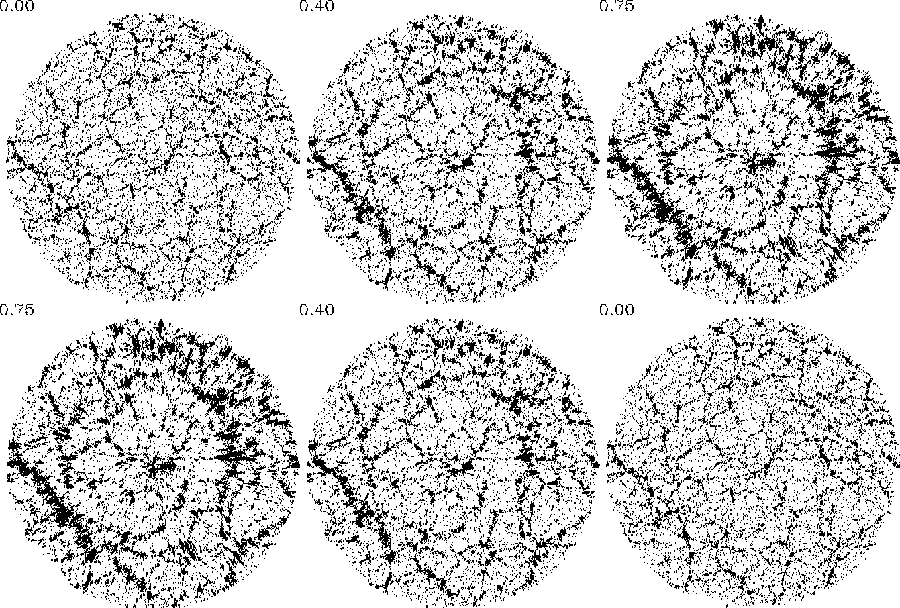
In the course of thinking about this, I dug about among some of my old course notes from here there and everywhere, some of which I’ve kept on an old laptop. I chanced upon this cute little graphic, which I don’t think I’ve ever used in a lecture, but I thought I’d put it up here because it’s pretty. Sort of.

What it shows is a simulation of the large-scale structure of the Universe as might be mapped out using a galaxy redshift survey. The observer is in the centre of the picture (which a two-dimensional section through the Universe); the position of each galaxy is plotted by assuming that the apparent recession velocity (which is what a redshift survey measures) is related to the distance from the observer by Hubble’s Law:

V\simeq cz =H_0 R

where V  is the recession velocity, z  is the redshift, H_0 is Hubble’s constant  and R is the radial distance of the galaxy. However, this only applies exactly in a completely homogeneous Universe. In reality the various inhomogeneities (galaxies, clusters and superclusters) introduce distortions into the Hubble Law by generating peculiar velocities

V=H_0 R+ V_p

These distort the pattern seen in redshift space compared to real space. In real space the pattern is statistically isotropic, but in redshift space things look different along the line of sight from the observer compared to the directions at right angles as described quite nicely by this slide from a nice web page on redshift-space distortions.

There are two effects. One is that galaxies in tightly bound clusters have high-speed disordered motions. This means that each cluster is smeared out along the line of sight in redshift space, producing artefacts sometimes called “Fingers of God” – elongated structures that always point ominously at the observer. The other effect caused by large-scale coherent motions as matter flows into structures that are just forming, which squashes large-scale features in the redshift direction more-or-less opposite to the first.

These distortions don’t simply screw up our attempts to map the Universe. In fact they help us figure out how much matter might pulling the galaxies about. The number in the upper left of the first (animated) figure is the density parameter, \Omega. The higher this number is, the more matter there is to generate peculiar motions so the more pronounced the alteration; in a low density universe, real and redshift space look rather similar.

Notice that in the high-density universe the wall-like structures look thicker (owing to the large peculiar velocities within them) but that they are also larger than in the low-density universe. In a paper a while ago, together with Adrian Melott and others, we investigated  the dynamical origin of this phenomenon, which we called the Bull’s-Eye Effect because it forms prominent rings around the central point. It turns out to be Quite Interesting, because the merging of structures in redshift-space to create larger ones is entirely analogous the growth of structure by hierarchical merging in real space, and can be described by the same techniques. In effect, looking in redshift space gives you a sneak preview of how the stucture will subsequently evolve in real space…


Share/Bookmark

Our Place in the Universe

Posted in Television, The Universe and Stuff with tags , , , on February 9, 2011 by telescoper

I suspect I’m not the only person working in astronomy who found inspiration in Carl Sagan‘s epic TV series Cosmos, which was broadcast on British television when I was at Secondary School. Although the graphics are a bit dated now, and the language perhaps a bit florid for modern tastes, it has lost nothing of its splendour or profundity which is largely due to the charisma (and beautiful writing) of the presenter. It’s also in stark contrast to the simple-minded stuff served up by modern so-called science programmes. Here’s a little taster, which brought back happy memories to me, and I hope will do the same for fellow astronomers-of-a-certain-age.

We live on an insignificant planet of a humdrum star lost in a galaxy tucked away in some forgotten corner of a Universe in which there are far more galaxies than people. We make our World significant by the courage of our questions, and by the depth of our answers.


Share/Bookmark

Children’s Song

Posted in Poetry with tags , , on February 9, 2011 by telescoper

We live in our own world,
A world that is too small
For you to stoop and enter
Even on hands and knees,
The adult subterfuge.
And though you probe and pry
With analytic eye,
And eavesdrop all our talk
With an amused look,
You cannot find the centre
Where we dance, where we play,
Where life is still asleep
Under the closed flower,
Under the smooth shell
Of eggs in the cupped nest
That mock the faded blue
Of your remoter heaven.

by R.S. Thomas (1913-2000)


Share/Bookmark