Hardly any time to breathe today, never mind post anything. Lectures, and exercise class and a meeting of the lost souls attempting to figure out what we should do to prefer for the Research Excellence Framework.
Now all that’s over I’m going to think about what I should do on stage this evening as I participate in the Second Bright Club Wales, at the Buffalo Bar in Cardiff City Centre. Apparently, this event “blends comedy, science, music and anything else that can happen on stage” which certainly leaves a lot to the imagination.
This evening is part of National Science and Engineering Week. In fact, there’s another event this evening in Cardiff tonight relating to this, comprising a public lecture at the School of Physics & Astronomy followed by an open evening allowing members of the public to use our telescopes. The weather has been lovely today, but clouds are starting to appear. I hope there’s enough clear sky to make it worthwhile.
I’m actually quite nervous about this Bright Club lark, as I’m not at all sure what to expect, but apparently I’ll be on fairly early in the evening so with a bit of luck the room won’t be too rowdy and I might not get pelted with rotten tomatoes. I don’t really know to what extent I’m expected to play it for laughs either. I sometimes try to tell jokes in lectures, but they usually go down like lead balloons, so perhaps I’ll just stick to some science and leave the funny stuff to the professional comedians. I’ve only got 8 minutes, but that’s plenty of time to make a fool of myself.
Between you and me, I have actually tried doing stand-up comedy once or twice. In fact, the most terrifying experience of my life was doing an open-mike spot at a Comedy Club in Cambridge Heath Road, when I lived in Bethnal Green. It’s one thing to try to be amusing in a pub or around the dinner table with friends, but quite another when you’re trying to make complete strangers laugh, especially when they’ve paid for it! Anyway, I survived my 3 minutes (just about) and even got a few laughs, but the experience didn’t make me want to quit my day job.
Anyway, I asked for an early shift so I could get home on time to deal with Columbo’s needs so I’ll update this post later on with a review of my performance. Or lack of it.
UPDATE: 10pm. Well, it turned out to be good fun. The audience was friendly and I got a few laughs. Although I didn’t really prepare very much materia,l and I was first one up so didn’t have a chance to see what went down well, I found it quite easy to make it up as I went along, given such a relaxed atmosphere. A couple of pints of Guinness probably helped too. Had to leave after the first half to see to Columbo, but I hope the rest of the evening went well.
Very busy day today, and I’ve been out and about for most of it in the spring sunshine. I just thought I’d keep up my record of posting every day by marking a centenary that falls today. One hundred years ago, on March 13 1911, L. Ron Hubbard was born. I said “marking” rather than “celebrating” because Hubbard was a truly appaling man – a liar, a charlatan, a conman, a drug addict, and an egomaniac – who left a trail of wrecked lives, largely through the sinister Church of Scientology he founded in the 1950s. Purporting to be a “self-help” organisation, it has succeeded only in helping itself to large amounts of money from its gullible victims, much of it subsequently spent silencing its many critics. Let’s see if they have a go at me!
In 1977, the FBI raided the offices of the Church of Scientology and found damning evidence of burglary and conspiracy. Hubbard’s wife, Mary Sue, was convicted and sentenced to five years in prison. Hubbard himself escaped justice by going into hiding. He died in 1986.
If you want to know more about this so-called Church, I suggest you read the book The Scandal of Scientology, all of which is available online here. I also mentioned it in a post last year.
I’ll just point out one particular victim of L Ron Hubbard: his own son, Quentin. A shy and sensitive boy, he took his own life in 1976 aged just twenty-two, no longer able to tolerate his father’s relentless homophobic goading.
I feel pity for those duped into signing up as scientologists – it seems to me such a transparently phoney operation I don’t see how anyone could fall for it – but for Hubbard himself, pity doesn’t come into it. He was monstrous.
My form for the 2011 Census arrived yesterday. Apparently they were all posted out on Monday, so that’s 5 days in the post. Par for the course for the Royal Mail these days. I’m slightly surprised it arrived at all.
There’s a hefty £1000 fine for not completing the Census, so I suppose I’ll fill it in, despite my feeling that it’s both intrusive and unnecessary. What’s worse is that several of the questions are so badly designed that the information resulting will be useless.
Very careful consideration is given to the questions included in the census. Questions must meet the needs of a substantial number of users in order that the census is acceptable to the public and yields good quality data. The questions are selected following several rounds of consultation with:
central and local government
academia
health authorities
the business community
groups representing ethnic minorities and others with special interests and concerns
Hang on. The “business community”? Why should they be consulted? What do they want with my personal information? I thought the census data was for planning public services! On the other hand, when everything is privatised maybe all our personal data will be flogged off to the private sector anyway.
The 2011 Census is the first one to include a question on health. According to the saturation advertising about the census, this question will help plan new hospitals and distribute NHS funding. So what is the new question, the answer to which will provide such valuable data? Here it is, together with the possible responses:
13. How is your health in general?
Very good
Good
Fair
Bad
Very Bad
And that’s it for “health”. Does anyone actually believe such a vague question is going to be of any use at all in planning NHS services? I certainly don’t.
And then there’s the famous question about religion.
20. What is your religion?
For a start I don’t think my religion or lack of it should be any concern to the government. To be fair, however, this question is marked as “voluntary” so respondents are allowed not to answer it without getting locked up in the Tower of London. But in any case it’s a leading question and should never have been included in the census in this form anyway. “Do you have a religion and, if so, what is it?” would have been much better.
I could go on, but I’ve got better things to do today.
I’ll just say this last thing about the Census. Most of it clearly has nothing whatever to do with planning public services. In fact the government already holds most of the information about your private circumstances the form demands. The Census is nothing more an opportunity for the government to cross-check tax, benefit or other records in the hope of finding inaccuracies. In other words, Big Brother is watching you.
And the cost of all this snooping? A whopping £500 million, more than double the cost of the 2001 Census, and all of it at a time of huge cuts to public services. You have to laugh, don’t you?
It’s Friday afternoon and time for a mildly frivolous post.
I’ve been recently been teaching first-year astrophysics students (and others) about the radiation emitted by stars, and how stellar spectra can be used to diagnose their physical properties.
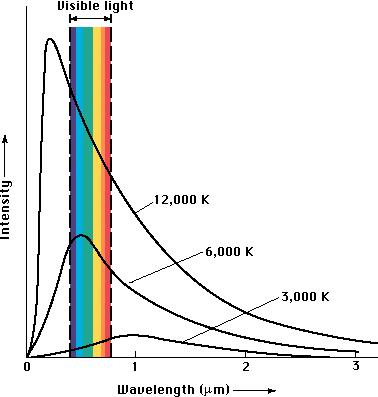
Received wisdom is that the continuous spectrum of light emitted by stars like the Sun is roughly of black-body form, with a peak wavelength inversely proportional to the surface temperature of the star. Here are some examples of black-body curves to illustrate the point.
The Sun has a surface temperature of about 6000 K – actually, more like 5800 K but we won’t quibble. The peak wavelength for the Sun’s spectrum therefore corresponds to bluey-green light, which is why the Sun appears … er… yellow.
Anyone care to offer an explanation as to why the Sun isn’t green? Answers on a postcard or, preferably, through the comments box.
And while you’re at it, you might want to comment on why, if the Sun produces so much green light, chlorophyll is actually green?
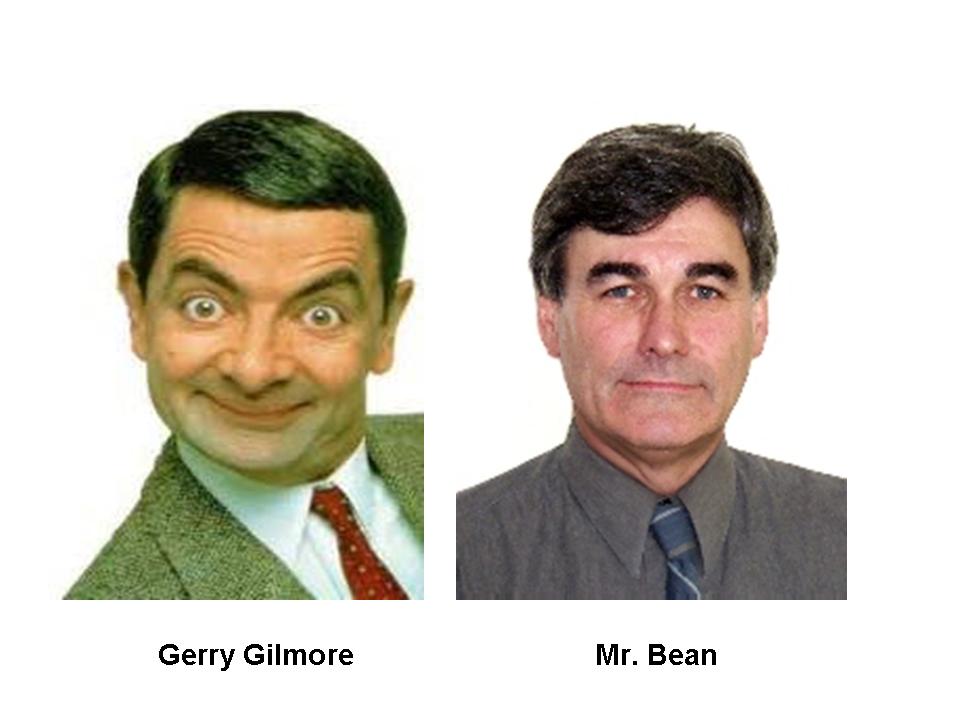
I think there’s a similarity in visual appearance between Professor Gerry Gilmore of Institute of Astronomy at the University of Cambridge and the hilarious comic creation Mr Bean, as played by Rowan Robinson Atkinson. I wonder if by any chance they might be related?
We’ve now reached the half-way point of the Spring Semester, which means that my teaching load has just doubled; I do the “Particle” bit of a third-year module on “Nuclear and Particle Physics”, which means I have 11 lectures from now until the end of the Semester to tell the students everything I know about particle physics. More than enough time.
Anyway, the first lecture today, as it was last year, was all about Natural Units. I always find it fun doing this, partly because the students stare at me as if I’ve taken leave of my senses. Come to think of it, they do that anyway.
The other night I was having a drink with some colleagues after work. Various topics came up, but we spent a bit of time talking about teaching. It appears that I’m in a small minority of my physics colleagues in that I actually like teaching. In fact, the older I’ve got the more I enjoy it. There’s always a limit, of course, and I wouldn’t like to do so much teaching that I couldn’t do other things, especially research, but I wouldn’t like to be in a job that didn’t involve teaching at all. I think most of my colleagues would jump at the chance to abandon teaching altogether. I can’t understand that attitude, mainly because I find it so rewarding myself, but I’m in a minority of one about so many things nowadays that I’ve ceased worrying about it.
I do sometimes wonder why I find teaching so rewarding. Perhaps it’s because I’m already middle-aged and don’t have any kids of my own. Teaching at least gives me a chance to play some sort of a role in someone else’s development as a person. I can’t guarantee that it’s necessarily a positive role, but there you are. Another thing is that sometimes when I travel about at conferences and whatnot I get to meet people I taught years ago. It means a lot when they say they remember the lectures, especially if they’ve now embarked on scientific careers of their own.
One of the problems of the government’s push for greater concentration of research funds and the simultaneous slashing of teaching budgets is that the quality of University teaching is bound to suffer. If research funding is allocated only to self-styled research “superstars” then Universities will obviously spare them from other duties. Teaching loads for ordinary foot soldiers will increase, with obvious consequences in decreasing enthusiasm among lecturing staff.
It’s already the case that teaching is grossly undervalued, and it’s probably worse in physics departments than anywhere else because, without research funding, most would simply go bust. Teaching funding is nowhere near sufficient to cover the real cost of a physics degree and in any case we can’t deliver advanced physics training without access to the research labs.
On top of this there’s the way teaching is entirely disregarded in promotion cases. On paper, promotion to Professor requires demonstrated commitment to teaching. In reality, all that committees care about is how much research income the candidate brings in. Excellence in teaching counts very little, if anything at all, in the assessment of a promotion case. I think this situation must change, especially with tuition fees set to rise to unprecedented levels, but all the forces currently at play are acting in precisely the wrong direction.
If we concentrate physics research funding any further then we’ll have a small number of rich institutions stuffed full of research professors whom the undergraduates never see. The less successful academics in these departments will be put on teaching-only contracts, not because they like teaching but because their alternative is Her Majesty’s Dole. Meanwhile, less favoured research labs – i.e. those who don’t get lucky in the REF – won’t be able to sustain world-class research or teaching activities and will be forced to shut up shop. Further research concentration is bad news all round for the higher education system.
But I digress.
One of the other things we talked about in the pub was the National Lottery. As regular readers of this blog might know, I put the princely sum of £1 on the lottery every Saturday. Some think this is strange, but I see it partly as one of those little rituals we all invent for ourselves and partly as a small price to pay for a little frisson of excitement when the numbers are drawn.
But I do sometimes wonder what on Earth I would do if I won a multi-million pound jackpot prize. Would I quit my job? Would I quit teaching? Actually, I’m not sure I would do either of those. If I could ditch the admin stuff, I would of course do so. I don’t have a car and have no interest in getting one, especially a fancy one. I don’t need a bigger house, or a yacht. In fact, frankly, there’s nothing that I would really want to buy that I couldn’t buy already. It’s not that I have a huge salary, just that I’m not exactly very materialistic.
So even if I were rich I’d probably carry on doing pretty much what I do now. And that thought brings home just how lucky we are, those of us working in academia. For all the frustrations, the fact remains that we are fortunate to be getting paid for things that we enjoy doing.
I was too busy teaching this morning to watch streaming video of the meeting of the House of Commons Science & Technology Committee I referred to in a previous post, but then, being a confirmed Luddite, I rarely manage to get such things to work properly anyway. Or is it just that Parliament TV isn’t very good? Anyway, I did get the chance to do a fast-forward skim through the coverage, and also saw a few comments on Twitter.
By all accounts the two big hitters for astronomy, Professor Roger Davies and Dame Jocelyn Bell Burnell both played good innings, watchful in defence, parrying the odd tricky delivery, but also scoring impressively when the opportunity arose. Dame Jocelyn, for example, got in a nice comment to the effect that the shortfall in observatory funding was equivalent to one banker’s bonus.
Any other reactions are welcomed through the comments box.
The e-astronomer (whose pseudonym is Andy Lawrence) has already blogged about the event, including a delightfully pithy summary of the written evidence submitted beforehand . But then Andy’s never reluctant to take the pith when the opportunity arises…
The thing that depresses me most is the contrast between the forthright and well-considered performances of leading figures from the astronomy establishment with the bumbling efforts of the Chief Executive of STFC, Keith Mason. As Andy Lawrence points out, some of the latter’s responses to questions at the last session of the inquiry were downright misleading, giving the impression that he didn’t know what he was talking about. And that’s the more generous interpretation. Combine the poor grasp of detail with his generally unenthusiastic demeanour, and it becomes easy to see that one of the main reasons for the ongoing crisis at STFC is its Chief Executive.
I’ve been told off repeatedly in private for posting items on here that are severely critical of Professor Mason, sometimes on the grounds that my comments are ad hominem, a phrase so frequently misused on the net that it is in danger of losing its proper meaning. It’s not an “ad hominem” attack to state that a person is demonstrably useless at their job. I stand my ground. He should have gone years ago.
Unfortunately we still have to wait another year or so before a replacement Chief Executive will be installed at STFC. Good people elsewhere – both inside and outside science – have lost or are losing their jobs, because of the recession and cutbacks, through no fault of their own. Reality is much less harsh if you’re at the top.
What power disbands the Northern Lights After their steely play? The lonely watcher feels an awe Of Nature’s sway, As when appearing, He marked their flashed uprearing In the cold gloom– Retreatings and advancings, (Like dallyings of doom), Transitions and enhancings, And bloody ray.
The phantom-host has faded quite, Splendor and Terror gone Portent or promise–and gives way To pale, meek Dawn; The coming, going, Alike in wonder showing– Alike the God, Decreeing and commanding The million blades that glowed, The muster and disbanding– Midnight and Morn.
Another Thelonious Monk tune, this time I Mean You, played by the superb British pianist Stan Tracey, who will be 75 later this year. He’s not very well known outside the UK, but I think he’s as good as any living jazz piano player anywhere in the world. See if you agree. This is just a fragment of a performance, recorded in London about 5 years ago, in which he demonstrates the highly unusual technique he uses to make music that’s inspired by Monk and Duke Ellington but which nevertheless manages be always uniquely Stan Tracey…
The views presented here are personal and not necessarily those of my employer (or anyone else for that matter).
Feel free to comment on any of the posts on this blog but comments may be moderated; anonymous comments and any considered by me to be vexatious and/or abusive and/or defamatory will not be accepted. I do not necessarily endorse, support, sanction, encourage, verify or agree with the opinions or statements of any information or other content in the comments on this site and do not in any way guarantee their accuracy or reliability.


 In the Dark