Archive for Thelonious Monk

R.I.P. Sonny Rollins (1930-2026)

Posted in Jazz, R.I.P. with tags , , , , , , , , on May 26, 2026 by telescoper

I woke this morning to the sad news that the great tenor saxophonist Sonny Rollins passed away yesterday at the age of 95. He was one of the most influential and creative musicians of his time and there are many justifiably glowing obituaries of him. I can’t add much that hasn’t already been said by them, other than say that I consider myself deeply privileged to have been able see and hear Sonny Rollins play live, not once but twice, during the 1980s. The first was in the relatively intimate surroundings of Ronnie Scott’s club in London and the second in the Royal Festival Hall. On both occasions he was fantastic. Sonny Rollins was one of those musicians who made me think when I watched him that if you took the instrument out of his mouth it would somehow carry on playing on its own. At Ronnie Scott’s club he opened one set by starting to play in the band room, walking out through the audience onto the stage still playing and then about an hour later walked off back the way he came, still playing. The tune was Thelonious Monk’s 52nd Street Theme. He ended his set at the Festival Hall with an unstoppable version of Don’t Stop The Carnival that had everyone leaping about in the aisles. There was so much music in him it just had to come out. Was he playing the music or was it playing him?

Sonny Rollins began playing professionally when he was a teenager in the late 1940s but came to the attention of the jazz world in earnest when he teamed up with Miles Davis for a 1954 recording session that led to a record called Miles Davis with Sonny Rollins. (Coincidentally, today would have been Miles Davis’s 100th birthday). That record, originally issued on a 10″ LP, showcased Rollins’s big muscular sound on tenor sax, but also consisted of four tracks, three of which were compositions by Sonny Rollins, including a now-standard Oleo. That record was really Sonny’s breakthrough and he went on to record dozens of superb albums both as leader: A Night at the Village Vanguard, Saxophone Colossus, Newk’s Time, and Way Out West, to name just four. He also made many records as a side man, including the must-have album, Brilliant Corners with Thelonious Monk.
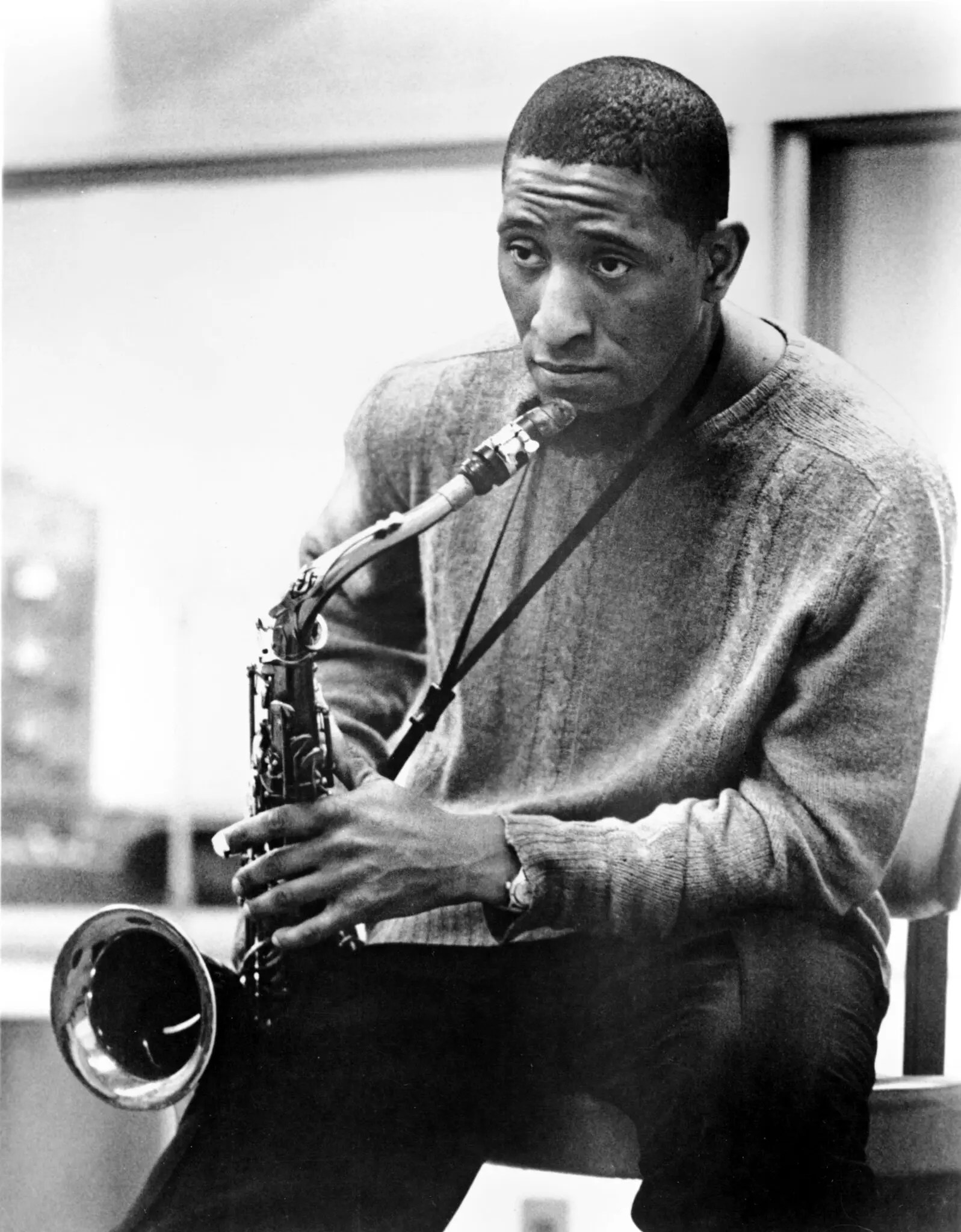
Having established himself as a major artist, Rollins suddenly took a three-year break from playing between 1959 to 1961 to develop his technique. Lacking space to practice in his apartment, he did so every day on the Williamsburg Bridge. When he returned to a recording studio in early 1962, the result was another classic album, The Bridge.

(Left: Sonny Rollins c. 1960)

Having established himself as a major artist, Rollins suddenly took a three-year break from playing between 1959 to 1961 to develop his technique. Lacking space to practice in his apartment, he did so every day on the Williamsburg Bridge. When he returned to a recording studio in early 1962, the result was another classic album, The Bridge.

In all he made over 60 albums, of which I have about a dozen. I’ll be listening to them a lot over the next few days and may post a few further items about them in due course.One thing I always liked about Sonny Rollins was his tendency to take a shine to very unexpected tunes and turn them into something magical. Off the top of my head I can think of The Surrey with the Fringe on Top, How are Things in Glocca Morra? and I’m an Old Cowhand.

It’s impossible to pick a single track than can do justice to Sonny Rollins so I’m just going to include a couple here. The first is the very first track I ever heard by him, on a Blue Note sampler album. It’s a Miles Davis tune called Tune Up and it’s from the 1957 Blue Note album Newk’s Time with Wynton Kelly (piano), Doug Watkins (bass), and Philly Joe Jones (drums). Perhaps listening to the energy and invention of his playing, delivered with that characteristically leathery tone then you’ will understand why I fell instantly in love with his music and wanted to hear more.

The second is one of my favourite records of all time. It’s called Hold’ Em Joe and it was recorded in 1965 with Ray Bryant (piano), Walter Booker (bass) and the fabulous Mickey Roker on drums:

As a sad footnote on this sad occasion, the passing of Sonny Rollins means that not one of the great musicians in this famous photograph A Great Day in Harlem, taken on August 12th 1958, is still with us:
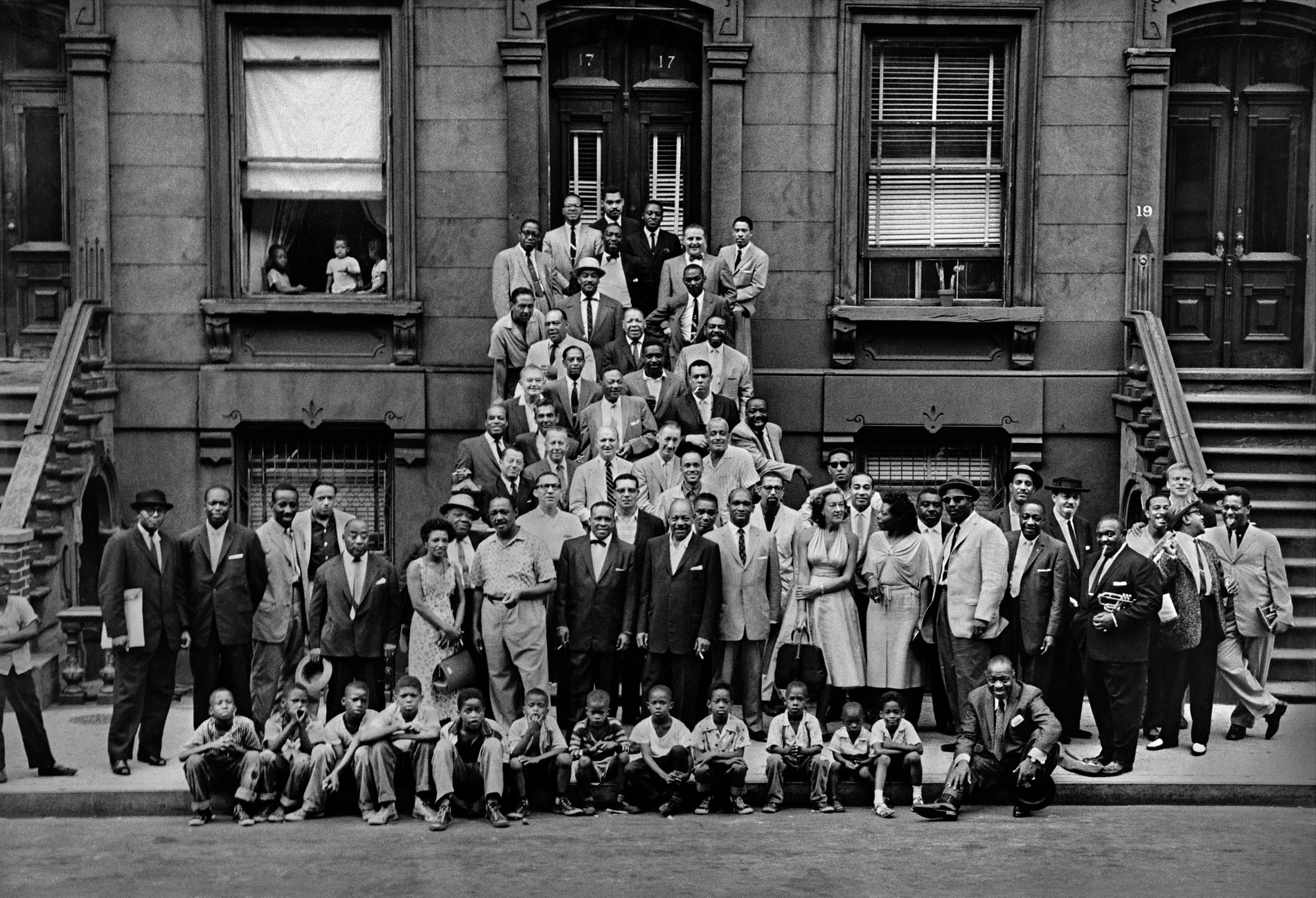
Rest in Peace Sonny Rollins (1930-1954), Saxophone Colossus indeed.

Bird 100: Bloomdido

Posted in Jazz with tags , , , , , , on August 29, 2020 by telescoper

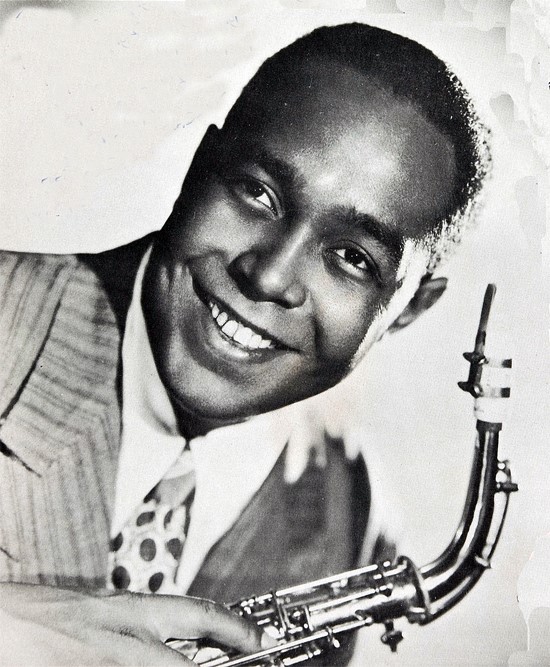
Here is another bit of music to celebrate the 100th anniversary of the birth of the great saxophonist Charlie Parker (“Bird”) on 29th August 1920.

bird

I’ve written quite a few posts relating to Charlie Parker over the years but today has provided a good excuse to spend my lunchtime writing another one, this time featuring one of my favourite tracks from one of my favourite albums. First released in 1952 but in fact recorded in two separate sessions in 1949 and 1950, the album Bird and Diz was actually the last studio album made under the joint leadership of Charlie Parker and Dizzy Gillespie, the two main architects of the bebop revolution; the track I’ve picked has the added advantage of featuring another great musical genius on piano, Thelonious Monk.

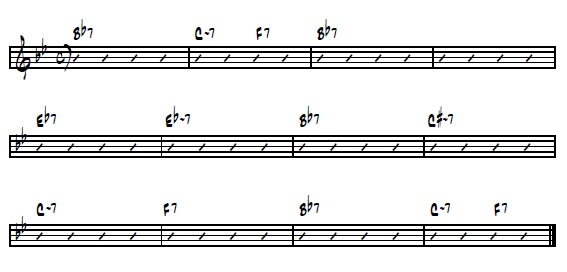
The Charlie Parker composition Bloomdido is yet another of his variations on the blues, though this one is a bit less intricate than some of the others he wrote. Here are the chords for Bloomdido:

Bloomdido

You can see that the progression is based around the standard three chords of a blues in B♭. The foundation is a “tonic” chord (T) based on the root note of whatever key it’s played in, in this case B♭. This sometimes a basic triad consisting of the first, third and five notes of a major scale starting on that note or, as in this example, including the dominant 7th so it’s B♭7. The next chord is the subdominant chord (S), shifting things up by a perfect fourth relative to the tonic, in this case an E♭7 and then finally we have the dominant (D) which brings us up by a fifth from the original root note, in this case F7.

The basic blues sequence in B♭ would be four bars of B♭7 (T), two of E♭7 (S), back to B♭7 (T) for two, then the characteristic bluesy cadence returning to two bars of B♭7 (T) via one bar each of F7 (D) and E♭7 (S). The sequence for Bloomdido has a few alterations, including a characteristic turnaround at the end, but is otherwise fairly recognizable. I guess the first part of the title is a play on the blues origin too, though I wonder if the second part suggests that some of the alterations are inspired by the A-section of the Juan Tizol standard Perdido?

Some people tell me they find Charlie Parker’s music “too technical” and that somehow if music “needs to be explained” it’s not good music. I don’t understand that attitude at all. I find this music so fascinating and exciting to listen to that I want to try to dig a little bit into it and find out what’s going underneath the surface. It’s particularly striking what a difference a few substitutions and passing chords can make to the overall harmonic “feel” of a piece like this compared to a standard blues sequence, for example. But you don’t need to study the chords to appreciate the sheer beauty of the music that Charlie Parker built on these harmonic foundations; his solo on this track, as on so many others he recorded in his short life, is just sublime even if you don’t realise how hard it is to play! I guess it all depends whether your way of enjoying a thing is to sit back and let it wash over you, or for it to inspire you to find out more. Many of the physicists I know are deeply interested in music. Perhaps that’s because they’re the sort of people who don’t just think “wow that’s beautiful”, they tend to think “wow that’s beautiful – how does it work?”.

Charlie Parker and Albert Einstein died in the same year, just over a month apart, the former in March 1955 and the latter in April. They were two very different geniuses but it’s as difficult to imagine physics without Einstein as jazz without Bird.

Bright Mississippi – Allen Toussaint

Posted in Jazz with tags , , , on May 7, 2020 by telescoper

I have, on a few occasions posted pieces of Jazz that cross over different eras and here’s a wonderful example that has been in my head for a while. Bright Mississippi is a typically quirky composition by Thelonious Monk, a man often described as the ‘High Priest of Bop’. This version in a live performance by a band led in 2009 by Allen Toussaint, however, gives it a joyously carefree New Orleans treatment.

R.I.P. Henry Grimes (1935-2020)

Posted in Jazz with tags , , , , , on April 19, 2020 by telescoper

The Coronavirus continues to cut a swathe through a generation of great Jazz musicians. The latest sad news is of the passing of bass player Henry Grimes at the age of 84.

Henry Grimes was very active in the 50s and 60s, playing with such luminaries as Sonny Rollins and Thelonious Monk, and appearing on some classic recordings, but he dropped out of the music scene as a performer for roughly thirty years from about 1970 during which time he was virtually destitute. He returned to music around 2002 after a Jazz fan tracked him down and bought him a double bass to play – he had sold his instrument decades earlier – and remained active until his death.

When I heard last night of the death of Henry Grimes the first thing that popped into my mind was this sequence from the movie Jazz On A Summer’s Day. You can see shot of the young Henry Grimes right at the beginning in this clip of the Thelonious Monk trio playing Blue Monk at the Newport JJazz Festival in 1958; Roy Haynes was the drummer.

Rest in peace, Henry Grimes (1935-2020)

Thelonious Monk plays Duke Ellington

Posted in Jazz with tags , , , , on February 17, 2020 by telescoper

This morning there was a reminder on the radio that today is the anniversary of the death of the great Thelonious Monk, who died on 17th February 1982. I went to a concert by British pianist Stan Tracey the day after the sad news broke and he threw away his intended play list and played nothing but Monk tunes for the whole evening. It was a wonderful concert and a moving tribute from one musician to another who had clearly influenced him deeply.

Last week I was asked by a young man to recommend some albums because he wanted to find out more about Monk’s music. Among those I suggested was Thelonious Monk plays Duke Ellington which was recorded in 1956 for the Riverside Label, and features a trio of Thelonious Monk (piano), Oscar Pettiford (bass) and Kenny Clarke (drums).

This is an unusual album because it finds Monk doing what the recording executives asked, namely to play standard tunes rather than his original compositions. The most performed jazz composer of all time* is Duke Ellington so he was a natural source of material to choose, and the album that resulted is absolutely fascinating not least because Monk clearly relates very well to Ellington’s music. In fact it’s one of my all-time favourites. Here is just one track from it, I let a Song go out of my Heart. Enjoy!

*The second most performed jazz composer of all time is none other than Monk himself!

On Off Minor

Posted in Jazz with tags , , , , on May 19, 2018 by telescoper

One of the contributors to the `Out Thinkers’ event I went to a couple of weeks ago, Emer Maguire, talked about science and music. During the course of her presentation she mentioned one of the most common sets of chord changes in pop music, the I-V-vi-IV progression. In the key of C major, the chords of this progression would be C, G, Am and F. You will for example find this progression comes up often in the songs of Ed Sheeran (whoever that is).

These four chords include those based on the tonic (I), the dominant (V) and the sub-dominant (IV) – i.e. the three chords of the basic blues progression – as well as the relative minor (vi). The relative minor for a major key is a key with exactly the same notes (i.e. the same sharps and flats) in it, but with a different tonic. With these four chords (shuffled in various ways) you can reproduce the harmonies of a very large fraction of the modern pop repertoire. It’s a comfortable and pleasant harmonic progression, but to my ears it sounds a bit bland and uninteresting.

These thoughts came into my head the other night when I was listening to an album of music by Thelonious Monk. One of my `hobbies’ is to try to figure out what’s going on underneath the music that I listen to, especially jazz. I can’t really play the piano, but I have an electronic keyboard which I play around on while trying to figure out what chord progressions are being used. I usually make a lot of terrible mistakes fumbling around in this way, so my neighbours and I are grateful that I use headphones rather than playing out loud!

I haven’t done a detailed statistical study, but I would guess that the most common chord progression in jazz might well be ii-V-I, a sequence that resolves onto the tonic through a cadence of fifths. I think one of the things some people dislike about modern jazz is that many of the chord progressions eschew this resolution which can make the music rather unsettling or, to put it another way, interesting.

Here’s a great example of a Thelonious Monk composition that throws away the rule book and as a result creates a unique atmosphere; it’s called Off Minor and it’s one of my absolute favourite Monk tunes, recorded for Blue Note in 1947:

The composition follows the standard 32 bar format of AABA; the A section ends with a strange D sharp chord extended with a flattened 9th which clashes with a B in the piano melody. This ending is quite a shock given the more conventional changes that precede it.

But it’s the B section (the bridge) where it gets really fascinating. The first bar starts on D-flat, moves up to D, and then goes into a series of unresolved ii-V changes beginning in B-flat. That’s not particularly weird in itself, but these changes don’t take place in the conventional way (one each bar): the first does, but the second is over two bars; and the third over four bars. Moreover, after all these changes the bridge ends on an unresolved D chord. It’s the fact that each set of eight bars ends in mid-air that provides this piece with its compelling  sense of forward motion.

There’s much more to it than just the chords, of course. There are Monk’s unique voicings and playful use of time as he states the melody, and then there’s his improvised solo, which I think is one of his very best, especially in the first chorus as he sets out like a brave explorer to chart a path through this curious harmonic landscape..

Ed Sheeran, eat your heart out!

Yellow Tango

Posted in Jazz with tags , , , on January 12, 2018 by telescoper

Before Christmas I posted one of my favourite pieces of music, The Fable of Mabel, performed by a band led by Serge Chaloff and featuring pianist Dick Twardzik (who also composed the piece). I thought I’d follow this up with another piece by Twardzik, this time in a trio with Carson Smith on bass and the excellent Peter Littman on drums.

This piece was recorded in late 1954, at which time the two great influences on jazz piano were Bud Powell and Thelonious Monk. Here’s a good example of how Twardzik manages to nod in the very different directions of these two great musicians – the Monk influence in particular stands out a mile when the rhythm switches from Latin-American to 4/4 at about 1:43 – while also managing to find a very original voicea which was all his own. It’s such a terrible shame that within a few months of this session Twardzik was dead (of a heroin overdose, at the age of 24) and jazz had lost one of its most promising young artists.

Thelonious Monk, Genius of Modern Music

Posted in Jazz with tags , , , on November 21, 2017 by telescoper

I was delighted to discover that this week’s Composer of the Week on BBC Radio 3 is none other than the great Thelonious Monk, who thoroughly deserves the honour as he was enormously influential as a composer as well as a bandleader and piano soloist. Many of Monk’s highly original compositions – such as Blue Monk, Straight No Chaser, In Walked Bud and ‘Round Midnight– have become jazz standards, but his unique approach to composition really changed the entire evolution of jazz in the immediate post-war era. In fact, Monk is the second-most recorded jazz composer ever, after Duke Ellington (a man he admired enormously and whose piano style influenced Monk’s).

The series of radio programmes about him is particularly timely as this year marks the centenary of his birth (10th October 1917).

In my top 50 jazz albums there would probably be about half a dozen by Thelonious Monk. I’ve loved his music since I heard the very first track by him way back when I was a teenager. Although he has often been given the nickname `The High Priest of Bop’, I’ve never really thought of him as fitting neatly in the bebop style – the archetypal bebop pianist was surely Bud Powell – but he was clearly a profound influence on others of that era, such as Charlie Parker and Dizzy Gillespie. I should add that he was entirely self-taught, which is probably how he managed to get that instantly recognisable sound. You only need to hear one note to know that it’s Monk.

I think the word `genius’ is extremely overused these days, and I tend to reserve it for those who show such an astonishing level of creativity that you think to yourself `Where on Earth did that come from?’. In my opinion it is no exaggeration to apply the word `genius’ to Thelonious Monk. He was a very special artist. Indeed when he was signed up by the fledgling Blue Note label in 1947, they called his first albums Genius of Modern Music..

Anyway, when I listened to yesterday’s programme on iPlayer I remembered this, a compilation of Monk’s advice to band members (as collected by saxophonist Steve Lacy in 1960). As well as being in places very funny, it also contains a great deal of very sound advice for young musicians (especially the first, `Just because you’re not a DRUMMER, doesn’t mean that you don’t have to KEEP TIME’.

I also like `Don’t play the PIANO PART. I’m playing that.’. I’m sure there’s a story behind every one of these tips!

By way of my own little tribute to Thelonious Monk here’s one of my favourite Monk tunes, as recorded with Milt Jackson on vibes way back in 1948. It’s typically offbeat Monk composition, and also provides great examples of him as a soloist and accompanist. Just listen to what he does behind Milt Jackson’s solo on I Mean You, which appeared on Genius of Modern Music Vol. 1…


The Top 10 Jazz Artists

Posted in Jazz with tags , , , , , on December 8, 2015 by telescoper

Back from a short break I thought I’d mention that BBC Radio 3 recently announced the results of a poll for the top Jazz artist of all time. The result was:

  1. Miles Davis
  2. Louis Armstrong
  3. Duke Ellington
  4. John Coltrane
  5. Ella Fitzgerald
  6. Charlie Parker
  7. Billie Holiday
  8. Thelonious Monk (8=)
  9. Bill Evans (8=)
  10. Oscar Peterson

Although my ordering would have been a little different, I was quite surprised that the top 10 corresponded so closely with my own selection. In fact 8 of the above list would have made it into mine: Miles Davis; Louis Armstrong; John Coltrane; Charlie Parker; Billie Holiday; Thelonious Monk; and Bill Evans.

The only differences were that (a) I couldn’t possibly have had Billie Holiday without having Lester Young and (b) I simply had to have Ornette Coleman in there. To accommodate Messrs Young and Coleman I would have displaced Ella Fitzgerald and Oscar Peterson. The latter are great artists, of course, but I wouldn’t say either influenced the development of Jazz as much as the others I mentioned, and that’s one of the criteria I applied.

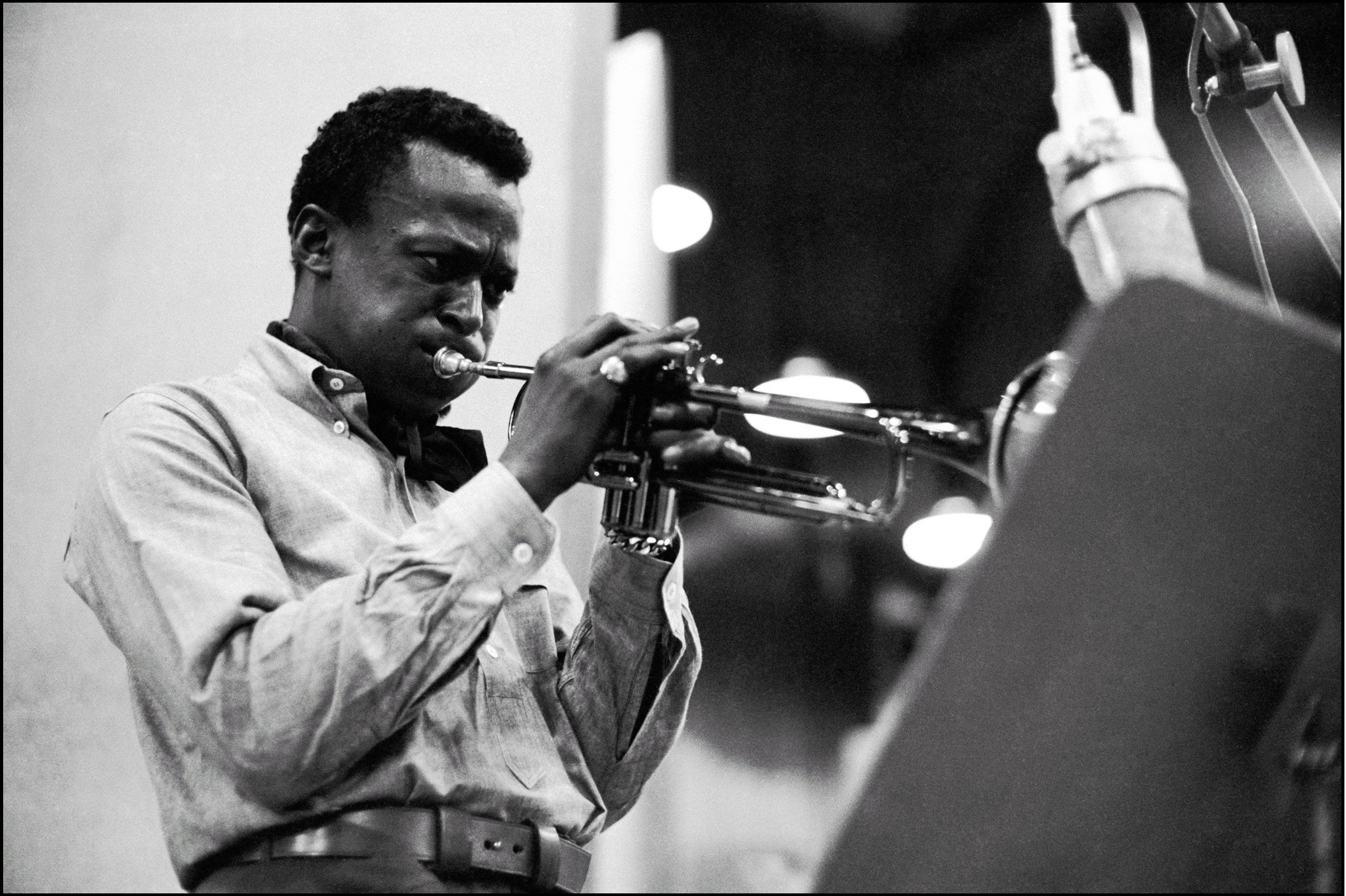
miles-davis

No surprise that Miles Davis (above) came top. He changed musical direction so many times that he should actually count as four or five different musicians. It’s no coincidence that Miles Davis, John Coltrane and Bill Evans all appeared on Kind of Blue, which is arguably the greatest jazz record of all time. I don’t think any serious Jazz enthusiast could have left out Charlie Parker or Thelonious Monk either. And of course, Louis Armstrong just had to be there too. It’s hard to imagine what Jazz would have been without Satchmo. The same goes for the great Duke Ellington.

Anyway, it’s all a matter of personal choice. There are dozens of great jazz artists who didn’t make it into the top ten. Among my near misses were Coleman Hawkins, Sidney Bechet, Eric Dolphy and Dizzy Gillespie.

Who else would you have picked?


Thelonious Monk – Misterioso

Posted in Jazz with tags , , , , on September 26, 2015 by telescoper

A couple of days ago I posted a piece of music by Eric Dolphy that was inspired by Thelonious Monk , so today I thought I’d post something by Monk himself together with my own appreciation of his music.

Thelonious Monk was a remarkable musician. His self-taught style of piano-playing was unlike that of anyone who came before or after him, including those followers who tried to copy him. He broke many rules, especially in the way he used his fingers – keeping them straight as he played to get a uniquely percussive sound from the instrument, well matched, on the track I’ve posted below, to the vibraphone of Milt Jackson.

Monk was often called “The High Priest of Bop” and regarded as one of the leaders of the post-war bebop revolution in Jazz alongside Charlie Parker and Dizzy Gillespie. Actually, I don’t think Monk ever really played bebop at all. I’ve always thought the archetypal bop pianist was Bud Powell whose style was totally different to Monk’s. But the “High Priest” tag owed at least something to his eccentric personality: he hardly ever spoke and, aside from his music, he seemed to communicate with the outside world largely through his choice of hat.

Monk’s piano style is hard to describe – his wife Nellie once described it as “Melodious Thunk” – but I’ve always loved his music. To me his solos sound like someone talking directly at you in a strange and wonderful language that you don’t quite understand but which sounds beautiful anyway. His use of syncopation is quite different from the usual bebop musicians and it seems, to me anyway, to echo the rhythms of everyday speech. But, above all, when you hear Monk play the piano, you know immediately who it is. He had many admirers, but nobody could play like him. He was a genius.

In later life his behaviour became disturbingly erratic; he would sometimes stand up in the middle of a performance and go wandering around the stage.  In my opinion his music also deteriorated from the early sixties onwards.  I think it was generally assumed that he had a drugs problem, which he may well have had, but it was eventually realised that he was suffering from a serious mental illness. Although attempts were made to treat this, he stopped playing in the 1970s and lived out the rest of his life as a virtual recluse.

I remember very well the day he died, in February 1982. It was during the Newcastle Jazz Festival, on the day when the great British jazz pianist Stan Tracey was due to give a concert there. As we took our seats in the Newcastle Playhouse for the gig, an announcement was made that Thelonious Monk had died. Stan Tracey, for whom Monk had been a major musical inspiration, responded to the occasion by playing two sets exclusively consisting of tunes by his hero. It was one of the best concerts I’ve ever been to and remains strong in my memory to this day.

I think Monk’s best records are from the 40s and 50s, and he was certainly in his prime in 1948 when he recorded this classic performance, for the Blue Note label, of his own composition, Misterioso.