Archive for June, 2011

A Bridge Too Far

Posted in Education with tags , , , on June 11, 2011 by telescoper

My commitment to the education of the great unwashed knows no bounds. Tonight’s subjects are architecture and geography.

Not a lot of people know that the relatively unknown Sydney Harbour Bridge is in fact a cheap replica of a much more famous structure in a much more interesting location:

Sydney Harbour Bridge

Tyne Bridge

The Value of Honour

Posted in Politics with tags , , , on June 11, 2011 by telescoper

Big news this morning was the release of the Queen’s Birthday Honours List for 2011 which, if you’re interested, you can download in full here. The awards that made the headlines were a knighthood for Bruce Forsyth and gongs for England cricket stars  Andrew Strauss and Alastair Cook. A smattering of academics (including an astrophysicist and a particle physicist) were also among those to get invitations to  Buckingham Palace in order to receive honours of various sorts from Her Majesty.

The honours system must appear extremely curious to people from outside the United Kingdom. It certainly seems so to me. On the one hand, I am glad that the government has a mechanism for recognising the exceptional contributions made to society by certain individuals. Musicians, writers, sportsmen, entertainers and the like generally receive handsome financial rewards, of course, but that’s no reason to begrudge a medal or two in recognition of the special place they occupy in our cultural life.  It’s  good to see scientists recognized too, although they tend not to get noticed so much by the press.

On the other hand, there are several things about the system that make me extremely uncomfortable. One is that the list of recipients  of certain categories of award is overwhelmingly dominated by career civil servants, for whom an “honour”  goes automatically with a given rank. If an honour is considered an entitlement in this way then it is no honour at all, and in fact devalues those awards that are  given on merit to people outside the Civil Service. Civil servants get paid for doing their job, so they should have no more expectation of an additional reward than anyone else.

Honours have relatively little monetary value on their own, of course so this is not question of financial corruption. An honour does, however, confer status and prestige on the recipient so what we have is a much more subtle form of perversion.

Worse still is the dishing out of gongs to political cronies, washed-up ministers, and various sorts of government hangers-on. An example of the latter is the knighthood awarded to Steve Smith, Chair of Universities UK, who stated, apparently without humorous intent,

Normally the UUK president gets a knighthood in the summer after they finish, so I was expecting it – in the sense that you ever expect these things – in July next year.

I read this as meaning

Usually the UUK president is rewarded for being a spineless government lackey after they’ve finished, but I’ve been such a brilliant spineless government lackey I’m getting my reward early.

Although the honours system has opened up a little bit over the last decade or so, to me it remains a sinister institution that attempts to legitimise the self-serving nature of its patronage by throwing the odd bone to individuals outside the establishment. I don’t intend any disrespect to the individuals who have earned their knighthoods, MBEs, OBEs, CBEs or whatnot. I just think they’re being rewarded with tainted currency.

And that’s even before you take into account the award of a knighthood to the loathsome homophobic spiv Brian Souter. Well, I mean. Does anyone really think it’s an honour to be in the same club as him? I find it deeply offensive that he could  have been considered an appropriate person to be on the list. If you feel the way I do, please sign the petition here.

There. I’ve said it. Bang goes my knighthood.

All together now, say after me .. “rød grød med fløde”

Posted in Uncategorized with tags , , on June 10, 2011 by telescoper

Although I’ve been many times to Denmark I’ve never managed to learn a significant amount of Danish. Part of the reason is that most Danes speak perfect English, but another aspect is that Danish is impossibly difficult to pronounce. People have told me that it’s a bit of an advantage in this respect being a Geordie, because the dialect of the Northeast of England has some similarities with Danish. There’s obviously some truth in that. For example, the Danish word for “home” is “hjem” which is pronounced in almost exactly the same way Geordies say it, as in “gannin’ hyem”.

However, this marginal advantage hasn’t helped me get to grips with Danish. To see why, consider this seemingly innocent phrase rød grød med fløde. This is, in fact, a dessert dish but that’s not the point. It’s so difficult for foreigners to pronounce that it’s often used humorously as a tongue-twister and, more seriously, was used by members of the Danish resistance in World War 2 to weed out interlopers.

Listen to how this is pronounced by actual real Danish people, and you’ll probably understand why I never got to grips with the language.

The Laws of Extremely Improbable Things

Posted in Bad Statistics, The Universe and Stuff with tags , , , , , , , , on June 9, 2011 by telescoper

After a couple of boozy nights in Copenhagen during the workshop which has just finished, I thought I’d take things easy this evening and make use of the free internet connection in my hotel to post a short item about something I talked about at the workshop here.

Actually I’ve been meaning to mention a nice bit of statistical theory called Extreme Value Theory on here for some time, because not so many people seem to be aware of it, but somehow I never got around to writing about it. People generally assume that statistical analysis of data revolves around “typical” quantities, such as averages or root-mean-square fluctuations (i.e. “standard” deviations). Sometimes, however, it’s not the typical points that are interesting, but those that appear to be drawn from the extreme tails of a probability distribution. This is particularly the case in planning for floods and other natural disasters, but this field also finds a number of interesting applications in astrophysics and cosmology. What should be the mass of the most massive cluster in my galaxy survey? How bright the brightest galaxy? How hot the hottest hotspot in the distribution of temperature fluctuations on the cosmic microwave background sky? And how cold the coldest? Sometimes just one anomalous event can be enormously useful in testing a theory.

I’m not going to go into the theory in any great depth here. Instead I’ll just give you a simple idea of how things work. First imagine you have a set of n observations labelled X_i. Assume that these are independent and identically distributed with a distribution function F(x), i.e.

\Pr(X_i\leq x)=F(x)

Now suppose you locate the largest value in the sample, X_{\rm max}. What is the distribution of this value? The answer is not F(x), but it is quite easy to work out because the probability that the largest value is less than or equal to, say, z is just the probability that each one is less than or equal to that value, i.e.

F_{\rm max}(z) = \Pr \left(X_{\rm max}\leq z\right)= \Pr \left(X_1\leq z, X_2\leq z\ldots, X_n\leq z\right)

Because the variables are independent and identically distributed, this means that

F_{\rm max} (z) = \left[ F(z) \right]^n

The probability density function associated with this is then just

f_{\rm max}(z) = n f(z) \left[ F(z) \right]^{n-1}

In a situation in which F(x) is known and in which the other assumptions apply, then this simple result offers the best way to proceed in analysing extreme values.

The mathematical interest in extreme values however derives from a paper in 1928 by Fisher \& Tippett which paved the way towards a general theory of extreme value distributions. I don’t want to go too much into details about that, but I will give a flavour by mentioning a historically important, perhaps surprising, and in any case rather illuminating example.

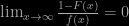
It turns out that for any distribution F(x) of exponential type, which means that

\lim_{x\rightarrow\infty} \frac{1-F(x)}{f(x)} = 0

then there is a stable asymptotic distribution of extreme values, as n \rightarrow \infty which is independent of the underlying distribution, F(x), and which has the form

G(z) = \exp \left(-\exp \left( -\frac{(z-a_n)}{b_n} \right)\right)

where a_n and b_n are location and scale parameters; this is called the Gumbel distribution. It’s not often you come across functions of the form e^{-e^{-y}}!

This result, and others, has established a robust and powerful framework for modelling extreme events. One of course has to be particularly careful if the variables involved are not independent (e.g. part of correlated sequences) or if there are not identically distributed (e.g. if the distribution is changing with time). One also has to be aware of the possibility that an extreme data point may simply be some sort of glitch (e.g. a cosmic ray hit on a pixel, to give an astronomical example). It should also be mentioned that the asymptotic theory is what it says on the tin – asymptotic. Some distributions of exponential type converge extremely slowly to the asymptotic form. A notable example is the Gaussian, which converges at the pathetically slow rate of \sqrt{\ln(n)}! This is why I advocate using the exact distribution resulting from a fully specified model whenever this is possible.

The pitfalls are dangerous and have no doubt led to numerous misapplications of this theory, but, done properly, it’s an approach that has enormous potential.

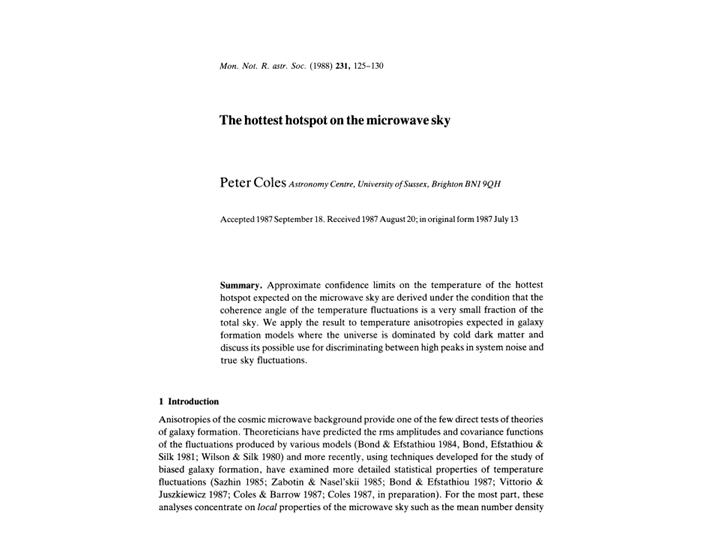
I’ve been interested in this branch of statistical theory for a long time, since I was introduced to it while I was a graduate student by a classic paper written by my supervisor. In fact I myself contributed to the classic old literature on this topic myself, with a paper on extreme temperature fluctuations in the cosmic microwave background way back in 1988..
Of course there weren’t any CMB maps back in 1988, and if I had thought more about it at the time I should have realised that since this was all done using Gaussian statistics, there was a 50% chance that the most interesting feature would actually be a negative rather than positive fluctuation. It turns out that twenty-odd years on, people are actually discussing an anomalous cold spot in the data from WMAP, proving that Murphy’s law applies to extreme events…

Auditorium A

Posted in Biographical, Books, Talks and Reviews with tags , , , , , on June 8, 2011 by telescoper

Just back from a splendidly wine-laden workshop dinner, I thought I’d do a quick post. My talk was moved to this morning, instead of the scheduled slot in the afternoon I think it went OK considering that, in the spirit of a small informal workshop, I talked mainly about work in progess…

That’s the whiteboard in my office in Cardiff, by the way, not my talk this morning. Auditorium A has good old-fashioned blackboards.

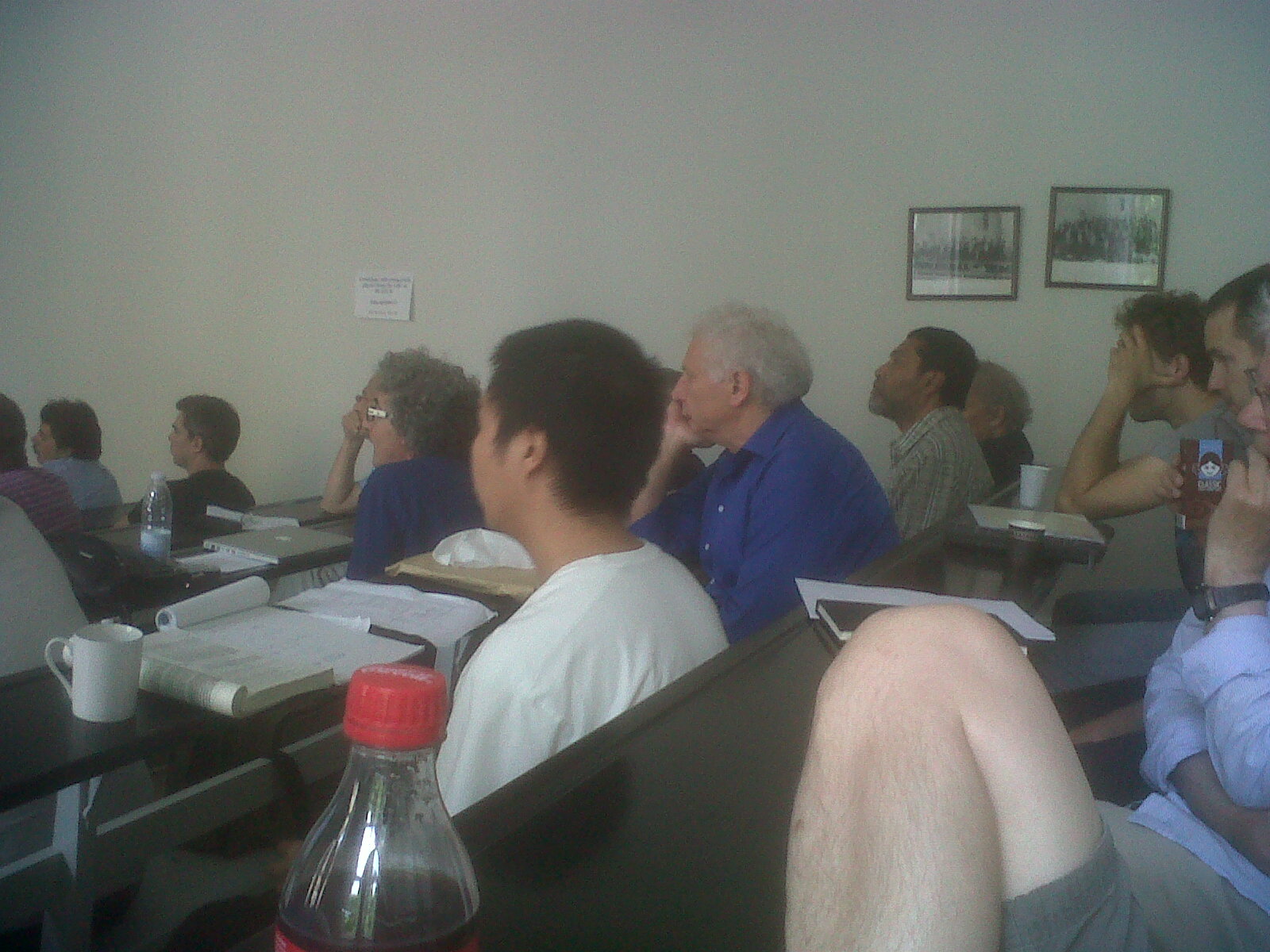
An advantage of speaking in the morning was that after it was over I was able to relax with a beer at lunchtime, but in the warm weather that made it rather difficult to stay on the ball afterwards. I’ve lost track of the amount of time I’ve spent sitting (or even speaking) in the famous Auditorium A of the Niels Bohr Institute over the years, actually, but I don’t think I’ve ever taken a picture there, so here’s one.

On the extreme left you can see our genial host Pavel Naselsky; in the centre left with blue shirt and grey hair, pretending not to be asleep, is Leonid Grishchuk; beside him to the right is Subir Sarkar and next to him,  more-or-less hidden from view, is Holger Bech Nielsen who travelled backwards in time especially to attend the workshop. The knee in the foreground remains unattributed.

Here is an “official” workshop photograph, taken while the participants were looking a bit more awake, but before quite a few had made it back from lunch..

Hello everyone! (via Astronomy Journal Club)

Posted in Uncategorized with tags on June 8, 2011 by telescoper

I thought I’d interrupt the preparation of my talk, which has been brought forward to 10.15 this morning, to reblog this interesting experiment. I guess most people likely to be interested will have heard about it on twitter, but for those who haven’t please have a look.

I’m not sure how successful it will be – that 140 character limit looks like a challenge when discussing a technical paper – but you never know!

Welcome all and thanks for your interest in the twitter astronomy journal club! The general idea is that we meet up on twitter at a prearranged day and time and discuss an interesting piece of astronomy research. This will generally take the form of an academic paper, but we could also include some articles too. Everyone's welcome to participate, whether you know anything about the topic or not. This is all inspired by the original Twitter Journa … Read More

via Astronomy Journal Club

The Happiest Place on Earth

Posted in Biographical with tags , on June 7, 2011 by telescoper

Here I am in wonderful Copenhagen. I arrived yesterday afternoon in lovely sunny weather, found my hotel, and then went for an evening stroll. It was so hot, in fact, that I was forced to sit outside drinking cold beer instead of preparing my talk, but then I’m not on until Thursday so there’s still time. Later on, the weather broke in spectacular fashion with a huge thunderstorm brewing up over the city. I sat and watched the son et lumière show out of the hotel window into the early hours, savouring the gorgeous earthy smell that comes with summer rain.

As I’ve mentioned before, Copenhagen is one of my favourite places. I was first invited here while I was a PhD student twenty-odd years ago and have been back at least once a year ever since. Of course, in the summer, especially in June when the days are longest, the city is particularly fine, but I actually like it here all year round. Of course it’s a bit dark and a bit cold in the winter months, but snow doesn’t make things fall apart here like it does in Britain, and Copenhagen takes on an austere beauty at that time of year which endows it with a unique sense of place. And, best of all, the harsh winter seems to make people embrace the summer even more joyfully. It was lovely to see people out enjoying themselves last night in the sunshine without a hint of the violence that blights Britain’s town centres after a day like this. Above all, though, Denmark is just such a civilised place. It’s a very egalitarian society, with excellent public services, virtually no poverty, a strong sense of its own identity, and a robust democracy.

After an early breakfast in my hotel (the slightly odd but very comfortable Hotel 9 Små Hjem where I’ve stayed a number of times in the past), I found this clip on Youtube.

I find it very amusing for a number of reasons. One is the supposition that happiness goes with sunny weather, which I find laughably superficial. I’d hate to live anywhere where the weather was the same every day, even if it were warm. The reporter also seems bemused that Canada appears higher in the table than the USA. It’s no surprise to me: given the choice, I’d much rather live in Canada than America!
Above all, the snide incredulity about “cold, dreary, unspectacular” Denmark is a truly excellent self-parody. It may be cold – sometimes – but, as Billy Connolly once said, “there’s no such thing as bad weather, just the wrong clothes”. But there’s certainly nothing dreary about Denmark – it has a vibrant culture and a long and fascinating history. It may be “unspectacular”, if by that you mean that it’s not gaudy or pompous or ostentatious. Modesty is a sadly underrated virtue.

I’m not a fan of league tables – and I dread to think what bizarre methodology produced the one referred to in the clip – but as a seasoned visitor it actually comes as no suprise to me that the Danes are in the Premier division for happiness. The point is that happiness isn’t about external things such as the weather. Nor is it about showing off. It’s a frame of mind. The Danes seem to understand that better than most.

P.S. I love Victor Borge! And what’s wrong with herring sandwiches?

Time Present and Time Past

Posted in Poetry with tags , , on June 6, 2011 by telescoper

Up early this morning to set off for the airport. No time for a proper post until I get to Copenhagen so I thought I’d just put this up, as it popped into my mind after I’d written yesterday’s item. I’m a bit reluctant to post a bit of a poem, rather than a whole one, but here goes.  This is the opening passage from Burnt Norton, the first of the Four Quartets by T.S. Eliot. If you haven’t read the whole thing, you should.

Time present and time past
Are both perhaps present in time future,
And time future contained in time past.
If all time is eternally present
All time is unredeemable.
What might have been is an abstraction
Remaining a perpetual possibility
Only in a world of speculation.
What might have been and what has been
Point to one end, which is always present.
Footfalls echo in the memory
Down the passage which we did not take
Towards the door we never opened
Into the rose-garden.

From Time to Time

Posted in Biographical, The Universe and Stuff with tags , , on June 5, 2011 by telescoper

It having been my birthday yesterday, and very nice it was too, thank you for asking, I’m filled this morning with thoughts about the passage of time. It’s strange how working in education imposes a cycle on your life: admissions, teaching, exams, graduation ceremonies, summer recess, and so on. The main thing that breaks this pattern of recurrence is when students finish their finals and leave for the big wide world. Since I moved to Cardiff in 2007, the 4th year students who have just finished their examinations are the first cohort that I’ve seen through their whole degree programme at Cardiff University, and it will be great to see them all get their degrees next month in St David’s Hall, but it will be yet another reminder of the passage of the years.

Not that I’m one to get depressed about such things. I’ve taken surprisingly well to middle age and gracefully (?) surrendered the things of youth some time ago. However, time is such a mysterious thing it’s hard not to think about its passing every now and then.

This time last year I was in Copenhagen for a small cosmology workshop. There’ll be a repeat performance next week too, so I’ll be off to Denmark for a few days. In fact I bought my ticket some time ago, but realised only on Friday that it was next week, and not the week after, so have had to rearrange a few things rather hastily. The advancing years have obviously addled my brain.

Anyway, all this talk about time and cycles gives me some sort of excuse to post the following video from the ESO Very Large Telescope in Chile. The photography is wonderful. Pity about the music, though. Spoils it a bit if you ask me…

June

Posted in Poetry with tags , on June 4, 2011 by telescoper

Now summer is in flower and natures hum
Is never silent round her sultry bloom
Insects as small as dust are never done
Wi’ glittering dance and reeling in the sun
And green wood fly and blossom haunting bee
Are never weary of their melody
Round field hedge now flowers in full glory twine
Large bindweed bells wild hop and streakd woodbine
That lift athirst their slender throated flowers
Agape for dew falls and for honey showers
These round each bush in sweet disorder run
And spread their wild hues to the sultry sun.

by John Clare (1793-1864).