Archive for October, 2011

News Flash from STFC

Posted in Science Politics with tags , , on October 18, 2011 by telescoper

At last!

The worst kept secret in science is now out. The new Chief Executive of the Science and Technology Facilities Council is Professor John Womersley. Here’s an official-looking picture of him, although I think it has been photo-shopped to stop him looking so much like Christopher Biggins:

The announcement of appointment of the new CEO has been expected for months now. It appears that the reason for the delay is tied up with the start date. John Womersley will in fact take up the reins at STFC on 1st November 2011, not when the current CEO retires (at the end of March next year) as originally planned. The current CEO, Professor Keith Mason, has been shunted across to kicked into touch at booted into the long grass in given the opportunity to take up a secondment at the UK Space Agency until he retires next year. Apparently he is moving there

to advise on steps needed to leverage the research base to maximise the economic growth of the space sector.

Don’t ask me what it means, but one guesses some form of negotiation must have been going on behind the scenes all this time (a) to persuade Keith Mason to go early and (b) to persuade UKSA to make room in the basement for him.

Anyway, heartiest congratulations to John Womersley (@JohnWomersley on Twitter)  on his new appointment. A change was long overdue, and I wish him well in what is going to be a difficult job.

The Physics of the Pole Vault

Posted in Education, The Universe and Stuff with tags , , , , , on October 17, 2011 by telescoper

At the RAS Club Dinner last Friday I chatted for a while with my former DPhil supervisor, John Barrow. I’m not sure how, but the topic came up about how helpful it is to use sports to teach physics. By coincidence he chose the same example as I have used in the past during first-year tutorials,  the pole vault.

Years ago I went to watch an athletics meeting at Gateshead Stadium and sat right next to the pole vault area. I can tell you that the height the vaulters reach is truly spectacular, especially when you’re close to the action. The current world record for the pole vault is 6.14m, in fact, set by the legendary Sergey Bubka in 1994, so the record hasn’t been broken for 17 years. Here’s a clip of him a few years earlier clearing a mere 6.10 metres (pretty comfortably, by the look of it)…

One might infer, from the fact that the record has not been broken for such a long time, that pole vaulters are working pretty much at the limit of what the human body can achieve. And a bit of physics will convince you of the same.

Basically, the pole is a device that converts the horizontal kinetic energy of the vaulter \frac{1}{2} m v^2,  as he/she runs in, to the gravitational potential energy m g h acquired at the apex of his/her  vertical motion, i.e. at the top of the vault.

Now assume that the approach is at the speed of a sprinter, i.e. about 10 ms^{-1}, and work out the height h = v^2/2g that the vaulter can gain if the kinetic energy is converted with 100% efficiency. Since g = 9.8 ms^{-2} the answer turns out to be about 5 metres.
This suggests that  6.15 metres should not just be at, but beyond, the limit of a human vaulter,  unless the pole were super-elastic. However, there are two things that help. The first is that the centre of mass of the combined vaulter-plus-pole does not start at ground level; it is at a height of a bit less than 1m for an an average-sized person.  Nor does the centre of mass of the vaulter-pole combination reach 6.15 metres. The pole does not go over the bar, but it’s pretty light so that probably doesn’t make much difference. However, it’s not  obvious that the centre of mass of the vaulter actually passes over the bar.  That certainly doesn’t happen in the high jump – owing to the flexibility of the jumper’s back the arc is such that the centre of mass remains under the bar while the different parts of the jumper’s body go over it.

Moreover, it’s not just the kinetic energy of the vaulter that’s involved. A human can in fact jump vertically from a standing position, using elastic energy stored in muscles. One can’t jump very high like that, but it seems likely to me that this accounts for a few tens of centimetres.

Anyway, it is clear that pole vaulters are remarkably efficient athletes. And not a little brave either – as someone who is scared of heights I can tell you that I’d be absolutely terrifed being shot up to 6.15 metres on the end of  a bendy stick, even with something soft to land on!

The Ex-Queen Among the Astronomers

Posted in Poetry with tags , , on October 17, 2011 by telescoper

They serve revolving saucer eyes,
dishes of stars; they wait upon
huge lenses hung aloft to frame
the slow procession of the skies.

They calculate, adjust, record,
watch transits, measure distances.
They carry pocket telescopes
to spy through when they walk abroad.

Spectra possess their eyes; they face
upwards, alert for meteorites,
cherishing little glassy worlds:
receptacles for outer space.

But she, exile, expelled, ex-queen,
swishes among the men of science
waiting for cloudy skies, for nights
when constellations can’t be seen.

She wears the rings he let her keep;
she walks as she was taught to walk
for his approval, years ago.
His bitter features taunt her sleep.

And so when these have laid aside
their telescopes, when lids are closed
between machine and sky, she seeks
terrestrial bodies to bestride.

She plucks this one or that among
the astronomers, and is become
his canopy, his occulation;
she sucks at earlobe, penis, tongue

mouthing the tubes of flesh; her hair
crackles, her eyes are comet-sparks.
She brings the distant briefly close
above his dreamy abstract stare.

by Fleur Adcock.


Late Arrivals at the Statistician’s Ball

Posted in Uncategorized with tags , , on October 16, 2011 by telescoper

I’m in a frivolous mood this Sunday morning so I thought I’d have a go at stirring up a bit of audience participation. Taking my cue from I’m Sorry I Haven’t a Clue, please let me announce some of the late arrivals at the Statistician’s Ball. Your contributions are also welcomed…

Ladies and Gentlemen may I introduce:

Mr and Mrs Ear-Regresssion and their daughter Lynne Ear-Regression

Mr and Mrs Thmetick-Mean and their son, Harry Thmetick-Mean

Mr and Mrs D’arderra and their son, Stan.

Mr and Mrs Layshun and their daughter, Cora

Here’s Mark Offchain and his friend Monty Carlo

Incidentally, the food this evening will be served at your table free of charge; there’s a “Buy no meal” distribution…

Mr and Mrs Rating-Function and their daughter, Jenna.

Mr and Mrs Mentz and their daughter, Mo.

Mr and Mrs Al-Distribution and their son Norm.

Mr and Mrs Variate and their daughter Una; she’s still single, by the way…

Mr and Mrs Otis and their son, Curt

Mr and Mrs Pling-Bias  and their son, Sam

Mr and Mrs Inal-Probability and their daughter, Marge.

Mr and Mrs Over and their daughter, Anne Over.

Mr and Mrs Mogorov and their son, Carl. I’m sure he’ll want to try out the vodka. Hey Carl Mogorov! Smirnov test?

Mr and Mrs Fordslaw and their son, Ben.

Mr and Mrs Knife and their son, Jack.

Mr and Mrs Motion and their son Ian (who’s just back from a holiday during which he got a very deep tan), yes it’s Brown Ian Motion.

Mr and Mrs Rage and their daughter, Ava.

Mr and Mrs Sprier and their son, Jeffrey Sprier.

And now we’re joined by royalty. From the distinguished house of Ippal-Components, here’s Prince Ippal-Components.

Mr and Mrs D’alscoefficient and their son, Ken.

Here’s the Hood family with their particularly amiable son, Lee. I’m sure you will like Lee Hood!

Mr and Mrs Gale and their son, Martin.

Mr and Mrs Imum-Entropy and their son, Max.

Mr and Mrs Spectra and their daughter, Polly.

That’s all I’ve got time for at the moment, but please feel free to offer your own suggestions through the box below…

Over the Rainbow

Posted in Jazz with tags , , , on October 15, 2011 by telescoper

No time for a proper post today, so I’ll just offer a lovely bit of jazz from the late great Ben Webster that I bookmarked for future posting some time in the past. Webster was a big boozy brutish kind of bloke, but he played ballads with a heartwarming tenderness, as you can tell from this performance which also features the vastly underrated British pianist, Stan Tracey, who is still going strong after over 60 years in the business. Enjoy!

The Astronomy Career Problem – it starts with the PhD

Posted in Science Politics with tags , , , , , on October 14, 2011 by telescoper

Just time for a quickie today, as I’ve got to run an examples class before dashing off on the train to London to attend the annual George Darwin Lecture which, this year, is to be given by Michael Turner with the title From Quarks to the Cosmos. I expect it to be very enjoyable and may well write a report at the weekend.

Yesterday evening there was a discussion on twitter (#astrojc) about the astronomy careers problem. I didn’t take part – in fact I didn’t realise it was happening – as I was slaving over the Private Eye crossword at the time.

Anyway, it gives me the excuse to rehash an argument I have presented before, which is that most analyses of the problems facing young postdoctoral researchers in astronomy are looking at the issue from the wrong end. I think the crisis is essentially caused by the overproduction of PhDs in this field. To understand the magnitude of the problem, consider the following.

Assume that the number of permanent academic positions in a given field (e.g. astronomy) remains constant over time. If that is the case, each retirement (or other form of departure) from a permanent position will be replaced by one, presumably junior, scientist.

This means that over an academic career, on average, each academic will produce just one PhD who will get a permanent job in academia. This of course doesn’t count students coming in from abroad, or those getting faculty positions abroad, but in the case of the UK these are probably relatively small corrections.

Under the present supply of PhD studentships an academic can expect to get a PhD student at least once every three years or so. At a minimum, therefore, over a 30 year career one can expect to have ten PhD students. A great many supervisors have more PhD students than this, but this just makes the odds worse. The expectation is that only one of these will get a permanent job in the UK. The others (nine out of ten, according to my conservative estimate) above must either leave the field or the country to find permanent employment.

The arithmetic of this situation is a simple fact of life, but I’m not sure how many prospective PhD students are aware of it. There is still a reasonable chance of getting a first postdoctoral position, but thereafter the odds are stacked against them.

The upshot of this is we have a field of understandably disgruntled young people with PhDs but no realistic prospect of ever earning a settled living working in the field they have prepared for. This problem has worsened considerably in recent  years as the number of postdoctoral positions has almost halved since 2006. New PhDs have to battle it out with existing postdoctoral researchers for the meagre supply of suitable jobs. It’s a terrible situation.

Now the powers that be – in this case the Science and Technology Facilities Council – have consistently argued that the excess PhDs go out into the wider world and contribute to the economy with the skills they have learned. That may be true in a few cases. However, my argument is that the PhD is not the right way to do this because it is ridiculously inefficient.

What we should have is a system wherein we produce more and better trained Masters level students  and fewer PhDs. This is the system that exists throughout most of Europe, in fact, and the UK is actually committed to adopt it through the Bologna process.  Not that this commitment seems to mean anything, as precisely nothing has been done to harmonize UK higher education with the 3+2+3 Bachelors+Masters+Doctorate system Bologna advocates.

The training provided in a proper two-year Masters programme will improve the skills pool for the world outside academia, and also better prepare the minority of students who go on to take a PhD. The quality of the  PhD will also improve, as only the very best and most highly motivated researchers will take that path. This used to be what happened, of course, but I don’t think it is any longer the case.

The main problem with this suggestion is that it requires big changes to the way both research and teaching are funded. The research councils turned away from funding Masters training many years ago, so I doubt if they can be persuaded to to a U-turn now.

This won’t solve the existing careers crisis, of course, but in order to make things better you first have to stop them getting worse.

Another day, another tutorial…

Posted in Education, The Universe and Stuff with tags , , , , on October 13, 2011 by telescoper

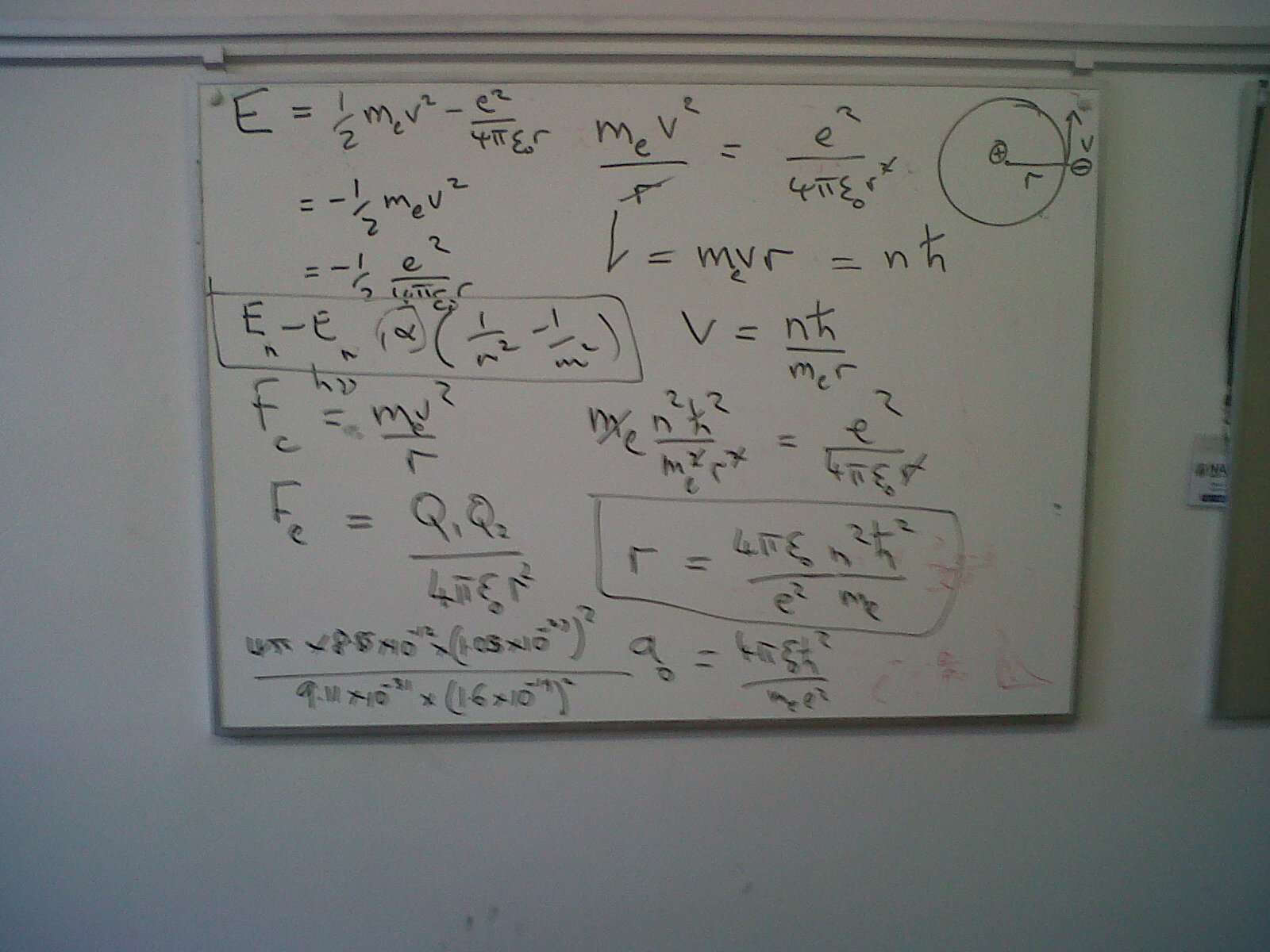
Oh what fun it is to derive the Bohr radius. At least the camera on my Blackberry works!

My Blackberry (still) is not Working!

Posted in Uncategorized with tags , , on October 13, 2011 by telescoper

Who needs the University of Wales?

Posted in Education, Politics with tags , , , , , , on October 12, 2011 by telescoper

I couldn’t resist a quick  and possibly inflammatory, comment about the University of Wales affair.

I’m not sure how much this story has spread outside Wales, but it’s relatively easy to summarise quickly.  The University of Wales has had a complicated history which I won’t go into details about, but in essence it used to be the only University in Wales; my current employer, Cardiff University, for example, was for a long time a College of the University of Wales.  In 1992 the special status of the University of Wales changed when the former Polytechnic of Wales became the University of Glamorgan. In subsequent years a number of institutions within the University of Wales, including the College of  Cardiff in 2004, sought and were granted the ability to award their own degrees rather than degrees accredited by the University of Wales and so effectively became independent. As  a consequence, the importance of the University of Wales in the landscape of Welsh Higher Education rapidly dwindled to the point where it was a “rump” of an institution accrediting degrees for just a few relatively small institutes.

Having spent some time in my career working in London, it seems to me that there’s at least superficially a  striking parallel between the situation in Wales and that surrounding the former colleges of the University of London, most of which now award their own degrees rather than University of London degrees. The University of London nevertheless still exists, though I’ve never really understood why.

It tends to be the case that administrative structures refuse to die a natural death but instead try to find new things to administer. In order to justify itself, the University of Wales diversified into accrediting degrees from a host of smaller institutions both at home and abroad.  To cut several long stories very short, much of its business in recent years has been dodgy to say the least.  The University of Wales’ involvement in visa scams and  the selling of bogus degrees are just two of the revelations that have led to many calling for the organisation to be scrapped altogether, prominent among them being the Welsh Assembly Minister responsible for higher education, Leighton Andrews.

The University of Wales “brand” has now become so tarnished that some of   Welsh Higher Education institutions whose degrees it accredits now seem anxious to sever their ties altogether. The University of Wales, Institute of Cardiff (UWIC) wishes to change its name to Cardiff Metropolitan University and award its own degrees.

I think it’s quite clear that the University of Wales is now damaged beyond repair and should be dissolved, although the mechanism by which this can be achieved is unclear as universities are  independent charitable institutions, not run directly from government.  So egregious has been the conduct of the senior management of this organisation, however, that I’m sure a way can be found to wind it up. I just can’t see how it can possibly survive these scandals.

Unfortunately, dissolution  in itself will not repair the damage already done; some institutions under the University of Wales umbrella will surely find that, through no fault of their own, a great deal of mud will stick.

Leighton Andrews has already called – rightly, in my view – for a reduction in the number of universities in Wales, most of which are small. In my neck of the woods, South-east Wales, for example, a game of musical mergers has been going on for months already between UWIC, Glamorgan and the University of Wales, Newport but no concrete plans have emerged. In my opinion the region can only sustain one world-class, research intensive university and one teaching led “new” university. Will  the  chaos generated by the public disintegration of the University of Wales make it easier or harder to achieve this?

But I can’t help feel sad about the inevitable demise of the University of Wales, which seems to me to be more of a tragedy than a farce. Its problems can all be traced back to the terrible decision,  taken by the Conservative government in 1992, to allow the polytechnics to call themselves universities. Wales was much better off when it had one University and one Polytechnic, and neither had to prostitute itself to make ends meet.

Wave your hands and think of Astronomy….

Posted in The Universe and Stuff with tags on October 12, 2011 by telescoper

Here’s a short video presentation in which it is demonstrated that astronomers like to move their hands while talking. It’s frightfully amusing, but I can’t help thinking it would have been even better if the musical accompaniment had been, well, musical. Anyway, keep watching until 2:17 or thereabouts and you’ll see that I have a small part.