Archive for February, 2012

Why not pardon Turing?

Posted in History, Politics with tags , , , , on February 9, 2012 by telescoper

I couldn’t resist a quick comment or two on the government’s decision not to issue a posthumous pardon to Alan Turing, in the matter of his his criminal conviction for homosexuality, recently announced by Lord McNally. This is Lord McNally’s reply to a question asked by Lord Sharkey:

The question of granting a posthumous pardon to Mr Turing was considered by the previous Government in 2009.

As a result of the previous campaign, the then Prime Minister Gordon Brown issued an unequivocal posthumous apology to Mr Turing on behalf of the Government, describing his treatment as “horrifying” and “utterly unfair”. Mr Brown said the country owed him a huge debt. This apology was also shown at the end of the Channel 4 documentary celebrating Mr Turing’s life and achievements which was broadcast on 21 November 2011.

A posthumous pardon was not considered appropriate as Alan Turing was properly convicted of what at the time was a criminal offence. He would have known that his offence was against the law and that he would be prosecuted. It is tragic that Alan Turing was convicted of an offence which now seems both cruel and absurd-particularly poignant given his outstanding contribution to the war effort. However, the law at the time required a prosecution and, as such, long-standing policy has been to accept that such convictions took place and, rather than trying to alter the historical context and to put right what cannot be put right, ensure instead that we never again return to those times.

In other words he is using the argument that Turing was properly convicted of behaviour that was considered an offence at the time so that conviction should not be negated.

This argument is entirely specious. A pardon is an act of clemency or forgiveness, exercised under the royal prerogative whenever advised by the government. It is not the mechanism for overturning wrongful convictions, so the observation that this conviction was lawful at the time is a red herring. Moreover, in what I consider to be an entirely analogous situation, all soldiers convicted and executed for cowardice in World War I actually received pardons in 2006. Their actions were also considered punishable at the time. This sets a clear precedent. Why is the Turing case logically different?

The answer to that is that if Turing were to receive a pardon, why should all the other gay people convicted of the criminal offence of being homosexual not also receive pardons? Why does it matter logically in this case that Turing was a brilliant mathematician who made immense contributions to the Allied effort during World War II? What about those gay men who were prevented from joining the services because of their sexuality? Why should one’s brilliance or eminence in a given field lead one to be treated differently under the law? Wouldn’t that just be saying “yes, he was gay, which is a problem, but we’ll forgive him because he made up for it in other ways”?

I think the government’s primary motivation for denying a pardon in this case is in fact the argument I just gave: that they should then have to pardon everyone convicted of homosexuality…

Of course you might ask in that case why it is that people are campaigning for a pardon for Turing in particular? Why not campaign for a universal pardon? I admit that it’s slightly illogical to do so, but it’s a question of pragmatism. Arguing the case for Turing in particular provides a focus which hopefully will lead to a wider resolution of the issue.

Asking for a posthumous pardon isn’t asking for very much, but I suspect the government is more worried about those people still alive who were convicted of homosexuality before 1967, which is when such acts were decriminalized. The case for denying pardons in this situation, when pardons were granted in the case of the executed WWI troops, therefore rests entirely on the possibility that there may be some pesky people who were convicted of homosexuality in the past but who unfortunately, unlike Turing, are not yet dead.

That’s the message this decision sends from the government to gay people.

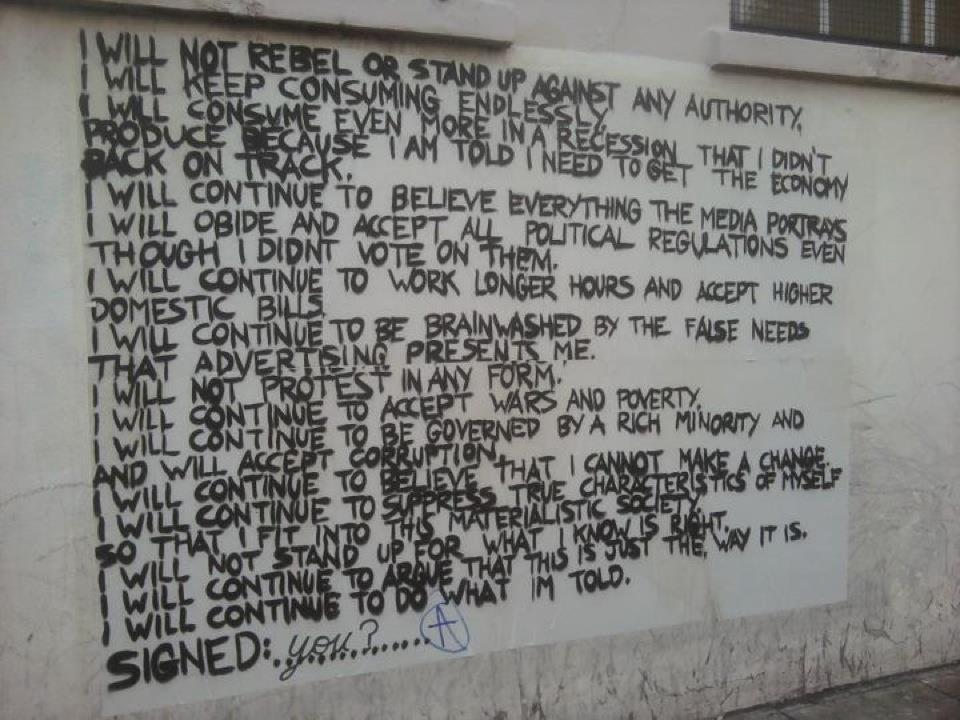
Graffiti Politti

Posted in Art, Politics with tags , , , on February 9, 2012 by telescoper

Sonnet No. 29

Posted in Poetry with tags , on February 8, 2012 by telescoper

When, in disgrace with fortune and men’s eyes,
I all alone beweep my outcast state
And trouble deaf heaven with my bootless cries
And look upon myself and curse my fate,
Wishing me like to one more rich in hope,
Featured like him, like him with friends possess’d,
Desiring this man’s art and that man’s scope,
With what I most enjoy contented least;
Yet in these thoughts myself almost despising,
Haply I think on thee, and then my state,
Like to the lark at break of day arising
From sullen earth, sings hymns at heaven’s gate;
For thy sweet love remember’d such wealth brings
That then I scorn to change my state with kings.

Sonnet No. 29, by William Shakespeare (1564-1616)

Sinfonia Antarctica

Posted in History, Music with tags , , , , , , , , on February 8, 2012 by telescoper

Just time for a quick post while I eat my breakfast this morning about last night’s Scott Centenary Concert at St David’s Hall Cardiff. The concert was given by the City of London Sinfonia (conducted by Stephen Layton) and last night’s performance was actually the third date in a tour which takes them next to Cheltenham and then to the Cadogan Hall in London. I mentioned this concert in a post last week.

The main music for the evening was written by Vaughan Williams. The concert started with excerpts from his score for the 1948 film Scott of the Antarctic, interspersed with dramatic readings from Scott’s own diaries and letters, by actor Hugh Bonneville. Apparently Vaughan Williams found the subject matter of the film so compelling that he wrote a huge amount of music, most of it before even seeing the screenplay, and only a small part was actually used in the movie soundtrack. He later re-worked much of this material into a full symphony, The Sinfonia Antarctica, his 7th, which was performed in full after the interval. Musically speaking, therefore, the opening piece was really a taster for the full work, but the readings were deeply moving.

Scott kept full diaries all the way from the beginning to the end of the expedition so they describe the journey in remarkable detail, and with no little poignancy. The initial optimism gradually tempered turned to crushing disappointment when they discovered that Amundsen had beaten them to the South Pole. When they turned  home to try to reach safety before the Antarctic winter closed in around them, Scott’s diary asks for the first time “I wonder if we’ll make it.”  Passages describing the awful death of Petty Officer Evans and Captain Oates’ noble sell-sacrifice were included, and the last terrible days when, without food or fuel, the three remaining companions were entombed in their tent by a raging blizzard, were depicted by Scott’s increasingly fragmentary and heartbreaking notes. One can’t really imagine the depth of their suffering, of course, but the desolation of their last hours is obvious. Their bodies were not found until 8 months later.

Before the interval we heard a new commission, Seventy Degrees Below Zero, by Cecilia McDowell, featuring tenor Robert Murray. This was an orchestral setting of various parts of the scientific record of Scott’s Last Expedition. I have to say I didn’t really like the piece: the vocal lines lacked interest and the orchestral music lacked any real sense of variation or development. Robert Murray struggled to project, his rather thin tenor voice not really suited to the music.

After the interval we had a complete performance of the Sinfonia Antarctica. Although I enjoyed it very much, I’m still not sure how well this hangs together as a symphony. There’s no doubt, however,  that it contains a number of strokes of genius. The opening theme, heard at various points later on in the piece, manages to conjure up  the Antarctic landscape – not only the snow and ice but also its singular desert-like aridity – as well as a deep sense of tragedy. The second movement featuring soprano Katherine Watson and women’s voices from the Bath Camerata and Wells Cathedral School Chamber Choir in wordless singing produced a wonderful unearthly atmosphere. Later on, there’s a passage featuring an organ which gave me the chance to  hear he magnificent organ at St David’s Hall for the first time.

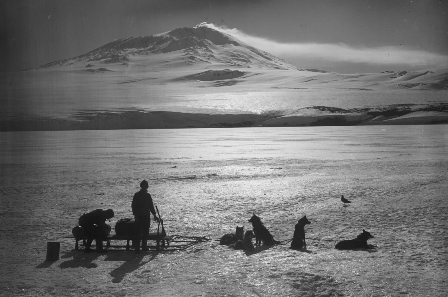
Projected above the orchestra throughout the performance were still photographs actually taken during the expedition. Some of these – like the one shown above – were stunning, but after a while I found them a bit of a distraction from the music.

Overall, an interesting concert rather than a brilliant one, which was well received by the (relatively small) audience at St David’s.

Cambridge Entrance Examination – Mathematics for Natural Sciences (1981)

Posted in Biographical, Education with tags , , , on February 7, 2012 by telescoper

I thought I’d take 5 minutes this lunchtime to add another item to the collection of old examination papers I’ve been posting, as someone asked me about this type of examination via a comment recently. This is the Mathematics paper I took way back in November 1981 for entry the following October to do Natural Sciences. I also took papers in Physics and Chemistry, as well as a General paper. Looking at this after a gap of over 30 years it looks pretty tough. One thing I should point out, though, is that the timing of the paper required us to come back after A-levels for an extra term (“the seventh term”)  at my school, the Royal Grammar School in Newcastle,  to form the “Third Year Sixth” who were all Oxbridge candidates. We were then intensively coached for the entrance examination. You will notice, for example, a couple of questions on this paper relating to group theory, which wasn’t on the A-level syllabus but which we were taught specifically for this examination. Some schools couldn’t offer this specialist teaching so pupils from them were significantly disadvantaged by this form of selection. As it happens, I answered both the (relatively easy) questions on group theory and got in to Cambridge…

Comments on the content and/or difficulty are welcome through the box below!

Astronomy Look-alikes, No. 73

Posted in Astronomy Lookalikes with tags , , on February 6, 2012 by telescoper

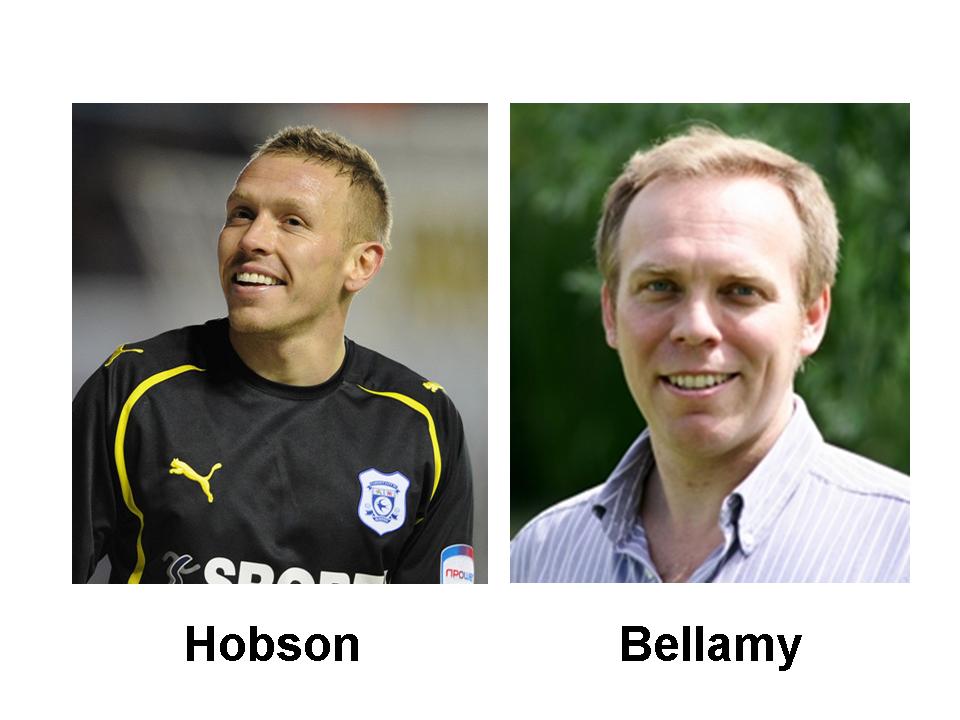
I think Cambridge astrophysicist Mike Hobson bears more than a passing resemblance to  Norwich City  Coventry City Newcastle United Blackburn Rovers Liverpool West Ham United  Manchester City Cardiff City  Liverpool  striker Craig Bellamy. I wonder if, by any chance, they might be related?

Leave the kids alone!

Posted in Education, Literature with tags , , , , on February 6, 2012 by telescoper

I’ve been annoyed ever since I woke up this morning because there was an item on the 7am news that irked me. A person called Claire Tomalin was quoted as saying, among other things, that

Children are not being educated to have prolonged attention spans and you have to be prepared to read steadily for a Dickens novel and I think that’s a pity.

She goes on to lay most of the blame for this shortcoming on television, as such people tend to do.

It’s a facile argument. For one thing most of Dickens’ novels were originally published in short installments, so reading them  that way seems quite a sensible approach to me, and one that should probably be encouraged not criticized.  There’s no getting away either from the fact that some of Dickens’ output is very heavy going indeed. Dare I say that not all Dickens is particularly good? Not liking Dickens is a matter of taste, not a mental defect caused by watching Big Brother.

And another thing: what fraction of children in Dickens’ time could read at all? Much lower than today, I suspect.

Claire Tomalin’s comment is  not just a lazy generalization, it’s also yet another easy shot at the  younger generations who have to put up with this sort of gibe from middle-aged grouches over and over again.

Examination results usually provoke similar outbursts, related to “dumbing down”. I actually do think that, at least in some subjects, examinations are much easier than they were “in my day”, but I don’t think that’s a reason to criticize the examinees. It’s more a fault with the examiners, who have decided that the young can’t cope with difficult challenges. That’s an insult in its own right. I maintain my view that education, especially higher education, is not about making things easy.  It’s about showing students that they can do things that are hard. Most importantly, though, dumbing down examinations is not the same as dumbing down people.

It’s not just young schoolkids that attract such ill-informed invective. I come across it quite regularly with respect to the (alleged) lack of skills possessed by the young adults (usually 18-22) we teach as undergraduates, some of it even from colleagues.

I was thinking the other day what a boon it is for a middle-aged fogey – and obvious potential grouch – like myself to have the pleasure of actually talking to so many younger people at work, and listening to what they have to say. That way I’ve come to my own conclusions about what they’re really like. You know, like you do with people. Most folk  of my age don’t have jobs that bring them into contact with younger folk, so they have  to rely on articles in the Daily Telegraph to tell them  what to think. That, sadly, even goes for those lecturers who have fixed ideas about the inferiority of “students nowadays”.

I think I’ve been very lucky, especially over the last few years, to have had the opportunity to work with a wide range of students as, e.g., project supervisor or tutor. Interactions like this provide a constant reminder not to generalize about the generations. There is of course a range of ability and commitment, but there was in my day too. The majority  still work hard,  learn quickly, and are friendly and courteous. There’s also no doubt in my mind that the best students nowadays are as good as they have ever been, if not better.

It’s the oldies who are the problem.

A Shared Disservice

Posted in Biographical, Science Politics with tags , , , , , on February 5, 2012 by telescoper

If you’ve never heard of the Shared Services Centre then you’re a very lucky person. If you have heard of it, and especially if you’ve had any dealings with it, then the following excerpt  from the SSC website description of itself will make you either laugh or cry:

The UK’s seven Research Councils, working together as Research Councils UK (RCUK), set up a shared services centre to reduce spend on administration. Sharing and standardising processes simply frees more funds for keeping the UK at the forefront of research and innovation.

Each year the Research Councils invest around £2.8 billion in research into understanding and improving the world around us. They’re involved in everything from tackling superbugs or studying social trends to analysing the geo-climate of the Antarctic. So, operating efficiently benefits our whole society.

What is more, sharing services does not mean compromising quality. The RCUK Shared Services Centre Ltd (SSC) is dedicated to providing exceptional standards of service in Human Resources, Finance, Procurement, IT IS and Grants administration. Our people achieve this by sharing their skills, knowledge and our vision:

‘Professional people working together, delivering quality services for the benefit of the research community’

The italics are mine. I added them  to sections that made me laugh out loud.  In fact almost all the above description of the SSC is complete tripe. The organization is a  fiasco. It has cost more than twice its original budget to implement and since its inception the quality of research administration has deteriorated beyond all recognition. The only thing I’ll say about the statement quoted above is that George Orwell would have been very proud.

This has serious consequences for those dependent for funding on the Research Councils, including the Science and Technology Facilities Council (STFC), which has been forced to use the Shockingly Shambolic Catastrophe to administer the grants it issues.  The time taken to process and issue grants is now far longer than it was previously, when such tasks were done by people who actually knew (and cared about) what they were doing.

I’m told by reliable sources that the whole SSC debacle is such an embarrassment that staff employed by the Research Councils have been forbidden to say negative things about it and have instead to pretend everything is just hunky-dory lest the mess damages the reputations of their political masters in BIS.  The result of this strategy is that BIS now think the SSC is doing a fabulous job and are going to expand its activities across other departments. If nobody blows the whistle on it, the SSC behemoth will gradually take over the entire government and turn everything into crap. Or perhaps that has already happened?

Anyway, I’m far too old to play David versus Goliath in this particular battle. I’ll leave that to the continuing efforts of, e.g., Private Eye. But I will give you a tiny – and not particular important – illustration of how useless the SSC really is. I’m one of those people who has to fill in a self-assessment tax return every year. It’s not too difficult to do because I retain a chap to organize my accounts and in any case   income I receive on top of my main salary is usually documented in the various P60s I get at the end of each tax year. Except this year I didn’t get a P60 for the work I did for STFC on the Astronomy Grants Panel. Such payments are also administered by SSC, and it is their statutory responsibility to provide a P60, but despite repeated attempts to extract one, I didn’t get it  in time for the January 31st deadline. I therefore filed my return with estimated figures and an explanatory note.

Finally SSC replied. It seems they had decided to send my P60 to my old address in Nottingham, along with a number of other items of correspondence. Why they did so I have no idea, as I moved from there in 2008. I told STFC my new address at that time, and have been receiving various bits and bobs from them at my correct address since then. Moreover, SSC have been sending items here too, so they do have the right details. Only it seems I’ve been getting letters from Finance, whereas the tax stuff is dealt with by the dreaded Human Resources. As seems inevitable with large bureaucracies, the different parts clearly do not communicate with each other.

Anyway, to cut a very long story very short, after I filed my tax return I finally received an email from SSC explaining what had happened. It also said that it was not possible to issue a duplicate P60, but they were attaching a statement of earnings and tax paid. Only there was no attachment. I emailed back to ask what had happened to the attachment. Three days later I got a reply with the attachment. The email began “Dear Professor Collins…”.

Curiously the attachment – when it finally was sent – arrived in encrypted form “for security”. A bit of a waste of time, methinks, when they’ve been posting confidential documents to the wrong address for more than three years!

I’ve corrected my tax return in the light of the new information they sent, but I may still be liable for some sort of surcharge. It’s clearly the fault of the SSC, but there’s no symmetry in tax affairs. If Joe Bloggs is late or makes an error, he gets stamped on by the Inland Revenue. If a government agency messes up it probably gets away scot free.

This is all small potatoes of course, but the dire state of their record-keeping in a trivial case like mine makes me worry about what might be going wrong with more serious things…

I have the feeling that there might be one or two people out there with SSC stories of their own. Do feel free to share them via the comments box.

Spellbound

Posted in Poetry with tags , , on February 4, 2012 by telescoper

The night is darkening round me,
The wild winds coldly blow;
But a tyrant spell has bound me
And I cannot, cannot go.

The giant trees are bending
Their bare boughs weighed with snow.
And the storm is fast descending,
And yet I cannot go.

Clouds beyond clouds above me,
Wastes beyond wastes below;
But nothing dear can move me;
I will not, cannot go.

by Emily Brontë (1818-1848)

Winterreise – Das Wirtshaus

Posted in Art, Music with tags , , , on February 4, 2012 by telescoper

It’s cold again, and it’s just  started snowing, so here’s some wintry music. I know that the recording of Winterreise by Benjamin Britten and Peter Pears is by no means everyone’s favourite version, but I like it a lot. There’s the added bonus in this video of a glimpse of the art of Caspar David Friedrich.

P.S. Das Wirtshaus means “The Inn”, but in the poem by Müller that forms the lyric for this song, the inn is actually a graveyard…