We’re enjoying a spell of perfect weather at the moment, so I’m going to be out most of the afternoon enjoying the flowers and trees in Bute Park. I assume I’m not in danger of being run over by a lorry speeding along the paths, since I don’t think they work on Sundays. Anyway, BBC Radio 3 is devoting the period until the end of March to a “Spirit of Schubert” festival, so I thought I’d join in by posting an appropriately seasonal ditty. This is Im Frühling (D. 882) (“In Spring”), sung by Peter Pears with piano accompaniment by Benjamin Britten way back in 1950. Gives me a lovely glow inside listening to this. I hope you feel the same..
Follow @telescoperArchive for March, 2012
Im Frühling
Posted in Music with tags Benjamin Britten, Franz Schubert, Peter Pears on March 25, 2012 by telescoperDespair
Posted in Poetry with tags H. P. Lovecraft, Poetry on March 24, 2012 by telescoperO’er the midnight moorlands crying,
Thro’ the cypress forests sighing,
In the night-wind madly flying,
Hellish forms with streaming hair;
In the barren branches creaking,
By the stagnant swamp-pools speaking,
Past the shore-cliffs ever shrieking;
Damn’d daemons of despair.
Once, I think I half remember,
Ere the grey skies of November
Quench’d my youth’s aspiring ember,
Liv’d there such a thing as bliss;
Skies that now are dark were beaming,
Gold and azure, splendid seeming
Till I learn’d it all was dreaming—
Deadly drowsiness of Dis.
But the stream of Time, swift flowing,
Brings the torment of half-knowing—
Dimly rushing, blindly going
Past the never-trodden lea;
And the voyager, repining,
Sees the wicked death-fires shining,
Hears the wicked petrel’s whining
As he helpless drifts to sea.
Evil wings in ether beating;
Vultures at the spirit eating;
Things unseen forever fleeting
Black against the leering sky.
Ghastly shades of bygone gladness,
Clawing fiends of future sadness,
Mingle in a cloud of madness
Ever on the soul to lie.
Thus the living, lone and sobbing,
In the throes of anguish throbbing,
With the loathsome Furies robbing
Night and noon of peace and rest.
But beyond the groans and grating
Of abhorrent Life, is waiting
Sweet Oblivion, culminating
All the years of fruitless quest.
by H.P. Lovecraft (1890-1937)
Posted (a bit late) to mark the 75th anniversary of Lovecraft’s death on March 15th 1937. You can see the very strong influence of Edgar Allen Poe’s The Raven on this poem…
Follow @telescoperSêr Cymru
Posted in Science Politics with tags Cardiff University, John Harries, Sêr Cymru, Star Wales on March 24, 2012 by telescoperThe Welsh Government’s vision for a world-leading science base in Wales was unveiled on Thursday 15 March during a keynote address by Wales’ Chief Scientific Officer, Professor John Harries, who delivered a public lecture at Cardiff University to reveal how he thinks this strategic agenda can steer Welsh science and engineering into the future.
Here is the lecture in its entirety
One the principal components this strategy is the Sêr Cymru (“Star Wales”) project which will involve expenditure of about £50 million over 5 years to attract research leaders to Wales. This announcement attracted quite a lot of local news coverage, e.g in the Western Mail, but it isn’t exactly a new proposal. In fact I blogged about it several months ago. Here is a summary of the points I made back then together with some new comments.
The basic point is that Welsh universities currently only attract about 3% of the UK’s total research funding whereas the famous Barnett formula allocates Wales about 5% of the total in other areas of public expenditure. Nobody involved in research would argue for funds to be allocated on any other basis than through quality, so there’s no clamour for having research funding allocated formulaically a là Barnett; the only way to improve the success rate is to improve the quality of applications. John Harries suggests that means poaching groups from elsewhere who’ve already got a big portfolio of research grants…
The problem with that strategy is that it’s not very easy to persuade such people to leave their current institutions, especially if they’ve already spend years acquiring the funding needed to equip their laboratories. It’s not just a question of moving people, which is relatively easy, but can involve trying to replace lots of expensive and delicate equipment. The financial inducements needed to fund the relocation of a major research group and fight off counter-offers from its present host are likely to be so expensive that the benefit gained from doing this takes years to accrue, even they are successful.
I agree with Prof. Harries that Welsh universities need to raise their game in research, but I don’t think this “transfer market” approach is likely to provide a solution on its own. I think Wales needs a radical restructuring of research, especially in science, across the whole sector, which I think is unacceptably complacent about the challenges ahead.
For a start, much more needs to be done to identify and nurture younger researchers, i.e. future research stars rather than present ones. Most football clubs nowadays have an “academy” dedicated to the development of promising youngsters, so why can’t we do a similar thing for research in Wales? Research groups in different Welsh universities also need to develop closer collaborations, and perhaps even full mergers, in order to compete with larger English institutions.
More controversially, I’d say that the problem is not being helped by Welsh universities continuing to be burdened by the monstrous bureaucracy and bizarre practices of the Research Excellent Framework, which allocates “QR” research funds according to priorities set by HEFCE in a way that reflects the thinking of the Westminster parliament. The distribution of QR funding in Wales, which is meant to supplement competitive grant income from UK funding bodies, should be decided by HEFCW in line with Welsh strategic priorities. Wales would be far better off withdrawing from the REF and doing its own thing under the auspices of the Welsh Assembly Government.
In fact there are dark rumours circulating that HEFCW will not have enough money to pay any QR funding anyway. If that’s true then the widening funding gap between Wales and England will do more damage than can possibly be remedied by importing a few big shots from elsewhere. The sum involved (£50 million) seems like a lot, but it won’t pay for more than a few groups around Wales if they are in experimental science or engineering technology, because the cost of setting up new labs and acquiring new equipment is considerable. Although buying in mercenaries might be of short-term benefit, what are the chances that they’ll take someone else’s dollar in the near future?
Wales needs a sustainable research base, so at very least I’d like to see a bottom-up project, encouraging younger researchers at PhD and PDRA level, perhaps through a system of national fellowships, to complement the “top-down” of the Star Wales project. Unless that happens, we might have leaders with no-one to follow them.
Follow @telescoperVISTA on Video
Posted in The Universe and Stuff with tags astronomy, ESO, European Southern Observatory, Paranal, UltraVISTA, VISTA on March 23, 2012 by telescoperA chance tweet brought to my attention this video that fits well with a news story that’s been doing the rounds for a few days. This concerns a very deep and wide survey called UltraVISTA, that has been made using the VISTA telescope at the European Southern Observatory’s Paranal Observatory in Chile. You can find the full press release from ESO that started the media interest here, where some lovely images can also be found.
VISTA is the world’s largest infra-red survey telescope, and is unusual among telescopes for having only one instrument on it, an Infra-red camera. Technically, therefore, it should really be called ISTA; owing to cost constraints the Visible camera that was initially proposed to accompany the Infra-red one and supply the V in its acronym, was never built. Anyway, VISTA was designed explicitly to do survey work involving very distant and faint objects; its forte is to allow very deep images to be made with a very wide field of view, as demonstrated on the video…
Since I’m using the handle “telescoper” on this blog, I suppose I really should post about telescopes a bit more often than I do but I hope this will do for now!
Follow @telescoperLines Written in Early Spring
Posted in Poetry with tags Lines written in early Spring, William Wordsworth on March 23, 2012 by telescoperI heard a thousand blended notes,
While in a grove I sate reclined,
In that sweet mood when pleasant thoughts
Bring sad thoughts to the mind.
To her fair works did Nature link
The human soul that through me ran;
And much it grieved my heart to think
What man has made of man.
Through primrose tufts, in that green bower,
The periwinkle trailed its wreaths;
And ’tis my faith that every flower
Enjoys the air it breathes.
The birds around me hopped and played,
Their thoughts I cannot measure:–
But the least motion which they made
It seemed a thrill of pleasure.
The budding twigs spread out their fan,
To catch the breezy air;
And I must think, do all I can,
That there was pleasure there.
If this belief from heaven be sent,
If such be Nature’s holy plan,
Have I not reason to lament
What man has made of man?
by William Wordsworth (1770-1850)
Follow @telescoperB2FH
Posted in The Universe and Stuff with tags Cardiff Scientific Society, Fred Hoyle, Geoffrey Burbidge, Margaret Burbidge, Mike Edmunds, Nuclear Physics, Origin of the Chemical Elements, Physics, Willie Fowler on March 22, 2012 by telescoperI spent a pleasant evening yesterday at a public lecture arranged by Cardiff Scientific Society and given by Professor Mike Edmunds, former Head of the School of Physics & Astronomy at Cardiff University and now Emeritus Professor here. The subject of his talk was Origin of the Chemical Elements, a subject Mike has worked on for many years. Here’s the abstract of his talk:
When the Universe was 300,000 years old, the only chemical elements with significant abundance were hydrogen, helium and a small amount of lithium. All the atoms of all the other elements in the Periodic Table have been synthesised during the 13.7 billion years since that time. Research in physics and astronomy over the last 64 years has allowed us to identify the nuclear processes involved, including the importance of the humble neutron in the manufacture of the heavier elements. We now have a good picture of the astronomical sites where elements such as the carbon, nitrogen, oxygen and iron in our bodies were made, including violent supernova explosions. It is a picture that appears almost, but not quite, complete.
That last sentence is tempting fate a bit, but it’s fair comment! The lecture, which I had the pleasure of chairing, was both entertaining and informative, and very warmly received by the large audience in the Reardon Smith Lecture Theatre (in the National Museum of Wales).
Inevitably in a talk on this subject, the subject came up of the classic work of Burbidge, Burbidge, Fowler and Hoyle in 1957 (a paper usually referred to as B2FH after the initials of its authors). It’s such an important contribution, in fact, that it has its own wikipedia page…
This reminded me that one of the interesting astronomical things I’ve acquired over the years is a preprint of the B2FH paper. Younger readers will probably not be aware of preprints – we all used to post them in large numbers to (potentially) interested colleagues before publication to get comments – because in the age of the internet people don’t really bother to make them any more.
Anyway, here’s a snap of it.
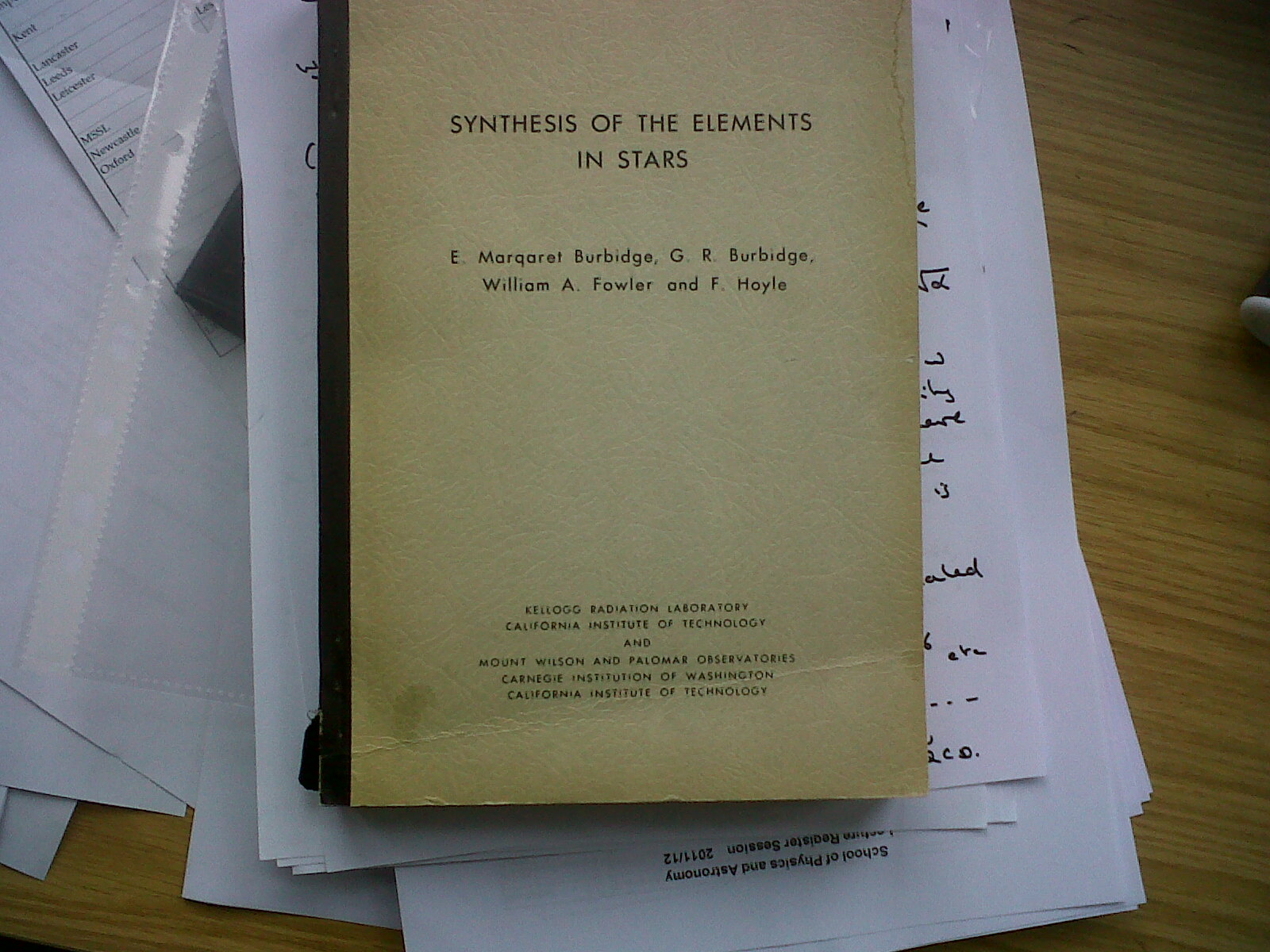
It’s a hefty piece of work, and an important piece of astronomical history. In years to come perhaps it may even acquire some financial value. Who knows?
Follow @telescoperTeaching Physics
Posted in Education, The Universe and Stuff with tags education, Physics, xkcd on March 22, 2012 by telescoper
The Budget – a Pictorial Guide
Posted in Finance, Politics with tags BBC Website, Budget 2012, Politics on March 21, 2012 by telescoper
Posted in Uncategorized on March 21, 2012 by telescoper
Elsevier redefines the meaning of “free”…their open access articles in fact cost over £10 each to download.

Well, I’ve spent a lot of time on this blog trying to determine what the terms are for Elsevier’s elective open-access articles — what they term “Sponsored Articles“. [For anyone who needs to catch up: part 1, part 2, part 3, unofficial part 3-and-a-bit, part 4.]
We are as far as ever from getting a good, clear, explicit statement like the one Springer provide on their “Open Choice” page (“all Open Choice articles are published under the Creative Commons Attribution (CC BY) license”. There — that wasn’t so hard, was it?) But we do have an important new nugget of information, thanks to a pair of tweets from Erin McKiernan (@emckiernan13).
—
We start at this page, the table of contents for Neuron 73(5). Neuron is published by Cell Press, which is an imprint of Elsevier. As you…
View original post 375 more words
A Style of Loving
Posted in Poetry with tags A Style of Loving, Poetry, Vikram Seth on March 21, 2012 by telescoperLight now restricts itself
To the top half of trees;
The angled sun
Slants honey-coloured rays
That lessen to the ground
As we bike through
The corridor of Palm Drive.
We two
Have reached a safety the years
Can claim to have created:
Unconsummated, therefore
Unjaded, unsated.
Picnic, movie, ice-cream;
Talk; to clear my head
Hot buttered rum — coffee for you;
And so not to bed.
And so we have set the question
Aside, gently.
Were we to become lovers
Where would our best friends be?
You do not wish, nor I
To risk again
This savoured light for noon’s
High joy or pain.
by Vikram Seth (b. 1952).
Follow @telescoper
 In the Dark