Archive for June, 2012

The Higgs Buzz

Posted in The Universe and Stuff with tags , , , , on June 19, 2012 by telescoper

Reaction to rumours about the Higgs, and a not-entirely good-tempered comment thread about the ethics of blogging. All in a day’s work for a particle physicist, I guess! Read the inside story on this post…

..and if you read this article you’ll see where the rumour originated.

Matt Strassler's avatarOf Particular Significance

The rumors about the Higgs particle at the Large Hadron Collider [LHC] have begun again, and since that’s all anyone is going to want to talk about until we actually get the news for real, at the ICHEP conference in Melbourne in a couple of weeks, we may as well get started.

[This is especially true since we learned last year that some well-known non-particle-physicist bloggers have information pipelines directly into the experiments.  It is perhaps inevitable that there are scientists who see it in their best interest to subvert the scientific process.]

The current hot rumor is that the LHC experiments ATLAS and CMS have seen, in the new 2012 data, very roughly what they saw last December in the 2011 data, at least as far as the signal from a Higgs decaying to two photons (particles of light) in the mass range of 125 GeV/c2

View original post 1,101 more words

Opening Access – The Finch Report

Posted in Open Access with tags , , , on June 19, 2012 by telescoper

Just a quickie this morning for those of you who have been following the debate about Open Access to academic research. Yesterday saw the publication of the Finch Report which was commissioned by David Willetts at the end of 2011. Here’s part of the opening paragraph of the announcement:

The report of the Working Group chaired by Dame Janet Finch published on 18 June recommends a programme of action to enable more people to read and use the publications arising from research. Better, faster communication of research results will bring benefits for public services and for economic growth. It will also bring improved efficiency for researchers, and opportunities for more public engagement with research.

Sounds promising. Even more promising is the following statement you can find in the summary:

The principle that the results of research that has been publicly funded should be freely accessible in the public domain is a compelling one, and fundamentally unanswerable

However, it is a long report that also raises many difficulties, some real but many (in my opinion) imaginary. It will take a while to digest it and judge whether the momentum that seems to have been generated towards open access dissipates under pressure from the academic publishing industry, which has been lobbying vigorously in recent months. At first reading, however, I’m bound to say that it looks like a sell-out.

A particular worry is that the report favours the so-called “Gold” open access model in which authors pay up front to make their articles publicly available, rather than publishing them in journals to which access is restricted to subscribers. There’s a danger that this will simply provide the publishers with another way of profiteering and won’t save any money at all. In fact, as the Finch report says, phasing in such a system alongside the old one would cost an additional $50 million per year.

My favoured solution is to dispense with the academic journal racket altogether, and for researchers just to put their results on publicly accessible repositories, like the arXiv. Disciplines such as Physics and Astronomy could stop using journals immediately at no additional cost whatsoever, and with an enormous saving in library subscriptions. This option – the so-called “Green” Open Access – is favoured by most researchers but obviously not the academic publishing lobby. Of course this report could turn out to be an irrelevance, if UK researchers have the courage to go Green unilaterally.

I don’t really have time to do a full job on the Finch Report now, but fortunately you can find a number of commentaries already, including a blog piece by Stephen Curry, a piece by Alok Jha in the Grauniad, an item in the Times Higher, and an article on the BBC Website.

I feel I should also draw your attention to a related piece in the Daily Mail which, in a manner that’s typical for said organ, gets hold of the wrong end of the stick and proceeds to beat about the bush with it. At least it doesn’t claim that Open Access will have a devastating effect on house prices.

Anyway, I’m sure to return to this when I’ve had time to read the report thoroughly, but in the meantime please feel free to comment through the usual channel…

P.S. Let me also plug my recent piece on open access in the Guardian

Honours and Admissions

Posted in Politics, Science Politics with tags , , , on June 18, 2012 by telescoper

Time for a quick comment on the Queen Birthday Honours List for 2012 which, if you’re interested, you can download in full here.

The honours system must appear extremely curious to people from outside the United Kingdom. It certainly seems so to me. On the one hand, I am glad that the government has a mechanism for recognising the exceptional contributions made to society by certain individuals. Musicians, writers, sportsmen, entertainers and the like generally receive handsome financial rewards, of course, but that’s no reason to begrudge a medal or two in recognition of the special place they occupy in our cultural life.  It’s  good to see scientists recognized too, although they tend not to get noticed so much by the press.

First of all, therefore, let me congratulate space scientist, and occasional commenter on this blog, Professor Monica Grady on her award of a CBE. I also couldn’t resist commenting on the award of a knighthood to the Chair of the Science and Technology Facilities Council

..Professor Michael Sterling, who has turned round the Science and Technology Facilities Council

according to the official government announcement; the emphasis is mine. The phrase “turned around” is an interestingly frank way of putting it, and a refreshing admission from a very high level  that STFC was in disarray under its previous management.

Although I’m happy to see recognition given to such people, as I did last year on this occasion I can’t resist stating my objections to the honours system for the record. One is that the list of recipients  of certain categories of award is overwhelmingly dominated by career civil servants, for whom an “honour”  goes automatically with a given rank. If an honour is considered an entitlement in this way then it is no honour at all, and in fact devalues those awards that are  given on merit to people outside the Civil Service. Civil servants get paid for doing their job, so they should have no more expectation of an additional reward than anyone else.

Honours have relatively little monetary value on their own, of course so this is not question of financial corruption. An honour does, however, confer status and prestige on the recipient so what we have is a much more subtle form of sleaze. One wonders how many names listed in the current roll of honours are there because of political donations, for example.

I wouldn’t accept an honour myself, but that’s easy to say because I’m sure I’ll never be nominated for one. However, I imagine that even people like me who are against the whole system are probably still tempted to accept such awards when offered, as they generate good publicity for one’s field, institution and colleagues. Fortunately, having less than a cat in hell’s chance of being nominated, I’m never going to be tempted in that way!

Classical Fluids via Quantum Mechanics

Posted in The Universe and Stuff with tags , , , , , , on June 17, 2012 by telescoper

The subject of this post is probably a bit too technical to interest many readers, but I’ve been meaning to post something about it for a while and seem to have an hour or so to spare this morning so here goes. This is going to be a battle with the clunky WordPress latex widget too so please bear with me if it’s a little difficult to read.

The topic something I came across a while ago when thinking about the way the evolution of the matter distribution in cosmology is described in terms of fluid mechanics, but what I’m going to say is not at all specific to cosmology, and perhaps isn’t all that well known, so it might be of some interest to readers with a general physics background.

Consider a fluid with density \rho= \rho (\vec{x},t). The velocity of the fluid at any point is \vec{v}=\vec{v}(\vec{x},t). The evolution of such a fluid can be described by the continuity equation:

\frac{\partial \rho}{\partial t} + \vec{\nabla}\cdot (\rho\vec{v})= 0

and the Euler equation

\frac{\partial \vec{v}}{\partial t} + (\vec{v}\cdot\vec{\nabla})\vec{v} +\frac{1}{\rho} \vec{\nabla} P + \vec{\nabla} V = 0,

in which P is the fluid pressure (pressure gradients appear in the above equation) and V is a potential describing other forces on the fluid (in a cosmological context, this would include its self-gravity). To keep things as simple as possible, consider a pressureless fluid (as might describe cold dark matter) and restrict consideration to the case of a potential flow, i.e. one in which

\vec{v} = \vec{\nabla}\phi

where \phi=\phi(\vec{x},t) is a velocity potential; such a flow is curl-free. It is convenient to take the first integral of the Euler equation with respect to the spatial coordinates, which yields an equation for the velocity potential (cf. the Bernoulli equation):

\frac{\partial \phi}{\partial t} + \frac{1}{2} (\nabla \phi)^{2} + V=0.

The continuity equation becomes

\frac{\partial \rho}{\partial t} + \vec{\nabla}\cdot(\rho\vec{\nabla}\phi) = 0

This is all standard basic classical fluid mechanics. Now here’s the interesting thing. Introduce a new quantity \Psi defined by

\Psi(\vec{x},t) \equiv R\exp(i\phi/\nu),

in which R=R(\vec{x},t) and \nu is a constant. Using this construction, it turns out that

\rho = \Psi\Psi^{\ast}= |\Psi|^2=R^2.

After a little bit of fiddling around putting this in the previous equation you can obtain the following:

i\nu \frac{\partial \Psi}{\partial t} = -\frac{\nu^2}{2} \nabla^2{\Psi} + V\Psi + Q\Psi

which, apart from the last term Q and a slightly different notation, is identical to the Schrödinger equation of quantum mechanics; the term \nu would be  proportional to Planck’s constant h in that context, but in this context is a free parameter.

The mysterious term Q is pretty horrible:

Q = \frac{\nu^2}{2} \frac{\nabla^2 R}{R},

and it turns the Schrödinger equation into a non-linear equation, but its role can be understood by seeing what happens if you start with the normal single-particle Schrödinger equation and work backwards; this is the approach taken historically by David Bohm and others. In that case the term Q appears as a strange extra potential term in the Bernoulli equation which is sometimes called the quantum potential. In the context of fluid flow, however, the term describes  the the effect of pressure gradients that would arise if the fluid were barotropic. In the approach I’ve outlined, going in the opposite direction, this term is consequently sometimes called the “quantum pressure”. The parameter \nu controls the size of this term, which has the effect of blurring out the streamlines of the purely classical solution.

This transformation from classical fluid mechanics to quantum mechanics is not a new idea; in fact it goes back to Madelung who, in the 1920s, was trying to find a way to express quantum theory in the language of classical fluids.

What interested me about this approach, however, is more practical. It might seem strange to want transform relatively simple classical fluid-mechanical setup into a quantum-mechanical framework, which isn’t the obvious way to make progress, but there are a number of advantages of doing so. Perhaps chief among them is that the construction of \Psi means that the density \rho is guranteed positive definite; this means that a perturbation expansion of \Psi will not lead to unphysical negative densities in the same way that happens if perturbation theory is applied to \rho directly. This approach also has interesting links to other methods of studying the growth of large-scale structure in the Universe, such as the Zel’dovich approximation; the “waviness” controlled by the parameter \nu is useful in ensuring that the density does not become infinite at shell-crossing, for example.

Anyway, here are some links to references with more details:

http://adsabs.harvard.edu/abs/1993ApJ…416L..71W
http://adsabs.harvard.edu/abs/1997PhRvD..55.5997W
http://adsabs.harvard.edu/abs/2002MNRAS.330..421C
http://adsabs.harvard.edu/abs/2003MNRAS.342..176C
http://adsabs.harvard.edu/abs/2006JCAP…12..012S
http://adsabs.harvard.edu/abs/2006JCAP…12..016S
http://adsabs.harvard.edu/abs/2010MNRAS.402.2491J

I think there are many more ways this approach could be extended, so maybe this will encourage someone out there to have a look at it!

Mozart and Strauss, and the End of Term

Posted in Music with tags , , , , on June 16, 2012 by telescoper

Yesterday (Friday 15th June) was officially the last day of teaching term at Cardiff University. I think most of our students toddled off  some time ago when their last exams were finished,  so for us on the staff side the teaching term has fizzled out gradually rather than go out with a bang. Yesterday I met with a couple of next year’s project students to give them some background reading to do over the summer and that was that for another year of undergraduate teaching.

There was something of an “end-of-term” feeling too to last night’s concert at St David’s Hall, which was also broadcast live on BBC Radio 3; you can listen to it yourself by clicking on that second link. This was not only the last concert of the 2011/12 season by the BBC National Orchestra of Wales, but also  last concert at St David’s Hall to be conducted by Thierry Fischer, who has been principal conductor for the BBC NOW for the past six years. Next year Thomas Søndergård will take over.The concert turned out to be a fitting finale to the season and a fine farewell to Thierry Fischer.

The first item on the agenda was Mozart’s Piano Concerto No. 22 played by none other than the wonderful Angela Hewitt.  I wasn’t all that familiar with this piece beforehand, and was surprised to see such a large orchestra on stage before the start. Apparently  this work was the first time Mozart had used clarinets in a piano concerto, and the larger force than I’d normally have associated with a Mozart piece of this type gave the performance a much more opulent sound than I’d expected. It’s an interesting work, with a particularly fine Andante second movement which is both sombre and expansive sandwiched between two quicksilver Allegro movements, the last being a kind of rondo. Angela Hewitt played it with crisp elegance and perfect articulation. Some people find her playing a bit fussy and punctilious, and indeed there were times when I thought the performance could have had a bit more fire in it, but for my part it was a treat to get the chance to see a great artist in the flesh; she has an engaging presence on stage too, clearly enjoying the performance, and smiling from time to time in appreciation at the orchestral playing. We even got a nice little solo encore, which is quite unusual for a live broadcast from St David’s.

Then there was an interval so we could all check the football score, and guzzle a quick glass of overpriced wine before returning to hear the Alpine SymphonyOp. 64 by Richard Strauss. If the orchestra for Part 1 had been large by Mozartian standards, then this one was immense! Well over a hundred musicians, with a huge brass section (supplemented by many more standing off-stage and just visible to me through an open door), harps, percussion (including cow bells and a wind machine), and some unusual instruments including a Heckelphone (what the heck?…). Oh, and the fine organ in St David’s Hall got a full workout too.

Strictly speaking, this is not actually a symphony; it’s more of a tone poem. But Strauss was rather good at them and this one is a wonderful evocation of a day’s journey in the Bavarian Alps, from a resplendent dawn to a tranquil sunset, with summits to be scaled, thunderstorms to be endured, glaciers to be traversed, and so on. It’s certainly a very vivid piece of programmatic music.

As you might have inferred from huge band gathered on stage, this is a work that gets very loud, especially when the organist literally pulls out all the stops. What was especially fine about the performance was that, although the musicians of BBC NOW weren’t afraid to give it some welly whenever it was called for, their playing never became wild or ragged. I don’t know what it sounded like on the radio, but it was a thrilling experience to be in the hall.  I lost count of the number of towering crescendo passages, and just let the waves of wonderful noise wash over me. At times I could feel it through my feet too.

There were cheers at the end, and a standing ovation for Thierry Fischer not only for this performance but for his service to the BBC National Orchestra of Wales.  And that brought the term and the season to a close; both start again in late September 2012. There are some cracking concerts in store in the next season in St David’s Hall.

Power versus Pattern

Posted in Bad Statistics, The Universe and Stuff with tags , , , , , on June 15, 2012 by telescoper

One of the challenges we cosmologists face is how to quantify the patterns we see in galaxy redshift surveys. In the relatively recent past the small size of the available data sets meant that only relatively crude descriptors could be used; anything sophisticated would be rendered useless by noise. For that reason, statistical analysis of galaxy clustering tended to be limited to the measurement of autocorrelation functions, usually constructed in Fourier space in the form of power spectra; you can find a nice review here.

Because it is so robust and contains a great deal of important information, the power spectrum has become ubiquitous in cosmology. But I think it’s important to realise its limitations.

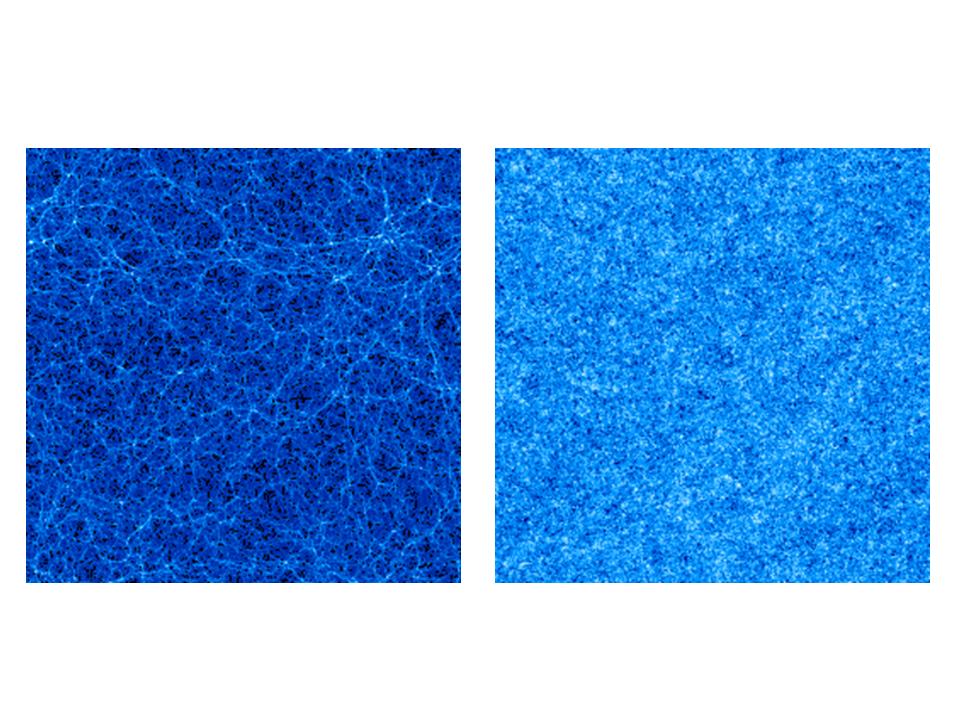
Take a look at these two N-body computer simulations of large-scale structure:

The one on the left is a proper simulation of the “cosmic web” which is at least qualitatively realistic, in that in contains filaments, clusters and voids pretty much like what is observed in galaxy surveys.

To make the picture on the right I first  took the Fourier transform of the original  simulation. This approach follows the best advice I ever got from my thesis supervisor: “if you can’t think of anything else to do, try Fourier-transforming everything.”

Anyway each Fourier mode is complex and can therefore be characterized by an amplitude and a phase (the modulus and argument of the complex quantity). What I did next was to randomly reshuffle all the phases while leaving the amplitudes alone. I then performed the inverse Fourier transform to construct the image shown on the right.

What this procedure does is to produce a new image which has exactly the same power spectrum as the first. You might be surprised by how little the pattern on the right resembles that on the left, given that they share this property; the distribution on the right is much fuzzier. In fact, the sharply delineated features  are produced by mode-mode correlations and are therefore not well described by the power spectrum, which involves only the amplitude of each separate mode.

If you’re confused by this, consider the Fourier transforms of (a) white noise and (b) a Dirac delta-function. Both produce flat power-spectra, but they look very different in real space because in (b) all the Fourier modes are correlated in such away that they are in phase at the one location where the pattern is not zero; everywhere else they interfere destructively. In (a) the phases are distributed randomly.

The moral of this is that there is much more to the pattern of galaxy clustering than meets the power spectrum…

Aedh wishes for the cloths of heaven

Posted in Poetry with tags , , , , on June 15, 2012 by telescoper

Had I the heavens’ embroidered cloths,
Enwrought with golden and silver light,
The blue and the dim and the dark cloths
Of night and light and the half light,
I would spread the cloths under your feet:
But I, being poor, have only my dreams;
I have spread my dreams under your feet;
Tread softly because you tread on my dreams.

by W.B. Yeats (1865-1939)

To the dark, and the endless skies….

Posted in Music with tags , on June 14, 2012 by telescoper

The Communications Data Bill is both Stupid and Wrong

Posted in Politics with tags , , , on June 14, 2012 by telescoper

No time for a lengthy post today, but then again I don’t think this topic merits one.

The government’s draft Communications Data Bill has now been published. The measures contained in this Bill would allow the security services to snoop at will on emails, web browsing, social network sites, internet phone calls, etc.

In other words it will give the government license to pry into personal communications between law-abiding individuals without any need for a warrant. The potential for abuse is obvious, so much so that it can only have been drafted by a government that intends to abuse it if and when it becomes law. It’s yet another deliberate erosion of our civil liberties and a further step towards a totalitarian state. Big Brother is here.

On top of all that, the proposed law is also entirely useless. All the measures proposed can be circumvented by anyone with even a rudimentary knowledge of IT. Even me. It won’t catch criminals, at least not important ones, because they’ll know the (easy) ways around it. This law will simply be used by the government to spy on anyone it doesn’t like the look of.

And that could be you.

My Even Newer Theory of the Universe

Posted in The Universe and Stuff with tags , , on June 13, 2012 by telescoper

I have decided this evening to unveil my new cosmological theory.

My previous work  was based on the idea that the Universe was obtained from the Swedish furniture and home accessory emporium IKEA. This “Easy Self Assembly” hypothesis dispenses with the need for creation from nothing, and also accounts naturally for the observed geometry of space (it came in a flat pack).

My subsequent study of this scenario has focussed on properties of the Universe that can’t be explained in the earlier version of the theory, specifically  the cosmic microwave background. However, making my supper just now I suddenly hit upon the answer to that particular puzzle. Clearly, wanting to achieve the best results possible, on his/her way back from IKEA the Divine Creator stopped off at Marks and Spencer …