Archive for November, 2012

Dond’escono quei vortici?

Posted in Education, Opera, The Universe and Stuff with tags , , , , on November 10, 2012 by telescoper

Just time for a quickie today. I seem to be writing that virtualy every day at this time, in fact. Anyway, yesterday I gave the last of a series of lectures on Fluid Dynamics during which I talked a little bit about the Navier-Stokes equation, and introduced the concept of turbulence, topic that Richard Feynman described as “the most important unsolved problem in classical physics”. Given that the origin of turbulence is so poorly understood, I had to cover it all fairly qualitatively but did at least explain that its onset is associated with high values of the Reynold’s Number, an interesting dimensionless number that characterizes the properties of viscous fluid flow in such a way as to bring out the dynamical similarity inherent in the equations. The difficulty is that there is no exact theory that allows one to calculate the critical value of the Reynold’s number and in any particular situation; that has to be determined by experiments, such as this one which shows turbulent vortices (or “eddies”) forming downstream of a cylindrical obstacle placed in flowing fluid. The (laminar) flow upstream, and in regions far from the cylinder, has no vorticity.

What happens is obviously extremely complicated because it involves a huge range of physical scales – the vorticity is generated by very small-scale interactions between the fluid elements and the boundary of the object past which they flow. It’s a very frustrating thing for a physicist, actually, because one’s gut feeling is that it should be possible to figure it out. After all, it’s “just” classical physics. It’s also of great practical importance in a huge range of fields. Nevertheless, despite all the progress in “exotic” field such as particle physics and cosmology, it remains an open question in many respects.

That’s why it’s important to teach undergraduates about it. Physics isn’t just about solved problems. It’s a living subject, and it’s important for students to know those fields where we don’t really know that much about what is going on…

PS. The title is a quotation from the libretto of Mozart’s opera, Don Giovanni, uttered by the eponymous Count as he is dragged down to hell. It translates as “Whence come these vortices?” Pretentious, moi?

RCUK is throwing money down a gold-plated drain

Posted in Open Access with tags , , , , , , on November 9, 2012 by telescoper

Right. Now I’m annoyed. Annoyed enough to dash off a quick post before getting the train to London to see this year’s RAS Gerald Whitrow Lecture.

RCUK, the umbrella organisation for the United Kingdom’s seven research councils, has announced that it will set aside £17 million next year, and £20 million the year after that, to pay for Gold Open Access publication of the research it sponsors. These funds will be made available to universities in the form of block grants to enable researchers to pay the infamous APCs  (“Article Processing Charges”). The average cost of an APC has been taken from the Finch report (estimated as £1727 plus VAT).

It’s astonishing that RCUK have fallen for this trap. What were they thinking of? The Finch report was clearly hijacked by the vested interests of the academic publishing industry who see the Gold Open Access model as an easy way of maintaining their profit margins at taxpayer’s expense. The new RCUK scheme will simply divert funds away from research into a subsidy for wealthy publishing houses (and, in some cases, the learned societies that run them). The actual cost of processing an article is nothing like £1727 and is any case borne by the people doing the work, i.e. academics who perform the refereeing usually for free. An APC at this level is simply a scam. That the RCUK has fallen for it is a disgrace.

What RCUK should have done was given universities and other research institutions funds to set up and maintain their own Green Open Access databases or international repositories like the arXiv. Throwing money at  Gold Open Access is disastrous way of proceeding. It’s not only ruinously expensive but also unsustainable. In a few years’ time it is inevitable that the traditional academic publishing industry will be bypassed by researchers doing it for themselves. All the money spent propping up the fat cats in the meantime will have been wasted.

However, despite its obvious stupidity, the RCUK did give me one idea. I’ve blogged before about how much learned societies such as the Institute of Physics “earn” from their own publishing houses. In effect, these outfits are living on income provided to them by hard-pressed university library budgets.  In such cases it can be argued that the profits at least remain within the discipline – the IOP does many good things with the money generated by its publishing arm – but is this actually an honest way of supporting the activities of learned societies?

Anyway, it seems clear to me that the financial model under which most learned societies, including the IOP, operate will not operate for much longer, as more and more researchers go for Green Open Access and more and more institutions cancel subscriptions to their ruinously expensive journals. How then can they survive in the long term?

Instead of  splashing money around for Gold Open Access,  RCUK should mandate that all its research be published in Green Open Access mode. That would pull the rug out from under the learned societies, but why not replace the funding they are syphoning off from journal subscriptions with direct block grants. Such grants would have to be audited to ensure that learned societies spend the money on appropriate things, and would probably amount to much less than such organizations currently receive. I don’t think that’s a bad thing. I think there’s a strong case for the IOP to be downsized, actually.

So there’s my suggestion. No RCUK subsidy for the academic publishing industry, but direct subsidies for the learned societies and Green Open Access to be compulsory for all RCUK funded institutions.

How’s that for a plan?

The Council for the Defence of British Universities

Posted in Education, Politics with tags , , on November 8, 2012 by telescoper

No time for a proper post today, but time to pass on news of the launch of a new independent campaigning body called The Council for the Defence of British Universities.

Here is the CDBU manifesto:

The Council for the Defence of British Universities is independent of any political party, for although we oppose many of the present government’s proposals, the assumptions to which we object were equally evident under its predecessor.

Our core principle is that the Council for the Defence of British Universities exists to advance university education for the public benefit. This is underpinned by nine supporting aims:

• To defend and enhance the character of British universities as places where students can develop their capacities to the full, where research and scholarship are pursued at the highest level, and where intellectual activity can be freely conducted without regard to its immediate economic benefit

• To urge that university education, both undergraduate and postgraduate, be accessible to all students who can benefit from it

• To maintain the principle that teaching and research are indispensable activities for a university, and that one is not pursued at the expense of the other

• To ensure that universities, while responding to the needs of students and society in general, should retain ultimate control of the content of the courses taught and the methods of instruction employed. As well as often providing vocational training, university education should equip graduates with the mental skills and intellectual flexibility necessary to meet the demands of a rapidly changing economy. It should develop the powers of the mind, enlarge knowledge and understanding, and enable graduates to lead fuller and more rewarding lives

• To emphasise that, as well as often having vital social and economic applications and being subject to accountability, academic research seeks to enhance our knowledge and understanding of the physical world, of human nature and of all forms of human activity

• To ensure that methods employed to assess the quality of university research do not encourage premature or unnecessary publication or inhibit the production of major works that require a long period of gestation

• To safeguard the freedom of academics to teach and to pursue research and enquiry in the directions appropriate to the needs of their subject

• To maintain the principle of institutional autonomy, to encourage academic self-government and to ensure that the function of managerial and administrative staff is to facilitate teaching and research

• To ensure that British universities continue to transmit and reinterpret the world’s cultural and intellectual inheritance, to encourage global exchange and to engage in the independent thought and criticism necessary for the flourishing of any democratic society.

For more information about the CDBU, including details on joining, you can visit their website.

If physicists analysed election results…

Posted in Bad Statistics, Politics, The Universe and Stuff on November 7, 2012 by telescoper

I think this is a wonderfully sharp satirical take on pollsters, physicists and statistics…

freakofnature's avatarFreak of Nature

Mainstream media outlets around the world have declared Barack Obama the victor in yesterday’s US presidential elections, but particle physicists at CERN say that the race is still too close to call.

With every state except Florida reporting, the New York Timesannounced that Obama had won the popular vote and easily gained the electoral college points needed to win re-election. The Princeton Election Consortium put the probability of Obama’s victory at 99.2%.

But that confidence level is still several standard deviations away from the point at which particle physicists would be willing to declare the next president. According to the norms of the field, pollsters would have to be 99.99995% confident that Obama had won before physicists would be willing to call the race.

“All we can say right now is there is some evidence that Barack Obama will return to the White House in January,” says Marcus Georgio…

View original post 237 more words

I Believe

Posted in Politics, Television with tags , , , , on November 7, 2012 by telescoper

I had decided to post this if last night’s  US Election result had turned out differently, but then thought I’d post it anyway.

Those of us of a certain age will remember the sense of incomprehension that spread around the world when Ronald Reagan was elected president of the United States in 1980 and were bracing themselves for similar trauma last night if Mitt Romney  had won. I’m sure I’m not the only person breathing a sigh of relief this morning. In deference to the losing candidate, I’ll echo the title of the song with a piece of Mitt Romney’s most inspirational rhetoric:

“I believe in an America where millions of Americans believe in an America that’s the America millions of Americans believe in. That’s the America I love.

Quite.

Anyway, lest you all get carried away with the euphoria of a second term for Barack Obama, I’ll say that although I’m glad  the electorate stepped back from the apocalyptic vision of a Romney victory, this is very much business as usual – with all that entails. Here is the late Gore Vidal’s summary of American politics (written in the 1970s).

 There is only one party in the United States, the Property Party … and it has two right wings: Republican and Democrat. Republicans are a bit stupider, more rigid, more doctrinaire in their laissez-faire capitalism than the Democrats, who are cuter, prettier, a bit more corrupt — until recently … and more willing than the Republicans to make small adjustments when the poor, the black, the anti-imperialists get out of hand. But, essentially, there is no difference between the two parties.

Taking Notes…

Posted in Education with tags , , , , on November 6, 2012 by telescoper

As if this week wasn’t busy enough, I’ve just received back the student questionnaires for my second-year module The Physics of Fields and Flows (which includes some theoretical physics techniques, such as vector calculus and Fourier methods, together with applications to fluid flow, electromagnetism and a few other things). I’ve only just taken up this module this year and was planning to prepare it over the summer, but circumstances rather intervened and I’ve had to put together more-or-less on the fly. I was, therefore, not inconsiderably apprehensive about the reaction I’d get from the students.

Fortunately most of the comments were fairly positive, although there were some very useful constructive criticisms, which I’ll definitely take into account for the rest of the term.

However, one recurring comment was that I write too fast on the whiteboard. In fact I go far more slowly than the lecturers I had at University. That brings me back to an old post I did some time ago about  lecture notes.

I won’t repeat the entire content of my earlier discussion, but one of the main points I made in that was about how inefficient many students are at taking notes during lectures, so much so that the effort of copying things onto paper must surely prevent them absorbing the intellectual content of the lecture.

I dealt with this problem when I was an undergraduate by learning to write very quickly without looking at the paper as I did so. That way I didn’t waste time moving my head to and fro between paper and screen or blackboard. Of course, the notes I produced using this method weren’t exactly aesthetically pleasing, but my handwriting is awful at the best of times so that didn’t make much difference to me. I always wrote my notes up more neatly after the lecture anyway. But the great advantage was that I could write down everything in real time without this interfering with my ability to listen to what the lecturer was saying.

An alternative to this approach is to learn shorthand, or invent your own form of abbreviated language. This approach is, however, unlikely to help you take down mathematical equations quickly.

My experience nowadays is that students simply aren’t used to taking notes like this – I suppose because they get given so many powerpoint presentations or other kinds of handout –  so they struggle to cope with the old-fashioned chalk-and-talk style of teaching that some lecturers still prefer. That’s probably because they get much less practice at school than my generation. Most of my school education was done via the blackboard..

Nowadays,  most lecturers use more “modern” methods than this. Many lecturers using powerpoint, and often they give copies of the slides to students. Others give out complete sets of printed notes before, during, or after lectures. That’s all very well, I think, but what are the students supposed to be doing during the lecture if you do that? Listen, of course, but if there is to be a long-term benefit they should take notes too.

Even if I hand out copies of slides or other notes, I always encourage my students to make their own independent set of notes, as complete as possible. I don’t mean copying down what they see on the screen and what they may have on paper already, but trying to write down what I say as I say it. I don’t think many take that advice, which means much of the spoken illustrations and explanations I give don’t find their way into any long term record of the lecture.

And if the lecturer just reads out the printed notes, adding nothing by way of illustration or explanation, then the audience is bound to get bored very quickly.

My argument, then, is that regardless of what technology the lecturer uses, whether he/she gives out printed notes or not, then if the students can’t take notes accurately and efficiently then lecturing is a complete waste of time. In fact for the module I’m doing now I don’t hand out lecture notes at all during the lectures, although I do post lecture summaries and answers to the exercises online after they’ve been done.

I like lecturing, because I like talking about physics and astronomy, but as I’ve got older I’ve become less convinced that lectures play a useful role in actually teaching anything. I think we should use lectures more sparingly, relying more on problem-based learning to instil proper understanding. When we do give lectures, they should focus much more on stimulating interest by being entertaining and thought-provoking. They should not be for the routine transmission of information, which is far too often the default.

I’m not saying we should scrap lectures altogether. At the very least they have the advantage of giving the students a shared experience, which is good for networking and building a group identity. Some students probably get a lot out of lectures anyway, perhaps more than I did when I was their age. But different people benefit from different styles of teaching, so we need to move away from lecturing as the default option.

I don’t think I ever learned very much about physics from lectures, but I’m nevertheless glad I learned out how to take notes the way I did because I find it useful in all kinds of situations. Effective note-taking is definitely a transferable skill, but it’s also a dying art.

Sometimes

Posted in Poetry with tags , on November 6, 2012 by telescoper

Sometimes things don’t go, after all,
from bad to worse. Some years, muscadel
faces down frost; green thrives; the crops don’t fail.
Sometimes a man aims high, and all goes well.

A people sometimes will step back from war,
elect an honest man, decide they care
enough, that they can’t leave some stranger poor.
Some men become what they were born for.

Sometimes our best intentions do not go
amiss; sometimes we do as we meant to.
The sun will sometimes melt a field of sorrow
that seemed hard frozen; may it happen for you.

by Sheenagh Pugh (b. 1950)

Fun with Vortex Rings

Posted in Education, The Universe and Stuff with tags , , on November 5, 2012 by telescoper

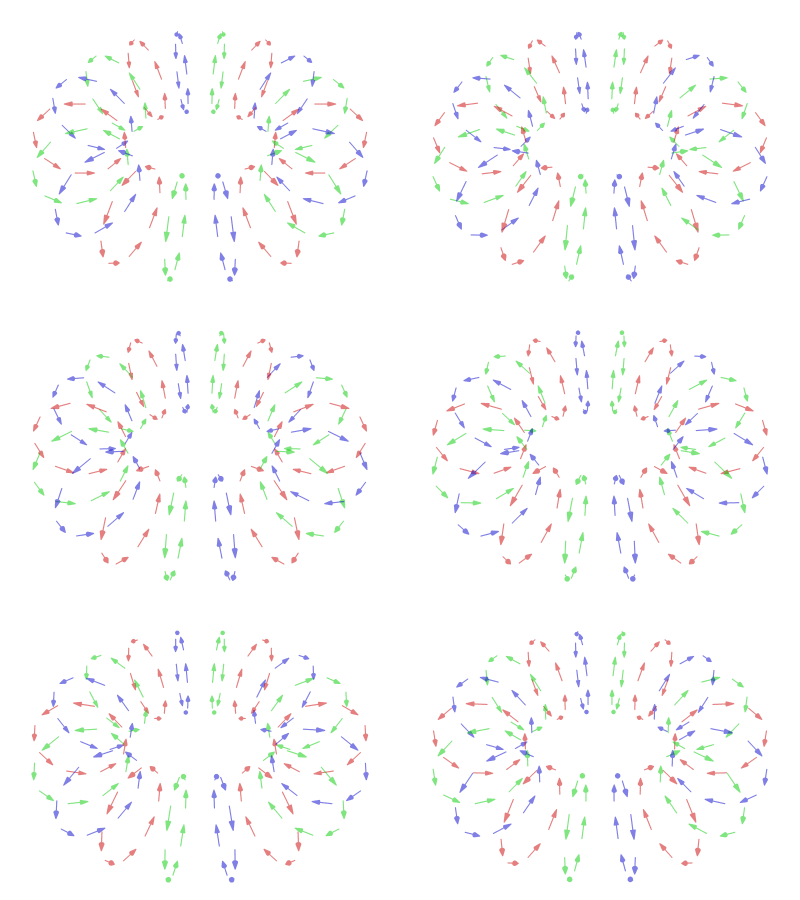
I decided to squeeze in a little bit about vortex rings into this morning’s lecture, partly because they illustrate the connections between fluid vorticity and magnetism, and partly because they’re fun…

Here’s an animation of a vortex ring showing how the fluid elements move around it (you might need to click on it to make it animate):

It’s quite easy to generate vortex rings in everyday situations, the simplest way being when a mass of fluid is impulsively pushed from an enclosed space through a narrow opening. In this case the poloidal flow is set in motion, at least in part, by interaction between the outer parts of the fluid mass and the edges of the opening. This results in fluid elements travelling in little circles, like those above, around a “core”; the direction of the vorticity is at right angles to these circles, i.e. in the toroidal direction. A vortex line can be formed from by joining together the vorticity vectors from each little circle to form a circle defining the core of the vortex ring. The behaviour of vortex lines in flows like this is entirely analogous to that of magnetic field lines. In this case, the vortex line follows the motion of the fluid, which is at right angles to it, so it propagates more-or-less without disruption. This is how most vortex ring toys work, such as shown in the two examples here; the second is far more dramatic!

The last video features some naturally-occurring vortex rings (as well as some  distinctly man-made examples). What I didn’t realise until I found this video last night is that whales and dolphins know how to make vortex rings too, only underwater. Why do they do this? Is there an evolutionary explanation? I doubt it! I think they’re just having fun.

http://www.youtube.com/watch?v=mHyTOcfF99o

A Name for Open Astrophysics?

Posted in Open Access with tags , , , , , on November 4, 2012 by telescoper

Regular readers of this blog may recall that  while ago  I posted an item in which I suggested setting up The Open Journal of Astrophysics. The motivation behind this was to demonstrate that it is possible to run an academic journal which is freely available to anyone who wants to read it, as well as at minimal cost to authors. Basically, I want to show that it is possible to “cut out the middle man” in the process of publishing scientific research and that by doing it ourselves we can actually do it better.

I was unwell for much of the summer, and more recently have had lots to do in connection with my forthcoming move to Sussex, so things have moved more slowly than I’d hoped but I just wanted to take this opportunity to give my assurance that this project is definitely going ahead. We have a (good) website design with ample space and other resources to run it, and a sufficient number of persons of suitable eminence have agreed to serve on the Editorial Board. It will basically be a front-end for the Arxiv, but will have a number of interesting additional features which make it a lot  more than that.  I’d prefer to save further details to the official launch, which is now planned to take place in January (as it would probably get buried in the pre-Xmas rush if we tried to launch before then). I can also confirm that the service we will provide will be free at the start, although if the volume of submissions grows we may have to charge a small fee for refereeing. And when I say “small” I mean small, not the hundreds or thousands of pounds charged by the rip-off merchants.

One thing I would like some ideas about, however, is the name. My working title for this project is The Open Journal of Astrophysics, which I think is OK but what I’d really like to do is break away from the old language of academic publishing as much as possible. I did think of the People’s Revolutionary Journal of Astrophysics, but feared that it might then split into Trotskyite and Marxist-Leninist factions. In any case the very name “journal” suggests something published periodically, whereas my idea is to have something that is updated continuously whenever papers are accepted. I’m therefore having second thoughts about having the word “Journal” in the title at all. Open Astrophysics might suffice, but I’m sure someone out there can come up with a better name. I know that Shakespeare said that a rose by any other name would smell as sweet, but I think a good title might make the difference between success and failure for this initiative…

That gives me the idea of enlisting the help of the denizens of the internet for some help in coming up with a better title; given the nature of the project, this seems an entirely appropriate way of proceeding. So please engage in collective or individual brainstorming sessions and let me have your suggestions through the comments box!

Se pieta di me non senti

Posted in Opera with tags , , , , on November 3, 2012 by telescoper

I heard this piece of music on Radio 3 earlier today and it completely blew me away.  I must get the DVD of the 2011 performance of Handel’s  Giulio Cesare from which it was taken, but in the meantime here’s a clip from Youtube to give you an idea. This is the marvellous Natalie Dessay as Cleopatra singing the da capo aria Se pieta di me non senti. It’s a truly sublime and moving performance from a singer at the very peak of her prowess. Brava!