Archive for January, 2013

Lost in Translation…

Posted in Biographical, Books, Talks and Reviews with tags on January 7, 2013 by telescoper

I was making a start at cleaning out some of the stuff in my office yesterday and came across a bunch of foreign editions of my book Cosmology: A Very Short Introduction. I’d forgotten I had these, and am not even certain what languages they are all in. Is the first in Japanese or Korean? I really can’t remember.

vsi_6

vsi_2

vsi_3

Vsi_5

vsi_4

…still, it’s interesting to see how they’ve chosen different covers for the different translations, and at least I know what my name looks like in Russian Bulgarian!

Sathya’s Cosmic Sirens

Posted in The Universe and Stuff, Uncategorized with tags , , , on January 7, 2013 by telescoper

Bit busy today so I thought I’d just post this talk by Cardiff’s own Prof. Bangalore Sathyaprakash at last year’s TEDX event in Cardiff.
The title is Cosmic Sirens although given that the topic is gravitational waves I hope that “sirens” isn’t intended to mean those entirely mythical entities that lure unsuspecting PhD students to their ultimate destruction…

Anyway, here’s the blurb:

In 1916 Einstein predicted that dynamical mass distribution generates ripples in the very fabric of spacetime that propagates outwards at the speed of light.

For over two decades B.S. Sathyaprakash (Sathya for his family and friends) is engaged in research to detect these ripples called gravitational waves, from cataclysmic cosmic events such as exploding stars, colliding black holes and the big bang. His personal goal is to observe and understand black holes and gravity using gravitational radiation. He is the head of the gravitational physics group at Cardiff University — a centre for modelling astronomical sources of gravitational radiation, discovering innovative algorithms to search for this radiation and analyzing data from gravitational-wave detectors using massive computer clusters.

Although there is firm indirect evidence that certain astronomical systems do emit gravitational waves, so far no one has detected them directly. Sathya and his team are part of a worldwide effort, called the LIGO Scientific Collaboration, to detect these elusive waves using kilometer long laser interferometers in the US, Europe and Japan. Recently, Sathya helped develop the science case for building such a detector in India. He has been involved in the European design study of a third generation underground detector with a 30 km baseline called the Einstein Telescope, chairing the group that developed the science case for this ambitious venture.

And here is the actual talk..

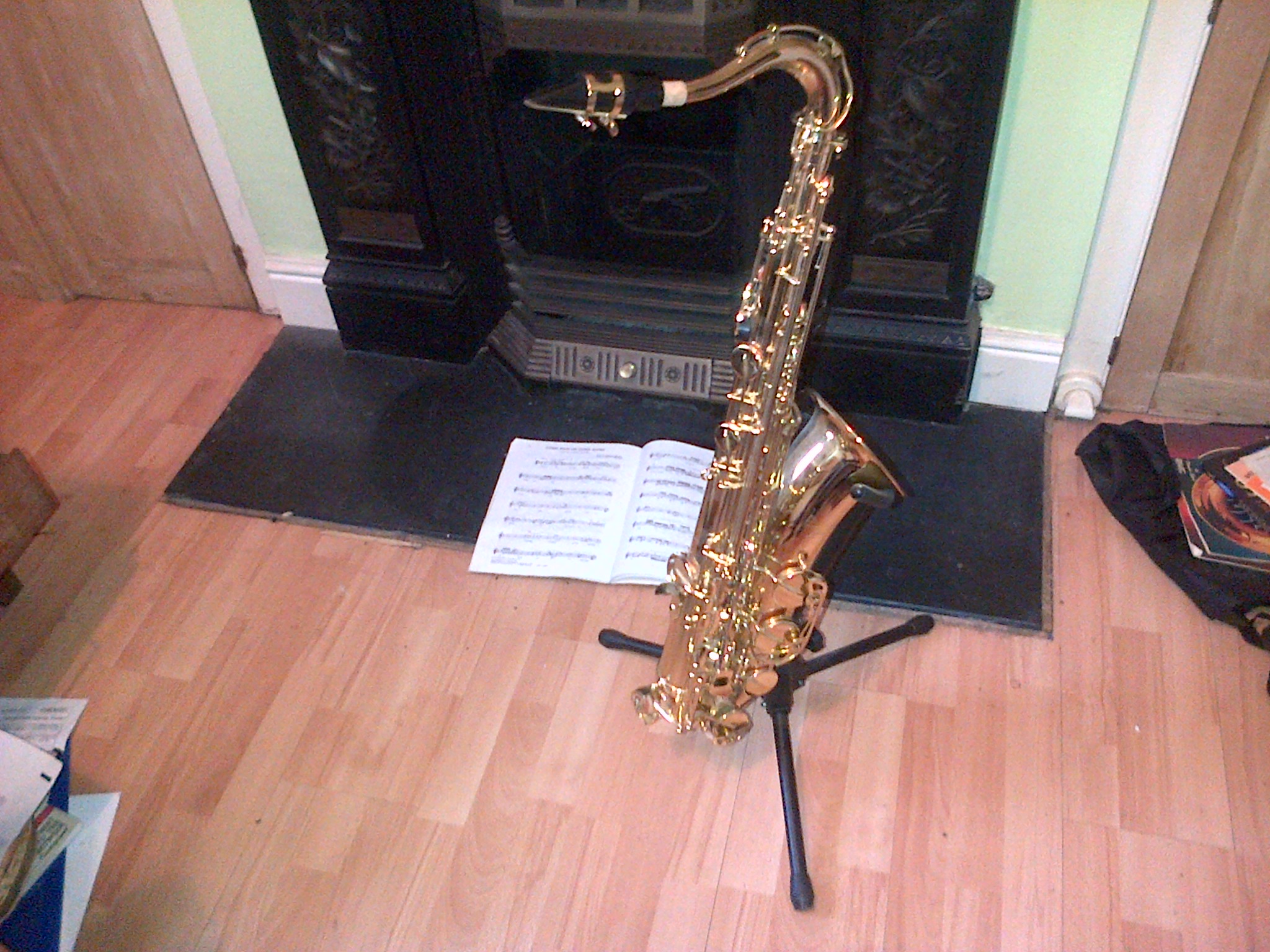
Me and my horn….

Posted in Biographical, Music with tags , , on January 6, 2013 by telescoper

How will I amuse myself when I’ve got no TV or internet connection?

Here’s the answer…

IMG-20130106-00029

..although I’m not sure the neighbours are going to be very happy about it!

Authentic Tidings of Invisible Things

Posted in Poetry, The Universe and Stuff with tags , , , , on January 5, 2013 by telescoper

One of my very first blog posts (from way back in 2008) was inspired by an old book of poems by William Wordsworth that I’ve had since I was a child. I was reading it again this evening and came across this short excerpt, near the end of the book, from The Excursion, and entitled for the purposes of the book The Universe a Shell. It struck me as having a message for anyone who works on the science of things either too big or too small to be sensed directly on a human scale, so I thought I’d post it.

I decided to scan it in rather than copy it from elsewhere on the net, as I really love the look of that old faded  typeface on the yellowing paper, even if it is a bit wonky because it went over two pages. I’ve been fond of Wordsworth for as long as I can remember and, like a few other things, that’s something I’ll never feel the need to apologize for…

Shell-a

Shell-b

Goodbye Virgin Media, and good riddance…

Posted in Biographical with tags , , , , on January 5, 2013 by telescoper

Virgin-Media-logo

With my move to Brighton imminent, I decided before Christmas to sort out a few things that I’ve been putting off for a while. One of them was to cancel the contract with Virgin Media at my house in Cardiff. Having made the decision to ditch them, I then received a letter from said company announcing that their “broadband” service would go up in price in February 2013 by almost 10%. That’s on top of a similar rise earlier in 2012. A price hike of 20% in a year is nothing short of a rip-off. I wouldn’t mind if the service was decent, but the broadband is particularly poor; I’m supposed to have a 20MB service but I rarely get even a tenth of that. I assume Virgin Media simply doesn’t have enough bandwith to deliver what it promises. And that’s not counting when the connection falls over completely, which is far from uncommon…

In 2012 Virgin Media announced that I was getting a “free” upgrade to 20MB – previously I had the cheapo 10MB service – which sounded great. Then, just over a month later, the cost of my broadband package went up by about 10%. That’s a clear misrepresentation, and I should have cancelled my account right away then. But for some reason I didn’t.

I also get a cable TV package from Virgin Media (which I very rarely watch). Cancelling that will probably mean I spend just a bit more time reading or listening to music, which is a good thing. The woeful state of TV generally, and the dire offerings available at Christmas in particular, make me confident that I can live quite happily without it. And I’ll save the license fee too. I also have a telephone land line which I hardly use either. So scrap it all, I thought.

Anyway, I picked up the phone and called Virgin Media on 8th December with the intention of cancelling my service. A very frustrating experience with automated responses followed. “You now have five options”, you know the sort of thing. After several sets of five options (none of which were to cancel my account), I got through to a vaguely humanoid life-form. Even that wasn’t the end of the story as instead of just following my request she asked dozens of irrelevant questions and tried to persuade me not to quit. In the end I got fed up and said “I’m not going to change my mind, please just cut the crap and cancel the account”. Finally I was told the account would close on 8th January and some packaging would be sent so I could return the box and modem to Virgin Media. Fair enough, I thought.

I was travelling before Christmas, but noticed when I got back that Virgin Media had made a number of attempt to phone me while I was away. Eventually they phoned when I was in. An operative told me he wanted to discuss “changes to my account” and asked for my password. I said there was nothing to discuss as I had cancelled it. He persisted. I put the phone down. When I got back from a Christmas break in Newcastle the same thing happened again, with the same response. Then again the same day. Then again. The third time it happened in the same morning, I’m afraid I lost my temper and told the Virgin Media representative to fuck off. That did the trick.

Yesterday I received a bill from Virgin Media including a charge for the period 8th January to 7th February 2013, being the month after my account was supposed to be cancelled. I picked up the phone and called Virgin Media, assuming that somehow the instruction to close the account had been lost. In fact it hadn’t. The person I spoke to said “yes, your account is to be closed on 8th January”. “Then why have you billed me for the following month?”, I asked. “That’s our standard practice.” was the reply.

Standard practice? Sounds to me like theft! Assuming it would be very difficult to get money back once Virgin Media had purloined it, I immediately cancelled my Direct Debit to stop them taking the funds from my bank account. If they send me a correct bill for what I actually owe, I’ll pay it of course. But I’m never having anything to do with Virgin Media ever again.

P.S. I won’t have internet at home for a while from 8th January, so probably won’t be doing much blogging at weekends. On the other hand, I will have a lot of other things to be getting on with as I gradually relocate to Brighton by the sea…

P.P.S. Just received an email from Virgin Media with the following header…

medialogo

…which is of course exactly what I did.

Blog Feedback Questionnaire

Posted in Uncategorized on January 4, 2013 by telescoper

I’m back to work with a thump, having received delivery of my module feedback questionnaires for last term. All useful feedback, so I’m grateful for the students who bothered to fill them in and especially to those who wrote detailed textual comments. Apart from one, that is, who was apparently so gripped by apoplexy that he/she was unable to hold the pen properly – the resulting scratchings were entirely illegible.

Anyway, in the light of the students’ response to the quality of my lecturing I thought I’d try to gather feedback on the quality of my blogging. Please complete the following survey. Textual comments may be provided in the form of textual comments through the textual comment box below.

Now is the Winter of our Discontent

Posted in Literature with tags , , on January 3, 2013 by telescoper

Astronomy Look-alikes, No. 82

Posted in Astronomy Lookalikes with tags , on January 2, 2013 by telescoper

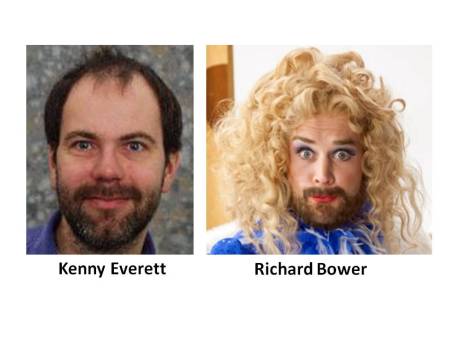
The resemblance between wacky comedian Richard Bower and Durham University astrophysicist Prof. Kenny Everett is too strong to be disguised even by a flamboyant wig. Surely there must be a family connection?

Lookalike

Science Propaganda

Posted in Science Politics, The Universe and Stuff with tags , , on January 2, 2013 by telescoper

I thought I’d do a quick rehash of an old post which is vaguely relevant to the still simmering controversy generated by the Cox-Ince editorial I blogged about before Christmas.

The legitimate interface between science and society has many levels to it. One aspect is the simple need to explain what science tells us about the world in order that people can play an informed part in our increasingly technological society. Another is that there needs to be encouragement for (especially young) people to study science seriously and to make it their career in order to maintain the supply of scientists for the future. And then there is the issue of the wider cultural implications of science, its impact on other belief-systems (such as religions) other forms of endeavour (such as art and literature) and even for government.

I think virtually all scientists would agree with the need for engagement in at least the first two of these. In fact, I’m sure most scientists would love to have the chance to explain their work to a lay audience, but not all subjects are as accessible or inspirational as, say, astronomy. Unfortunately also, not all scientists are very good at this sort of thing. Some might even be counter-productive if inflicted on the public in this way. So it seems relatively natural that some people have had more success at this activity than others, and have thus become identified as “science communicators”. Although some scientists are a bit snobby about those who write popular books and give popular talks, most of us agree that this kind of work is vital for both science and society.

Vital, yes, but there are dangers. The number of scientists involved in this sort of work is probably more limited than it should be owing to the laziness of the popular media, who generally can’t be bothered to look outside London and the South-East for friendly scientists. The broadsheet newspapers employ very few qualified specialists among their staff even on the science pages so it’s a battle to get meaningful scientific content into print in the mass media. Much that does appear is slavishly regurgitated from one of the press agencies who are kept well fed by the public relations experts employed by research laboratories and other science institutes.

These factors mean that what comes out in the media can be a distorted representation of the real scientific process. Heads of research groups and laboratories are engaged in the increasingly difficult business of securing enough money to continue their work in these uncertain financial times. Producing lots of glossy press releases seems to be one way of raising the profile and gaining the attention of funding bodies. Most scientists do this with care, but sometimes the results are ludicrously exaggerated or simply wrong. Some of the claims circulating around the time the Large Hadron Collider was switched on definitely fell into one or more of those categories. I realise that there’s a difficult balance to be struck between simplicity and accuracy, and that errors can result from over-enthusiasm rather than anything more sinister, but even so we should tread carefully if we want the public to engage with what science really is.

The Cox-Ince editorial is refreshingly clear about the limitations of science:

Science is a framework with only one absolute: all opinions, theories and “laws” are open to revision in the face of evidence. It should not be seen or presented, therefore, as a body of inviolate knowledge against which policy should be judged; the effect of this would be to replace one priesthood with another. Rather, science is a process, a series of structures that allow us, in as unbiased a way as possible, to test our assertions against Nature.

However, there is still far too much science reporting that portrays as facts  ideas and theories which have little or no evidence to support them. This isn’t science communication, it’s science propaganda and I think too many scientists go along with it. There’s a difficult balance to be struck, between engaging the public with inspirational but superficial TV programmes and explaining the intellectual struggles that science really involves.  Give the public the latter without any of the former and they’ll surely switch off!

Most worryingly is the perceived need to demonstrate black-and-white certainty over issues which are considerably more complicated than that. This is another situation where science popularisation becomes science propaganda. I’m not sure whether the public actually wants its scientists to make pronouncements as if they were infallible oracles, but the media definitely do. Scientists sometimes become cast in the role of priests, which is dangerous, especially when a result is later shown to be false. Then the public don’t just lose faith with one particular scientist, but with the whole of science.

Science is not about certainty. What it is a method for dealing rationally with uncertainty. It is a pragmatic system primarily intended for making testable inferences about the world using measurable, quantitative data. Scientists look their most arrogant and dogmatic when they try to push science beyond the (relatively limited) boundaries of its applicability and to ride roughshod over alternative ways of dealing with wider issues including, yes, religion.

I don’t have any religious beliefs that anyone other than me would recognize as such. I am also a scientist. But I don’t see any reason why being a scientist or not being a scientist should have any implications for my (lack of) religious faith. God (whatever that means) is, by construction, orthogonal to science. I’m not at all opposed to scientists talking about their religion or their atheism in the public domain. I don’t see why their opinions are of any more interest than anyone else’s in these matters, but I’m quite happy to hear them voiced.

This brings us to the question, often raised by hardline atheists, as to whether more scientists  should follow Richard Dawkins’ lead and be champions of atheism in the public domain. As a matter of fact, I agree with some of Dawkins’ agenda, such as his argument for the separation of church and state, although I don’t feel his heavy-handed use of the vitriol in The God Delusion achieved anything particularly positive (except for his bank balance, perhaps). But I don’t think it’s right to assume that all scientists should follow his example. Their beliefs are their business. I don’t think we will be much better off if we simply replace one set of priests with another. In this respect I wholeheartedly agree with Peter Higgs who has recently described Dawkins as “embarrassing”.

So there you have my plea for both public and scientists to accept that science will never have all the answers. There will always be “aspects of human experience that, even in an age of astonishing scientific advance, remain beyond the reach of scientific explanation”.

Can I have the Templeton Prize now please?

The Cox-Ince affair rumbles on..

Posted in Science Politics with tags , , on January 1, 2013 by telescoper

The Cox-Ince controversy rumbles on, apparently…

Ken's avatarOpen Parachute

Popular science presenters like Brian Cox are sometimes criticised by colleagues suffering from a bit of professional jealousy – although it’s a lot better than in the old days. I think most scientists today recognise the need for good science communication with the public – who, after all, are financing our science through the taxation system.

Brian Cox and his mate Robin Ince wrote a recent New Statesman editorial promoting a better understanding of the nature of science and its role in public decision-making (see Politicians must not elevate mere opinion over science). It made some good points – but upset some people. The jealousy this time seems to come from a few historians and sociologists – and not scientists themselves.

I think their criticism reveals an unfortunate attitude towards the scientific process, or indeed a misunderstanding of that process. Nevertheless, the debate does reveal some aspects of the…

View original post 2,382 more words