One of the candidates for the dark matter that seems to pervade the cosmos is a Weakly Interacting Massive Particle (WIMP, for short). Such particles are hypothetical but, if they exist they could have been produced in large numbers in the early Universe. Among the possible WIMPs are supersymmetric particles, but there are alternative candidates. Whatever their nature it is possible that they could be directed directly in collisions with regular matter but, because they are weakly interacting, the cross-section for such events is low and potentially masked by background events caused by radioactive decays. So far these experiments have drawn a collective blank (and a number of false alarms).
One experiment trying to detect dark matter directly is LUX-ZEPLIN (LZ for short) which is based at the Sanford Underground Research Facility in South Dakota in the USA but is a collaboration of 30 institutions worldwide, including the the UK, Portugal and South Korea as well as the USA. This experiment tries to detect WIMPs using an ultra-sensitive detector made of 7 tonnes of liquid xenon to hunt for signals of their interactions with atomic nuclei.
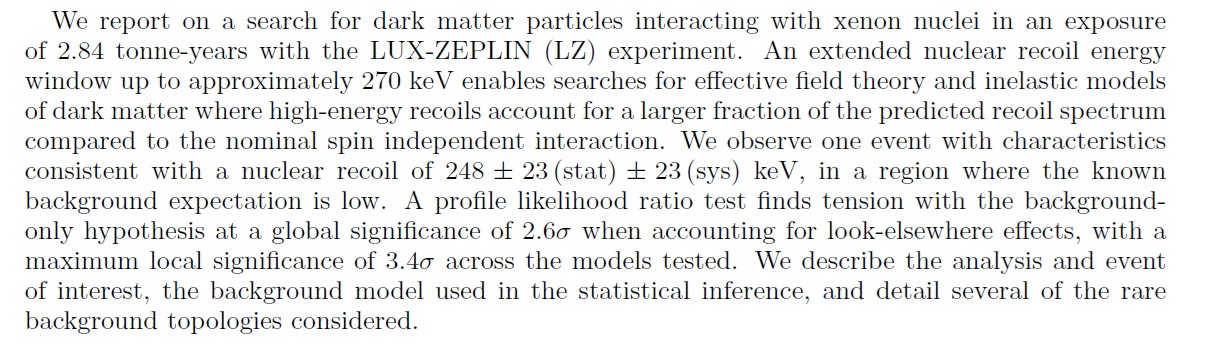
Today there was a potentially exciting announcement that LZ may have seen a WIMP, in a preprint with the following abstract:
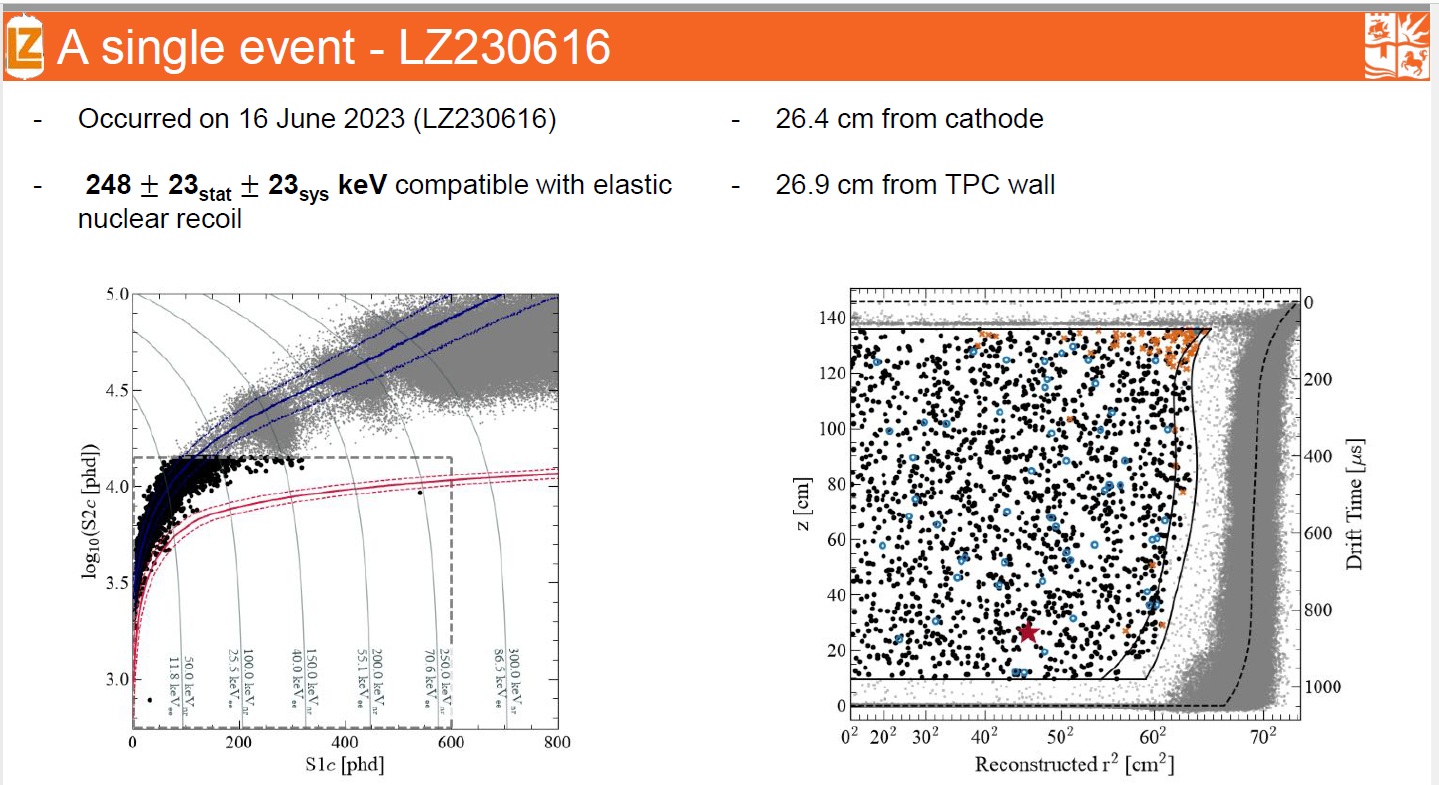
There is also a scientific presentation by Sam Eriksen from which I have extracted the crucial figure(s):
The event causing the excitement was detected over three years ago, on 16th June 2023. You can see it as the little black dot towards the upper right of the dashed square in the left hand panel. The LZ signal does appear unlikely to have been generated by known background events, but that does not necessarily mean that it is likely to be WIMP. The statistical significance quoted is not sufficiently high for it to be regarded as a clear detection; the implied odds are roughly the same as the odds that you, the reader, have a birthday on 16th June…
It’s Saturday once more so time for another update of activity at the Open Journal of Astrophysics. Since the last update we have published seven papers, bringing the number in Volume 9 (2026) to 11 and the total so far published by OJAp up to 459. This week has been quite busy; for only the second time in recorded history we published at least one paper each working day.
I will continue to include the announcements made on our Mastodon account (on Fediscience) to encourage you to visit it. Mastodon is a really excellent service, and a more than adequate replacement for X/Twitter which nobody should be using.
The first three papers this week were all published on Monday January 12th in the folder Astrophysics of Galaxies.
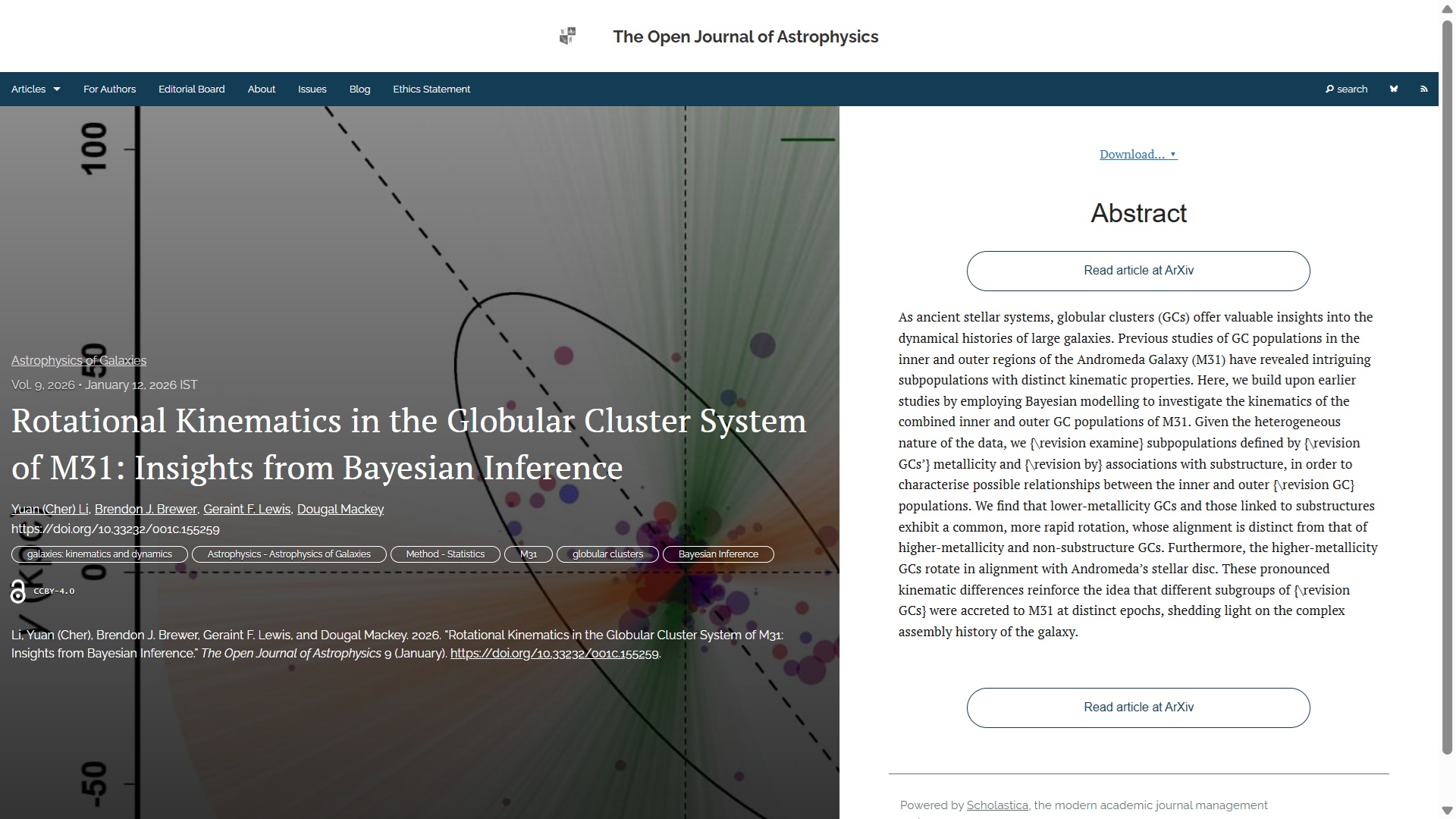
The first paper to report this week is “Rotational Kinematics in the Globular Cluster System of M31: Insights from Bayesian Inference” by Yuan (Cher) Li & Brendon J. Brewer (U. Auckland, New Zealand), Geraint F. Lewis (U. Sydney, Australia) and Dougal Mackey (independent researcher, Australia). This study uses Bayesian modelling to explore the kinematics of globular clusters in the Andromeda Galaxy, revealing distinct rotation patterns that suggest different subgroups were added at separate times.
The overlay is here:
You can find the officially accepted version on arXiv here and the announcement on Fediverse here:
New Publication at the Open Journal of Astrophysics: "Rotational Kinematics in the Globular Cluster System of M31: Insights from Bayesian Inference" by Yuan (Cher) Li & Brendon J. Brewer (U. Auckland, New Zealand), Geraint F. Lewis (U. Sydney, Australia) and Dougal Mackey
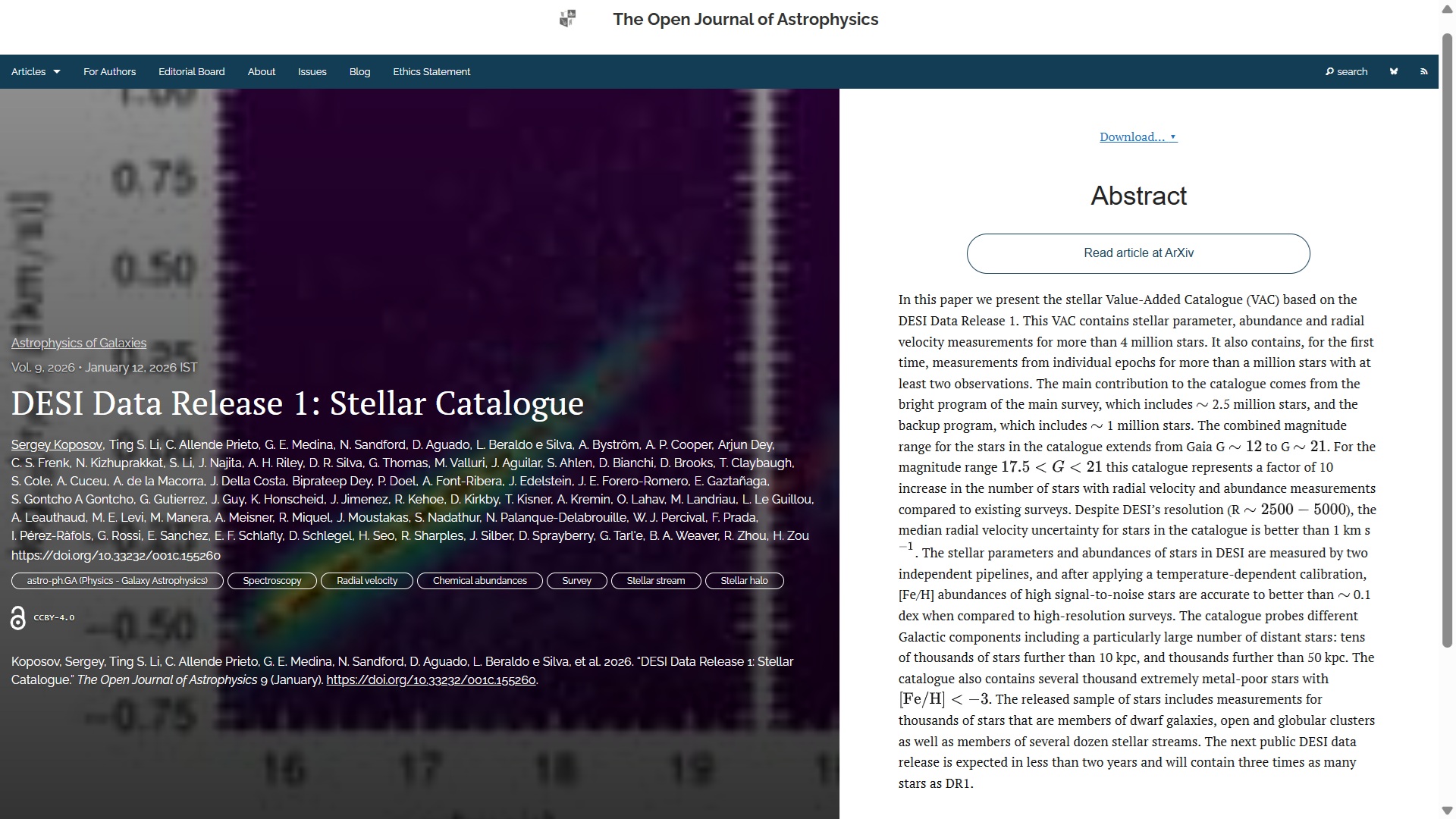
The second paper is “DESI Data Release 1: Stellar Catalogue” by Sergey Koposov (U. Edinburgh, UK) and an international cast of 67 other authors. This paper introduces and describes the stellar Value-Added Catalogue (VAC) based on DESI Data Release 1, providing measurements for over 4 million stars, including radial velocity, abundance, and stellar parameters.
The overlay for this one is here:
The official version of the paper can be found on arXiv here and the Fediverse announcement here:
New Publication at the Open Journal of Astrophysics: "DESI Data Release 1: Stellar Catalogue" by Sergey Koposov (U. Edinburgh, UK) and an international cast of 67 other authors.
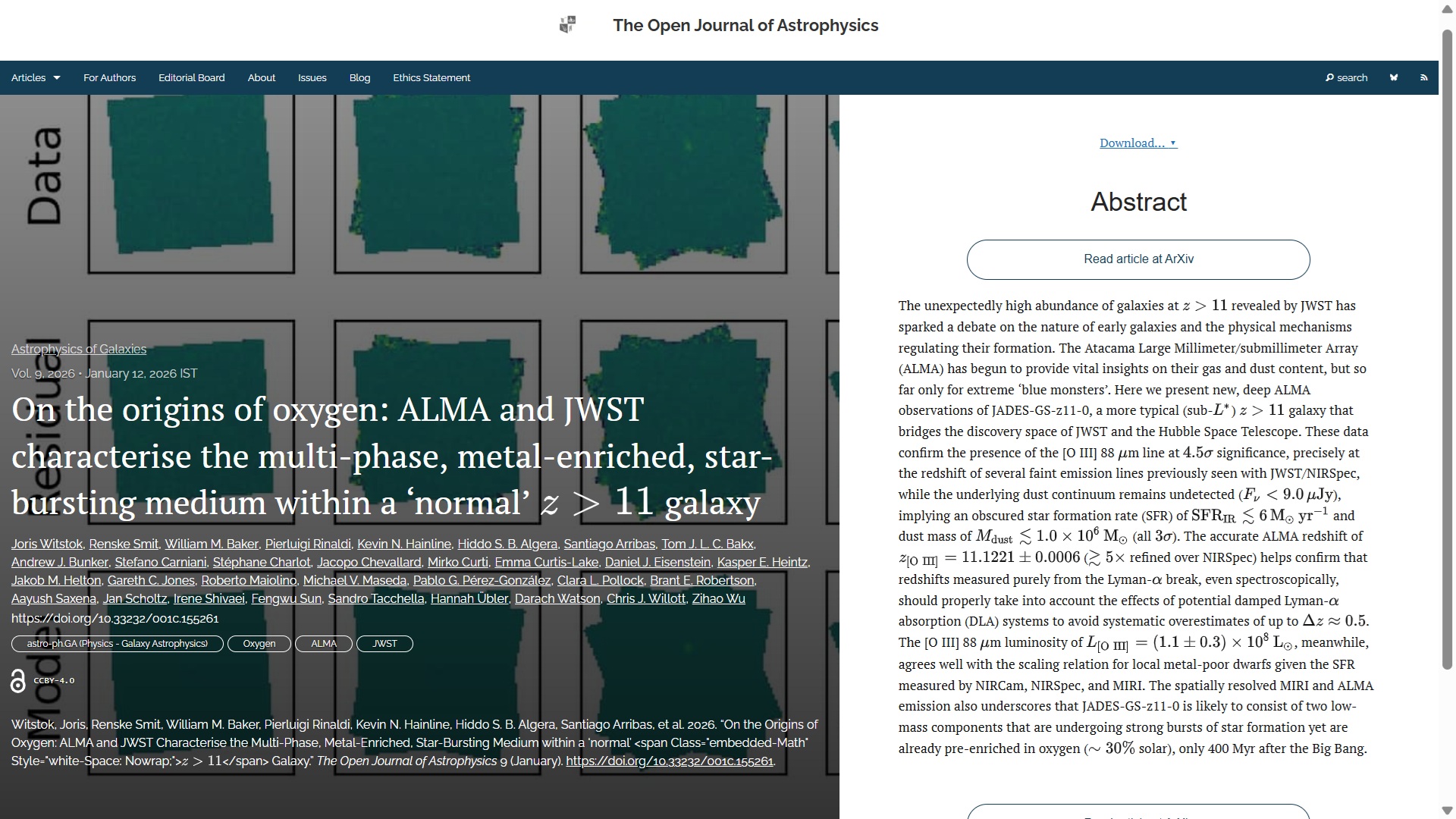
New Publication at the Open Journal of Astrophysics: "On the origins of oxygen: ALMA and JWST characterise the multi-phase, metal-enriched, star-bursting medium within a ‘normal’ z>11 galaxy" by Joris Witstok (Cosmic Dawn Centre, Copenhagen, Denmark) and 37 others dotted around the world
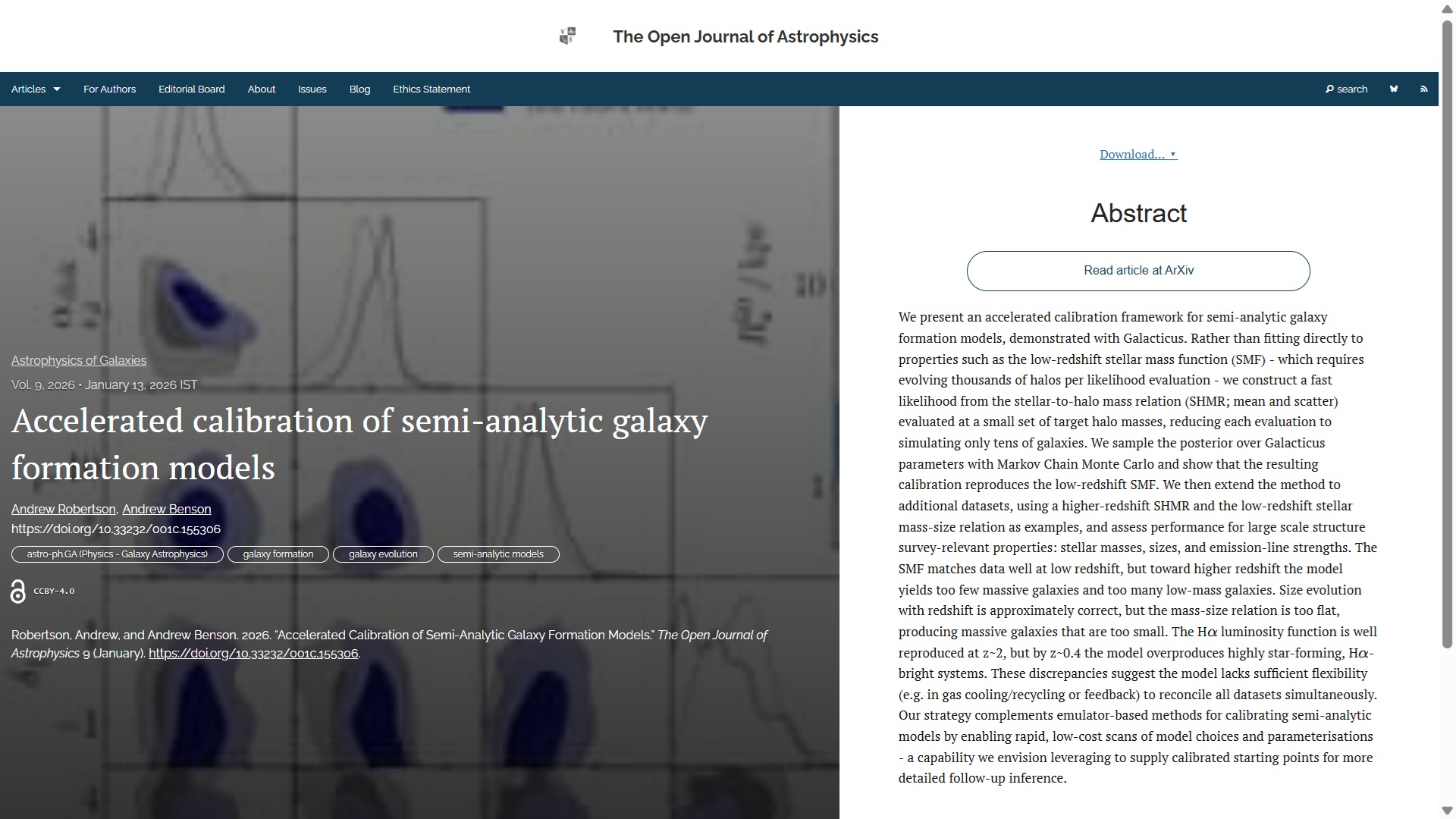
The fourth paper this week is also in the folder Astrophysics of Galaxies. but was published on Tuesday 13th January. It is entitled “Accelerated calibration of semi-analytic galaxy formation models” by Andrew Robertson and Andrew Benson (Carnegie Observatories, USA). This paper presents a faster calibration framework for galaxy formation models, using fewer simulations for each evaluation. However, the model shows discrepancies suggesting the model needs to be made more flexible.
The overlay is here:
You can find the officially accepted version on arXiv here and the Mastodon announcement here:
New Publication at the Open Journal of Astrophysics: "Accelerated calibration of semi-analytic galaxy formation models" by Andrew Robertson and Andrew Benson (Carnegie Observatories, USA)
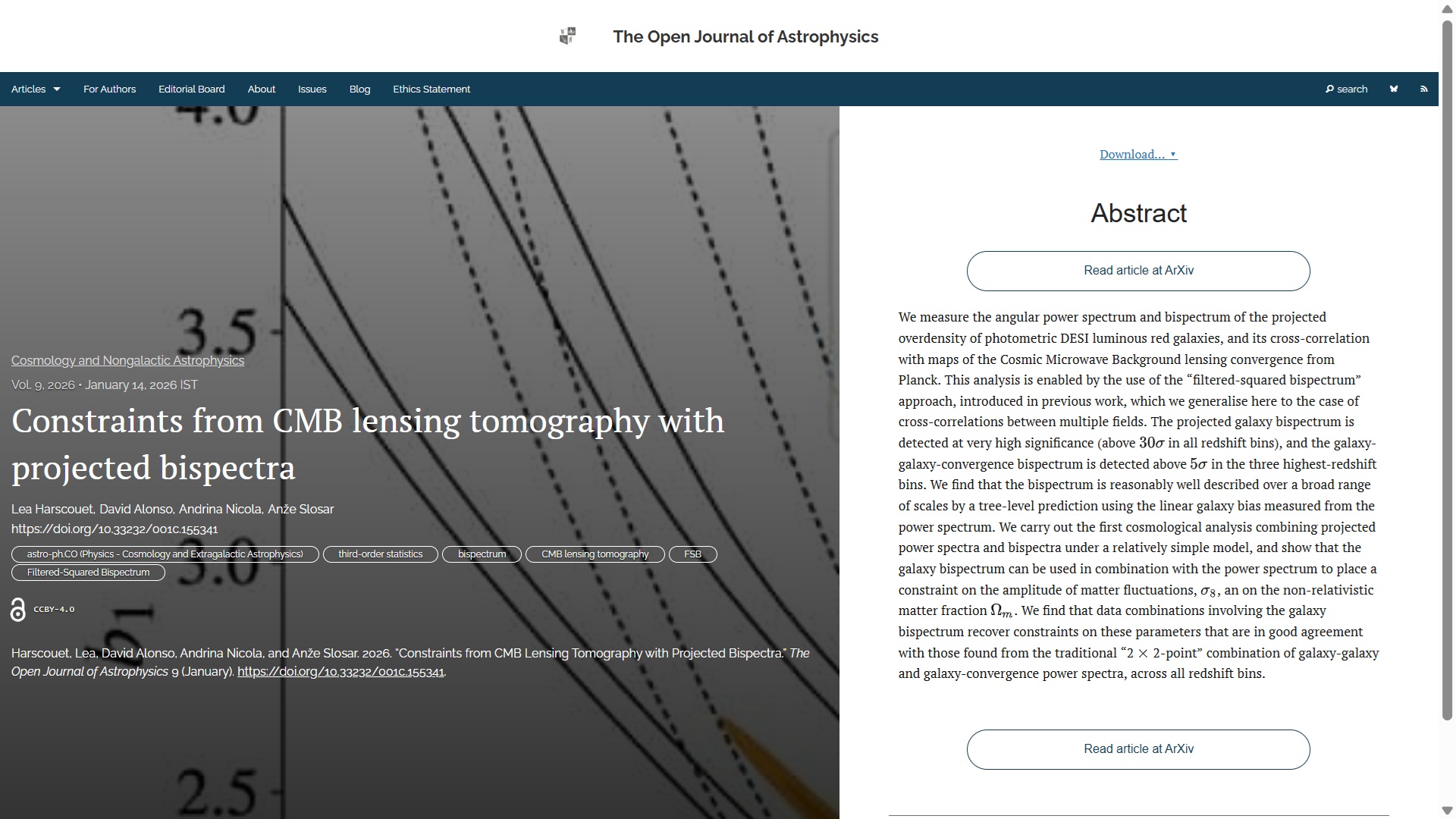
Next one up, published on Wednesday 14th January in the folder Cosmology and Nongalactic Astrophysics, is “Constraints from CMB lensing tomography with projected bispectra” by Lea Harscouet & David Alonso (U. Oxford), UK), Andrina Nicola (U. Manchester, UK) and Anže Slosar (Brookhaven National Laboratory, USA). This study presents angular power spectra and bispectra of DESI luminous red galaxies, finding that the galaxy bispectrum can constrain the amplitude of matter fluctuations and the non-relativistic matter fraction. The overlay is here:
You can find the officially accepted paper on arXiv here and the Mastodon announcement here:
New Publication at the Open Journal of Astrophysics: "Constraints from CMB lensing tomography with projected bispectra" by Lea Harscouet & David Alonso (U. Oxford, UK), Andrina Nicola (U. Manchester, UK) and Anže Slosar (Brookhaven National Laboratory, USA)
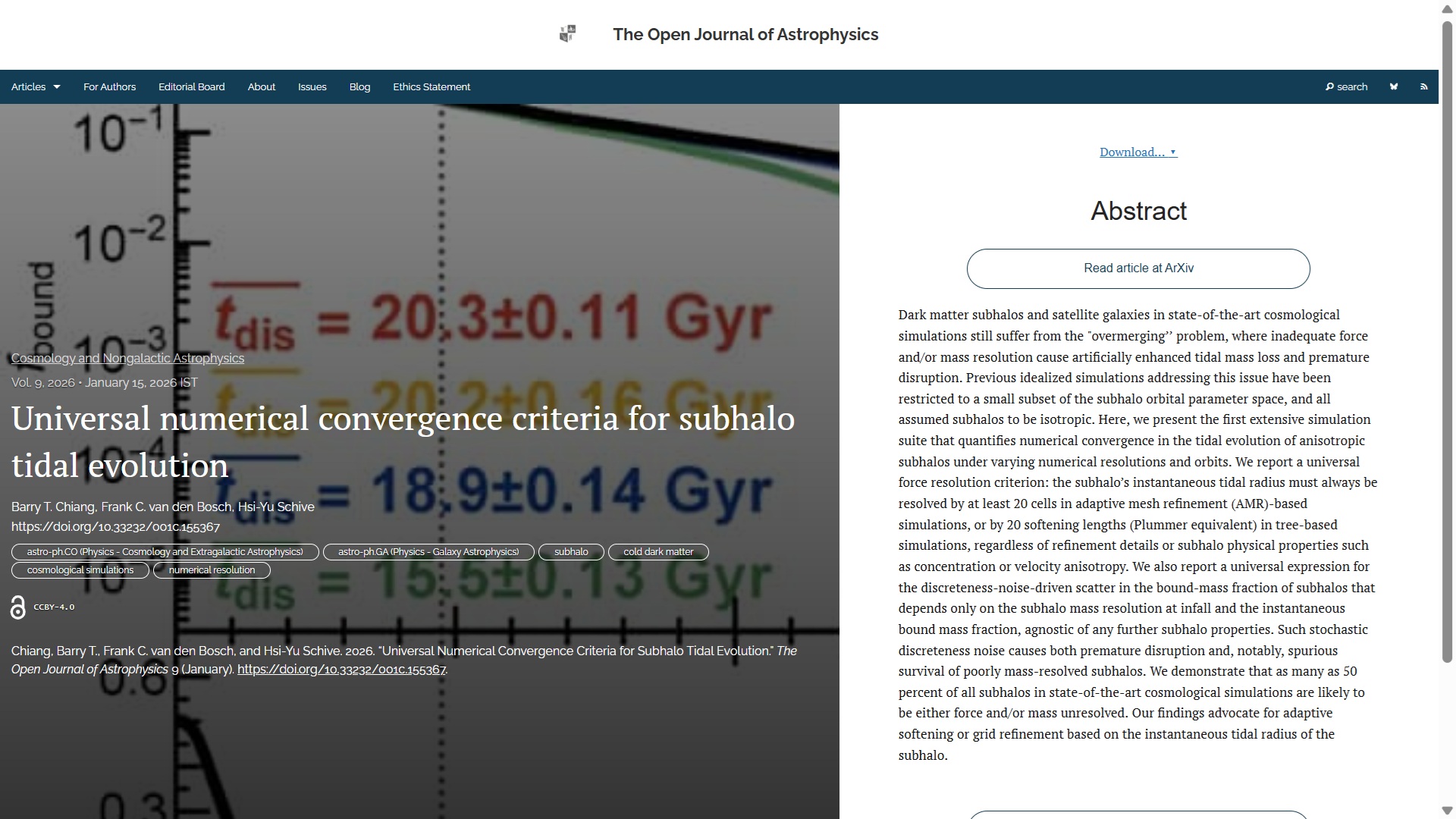
The sixth paper this week is “Universal numerical convergence criteria for subhalo tidal evolution” by Barry T. Chiang & Frank C. van den Bosch (Yale U., USA) and Hsi-Yu Schive (National Taiwan University, Taiwan). This was published on Thursday 15th January in the folder Cosmology and Nongalactic Astrophysics; it presents an analysis of a simulation suite that addresses the ‘overmerging’ problem in cosmological simulations of dark matter subhalos, showing that up to 50% of halos in state-of-the art simulations are unresolved. The overlay is here:
The final accepted version of this paper can be found on arXiv here. The Mastodon announcement follows:
New Publication at the Open Journal of Astrophysics: "Universal numerical convergence criteria for subhalo tidal evolution" by Barry T. Chiang & Frank C. van den Bosch (Yale U., USA) and Hsi-Yu Schive (National Taiwan University, Taiwan)
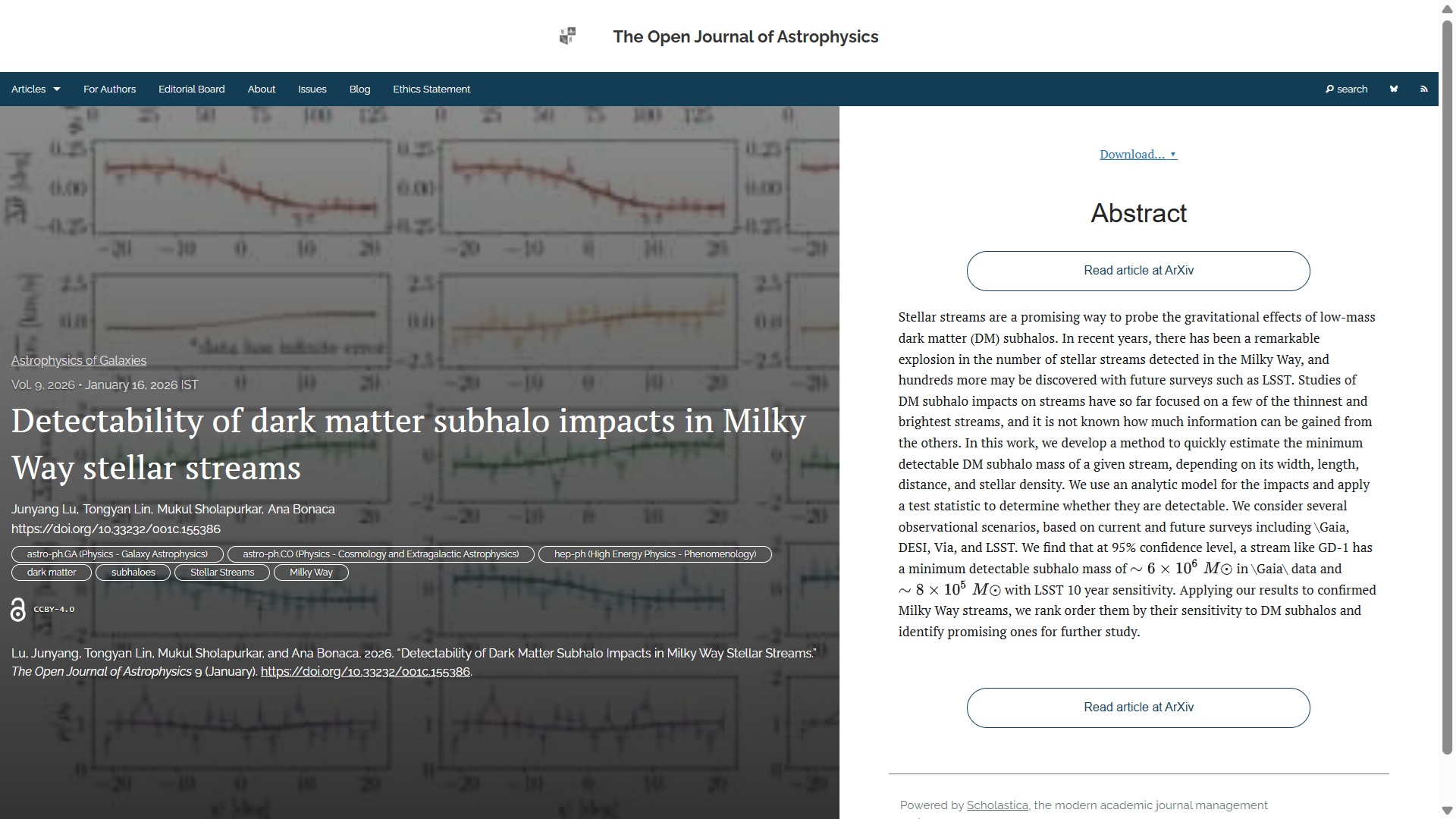
Finally for this week we have “Detectability of dark matter subhalo impacts in Milky Way stellar streams” by Junyang Lu , Tongyan Lin & Mukul Sholapurkar (UCSD, USA) and Ana Bonaca (Carnegie Observatories, USA). This was published on Friday 16th January (i.e. yesterday) in the folder Astrophysics of Galaxies. The study develops a method to estimate the minimum detectable dark matter subhalo mass in stellar streams, ranking them by sensitivity and identifying promising lines for further research.
The overlay is here:
The officially accepted version can be found on arXiv here and the Fediverse announcement here:
New Publication at the Open Journal of Astrophysics: "Detectability of dark matter subhalo impacts in Milky Way stellar streams" by Junyang Lu , Tongyan Lin & Mukul Sholapurkar (UCSD, USA) and Ana Bonaca (Carnegie Observatories, USA)
Time for the usual Saturday summary of papers at the Open Journal of Astrophysics. We have published five more papers since the last update a week ago. The count in Volume 7 (2024) is now up to 119 and the total altogether to 234. As I mentioned in a post last week this means we have published more papers this year (2024) than in all previous years put together.
In chronological order, the five papers published this week, with their overlays, are as follows. You can click on the images of the overlays to make them larger should you wish to do so.
First one up, published on Wednesday 18th December 2024 is “The picasso gas model: Painting intracluster gas on gravity-only simulations” byby Florian Kéruzoré, L. E. Bleem, N. Frontiere, N. Krishnan, M. Buehlmann, J. D. Emberson, S. Habib, and P. Larsen all of the Argonne National Laboratory, USA. The paper, which is in the folder marked Cosmology and NonGalactic Astrophysics describes a method using machine learning based on an analytical gas model to predict properties of the intracluster medium.
Here is a screen grab of the overlay, which includes the abstract:
You can find the officially accepted version of the paper on the arXiv here.
The second paper to announce, and the first of four published on Wednesday 19th December 2024, “maria: A novel simulator for forecasting (sub-)mm observations” by J. van Marrewijk (ESO, Garching, Germany) and 10 others based in Germany, USA, Norway, France and Italy. This paper describes a multi-purpose telescope simulator that optimizes scanning strategies and instrument designs, produces synthetic time-ordered data, time streams, and maps from hydrodynamical simulations, thereby enabling comparison between theory and observations. This one is in the folder marked Instrumentation and Methods for Astrophysics.
You can see the overlay here:
The accepted version of this paper can be found on the arXiv here.
The officially accepted version can be found on arXiv here.
The fourth paper, also published on 19th December 2024, is called “On the dark matter content of ultra-diffuse galaxies” and was written by Andrey Kravtsov (U. Chicago, USA). The article discusses the implications of measured velocity dispersions of ultra-diffuse galaxies for models of galaxy formation and is in the folder marked Astrophysics of Galaxies.
The overlay is here
You can find the officially accepted version of this paper here.
The fifth paper in this batch is “Estimating Exoplanet Mass using Machine Learning on Incomplete Datasets” by Florian Lalande (Okinawa Institute of Science and Technology), Elizabeth Tasker (Institute of Space and Astronautical Science, Kanagawa) and Kenji Doya (Okinawa); all based in Japan. This one was published on 10th October 2024 in the folder marked Earth and Planetary Astrophysics. It compares different methods for inferring exoplanet masses in catalogues with missing data
You can find the official accepted version on the arXiv here.
You can find the officially-accepted version on arXiv here.
That’s in for this week. I will do another update next Saturday only if we have any new papers on Monday. I will be taking a break over Christmas and also preparing Volume 8 (2025) for the new year, so publishing will be suspended from 24th December until 2nd January (inclusive). If you want your paper to be published in 2024 the final version must be on arXiv by Monday 23rd December at the latest, otherwise it will be held over until 2025.
The Mayall Telescope at Kitt Peak, in which DESI is housed. This PR image was taken during a meteor shower, which is not ideal observing conditions. Picture Credit: KPNO/NOIRLab/NSF/AURA/R. Sparks
I’ve just got time between meetings to mention that a clutch of brand new papers has emerged from the DESI (Dark Energy Spectroscopic Instrument) Collaboration. There is a press release discussing the results from the Lawrence Berkeley Laboratory here and one from the ICCUB in Barcelona here; several members of the group I visited there during sabbatical are working on DESI. Congratulations to them.
I haven’t had time to read them yet, but a quick skim suggests that the results are consistent with the standard cosmological model.
The latest batch contains three Key Publications:
DESI Collaboration et al., DESI 2024 II: Sample Definitions, Characteristics, and Two-point Clustering Statistics
Findlay et al. (2024), Exploring HOD-dependent systematics for the DESI 2024 Full-Shape galaxy clustering analysis
The links lead to the arXiv version of these papers. These articles can also be found, along with previously released publications by the DESI Collaboration, here.
Anyone who has read the latest papers is welcome to comment through the box below!
I had a very busy day yesterday culminating in the Space Week event I blogged about a few weeks ago. There was a good attendance – lots of young kids as well as adults – and the lecture room was very full. We could probably have filled a much bigger room, actually, but had been moved to a smaller venue and had to close registrations very early to avoid having too many people. I’d guess we had about 350. My talk was the last one, and didn’t finish until 8.30 by which time I was definitely ready for a pint.
You can find the slides I used for my presentation, The Universe according to Euclid, here.
There was an official photographer there who took quite a few pictures but I haven’t seen any of them yet. I’ll post a selection if and when I get them.
We live in a cyclic universe of a sort because every few years somebody tries to resurrect the idea that dark matter is somehow related to primordial black holes, i.e. black holes formed in the very early stages of the history of the Universe so that they have masses much smaller than black holes formed more recently by the collapse of stars or the merger of other black holes. If it forms very early the mass of a PBH could in principle be very small, much less than a star or a planet. The problem with very small black holes is that they evaporate very quickly via Hawking Radiation so would not survive the 14 billion years or so needed to still be in existence today and able to be dark matter.
An idea that was used in the past to circumvent this issue was that something might stop Hawking Radiation proceeding to reduce the mass of a PBH to zero, leaving a relic of finite mass usually taken to be the Planck mass. The suggestion has returned in different (but still speculative) guise recently, fueling a number of media articles of varying degrees of comprehensibility, e.g. here. The technical papers on which these articles are based can be found here and here.
Fortunately, there is now one of those excellent Cosmology Talks explaining the latest idea of how Hawking Radiation might break down and what the consequences are for Primordial Black Holes as a form of Dark Matter.
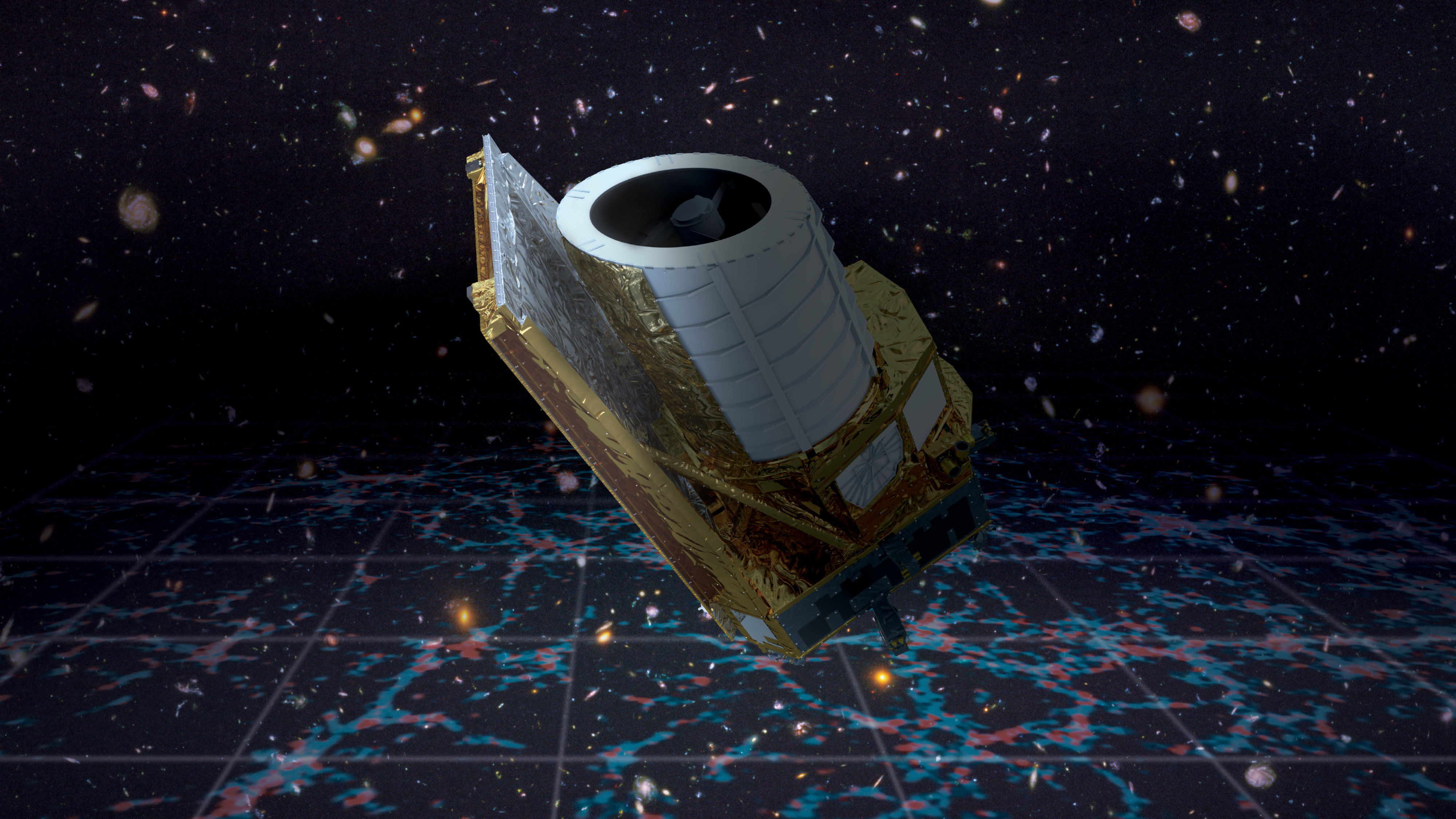
I haven’t posted anything about the European Space Agency’s Euclid mission recently but I can remedy that today by sharing a new video that describes one of the methods that Euclid will use to map the dark Universe. Here’s the video:
ESA’s Euclid mission is surveying the sky to explore the composition and evolution of the dark Universe. But how can Euclid see the invisible? Watch this video to learn about the light-bending effect that enables scientists to trace how dark matter is distributed in the Universe.
By making use of Euclid’s flagship simulation, the video illustrates how dark-matter filaments subtly alter the shape of galaxies. Light travelling to us from vastly distant galaxies is bent and distorted by concentrations of matter along its way. The effect is called gravitational lensing because matter (both ‘normal’ and dark matter) acts as a kind of magnifying glass.
Scientists distinguish between strong and weak gravitational lensing. In strong gravitational lensing distortions of background galaxies or other light sources are very apparent, resulting in arcs, multiple images or so-called Einstein rings. In weak lensing, background sources appear only mildly stretched or displaced. This means we can only detect this effect by analysing large numbers of sources in a statistical way.
The further we look, the more prominent the distortions from weak gravitational lensing are, because there are more dark-matter structures acting as lenses between us and the light sources.
Euclid will measure the distorted shapes of billions of galaxies over 10 billion years of cosmic history, providing a 3D view of the dark matter distribution in our Universe. This will shed light on the nature of this mysterious component.
The map of the distribution of galaxies over cosmic time will also teach us about dark energy, which affects how quickly the Universe expands. By charting the Universe’s large-scale structure in unprecedented detail, Euclid will enable scientists to trace how the expansion has changed over time.
I was reminded just now that 30 years ago today, on 25th August 1994, this review article by myself and George Ellis was published in Nature (volume 370, pp. 609–615).
Sorry for the somewhat scrappy scanned copy. The article is still behind a paywall. No open access for the open Universe!
Can this really have been 30 years ago?
Anyway, that was the day I officially became labelled a “crank”, by some, although others thought we were pushing at an open door. We were arguing against the then-standard cosmological model (based on the Einstein – de Sitter model), but the weight of evidence was already starting to shift. Although we didn’t predict the arrival of dark energy, the arguments we presented about the density of matter did turn out to be correct. A lot has changed since 1994, but we continue to live in a Universe with a density of matter much lower than the critical density and our best estimate of what that density is was spot on.
Looking back on this, I think valuable lessons would be learned if someone had the time and energy to go through precisely why so many papers at that time were consistent with a higher-density Universe that we have now settled on. Confirmation bias undoubtedly played a role, and who is to say that it isn’t relevant to this day?
Today sees the launch of a new initiative between Galaxy Zoo (part of the Zooniverse conglomerate) and the Euclid Consortium which I am delighted to be able to promote on this blog. What follows the graphic is the text of the announcement which is being promoted across social media today. I’ll start with a little factoid which might surprise you: already in November 2023, before science operations even began, Euclid had sent back to Earth more data than the Hubble Space Telescope has done in in its entire lifetime.
Thanks to a new Galaxy Zoo project launched today, you can help identify the shapes of thousands of galaxies in images taken by ESA’s Euclid space telescope. These classifications will help scientists answer questions about how the shapes of galaxies have changed over time, and what caused these changes and why.
In its mission to map out the Universe, Euclid will image hundreds of thousands of distant galaxies. In November 2023 and May 2024, the world got its first glimpse at the quality of Euclid’s images, which included a variety of sources, from nearby nebulas to distant clusters of galaxies. In the background of each of these images are hundreds of thousands of distant galaxies.
This square astronomical image shows thousands of galaxies across the black expanse of space. The closest thousand or so galaxies belong to the Perseus Cluster.
For the next six years, the spacecraft is expected to send around 100 GB of data back to Earth every day. That’s a lot of data, and labelling that through human effort alone is incredibly difficult.
That’s why ESA and Euclid consortium scientists have partnered with Galaxy Zoo. This is a citizen science project on the Zooniverse platform, where members of the public can help classify the shapes of galaxies.
Euclid will release its first catalogues of data to the scientific community starting in 2025, but in the meantime any volunteer on the Galaxy Zoo project can have a glimpse at previously unseen images from the telescope.
You could be the first person to lay eyes on a galaxy
The first set of data, which contains tens of thousands of galaxies selected from more than 800 000 images, has been made available on the platform, and is waiting for you to help classify them.
If you partake in the project, you could be the first to lay eyes on Euclid’s latest images. Not only that, you could also be the first human ever to see the galaxy in the image.
The Galaxy Zoo project was first launched in 2007, and asked members of the public to help classify the shapes of a million galaxies from images taken by the Sloan Digital Sky Survey. In the past 17 years, Galaxy Zoo has remained operational, with more than 400 000 people classifying the shapes of galaxies from other projects and telescopes, including the the NASA/ESA Hubble Space Telescope and the NASA/ESA/CSA James Webb Space Telescope.
Humans and AI working together
These classifications are not only useful for their immediate scientific potential, but also as a training set for Artificial Intelligence (AI) algorithms. Without being taught what to look for by humans, AI algorithms struggle to classify galaxies. But together, humans and AI can accurately classify limitless numbers of galaxies.
At Zooniverse, the team has developed an AI algorithm called ZooBot, which will sift through the Euclid images first and label the ‘easier ones’ of which a lot of examples already exist in previous galaxy surveys. When ZooBot is not confident on the classification of a galaxy, perhaps due to complex or faint structures, it will show it to users on Galaxy Zoo to get their human classifications, which will then help ZooBot to learn more.
On the platform, volunteers will be presented with images of galaxies and will then be asked several questions, such as “Is the galaxy round?”, or “Are there signs of spiral arms?”.
After being trained on these human classifications, ZooBot will be integrated in the Euclid catalogues to provide detailed classifications for hundreds of millions of galaxies, making it the largest scientific catalogue to date, and enabling groundbreaking new science.
This project makes use of the ESA Datalabs digital platform to generate a large number of cutouts of galaxies imaged by Euclid.
Thanks to a new Galaxy Zoo project launched today, you can help identify the shapes of thousands of galaxies in images taken by ESA’s Euclid space telescope. These classifications will help scientists answer questions about how the shapes of galaxies have changed over time, and what caused these changes and why.
The first set of data, which contains tens of thousands of galaxies selected from more than 800 000 images, has been made available on the platform, and is waiting for you to help classify them.
Examples of Euclid galaxies to classify are shown in this image.
Euclid Galaxy Zoo galaxies to classify. Forty galaxies are shown against a black background. The galaxies are all different in shape, some look like spirals, some look barred, or smooth. Image credit: ESA/Euclid/Euclid Consortium/NASA, CC BY-SA 3.0 IGO or ESA Standard Licence
Euclid is a European mission, built and operated by ESA, with contributions from NASA. The Euclid Consortium – consisting of more than 2000 scientists from 300 institutes in 15 European countries, the USA, Canada and Japan – is responsible for providing the scientific instruments and scientific data analysis. ESA selected Thales Alenia Space as prime contractor for the construction of the satellite and its service module, with Airbus Defence and Space chosen to develop the payload module, including the telescope. NASA provided the detectors of the Near-Infrared Spectrometer and Photometer, NISP. Euclid is a medium-class mission in ESA’s Cosmic Vision Programme.
This morning’s arXiv update brought the expected deluge of preprints from Euclid. You can find details of all fifteen of the new articles here. Ten of them relate to the Early Release Observations of which five were announced yesterday and five last November. These are essentially byproducts of the testing and calibration phase of the Euclid mission rather than the main cosmological survey. ESA is making a series of short videos about these results which I will share on here from time to time.
Of more direct relevance to cosmologists such as myself are the following five reference papers:
The overview paper, led by Yannick Mellier (Euclid Consortium Lead), giving a general description of the mission capabilities and science goals, will be the main reference paper and just about every active member of the Euclid Consortium is on the author list (including myself). That’s over a thousand people, not quite at the level of the Large Hadron Collider but getting there. I do think we need to find a better way of giving credit to work in large collaborations than through authorship, but until someone comes up with a workable scheme, and people responsible for hiring researchers adopt it, we’re stuck with what we’ve got. At least I can say that I’ve read that paper (which is 94 pages long, including the author list)
Papers II-IV are technical articles relating to Euclid’s instruments and their calibration, which will also be important references for the survey part of the Euclid mission. Paper V is about the Flagship simulations and the mock catalogues produced therefrom; I discussed these a while ago here. It is led by Francisco Castander of Institut de Ciencies de l’Espai, who organized the meeting I attended recently here in Barcelona.
These papers now now be peer-reviewed and, assuming they are accepted, published in a special issue of Astronomy & Astrophysics (A&A).
The views presented here are personal and not necessarily those of my employer (or anyone else for that matter).
Feel free to comment on any of the posts on this blog but comments may be moderated; anonymous comments and any considered by me to be vexatious and/or abusive and/or defamatory will not be accepted. I do not necessarily endorse, support, sanction, encourage, verify or agree with the opinions or statements of any information or other content in the comments on this site and do not in any way guarantee their accuracy or reliability.