Archive for March, 2013

Academic Publishing – added cost is not added value

Posted in Open Access with tags , , , , on March 19, 2013 by telescoper

I was having a quick plough through the evidence submitted to the recent House of Lords enquiry into Open Access and found the following interesting exchange relating to the arXiv. The italics in the response by Steven Hall, Managing Director of the Institute of Physics Publishing company, to the question from Lord Rees of Ludlow, are mine:

Q44 Lord Rees of Ludlow: We know that things are discipline-dependent, even within the physical sciences. I have a question for Mr Hall, really. In physics and space science, as you know, there is a well­organised archive and repository, which is used by almost all of the community. It would seem that that has coexisted with journals to a surprising extent.I wonder if you would like to comment on that as an example.

Steven Hall: Yes, thank you for the opportunity. When I speed-read the pile of submissions on the train last night I noticed at least three references to the success of the arXiv and its lack of impact on physics publishing. There are a number of myths about the arXiv and it would be good to deal with those here. First, it does not at all cover all of physics. There are certain sub-disciplines where there are very high levels of deposit in the arXiv; there are others where there is none whatsoever. To come back to your point, even within a discipline like physics there are real differences of approach. The other thing about the arXiv is that it is essentially a workflow tool. Much of physics is highly collaborative. Physicists will deposit early versions of their paper so that they can be looked at by their colleagues. It is a means for physicists to distribute to their immediate peers those early results of their research. It is a sharing tool. Most of the content of the archive is pre-print, though. It is not accepted manuscripts; it is not works that have gone through peer review. My own company’s policy there is the author can do whatever he or she likes with the pre-print, before we have added any value to it. We take a different view once we have added some value to it. The arXiv cannot be compared directly to, say, typical institutional depositories, which might have lots of accepted manuscripts in them. It coexists with formal publishing. The vast majority of physicists who use the arXiv would say that it is complementary to formal publication.

Lord Rees of Ludlow: Formal publication gives the accreditation, but I think most read the arXiv and would like to see it extended to other fields. It seems to be a rather good model, which, one would hope, would extend a bit more to other areas of science.

It will come as no surprise to hear that I’m right behind Martin Rees in his praise for the arXiv; the comments about it by Steven Hall are notable only for their irrelevance. Extending the arXiv to cover other branches of physics, and indeed other disciplines, would be much less expensive for the research community than the model he favours. I’d say that the arXiv needn’t be viewed as complementary to formal publication but that the arXiv gives us a way to make formal publication entirely redundant.  It’s only a small step to turn that potential into reality, which is why IOPP wishes to dismiss it.

Steven Hall has repeatedly argued that Gold Open Access is best, which I suppose it is if you’re a publisher interested in making easy money rather than a scientist wanting to disseminate your work in inexpensive and timely a fashion as possible. However, I was struck by the totally misleading phrase in italics relating to “added value”. IOPP does not add value to research publications, it merely adds cost. Any value that is added derives from peer review, which in most case costs nothing at all and can in any case be done independently of any publisher.

I’m afraid this is yet another example of publishers putting their own profits before the needs of researchers. The fact that IOPP’s profits also support the activities of the Institute of Physics is beside the point. I hope that before long the IOP remembers what it is actually for and changes its modus operandi to support the community it purports to serve, rather than exploiting it. The days of the traditional publisher are numbered in any case, and the IOP along with the other learned societies will have to find a way of surviving that doesn’t rely on income from the academic journal racket.

Before life and after

Posted in Poetry with tags , on March 18, 2013 by telescoper

A time there was – as one may guess
And as, indeed, earth’s testimonies tell –
Before the birth of consciousness,
When all went well.

None suffered sickness, love, or loss,
None knew regret, starved hope, or heart-burnings;
None cared whatever crash or cross
Brought wrack to things.

If something ceased, no tongue bewailed,
If something winced and waned, no heart was wrung;
If brightness dimmed, and dark prevailed,
No sense was stung.

But the disease of feeling germed,
And primal rightness took the tinct of wrong;
Ere nescience shall be reaffirmed
How long, how long?

by Thomas Hardy (1840-1928)

Open Confusion

Posted in Open Access with tags , , , on March 18, 2013 by telescoper

Catching up yesterday evening with the Times Higher, I found yet another article about the confusion generated by RCUK‘s plans for Open Access publishing. Apparently pressured by the powerful Publishers Association, RCUK has adopted the following “decision tree” to explain how its proposal will work.
RCUK%20decision%20tree

As you can see, this basically says that if you have any money from RCUK  for Open Access you have to spend it on the Gold Open Access which means you have to hand it all over to a publisher. Only when you’re skint can you go Green, and even then you have to tolerate a lengthy embargo.  This is as transparent a scam as you could ever hope to find. The Academic Publishing Industry is clearly out to fleece us for as much as it can get away with, bleeding our block grants dry before allowing us to do the right thing and publish our research the only sensible way, i.e. via Green OA repositories such as the arXiv.

There’s more:

An RCUK spokeswoman confirmed that even when funding for gold is still available via universities’ RCUK-provided block grants, researchers could still choose the green option with its shorter embargo periods.

But this reading of the decision tree was disputed by a spokeswoman for the Publishers Association. She insisted that if funds and gold options were available, researchers should choose gold.

It is obvious from this exchange that the agenda is not being generated by researchers or the research councils, but by the Publishers Association, who have hijacked the entire Open Access debate for their own ends.  Clearly the Academic Publishing Industry doesn’t live in the austere economy the rest of us inhabit – their profits are protected by generous dollops of cash from the taxpayer via RCUK.

And the government seems happy to go along with this hefty backdoor subsidy. I wonder why?

Balls in Cardiff

Posted in Biographical, Rugby with tags on March 17, 2013 by telescoper

I’ve been offline for a couple of days owing to being back at the old place in Cardiff, and consequently without internet connection. I could have used my phone, of course, as I’m doing now, but the 3G coverage in Wales is very poor so I find it frustrating to blog on my Blackberry.

Anyway, I came back to Cardiff to take care of a few loose ends and also to attend the annual Chaos Ball on Friday evening, which is run by the staff-student society in the School of Physics & Astronomy. It was a pleasant experience to see former colleagues and students again, so thanks to the organisers for finding tickets for me and my guest at the last minute!

Yesterday it was a different ball that took centre stage, as this year’s Six Nations rugby came to a dramatic conclusion with Wales’ comprehensive and well-deserved victory over England in Cardiff. I didn’t go to the game, but did watch it in a local pub. There’s a very special buzz in Cardiff on such occasions, and I was glad to experience it one more time, despite being an Englishman..

Now I have to get my act together and head back to Brighton. I wonder what sort of balls the British railway system will serve up?

Con Alma

Posted in Jazz, The Universe and Stuff with tags , , , on March 14, 2013 by telescoper

Well, Herschel may be going blind but it seems that just as one observatory gets ready to close its eyes on the Universe, another one gets ready to open them. Yesterday saw the official opening of the Atacama Large Millimetre Array (known to its friends as ALMA). What better way to celebrate the opening of this remarkable observatory than with an appropriately-named piece of music.

Con Alma is an original composition by Dizzy Gillespie who plays it on this track made with his big band in 1954, a period when Dizzy was experimenting with various fusions of bebop with Latin-American rhythms. It’s a deceptively complicated tune, with lots of changes of key to keep everyone on their toes. It may be more Cuban than Chilean in influence, but that’s the closest I could think of!

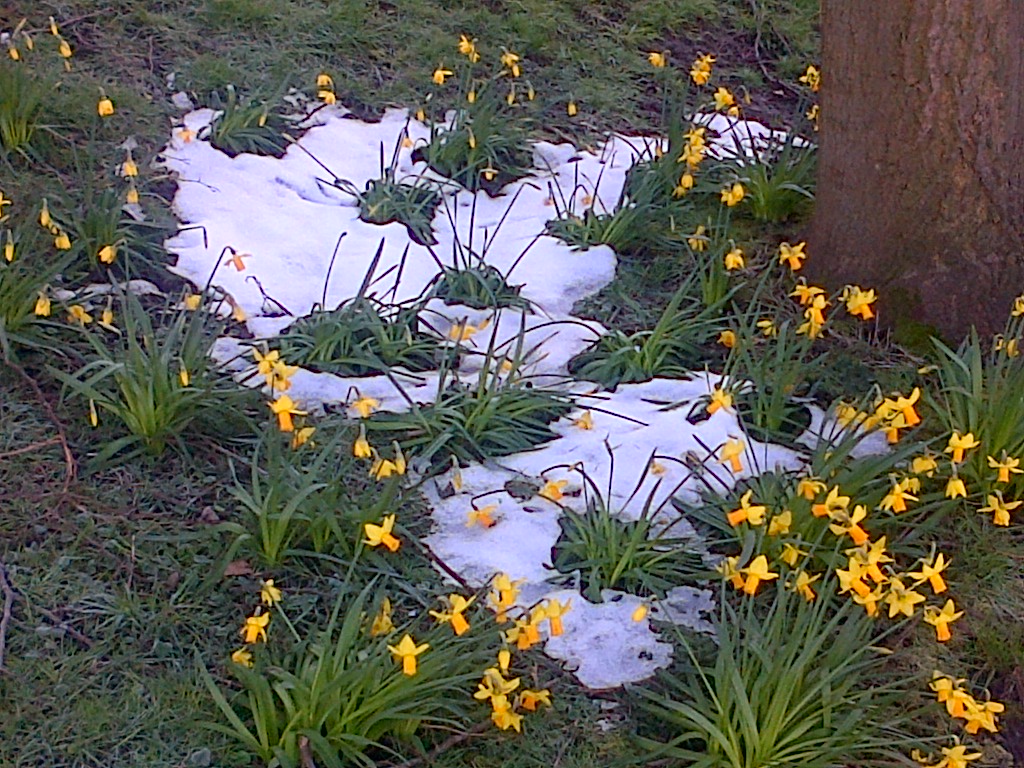
March Weather in Sussex…

Posted in Uncategorized with tags , , , on March 14, 2013 by telescoper

IMG-20130314-00078

The Heat Death of Herschel

Posted in The Universe and Stuff with tags , , , , on March 13, 2013 by telescoper

Most of the astronomers who read this blog will have heard the news that the Herschel Space Observatory is running out of the Helium that it has been using to keep it cool enough (~1.4K) to be sensitive to the far-infra-red radiation emitted by very distant objects.

There’s a gallery of wonderful images obtained by Herschel since it was launched in 2009 at the news item linked to above, but my favourite is one of the least photogenic:

_66205134_goodsn_3colour_cropped

Many of these fuzzy blobs correspond to immensely distant galaxies; what we see is starlight from very young stars absorbed by vast amounts of cosmic dust and then re-radiated in the infra-red. Understanding these sources is decidedly non-trivial and it will take many years to get all the information out that is hidden in images like this.

Anyway, one thing worth pointing out here is that what is going on now with Herschel is not some kind of failure. Quite the contrary, in fact. The original mission lifetime was planned to be three years, and Herschel has now been operating for nine months longer than that. The supply of Helium was always going to be the limiting factor as the spacecraft operates at the second Lagrange point of the Earth-Sun system, which is almost a million miles away and thus too far to be replenished. When the Helium does run out, Herschel will rapidly heat up to the point where its detectors are swamped. It will then be blind.

I was at this point going to make a cheap joke to the effect that after years on its own in the dark preoccupied with images of heavenly bodies, it was entirely predictable that Herschel would go blind. But I decided not to. I’ll save that kind of off-colour remark for Twitter…

ps. Coincidentally, on this day (March 13th) in 1781,  William Herschel  discovered the planet Uranus. The telescope is named in Herschel’s honour because he was also the first person to demonstrate the existence of infra-red radiation.

Snow, by Louis MacNeice

Posted in Poetry with tags , on March 13, 2013 by telescoper

I’ve posted this before, but it seems appropriate to post it again today…

The room was suddenly rich and the great bay-window was
Spawning snow and pink roses against it
Soundlessly collateral and incompatible:
World is suddener than we fancy it.

World is crazier and more of it than we think,
Incorrigibly plural. I peel and portion
A tangerine and spit the pips and feel
The drunkenness of things being various.

And the fire flames with a bubbling sound for world
Is more spiteful and gay than one supposes–
On the tongue on the eyes on the ears in the palms of your hands–
There is more than glass between the snow and the huge roses.

by Louis MacNeice (1907-1963).

Snowbound in Brighton

Posted in Biographical with tags , , on March 12, 2013 by telescoper

The last twenty-four hours in Brighton have been very strange. It started snowing yesterday morning. Not snowing very much, actually, but it was also very cold so not a very pleasant way to start the week. Nevertheless I had a trouble-free bus trip to the University of Sussex campus and got on with my business. It carried on snowing a bit, but not much. This is what it looked like outside my office at about 11.30.

IMG-20130311-00075

It kept on snowing a bit, but not much, all afternoon. By five o’clock I noticed that the Twitter feed for the Brighton & Hove Bus and Coach Company was announcing that some bus services were suspended. Then all of its bendy buses were withdrawn from service. Since most of the buses I get to and from campus are of the bendy variety I decided to head home. It was snowing a little heavier by then, and it took a long time to get home owing to heavy traffic, but I made it to my flat by about 6.30pm. Checking Twitter again I saw that all bus servives had been cancelled. The accumulated amount of snow in central Brighton was no more than a centimetre.

Buses remained suspended this morning. Owing to the transport difficulties facing its staff and students the University of Sussex decided to cancel teaching for the day and operate at a minimal level of service. I settled down to work a bit at home, with a view to travelling to campus as soon as the buses were running again. In fact the roads appeared very clear when I decided to make the most of my morning off, by doing some shopping and getting a haircut, but the bus service to Falmer was not reinstated until about two hours after I took this picture…

IMG-20130312-00076

When I did eventually get on a Number 25 bus, the roads were completely clear of snow. Not surprisingly, actually, because although it snowed for quite a long time it was really rather light.

What is staggering is that less than half an inch of snow could paralyse the transport system of entire Town the size of Brighton, especially when it was forecast days in advance. There may have been heavier snowfall elsewhere in the area of course. The town is also rather hilly which, in icy conditions could cause problems for buses. But Brighton & Hove Council’s preparations for this cold snap seem to have been woefully ineffective. It’s sobering to experience how vulnerable this town is to even slightly bad weather.

Anyway, I’m now on campus. It’s not snowing. The sun’s shining, in fact. All the roads are clear. But there are few students about because there’s no teaching going on. Time to get some work done…

..and then try to get home!

Oh what a tangled web we weave…

Posted in Bad Statistics with tags , , , , , , on March 11, 2013 by telescoper

..when first we practice frequentist statistics!

I couldn’t resist a quick post directing you to a short paper on the arXiv with the following abstract:

I use archival data to measure the mass of the central black hole in NGC 4526, M = (4.70 +- 0.14) X 10^8 Msun. This 3% error bar is the most precise for an extra-galactic black hole and is close to the precision obtained for Sgr A* in the Milky Way. The factor 7 improvement over the previous measurement is entirely due to correction of a mathematical error, an error that I suggest may be common among astronomers.

The “mathematical error” quoted in the abstract involves using chi-squared-per-degree-of-freedom instead of chi-squared instead of the full likelihood function instead of the proper, Bayesian, posterior probability. The best way to avoid such confusion is to do things properly in the first place. That way you can also fold in errors on the distance to the black hole, etc etc…