Archive for September, 2013

Where are all the LGBT astrophysicists?

Posted in Biographical, LGBTQ+, Science Politics with tags , , , , , on September 13, 2013 by telescoper

Having scoffed my lunchtime pasty in record time today, I seem to have a few spare minutes to spend writing a brief blog post on a question which popped into my mind when I accidentally discovered that somebody had recently written a blog post (about Einstein’s Blackboard) which mentions me. I used to look after this famous relic when I was in Nottingham many years ago, you see.

There’s a sentence in the post that says

Professor Coles is one of the few out gay astrophysicists in the UK.

Well, it all depends by what you mean by “few” but I think there are more gay (or lesbian or bisexual or transgendered) astrophysicists out there than most people probably think. I know quite a large number personally, dozens in fact, most of whom are “out”. It’s a safe bet that there are many more who aren’t open about their sexuality too. However, it is probably the case that LGBT scientists are much less visible as such through their work than colleagues in the arts or humanities. Read two research papers, one written by a straight astrophysicist and one by an LGBT astrophysicist, and I very much doubt you could tell which is which. Read two pieces of literary criticism, however, and it’s much more likely you could determine the sexual orientation of the writer.

There have been attempts to raise the profile of, e.g., LGBT astronomers through such initiatives as The Outlist, but only a very small fraction of the LGBT astronomers I know have their names on it. I’m not on it myself, although I used to be. It seems I’ve been struck off.

You might ask why it matters if an astrophysicist is straight or gay? Surely what is important is whether they are good at their job? I agree with that, actually. When it comes to career development, sexual orientation should be as irrelevant as race or gender. The problem is that the lack of visibility of LGBT scientists – and this doesn’t just apply to astrophysics, but across all science disciplines – could deter young people from choosing science as a career in the first place.

It has always annoyed me that the Independent newspaper’s annual “Pink List” of the UK’s most influential LGBT people never – and I mean never – has a single LGBT scientist on it, despite the immense amount they do not only in research, but also in teaching and outreach. It’s very sad that this work is largely unacknowledged and even sadder that a great many potential role models are hidden.

The effect of this invisibility is to reinforce the perception that science just isn’t something that LGBT people do. I have known gay students in physics or astrophysics who were on the verge of quitting because of this. I think it’s important for established scientists to be as open as possible about their sexual orientation to counter this. I really don’t think the consequences of coming out are as frightening as people think. This is not to say that homophobia doesn’t exist, but that straight colleagues are much more likely to be supportive than not and (with a few exceptions) most workplaces nowadays won’t tolerate discrimination or bullying based on sexual orientation.

But that brings us to the question of why we should care about whether LGBT students might be deterred from becoming scientists. This is much the same issue as to why we should worry that there are so few female physics students. The obvious answer is based on notions of fairness: we should do everything we can to ensure that people have equal opportunity to advance their career in whatever direction appeals to them. But I’m painfully aware that there are some people for whom arguments based on fairness simply don’t wash. For them there’s another argument that may work better. As scientists whose goal is – or should be – the advancement of knowledge, the message is that we should strive as hard as possible to recruit the brightest and most creative brains into our subject. That means ensuring that the pool from which we recruit is as large and as diverse as possible. The best student drawn from such a pool is likely to be better than the best student from a smaller and more restricted one.

Big companies haven’t become gay-friendly employers in recent years out of a sudden urge for altruism. They’ve done it because they know that they’d be discouraging many excellent employees from joining them. It’s exactly the same way for research.

At Sussex University we will soon be welcoming well over a hundred new students about to start their degree programmes in the Department of Physics & Astronomy. It’s a reasonable estimate than one in ten of these will be an LGBT student. The same will be true for many other departments around the country. So, regardless of your own orientation, if you’re reading this and you’re involved in teaching science just try not to assume, just because you’re talking to a science student, that you must be talking to a straight student. That shouldn’t be be too hard, should it?

(Guest Post) De Profundis

Posted in Music with tags , , , , on September 12, 2013 by telescoper

Time for a guest post, methinks. Here is a review of a recent concert by the one and only Leonard Cohen. I wasn’t lucky enough to be there myself, but the pseudonymous Miss Lemon certainly was, and here are her reflections on the performance.

–0–

Merveilleux, superbe, meraviglioso, di sogno – I have run out of English superlatives to even try to begin to describe the masterclass that was Leonard Cohen’s Old Ideas concert (NG Arena 8 September 2013). It’s not often that you can put the words magical and Birmingham in the same sentence (spoken as a Brummie) but this was one such occasion.

My initial introduction to the venerable man was as a teenager in the mid-70s. Whilst my parents and I sat downstairs probably watching something like Family at War, upstairs my slightly older, and much more in touch with her poetic side, teenage sister would allow the, as I/we heard it then, drones of Leonard Cohen to seep through the ceiling, much to the familial annoyance below. However, sometime later intrigued as to quite what this dirge-like music was, whilst Sis was back at school (I was fortunate to have longer school holidays), I listened to the Songs of Leonard Cohen and was bewitched by the, as I now realise, legend that is Leonard.

I first saw Mr Cohen back in the early ‘80s – a memorable and unexpectedly good-humoured concert – but nothing could have prepared me for Sunday’s dreamlike experience. His voice even more distinctive than I remember it and now ‘aged into a worn leather bass’. An audience whose ages ranged from early 20s to late 70s filled the cavernous halls of the NG Arena in Birmingham.  A large number of men of a certain age, not all with balding pates and ponytails, were adorned with Cohen fedoras and the first vision on the stage was that of all of the band wearing fedoras so that immediate identification of the great man himself was made a little difficult, which brought a wry smile to the assembled throng in the forum.

His nine-piece band, among them a glorious violin virtuoso, proved more than suitable playmates. An appealing alchemy of Leonard at his self-deprecating best enchanting us with songs old and new, the beautiful and haunting version of Alexandra Leaving sung by Sharon Robinson – even after three hours, like a bird on the wire, hey why not ask for more?

The esteemed Mr Cohen – modest and most generous of spirit – age has not diminished his ability to pen glorious words and sublime songs and to send 10,000 people home with a smile which would last even longer than his concert, nor has it dimmed the twinkle in his eye. He was indeed ‘born with the gift of a golden voice’.

Sincerely

Miss Lemon

A Late Flash from the Argus

Posted in Brighton with tags , on September 11, 2013 by telescoper

IMG-20130910-00167

On the Interpretation of Dreams

Posted in Biographical with tags , , , , on September 11, 2013 by telescoper

Last night I had a peculiar dream in which, for reasons obscure, I hijacked one of the dishes of the Ryle Telescope at the Mullard Radio Astronomy Observatory in Cambridge and drove it at high speed along a railway line all the way to Oxford (pursued by an ice cream van). To non-astronomers this probably sounds completely barking, but I should point out that the Mullard Radio Astronomy Observatory is located at the site of Lord’s Bridge, a former railway station on the (now defunct) line between Cambridge and Oxford and some of the telescope dishes move along sections of the old track. Of course the track no longer extends all the way to Oxford, and in any case there would be bridges under which one of the 13-metre antennae of the Ryle Telescope could not possibly pass. Such mundane considerations don’t matter in the world of dreams, however, and the whole escapade was like a madcap chase scene from a daft movie. I woke up chuckling.

I’m by no means an expert in the interpretation of dreams but on the occasions when I can remember what I’ve dreamt about it always seems to be a weird juxtaposition of things I’ve experienced in the recent past. In this particular case I recall reading an article about the possibility (now, I believe, shelved) that the Oxford-Cambridge railway might be reinstated. I’ve also been reading tweets and facebook messages from people currently at a radio-astronomy workshop in the Netherlands.

My interpretation of this sort of thing is that during a dream the sleeping brain is sifting through recent experiences and relating them to others, including recent events and things lodged in long-term memory. If I’m right, then this kind of dream is basically a by-product of the workings of a sort of subconscious filing system. Not sure how the ice cream van fits into this scheme though.

There are other kinds of dream, of course, and they don’t always fit into this pattern. In my experience the majority don’t make any sense at all, so I won’t say any more about that class. I don’t know how many people have regular recurrent dreams, but I do; these are of two types. The first is a standard “anxiety” dream. I could be sitting in an orchestra on the stage of a concert hall, or some similar situation. I have a musical instrument in my hands and am dressed for the part, like all the other musicians. It is shortly before the performance is due to start. The problem is that I don’t actually know how to play the instrument. Time is ticking away and I’m soon to be found out. How do I escape? I think it’s obvious that this dream is closely related to impostor syndrome.

The second type of recurrent dream is harder to fathom. I’ve moved around quite a lot during my career: starting in Sussex, then in London, Nottingham, Cardiff and then back to Sussex. In this kind of dream I’m supposed to be back in one of the places I used to live, but it’s curiously different from what it was like in reality. One example involved me being back in my old flat in Bethnal Green. Exploring the place I took a nice walk through the French windows and into the garden. Trouble is, the flat didn’t actually have French windows or a garden. How could it? It wasn’t even on the ground floor…

That kind of dream is quite disconcerting, especially since it’s recurrent. But I can give an example that’s even weirder. As regular readers of this blog – both of them – will know, I was unwell for a period last summer. During the worst of this episode I was confined for a while in a psychiatric clinic. I wasn’t there for very long (perhaps 3-4 days) but I didn’t really keep track of time very well and in retrospect it seems I was there much longer than that. I was also heavily sedated for a lot of the time I was there. The effect of this was to blur the distinction between sleeping and waking almost completely so I literally didn’t know whether I was conscious or unconscious.

Now I know for a fact that I didn’t have any visitors when I was in that place. However, I have perfect recollection of a time when a young man (a former student of mine of Cardiff University) came into my room, sat down beside my bed and opened a discussion about physics, his plans for doing a PhD in Early Universe Cosmology, and various other topics to do with books and films. Looking back on this I realize that the conversation I’d imagined was actually a kind of synthesis of bits of other conversations I’d previously had with the same person in a different environment (i.e. my old office in Cardiff University). The peculiarity is that I now remember that imagined pastiche of a conversation as if it were actually real, and it has always been difficult for me to convince myself that it didn’t happen. It’s almost as if the filing system had gone into reverse, pulling old memories out of their drawers and sticking them back in my consciousness.

Related to this (possibly) are various memories I have of very early childhood. These are often very vivid, but in many cases completely at odds with facts that I’ve subsequently established. I think what has happened in such examples is that I haven’t actually remembered the event in question, but have been told things about it so frequently that a memory has somehow been constructed to accommodate the narrative.

Over a year on I still find the clinic episode quite scary to think about. I think that’s mostly because it’s an extreme example of how one’s perception of what is real and remembered versus what is imaginary and dreamt can get confused. Am I really writing this? Or am I dreaming? Are you really reading it? Are you dreaming? Wake-up!

Seeing Sense on Open Access

Posted in Open Access, Politics, Science Politics with tags , , on September 10, 2013 by telescoper

Just time for a quick post to pass on the news that the Parliamentary Select Committee on Open Access has published its report. A PDF file of the whole thing is available here. I was eagerly anticipating this publication for many reasons, including the fact that this blog (inadvertently) provided evidence to it:

A senior academic wrote on his blog that “the publisher was deliberately and disgracefully misleading the author about the RCUK policy on open access in order to take money from them”. I could go on, but can you convince us otherwise, because if that is the case, this is one of the less helpful pieces of the work that the Government has decided to do?

Anyway, the good news is that the Select Committee has seen sense and produced a report that is very critical of the government’s rush to Gold Open Access. Here are the main conclusions:

92. The Government’s committed and pro-active stance to increasing access to published research findings is admirable, as is its desire to achieve full open access. Gold open access, at scale, is a desirable ultimate goal, and we acknowledge that the recommendations of the Finch Report, and the Government and RCUK’s open access policies were formulated with this end in mind.

93. However, almost without exception, our evidence has pointed to gaps in both the qualitative and quantitative evidence underpinning the Finch Report’s conclusions and recommendations, most significantly a failure to examine the UK’s Green mandates and their efficacy. This has been replicated in the formulation of the Government and RCUK’s open access policies and their mistaken focus on the Gold solution as the primary route to achieving open access at scale in the UK. The major mechanism of transition must be Green open access, specifically through strong immediate self-archiving mandates set by funders and institutions, either as a funding condition or tied to research assessment as appropriate.

94. Given the emphasis the Government has placed on the benefits of open access, the Government should seek a derogation in relation to VAT on e-journals as a matter of urgency.

95. The Minister for Universities and Science and members of the Finch working group are due to meet in September 2013 to assess impact and progress of open access policy. RCUK has said it intends to review its policy in 2014, to assess how developments compare to their expectations, and to meet annually after that. As part of those reviews, both Government and RCUK must fully consider and address the conclusions and recommendations set out in this Report.

Item 93 is pretty strong stuff and I agree with every word of it! I have long believed that the Finch Report, which precipitated the Government’s present policy, was hijacked by vested interests in the academic publishing industry, greatly to the detriment of the academic community. The government needs to reverse its policy, and fast, before more money that should be spent on research and scholarship is wasted on subsidies for greedy publishers. It remains to be seen whether the government has the courage to change course.

UPDATE: See here for a more detailed and considered report by Stephen Curry

Anna Bolena at WNO

Posted in History, Opera with tags , , , , on September 9, 2013 by telescoper

It was the Last Night of the Proms on Saturday, but I was otherwise engaged at the First Night of the new production by Welsh National Opera of Anna Bolena by Gaetano Donizetti at the Wales Millennium Centre in Cardiff. This is one of three famous Donizetti operas set in the Tudor period (Anna Bolena, Maria Stuarda and Roberto Devereux) which I was slightly surprised to learn are collectively often described as the “Three Donizetti Queens”; I’m not sure what this implies about the erstwhile Earl of Essex. Anyway, as a fan of Italian bel canto I decided I just had to go to see Anna Bolena in Cardiff, even though it meant a trek back to Brighton yesterday. Hopefully I’ll be able to see the other two Queens in due course.

Anna Bolena is Donizetti’s imagining of the last days of the life of Anne Boleyn, the second wife of Henry VIII, so it’s basically the dark story of a young woman trapped in a web of intrigue and betrayal, a story made all the darker by the fact that it is based on real events. I wonder if such a plot would have ever have been considered plausible if it hadn’t actually happened?

The opera begins with Anna already having lost favour with her husband Enrico (Henry VIII), who is intent on ditching her in favour of  Jane (Giovanna) Seymour (who would shortly become Wife Number Three), but he first has to find a pretext to have her got rid of. Enrico lays a trap involving her brother, George Boleyn (the Lord Rocheford), the young musician Smeaton and Anna’s ex, Lord Percy, into which they and Anna duly fall. The hapless Smeaton confesses to having had an affair with Anna in the mistaken belief that she would be spared if he did so. Unfortunately, this amounts to an admission of treason. Despite Jane Seymour’s plea to Enrico to spare Anna’s life, she is condemned to die. The opera ends with all four people implicated in the plot walking off the stage to face execution, reconciled to their fate.

Of course the story is familiar from school history lessons, but what is especially compelling about it how it is told in this context is how the opera draws the audience into the character and innermost thoughs of the protagonists. For examples, Anna is more complex than you might imagine. It is true that she is naive, and out of her depth in a court so filled with plots and snares, but she is also at the same time ambitious and determined. Anna’s relationship with her rival Jane Seymour is also subtly nuanced, their deep fondness for each other demonstrated in a truly wonderful duet between soprano (Anna) and mezzo (Giovanna). The only real weak spot as far as characterization goes is Enrico, who comes across as little more than a pantomime villain (even to the extent that he received humorous boos on his curtain call). Of course Henry’s behaviour was tyrannical, but the drama would have worked more convincingly if there were at least something about him (other than his crown) that made Anna and Giovanna both adore him so much..

In typical bel canto style the voices of the singers are often extremely exposed, with the orchestra taking a back seat to a succession of dazzling coloratura passages with very little doubling of the vocal line to act as a safety net. At times, Donizetti’s music is little more than a basic backing track, but there is gorgeous orchestral writing in there too where the drama requires it. And that’s the point. Bel canto is not and never has been just about beautiful singing; the great operas in this genre also have great dramatic power and emotional intensity.

Serena Farnocchia’s Anna Bolena (soprano) was ably matched in beauty and clarity of voice by Katharine Goeldner as Giovanna Seymour (mezzo soprano). Faith Sherman (contralto) sang the part of the boy Smeaton with great sensitivity. Alastair Miles was also pretty good as Enrico, but I think the role suits someone with a more powerful bass voice. Robert McPherson as Lord Percy sang accurately enough but his lightish tenor voice has a rather nasal edge to it which took me quite a while to get used to.

The staging is stark and rather minimal, with just a few references to the Tudor period in items of furniture and in the style of the costumes (which are mainly black) but otherwise very little in terms of scenery. Very effective use was made of the revolving centre of the stage which provided movement without distracting from the most important aspect of the opera, namely the emotional turmoil of the characters on stage. The various elements of the staging and music came together in stunning fashion during Anna’s `Mad Scene’ near the end of Act II in which, delirious on the eve of her execution, she lapses into a trance-like state and relives happier moments while her friends gradually drift away into darkness. The lighting is sombre throughout the production, but in the Mad Scene Anna takes on a ghostly appearance. Musically speaking, this scene is quite famous – there’s an amazing version with Maria Callas as Anna here– but I found the cumulative effect of the elements of the life performance quite overwhelming. I’ll have to add this one to my list of pieces of music likely to make me fall to bits and thus to be avoided on trains…

A word too for the Orchestra of Welsh National Opera under conductor Daniele Rusitioni who played the gorgeous music impeccably. And another word for the Chorus of Welsh National Opera who were also excellent, not just in their singing but also in their wider contributions onstage.

All in all, a very fine night at the opera. The only real disappointment for me was that there were so many empty seats. It’s true that Anna Bolena isn’t one of the best known operas, but it is a gem. I hope this production gets the audience it deserves. And I also hope I can get to see the rest of the Tudors!

PS. I notice that the Guardian review has given it 4 stars. Bit stingy, possibly..

Let’s talk about the Black Bird..

Posted in Uncategorized with tags , , , on September 8, 2013 by telescoper

I’m writing this using my Blackberry as the train I’m on trundles towards London. Since it’s standing room only (as usual on First Great Western) I thought I’d just pass a little time rambling on about birds.

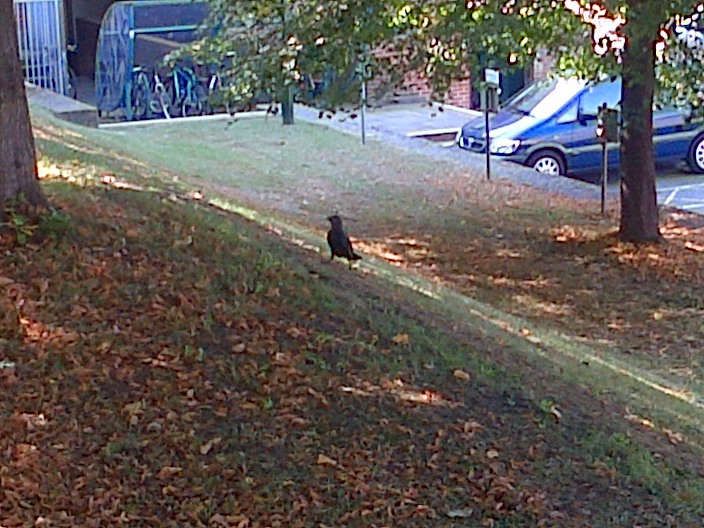
I took this picture the other day. The bird – a jackdaw? – is one of a pair who joined me for lunch but suddenly became camera shy when I got my phone out to take a picture. As you can see, I didn’t get very close.

I don’t know much about birds, but these are regular visitors to my place of work and I find them very amusing company. I love the way they strut about like officious constables when inspecting their surroundings for morsels of food. When in a hurry they bounce along like small boys do when they pretend to ride an imaginary horse. All members of the crow family, including magpies and jays, seem to share this peculiar style of getting about on the ground.

Anyway, whatever this bird was, at least it wasn’t a seagull. They’re rarely amusing, and often downright vicious. And it’s clearly not a falcon either, let alone a Maltese one…

Publication Vanity

Posted in Books, Talks and Reviews, The Universe and Stuff with tags on September 7, 2013 by telescoper

Doing a spot of tidying up I came across this little cutting of a little review (from the Grauniad) of my little book on Cosmology. It’s sheer vanity to keep such things of course, let alone post them on a blog, but it can’t do the sales any harm either!

Orion Nebula (Herschel, after Turner)

Posted in Art, The Universe and Stuff with tags , , , on September 6, 2013 by telescoper

I stumbled across this wonderful image (and associated description) yesterday and thought I’d share it. It’s a region of the Orion Nebula (which is located in the  Midlands region of Orion’s “sword”, i.e. the long thing hanging down below his belt).  It’s a turbulent region of dust and gas in which stars are forming. This image was taken in the far-infrared part of the spectrum by the Herschel Space Observatory, which is now defunct but much data remains to be analysed. Because the image was taken at wavelengths much longer than optical light, the colours are obviously “false”. I don’t work on star formation so I tend to see images like this just as beautiful things to be enjoyed for themselves rather than as a subject for scientific research. In fact, I have no difficulty at all in describing this picture as a work of art, slightly reminiscent of the cloudscapes and seascapes of  J.M.W Turner in that it is, at the same time, both a representation of a natural phenomenon and  an abstract creation that transcends it. You can click on the image to make it larger…

Orion_A

UPDATE: I see that someone else has thought of the parallel with Turner!

Widening Participation – Outreach versus Bursaries

Posted in Biographical, Education, Finance with tags , , , , , on September 5, 2013 by telescoper

This morning I came across a University of Sussex News Item which explains that Sussex has made the shortlist, published today (Thursday 5 September), for Widening Participation or Outreach Initiative of the Year in the Times Higher Education Awards 2013.  This piece reminded me of a discussion I had a while ago about the whole approach to widening participation in University education, an issue made all the more serious by the introduction of £9K a year tuition fees. In particular

The University has increased spending on widening participation activities to £8.1 million a year, with over half of this spent on the innovative First Generation Scholars scheme, which supports students who are from low-income backgrounds or who are the first in their family to go to university.

Before commenting on this in any detail I should put my cards on the table. When I went to University in 1982 I was the first in my family ever to go to university. I’m also, at least as far as my immediate family goes, the last. However, in those days there was no need for a First Generation Scholars scheme: there were no tuition fees and, because I don’t come from a wealthy background, I qualified for a full maintenance grant. Life (in Cambridge) as an undergraduate student was fairly comfortable.

Times have changed a lot. Many more people go to university nowadays, but the price is that support for those who don’t have access to family funds is now spread very thinly.  There are no full maintenance grants, and the fees are very high. Looking back, though, I don’t think it would have been the tuition fees that might have deterred me from going to university. After all, they don’t have to be paid back until after graduation, and when one’s income exceeds a certain level. What would have made a difference would have been the withdrawal of maintenance. Without the grant, I simply wouldn’t have been able to study without getting a job. Apart from the amount of work involved in doing my degree, the recession of the early 1980s meant that jobs were very hard to come by.

To get back to the news item I mentioned earlier, I have always thought there is a tricky calculation to be made when it comes to designing programmes intended to encourage students from as wide a range of backgrounds as possible to come to university, whether that be to do with socio-economic considerations, gender, ethnicity, age or anything else. The question is whether pumping money into bursaries is actually effective. I can imagine that a large bursary, perhaps equivalent in money terms to the old maintenance grant, would genuinely influence the decision of a prospective student, but if the pot is shared out among very many people the resulting bursaries are fairly modest. How much does a bursary have to be to make a difference? Answers on a postcard.

The other side of the debate is what the balance should be between bursaries and outreach. In a subject like Physics one of the principal obstacles faced by pupils from the state sector is the dire shortage of physics teachers as well as the lack of laboratory facilities in schools. Here in the Department of Physics & Astronomy at Sussex we have a very large (and growing) outreach programme which includes giving kids from local schools the chance to come into our building and do specially designed experiments in a laboratory set aside for the purpose.  This kind of activity is intended to get those of school age thinking about doing Physics or Astronomy, which they might not otherwise do.

I don’t see bursaries and outreach as mutually exclusive approaches to  the goal of widening participation. It’s more a question of the balance. How do we decide how to allocate resources? Is there research on the effectiveness of different programmes?

As always, comments are welcome via the box below!