Archive for October, 2013

Planck and Being Human

Posted in The Universe and Stuff with tags , , , on October 23, 2013 by telescoper

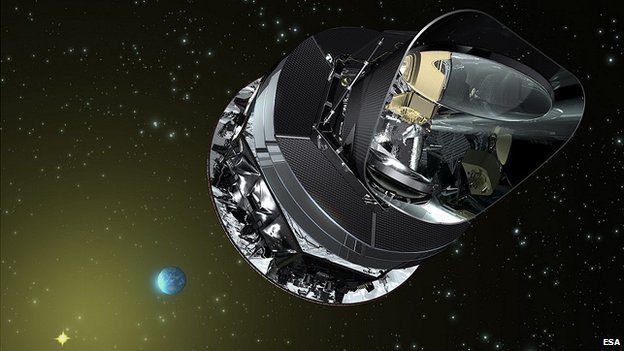
On Saturday 19th October the instruments and cooling systems on the European Space Agency’s Planck spacecraft were switched off, marking the end of the scientific part of the Planck mission, after about four years of mapping the cosmic microwave background.  Later, a piece of software was uploaded that would prevent  the spacecraft systems being  accidentally switched on again after being switched off and the transmitter from causing interference with any future probes.  Planck is already “parked” indefinitely in a what is called a “disposal” orbit, far from the Earth-Moon system, having been nudged off its perch at the 2nd Lagrangian Point (L2) in August by a complicated series of manoeuvres. On October 21st the spacecraft’s thrusters were fired to burn up the last of its fuel, an important aspect of rendering the spacecraft inert, as required by ESA’s space debris mitigation guidelines.

Planck

These preliminaries having been completed, today, at 12.00 GMT,  a final instruction will be transmitted to the spacecraft  to close it down permanently; thereafter Planck will circle the Sun as a silent memorial to the stunning success it achieved when active. I’m sure all those who worked on the Planck mission will pause as the final shutdown command is given and ponder the lonely future  of the spacecraft that had supplied so much interesting data.

But although this will be the end of the Planck mission, it is by no means the end of the Planck Era. Vast amounts of data still need to be fully analysed and key science results are still in the pipeline,  relating in particular to the polarization of the microwave background radiation. Moreover, the numerous maps, catalogues and other data products will be a priceless legacy to this generation, and no doubt many future generations, of scientists.

The fate of Planck illustrates two contrasting aspects of the human experience. On the one hand, there’s the fragility of our existence in a cosmos too vast for us to comprehend. Like the defunct spacecraft, our Earth too circles this little Sun of ours in a precarious orbit while the rest of the Universe – with its countless billion upon billion of other suns – carries on, oblivious to our very existence. Planck makes us painfully aware of our own insignificance.

But on the other hand there’s the sense of fulfillment, and even of joy, at finding things out. We may have puny monkey brains and many things are likely to remain forever beyond our mental grasp, but trying to figure things out is one of the things that defines us as human.  Experiments like Planck (and, for that matter, the Large Hadron Collider) are not the wasteful extravagance some people claim them to be. We need them not just for the sake of science, but to remind us of our common humanity.

UPDATE: And now, from ESA, confirmation that Planck has received its last command. Goodbye, and enjoy your retirement!

Introduction to the PhD for Physics or Astronomy students

Posted in Education with tags , , , , , , on October 22, 2013 by telescoper

It’s the time of year when final-year students start to think about the possibility of doing a PhD after they have graduated, so I I thought I’d jot down here a few general remarks that might be useful to people who are thinking of taking the plunge. I’ve posted on such matters before, but this is something that comes around every year so I hope you’ll excuse the repeat. I’m aiming this primarily at UK students applying for places in the UK; special considerations apply for students wanting to do graduate research abroad.

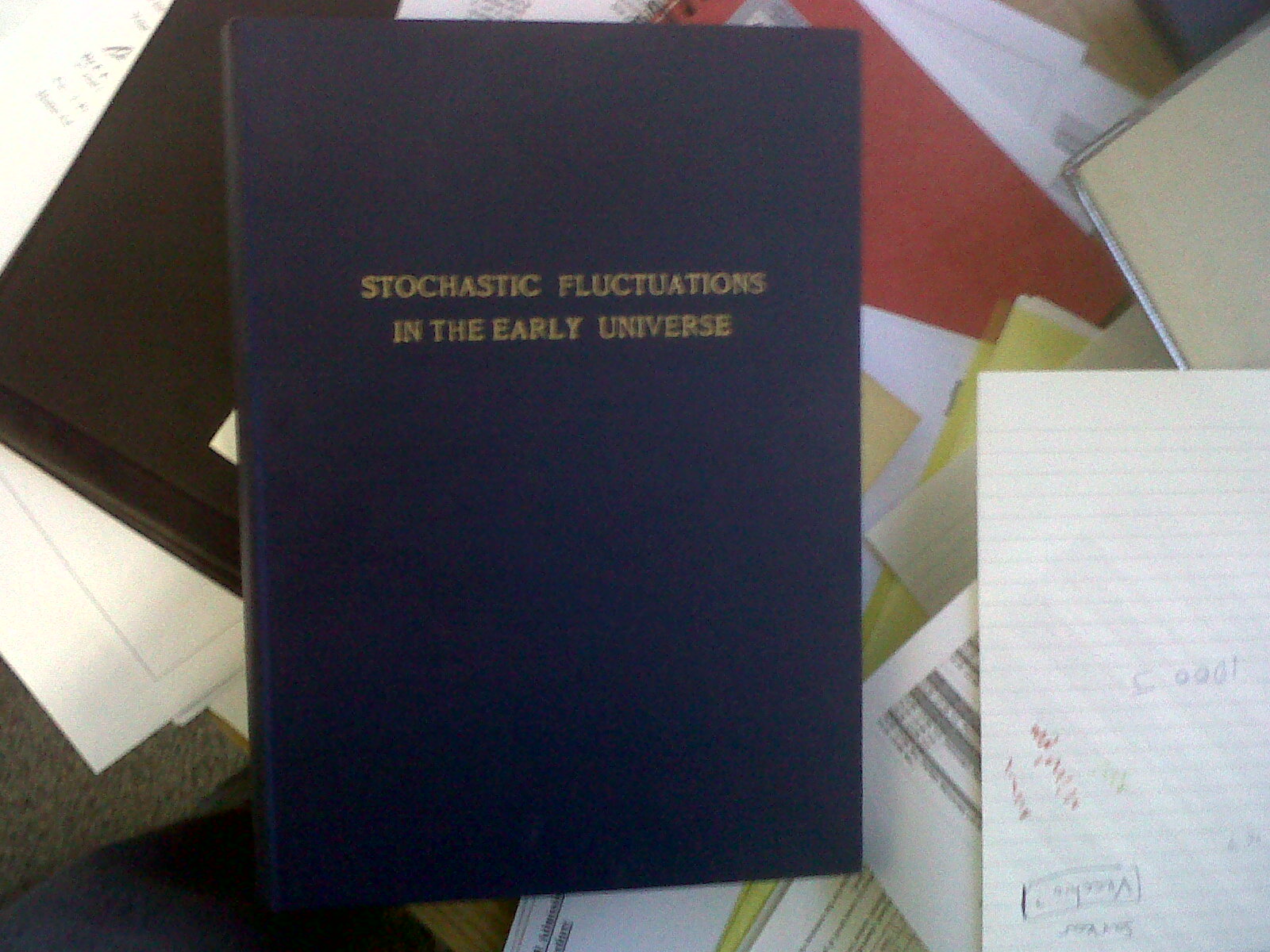
What is a PhD? The answer to that is relatively easy; it’s a postgraduate research degree. In order to obtain a PhD you have to present a thesis like that shown on the left (which happens to be mine, vintage 1988), typically in the range 100-250  pages long. A thesis has to satisfy two conditions for the award of the degree: it should contain original research, which is publishable in an academic journal; and it should present a coherent discussion of that original work within the context of ongoing work in the area of study. In Physics & Astronomy, the PhD is pretty much a prerequisite for any career in academic research, and it usually takes between 3 and 4 years to complete. After submission of the thesis you will have to undergo a viva voce examination conducted by two examiners, one internal and one external. This is quite a tough test, which  can last anywhere between about 2 and about 6 hours, during which you can be asked  detailed questions about your research and wide-ranging questions about the general area.

The Money Side. In the UK most PhDs are supported financially by the research councils, either EPSRC (most physics) or STFC (nuclear & particle physics, astronomy). These generally award quotas of studentships to departments who distribute them to students they admit. A studentship will cover your fees and pay a stipend, currently £13590 pa. That doesn’t sound like a lot, but you should at least remember that it is a stipend rather than a wage; it is therefore not taxed and there is no national insurance payable.

How do I choose a PhD? During the course of a postgraduate degree you are expected to become an expert in the area in which you specialize. In particular you should reach the point where you know more about that specific topic than your supervisor does. You will therefore have to work quite a lot on your own, which means you need determination, stamina and enthusiasm. In my view the most important criterion in your choice of PhD is not the institution where you might study but the project. You need to be genuinely excited by the topic in order to drive yourself to keep through the frustrations (of which there will be many). So, find an area that interests you and find the departments that do active research in that area by looking on the web. Check out the recent publications by staff in each department, to ensure that they are active and to have something to talk about at interview!

Qualifications. Most universities have a formal requirement that candidates for admission to the PhD should have a “good honours degree”, which basically means at least an Upper Second Class Honours degree. Some areas are more competitive than others, however, and in many disciplines you will find you are competing with a great many applicants with First Class degrees.

How to apply successfully. The application procedure at most universities is quite simple and can be done online. You will need to say something about the area in which you wish to do research (e.g. experiment/theory, and particular field, e.g. cosmology or star formation). You’ll also need a CV and a couple of references. Given the competition, it’s essential that you prepare. Give your curriculum vitae some attention, and get other people (e.g. your personal tutor) to help you improve it. It’s worth emphasizing particular skills (e.g. computing). If you get the chance, make use of your summer vacations by taking on an internship or other opportunity to get a taste of research; things like that will undoubtedly give your CV an edge.

The Interview. Good applicants will be invited for an interview, which is primarily to assess whether you have the necessary skills and determination, but also to match applicants to projects and supervisors. Prepare for your interview! You will almost certainly be asked to talk about your final-year project, so it will come across very badly if you’re not ready when they ask you. Most importantly, mug up about your chosen field. You will look really silly if you haven’t the vaguest idea of what’s going on in the area you claimed to be interested in when you wrote your  application!

Don’t be shy! There’s nothing at all wrong with being pro-active about this process. Contact academic staff at other universities by email and ask them about research, PhD opportunities. That will make a good impression. Also, don’t be afraid to ask for advice. Although we’re all keen to recruit good PhD students for our own departments, we academics are  conscious that it is also our job to give impartial advice. Ask your tutor’s opinion.

How many places should I apply for? Some research areas are more fashionable than others so the level of competition varies with field. As a general rule I would advise applying for about half-a-dozen places, chosen because they offer research in the right area. Apply to fewer than that and you might lose out to the competition. Apply to many more and you might not have time to attend the interviews.

What’s the timetable?  Most applications come in early in the new year for entry to the PhD in the following October. The Christmas break is therefore a pretty good time to get your applications sorted out. Interviews are normally held in February or March, and decisions made by late March. STFC runs a deadline system whereby departments can not force students to accept or decline offers before the end of March, so there should be ample time to visit all your prospective departments before having to make any decisions.

Here are some of the slides I used for a talk on such matters a year or so ago, which you might find useful.

That’s all I can think of for now. I hope at least some of these comments are useful to undergraduates anywhere in the UK thinking of applying for a PhD. If there are any further questions, please feel free to ask through the comments box. Likewise if I’ve missed anything important, please feel free to suggest additions in the same manner…
Updates for Cosmology: A Very Short Introduction?

Posted in Books, Talks and Reviews, The Universe and Stuff with tags , , , , , on October 21, 2013 by telescoper

Yet another very busy day, travelling in the morning and then in meetings all afternoon, so just time for another brief post. I thought I’d take the opportunity to do a little bit of crowdsourcing…

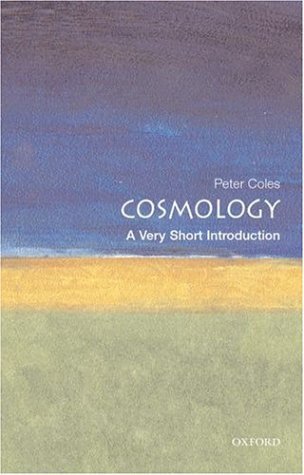
A few days ago I was contacted by Oxford University Press who are apparently considering the possibility of a second edition of my little book Cosmology: A Very Short Introduction, which is part of an extensive series of intensive books on all kinds of subjects.

I really enjoyed writing this book, despite the tough challenge of trying to cover the whole of cosmology in less than 35,000 words and was very pleased with the way it turned out. It has sold over 25000 copies in English and has been published in several other languages.

It is meant to be accessible to the interested layperson but the constraints imposed by the format mean it goes fairly quickly through some quite difficult concepts. Judging by the reviews, though, most people seem to think it gives a useful introduction to the subject, although you can’t please all of the people all of the time!

However, the book was published way back in 2001 and, well, one or two things have happened in the field of cosmology since then.  I have in fact had a number of emails from people asking whether there was going to be a new edition to include the latest developments, but the book is part of a very large series and it was basically up to the publisher to decide whether it wanted to update some, all or none of the series.

Now it seems the powers that be at OUP have decided to explore the possibility further and have asked me to make a pitch for a new edition.  I have some ideas of things that would have to be revised – the section on Dark Energy definitely needs to be updated, and of course first WMAP and then Planck have refined our view of the cosmic microwave background pretty comprehensively?

Anyway, I thought it would be fun to ask people out there who have read it, or even those who haven’t, what they feel I should change for a new edition if there is to be one. That might include new topics or revisions of things that could be improved. Your comments are therefore invited via the famous Comments Box. Please bear in mind that any new edition will be also constrained to be no more than 35,000 words.

Oh, and if you haven’t seen the First Edition at all, why not rush out and buy a copy before it’s too late? I understand you can snap up a copy for just £3 while stocks last. I can assure you all the royalties will go to an excellent cause. Me.

What, no Hammett?

Posted in Literature with tags , , , on October 20, 2013 by telescoper

I just took a break from work to have a look through the Sunday newspapers. In the Independent on Sunday I found an artincle about a new poll by the Crime Writers’ Association, which invites the public to vote on the best crime novel ever written.

I’m not going to quibble with the entire shortlist of ten books as such things are never going to generate a consensus. I will, however, admit being a bit annoyed with it for two reasons.

The first reason is the presence on the list of The Big Sleep by Raymond Chandler. Now don’t get me wrong, I think Chandler was a fine novelist. This particular book, though, is very far from his best work. It is notable for being the first novel to feature his detective Philip Marlowe, but the plot has too many gaps for it to be considered a great example of the genre. Perhaps the shocking nature of the plot, which revolves around drugs, pornography and sexual exploitation, has drawn attention away from these flaws. Anyway it wouldn’t be in my top ten. Chandler’s other book on the shortlist, The Long Goodbye is another story – it’s completely marvellous and thoroughly deserves its place on the list.

The second reason is the absence from the selection of any of the great novels by Dashiell Hammett. The Dain Curse, The Glass Key, Red Harvest and of course The Maltese Falcon are all contenders, in my opinion.

I just can’t understand why the Crime Writers’ Association picked an inferior Chandler over a brilliant Hammett.

Incidentally I don’t think Raymond Chandler would have disagreed. He was well aware of the failings of The Big Sleep and of Hammett he wrote:

Hammett gave murder back to the kind of people that commit it for reasons, not just to provide a corpse; and with the means at hand, not with hand-wrought duelling pistols, curare and tropical fish. He took murder out of the Venetian vase and dropped it in the alley. He was spare, frugal, hard-boiled, but he did over and over again what only the best writers can ever do at all. He wrote scenes that seemed never to have been written before.

There. I’ve said my piece. At least Hammett is on the list for the best Crime Writer. And by way of protest I’m going to have a glass of wine and watch a DVD of The Glass Key starring Alan Ladd and Veronica Lake, a classic film noir adapted from Hammett’s great novel.

A cute probability problem

Posted in Cute Problems with tags , , on October 20, 2013 by telescoper

I’ve got a lot to do today, so I’ll restrict myself to a very quick post in the series marked Cute Problems. This one is to do with probability.

Two people (A and B) play a game which involves a sequence of tosses of a coin. The coin is “fair” so that the probability of a Head (H) is 0.5, equal to the probability of a Tail (T). Successive tosses of the coin are independent.

The game ends when two successive tosses show either the sequence HT (in which case Player A wins) or the sequence TT (in which case Player B wins). If neither pairing is seen the coin is tossed again and again until either HT or TT is seen.

What is the probability that Player A wins?

Answers (with explanations please) through the comments box..

Share Your Sun

Posted in Art with tags , on October 19, 2013 by telescoper

It’s now ten years since Olafur Eliasson’s amazing instllation, Weather Project at Tate Modern. To celebrate this event people can share their responses to this unique experience online here or via the Grauniad website by contributing videos and photographs to a special archive.

Important Announcement

Posted in Uncategorized on October 18, 2013 by telescoper

Very busy this morning before heading off on some travels this afternoon, so only time for a brief post. One of the advantages of having a personal blog is that I can use it to relay important messsages from the Head of School to staff and students in the School of Mathematical and Physical Sciences here at Sussex University, so I’ll take this opportunity to do just that..

–o–

From the Desk of the Supreme Leader:

I regret to announce that, owing to an unfortunate administrative error arising from a confusion over three-letter acronyms, there will be no new Graduate Teaching Assistantships available in the School next academic year.

On the other hand, the School has acquired a large number of copies of the new edition of the computer game Grand Theft Auto which are now available for purchase at a discount from the School Office.

I hope this clarifies the situation.

Did I Miss Anything?

Posted in Education, Poetry with tags , , , on October 17, 2013 by telescoper

Question frequently asked by
students after missing a class

Nothing. When we realized you weren’t here
we sat with our hands folded on our desks
in silence, for the full two hours

Everything. I gave an exam worth
40 per cent of the grade for this term
and assigned some reading due today
on which I’m about to hand out a quiz
worth 50 per cent

Nothing. None of the content of this course
has value or meaning
Take as many days off as you like:
any activities we undertake as a class
I assure you will not matter either to you or me
and are without purpose

Everything. A few minutes after we began last time
a shaft of light descended and an angel
or other heavenly being appeared
and revealed to us what each woman or man must do
to attain divine wisdom in this life and
the hereafter
This is the last time the class will meet
before we disperse to bring this good news to all people on earth

Nothing. When you are not present
how could something significant occur?

Everything. Contained in this classroom
is a microcosm of human existence
assembled for you to query and examine and ponder
This is not the only place such an opportunity has been gathered

but it was one place

And you weren’t here

by Tom Wayman (b. 1945)

How do physicists and astronomers team up to write research papers?

Posted in Science Politics with tags , on October 16, 2013 by telescoper

Busy busy today so just time to reblog this, an interesting article about the irresistible rise of the multi-author paper. What fraction of the “authors” actually play any role at all in writing these papers? Am I the only one that thinks this has very profound implications for the way we interpret bibliometric analyses?

Augusto Carballido's avatarMoonshot

The way in which physicists and  astronomers team up to write technical papers has changed over the years, and not only is it interesting to look at this behavior for its own sake, but by analyzing the data it may be possible to better understand what role, if any, does the number of authors  have on the scientific impact of a paper. Likewise, such an analysis can allow physics and astronomy journals to make decisions about their publishing policies.

I was curious about the trends in the number of authors per refereed astronomy paper, so I set out to write an R script that would read in data from the NASA Astrophysics Data System, an online database of both refereed and non-refereed academic papers in astronomy and physics. The script counts the monthly number of refereed astronomy and physics papers between January 1967 and September 2013, as well as…

View original post 670 more words

Emmy Noether on Ada Lovelace Day

Posted in History, The Universe and Stuff with tags , , on October 15, 2013 by telescoper

It’s been an interesting morning. We had no electricity in the School for most of the morning owing to a power cut, but it was eventually restored while I was away at a meeting elsewhere on campus. Before that I was delayed getting into work because there was an explosion in central Brighton which disrupted the bus service I use to get to Falmer campus. That palaver provides me with a reasonable justification for not having much time to write a blog today.

However, since today is Ada Lovelace day, on which we celebrate inspiring stories of women in science and technology, I thought I’d post a (rather long) video about pioneering mathematical physicist Emmy Noether who is undoubtedly one of the most underrated physicists of all time. When I used to teach Theoretical Particle Physics many moons ago I spent quite a bit of time talking about the very deep connections that Noether uncovered between symmetry and conservation laws. Most of the students were well aware of the laws of conservation of energy and momentum, say, but unaware of the relationship between these laws and symmetries under time and space translations respectively. Making this connection helps to develop a much deeper understanding of many areas of physics. It’s also a very beautiful bit of mathematical analysis.