Archive for December, 2013

Elsevier is taking down papers from Academia.edu

Posted in Open Access with tags , on December 12, 2013 by telescoper

Yet another example of an academic publisher (Elsevier) acting in a manner clearly detrimental to research.

Mike Taylor's avatarSauropod Vertebra Picture of the Week

Lots of researchers post PDFs of their own papers on their own web-sites. It’s always been so, because even though technically it’s in breach of the copyright transfer agreements that we blithely sign, everyone knows it’s right and proper. Preventing people from making their own work available would be insane, and the publisher that did it would be committing a PR gaffe of huge proportions.

Enter Elsevier, stage left. Bioinformatician Guy Leonard is just one of several people to have mentioned on Twitter this morning that Academia.edu took down their papers in response to a notice from Elsevier. Here’s a screengrab of the notification:

oLI5n9w

And here is the text (largely so search-engines can index it):

Hi Guy

Unfortunately, we had to remove your paper, Resolving the question of trypanosome monophyly: a comparative genomics approach using whole genome data sets with low taxon sampling, due to a take-down notice from…

View original post 403 more words

Boycott Nature and Science!

Posted in Open Access, Science Politics with tags , , , , on December 11, 2013 by telescoper

On Tuesday Randy Schekman, joint winner of the 2013 Nobel Prize for Physiology or Medicine hit out at academic publishers for the way the most “prestigious” journals (specifically Cell, Nature and Science) publish only the “flashiest” research.  I see his announcement as part of a groundswell of opinion that scientists are being increasingly pressured to worry more about the impact factors of the journals they publish in than about the actual science that they do. Cynics have been quick to point out that his statements have emerged only after he received the Nobel Prize, and that it’s difficult for younger researchers who have to build their careers in a world to break free from the metrics that are strangling many disciplines. I feel, as do some of my colleagues (such as Garret Cotter of Oxford University), that it’s time for established researchers to make a stand and turn away from those publishers that we feel are having a negative impact on science and instead go for alternative modes of publication that are in better keeping with the spirit of open science.

In future, therefore, I’ll be boycotting Nature and Science (I don’t publish in Cell anyway) and I call upon my colleagues to do likewise. Here’s a nice logo (courtesy of Garrett Cotter) that you might find useful should you wish to support the boycott.

CNS

ps. For the record I should point out that during my career I have published four papers in Nature and one in Science.

The Cosmic Web at Sussex

Posted in Books, Talks and Reviews, The Universe and Stuff with tags , on December 10, 2013 by telescoper

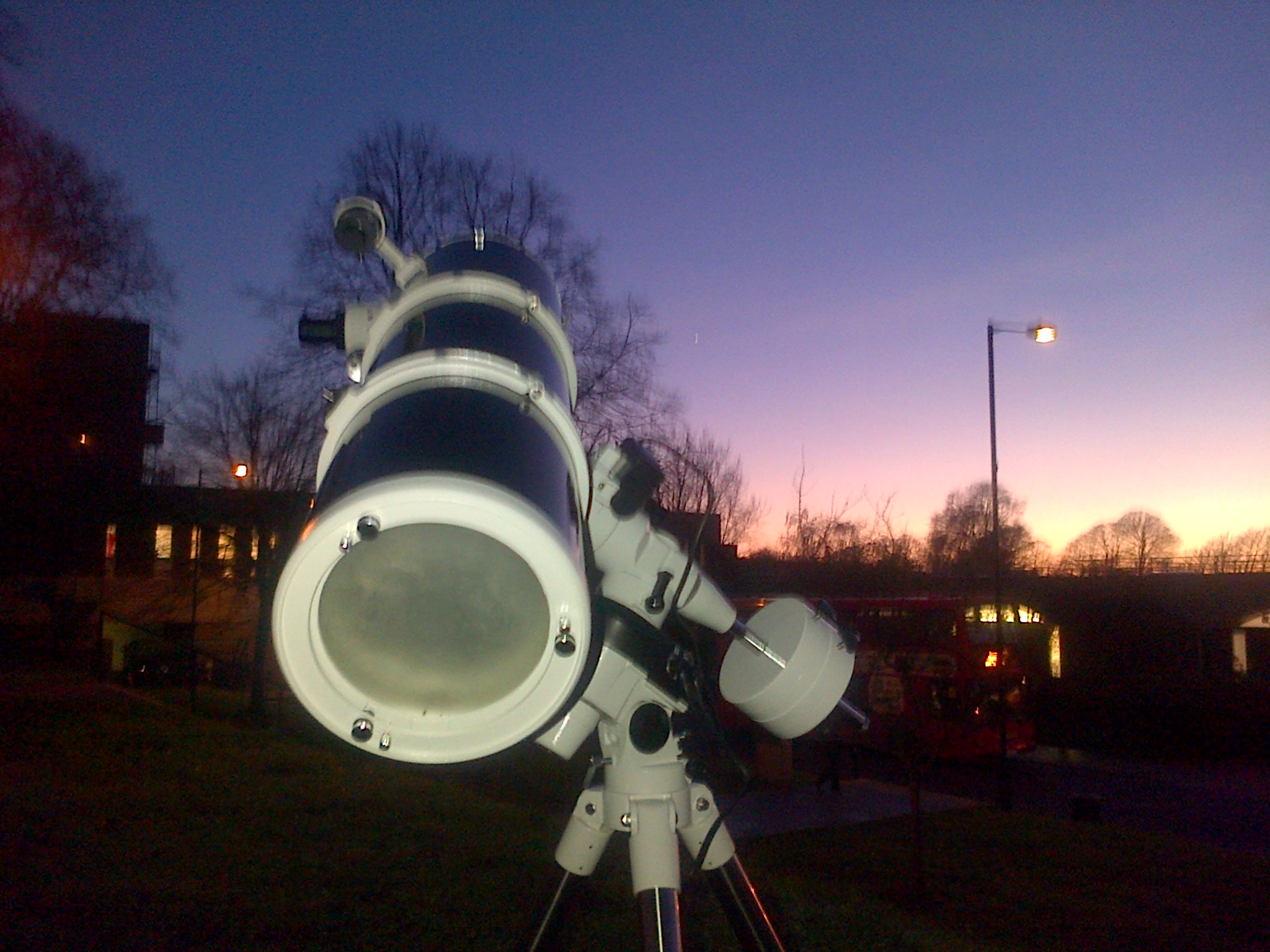
Yesterday I had the honour of giving an evening lecture for staff and students at the School of Mathematical and Physical Sciences at the University of Sussex. The event was preceded by a bit of impromptu twilight stargazing with the new telescope our students have just purchased:

IMG-20131209-00241 IMG-20131209-00243

You can just about see Venus in the second picture, just to the left of the street light.

Anyway, after briefly pretending to be a proper astronomer it was down to my regular business as a cosmologist and my talk entitled The Cosmic Web. Here is the abstract:

The lecture will focus on the large-scale structure of the Universe and the ideas that physicists are weaving together to explain how it came to be the way it is. Over the last few decades, astronomers have revealed that our cosmos is not only vast in scale – at least 14 billion light years in radius – but also exceedingly complex, with galaxies and clusters of galaxies linked together in immense chains and sheets, surrounding giant voids of (apparently) empty space. Cosmologists have developed theoretical explanations for its origin that involve such exotic concepts as ‘dark matter’ and ‘cosmic inflation’, producing a cosmic web of ideas that is, in some ways, as rich and fascinating as the Universe itself.

And for those of you interested, here are the slides I used for your perusal:

It was quite a large (and  very mixed) audience; it’s always difficult to pitch a talk at the right level in those circumstances so that it’s not too boring for the people who know something already but not too challenging for those who don’t know anything at all. A couple of people walked out about five minutes into the talk, which doesn’t exactly inspire a speaker with confidence, but overall it seemed to go down quite well.

Most of all, thank you to the organizers for the very nice reward of a bottle of wine!

Quantum Technology – a Sussex Strength

Posted in Finance, Politics, Science Politics, The Universe and Stuff with tags , , on December 9, 2013 by telescoper

Amid all the doom and gloom in the Chancellor’s Autumn Statement delivered last week there’s a ray of sunshine for research in Physics in the form of an injection of around £270 million in Quantum Technology. According to the Financial Times,

The money will support a national network of five research centres, covering quantum computing, secure communications, sensors, measurement and simulation.

Details of the scheme are yet to be released, but it seems the network will consist of “regional centres” although how evenly it will be spread across the regions remains to be seen. How many will be in the Midlands, for example?

We’re very happy here with this announcement here in the School of Physics & Astronomy at the University of Sussex as we have a well-established and expanding major research activity in Quantum Technology and an MSc Course called Frontiers of Quantum Technology. Moreover, as members of the South East Physics Network (SEPNet) we seem to be in a good position to be for funds as a truly regional centre. Assuming, that is, that the scheme hasn’t already been divvied up behind closed doors before it was even announced!

The investment announced by the government mirrors a growing realization of the potential for economic exploitation of, e.g., quantum computing which is bound to lead to a new range of career opportunities for budding physics graduates.

I’d welcome any comments from people who know any more information about the details of the new investment, as I’m too lazy to search for it myself…

The Sad Tale of Veronica Lake

Posted in Film with tags , , , , , , on December 8, 2013 by telescoper

A few weeks ago I indulged myself by watching, during the same evening, a couple of class examples of Film Noir, The Glass Key and The Blue Dahlia The first of these is based on the novel of the same name by Dashiell Hammett and the second has an original screenplay by Raymond Chandler. Both feature the same leading actors, Alan Ladd and Veronica Lake, The Glass Key being the first film featuring this pairing.

There’s a pragmatic reason why Paramount Studios chose Veronica Lake to star with Alan Ladd, namely her size. Alan Ladd was quite a small man, standing  just a shade under 5′ 5″ tall, and the casting directors consequently found it difficult to locate a leading lady who didn’t tower over him. Veronica Lake, however, was only 4′ 11″ and fitted the bill nicely:
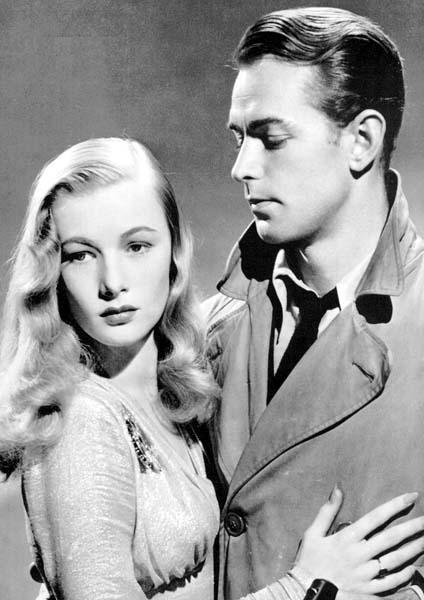
Veronica Lake and Alan Ladd

Veronica Lake and Alan Ladd

It wasn’t just her diminutive stature that propelled Veronica Lake to stardom; she was also very beautiful and managed to project a screen image of cool detachment which made her a perfect choice as femme fatale, a quintessential ingredient of any Film Noir. She’s absolutely great in both the movies I watched, and in many more besides. Her looks and screen presence turned her into a true icon -a vera icon in fact- appropriately enough, because the name Veronica derives from that anagram. The cascade of blond hair, often covering one eye, became a trademark that later found its way into, for example, the character of Jessica Rabbit in the animated film Who Framed Roger Rabbit?

However, her success as a movie star was short-lived and Veronica Lake disappeared from Hollywood entirely in the 1950s. She was rediscovered in the 1960s working as a waitress in a downmarket New York bar, and subsequently made a film called Footsteps in the Snow but it disappeared without trace and failed to revitalize her career. She died in 1973.

So why did an actress of such obvious talent experience such a dramatic reversal of fortune? Sadly, the answer is a familiar one: problems with drink and drugs, struggles with mental illness, a succession of disastrous marriages, and a reputation for being very difficult to work with. Her famous screen persona seems largely to have been a result of narcotics abuse. “I wasn’t a Sex Symbol, I was Sex Zombie”, as she wrote in her biography. She appeared to be detached, because she was stoned.

It’s a sad tale that would cast a shadow over even over the darkest Film Noir but though she paid a heavy price she still left a priceless legacy. Forty years after her death, all that remains of her is what you can see on the screen, and that includes some of the greatest movies of all time.

Caught in the Middle

Posted in Education, Politics with tags , , , , on December 7, 2013 by telescoper

Academics these days are caught between a rock and a hard place.

On one side we have a government which seems not only malevolent but also utterly incompetent. I cite the recent example of the Department of Business Innovation and Skills, which has completely lost control of its budget, meaning that further cuts are likely to a higher education sector already struggling to cope with the instability generated by constant meddling from successive governments.

On the other we have our students, who are definitely getting a very raw deal compared with those of my generation. Most are justifiably  unhappy with the high level of fees they have to pay. Many also feel generally alienated by the way the country is run, for the benefit of the rich  at the expense of the young and the poor. Recent campus protests across the country are clearly a manifestation of this groundswell of resentment, although in some cases they have clearly been hijacked by extremist elements who will protest about anything at the drop of a hat just for the sake of it.

In between we have us academics, the vast majority of whom agree with the students  that UK higher education is in a complete mess and that the UK government is responsible. However, most of us also believe in the importance of universities as places of research, scholarship and teaching and want to carry out those activities as best we can for the benefit not only of our current students but for society as a whole.

So what should we academics who find ourselves caught  in the middle do?

Unsurprisingly, opinions differ and I don’t claim to speak for anyone but myself when I state mine. I think it’s the responsibility of academic staff to recognize the burden placed on our students by government and in the light of that do absolutely everything in our power to give them the best education we can. That means ensuring that as much of the money coming into universities from tuition fees goes directly towards improving the education of students – better teaching facilities, more and better trained staff and a better all-round experience of campus life. That is the reason that I did not participate in the recent strikes over pay: I absolutely refuse to take any action that would be in any way detrimental to the education of students in my School. Call me a scab if you wish. My conscience is clear. For me it’s not a matter of choice, it’s a matter of responsibility.

So what about the recent wave of student protests? Again, all I can do is give my own opinion (not that of my employer or anyone else) which is that I believe in the right to protest – as long as it’s peaceful – but targeting universities is short-sighted and counterproductive.  I’m sure that all the government is delighted that none of the latest protests have been in Whitehall, which is where the focus of complaint should be, but instead dissipated at arms length in a series of futile and divisive campus demonstrations.

And if one of these protests causes enough disruption that it succeeds in closing down a university for good – and don’t tell me that this government won’t allow that to happen – what good will that have done?

Haikus for the Day

Posted in Biographical, Poetry on December 6, 2013 by telescoper

Invited guest of
the Japanese Embassy
in Piccadilly

“A Symposium”
they call this. Lectures followed
by wine (hopefully)..

Astronomy and
Space Science unite nations.
One cosmos for all!

Smiley talks to Toby

Posted in Television with tags , , , , on December 5, 2013 by telescoper

Just time for a brief post as it has been a very long and stressful day (it’s probably best if I don’t try to explain why). I’m going to pour myself into a bottle of wine when I get home. For some reason I thought of this clip, from the TV series Smiley’s People, which I thought I’d share because I happened to watch the entire series on DVD at the weekend. I think it’s beautifully done.

Just to set the scene, the series (based on the novel of the same name by John Le Carré) is set a few years after Tinker Tailor Soldier Spy. Intelligence officer George Smiley (Alec Guinnness) is in retirement, as is his former colleague Toby Esterhase (Bernard Hepton) who has adopted the identity of a dodgy art dealer. Smiley is called back into action when a former agent by the name of Vladimir is murdered on Hampstead Heath en route to an appointment with British Intelligence (aka “The Circus”). Smiley is told to find out what happened and hush it up, but a combination of detective work and intuition leads him to the realization that he may, at last, have stumbled upon a way of bringing down his opposite number in Soviet Intelligence, the enigmatic Karla. This scene, wherein Smiley and Esterhase meet up for the first time since they parted company with the Circus marks the point where Smiley decides to ignore his instructions to bury the case and embark on one last operation in the hope that he can at last locate Karla’s Achilles Heel. To find out more, you’ll have to watch the series, which unfolds slowly, but brilliantly…


Bohmian Mechanics Explained

Posted in The Universe and Stuff with tags , , on December 4, 2013 by telescoper

Here’s a nice set of short videos about the de Broglie-Bohm theory which is a causal, deterministic, interpretation of Quantum Mechanics that can be thought of as a hidden variable theory. It’s a common misconception that hidden-variable theories are ruled out by experimental evidence (which is probably why they tend not to be discussed very much at undergraduate level) but this is not the case. What is true is that hidden variables have to be non-local, which many physicists consider too weird for comfort – but who’s to say that the Universe isn’t even weirder than we thought?

Service Complet

Posted in Biographical, Science Politics with tags , on December 3, 2013 by telescoper

Just time for a quick post from the London to Brighton train, having spent the day at my last ever “Plenary” meeting of the Astronomy Grants Panel of the Science and Technology Facilities Council which was held at the Institute of Physics. This meeting marks the end of the annual grants round; in January there’ll be a meeting to kick off next year’s business.

I’ve been on this panel for four years now, so I think I’ve done my bit. Time for some new blood to replace those of us who have been stood down.

Anyway I just want to say a big public thank you to the STFC staff, especially Kim, Diane, and Colin for doing their best to keep the panel members in order, as well as to Theory sub-Panel Chair Tom and overall Chair Andy who are also stepping down.

Better is the end of a thing than the beginning thereof. I refer to the day, not the AGP, because it began with a major wobbly in Victoria station on the way to the IOP but ended with a couple of pints and a nice chinwag in the pub round the corner..