Archive for January, 2014

Qualification Matters

Posted in Biographical, Education with tags , , , on January 18, 2014 by telescoper

Yesterday evening I had a very enjoyable dinner with a seminar speaker and group of students from the Kobayashi-Maskawa Institute at Nagoya University. On the way back to the guest house I’m staying in, at about 9.30pm, we passed a group of young kids in uniform apparently returning from school. I was told that they were students from a Junior High School (chūgaku) who had been studying late in preparation for an entrance examination to the (selective) Senior High Schools (kōtōgakkō). I was a bit surprised to see young teenagers putting in such long hours, but such behaviour seems quite normal here in Japan.

One of the things I have to get to grips with when I get back to the School of Mathematical Sciences at the University of Sussex on Monday is the annual admissions cycle. I have meetings in my calendar for next week about this, and we are hosting an applicant visit day on Saturday 25th January; we have of course already made offers to a large number of students based on their predicted grades at GCE A-level. This process is fraught with difficulties, not least because there some schools seem to over-predict the grades that their pupils achieve in order to maximise the chance of them getting into University. Predicted grades being rather unreliable, it would of course be fairer on all concerned to use actual grades, i.e. to defer university applications until after the A-level results come out, but that would be far too sensible so obviously will not happen in the United Kingdom. I’m actually quite sceptical of the usefulness of A-levels for preparing students for University in general, but that’s another matter.

Anyway, the mini-rant above isn’t main point of this post, which is instead to issue a warning to those  students taking A-levels later this year. It is  based on anecdotal evidence, but quite a lot thereof. The point is that universities will often reduce their usual offer at A-level when they find an applicant with very high predicted grades, sometimes even making an unconditional offer (actually the minimum is two E grades) to high-fliers. This happened a lot in the old days when I was applying for a place at university. Though it is less common nowadays the government’s policy of lifting controls on universities’ ability to recruit students with three A-level grades at ABB or better is bound to increase the amount of game-playing as competition between recruiters intensifies.

This creates a number of issues, but the one I want to pick out arises when a student is predicted to get three As at A-level, but his/her first-choice university gives them an unconditional offer. Their first reaction will obviously be “whoopee! I’ll accept that offer and, what’s more, I don’t need to fret too much about my summer examinations..”.

In fact I’ve known plenty of students who came into university with quite modest A-level grades, but did brilliantly well at their studies and ended up with first-class degrees. There can be many explanations behind such cases quite apart from the relaxation effect. Some schools don’t have good specialist science teachers, for example; this can mean that a student’s interest is really only ignited once they get into university.

The problem is, though, that A-levels results are not just for university entry, they’re for life. A student may graduate with a good degree, even a First,  but so do many others. When selecting for postgraduate jobs, or even postgraduate study, recruiters often have a large number of people with excellent degrees; that’s an obvious consequence of the expansion of the Higher Education sector in recent years. What happens, therefore, is that employers and PG admissions tutors have to look at other factors; naturally, that includes A-level results but also even GCSEs. You might be surprised to learn that even if you get a first-class degree, your chances of getting a PhD place at a top institution depends on your performance at School but they definitely do. I’m not saying that this should, be the case, just that it in practice it is.

I recall hearing recently from one former student who had a first-class degree in Physics and a PhD from an excellent University, and who was applying for a job in a research institute (not in the university sector). The application form he received asked him to list not only his A-levels but also his GCSE results!

I hope I’ve made my point to any prospective students, but I’ll summarize it in case I haven’t. If you get a generous offer from your chosen university then that’s a good thing, because it means that they want you. You should be happy. But don’t ease off on your studies because if you end up getting poorer A-levels than you deserve, they may one day come back to haunt you.

Comedians Are Not Psychotic

Posted in Uncategorized on January 17, 2014 by telescoper

Enjoyable dismantling of yet another dodgy psychological “study” by Dave Steele, who may or may not be a comedian…..

davehullo's avatarDelight Through Logical Misery

“Successful comedians display symptoms of psychosis, study says” went the headline. “Psychotic traits in comedians” said the title of the study the headline was referring to. “Bang” went the foreheads meeting the desks of many psychologists, psychiatrists and humans who’d thought for five seconds about what this headline could do for science, psychology, psychiatry and mental illness stigma.

The scientific study, which in this case is apparently Latin for “press release based on a journal article”, states that the popular belief that creativity is related to mental illness is borne out in comedians, who showed higher levels of psychotic traits than actors, who both showed higher levels of psychotic traits than “normal” people. The word normal was the article’s rather than mine as obviously actors and comedians (and by association people with traits of mental illness [?!]) aren’t “normal”. At least the authors are thematically consistent with their…

View original post 1,054 more words

For the sake of a seminar..

Posted in Biographical, Books, Talks and Reviews, The Universe and Stuff with tags , , , on January 17, 2014 by telescoper

Just a quick post while I drink my morning coffee. Yesterday afternoon I gave a seminar here in the Kobayashi-Maskawa Institute at Nagoya University. It was actually at 5pm; I almost made a mistake when I saw it on the the high-tech digital display screen shown here (see top right) because I thought that 16 meant 1600 hours:

IMG-20140116-00264

Although I’ve got used to the time difference pretty well, I am still struggling to work out what day it is. The 16 stands for 16th January of course…

Anyway, it seemed to go fairly well and was pretty well attended by the students and postdocs as well as faculty. The lecture theatre was extremely well equipped with AV equipment and I got distracted quite often playing with the various gadgets. Also there were two projector screens, side by side, so the audience got my slides in stereo, so to speak.

In case you’re interested, here are the slides from my talk – complete with artistic flourishes:

For the cosmologists among you, the main protagonists here are Naoshi Sugiyama, who has a joint appointment here and at the Kavli Institute in Tokyo, Takahiko Matsubara, and Chiaki Hikage. The latter was a postdoc working with me at Nottingham and Cardiff; he then worked in Princeton before returning to Japan; Chiaki has been my host during my stay here.

After my talk, and a question-and-answer session, the staff treated me to dinner. We had some discussion about where to go during which I mentioned that I’d seen a place called Hamakin, which claimed to be a Japanese-Italian restaurant:

640x640_rect_21510962

I wasn’t convinced by the concept but it turned out that, although it was a new place, Takahiko had been there before and thought it was very good. We ended up there and, much to my surprise, it was excellent. It was a lot more Japanese than Italian, I have to say, but we did try an interesting take on pizza with cod roe as part of the topping. They had an English menu, with some curious choices of English words. I wasn’t really tempted by “Economic Steak”, and “Cod Ovum” suggested, by use of the Latin singular of “egg”, an extremely small portion. I still don’t know what “pastured chicken” is, either.

As a special treat some sake from a bamboo container was served for me in a bamboo cup; the bamboo is supposed to make it taste nicer but I wasn’t able to discern a difference between the special sake and normal sake. I clearly don’t have a sufficiently cultivated palate. Apologies for the pun in the title of the post too!

Today, Friday, is the last working day of my visit so I’d better get on and finish what I’m here to do because there’s another seminar this afternoon which I’d like to attend. Tomorrow, if I can get myself organized, I might take a trip on the bullet train for a day’s sightseeing in Kyoto, which I am told is a must-see city.

Toodle-pip!

Living in the Vortices of Infinity

Posted in Biographical, Literature, The Universe and Stuff with tags , , , , on January 16, 2014 by telescoper

As a boyhood fan of influential American horror writer Howard Phillips Lovecraft (known to his friends as “H.P.”), I was dismayed to discover some time ago a poem which revealed his obnoxiously racist attitudes. I always find it difficult knowing what to do when someone whose artistic work you admire turns out to have a dark side to his or her personality. It’s always hard to separate the creation from the creator. In the case of H.P. Lovecraft I’ve maintained an interest in him and his work, I suppose in an attempt to find some redeeming features.

Anyway, in Lovecraft’s Selected Letters, I came across a passage which is reminiscent of the following quotation from an interview with physicist Steven Weinberg:

I believe that there is no point in the universe that can be discovered by the methods of science. I believe that what we have found so far, an impersonal universe in which it is not particularly directed toward human beings is what we are going to continue to find. And that when we find the ultimate laws of nature they will have a chilling, cold impersonal quality about them.

I don’t think this means [however] there’s no point to life. Usually the remark is quoted just as it stands. But if anyone read the next paragraph, they would see that I went on to say that if there is no point in the universe that we discover by the methods of science, there is a point that we can give the universe by the way we live, by loving each other, by discovering things about nature, by creating works of art. And that — in a way, although we are not the stars in a cosmic drama, if the only drama we’re starring in is one that we are making up as we go along, it is not entirely ignoble that faced with this unloving, impersonal universe we make a little island of warmth and love and science and art for ourselves. That’s not an entirely despicable role for us to play.

This is the passage in Lovecraft’s Selected Letters

As you are aware, I have never been able to soothe myself with the sugary delusions of religion; for these things stand convicted of the utmost absurdity in light of modern scientific knowledge. With Nietzsche, I have been forced to confess that mankind as a whole has no goal or purpose whatsoever, but is a mere superfluous speck in the unfathomable vortices of infinity and eternity. Accordingly, I have hardly been able to experience anything which one could call real happiness; or to take as vital an interest in human affairs as can one who still retains the hallucination of a “great purpose” in the general plan of terrestrial life. … However, I have never permitted these circumstances to react upon my daily life; for it is obvious that although I have “nothing to live for”, I certainly have just as much as any other of the insignificant bacteria called human beings. I have thus been content to observe the phenomena about me with something like objective interest, and to feel a certain tranquillity which comes from perfect acceptance of my place as an inconsequential atom. In ceasing to care about most things, I have likewise ceased to suffer in many ways. There is a real restfulness in the scientific conviction that nothing matters very much; that the only legitimate aim of humanity is to minimise acute suffering for the majority, and to derive whatever satisfaction is derivable from the exercise of the mind in the pursuit of truth (from Letter to Reinhardt Kleiner  (14 September 1919), in Selected Letters I, 1911-1924 edited by August Derleth and Donald Wandrei, pp. 86-87).

I think my own philosophy of life is some sort of juxtaposition of these two…

Early Junction: Door of the Cosmos

Posted in Jazz, The Universe and Stuff with tags , , , on January 15, 2014 by telescoper

One of the quirks of being in Japan is the 9 hour time difference between here and the UK, which means I’m just getting up when folk back home are going to bed; and one of the consequences is that BBC Radio 3’s Late Junction is on (via the internet) in the morning. It’s playing as a write this, in fact. Yesterday morning there was a track by Sun Ra, which reminded me that 2014 is the centenary of his birth. It prompted me to look back at an old post I’d written about him where I found the track included there had been deleted from Youtube. I therefore decided to post a new version, including a different track.

Sun Ra was one of the most extraordinary composers and bandleaders of the 20th Century,  was born Herman Poole Blount in Bimingham, Alabama, on 22nd May 1914. From the 1950s, until his death in 1993, he led various combinations of musicians in bands with various permutations of names involving the word Arkestra, such as the Blue Universe Arkestra and the Solar Myth Arkestra. He himself played keyboards, sometimes solo and sometimes with huge bands  of over 30 musicians; his music touched on virtually the entire history of jazz, from ragtime to swing music, from bebop to free jazz, as well as soul and pop. He was also  one of the first musicians, in any genre, to make extensive use of electronic keyboards.

He never achieved mainstream commercial success, but was a prolific recording artist with a cult following, partly fuelled by his outrageous claims to have been born not on Earth but on Saturn and the fact that much of his music was to do with space travel. Quoted in Jazziz magazine

They really thought I was some kind of kook with all my talk about outer space and the planets. I’m still talking about it, but governments are spending billions of dollars to go to Venus, Mars, and other planets, so it’s no longer kooky to talk about space

Quite. In fact, Sun Ra developed a complex performing identity based on his music, “cosmic” philosophy, and poetry. He abandoned his birth name, took on the persona of Sun Ra (Ra being the ancient Egyptian god of the sun), and often dressed in the style of an ancient Egyptian pharoah, as in the video clip. In other words, he was very odd.

Sun Ra’s music is eclectic, outrageous and sometimes downright mystifying, but it also has a marvellous coherence to it maintained as his style evolved over four decades and is consistently imbued with a powerful sense of the Jazz tradition.  Anyway, whatever I think, the music of Sun Ra has withstood its skeptics and detractors for generations and long may it continue to do so. The world needs more of his kind of eccentric.

Here’s a number called Door of the Cosmos. See what you think.

Home-thoughts from Abroad

Posted in Biographical with tags , , , on January 15, 2014 by telescoper

So here I am, about half-way through my trip to Japan and more-or-less getting the hang of life here. I have to admit that when I was a bit apprehensive ahead of my arrival because various friends back home had warned me that everyday things, particularly food, would be quite difficult to get used to in such a different culture; one even advised me to put plenty of sachets of Cup-a-Soup in my luggage in case I couldn’t find anything edible. As it turns out I’ve taken to the food rather well. First night here we had a traditional meal with various forms of Sashimi, which I liked very much indeed. At the weekend I went to a different kind of traditional eating-place and ate a hearty and very filling lunch of roast pork. The staff and other diners at this second place were quite surprised to see a European person there; they were impeccably polite, but clearly found it hilarious to see a middle-aged man struggling so much with his chopsticks. It occurred to me that they probably thought that only a barbarian could be such a messy eater. The food, however, was delicious.

Being conspicuous is something I’ve had to get used to. Although Nagoya is quite a large city, it’s not really a prime tourist location and there are not many Europeans to be found. There are numerous shops and eating places on the Nagoya University campus in which the clientele is overwhelmingly local; I always feel that I stick out like a sore thumb when I walk in. I can’t read a word of Japanese either, which means I have to point at the menu and hope that there are no options because that would require a question to be asked and answered. Today at lunch in one of the University Dining Halls I didn’t know how to answer a question and ended up with a side order of chips by default. They probably assumed that’s what I wanted, but in fact I’d have been happy trying something a little more exotic.

People don’t seem to eat any kind of dessert here, at either lunch or dinner. There are several pleasant coffee bars that serve good quality coffee near us, and there’s also a Starbucks. Also, people never tip in restaurants: you pay at the door on the way out, rather than at the table.

Supermarkets are interesting too. Most products have only Japanese writing on them so guesswork is often involved in figuring out the ingredients. Only rarely is there any English writing. Sometimes there’s a picture, but it doesn’t always help. I bought a bag of crisps the other day but had no idea what flavour they would be. After eating them I still haven’t a clue. Tasty though.

A small convenience store near the department sells pastries and the like so that’s what I’m having for breakfast these days. There’s a small water boiler in my room so I can make tea or (instant) coffee there; green tea is provided in the room. I bought some allegedly English (“black”) tea in a supermarket the other day, but sadly it turned out to be revolting. Perhaps I’ll bring it home with me and give it to someone I don’t like.

Generally food is pretty cheap: you can get a substantial meal in a reasonable restaurant for less than the equivalent of £10; items in supermarkets where I’ve been able to make a comparison are about 2/3 of the price you would pay in Britain. Come to think of it that’s probably less to do with Japan being cheap and more to do with Britain being expensive.

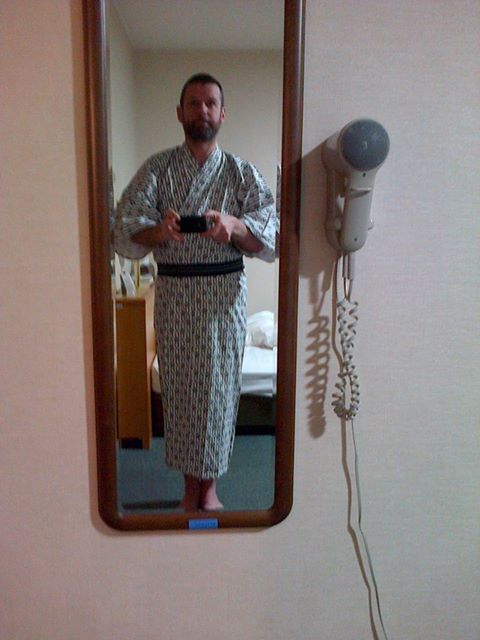
yukata

Selfie, with Yukata

Among the items provided in my room is a Yukata, a simple cotton robe with wide sleeves worn with an obi (belt). I decided to try mine on and the result is shown on the left. Unfortunately I broke the symmetry incorrectly: one is supposed to wrap the left side over the right, whereas I did it right over left. The way I did it is apparently the way a body is dressed for burial. At least it looks right correct in the mirror.

Incidentally, the Japanese also drive on the right side of the road, ie the left.

The Yukata is extremely comfortable, and is often worn outdoors during the summer months or so I’m told. It’s too chilly in Nagoya at this time of year to go out wearing one, but it’s fine for indoors.
And before you ask, that’s not a telephone by the mirror but a hair-dryer…

During the days I’ve been busy getting on with work as well as talking a very great deal with some of the Doctoral and Masters students here at the Kobayashi-Maskawa Institute about their work. I think they relished the chance to practice speaking English as much as to get my input into the science. Anyway, the topics are very wide-ranging: higher-order perturbations to the Boltzmann Equation, analysis of Hα galaxy surveys, weak lensing in modified gravity theories, primordial magnetic fields, luminous red galaxies in clusters, analysis of 21cm surveys, etc.


A strange thought struck me walking to the office this morning. To me Japan is a foreign culture and I can’t speak a word of the language but, despite all that, I find it much easier to imagine living here than, say, America (where I can at least speak a similar language to the locals).  I’m not sure that this makes sense in terms of an explanation, but Japan seems to be a country that probably makes a lot of sense once you come to terms with it. I’m not saying that I want to move here, just that I feel a lot less alien here than I expected, and a lot less alien than I do in places much closer to home.

Cosmological Tanka

Posted in Poetry, The Universe and Stuff with tags , , , on January 14, 2014 by telescoper

Most readers of this blog will be familiar with the form of Japanese poetry known as Haiku. I’ve even had a go at producing some cosmological Haiku myself. I suspect rather fewer will have come across another form known as Tanka. Being 31 syllables long rather than the 17 of Haiku, these are not quite as short but still quite a challenge to write.  They comprise 5 lines with a 5-7-5-7-7 pattern of syllables. I’m told by Japanese friends that Tanka are specifically written to celebrate a special event or to capture the mood of a particular moment. Here is an exquisite example by a famous poet called Otomo No Yakamochi:

From outside my house,
only the faint distant sound
of gentle breezes
wandering through bamboo leaves
in the long evening silence.

I’ve had a go at composing a couple of Tanka to do with specific moments in cosmology. Here’s one about the epoch of recombination:

An electron finds
a proton and marries it;
they make hydrogen.
Simultaneous weddings
free light across the cosmos.

I was talking to some students about the spherical collapse model so here’s a Tanka for that:

I was more dense than
my surroundings, expanded
more slowly, then stopped.
Now I must start to collapse;
soon I shall virialize.

Further attempts welcome through the comments box!

A Summer of Undergraduate Physics Research

Posted in Biographical, Education, The Universe and Stuff with tags , , , , on January 14, 2014 by telescoper

I was compiling a bibliography for a new paper yesterday and noticed that a paper published in December 2013 cited one I wrote in 2005 with Andrew Stannard while I was working at the University of Nottingham; the rarity of anyone actually referring to any of my papers caught my attention. I include the abstract of the Stannard-Coles paper here for reference:

We investigate the properties of the (complex) coefficients obtained in a spherical harmonic representation of temperature maps of the cosmic microwave background (CMB). We study the effect of the coefficient phase only, as well as the combined effects of phase and amplitude. The method used to check for anomalies is to construct a `random walk’ trajectory in the complex plane where the step length and direction are given by the amplitude and phase (respectively) of the harmonic coefficient. If the fluctuations comprise a homogeneous and isotropic Gaussian random field on the sky, the path so obtained should be a classical `Rayleigh flight’ with very well known statistical properties. We illustrate the use of this random-walk representation by using the net walk length as a test statistic, and apply the method to the coefficients obtained from a Wilkinson Microwave Anisotropy Probe (WMAP) preliminary sky temperature map.

This seems like ancient history now, particularly with regard to the use of “preliminary” WMAP data, but it was only just over 8 years ago. I never imagined during the time that we were working on this paper that I’d be moving twice! By contrast, Andrew Stannard remained in Nottingham, doing a PhD there and is now employed as a Research Fellow, although he switched fields after the project and moved into nanoscience.

Anyway, I wasn’t posting this so I could take a trip down memory lane. I thought I’d post it in order to point out that this paper actually came about as an undergraduate research project that Andrew did under my supervision during the summer of 2005, funded by a Mary Cannell Summer Studentship. Mary Cannell was the author of a book about the life of George Green (the famous mathematician who came from Nottingham); she passed away in 2000 leaving some money to the School of Physics & Astronomy to fund summer research placements for undergraduates. If I recall correctly, we completed the analysis and wrote the paper during the summer of 2005, submitting it in August and having it accepted in September. If only it were always so straightforward! Since publication it has garnered 15 citations according to the ADS website; not exactly earth-shattering, but respectable enough, especially given the background. I think it may get a few more in the next few years because the quality of data from Planck may now be good enough to actually detect the features we were looking for all those years ago!

It’s worth mentioning that in the School of Physics and Astronomy at the University of Sussex we have a degree programme in which students receive a stipend to cover living expenses during a summer vacation placement with one of the research groups each and every year of their studies. This is in addition to the usual lectures and laboratory work of the standard  course. This involves many more students than was the case back in Nottingham in 2005, but since I’ve only been at the University of Sussex for  a year I don’t know how many such placements have led to actual publications.

Does anyone know of any really important papers out there that came from undergraduate research projects? If so, please let me know through the comments box..

Come again? “Penile Strangulation by Metallic Rings” retracted for duplication

Posted in Uncategorized on January 13, 2014 by telescoper

Here’s an interesting development from the inestimable blog Retraction Watch, which I thought I should display on my own organ. A paper on “Penile Strangulation by Metallic Rings” has been withdrawn from publication. Pity, because the authors probably went through lots of hoops to get it past the editor…

Adam Marcus's avatarRetraction Watch

indjrnsurgThe Indian Journal of Surgery, a Springer-Verlag title, has retracted a 2011 paper with a title only the Marquis de Sade would love: “Penile Strangulation by Metallic Rings.”

We know what you’re saying: Who knew penises could be strangulated? Well, it’s true.

View original post 606 more words

The Riddle of the Samurai Sword

Posted in Cute Problems with tags , on January 13, 2014 by telescoper

For some reason I just remembered a simple little puzzle I was told about ages ago, so I thought I’d try it out here.

On certain trains in Japan, passengers are not allowed to enter a compartment with any piece of luggage which is too long or too wide to be placed in the overhead racks; any parcel or package with dimensions larger than 60 cm × 80 cm is forbidden.  It is possible however to enter the carriage with a metre-long samurai sword.

How?

Answers through the comments box please…