Archive for January, 2015

The Love Song of J Alfred Prufrock

Posted in Poetry with tags , , , on January 15, 2015 by telescoper

S’io credesse che mia risposta fosse
A persona che mai tornasse al mondo,
Questa fiamma staria senza piu scosse.
Ma perciocche giammai di questo fondo
Non torno vivo alcun, s’i’odo il vero,
Senza tema d’infamia ti rispondo.

Let us go then, you and I,
When the evening is spread out against the sky
Like a patient etherized upon a table;
Let us go, through certain half-deserted streets,
The muttering retreats
Of restless nights in one-night cheap hotels
And sawdust restaurants with oyster-shells:
Streets that follow like a tedious argument
Of insidious intent
To lead you to an overwhelming question…
Oh, do not ask, “What is it?”
Let us go and make our visit.

In the room the women come and go
Talking of Michelangelo.

The yellow fog that rubs its back upon the window-panes,
The yellow smoke that rubs its muzzle on the window-panes
Licked its tongue into the corners of the evening,
Lingered upon the pools that stand in drains,
Let fall upon its back the soot that falls from chimneys,
Slipped by the terrace, made a sudden leap,
And seeing that it was a soft October night,
Curled once about the house, and fell asleep.

And indeed there will be time
For the yellow smoke that slides along the street,
Rubbing its back upon the window-panes;
There will be time, there will be time
To prepare a face to meet the faces that you meet;
There will be time to murder and create,
And time for all the works and days of hands
That lift and drop a question on your plate;
Time for you and time for me,
And time yet for a hundred indecisions,
And for a hundred visions and revisions,
Before the taking of a toast and tea.

In the room the women come and go
Talking of Michelangelo.

And indeed there will be time
To wonder, “Do I dare?” and, “Do I dare?”
Time to turn back and descend the stair,
With a bald spot in the middle of my hair—
[They will say: “How his hair is growing thin!”]
My morning coat, my collar mounting firmly to the chin,
My necktie rich and modest, but asserted by a simple pin—
[They will say: “But how his arms and legs are thin!”]
Do I dare
Disturb the universe?
In a minute there is time
For decisions and revisions which a minute will reverse.

For I have known them all already, known them all—
Have known the evenings, mornings, afternoons,
I have measured out my life with coffee spoons;
I know the voices dying with a dying fall
Beneath the music from a farther room.
So how should I presume?

And I have known the eyes already, known them all—
The eyes that fix you in a formulated phrase,
And when I am formulated, sprawling on a pin,
When I am pinned and wriggling on the wall,
Then how should I begin
To spit out all the butt-ends of my days and ways?
And how should I presume?

And I have known the arms already, known them all—
Arms that are braceleted and white and bare
[But in the lamplight, downed with light brown hair!]
Is it perfume from a dress
That makes me so digress?
Arms that lie along a table, or wrap about a shawl.
And should I then presume?
And how should I begin?

. . . . .

Shall I say, I have gone at dusk through narrow streets
And watched the smoke that rises from the pipes
Of lonely men in shirt-sleeves, leaning out of windows? …

I should have been a pair of ragged claws
Scuttling across the floors of silent seas.

. . . . .

And the afternoon, the evening, sleeps so peacefully!
Smoothed by long fingers,
Asleep… tired… or it malingers,
Stretched on the floor, here beside you and me.
Should I, after tea and cakes and ices,
Have the strength to force the moment to its crisis?
But though I have wept and fasted, wept and prayed,
Though I have seen my head [grown slightly bald] brought in upon a platter,
I am no prophet—and here’s no great matter;
I have seen the moment of my greatness flicker,
And I have seen the eternal Footman hold my coat, and snicker,
And in short, I was afraid.

And would it have been worth it, after all,
After the cups, the marmalade, the tea,
Among the porcelain, among some talk of you and me,
Would it have been worth while,
To have bitten off the matter with a smile,
To have squeezed the universe into a ball
To roll it toward some overwhelming question,
To say: “I am Lazarus, come from the dead,
Come back to tell you all, I shall tell you all”—
If one, settling a pillow by her head,
Should say: “That is not what I meant at all.
That is not it, at all.”

And would it have been worth it, after all,
Would it have been worth while,
After the sunsets and the dooryards and the sprinkled streets,
After the novels, after the teacups, after the skirts that trail along the floor—
And this, and so much more?—
It is impossible to say just what I mean!
But as if a magic lantern threw the nerves in patterns on a screen:
Would it have been worth while
If one, settling a pillow or throwing off a shawl,
And turning toward the window, should say:
“That is not it at all,
That is not what I meant, at all.”

. . . . .

No! I am not Prince Hamlet, nor was meant to be;
Am an attendant lord, one that will do
To swell a progress, start a scene or two,
Advise the prince; no doubt, an easy tool,
Deferential, glad to be of use,
Politic, cautious, and meticulous;
Full of high sentence, but a bit obtuse;
At times, indeed, almost ridiculous—
Almost, at times, the Fool.

I grow old… I grow old…
I shall wear the bottoms of my trousers rolled.

Shall I part my hair behind? Do I dare to eat a peach?
I shall wear white flannel trousers, and walk upon the beach.
I have heard the mermaids singing, each to each.

I do not think that they will sing to me.

I have seen them riding seaward on the waves
Combing the white hair of the waves blown back
When the wind blows the water white and black.

We have lingered in the chambers of the sea
By sea-girls wreathed with seaweed red and brown
Till human voices wake us, and we drown.

by T.S. Eliot (1888-1965)


Lognormality Revisited

Posted in Biographical, Science Politics, The Universe and Stuff with tags , , , , , on January 14, 2015 by telescoper

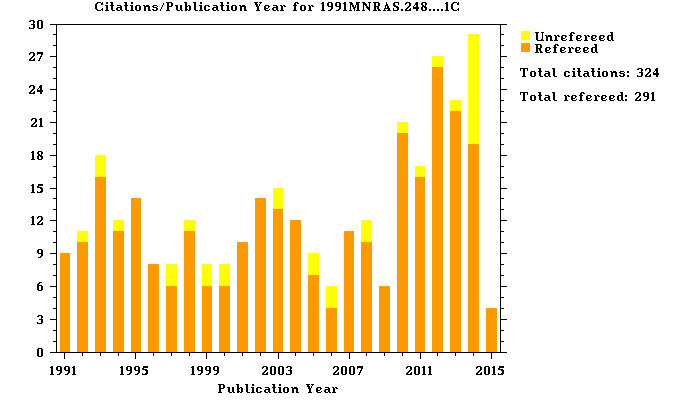
I was looking up the reference for an old paper of mine on ADS yesterday and was surprised to find that it is continuing to attract citations. Thinking about the paper reminds me off the fun time I had in Copenhagen while it was written.   I was invited there in 1990 by Bernard Jones, who used to work at the Niels Bohr Institute.  I stayed there several weeks over the May/June period which is the best time of year  for Denmark; it’s sufficiently far North (about the same latitude as Aberdeen) that the summer days are very long, and when it’s light until almost midnight it’s very tempting to spend a lot of time out late at night..

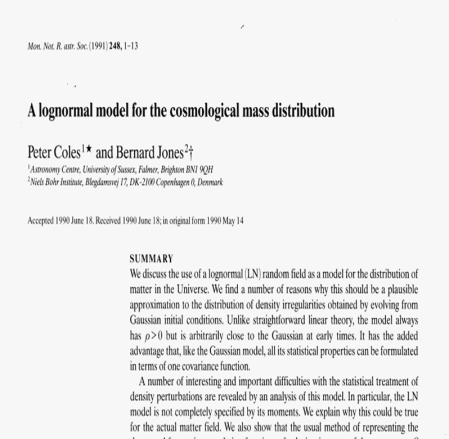
As well as being great fun, that little visit also produced what has turned out to be  my most-cited paper. In fact the whole project was conceived, work done, written up and submitted in the space of a couple of months. I’ve never been very good at grabbing citations – I’m more likely to fall off bandwagons rather than jump onto them – but this little paper seems to keep getting citations. It hasn’t got that many by the standards of some papers, but it’s carried on being referred to for almost twenty years, which I’m quite proud of; you can see the citations-per-year statistics even seen to be have increased recently. The model we proposed turned out to be extremely useful in a range of situations, which I suppose accounts for the citation longevity:

lognormal

I don’t think this is my best paper, but it’s definitely the one I had most fun working on. I remember we had the idea of doing something with lognormal distributions over coffee one day,  and just a few weeks later the paper was  finished. In some ways it’s the most simple-minded paper I’ve ever written – and that’s up against some pretty stiff competition – but there you go.

Picture1

The lognormal seemed an interesting idea to explore because it applies to non-linear processes in much the same way as the normal distribution does to linear ones. What I mean is that if you have a quantity Y which is the sum of n independent effects, Y=X1+X2+…+Xn, then the distribution of Y tends to be normal by virtue of the Central Limit Theorem regardless of what the distribution of the Xi is  If, however, the process is multiplicative so  Y=X1×X2×…×Xn then since log Y = log X1 + log X2 + …+log Xn then the Central Limit Theorem tends to make log Y normal, which is what the lognormal distribution means.

The lognormal is a good distribution for things produced by multiplicative processes, such as hierarchical fragmentation or coagulation processes: the distribution of sizes of the pebbles on Brighton beach  is quite a good example. It also crops up quite often in the theory of turbulence.

I’ll mention one other thing  about this distribution, just because it’s fun. The lognormal distribution is an example of a distribution that’s not completely determined by knowledge of its moments. Most people assume that if you know all the moments of a distribution then that has to specify the distribution uniquely, but it ain’t necessarily so.

If you’re wondering why I mentioned citations, it’s because it looks like they’re going to play a big part in the Research Excellence Framework, yet another new bureaucratical exercise to attempt to measure the quality of research done in UK universities. Unfortunately, using citations isn’t straightforward. Different disciplines have hugely different citation rates, for one thing. Should one count self-citations?. Also how do you aportion citations to multi-author papers? Suppose a paper with a thousand citations has 25 authors. Does each of them get the thousand citations, or should each get 1000/25? Or, put it another way, how does a single-author paper with 100 citations compare to a 50 author paper with 101?

Or perhaps the REF panels should use the logarithm of the number of citations instead?

Puzzle Time: Playing With Matches

Posted in Cute Problems with tags , , on January 13, 2015 by telescoper

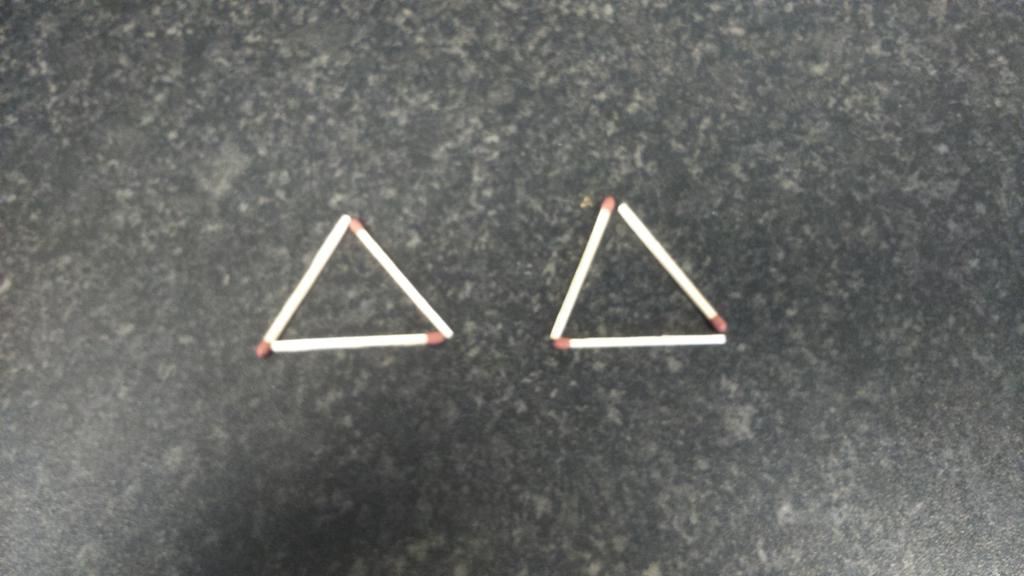
matchesPuzzle time! Move three (and only three) matches and position them to create just four, i.e four and only four,  (identical) triangles. No cutting the matches, either!

Click on to see the answer…

Continue reading

Why was 2014 warm AND wet?

Posted in The Universe and Stuff with tags , , on January 12, 2015 by telescoper

It’s certainly a wet start to 2014 here in Brighton, but did you know that 2014 was the warmest year in the UK since records began as well as one of the wettest?

Michael de Podesta's avatarProtons for Breakfast

Colour-coded Map of UK showing how each region of the UK exceeded the 1981-2010 average temperature. Crown Copyright Colour-coded Map of UK showing how each region of the UK exceeded the 1981-2010 average temperature. Crown Copyright

2014 was the warmest year in the UK ‘since records began’ – and most probably the warmest since at least 1659. You can read the Met Office Summary here

The World Meteorological Organisation (WMO) also report that 2014 is likely to have been the warmest year in Europe and indeed over the entire Earth for at least 100 years.

This was briefly ‘news but somehow this astonishing statistic seems to have disappeared almost without trace.

In fact there are three astonishing things about the statistic

  • Firstly – we know it, and it is likely to be correct.
  • Secondly – the warmest year was ‘warmer all over’ but did not include the ‘hottest month’.
  • Thirdly- the warmest year was also overly wet – both in the UK and world wide.

This article is about why

View original post 519 more words

Fox News Facts on Twitter

Posted in Politics with tags , , , , , , on January 12, 2015 by telescoper

The following clip comes from a broadcast on Fox News:

The fact that Steve Emerson’s statement was laughably exaggerated and based entirely on ignorance (in this case of the city of Birmingham) comes as no surprise. After all, this was Fox News – a channel whose drivel-mongering is often beyond parody. It did however provoke two things that were surprising, at least to me.

One was something that is a rare commodity these days: a full and unreserved apology:

apology

It’s better not to say stupid things in the first place, but credit to him at least for doing the right thing. I gather he has made a donation to a children’s hospital in Birmingham. So there’s that.

The other surprising thing was what happened on Twitter. Some genius had the idea of setting up a hashtag called #FoxNewsFacts. The consequences were hilarious, as hundreds of people contributed tweets lampooning Fox News for its ignorance of the United Kingdom and of Islam. You can find some of the funniest ones here.

I even contributed a few myself. This one proved a particular hit:

There was also this:

and this

But my favourite was this:

I thought it was wonderful how Twitter users responded in such an imaginative, light-heartedly humorous, and sometimes downright surreal, way to something which could instead have produced pure bile. Twitter isn’t always like that, but yesterday it was a delight on a dark and stormy evening and a welcome change of mood after the depressing events of the last week. And I’m glad to say #FoxNewsFacts is still trending…so it’s not too late to have a go yourself!

The Giant Steps of Buddy DeFranco

Posted in Jazz with tags , , , , , , on January 11, 2015 by telescoper

Christmas Eve saw the passing of another great Jazz artist, the clarinettist Buddy DeFranco , at the grand old age of 91. Not surprisingly, glowing tributes to him have appeared in all the mainstream media as well as in specialist jazz sources as he was an absolutely superb musician as well as a distinctive stylist. Alongside countless other measures of his greatness and popularity, he won no less than twenty Downbeat Magazine Awards and nine Metronome Magazine Awards as the number one jazz clarinettist in the world.

It’s an interesting facet of jazz history that the clarinet, a mainstay of jazz styles from the New Orleans roots through to the Swing Era, fell into disfavour in the post-war era with the advent of bebop when it was largely eclipsed by the saxophone. Very few musicians persisted with the clarinet into the era of modern jazz, but Buddy DeFranco was one who did. That’s not to say that he disliked swing music though. In fact he began his career playing with big bands of that era, such as those led by Gene Krupa and Tommy Dorsey. One of the most famous bands of that era, the Glenn Miller Orchestra, formed in 1935 and saw its greatest popularity during the Second World War. It was disbanded in 1944 on the death of its leader, but it started again in 1956 and, although it has had a number of changes of personnel, it is still going strong. So strong that there’s a minimum two year waiting list if you want to book the Glenn Miller Orchestra for a gig! With the 70th anniversary of the end of World War Two coming up this year, I’ve no doubt that there’ll be a great deal of nostalgia evoked by renditions of Moonlight Serenade..

The distinctive sound of the original Glenn Miller Orchestra largely derived from the unusual arrangement of its reed section: usually four saxophones playing in harmony, topped by a high clarinet lead. Many jazz fans found that blend a bit too honeyed compared with the likes of, e.g., the Count Basie Orchestra but there’s no question that it gave the band an immediately recognisable sound. Despite his predilection for more modern jazz idioms, especially bebop, Buddy DeFranco obviously very much liked the idea of a big band with a clarinet playing such a prominent part and, in fact, he was the leader and musical director of the revived Glenn Miller Orchestra from 1966 until 1974, and also guested with them on a number of occasions after that.

Anyway, Buddy DeFranco was one of the most technically accomplished clarinettists in all of jazz. Very few have ever been able to match his control, particularly in the upper register. But what I admired most about him was his willingness to take on material not usually associated with his instrument. Here’s a great example, of him playing the John Coltrane classic Giant Steps together with Terry Gibbs on vibraphone. When I saw the relatively low quality reproduction of the film I assumed the sound quality would be similarly poor, but some superb remastering work has been done and this sounds terrific.

Rest In Peace, Buddy DeFranco (1923-2014).

Hubble + Beethoven

Posted in Music, The Universe and Stuff with tags , , on January 10, 2015 by telescoper

In an attempt to get away from the horrors of the last few days I thought I’d offer this video I just found on Youtube. It features majestic, life-affirming music from the 2nd Movement of Beethoven’s Symphony No. 7 in A Major along with some wonderful astronomical images from the Hubble Space Telescope. Science and art for all humanity. How pathetic our petty squabbles appear when we think about the Universe or listen to great music.

The Durham YETI

Posted in Talks and Reviews, The Universe and Stuff with tags , , , , on January 9, 2015 by telescoper

On Wednesday afternoon, after an important meeting that took up most of the morning, I headed off my train to Durham. Unusually by the standards of my recent experiences of railways, the trip went smoothly and I arrived on time. The cathedral was looking rather spectral when I arrived:

Durham

The occasion of my vist was the Young Experimentalists and Theorists Institute (YETI for short), a gathering of early career particle physicists, mainly graduate students. I was scheduled to give a 90-minute lecture on Cosmic Microwave Background Theory to the 40-50 folks attending the workshop. It was nice to get the chance to get away from budgets and spreadsheets for a time and talk about cosmology, and it was an interesting audience different from the usual more specialist crowd I get to talk to at graduate workshops. It’s good, especially for beginning research students, to find out about subjects outside their immediate research topic and I’m glad the YETI organizers appreciate that. On the other hand, CMB theory is a huge topic so it was difficult to decide what to put in and what to leave out.

Incidentally, 2015 sees the 50th anniversary of the discovery of the Cosmic Microwave Background, and with yet more exciting results due out soon I’m sure the CMB will be in the news a lot this year.

I spent Wednesday night at Collingwood College, where the conference delegates were accommodated, and gave my 90-minute talk, starting at 9am yesterday morning, paused for quick cup of coffee and then legged it back to Durham station for the return journey back to Brighton. It’s a pity I didn’t get the chance to stay longer, especially because the second speaker of the morning, on CMB Observations, was Jo Dunkley of Oxford University who this afternoon is giving a talk at the Royal Astronomical Society because she has just been awarded the Society’s Fowler Prize. I can’t attend that meeting because of work commitments either. Sigh.

The train journey back to Brighton went smoothly and on time too. Wonders never cease!

Anyway, thanks to the organizers of YETI for inviting me. I hope the talk was reasonably comprehensible. Apologies to my other friends at Durham for not hanging around, but I really didn’t have time to stop for a natter or, more importantly, a beer or several.

Bargain Bucket

Posted in Brighton with tags , , on January 9, 2015 by telescoper

bucket

Je Suis Charlie

Posted in Charlie Hebdo, Paris with tags on January 8, 2015 by telescoper

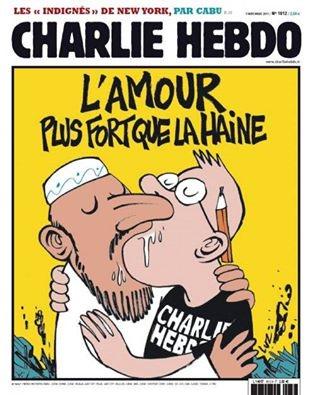
image