The day before last week’s (partial) solar eclipse I posted an item in which I mentioned the apparent coincidence that makes total eclipses possible, namely that the Moon and Sun have very similar angular sizes when seen from Earth.
In the interest of balance I thought I would direct you to a paper by Steve Balbus that develops a detailed argument to the contrary along the lines I described briefly in my earlier post. I am not entirely convinced but do read it and make up your own mind:
Here is the abstract:
The nearly equal lunar and solar angular sizes as subtended at the Earth is generally regarded as a coincidence. This is, however, an incidental consequence of the tidal forces from these bodies being comparable. Comparable magnitudes implies strong temporal modulation, as the forcing frequencies are nearly but not precisely equal. We suggest that on the basis of paleogeographic reconstructions, in the Devonian period, when the first tetrapods appeared on land, a large tidal range would accompany these modulated tides. This would have been conducive to the formation of a network of isolated tidal pools, lending support to A.S. Romer’s classic idea that the evaporation of shallow pools was an evolutionary impetus for the development of chiridian limbs in aquatic tetrapodomorphs. Romer saw this as the reason for the existence of limbs, but strong selection pressure for terrestrial navigation would have been present even if the limbs were aquatic in origin. Since even a modest difference in the Moon’s angular size relative to the Sun’s would lead to a qualitatively different tidal modulation, the fact that we live on a planet with a Sun and Moon of close apparent size is not entirely coincidental: it may have an anthropic basis.
I don’t know if it’s a coincidence or not but I always follow the advice given by my role model, Agatha Christie’s Miss Marple in Nemesis: “Any coincidence is worth noticing. You can throw it away later if it is only a coincidence.”..
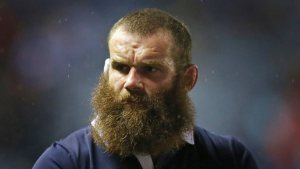
SCOTLAND’S GEOFF CROSS WINS BEARD OF SIX NATIONS POLL
The Beard Liberation Front, the informal network of beard wearers, has said that with the most hirsute Six Nations rugby Championship ever now concluded, a key contest, the Beard of the Six Nations, has also found a winner.
Scotland’s Geoff Cross beat Wales’s Leigh Halfpenny by several pitch lengths in the on-line poll.
Cross’s beard has been a significant hirsute presence throughout the Six Nations although according to the authoritative Sport BeardWatch, Cross is set to shave his beard for charity, prior to retiring from rugby to become a GP.
The impact of beards on the field has meant that even noted pogonophobes such as Clive Woodward who argued in 2013 on the BBC that he wouldn’t select players with beards, have remained silent on the matter this year.
What a contest the Six Nations Rugby has given us today. I’ve just got my breath back after England’s extraordinary game against France. England won 55-35, a remarkable scoreline at this level, but just not quite enough to win the title.
Going into today’s final round of three games, Wales, Ireland and England were all level on six points, having won three games each. England were on top on points difference but Wales and Ireland had easier opponents, in Italy and Scotland respectively.
The day started with Wales demolishing Italy by 61-20 to give both Ireland and England a lot to do to catch up. Ireland responded by thrashing Scotland 40-10 which put them top with an even bigger points difference. To win the title England had to beat France by 26 points or more.
It was a tall order and, I thought, a shame that the competition was going to be decided by the scale of the whipping delivered to the weakest teams, rather than a head-to-head between the top ones. Of course the fixture list was compiled months ago before anybody knew the results of the earlier games, but it turned out that the script for this particular drama had been written perfectly!
England gave it everything in their match again France. The game contained great rugby, lots of errors, and breathless end-to-end excitement. They might have done it on another day but that last converted try just eluded them.
So congratulations to Ireland, who actually beat England earlier and are worthy champions. The lesson for England is clear from the table: they’re scoring enough points but need to concede fewer if they are to be serious contenders for the World Cup which takes place in the Autumn.
The last day of the Six Nations comes this year immediately after the Vernal Equinox, which happened last night at 22:45 GMT, both sporting and astronomical calendars telling us that spring is here. I hope England’s cricketers put up as much of a fight against the Aussies this summer!
It’s been an astronomical and meteorological rollercoaster of a morning. When I woke up at 6am this morning, the Sun was just rising. There was hazy cloud and there seemed to be every chance that it would break up to allowing viewing of today’s partial solar eclipse. Unfortunately, however, the cloud thickened rather than breaking up so I abandoned my plan to watch from the seafront and headed up to the University of Sussex campus at Falmer. Being higher up and a few miles inland, the weather is often clearer in Falmer than in Brighton. Unfortunately it was even murkier when I got here, so I assumed I was in for a disappointing morning.
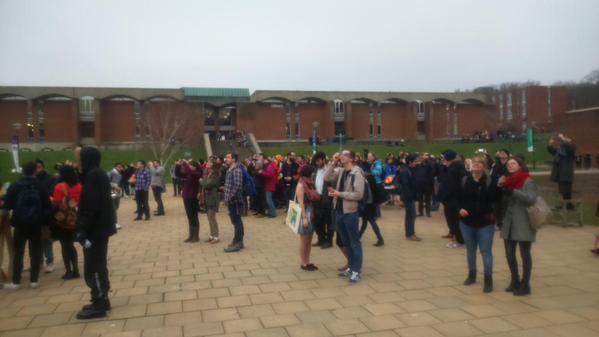
Nevertheless I did join the large gathering in Library Square to experience the event. First contact between the Moon and the Sun happened at about 8.30, but the cloud cover was total at that point so nothing was visible. It did get gradually darker, but this happened slowly enough for eyes to adapt to the dark so it wasn’t all that noticeable to us humans. The birds on campus certainly noticed, however, and began to perform display roosting behaviour thinking it was evening. It also got really very cold.
Around 9.30 the coverage of the Sun by the Moon was about its maximum – 85% or so – but everything was still enshrouded in cloud. The crowd waited patiently in the gloom. It was a very British experience, a large group of people sharing their sense of collective disappointment in appropriately stoical fashion.
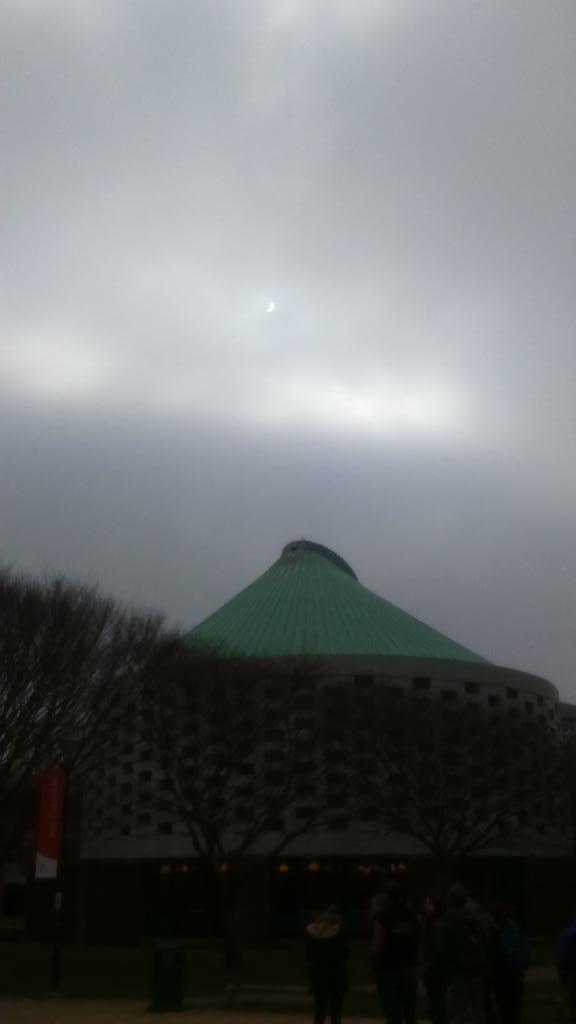
Gradually the wind seemed to increase, pushing the clouds over more quickly and causing them to break up. Then, suddenly, a small gap in the cloud opened up and there was the eclipse. For about a second. It may have been only a moment, but it generated a huge cheer which, I should add, wasn’t entirely ironic. The breaking up of the clouds continued and we were treated to several good views of the main event. It was definitely worth it.
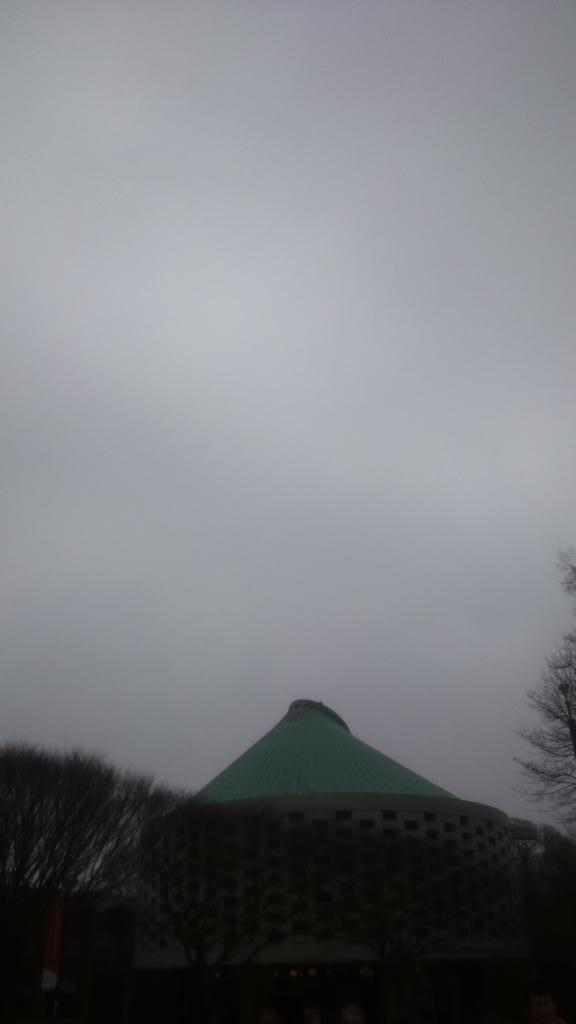
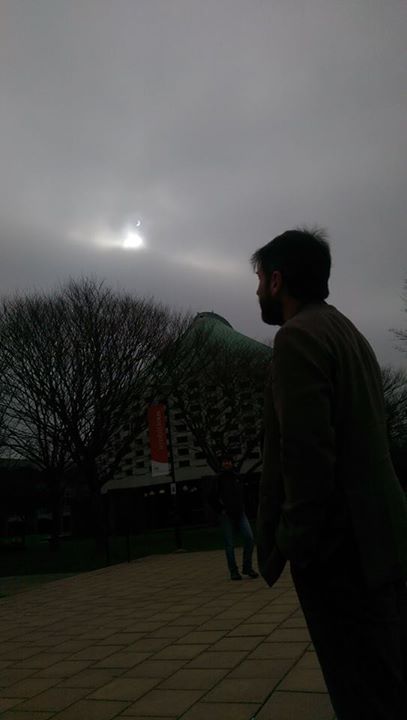
Most of the pictures I took didn’t come out at all well, but here is one with the famous Meeting House in the foreground:
And here’s a rather nice picture from John Sander of the International Office at Sussex University, showing yours truly during the final stages of the eclipse..
I’ll add more pictures as I find them. Please feel free to share your comments and observations via the appropriate box!
As you will no doubt be aware, tomorrow there will be a Partial Eclipse of the Sun visible from the United Kingdom. Here’s a handy guide, courtesy of the Met Office, to the time and maximum fraction of the Sun’s disk that will be obscured.
Unfortunately the weather forecast for Brighton isn’t marvellous so it’s possible that the main event will be obscured by cloud and all we experience is that an already dark and gloomy morning gets even darker and gloomier.
However, in the event that the weather forecast turns out to be inaccurate, which is far from unheard of, please make sure you follow the official Royal Astronomical Society guidelines to make sure you observe it safely.
And while I’m at it, here is a video of a nice lecture by Ian Ridpath explaining all about Solar and Lunar Eclipses.
As a spectacle a partial solar eclipse is pretty exciting – as long as it’s not cloudy – but even a full view of one can’t really be compared with the awesome event that is a total eclipse. I’m lucky enough to have observed one and I can tell you it was truly awe-inspiring.
If you think about it, though, it’s rather odd that such a thing is possible at all. In a total eclipse, the Moon passes between the Earth and the Sun in such a way that it exactly covers the Solar disk. In order for this to happen the apparent angular size of the Moon (as seen from Earth) has to be almost exactly the same as that of the Sun (as seen from Earth). This involves a strange coincidence: the Moon is small (about 1740 km in radius) but very close to the Earth in astronomical terms (about 400,000 km away). The Sun, on the other hand, is both enormously large (radius 700,000 km) and enormously distant (approx. 150,000,000 km). The ratio of radius to distance from Earth of these objects is almost identical at the point of a a total eclipse, so the apparent disk of the Moon almost exactly fits over that of the Sun. Why is this so?
The simple answer is that it is just a coincidence. There seems no particular physical reason why the geometry of the Earth-Moon-Sun system should have turned out this way. Moreover, the system is not static. The tides raised by the Moon on the Earth lead to frictional heating and a loss of orbital energy. The Moon’s orbit is therefore moving slowly outwards from the Earth. I’m not going to tell you exactly how quickly this happens, as it is one of the questions I set my students in the module Astrophysical Concepts I’ll be starting in a few weeks, but eventually the Earth-Moon distance will be too large for total eclipses of the Sun by the Moon to be possible on Earth, although partial and annular eclipses may still be possible.
It seems therefore that we just happen to be living at the right place at the right time to see total eclipses. Perhaps there are other inhabited moonless planets whose inhabitants will never see one. Future inhabitants of Earth will have to content themselves with watching eclipse clips on Youtube.
Things may be more complicated than this though. I’ve heard it argued that the existence of a moon reasonably close to the Earth may have helped the evolution of terrestrial life. The argument – as far as I understand it – is that life presumably began in the oceans, then amphibious forms evolved in tidal margins of some sort wherein conditions favoured both aquatic and land-dwelling creatures. Only then did life fully emerge from the seas and begin to live on land. If it is the case that the existence of significant tides is necessary for life to complete the transition from oceans to solid ground, then maybe the Moon played a key role in the evolution of dinosaurs, mammals, and even ourselves.
I’m not sure I’m convinced of this argument because, although the Moon is the dominant source of the Earth’s tides, it is not overwhelmingly so. The effect of the Sun is also considerable, only a factor of three smaller than the Moon. So maybe the Sun could have done the job on its own. I don’t know.
That’s not really the point of this post, however. What I wanted to comment on is that astronomers generally don’t question the interpretation of the occurence of total eclipses as simply a coincidence. Eclipses just are. There are no doubt many other planets where they aren’t. We’re special in that we live somewhere where something apparently unlikely happens. But this isn’t important because eclipses aren’t really all that significant in cosmic terms, other than that the law of physics allow them.
On the other hand astronomers (and many other people) do make a big deal of the fact that life exists in the Universe. Given what we know about fundamental physics and biology – which admittedly isn’t very much – this also seems unlikely. Perhaps there are many other worlds without life, so the Earth is special once again. Others argue that the existence of life is so unlikely that special provision must have been made to make it possible.
Before I find myself falling into the black hole marked “Anthropic Principle” let me just say that I don’t see the existence of life (including human life) as being of any greater significance than that of a total eclipse. Both phenomena are (subjectively) interesting to humans, both are contingent on particular circumstances, and both will no doubt cease to occur at some point in perhaps not-too-distant the future. Neither tells us much about the true nature of the Universe.
Perhaps we should just face up to the fact that we’re just not very significant….
Just a quick post to advertise the fact that the BBC Television series Stargazing Live will be broadcast in the evenings this week from Wednesday 18th to Friday 20th March, 2015. The programme is hosted by Professor Brian Cox and Dara O Briain and will be beamed to you (or at least to those of you who have television sets) from Jodrell Bank, which is near Manchester (in the Midlands).
Closer to home, at least for those of you whose home is closer to mine than it is to Jodrell Bank, the Department of Physics & Astronomy at the University of Sussex will be running a series of astronomical activities (including planetarium shows, observing sessions and lectures) for all ages to coincide with the programme tonight (i.e. Wednesday 18th March). This also takes place within One World Week at the University of Sussex, which gives it added interest for both staff and students. There’s nothing like astronomy to make you aware of our shared existence on this little planet…
There are two sessions this evening. One is from 6pm to 7.30pm and the other from 8pm to 9.30pm. You can find full details of both sessions here, but here’s a taster of the menu for the earlier session:
It’s lovely and sunny on Sussex University campus as I write this, and the forecast is good for this evening too. Might we be able to get a glimpse of the Aurorae that lit up the skies over Britain last night? I can’t promise that, but there’s a chance! Sadly the forecast for Friday’s partial solar eclipse is not so good, but we live in hope.
Anyway, wherever you are and whatever you do this evening, here’s wishing you Happy Stargazing!
In that great journey of the stars through space About the mighty, all-directing Sun, The pallid, faithful Moon, has been the one Companion of the Earth. Her tender face, Pale with the swift, keen purpose of that race, Which at Time’s natal hour was first begun, Shines ever on her lover as they run And lights his orbit with her silvery smile.
Sometimes such passionate love doth in her rise, Down from her beaten path she softly slips, And with her mantle veils the Sun’s bold eyes, Then in the gloaming finds her lover’s lips. While far and near the men our world call wise See only that the Sun is in eclipse.
This poster, advertising a forthcoming Summer School in honour of the famous mathematician Paul Erdös arrived this morning, so I thought I’d advertise it through this blog.
In case you didn’t know, Paul Erdős (who died in 1996) was an eccentric yet prolific Hungarian mathematician who wrote more than 1000 mathematical papers during his life but never settled in one place for any length of time. He travelled constantly between colleagues and conferences, mostly living out of a suitcase, and showed no interest at all in property or possessions. His story is a fascinating one, and his contributions to mathematics were immense and wide-ranging, and I’m sure the conference in his honour will be fascinating.
A strange offshoot of his mathematical work is the Erdős number, which is really a tiny part of his legacy, but one that seems to have taken hold. Some mathematicians appear to take it very seriously, but most treat it with tongue firmly in cheek, as I certainly do.
So what is the Erdős number? It’s actually quite simple to define. First, Erdős himself is assigned an Erdős number of zero. Anyone who co-authored a paper with Erdős then has an Erdős number of 1. Then anyone who wrote a paper with someone who wrote a paper with Erdős has an Erdős number of 2, and so on. The Erdős number is thus a measure of “collaborative distance”, with lower numbers representing closer connections. I say it’s quite easy to define, but it’s rather harder to calculate. Or it would be were it not for modern bibliographic databases. In fact there’s a website run by the American Mathematical Society which allows you to calculate your Erdős number as well as a similar measure of collaborative distance with respect to any other mathematician. Also, a list of individuals with very low Erdős numbers (1, 2 or 3) can be found here. I did a quick poll around the Department of Mathematics here at the University of Sussex and it seems that the shortest collaborative distance among the staff belongs to Dr James Hirschfeld who has an Erdos Number of 2. There is a paper of his, with M. Deza and P. Frankl, Sections of varieties over finite fields as large intersection families, Proc. London. Math. Soc. 50 (1985), 405-425 and both Michel Deza and Peter Frankl have joint papers with Paul Erdős.
Given that Erdős was basically a pure mathematician, I didn’t expect first to show up as having any Erdős number at all, since I’m not really a mathematician and I’m certainly not very pure. However, his influence is clearly felt very strongly in physics and a surprisingly large number of physicists (and astronomers) have a surprisingly small Erdős number. Anyway, my erstwhile PhD supervisor Professor John D. Barrow emailed to point out that he had written a paper with Robin Wilson, who once co-authored a paper (on graph theory) with Erdős himself. That means that John’s Erdős number is now 2, mine is consequently 3 (unless, improbably, I have unkowingly written a paper with someone who has written a paper with Erdős). Anyone I’ve ever written a paper with has an Erdős number no greater than 4; they of course may have other routes to Erdős than through me.
Anyway, none of that is important compared to the real legacy of Erdős, which is his mathematical work. I’m sure the Summer School will be both rewarding and enjoyable!
I’m not sure it’s possible for any record to be perfect, but there are definitely some that I couldn’t be improved in any way that I can imagine. I can think of a number of Jazz records that fall into that category, including this version of When You’re Smiling made in 1938. It features Billie Holliday and Lester Young along a number of other members of the Count Basie Orchestra (apart from the Count himself, who is replaced by Teddy Wilson on piano).
That this is a favourite record of mine is a bit of a paradox, because I don’t really like the song very much. However, in jazz the tune is just the starting point. In her early recording career, Billie Holliday wasn’t very well known so she was often given relatively unpromising songs to sing. She turned out to be brilliant at turning this base metal into gold and becamse the best singer of a bad song there has ever been.
It’s not just the way Billie Holliday’s voice floats ethereally across the beat as she takes outrageous liberties with both melody and rhythm. Nor is the way she manages to express everything there is about life and love and hearteache through the rather banal lyrics, investing the song with a deep sense of tragic irony. Nor is it Lester Young’s superbly constructed tenor saxophone solo near the end, which one of the very greatest by one of the very greatest. Nor is it that lightly swinging rhythm section of Freddie Green, Walter Page and Jo Jones who push the whole thing along on gossamer wings, making most of their rivals sound like clodhoppers; the drummer Jones,for example, adds punctuation in the form of accents to the poetry of Lester Young’s solo. All the component parts are magnificent, but the whole is even greater than their sum. It’s a timeless jazz masterpiece.
I don’t know why I haven’t posted this track before, but better late than never. I hope you can take 3 minutes to enjoy it!
The views presented here are personal and not necessarily those of my employer (or anyone else for that matter).
Feel free to comment on any of the posts on this blog but comments may be moderated; anonymous comments and any considered by me to be vexatious and/or abusive and/or defamatory will not be accepted. I do not necessarily endorse, support, sanction, encourage, verify or agree with the opinions or statements of any information or other content in the comments on this site and do not in any way guarantee their accuracy or reliability.




 In the Dark