Archive for July, 2015

Pluto and the Pavilion

Posted in Biographical, Football, History with tags , , , , , on July 14, 2015 by telescoper

This is a busy week in many ways and for many reasons, but the main activity revolves around Graduation at the University of Sussex; the ceremony for graduates from my School (Mathematical and Physical Sciences) takes place on Thursday which gives me a couple of days to practice the pronunciation of the names I have to read out!

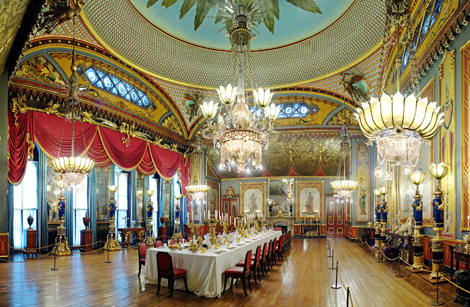
Anyway, last night there was a very Commemoration Dinner in the Dining Room of Brighton Pavilion:

Brighton_Pavilion_Dining_room

The decor is a little understated for my tastes, and in any case I was among a group of about 40 guests who were seated elsewhere owing to the popularity of the event. In fact I was in the Red Drawing Room, which as its name suggests is, er, red:

5_royal_pavilion_red_drawing_room

Anyway, the dinner itself was splendid with particularly fine wine to boot. One of the topics of conversation was the forthcoming flypast of Pluto by the NASA New Horizons spacecraft. As the token astrophysicist on my table I tried my best to answer questions about this event. In fact the closest approach to Pluto takes place about 12.50 pm today (BST) but it will take some time for the images to be downloaded and processed; data transmission rates from the outer edge of the Solar System are rather limited! After passing Pluto, the spacecraft will carry on out of the Solar System into interstellar space. One thing I didn’t know until this morning was that the discoverer of Pluto, Clyde Tombaugh, expressed a wish that when he died his ashes should be sent into space. In fact, they are on New Horizons,  being carried past the planet object he found just 85 years ago. I find that very moving, but it’s also so inspiring that such a short time after Pluto was discovered a spacecraft is arriving there to study it. We humans can do great things if we put our minds to them. Science provides us with constant reminders of this inspirational fact. Unfortunately, politics tends to do the opposite…

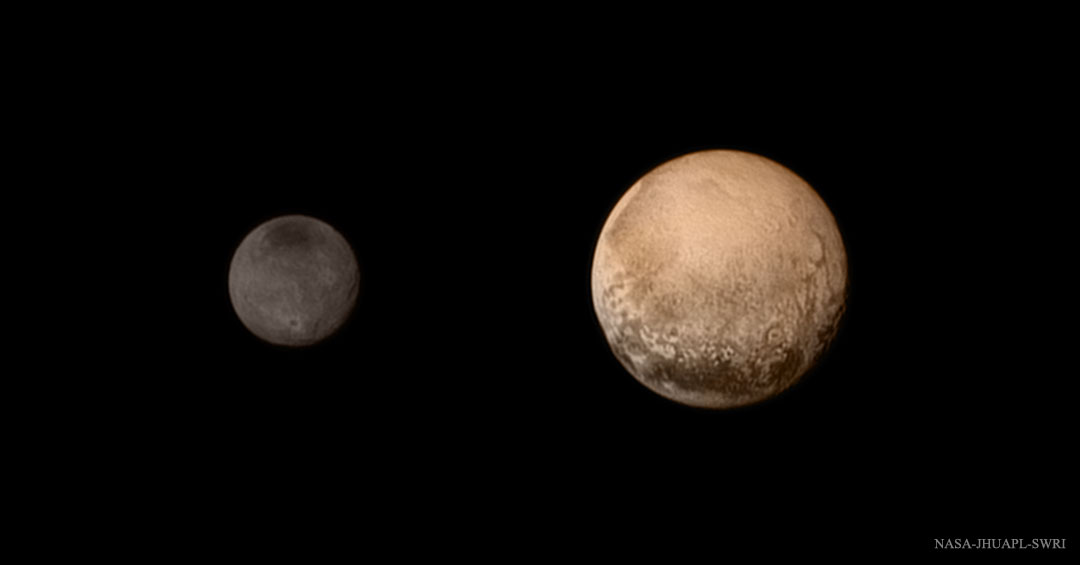
I hope to provide a few updates with images from New Horizons if I get time. Here to whet your appetite is today’s stunning Astronomy Picture of the Day, showing Pluto and its largest moon, Charon, in the same frame:

PlutoCharon01_NewHorizons_1080

Here’s a close-up of Pluto from yesterday:

Pluto_yesterday

And if that isn’t enough, click here for a simulation of the detail we expect to see when New Horizons reaches its closest approach to Pluto.

A Galaxy at Record Redshift?

Posted in The Universe and Stuff with tags , , , , , on July 13, 2015 by telescoper

Skimming through the arXiv this morning I discovered a paper by Zitrin et al. with the following abstract:


abstract_z

I’m not sure if the figures are all significant, but a redshift of z=8.68 makes this the most distant spectroscopically confirmed galaxy on record with a present proper distance of about 9.3 Gpc according to the standard cosmological model, just pipping the previous record holder (whose redshift was in any case disputed). Light from this galaxy has taken about 13.1 Gyr to reach us; that means light set out from it when the Universe was only about 4% of its current age, only about 600 million years after the Big Bang. (Those figures were obtained using the inestimable Ned Wright’s cosmology calculator.)

We are presumably seeing a very young object, in which stars are forming at a considerable rate to account for its brightness. We don’t know exactly when the first stars formed and began to ionize the intergalactic medium, but every time the cosmic distance record is broken we push that time back closer to the Big Bang.

Mind you, I can’t say I’m overwhelmingly convinced by the identification of the redshifted Lyman-α line:

high_zBut what do I know? I’m a theorist whose suspicious of data. Any observers care to comment?

Awaiting The Barbarians

Posted in Finance, Poetry, Politics with tags , , , , , on July 13, 2015 by telescoper

— Why are we come together in the market place?
 
            Barbarians are expected here to-day.
 
— Why in the Senate-house this inactivity —
why sit the Senators and do not legislate?
 
            Because barbarians are to come to-day
            What laws should they make now — the Senators?
            Presently the barbarians will make laws.
 
— Why has our Emperor risen close upon the sun —
why is he waiting there, by the main city-gates,
seated upon the throne, — august, wearing the crown?
 
            Because barbarians are to come to-day
            And so the Emperor in person waits
            to greet their leader. He has even prepared
            a title-deed, on skin of Pergamus,
            in favour of this leader. It confers
            high rank on the barbarian, many names.
 
— Why do our consuls and the praetors go about
in scarlet togas fretted with embroidery;
why are they wearing bracelets rife with amethysts,
and rings magnificent with glowing emeralds;
why are they holding those invaluable staffs
inlaid so cunningly with silver and with gold?
 
            Because barbarians are to come to-day;
            and the barbarians marvel at such things.
 
— Why come not, as they use, our able orators
to hold forth in their rhetoric, to have their say?
 
            Because barbarians are to come to-day;
            and the barbarians have no taste for words.
 
— Why this confusion all at once, and nervousness:
(how serious of a sudden the faces have become):
why are the streets and meeting-places emptying,
and all the people lost in thought as they turn home?
 
            Because the daylight fails, and the night comes,
            but the barbarians come not. And there be
            who from the frontier have arrived and said
            there are no barbarians any longer.

And now what shall become of us without barbarians?
These people were in sooth some sort of settlement.

by C.P. Cavafy (1863-1933); posted on the occasion of the all-night negotiations between the EU and Greece over a bailout deal.

Cricket, Lovely Cricket – Ashes Victory in Cardiff

Posted in Cardiff, Cricket with tags , , , , on July 12, 2015 by telescoper

Last Wednesday (8th July 2015) I had the good fortune to be in the crowd at the SWALEC Stadium in Cardiff to see the first day’s play in the First Test between England and Australia of this summer’s Ashes series. I have to say that I was very apprehensive about how the game would go, but as I was in Wales anyway I couldn’t resist being there to watch it. I think I can say without fear of contradiction that it didn’t turn out too badly.

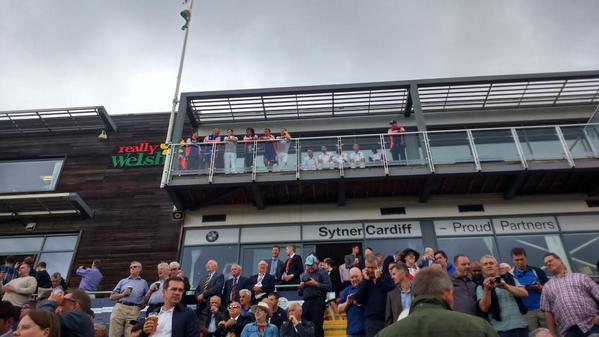
It wasn’t a very auspicious start to the day – light rain was falling as we walked to the ground and at the scheduled start time the England team were still in the pavilion:

England

Play eventually got going about fifteen minutes late, though it could have started earlier had the Powers That Be dispensed with some of the silly preliminaries. It did rain a little before lunch too, but the players didn’t come off. Thereafter the weather steadily improved and we got a full day’s play, closing at about 6.45pm. I even had sunburnt knees as a souvenir, as I had decided to wear shorts for the day and the stand we were in offered no protection from the afternoon sun. Good job I had brought my sunhat.

England had won the toss and decided to bat. The desire to have first use of a good batting pitch must have been tempered in England Captain Alastair Cook’s mind by the likelihood that the overcast conditions would help the Aussie fast bowlers. England struggled early on with the bat, Lyth getting out cheaply playing across a straight one from Hazlewood (who was in the team to replace the injured Ryan Harris) to leave England at 7 for 1. Ballance battled hard at Number 3 but Cook at the other end looked relatively comfortable. Then Michael Clarke threw the ball to offspinner Nathan Lyon to have a go at the lefthanded Cook who seemed impatient to score off him. That proved his downfall as he was out for 20, caught at the wicket, trying to cut a short ball. Ian Bell came, scored one run off a nervous looking lofted drive and was then dismissed leg before wicket by a good inswinger from the excellent Mitchell Starc. At 43-3 England were on the brink, and could have fallen over it a few balls later when new batsman Joe Root played a strange shot at his second ball, a very full swinging delivery from Starc which resulted in an edge that went at a good height to wicket-keeper Brad Haddin diving (somewhat theatrically) to his right. Fortunately for England, Haddin spilled what looked a relatively straightforward chance; having seen the replay a number of times I don’t understand why Haddin didn’t go for it with both hands. At 43-4 England would have been in deep doo-doo, but as it happened Ballance and Root steadied the ship and after a tense morning England reached lunch at 88 for 3.

The ball certainly did swing in that morning session, but the predominant impression I got was that it was a very flat pitch, with very little bounce. Watching from a position square of the wicket to a batsman at the River Taff end, it was noticeable how many balls didn’t carry through to the wicket-keeper. Indeed, Warner’s excellent slip catch to take the wicket of Lyth was harder than it needed to have been because the slips were standing too deep for much of the game. Mitchell Starc was easily the pick of the Australian bowlers; the other Mitchell (Mitchell Johnson) laboured ineffectively on the kind of pitch he clearly doesn’t like to bowl on. He was expensive too. England’s Nemesis of the 13/14 Ashes Tour down under was to finish with 0-111 off 25 overs.

After lunch the sun came out and the character of the play changed. Root and Ballance completed partnership of 153 before Ballance fell for 61 with the score on 196 for 4. This ushered in the belligerent Stokes who didn’t have it all his own way – he got into a tangle trying to hook a Mitchell Johnson bouncer, sending it high over Haddin’s head for six – but Root at the other end had ridden his early luck and made an excellent century. Root is currently in unbelievably good form and it says something for his temperament that he looked bitterly disappointed when he eventually got out for a superb 134, shortly followed by Stokes who made 54. The score was then 293 for 6, by no means enough runs on a good batting pitch but a good recovery from 43-3. Buttler and Moeen Ali added another 50 partnership in quick time until Buttler fell nearly at the end of the day’s play. I was particularly impressed with Moeen’s batting late on and it was he who produced the short of the day for me – a magnificent sweep into the stands for six off the bowling of Lyon. Broad survived a torried couple of overs to leave England on 343-7 at the close of play.

I couldn’t help recalling that the closing score on the first day of corresponding fixture in 2009, which ended famously in a draw, was 336-7. On that occasion, England’s tail wagged brightly the following morning (when I was in the ground) to take their score to 435 all out. As things stood, I felt that the match was evenly poised. If England could do something similar to their feats of 2009 on the second day of this match then they would have a good chance of winning, but if Australia could take quick wickets they would have the edge.

Unfortunately I only had tickets for the first day so I ad to keep up with the rest of the match on the radio and via Twitter. On Day 2, England’s tail did wag – Moeen scoring an excellent 77 – to finish on 430 all out. So far the pattern remained similar to 2009, but that was about to change. Australia got a much better start to their first innings than England had, but lost wickets at the end of Day 2 to close on 264-5 – a far cry from the 248-1 which was their position at the end of Day 2 in 2009. The following morning they were all out for 308, a deficit of 122. England batted again on Day 3 and, not without moments of alarm, accumulated enough runs to build an imposing lead; they were eventually all out at the end of Day 3 for 289. Australia needed to score 412 to win with two days left, though the forecast for Day 5 was for heavy rain.

Clouds had returned to Cardiff for Day 4 (Saturday) and the Australian batsmen were in all sorts of difficulties against the swing on Anderson and Broad. Rogers fell cheaply, Warner was having trouble laying bat on ball, and the runs had dried up. Then Alastair Cook made I think his only tactical mistake of the match: he brough Moeen on to bowl too early. Warner seemed to relax and played some good shots. Moeen was withdrawn after just two expensive overs. The momentum had been handed back to Australia, who began scoring freely. In the last over before lunch they were 97-1, with two batsmen at the crease who were both perfectly capable of posting big scores. Then Cook brough Moeen back for one over before lunch, whereupon he trapped Warner lbw for 52. It was just the fillip England needed. After lunch Smith, Clarke and Voges fell in quick succession to leave Australia in the mire at 106-5. Neither Haddin not Watson stayed around long and Australia were soon 151 for 7. Mitchell Johnson batted defiantly in difficult circumstances, adding 72 for the 8th wicket with Mitchell Starc until their partnership was broken by none other than Joe Root, who as well as being a superb batsman is a spin bowler with an uncanny knack of taking important wickets. Root also took the catch, off the bowling of Moeen Ali, that sealed the game. Australia were all out for 242 about an hour after tea. England had won by 169 runs. Man of the Match: Joe Root, obviously.

So, first blood to England. Of course there are another four Tests to go, starting at Lord’s on Thursday where the pitch may well be much more helpful to the Australian quick bowlers, but this result is better than I imagined at the start of the game and if England can keep it up they at least have a chance of winning back the Ashes. Don’t expect the Aussies to roll over, though. They will be stung by this defeat, and I full expect them to come back hard.

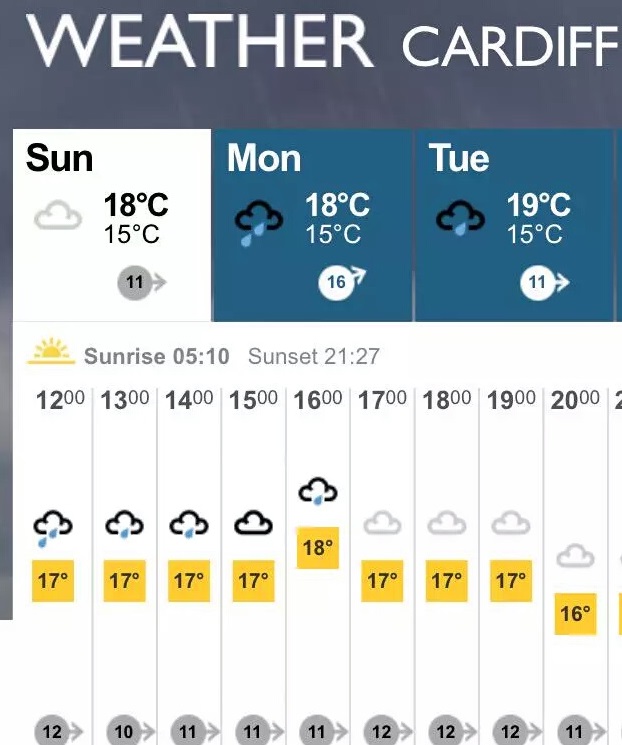
P.S. This was the weather situation in Cardiff earlier today, which would have been the fifth day.

Cardiff_weather

Had Australia batted through to the close on Day 4, it is quite possible that there would have been no play on Day 5, which means the game would have ended in a draw. Now I understand why this Test started on a Wednesday!

P.P.S. Only three members of the current England team played in the 2009 Ashes Test in Cardiff: Anderson, Broad and Cook.

R.I.P. Jon Vickers (1926-2015)

Posted in Opera with tags , , , , on July 12, 2015 by telescoper

Ah well. Back in the office on a rainy Sunday afternoon after a few days away trying to catch up before a very busy week next week. I thought I’d pause first, however, to pay my respects to the great Canadian tenor Jon Vickers, whose death I learnt of last night. Many tributes have been paid to him already, including several examples of his work on Radio 3 this morning. There’s nothing much I can add to them except to say that he not only had a great voice, but was also a fine actor with a powerful stage presence.

What I can do is post again one of my favourite examples of Jon Vickers, singing the greatest passages in one of the greatest of all operas, Peter Grimes by Benjamin Britten. Most people I know who have seen Peter Grimes think it is a masterpiece, and I’m interested to see another physics blog has already discussed this aria. Still, I don’t think Britten is sufficiently appreciated even in the land of his birth. There aren’t that many operas written in English so perhaps we feel a little uncomfortable when we can actually understand what’s going on without reading the surtitles?

I’ve often heard Peter Grimes described as one of the great operas written in English. Well, as far as I’m concerned you can drop “written in English” from that sentence and it’s still true. It’s certainly in my mind fit to put up alongside anything by Verdi, Puccini, Wagner and even Mozart.

In this aria it’s not just the extraordinary vocal line, beginning way up among the “head notes” beyond a tenor’s usual range, that makes it such a  powerful piece of music,  but also the tragic poetry in the words. The main character of Peter Grimes is neither hero nor villain, but  a man trapped in his own destiny. It’s a tragedy in the truest sense of the word:

Now the great Bear and Pleiades where earth moves
Are drawing up the clouds of human grief
Breathing solemnity in the deep night.
Who can decipher in storm or starlight
The written character of a friendly fate
As the sky turns, the world for us to change?
But if the horoscope’s bewildering
Like a flashing turmoil of a shoal of herring,
Who can turn skies back and begin again?


The part of Peter Grimes was actually written by Britten specifically to suit the voice of his partner, Peter Pears, who performed the role first. The classic recording of that performance is wonderful, but this later version starring Jon Vickers is quite different, and the inner agony portrayed by Vickers’ voice in the upper register is most moving. For its combination of musical expressiveness and dramatic intensity, this music really does take some beating even if you listen to it on its own outside the context of the opera.

Rest in Peace, Jon Vickers (1926-2015)

Ten Years and a Day…

Posted in Biographical with tags , , on July 7, 2015 by telescoper

Today is the tenth anniversary of the terrorist attacks that killed 58 people in London on 7th July 2005. Can that really have been ten years ago?

It seems apt to post this recollection again.

–o–

One summer morning in 2005 I rose early and left my house – I was living in Nottingham then – and took a train to London. I was quite excited. I was going to be interviewed later that day for a programme in the BBC TV series Horizon called The Hawking Paradox. The filming was to take place inside the Café de Paris near Piccadilly Circus, for the simple reason that it wasn’t used during the daytime, and would therefore be both quiet and cheap to hire. I was keen not to be late so I got a train that was due to arrive at St Pancras Station in London at about 9.30am.

On the train I dealt with a few bits of correspondence, filling in forms and writing out cheques to pay bills, so had a couple of  items of mail to post when I got to London. The train was on time, and it was a fine morning, so I decided to walk from the station down through Soho to the location of the shoot.

I crossed Euston Road and walked down towards Bloomsbury. Spying  a bright red Royal Mail postbox across the road  in Tavistock Square, I waited for a bus to go past, crossed the road and popped my letters into the box. I looked at my watch to see if I had time for coffee on the way to Piccadilly. It was exactly 9.45am, on July 6th 2005.

I enjoyed the filming, although it took quite a long time – as these things do. Breaking for lunch in a local pizzeria, we were surrounded by a hubbub of excitement when news broke that London had been awarded the right to stage the 2012 Olympics. We finished the filming and I headed back to Nottingham on the train. All-in-all it had been a very pleasant day.

Last week the inquest into the terrorist attacks on London delivered its long awaited verdict into the terrible events of 7th July 2005, the day after my trip. Here is a picture of the postbox in Tavistock Square taken on 7/7/2005. The bomb that tore the roof off the bus and killed 13 people went off at 9.47am, almost exactly 24 hours after I had been in precisely the same spot. Spooky.

Why not doing research all the time can make you a better researcher

Posted in Uncategorized on July 5, 2015 by telescoper

Yesterday I read a nice little article  in Nature about how doing something different from research every now and again can actually make you a better researcher. I agree with that completely, so thought I’d expand upon the theme with a few comments of my own. I think this is an issue of particular importance for early career researchers, as that is the stage at which good habits need to be established, so I will focus on PhD students.

The point is that a postgraduate research degree is very different from a programme of undergraduate study. For one thing, as a research student you are expected to work on your own a great deal of the time. That’s because nobody else will be doing precisely the same project so, although other students will help you out with some things, you’re not trying to solve the same problems as your peers as is the case with an undergraduate. Your supervisor will help you of course and make suggestions (of varying degrees of helpfulness), but a PhD is still a challenge that you have to meet on your own. I don’t think it is good supervisory practice to look over a research student’s shoulder all the time. It’s part of the purpose of a PhD that the student learns to go it alone. There is a balance of course, but my own supervisor was rather “hands off” and I regard that as the right way to supervise. I’ve always encouraged my own students to do things their own way rather than try to direct them too much.

The sense of isolation that can come from immersing yourself in research is tough in itself, but there’s also the scary fact that you do not usually know whether your problem has a solution, let alone whether you yourself can find it. There is no answer at the back of the book; if there were you would not be doing research. A good supervisor will suggest a project that he or she thinks is both interesting and feasible, but the expectation is that you will very quickly be in a position where you know more about that topic than your supervisor.

I think almost every research student goes through a phase in which they feel out of their depth. There are times when you get thoroughly stuck and you begin to think you will never crack it. Self-doubt, crisis of confidence, call it what you will, I think everyone who has done a postgraduate degree has experienced it. I certainly did. A year into my PhD I felt I was getting nowhere with the first problem I had been given to solve. All the other research students seemed much cleverer and more confident than me. Had I made a big mistake thinking I could this? I started to panic and began to think about what kind of job I should go into if I abandoned the idea of pursuing a career in research.

So why didn’t I quit?

There were a number of factors, including the support and encouragement of my supervisor, staff and fellow students in the Astronomy Centre, and the fact that I loved living in Brighton, but above all it was because I knew that I would feel frustrated for the rest of my life if I didn’t see it through. I’m a bit obsessive about things like that. I can never leave a crossword unfinished either.

But while it can be good to be a  obsessive about your research, that doesn’t mean you should try to exclude other things, even other obsessions, from your life.

What happened in my case was that after some discussion with my supervisor I shelved that first troublesome problem and tried another, much easier one. I cracked that fairly quickly and it became my first proper publication. Moreover, thinking about that other problem revealed that there was a way to finesse the difficulty I had failed to overcome in the first project. I returned to the first project and this time saw it through to completion. With my supervisor’s help that became my second paper, published in 1987.

I know it’s wrong to draw inferences about other people from one’s own particular experiences, but I do feel that there are general lessons. One is that if you are going to complete a research degree you have to have a sense of determination that borders on obsession. I was talking to a well-known physicist at a meeting not long ago and he told me that when he interviews prospective physics students he asks them “Can you live without physics?”. If the answer is “yes” then he tells them not to do a PhD. It’s not just a take-it-or-leave-it kind of job being a scientist. You have to immerse yourself in it and be prepared to put long hours in. When things are going well you will be so excited that you will find it as hard to stop as it is when you’re struggling. I’d imagine it is the just same for other disciplines.

The other, equally important, lesson to be learned is that it is essential to do other things as well. Being “stuck” on a problem is part-and-parcel of mathematics or physics research, but sometimes battering your head against the same thing for days on end just makes it less and less likely you will crack it. The human brain is a wonderful thing, but it can get stuck in a rut. One way to avoid this happening is to have more than one thing to think about.

I’ve lost count of the number of times I’ve been stuck on the last clue in a crossword. What I always do in that situation is put it down and do something else for a bit. It could even be something as trivial as making a cup of tea, just as long as I don’t think about the clue at all while I’m doing it. Nearly always when I come back to it and look at it afresh I can solve it. I have a large stack of prize dictionaries to prove that this works!

It can be difficult to force yourself to pause in this way. I’m sure that I’m not the only physicist who has been unable to sleep for thinking about their research. I do think however that it is essential to learn how to effect your own mental reboot. In the context of my PhD research this involved simply turning to a different research problem, but I think the same purpose can be served in many other ways: taking a break, going for a walk, playing sport, listening to or playing music, reading poetry, doing a crossword, or even just taking time out to socialize with your friends. Time spent sitting at your desk isn’t guaranteed to be productive.

So, for what it’s worth here is my advice to new postgraduate students. Work hard. Enjoy the challenge. Listen to advice from your supervisor, but remember that the PhD is your opportunity to establish your own identity as a researcher. Above all, in the words of the Desiderata:

Beyond a wholesome discipline,
be gentle with yourself.

Never feel guilty about establishing a proper work-life balance. Having more than one dimension to your life will not only improve your well-being but also make you a better researcher.

Introduction of me, my ideology and this blog

Posted in Uncategorized on July 4, 2015 by telescoper

A new blog about science education for students with special needs.

Why not give it a follow?

feelthegraphicx's avatarSENSE: Science Education as a Non-Sighted Experience

If you look at the “About me” section of this set of articles, you will most probably find nothing. The reason for that is deep in the roots of the idea; it does not matter who I am. It does not matter what my name, age, gender is, that does not tell you a lot about me if you know I have long hair and green eyes. Similarly, it really doesn’t change much whether you know my nationality, profession, or the food, music I like. I would be too subjective and biased to introduce myself in words of descriptions, adjectives and attributes. Why don’t you tell me and retell others who I am, what I believe in, what I do, based on the things I say, think or in this case blog post.
I also wouldn’t want to write about me, simply because there are certainly more people thinking the…

View original post 388 more words

“Dutch universities start their Elsevier boycott plan”

Posted in Open Access with tags , on July 3, 2015 by telescoper

Good for them!

jrochkind's avatarBibliographic Wilderness

“We are entering a new era in publications”, said Koen Becking, chairman of the Executive Board of Tilburg University in October. On behalf of the Dutch universities, he and his colleague Gerard Meijer negotiate with scientific publishers about an open access policy. They managed to achieve agreements with some publishers, but not with the biggest one, Elsevier. Today, they start their plan to boycott Elsevier.

Dutch universities start their Elsevier boycott plan

View original post

Bad Statistics, Bad Science

Posted in Bad Statistics, Science Politics, The Universe and Stuff with tags , , on July 2, 2015 by telescoper

I saw an interesting article in Nature the opening paragraph of which reads:

The past few years have seen a slew of announcements of major discoveries in particle astrophysics and cosmology. The list includes faster-than-light neutrinos; dark-matter particles producing γ-rays; X-rays scattering off nuclei underground; and even evidence in the cosmic microwave background for gravitational waves caused by the rapid inflation of the early Universe. Most of these turned out to be false alarms; and in my view, that is the probable fate of the rest.

The piece goes on to berate physicists for being too trigger-happy in claiming discoveries, the BICEP2 fiasco being a prime example. I agree that this is a problem, but it goes far beyond physics. In fact its endemic throughout science. A major cause of it is abuse of statistical reasoning.

Anyway, I thought I’d take the opportunity to re-iterate why I statistics and statistical reasoning are so important to science. In fact, I think they lie at the very core of the scientific method, although I am still surprised how few practising scientists are comfortable with even basic statistical language. A more important problem is the popular impression that science is about facts and absolute truths. It isn’t. It’s a process. In order to advance it has to question itself. Getting this message wrong – whether by error or on purpose -is immensely dangerous.

Statistical reasoning also applies to many facets of everyday life, including business, commerce, transport, the media, and politics. Probability even plays a role in personal relationships, though mostly at a subconscious level. It is a feature of everyday life that science and technology are deeply embedded in every aspect of what we do each day. Science has given us greater levels of comfort, better health care, and a plethora of labour-saving devices. It has also given us unprecedented ability to destroy the environment and each other, whether through accident or design.

Civilized societies face rigorous challenges in this century. We must confront the threat of climate change and forthcoming energy crises. We must find better ways of resolving conflicts peacefully lest nuclear or conventional weapons lead us to global catastrophe. We must stop large-scale pollution or systematic destruction of the biosphere that nurtures us. And we must do all of these things without abandoning the many positive things that science has brought us. Abandoning science and rationality by retreating into religious or political fundamentalism would be a catastrophe for humanity.

Unfortunately, recent decades have seen a wholesale breakdown of trust between scientists and the public at large. This is due partly to the deliberate abuse of science for immoral purposes, and partly to the sheer carelessness with which various agencies have exploited scientific discoveries without proper evaluation of the risks involved. The abuse of statistical arguments have undoubtedly contributed to the suspicion with which many individuals view science.

There is an increasing alienation between scientists and the general public. Many fewer students enrol for courses in physics and chemistry than a a few decades ago. Fewer graduates mean fewer qualified science teachers in schools. This is a vicious cycle that threatens our future. It must be broken.

The danger is that the decreasing level of understanding of science in society means that knowledge (as well as its consequent power) becomes concentrated in the minds of a few individuals. This could have dire consequences for the future of our democracy. Even as things stand now, very few Members of Parliament are scientifically literate. How can we expect to control the application of science when the necessary understanding rests with an unelected “priesthood” that is hardly understood by, or represented in, our democratic institutions?

Very few journalists or television producers know enough about science to report sensibly on the latest discoveries or controversies. As a result, important matters that the public needs to know about do not appear at all in the media, or if they do it is in such a garbled fashion that they do more harm than good.

Years ago I used to listen to radio interviews with scientists on the Today programme on BBC Radio 4. I even did such an interview once. It is a deeply frustrating experience. The scientist usually starts by explaining what the discovery is about in the way a scientist should, with careful statements of what is assumed, how the data is interpreted, and what other possible interpretations might be and the likely sources of error. The interviewer then loses patience and asks for a yes or no answer. The scientist tries to continue, but is badgered. Either the interview ends as a row, or the scientist ends up stating a grossly oversimplified version of the story.

Some scientists offer the oversimplified version at the outset, of course, and these are the ones that contribute to the image of scientists as priests. Such individuals often believe in their theories in exactly the same way that some people believe religiously. Not with the conditional and possibly temporary belief that characterizes the scientific method, but with the unquestioning fervour of an unthinking zealot. This approach may pay off for the individual in the short term, in popular esteem and media recognition – but when it goes wrong it is science as a whole that suffers. When a result that has been proclaimed certain is later shown to be false, the result is widespread disillusionment.

The worst example of this tendency that I can think of is the constant use of the phrase “Mind of God” by theoretical physicists to describe fundamental theories. This is not only meaningless but also damaging. As scientists we should know better than to use it. Our theories do not represent absolute truths: they are just the best we can do with the available data and the limited powers of the human mind. We believe in our theories, but only to the extent that we need to accept working hypotheses in order to make progress. Our approach is pragmatic rather than idealistic. We should be humble and avoid making extravagant claims that can’t be justified either theoretically or experimentally.

The more that people get used to the image of “scientist as priest” the more dissatisfied they are with real science. Most of the questions asked of scientists simply can’t be answered with “yes” or “no”. This leaves many with the impression that science is very vague and subjective. The public also tend to lose faith in science when it is unable to come up with quick answers. Science is a process, a way of looking at problems not a list of ready-made answers to impossible problems. Of course it is sometimes vague, but I think it is vague in a rational way and that’s what makes it worthwhile. It is also the reason why science has led to so many objectively measurable advances in our understanding of the World.

I don’t have any easy answers to the question of how to cure this malaise, but do have a few suggestions. It would be easy for a scientist such as myself to blame everything on the media and the education system, but in fact I think the responsibility lies mainly with ourselves. We are usually so obsessed with our own research, and the need to publish specialist papers by the lorry-load in order to advance our own careers that we usually spend very little time explaining what we do to the public or why.

I think every working scientist in the country should be required to spend at least 10% of their time working in schools or with the general media on “outreach”, including writing blogs like this. People in my field – astronomers and cosmologists – do this quite a lot, but these are areas where the public has some empathy with what we do. If only biologists, chemists, nuclear physicists and the rest were viewed in such a friendly light. Doing this sort of thing is not easy, especially when it comes to saying something on the radio that the interviewer does not want to hear. Media training for scientists has been a welcome recent innovation for some branches of science, but most of my colleagues have never had any help at all in this direction.

The second thing that must be done is to improve the dire state of science education in schools. Over the last two decades the national curriculum for British schools has been dumbed down to the point of absurdity. Pupils that leave school at 18 having taken “Advanced Level” physics do so with no useful knowledge of physics at all, even if they have obtained the highest grade. I do not at all blame the students for this; they can only do what they are asked to do. It’s all the fault of the educationalists, who have done the best they can for a long time to convince our young people that science is too hard for them. Science can be difficult, of course, and not everyone will be able to make a career out of it. But that doesn’t mean that it should not be taught properly to those that can take it in. If some students find it is not for them, then so be it. I always wanted to be a musician, but never had the talent for it.

I realise I must sound very gloomy about this, but I do think there are good prospects that the gap between science and society may gradually be healed. The fact that the public distrust scientists leads many of them to question us, which is a very good thing. They should question us and we should be prepared to answer them. If they ask us why, we should be prepared to give reasons. If enough scientists engage in this process then what will emerge is and understanding of the enduring value of science. I don’t just mean through the DVD players and computer games science has given us, but through its cultural impact. It is part of human nature to question our place in the Universe, so science is part of what we are. It gives us purpose. But it also shows us a way of living our lives. Except for a few individuals, the scientific community is tolerant, open, internationally-minded, and imbued with a philosophy of cooperation. It values reason and looks to the future rather than the past. Like anyone else, scientists will always make mistakes, but we can always learn from them. The logic of science may not be infallible, but it’s probably the best logic there is in a world so filled with uncertainty.