I’ve been on an interview panel all day and have only just emerged, blinking, into the daylight. I thought I’d take the opportunity to remind readers that there is a very important meeting/rally scheduled for Monday evening (26th October) at the Conway Hall in London organised by Science is Vital to campaign against proposed cuts in UK science funding. I got my ticket some time ago, but I think there are a few places left. If you can’t make the meeting then you can still write a postcard to George Osborne. I have done a couple myself. Being in Brighton I was tempted to send one demonstrating the subtle humour characteristic of British seaside postcards, such as this one
but I decided not to.
Anyway, it’s almost five years since I last participated in a rally in London to protest against proposed cuts to the UK science budget. Since then research funding has been heavily squeezed by a “flat cash” settlement that threatens the survival our science base, with consequent damaging effects on the long-term future of the economy. This graphic, from a post by Stephen Curry, says it all:
Back in 2010, most of us were relieved that the outcome of the Chancellor’s spending review was a level funding in cash terms, although the decline in real terms funding since then has been enormously challenging across the board. The forthcoming spending review puts us in an even more dangerous situation. After the 2010 election the Coalition government announced a “ring fence” that protected science spending from cash cuts for the duration of the last Parliament (although this has, as the graphic above demonstrates) translated into real-terms cuts year on year. This time any commitment to a ring-fence from the Conservative government has been conspicuous by its absence. Indeed, its decision to claw back funding of STEM subjects through HEFCE has demonstrated its intention to remove even this modest protection. The government has signalled its desire to cut overall spending massively this time, and there are few places left for the axe to fall other than in research. Now the UK’s research councils are being told to budget for cuts of 20% and 40% to their core funding. This will lead to the abandonment of many international research projects and lead to large-scale redundancies across the sector, driving the best of our scientists abroad. These plans are bad not only for science, but for the economy as a whole because it is only through growth triggered by research and innovation that this country can hope to recover from the mess that it is currently in.
A quick lunchtime post containing a confession and a question, both inspired by an interesting paper I found recently on the arXiv with the abstract:
We investigate the quantumness of primordial cosmological fluctuations and its detectability. The quantum discord of inflationary perturbations is calculated for an arbitrary splitting of the system, and shown to be very large on super-Hubble scales. This entails the presence of large quantum correlations, due to the entangled production of particles with opposite momentums during inflation. To determine how this is reflected at the observational level, we study whether quantum correlators can be reproduced by a non-discordant state, i.e. a state with vanishing discord that contains classical correlations only. We demonstrate that this can be done for the power spectrum, the price to pay being twofold: first, large errors in other two-point correlation functions, that cannot however be detected since hidden in the decaying mode; second, the presence of intrinsic non-Gaussianity the detectability of which remains to be determined but which could possibly rule out a non-discordant description of the Cosmic Microwave Background. If one abandons the idea that perturbations should be modeled by Quantum Mechanics and wants to use a classical stochastic formalism instead, we show that any two-point correlators on super-Hubble scales can exactly be reproduced regardless of the squeezing of the system. The later becomes important only for higher order correlation functions, that can be accurately reproduced only in the strong squeezing regime.
I won’t comment on the use of the word “quantumness” nor the plural “momentums”….
My confession is that I’ve never really followed the logic that connects the appearance of classical fluctuations to the quantum description of fields in models of the early Universe. People have pointed me to papers that claim to spell this out, but they all seem to miss the important business of what it means to “become classical” in the cosmological setting. My question, therefore, is can anyone please point me to a book or a paper that addresses this issue rigorously?
Please let me know through the comments box, which you can also use to comment on the paper itself…
I just noticed that today is the birthday of the great American modernist composer Charles Ives, who was born 141 years ago on this day. Some time ago I read The Life of Charles Ives by Stuart Feder, it’s a very interesting and informative biography of one of the strangest but most fascinating composers in the history of classical music so I thought I’d rehash an old piece I wrote about him to celebrate his birthday.
Charles Ives was by any standards a daring musical innovator. Some of his compositions involve atonal structures and some involve different parts of the orchestra playing in different time signatures. He also wrote strange and wonderful piano pieces, including some which involved re-tuning the piano to obtain scales involving quarter-tones. Among this maelstrom of modern ideas he also liked to add quotations from folk songs and old hymns which gives his work a paradoxically nostalgic tinge.
His pieces are often extremely diffficult to play (so I’m told) and sometimes not that easy to listen to, but while he’s often perplexing he can also be exhilarating and very moving. Other composers might play off two musical ideas against each other, but Ives would smash them together and to hell with the dissonance. I think the wholeheartedness of his eccentricity is wonderful, but I know that some people think he was just a nut.. You’ll have to make your own mind up on that.
My favourite quote of his can be found scrawled on a hand-written score which he sent to his copyist:
Please don’t try to make things nice! All the wrong notes are right. Just copy as I have – I want it that way.
But the point of adding this post to my blog was that in the course of reading the biography, it struck me that there is a strange parallel between the life of this controversial and not-too-well known composer and that of Albert Einstein who is certainly better known, especially to people reading what purports to be a physics blog.
For one thing their lifespans coincide pretty closely. Charles Ives was born in 1874 and died in 1954; Albert Einstein lived from 1879 to 1955. Of course the former was born in America and the latter in Germany. One inhabited the world of music and the other science; Ives, in fact, made his living in the insurance business and only composed in his spare time while Einstein spent most of his career in academia, after a brief period working in a patent office. Not everything Ives wrote was published professionally and he also rewrote things extensively, so it is difficult to establish exact dates for things, especially for a non-expert like me. In any case I don’t want to push things too far and try to argue that some spooky zeitgeist acted at a distance to summon the ideas from each of them in his own sphere. I just think it is curious to observe how similar their world lines were, at least in some respects.
We all know that Einstein’s “year of miracles” was 1905, during which he published classic papers on special relativity, Brownian motion and the photoelectric effect. What was arguably Ives’ greatest composition, The Unanswered Question, was completed in 1906 (although it was revised later). This piece is subtitled “A Cosmic Landscape” and it’s a sort of meditation on the philosophical problem of existence: the muted strings (which are often positioned offstage in concert performances) symbolize silence while the solo trumpet evokes the individual struggling to find meaning within the void. Here’s a fine recording of this work, featuring the New York Philharmonic conducted by Leonard Bernstein:
The Unanswered Question is probably Ives’ greatest masterpiece, but it wasn’t the only work he composed in 1906. A companion piece called Central Park in the Dark also dates from that year and they are sometimes performed together as a kind of diptych which offers interesting contrasts. While the former is static and rather abstract, the latter is dynamic and programmatic (in that it includes realistic evocations of night-time sounds).
Einstein’s next great triumph was his General Theory of Relativity in 1915, an extension of the special theory to include gravity and accelerated motion, which which came only after years of hard work learning the required difficult mathematics. Ives too was hard at work for the next decade which resulted in other high points, although they didn’t make him a household name like Einstein. The Fourth Symphony is an extraordinary work which even the best orchestras find extremely difficult to perform. Even better in my view is Three Places in New England (completed in 1914) , which contains my own favourite bit of Ives. The last movement, The Housatonic at Stockbridge is very typical of his unique approach, with a beautifully paraphrased hymn tune floating over the top of complex meandering string figures until the piece ends in a tumultuous crescendo.
After this period, both Einstein and Ives carried on working in their respective domains, and even with similar preoccupations. Einstein was in search of a unified field theory that could unite gravity with the other forces of nature, although the approach led him away from the mainstream of conventional physics research and his later years he became an increasingly marginal figure.
By about 1920 Ives had written five full symphonies (four numbered ones and one called the Holidays Symphony) but his ambition beyond these was perhaps just as grandiose as Einstein’s: to create a so-called “Universe Symphony” which he described (in typically bewildering fashion) as
A striving to present – to contemplate in tones rather than in music as such, that is – not exactly within the general term or meaning as it is so understood – to paint the creation, the mysterious beginnings of all things, known through God to man, to trace with tonal imprints the vastness, the spiritual eternities, from the great unknown to the great unknown.
I guess such an ambitious project – to create an entirely new language of “tones” that could give expression to timeless eternity, a kind of musical theory of everything – was doomed to failure. Although Ives was an experienced symphonic composer he couldn’t find a way to realise his vision. Only fragments of the Universe Symphony remain (although various attempts have been made by others to complete it).
In fact, the end of Ives’ creative career was much more sudden and final than Einstein who, although he never again reached the heights he had scaled in 1915 – who could? – remained a productive and respected scientist until his death. Ives had a somewhat melancholic disposition and from time to time suffered from depression. By 1918 he already felt that his creative flame was faltering, but by 1926 the spark was extinguished completely. His wife, appropriately named Harmony, remembered the precise day when this happened at their townhouse in New York:
He came downstairs one day with tears in his eyes, and said he couldn’t seem to compose anymore – nothing went well, nothing sounded right.
Although Charles Ives lived almost another thirty years he never composed another piece of music after that day in 1926. I find that unbearably sad, but at least a lot of his work is available and now fairly widely played. Alongside the pieces I have mentioned, there are literally hundreds of songs, some of which are exceptionally beautiful, and dozens of smaller works including piano and violin sonatas.
Although they both lived in the same part of America for many years, I don’t think Charles Ives and Albert Einstein ever met. I wonder what they would have made of each other if they had?
If you believe in the multiverse, of course, then there is a part of it in which they do meet. Einstein was an enthusiastic violinist so there will even be a parallel world in which Einstein is playing the Ives’ Violin Sonata on Youtube…
And now for something completely different: a piece of pure nostalgia. I remember watching Pogles’ Wood when I was a little boy. I wonder if any of my readers are old enough to remember Pippin, Tog and the Pogles? Here is an episode, called Honey Bees, which will bring it all back…
P.S. Should it be Pogles Wood, Pogle’s Wood or Pogles’ Wood?
I’ve waited quite a while before writing anything substantial about the Geoff Marcy case, partly because I was too angry to reflect properly and partly because this is something impossible to write about with raising some very unpleasant ghosts. The scandalous behaviour of Geoff Marcy – whose repeated sexual harassment of a number of female members of his Department went unchallenged by the University of California at Berkeley for fifteen years – resulted in a slap on the wrist and a “don’t do it again” from the authorities followed by a badly misjudged email from the Head of the Department of Astronomy (where Marcy worked) which includes the following statement:
Of course, this is hardest for Geoff in this moment. For those who are willing and able, he certainly can use any understanding or support they can offer (this wouldn’t include endorsement of the mistakes he acknowledges in an open letter on his website). I ask that those who have the room for it (now or later), hear him out and judge whether there is room for redemption in all that will transpire.
No. It just isn’t “hardest for Geoff”. It’s hardest for the women he harassed, some of whom had to wait 15 years for some semblance of justice. This comment displays a lack of compassion for Marcy’s victims. This not only compounds an already disgraceful episode, but also gives a very clear indication of an attitude that explains why nothing was done earlier. It’s hard to believe that nobody knew what Marcy was up to, but it seems he had powerful friends to protect him.
Subsequently, however, a majority of faculty in the Astronomy Department composed a strongly worded statement concluding that Marcy could no longer perform the functions of a faculty member. I suspect it was that, rather than the feeble actions of the University authorities that persuaded Marcy finally to resign. He should, of course, have been sacked forthwith. He has now gone, but the fallout from this episode will last a very long time. Hopefully out of the debris some good will emerge, not just for Astronomy at Berkeley – because this problem is by no means unique to that place – but for science as a whole. I’d love to believe that Geoff Marcy is an isolated example, but I’m afraid that just isn’t the case.
I think it’s important not to let this case slip from our collective memory before lessons can be learned – hot topics grow cold so quickly these days. So many things are desperately wrong about this case that it’s impossible to comment on all of them, so I’ll just pick up on a few and make some personal comments and hopefully some suggestions. I’m focussing on sexual harassment because of the Marcy case, but what I say applies equally to other forms of harassment (e.g. racially motivated or homophobic) and bullying in the workplace.
The first issue I want to raise is that of procedure. I wish harassment and bullying didn’t happen, but sadly they do. If all members of a University department (staff and students) are to work together in an atmosphere of dignity and mutual respect then there has to be some sort of code of conduct and a process for dealing with behaviour that is unacceptable under the code. But it is not enough for these to exist. Staff and students also have to be aware of their existence and also to believe that the disciplinary process will be enforced rigorously. I have no doubt that UCB has a code of conduct, but the process of enforcing it failed lamentably. It’s not hard to see why given the attitude of the Department Chair.
In my opinion as soon as an allegation of sexual harassment is made it should always be given to an independent person to investigate. By “independent” I mean from outside the Department concerned and preferably someone who has no direct personal knowledge of the individuals involved. That would at a stroke prevent pals of the perpetrator from closing ranks. This is what we do in my own institution, in fact. I’m not saying that there are no instances of sexual harassment here but I really don’t believe anything would be allowed to go on as long here as it did at UCB.
A properly enforced disciplinary procedure shouldn’t just protect the person making the complaint; it needs also to protect innocent individuals from malicious allegations. It must also realise that people do make mistakes. Who can say that they have never made any inappropriate remark in jest that may have inadvertently caused offence? I certainly can’t. Likewise it is possible simply to misread a situation, to misinterpret a remark or body language, or to take a straightforward comment as a flirtation of some sort. We’re all humans and we can’t read each other’s minds. I don’t think such errors need to go to a full disciplinary hearing; an informal warning should do for a first offence, as long as there is an apology. Repeated offences are a different matter. A first offence of sexual harassment of the kind committed by Geoff Marcy should at the very least have received a final written warning, followed by summary dismissal for any further offence. Any difference in seniority must also be taken into account. All cases of harassment are unacceptable but harassment of a student by a senior Professor takes “unacceptable” to an extreme.
Failure to act strongly when such behaviour is proven just sends out the message that the institution doesn’t take sexual harassment seriously. Confidentiality is needed during an investigation – to protect both sides – but if the conclusion is that misconduct has taken place, it must be ackowledged publicly. Justice has to be seen to be done. Sexual assault, of course, is another matter entirely – that should go straight to the police to deal with.
So far I’ve just talked about protocols and procedures, but these can only ever apply a sticking-plaster solution to a problem which is extremely deeply rooted in the culture of many science departments and research teams across the world. These tend to be very hierarchical, with power and influence concentrated in the hands of relatively few, usually male, individuals. A complaint about harassment generally has to go up through the management structure and therefore risks being blocked at a number of stages for a number of reasons. This sort of structure reinforces the idea that students and postdocs are at the bottom of the heap and discourages them from even attempting to pursue a case against someone at the top.
This hierarchy of power suits those – usually men – who style themselves as “Great Scientists”. These individuals generally flourish at the head of a team of students and postdocs, but take as much as credit as they can for themselves, often actively hindering the career prospects of junior collaborators. They usually bring in large amounts of grant funding or other awards and possibly even the prospect of a Nobel Prize. In this way they convince their employers that they are indispensible to their institution, which encourages the bosses to turn a blind eye to their transgressions. They may be flawed humans but they are perceived to be great scientists. They are untouchable. Power corrupts, but it’s also too easily acquired by those who are corrupt already.
In reality the only reason why such people may appear indispensible is that they have made themselves so by neglecting (or abusing) their responsibilities to junior staff and students by (for example) not allowing them opportunities to pursue their own research. I’ve many stories of this type of controlling behaviour, which usually results in postdocs and students being discarded or forced out of research for lack of wider experience.
The fact of the matter is that the “Great Man of Science” is a myth, and a dangerous one at that. I’m not saying that there are no great scientists (male or female). I am saying that the elevated status awarded to some eminent individuals is deeply unhealthy and can lead to abuse of power, as recent events have revealed all too clearly. They are also an increasingly distorted reflection of how science actually works, which is more often than not through collaborations of equal but complementary efforts.
The unhealthy power structures I’ve discussed will not be easy to dismantle entirely, but there are simple things that can be done to make a start. “Flatter”, more democratic, structures not only mitigate this problem but are also probably more efficient by, for example, eliminating the single-point failures that plague hierarchical organisational arrangements. On the other hand, turkeys don’t vote for Christmas and the existing arrangements clearly suit those who benefit from them. If things are to change at all, however, we’ll have to start by recognising that there’s a problem.
P.S. For the record I’ll just state that I’m obviously not a “Great Man of Science”. Nor am I a great scientist. I’m not a great manager of people either. But I like to think that I’ve done my job as Head of School sufficiently well that I now consider myself entirely dispensible!
not. Progress is a comfortable disease: your victim (death and life safely beyond)
plays with the bigness of his littleness — electrons deify one razorblade into a mountainrange; lenses extend unwish through curving wherewhen till unwish returns on its unself. A world of made is not a world of born — pity poor flesh
and trees, poor stars and stones, but never this fine specimen of hypermagical
ultraomnipotence. We doctors know
a hopeless case if — listen: there’s a hell of a good universe next door; let’s go
I passed through Worthing on the train on the way to Brighton on Monday – the line is immaterial. Today, Friday 16th October 2015, is the 161st anniversary of the birth of Oscar Wilde. From that tenuous connection I offer you this glorious clip from the 1952 film of The Importance of Being Earnest. The principals are Michael Redgrave as Mr Ernest Worthing, Joan Greenwood as Gwendolyn and the wondrous Edith Evans as the formidable Lady Bracknell. It’s an absolutely brilliant scene, but if I had to choose one particular excerpt from the script it would be this:
“I do not approve of anything that tampers with natural ignorance. Ignorance is like a delicate exotic fruit; touch it and the bloom is gone. The whole theory of modern education is radically unsound. Fortunately in England, at any rate, education produces no effect whatsoever.”
This short video clip features Daniel Hajas, a third-year theoretical physics student in the Department of Physics & Astronomy at the University of Sussex who has been working on technology intended to help visually impaired students to engage with the charts, graphs and equations involved in studying mathematics and physics. Here is a news item arising from a recent poster competition for which Daniel, who is himself visually impaired, highlighted the challenges faced by blind students by exhibiting a completely blank poster, explaining that this was how a blind person would experience a complex equation. In the video he explains a little more about the work he has been doing.
I’ve been on the go since 8am today, so I’m going home earlier than usual (i.e. before 7pm). I have just got time before I go to share this picture of staff of the School of Mathematical and Physical Sciences at the University of Sussex taken one sunny day in September.
I am proud that in my role as Head of School I have provided such effective leadership. The number of beards has clearly increased since last year!
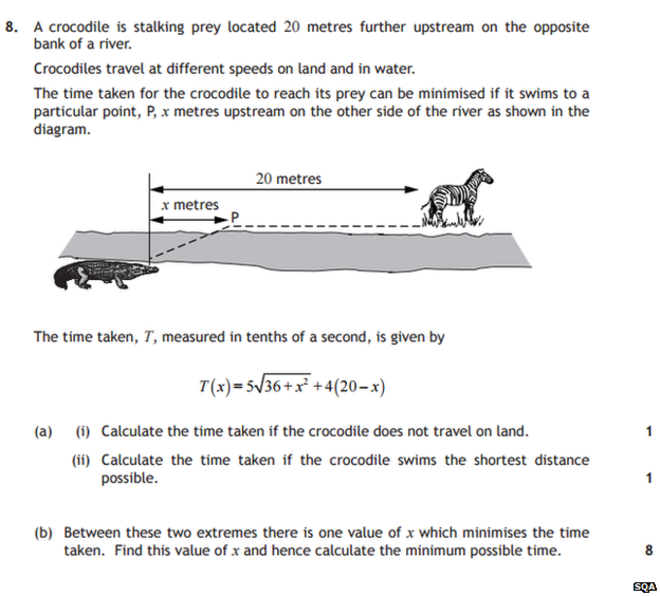
I’m indebted to an anonymous informant (John Peacock) for drawing my attention to a BBC Scotland story about an allegedly challenging examination question that appeared on a “Higher Maths” paper. For those of you not up with the Scottish examination system, “Highers” are taken in the penultimate year at school so are presumably roughly equivalent to the AS levels taken in England and Wales.
Anyway, here is the question that is supposed to have been so difficult. For the record, it’s Paper 2, Question 8 of the SQA examination 2015.
Call me old-fashioned, but it doesn’t seem that difficult to me but I never took Scottish Highers and there have been many changes in Mathematics education since I did my O and A-levels; here’s the O-level Mathematics paper I took in 1979, for example. I wonder what my readers think? Comments through the box if you please.
The views presented here are personal and not necessarily those of my employer (or anyone else for that matter).
Feel free to comment on any of the posts on this blog but comments may be moderated; anonymous comments and any considered by me to be vexatious and/or abusive and/or defamatory will not be accepted. I do not necessarily endorse, support, sanction, encourage, verify or agree with the opinions or statements of any information or other content in the comments on this site and do not in any way guarantee their accuracy or reliability.
 but I decided not to.


 In the Dark