Archive for January, 2016

Morning over the Marina

Posted in Brighton on January 25, 2016 by telescoper

How clear, how lovely bright,
How beautiful to sight
Those beams of morning play;
How heaven laughs out with glee
Where, like a bird set free,
Up from the eastern sea
Soars the delightful day.

image

p.s. note the authentic “rosy fingers” to the left of the shot…

Tannhäuser und der Sängerkrieg auf Wartburg

Posted in Opera with tags , , , on January 24, 2016 by telescoper

After spending most of the day on campus for the first Applicant Visit Day of 2106 at the University of Sussex I went home feeling a bit exhausted, but my spirits were soon lifted when I switched on BBC Radio 3 to find a broadcast just startiong of Tannhäuser (or  Tannhäuser und der Sängerkrieg auf Wartburg to give it it’s full title). It wasn’t quite the usual Saturday Night Live from the Met because the performance was actually recorded on October 31st 2015 at the Metropolitan Opera in New York, so I won’t quibble about that. Composed in 1845,  Tannhäuser is a relatively early work by Richard Wagner which he called a  “Romantic opera in three acts” indicating that it has the structure of a conventional opera; later on in his career he was to abandon that format in favour of the Music Drama (which is not built on a succession of arias and recitatives) as Tannhäuser is.

I won’t go into too much detail of the plot, but Tannhäuser is basically about typical Wagnerian themes: the conflict between spiritual and earthly love, between life and death, and the hope of redemption. The eponymous hero, a minstrel knight, takes a walk on the wild side in Act I by visiting Venusberg, in the course of which he is unfaithful to his beloved Elizabeth. He turns up in Act II at Wartburg where there i a sort of mediaeval Eurovision Song contest. First singer up is the naive but honorable Wolfram who sings a beautiful song about courtly love, but Tannhäuser finds it all a bit tame and sings a much raunchier number, which reveals that he’s been a naughty boy. There is uproar, swords are drawn and it all gets a bit fraught. Eventually Tannhäuser is persuaded to atone for his transgressions by undertaking a pilgrimage to Rome. Unfortunately for him the Pope isn’t in an absolving mood and tells him he’s going to suffer eternal damnation. In Act III, Tannhäuser, clearly unhinged, talks about returning to Venusberg – if he’s damned anyway he might as well go out with a bang – but then he discovers his beloved Elizabeth is dead and, overcome by grief and remorse,  he dies too.

Regular readers of this blog will know that I have an ambivalent attitude to Wagner, but last night I was hooked from the moment I switched the radio on and listened right through to the end, which came four hours later. I have heard Tannhäuser before and knew the familiar show-stoppers (especially the famous Pilgrim’s Chorus, which is as uplifting a piece of music as you will hear anywhere). What was so very special last night, however, was the quality of the singing, which was truly wonderful all the way through the principals and chorus. The broadcast is available on iPlayer for the next month. If you have never had a taste of Wagner, give it a go. This opera is full of great tunes but they were sung better in this performance than in any other I have heard. As a little taster, here is Wolfram (sung by baritone Peter Mattei) from the same production we heard last night, singing his Act III aria O du mein holder Abendstern (O thou my fair evening star).


Jazz, STEM and the Creative Process

Posted in Art, Jazz, The Universe and Stuff with tags , , , , , , on January 23, 2016 by telescoper

The Times Higher has given me yet  another reason to be disgruntled this week, in the form of an article that talks about the possible effect of the proposed Teaching Excellence Framework (TEF) on “creative” subjects. What bothers me about this piece is not that it criticises the TEF – I think that’s an unworkable idea that will cause untold damage to the University system if, as seems likely, it is railroaded through for political reasons – but that the author (Nigel Carrington, Vice-Chancellor of the University of Arts London), like so many others, lazily implies that STEM disciplines are not creative. I think some of the most intensively creative people in the world are to be found in science and engineering and creativity is something we try very hard to nurture in students at Sussex University regardless of discipline.

Anyway, while feeling grumpy about this article, I remembered this video of an interview with the great jazz pianist, Bill Evans. Jazz is undoubtedly an intensely creative form, not only because it requires spontaneous real-time conversion of ideas into sounds. Evans talks with great passion and insight about creativity in music-making, but the striking thing about what he says at the  very beginning about the need to analyse your subject at a very elementary level before proceeding in order to create something that’s “real” applies equally well to, e.g. theoretical physics as it does to jazz.

In the following section he reiterates this point, but also stresses the discipline imposed by a particular form and why this does not limit creativity but makes it stronger.

It’s better to do something simple that is real. It’s something you can build on. because you know what you’re doing. Whereas, if you try to approximate something very advanced and don’t know what you’re doing, you can’t build on it.

No matter how far I might diverge or find freedom in this format, it only is free insofar that it has reference to the strictness of the original form. That’s what gives it its strength.

In much the same way, theoretical physics is not made less creative because it has to obey the strict rules of mathematics but more so. This is true also in the fine arts: the more limited the canvas the more creative the artist must be, but it also applies to, e.g. engineering design. Self-teaching is important in STEM subjects too: the only really effective way of learning, e.g. physics, is by devoting time to working through ideas in your own mind, not by sitting passively in lectures.

All subjects require technical skill, but there is more to being a great jazz musician than mastery of the instrument just as there’s more to being a research scientist than doing textbook problems. So here’s to creativity wherever it is found, and let’s have a bit more appreciation for the creative aspects of science and engineering!


Statement on the Litvinenko Case

Posted in Uncategorized with tags , , on January 22, 2016 by telescoper

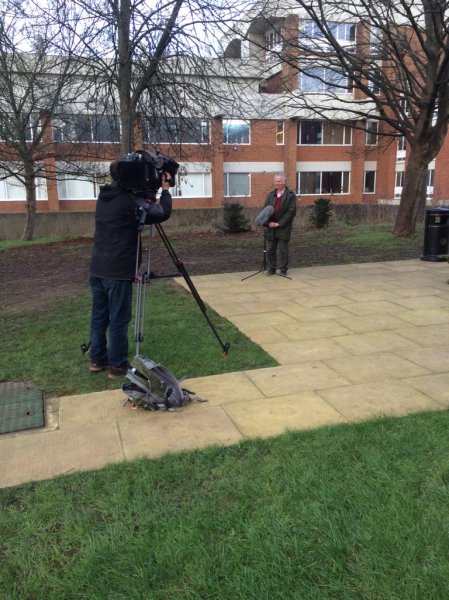
Yesterday while I was at the Winter Graduation ceremony, one of the esteemed  Emeritus Professors in the Department of Physics of Astronomy, Norman Dombey, recorded two TV interviews about the Alexander Litvinenko case. Professor Dombey was an expert witness who contributed evidence to an inquiry that concluded that Mr Litvinenko was deliberately poisoned with radioactive Polonium, and that his murder was probably explicitly authorised by Vladimir Putin.

One of the interviews took place outside the Department:

Dombey

The other was filmed in my office while I was on graduation duty.

In case any KGB agents are in the habit of reading this blog, I wish to point out that the use of my office by Professor Dombey should not be taken as evidence that I endorse the conclusion that Vladimir Putin ordered the assassination of Mr Litvinenko. Even if that is probably the case.


Winter Graduation

Posted in Uncategorized on January 21, 2016 by telescoper

image

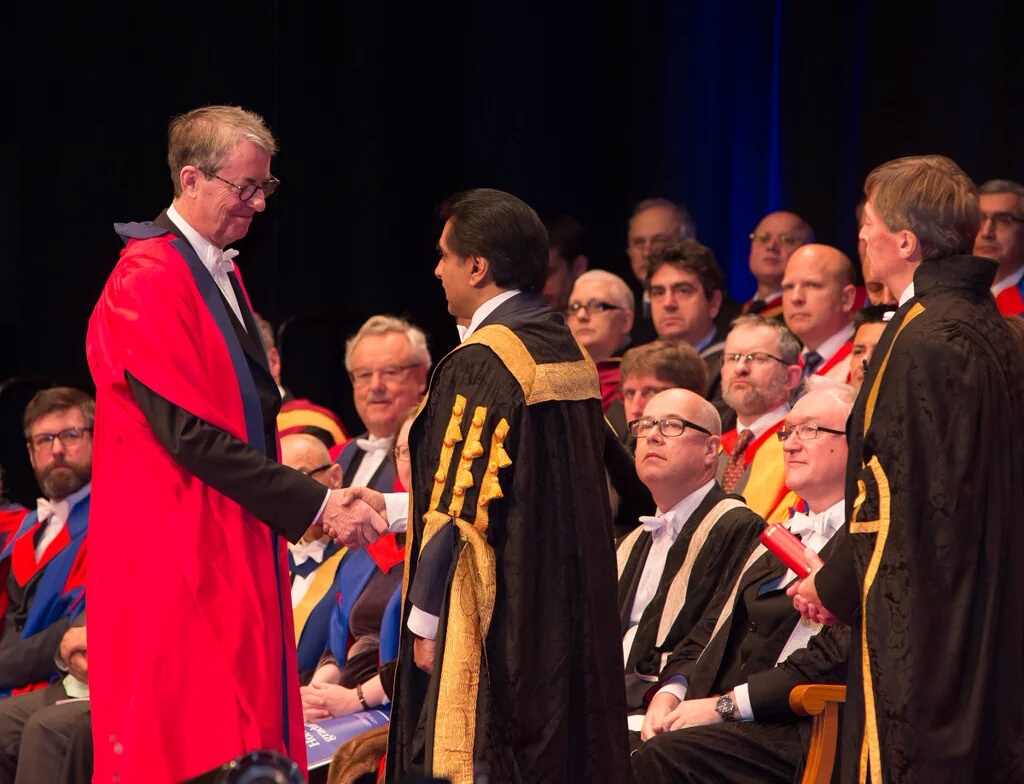
A very busy week found me on graduation duty today at the Brighton Dome for the Winter Graduation for the School of Mathematical and Physical Sciences at the University of Sussex. In fact students from all the Science schools at Sussex graduated this morning, so it was quite a long ceremony but it was, as usual, made very enjoyable by the presence of the Chancellor, Sanjeev Bhaskar, who was at one point lifted clean off his feet by a strapping graduand. I’ve seen hugs, handshakes and selfish galore on the stage at The Dome. but I don’t think Ive ever seen the Chancellor get picked up before!

In the photograph above Sanjeev is presenting an honorary degree to a distinguished expert in the field of art conservation, Dr David Bomford. You can just see me on the far left.

Many congratulations to all those who graduated today!

Physics & Astronomy at Sussex – The Videos!

Posted in Brighton, Education with tags , , on January 20, 2016 by telescoper

So the annual University admissions cycle is getting into gear, which means I’ll be spending quite a few Saturdays giving talks and chatting to prospective students and their parents. As we prepare for  the first of Applicant Visit Days at the University of Sussex (on Saturday 23rd January) we’ve produced a number of videos featuring current students in the Department of Physics & Astronomy. I thought I’d share a couple here.

First here’s Anjelah, a student on our 4-year MPhys degree in Theoretical Physics. She still seems quite keen, despite having taken my Theoretical Physics module in her second year!

Here’s Joe, a 4-year MPhys (Physics) student:

And here’s another by Linn, who is on the BSc in Physics with Astrophysics degree:

You’ll notice that both of them talk about our dedicated study spaces, which the students really like. We’re one of the few Physics & Astronomy Departments in the UK – in fact the only that I know of – that has turned over the management of a large suite of rooms over to our students. We don’t just allow them to use the rooms 24 hours a day; we also give them a budget for furniture and books and they basically decide what they want and how to arrange it all. We also provide a constant supply of free tea and coffee (although I have to admit that I do pop in there from time to time and help myself too).


The Universe is inhomogeneous. Does it matter?

Posted in The Universe and Stuff with tags , on January 20, 2016 by telescoper

Interesting piece by Buchert et al. about the role of inhomogeneities in cosmology….

Adam Day's avatarCQG+

Yes! The biggest problem in cosmology—the apparent acceleration of the expansion of the Universe and the nature of dark energy—has stimulated a debate about “backreaction”, namely the effect of inhomogeneities in matter and geometry on the average evolution of the Universe. Our recent paper aims to close a chapter of that debate, to encourage exciting new research in the future.

Although matter in the Universe was extremely uniform when the cosmic microwave background radiation formed, since then gravitational instability led to

View original post 1,044 more words

Morning over the Marina

Posted in Brighton with tags on January 19, 2016 by telescoper

image

Ligatures, Diphthongs and Supernovae

Posted in History, Pedantry, The Universe and Stuff with tags , , , , , , , , on January 18, 2016 by telescoper

At the weekend I noticed a nice article by John Butterworth on his Grauniad blog about where Gold comes from. Regular readers of this blog (Sid and Doris Bonkers) know that I am not at all pedantic but my attention was drawn to the plural of supernova in the preamble:
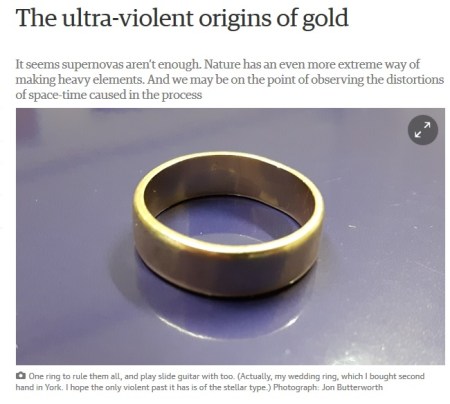
Supernovas

I have to confess that I much prefer the latin plural “supernovae” to the modernised “supernovas”, although most dictionaries (including the One True Chambers) give these both as valid forms.  In the interest of full disclosure I will point out that I did five years of Latin at school, and very much enjoyed it…

When I tweeted about my dislike for supernovas and preference for supernovae some replied that English words should have English plurals so that supernovas was preferred (although I wonder if that logic extends to, e.g. datums and phenomenons). Others said that supernovae was fine among experts but for science communication purposes it was better to say “supernovas” as this more obviously means “more than one supernova”. That’s a reasonable argument, but I have to admit I find it a little condescending to assume that an audience can cope with the idea of a massive star exploding as a consequence of gravitational collapse but be utterly bewildered by a straightforward latin plural.

One of the reasons I prefer the Latin plural – along with some other forms that may appear archaic, e.g. Nebulae – is that Astronomy is unique among sciences for having such a long history. Many astronomical terms derive from very ancient sources and in my view we should celebrate this fact because it’s part of the subject’s fascination. That’s just my opinion, of course. You are welcome to disagree with that too.

Anyway, you might be interested to know a couple of things. One is that the first use of “super-nova” recorded in the Oxford English Dictionary was in 1932 in a paper by Swedish astronomer Knut Lundmark. This word is however formed from “nova” (which means “new” in Latin) and the first use of this term in an astronomical setting was in a book by Tycho Brahe, published in 1573:
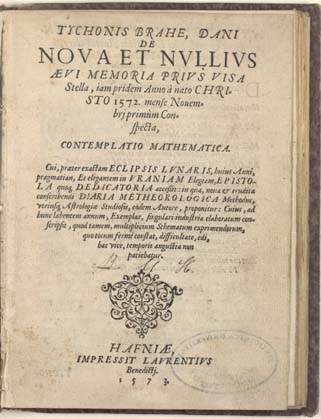
Brahe_book(I’ll leave it as an exercise to the student to translate the full title.)

Nowadays a nova is taken to be a much lower budget feature than a supernova but the “nova” described in Tycho’s book was was actually a supernova, SN1572 which he, along with many others, had observed the previous year. Historical novae were very often supernovae, in fact, because they are much brighter than mere novae. The real difference between these two classes of object wasn’t understood until the 20th Century, however, which is why the term supernova was coined much later than nova.

Anyway, back to pedantry.

A subsequent tweet from Roberto Trotta asserted  that in fact supernovae and supernovas are both wrong; the correct plural should be supernovæ, in which the two letters of the digraph “ae” are replaced with a single glyph known as a ligature. Often, as in this case, a ligature stands for a diphthong, a sort of composite vowel sound made by running two vowels together.   It’s one of the peculiarities of English that there are only five vowels, but these can represent quite different sounds depending on the context (and on the regional accent). This  means that English has many hidden diphthongs. For example,  the “o” in “no” is a diphthong in English. In languages such as Italian, in which the vowels are very pure, “no” is pronounced quite differently from English. The best test of whether a vowel is pure or not is whether your mouth changes shape as you pronounce it: your mouth moves as you say an English “no”, closing the vowel that stays open in the Italian “no”…

So, not all diphthongs are represented by ligatures. It’s also the case that not all ligatures represent diphthongs. Indeed some are composed entirely of consonants. My current employer’s logo features a ligature formed from the letters U and S:

image

The use of the ligature æ arose in Mediaeval Latin (or should I say Mediæval?). In fact if you look at the frontispiece of the Brahe book shown above you will see a number of examples of it in its upper-case form Æ. I’m by no means an expert in such things but my guess is that the use of such ligatures in printed works was favoured simply to speed up the typesetting process – which was very primitive – by allowing the compositor to use a single piece of type to set two characters. However, it does appear in handwritten documents e.g. in Old English, long before printing was invented so easier typesetting doesn’t explain it all.

Use of the specific ligature in question caught on particularly well in Scandinavia where it eventually became promoted to a letter in its own right (“aesc”) and is listed as a separate vowel in the modern Danish and Norwegian alphabets.  Early word-processing and computer typesetting software generally couldn’t render ligatures because they were just too complicated, so their use fell out of favour in the Eighties, though there are significant exceptions to this rule. Latex, for example, always allowed ligatures to be created quite easily. Software – even Microsoft Word – is much more sophisticated than it used to be, so it’s now not so much of a problem to use ligatures in digital text. Maybe they will make a comeback!

Anyway, the use of æ was optional even in Mediaeval Latin so I don’t think it can be argued that supernovæ is really more correct than supernovae, though to go back to a point I made earlier, I do admit that a rambling discussion of ligatures and diphthongs would not add much to a public lecture on exploding stars.

 

“Stars” by Kandinsky

Posted in Art with tags , on January 17, 2016 by telescoper

No time for a proper post so I thought I’d fill a bit of space with Stars, or at least with a picture of the lithograph of that title by Wassily Kandinsky made, I think, in 1938. It is certainly a different kind of image from that produced by astronomers, but it does put me in mind of star-forming regions such as the Orion Nebula..

wp-1453055880496.jpeg