The other day I came across the interesting news that my favourite film, The Maltese Falcon, directed by John Huston, is being shown in “movie theaters” around the United States on 21st and 24th February to celebrate the 75th anniversary of the film’s release. The choice of dates is a little odd because the film actually premiered in October 1941, but I presume the timing is dictated by business considerations. Although I have seen this film many times on TV and on DVD I have never seen it in a cinema, and I hope there is a possibility I can do so somewhere in the UK this year. Here is the original trailer as shown in cinemas back in the day. I imagine that the sizeable frame of Sidney Greenstreet made quite an impression on movie-goers as he loomed out of the darkness!
Sometime in the late Seventies I bought a vinyl LP called Jazz at the Pawnshop, which featured live performances by four veterans of the Swedish Jazz scene; Arne Domnerus (alto saxophone), Bengt Hallberg (piano), Egil Johansen (drums) and George Riedel on bass. Sadly, three of the four musicians involved are no longer with us; only George Riedel is still alive, but at least their music lives on.
The content was recorded in Stockholm over two days in December 1976 at a Jazz club on a site where a pawnshop once stood, hence the name. The album was reissued on CD in 1996 and then, just last year, somebody posted it on Youtube. That gives me an excuse to share my favourite track, which features the band not playing one of the classic bebop tunes on which they cut their teeth when they were young, but the Lil Hardin composition from a much earlier era Struttin’ with some Barbecue which was something of a vehicle for her husband, Louis Armstrong. Not, ‘Strittin’ by the way as it says on the Youtube link.
I loved this track from the moment I first heard it, from the intriguing out-of-tempo opening through a jaunty bossa nova passage, and evolving into an extended improvised exploration by Domnerus set against typically bebop-inspired patterns from the rhythm section. Modern jazz treatments of tunes from the classic era don’t always turn out well, but this one surely did. Enjoy!
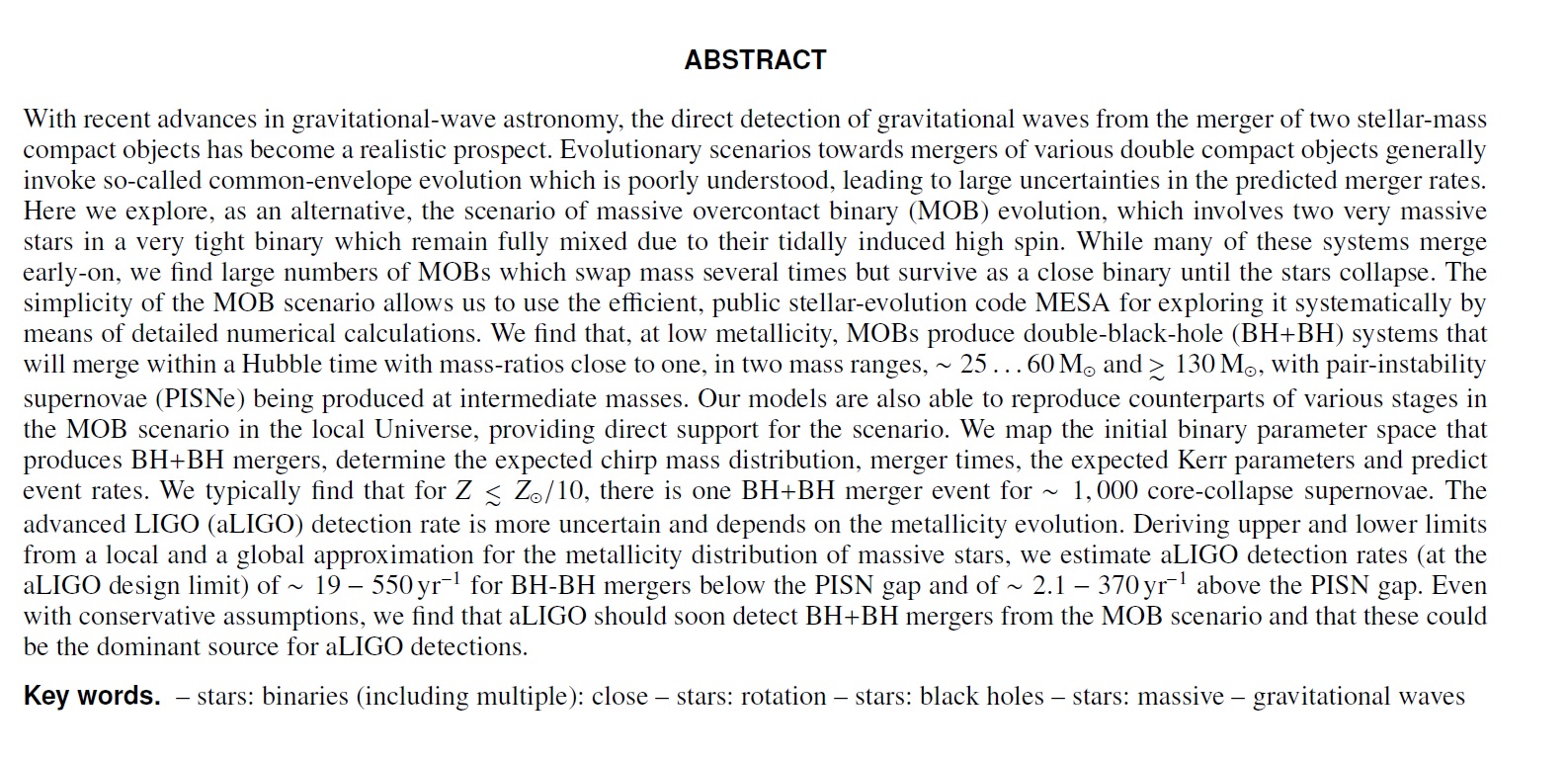
Although there is some technical jargon, the point is relatively clear. It appears that very masssive, very low metallicity binary stars can evolve into black hole binary systems via supernova explosions without disrupting their orbit. The term ‘low metallicity’ characteristises stars that form from primordial material (i.e. basically hydrogen and helium) early in the cycle of stellar evolution. Such material has very different opacity properties from material with significant quantities of heavier elements in it, which alters the dynamical evolution considerably.
(Remember that to an astrophysicist, chemistry is extremely simple. Hydrogen and helium make up most of the atomic matter in the Universe; all the rest is called “metals” including carbon, nitrogen, and oxygen…. )
Anyway, this theoretical paper is relevant because the mass ratios produced by this mechanism are expected to be of order unity, as is the case of GW150914. One observation doesn’t prove much, but it’s definitely Quite Interesting…
Incidentally, it has been reported that another gravitational wave source may have been detected by LIGO, in October last year. This isn’t as clean a signal as the first, so it will require further analysis before a definitive result is claimed, but it too seems to be a black hole binary system with a mass ratio of order unity…
You wait forty years for a gravitational wave signal from a binary black hole merger and then two come along in quick succession…
Posted in Uncategorized on February 15, 2016 by telescoper
And now for something completely different. I noticed on the arXiv a recent post with the following abstract:
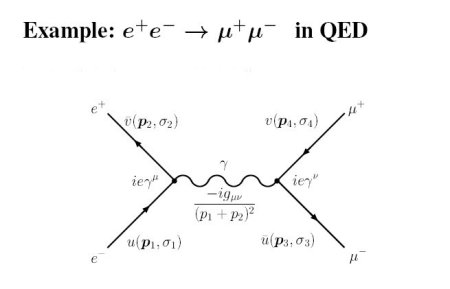
We give a short introduction to Feynman diagrams, with many exercises. Text is targeted at students who had little or no prior exposure to quantum field theory. We present condensed description of single-particle Dirac equation, free quantum fields and construction of Feynman amplitude using Feynman diagrams. As an example, we give a detailed calculation of cross-section for annihilation of electron and positron into a muon pair. We also show how such calculations are done with the aid of computer.
The paper is indeed very nice and I recommend it to students everywhere. I had to teach myself what quantum field theory I know (which isn’t much) and I certainly wish I’d had an introduction like this to work through the examples!
In elementary courses on elementary particles Feynman diagrams are often presented as mere “cartoons” illustrating particular scattering or other processes, and they can play that role very usefully, but they are actually much more than that: they provide a neat and potentially very powerful way of doing real calculations.
My luminary, my morning and evening star. My light at noon when there is no sun and the sky lowers. My balance of joy in a world that has gone off joy’s standard. Yours the face that young I recognised as though I had known you of old. Come, my eyes said, out into the morning of a world whose dew waits for your footprint. Before a green altar with the thrush for priest I took those gossamer vows that neither the Church could stale nor the Machine tarnish, that with the years have grown hard as flint, lighter than platinum on our ringless fingers.
At the end of a very exciting week I had the pleasure last night of toasting LIGO and the future of gravitational wave astronomy with champagne at the RAS Club in London. Two members of the LIGO collaboration were there, Alberto Vecchio and Mike Cruise (both from Birmingham); Alberto had delivered a very nice talk earlier in the day summarising the LIGO discovery while Mike made a short speech at the club.
This morning I found this interesting video produced by California Institute of Technology (CalTech) which discusses the history of the LIGO experiment:
It has taken over 40 years of determination and hard work to get this far. You can see pictures of some of the protagonists from Thursday’s press conference, such as Kip Thorne, when they were much younger. I bet there were times during the past four decades when they must have doubted that they would ever get there, but they kept the faith and now can enjoy the well-deserved celebrations. They certainly will all be glad they stuck with gravitational waves now, and all must be mighty proud!
Mike Cruise made two points in his speech that I think are worth repeating here. One is that we think of the LIGO discovery is a triumph of physics. It is that, of course. But the LIGO consortium of over a thousand people comprises not only physicists, but also various kinds of engineers, designers, technicians and software specialists. Moreover the membership of LIGO is international. It’s wonderful that people from all over the world can join forces, blend their skils and expertise, and achieve something remarkable. There’s a lesson right there for those who would seek to lead us into small-minded isolationism.
The other point was that the LIGO discovery provides a powerful testament for university research. LIGO was a high-risk experiment that took decades to yield a result. It’s impossible to imagine any commercial company undertaking such an endeavour, so this could only have happened in an institution (or, more correctly, a network of institutions) committed to “blue skies” science. This is research done for its own sake, not to create a short-term profit but to enrich our understanding of the Universe. Asking profound questions and trying to answer them is one of the things that makes us human. It’s a pity we are so obsessed with wealth and property that we need to be reminded of this, but clearly we do.
The current system of Research Assessment in the UK requires university research to generate “impact” outside the world of academia in a relatively short timescale. That pressure is completely at odds with experiments like LIGO. Who would start a physics experiment now that would take 40 years to deliver? I’ve said it time and time again to my bosses at the University of Sussex that if you’re serious about supporting physics you have to play a long game because it requires substantial initial investment and generates results only very slowly. I worry what future lies in store for physics if the fixation on market-driven research continues much longer.
Finally, I couldn’t resist making a comment about another modern fixation – bibliometrics. The LIGO discovery paper in Physical Review Letters has 1,004 authors. By any standard this is an extraordinarily significant article, but because it has over a thousand authors it stands to be entirely excluded by the Times Higher when they compile the next World University Rankings. Whatever the science community or the general public thinks about the discovery of gravitational waves, the bean-counters deem it worthless. We need to take a stand against this sort of nonsense.
My monthly trip to London for the Royal Astronomical Society Meeting allowed me not only to get out of the office for the day but also to attend a nice talk by Alberto Vecchio about yesterday’s amazing results.
I hear that we will be having champagne at the club later on to celebrate. In the meantime here’s a little Haiku I wrote on the theme:
Two black holes collide A billion years ago. LIGO feels the strain.
Clifford Will is the Editor-in-Chief of Classical and Quantum Gravity
As if celebrating the 100th birthday of general relativity weren’t enough, the LIGO-Virgo collaboration has provided “the icing on the cake” with today’s announcement of the first direct detection of gravitational waves. At press conferences in the USA and Europe, and in a paper in Physical Review Letters published afterward, the team announced the detection of a signal from a system of two merging black holes.
The signal arrived on 14 September, 2015 (its official designation is GW150914), and was detected by both the Hanford and Livingston advanced detectors of the LIGO observatory (the advanced Virgo instrument in Italy is not yet online). It was detected first by
As rumoured, the signal corresponds to the coalescence of two black holes, of masses 29 and 36 times the mass of the Sun.
The signal arrived in September 2015, very shortly after Advanced LIGO was switched on. There’s synchronicity for you! The LIGO collaboration have done wondrous things getting their sensitivity down to such a level that they can measure such a tiny effect, but there still has to be an event producing a signal to measure. Collisions of two such massive black holes are probably extremely rare so it’s a bit of good fortune that one happened just at the right time. Actually it was during an engineering test!
Here are the key results:
Excellent signal to noise! I’m convinced! Many congratulations to everyone involved in LIGO! This has been a heroic effort that has taken many years of hard slog. They deserve the highest praise, as do the funding agencies who have been prepared to cover the costs of this experiment over such a long time. Physics of this kind is a slow burner, but it delivers spectacularly in the end!
You can find the paper here, although the server seems to be struggling to cope! One part of the rumour was wrong, however, the result is not in Nature, but in Physical Review Letters. There will no doubt be many more!
No prizes for guessing where the 2016 Nobel Prize for Physics is heading, but in a collaboration of over 1000 people across the world which few will receive the award?
So, as usual, I had a day filled with lectures, workshops and other meetings so I was thinking I would miss the press conference entirely, but in the end I couldn’t resist interrupting a meeting with the Head of the Department of Mathematics to watch the live stream…
The views presented here are personal and not necessarily those of my employer (or anyone else for that matter).
Feel free to comment on any of the posts on this blog but comments may be moderated; anonymous comments and any considered by me to be vexatious and/or abusive and/or defamatory will not be accepted. I do not necessarily endorse, support, sanction, encourage, verify or agree with the opinions or statements of any information or other content in the comments on this site and do not in any way guarantee their accuracy or reliability.


 In the Dark